Chapter I
A spirit of wrath, a king of demons
The name is older than any dungeon. When people first spoke it, they weren't talking about a devil at all. They meant a quality of the soul. Most scholars trace back to Persia and the Zoroastrian aeshma daeva, the spirit of wrath, the demon of fury that stirs men to violence. The name moved from tongue to tongue and wore down a little each time, the way a river smooths its stones. In Hebrew it became , or . In Greek it became . Later writers would spell it , and, in one famous poem, . Behind all of them is that first idea, a spirit of anger moving through the world.
His first real story comes from the Book of . That book belongs to the Catholic and Orthodox Bibles, and Protestant readers keep it among the Apocrypha. Its setting is the city of in , where a young woman named Sarah, the daughter of , lives under a terrible shadow. She has been married seven times. Each time, on the wedding night, before the marriage can be made whole, her husband dies in the bridal chamber, killed by the demon Asmodeus.
The story has a strange tenderness about it. Later in the tale, young says the demon loves Sarah. He does her no harm. He harms only the men who come near her. So this first Asmodeus is a jealous presence more than a monster, a spirit that has fixed its longing on one mortal woman and won't let anyone else have her. The poets who came later held on to that detail.
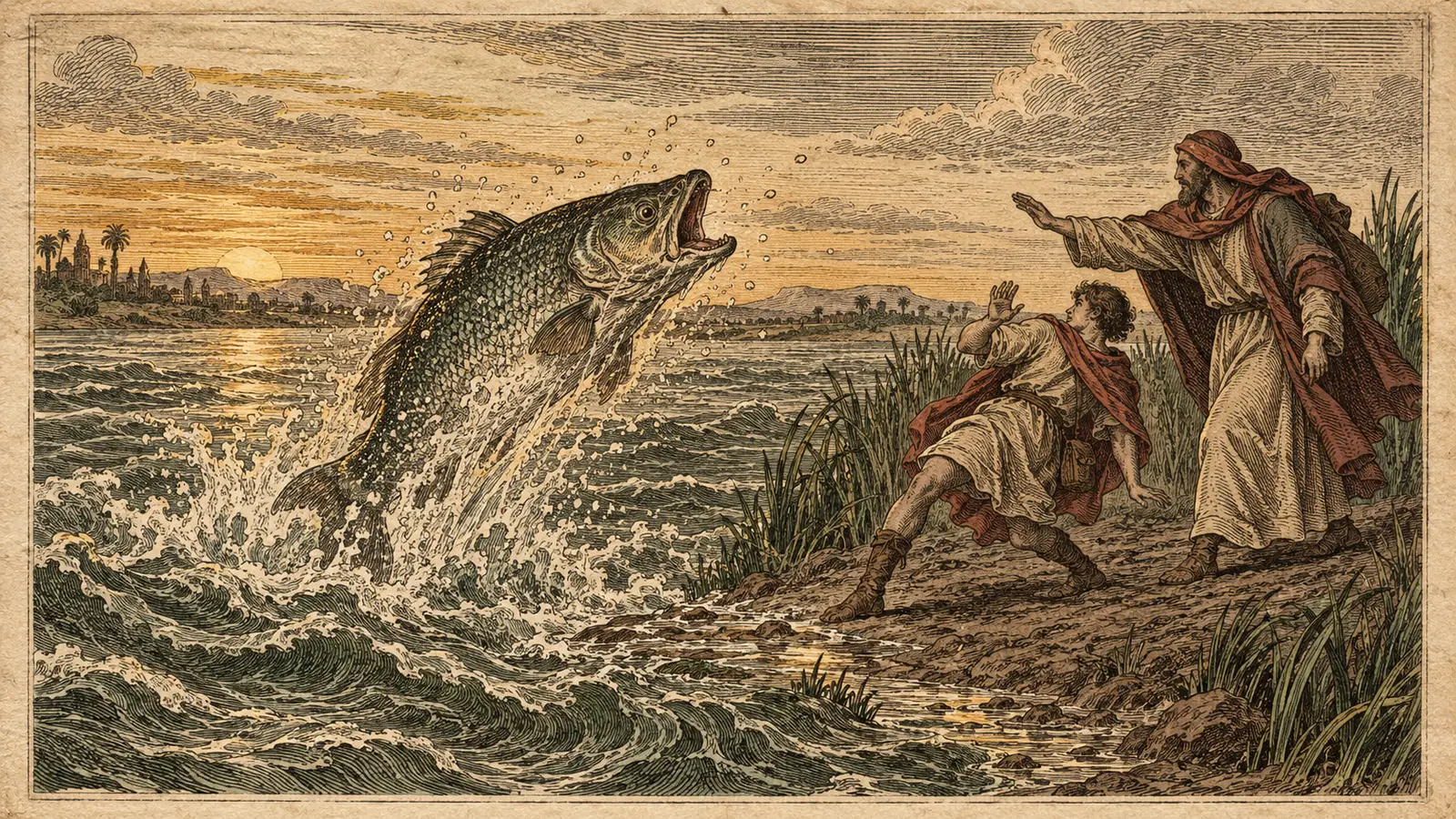
Tobias himself is on a journey. His father, old Tobit, has gone blind, his eyes clouded by white films, and has sent the young man to recover money held for the family far away. Tobias travels with a companion who seems like an ordinary man. He is really the angel in disguise. On the way they stop by the river , and a great fish leaps from the water at the young man. Raphael tells him to catch it and keep its heart, its liver and its gall. Burning the heart and liver makes a smoke that drives away evil spirits, and the gall will make a salve to heal the blindness at home.
The road leads them to Raguel's house. Tobias asks to marry Sarah, and everyone fears for his life. On the wedding night he follows the angel's advice and lays the fish's heart and liver on the embers. The smoke rises through the chamber. In the old translations the demon smelled it and fled into the uppermost parts of Egypt, and the angel followed him there and bound him. Tobias and Sarah pray together in the quiet that follows, and the marriage holds. When Tobias comes home, the gall clears his father's eyes.
Picture that night for a moment. A small room, a low fire, the sharp smell of burning fish, two young people afraid of something they can't see. Then something huge and invisible leaves the room, driven across deserts toward the far south, where an angel waits with bonds. It's an intimate kind of exorcism. Nobody fights. A remedy is applied with patience, and the thing gives way.
Some centuries later a different Asmodeus turns up in a Greek text called the Testament of Solomon, usually dated somewhere between the first and third centuries of the common era. In it, King Solomon holds a magic ring that lets him summon demons, question them and put them to work building the Temple in Jerusalem. One by one they're brought before him. When it's Asmodeus's turn, he is proud and defiant.
He tells Solomon he was born of an angel's seed by a daughter of man, half heaven and half earth. He says his star is in the sky, and that some men call him the Great Bear while others call him the Offspring of a Dragon. His work, he says, is to plot against newlyweds and keep them apart, to cause adultery and to spread madness. That reaches straight back to the bridal chamber in Ecbatana. Pressed further, he admits what defeats him: the angel Raphael, and the liver and gall of a fish, a sheatfish from the rivers of Assyria, smoked over ash. He also says he hates water and birds.
Solomon binds him with iron and sets him to work. It's a curious picture, a demon who has bragged of descending from the stars kneading clay and making water vessels for the Temple. Even this early, a pattern has started that the game will someday make its own. Asmodeus is a power that can be bound, and once bound, he can be put to use.
The richest of the old stories comes from the Babylonian Talmud, in the tractate called , and here he goes by Ashmedai, king of the demons. Solomon is building the Temple, but there's a problem. Iron tools may not be used on the holy stones, because iron is the metal of war and bloodshed and doesn't belong in a house of peace. Solomon needs another way to cut stone. That way is the shamir, a marvellous creature or stone that can split rock just by touching it. The one being who knows where it is kept is Ashmedai.
Ashmedai's life, as the Talmud tells it, has a gentle routine. He lives on a mountain, where he has dug a well and sealed it with a heavy stone. Every morning he rises to heaven to listen at the heavenly academy, where the deepest questions are studied. Then he comes down and stands invisibly in the study houses of the earth, listening to mortal scholars argue. In the evening he goes home, checks the seal on his well, makes sure no one has touched it, and drinks.
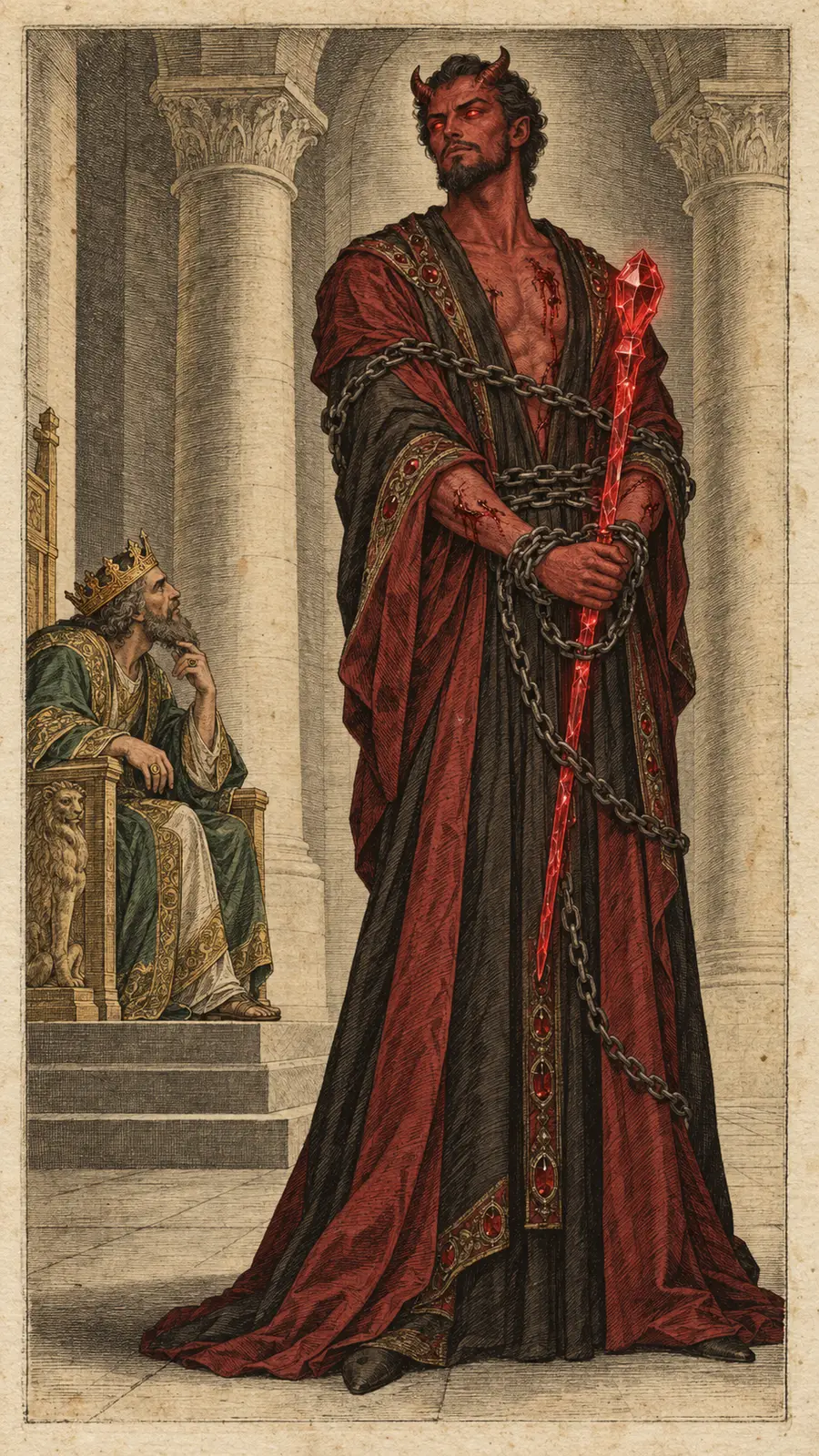
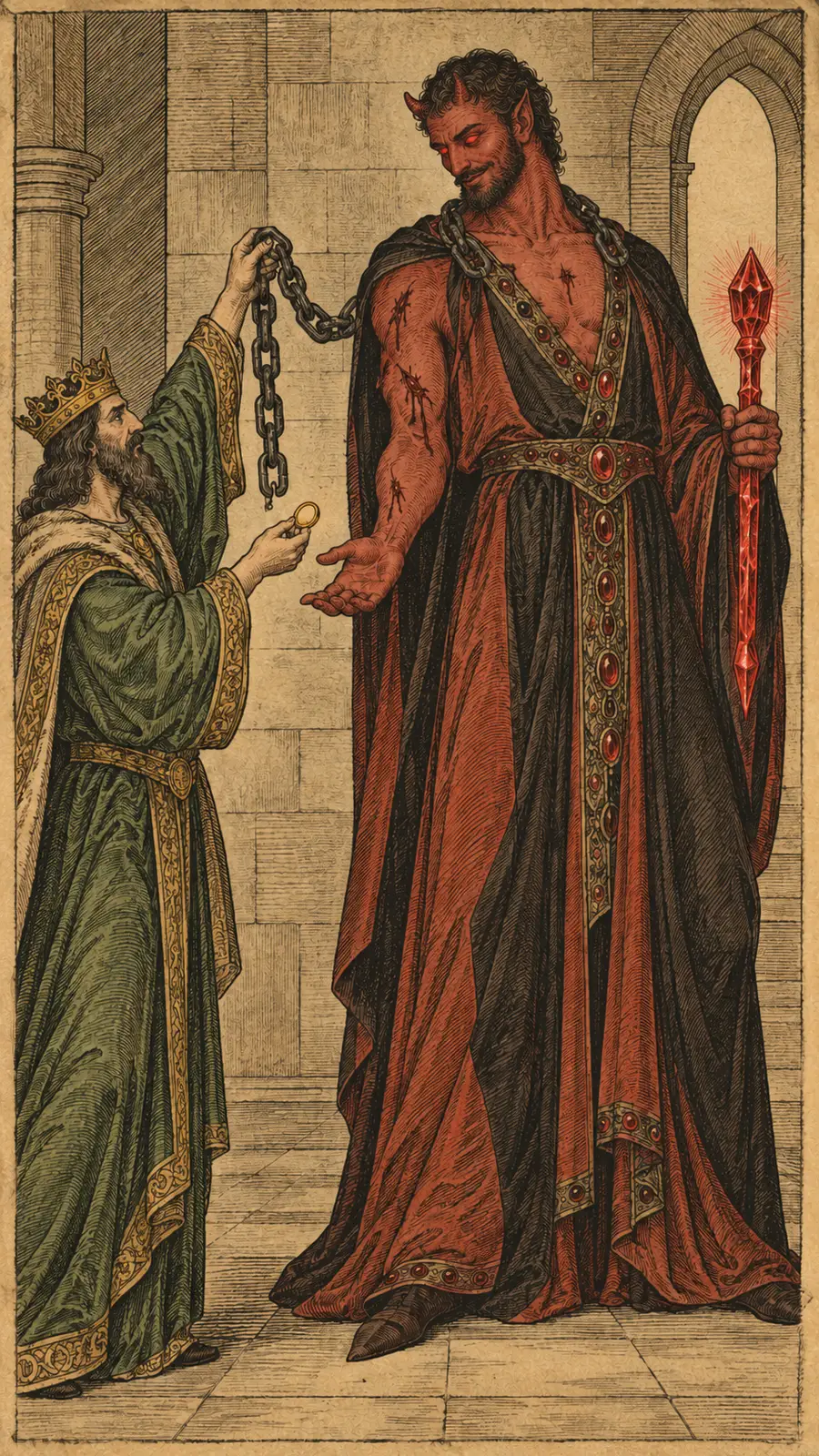
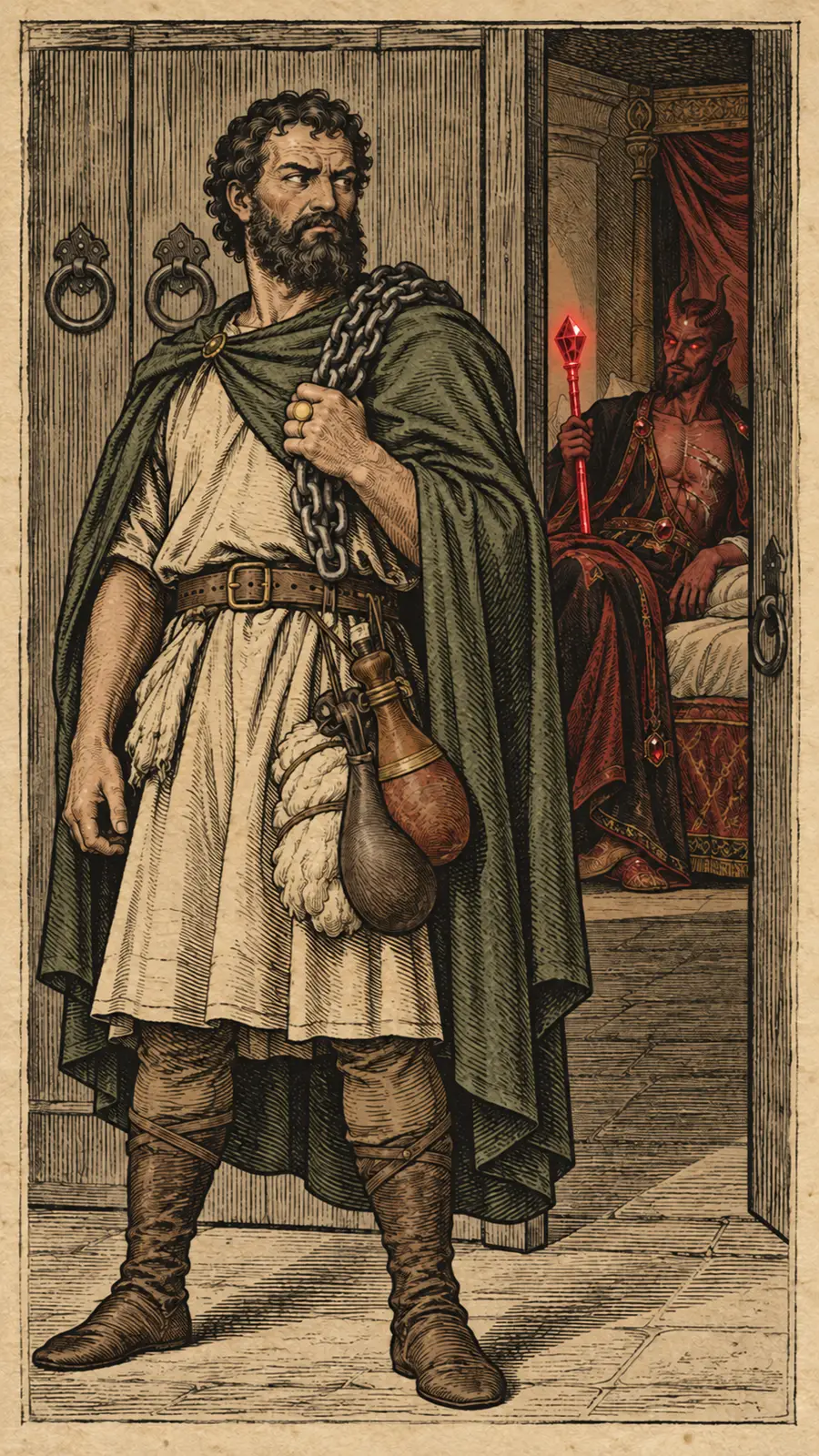
Solomon sends his chief servant, son of , to capture him. Benaiah carries a chain and a ring, both engraved with the Divine Name, along with a bundle of wool and skins of wine. He finds the well, drains it, plugs the channel with the wool, and fills it with wine. Then he waits. Ashmedai comes home in the evening, finds the seal unbroken and drinks. The wine is strong. He grows drowsy and falls asleep beside the well, and Benaiah slips the chain around him. When the demon wakes and struggles, Benaiah tells him that the Name of his Master is upon him, and Ashmedai goes quiet.
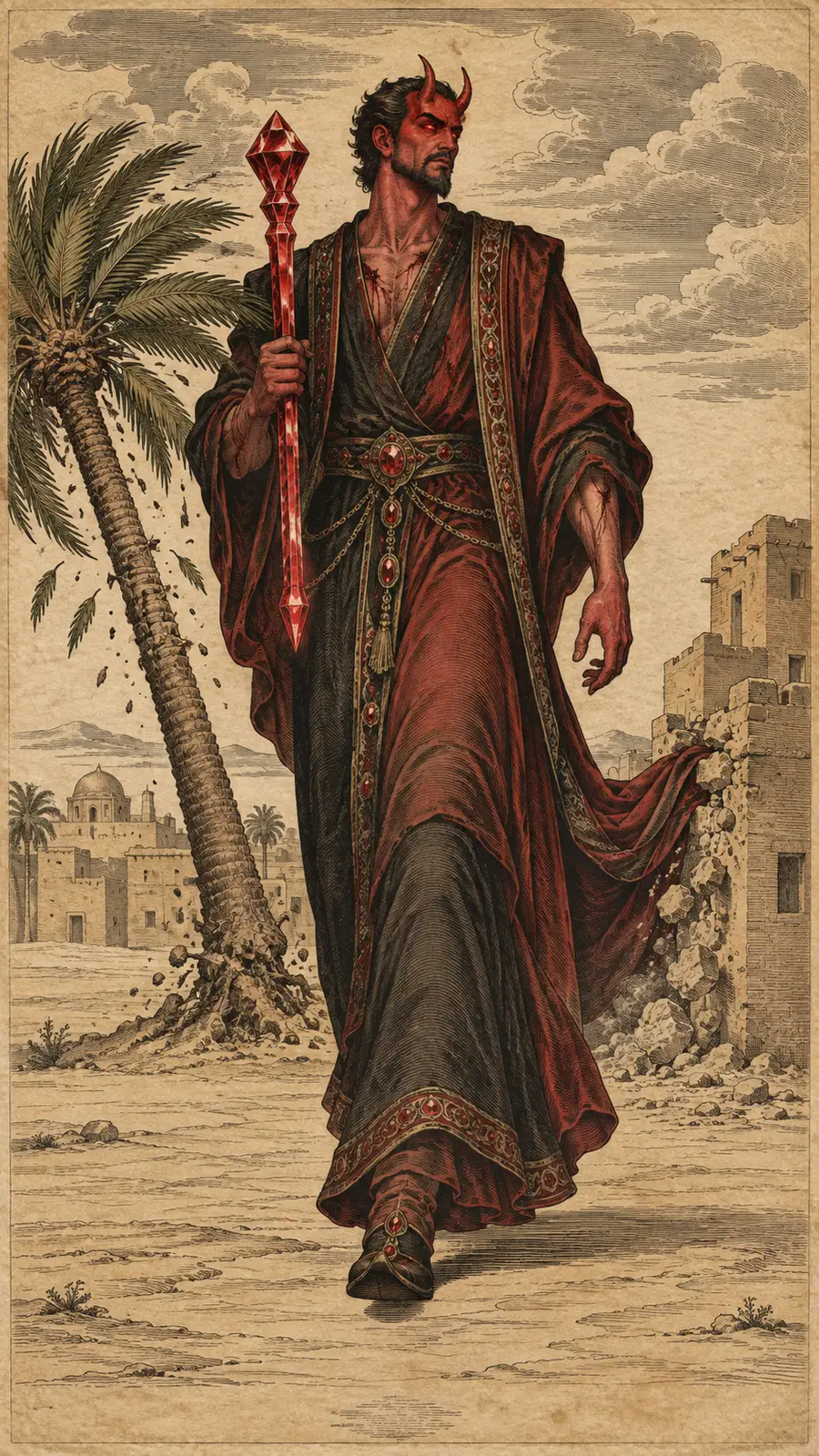
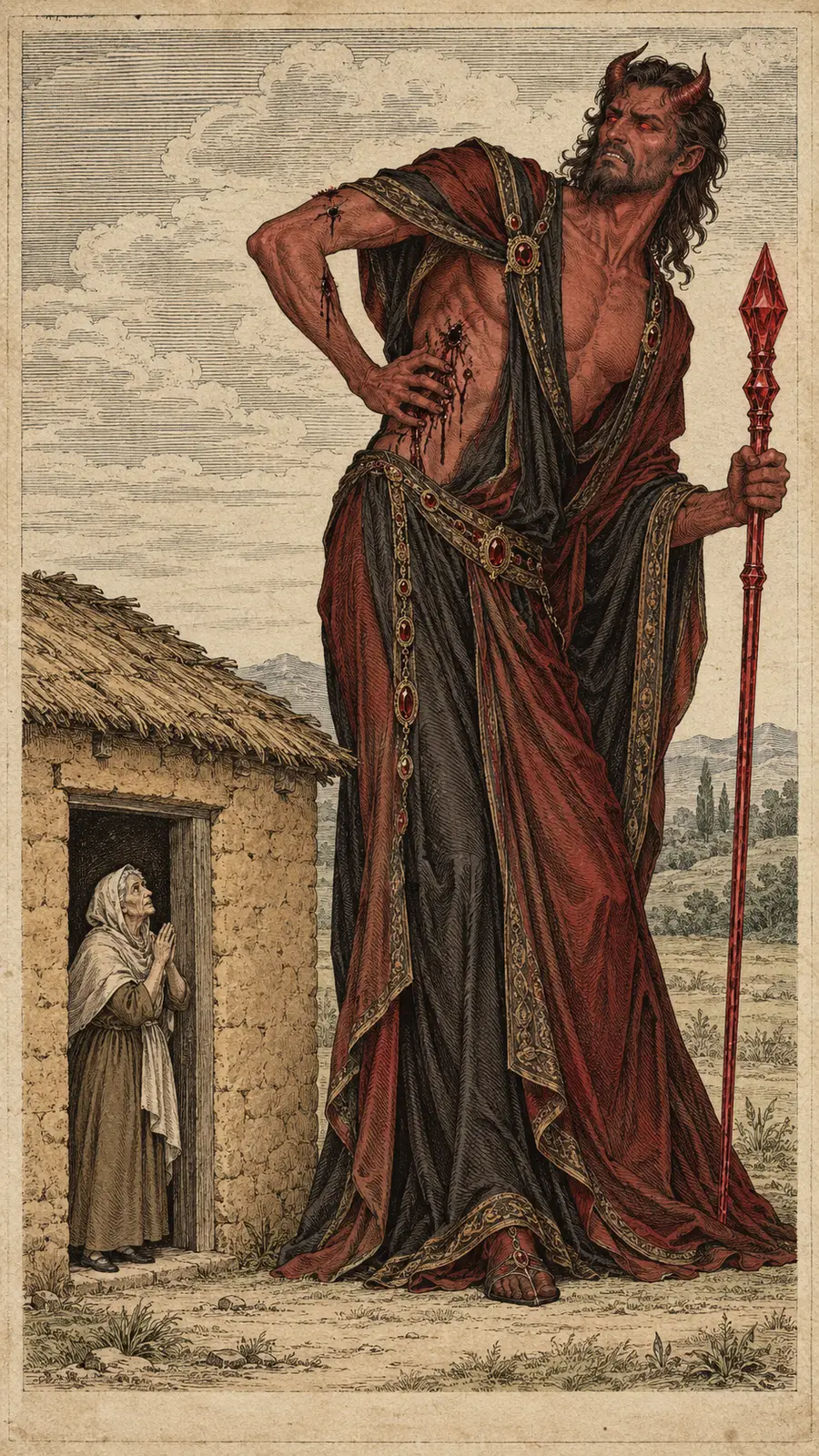
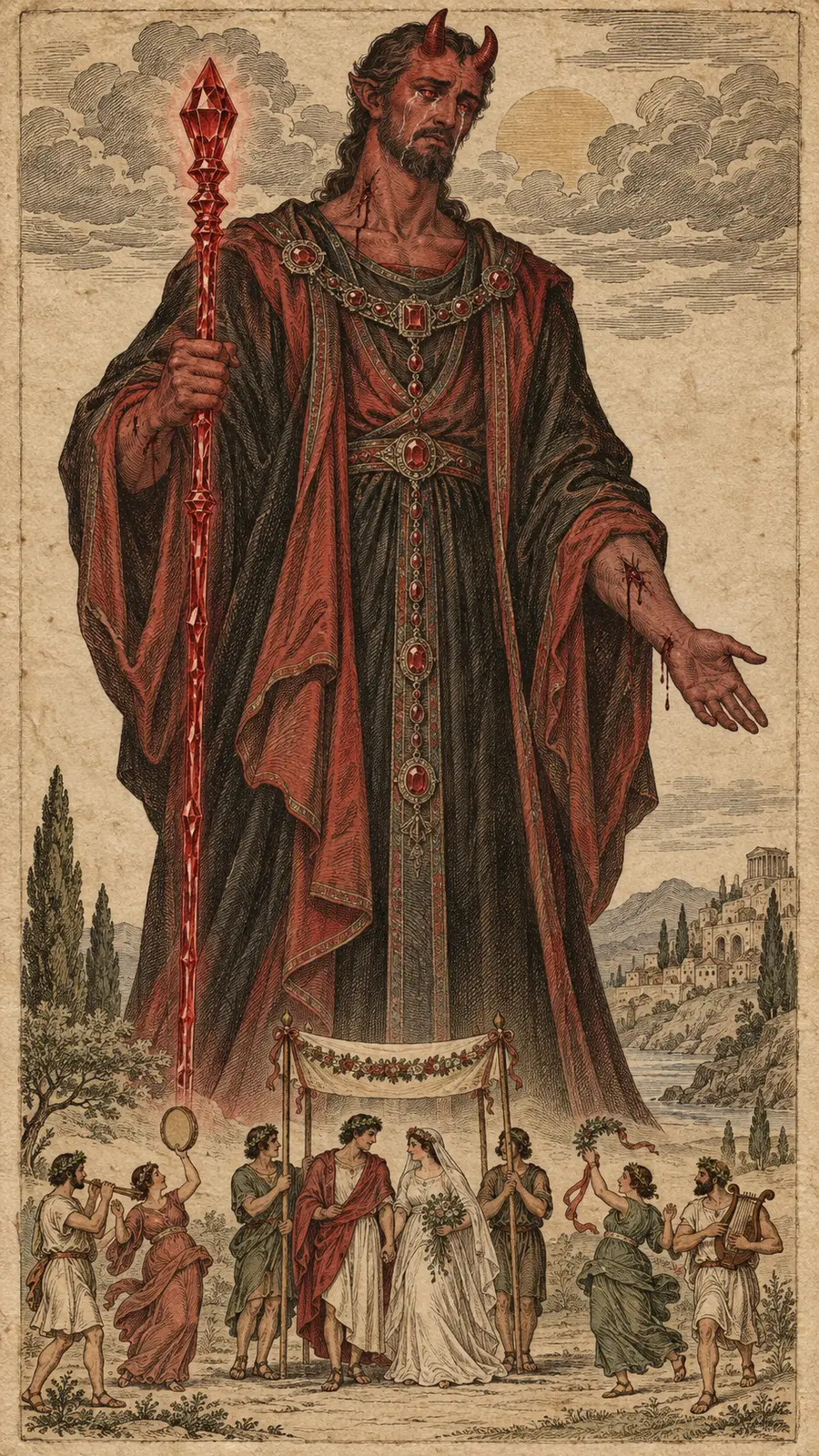
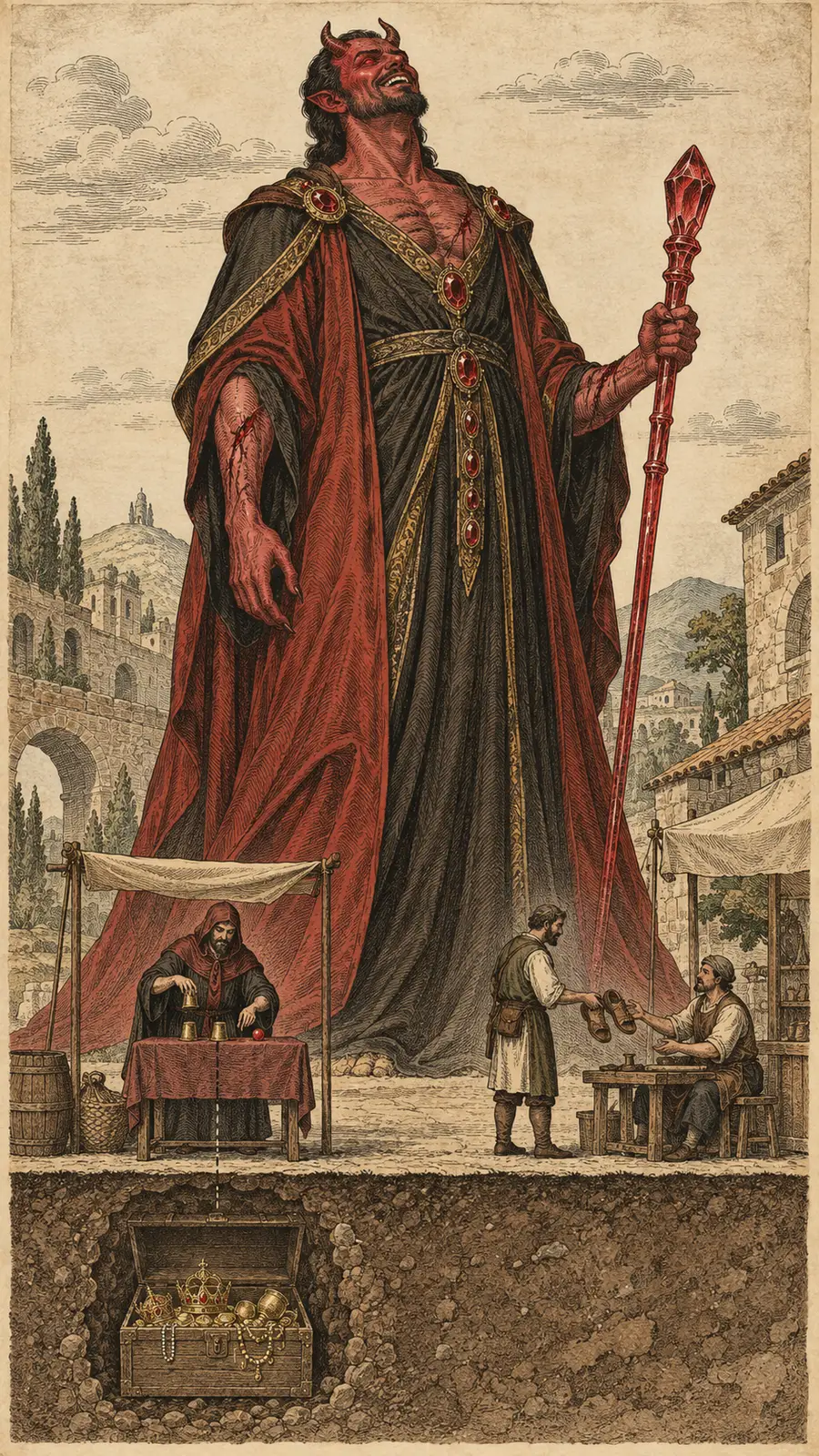
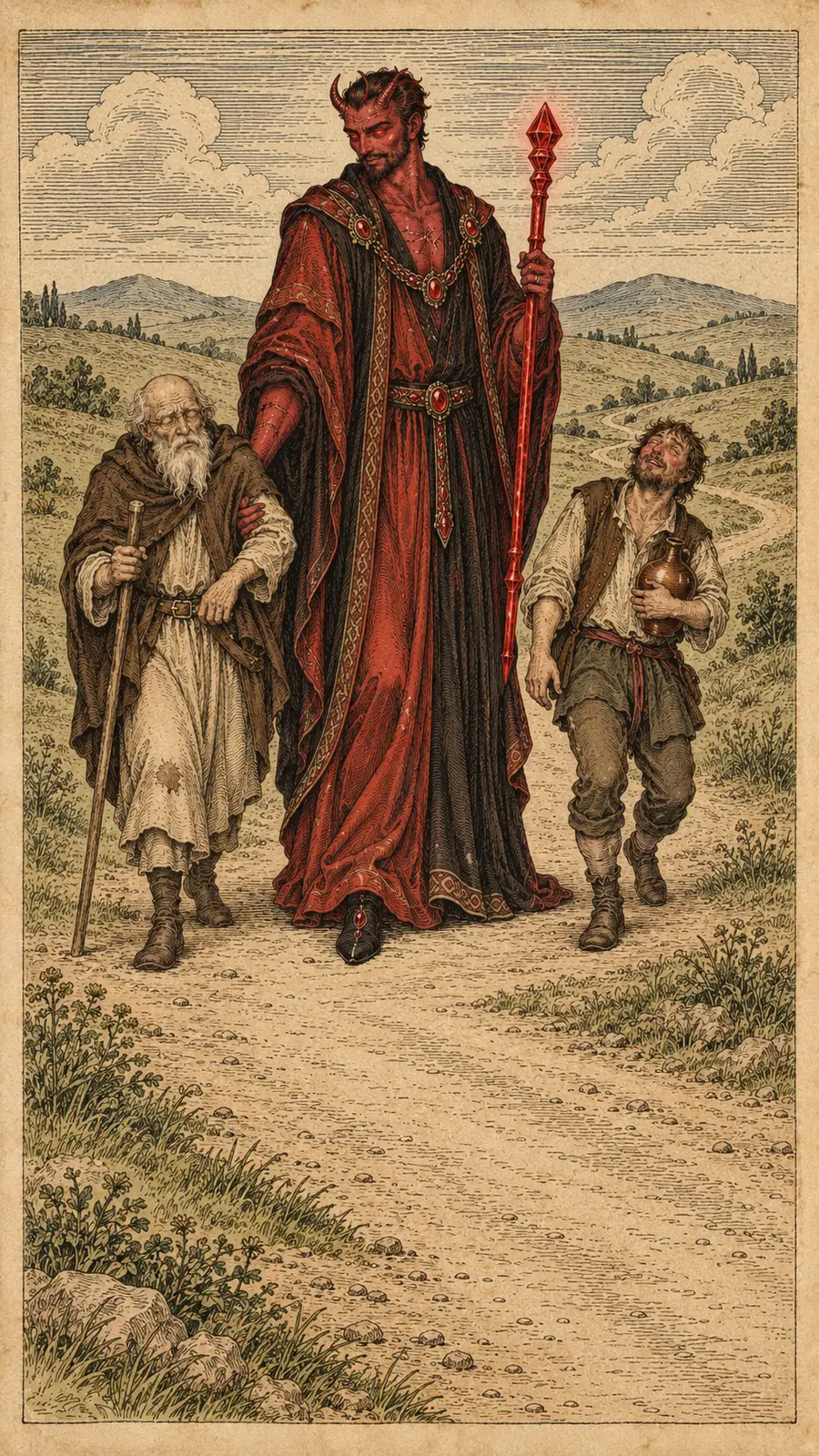
The walk back to Jerusalem is one of the loveliest passages in all the old demon lore. Ashmedai is huge and powerful, and when he rubs against a palm tree it topples. He brushes a house and it falls. Then a poor widow comes out and begs him to spare her small home, and he bends aside so carefully that he breaks one of his own bones. Further on, he passes a joyful wedding and weeps, because he knows the groom will die within thirty days. He laughs at a man ordering shoes that will last seven years, because he knows the man won't live seven days. He laughs at a sorcerer plying his trade in the market, because the sorcerer doesn't know a royal treasure lies buried right under his feet. And when a blind man and a drunkard wander lost from the road, Ashmedai gently sets each of them back on his way.
That's a very different figure from the jealous spirit of Tobit. This Ashmedai is wise, sees the future and is oddly kind. He laughs at human folly and weeps at human sorrow. He knows where the treasure is. You'll find echoes of him much later, in the courtly devil who knows everyone's secrets and is never surprised by them.
When they reach the king, Ashmedai explains that the shamir was never given to him. It belongs to the Prince of the Sea, who entrusted it to the wild rooster, the hoopoe, and only trickery will win it. Solomon follows the advice, the shamir is found, and the Temple rises without the ring of iron on stone.
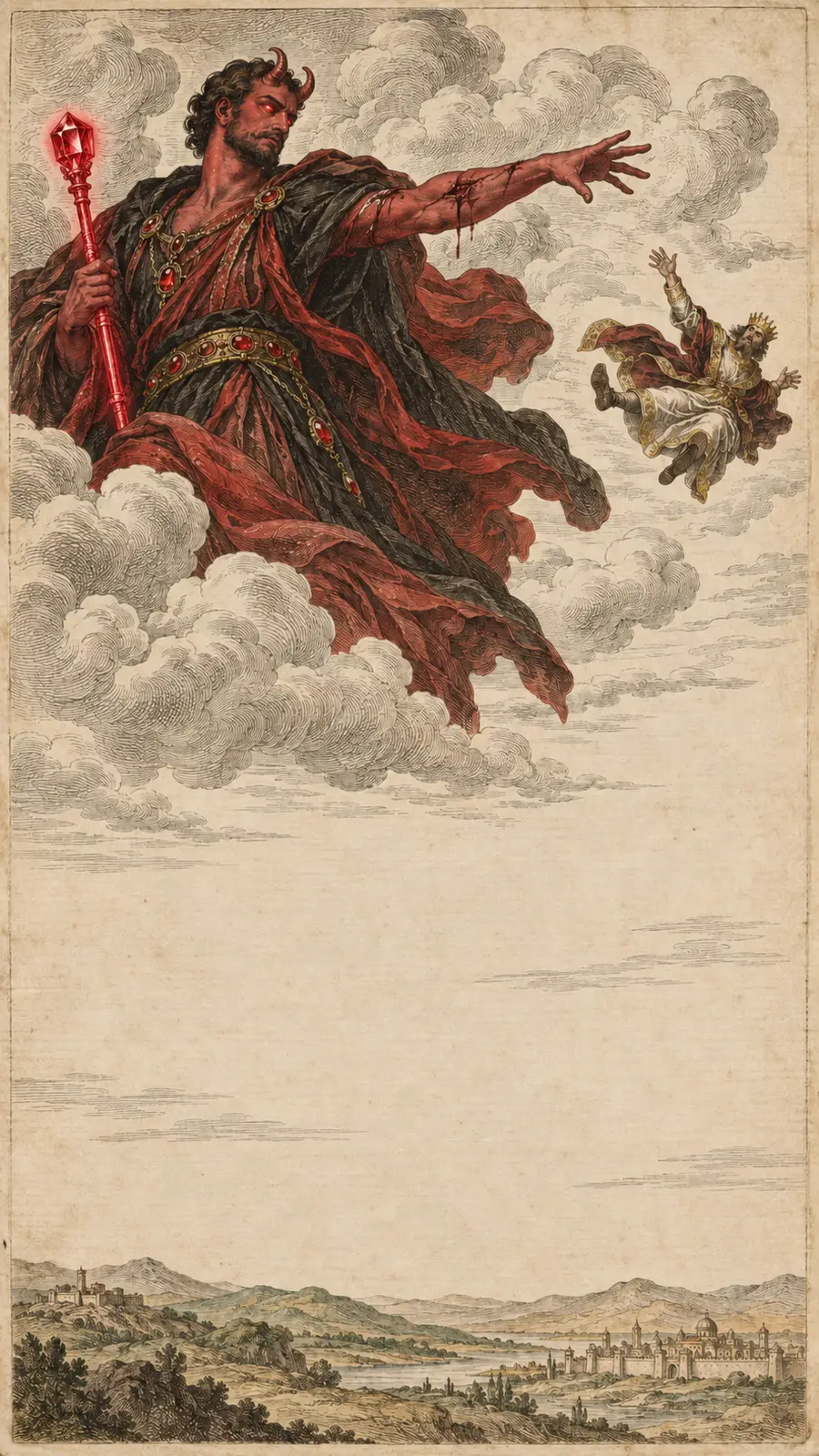
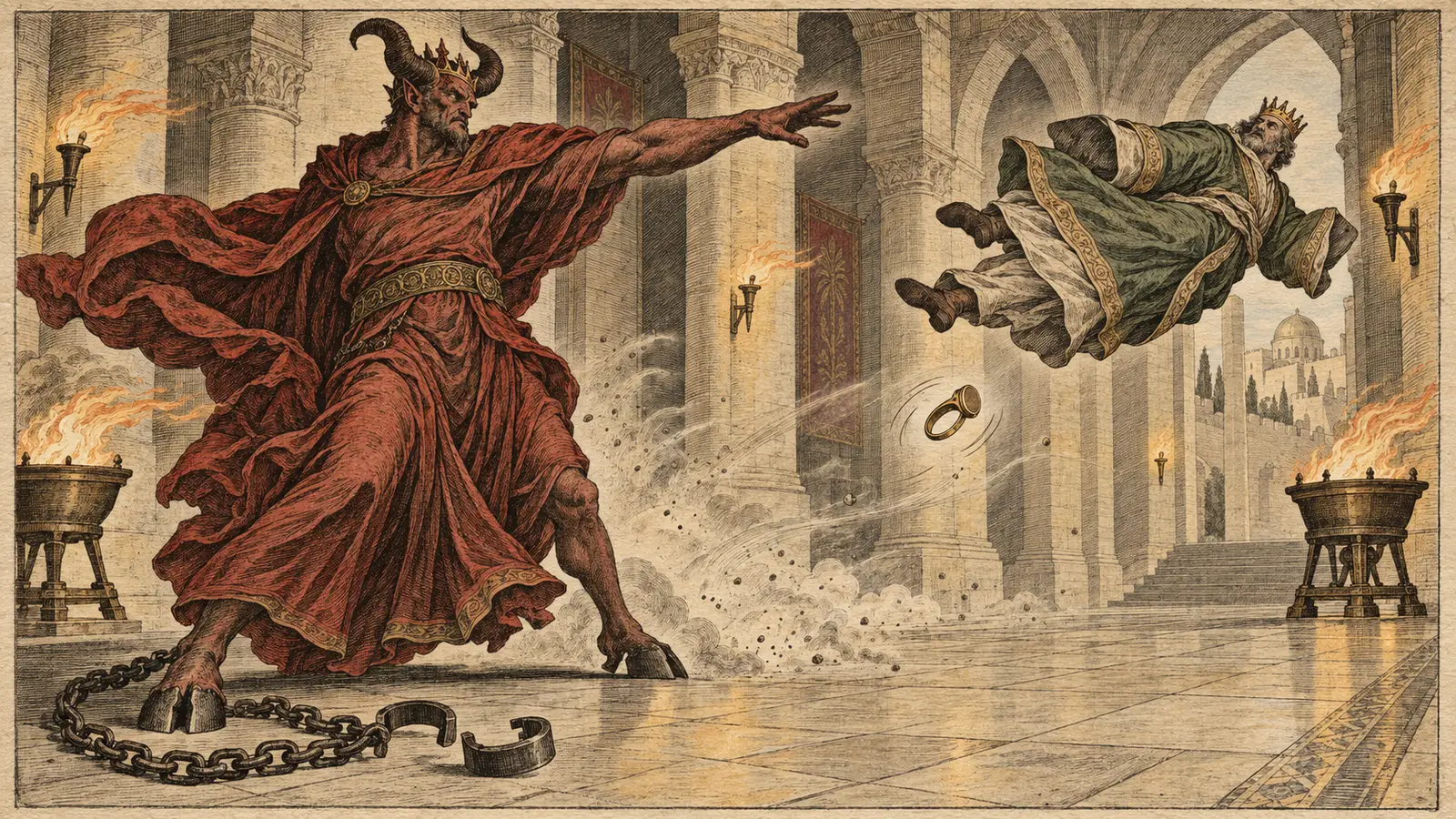
The story doesn't end there, though. One day Solomon asks the demon king how demons can be greater than men, since a man has him in chains. Ashmedai replies that he'll show him, if Solomon will take off the chain and lend him the ring. Solomon agrees. Freed, Ashmedai seizes him and flings him four hundred parasangs from Jerusalem, so far that the king lands in a country where nobody knows his face. Then the demon takes Solomon's form and sits on his throne.
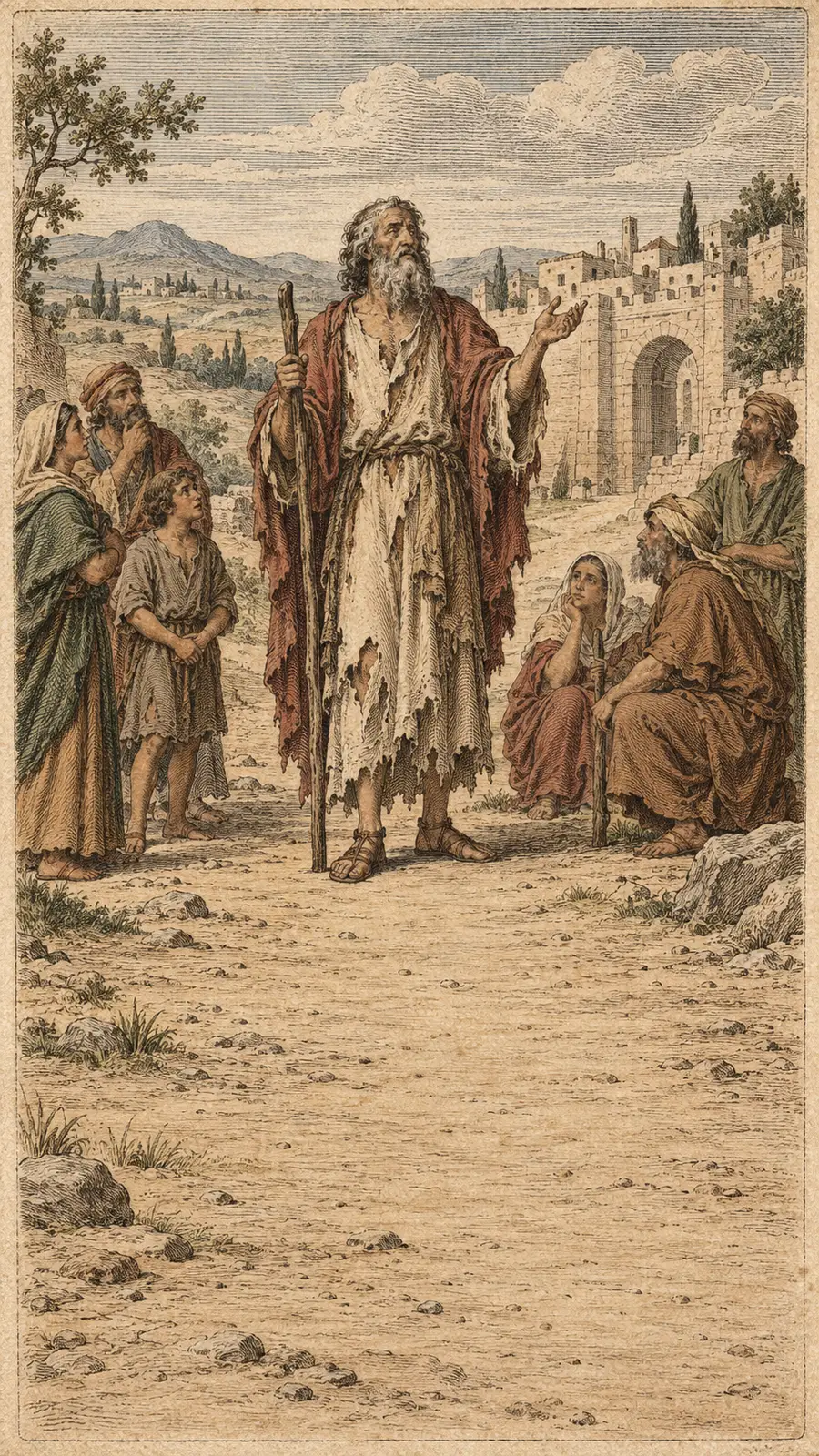
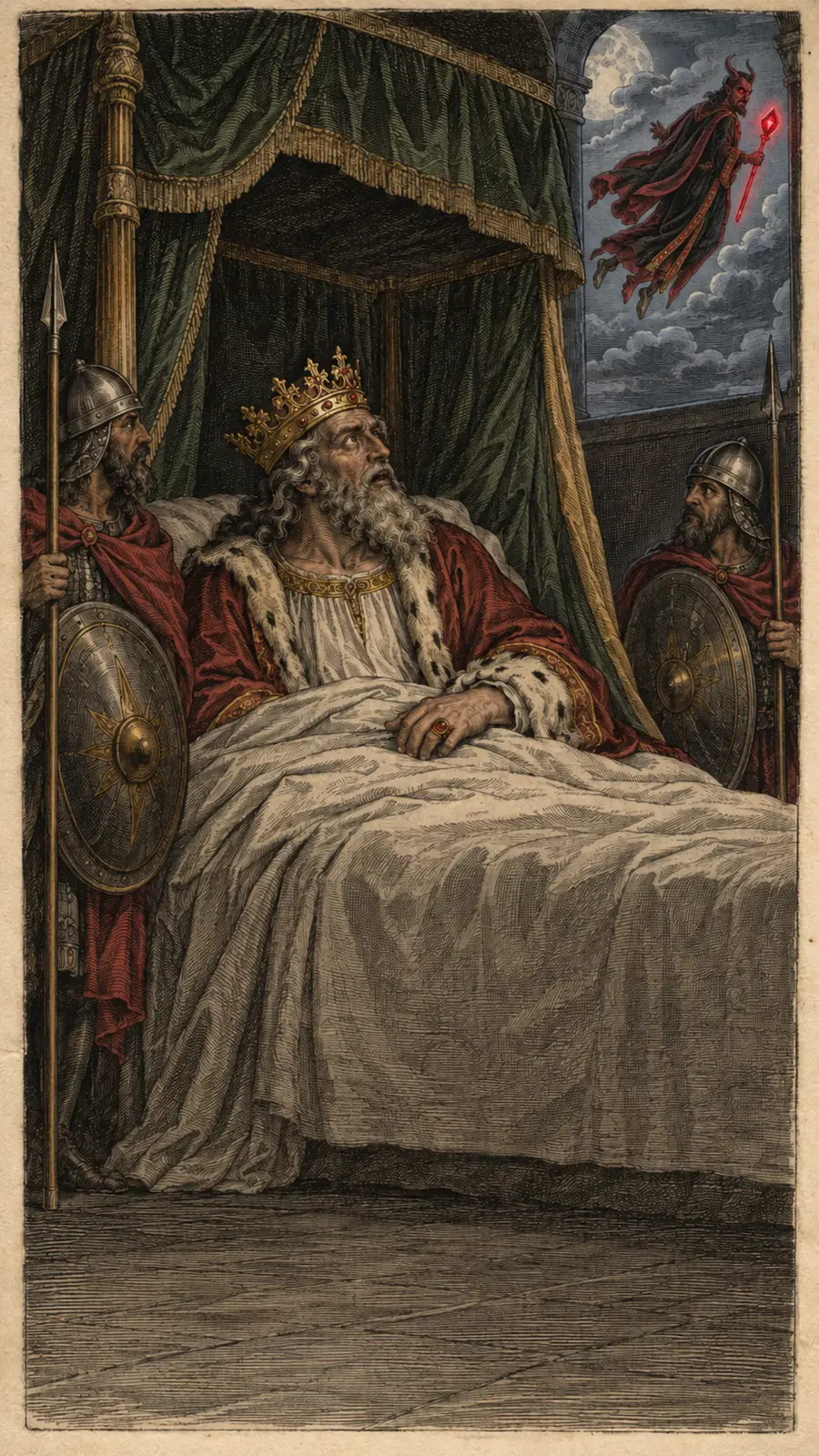
Solomon wanders as a beggar from town to town, telling anyone who'll listen that he, , was once king over Israel in Jerusalem. The words echo the opening of the Book of Ecclesiastes. Back in the palace, the grows suspicious. Benaiah, the king's oldest servant, is never admitted to the king's presence any more. The king's wives say he always keeps his slippers on, even in bed. Demons were said to have the feet of a cockerel, and a demon wearing a king's face would have to hide them. Solomon is brought back, given the chain and ring again, and Ashmedai flies away. In some tellings the king was afraid of him ever after and kept armed guards around his bed through the night.
In later Jewish folklore Ashmedai stays king of the shedim, the demons, and is sometimes paired with or other demon queens. He is never quite as purely evil as the Christian Asmodeus would become. He's a king among spirits, clever and dangerous, but bound by law and capable of strange courtesy.
Christian writers took the darker thread. Building on the bridal chamber of Tobit, medieval and Renaissance demonologists made Asmodeus the demon of lust. In 1589 a German bishop and theologian named matched seven princes of Hell to the seven deadly sins. Lucifer took pride, greed, Leviathan envy, gluttony, Satan wrath and sloth. Asmodeus took lust. Several of those names will come back in the deep layers of the Nine Hells.
Then the grimoires took him up. In 1577 the physician published a short catalogue of spirits called the , as an appendix to a larger book that doubted the witchcraft accusations of his day. Among its entries is a spirit called , also known as Asmoday, a great king, strong and mighty. A few years later Reginald Scot carried the list into English in his Discoverie of Witchcraft.
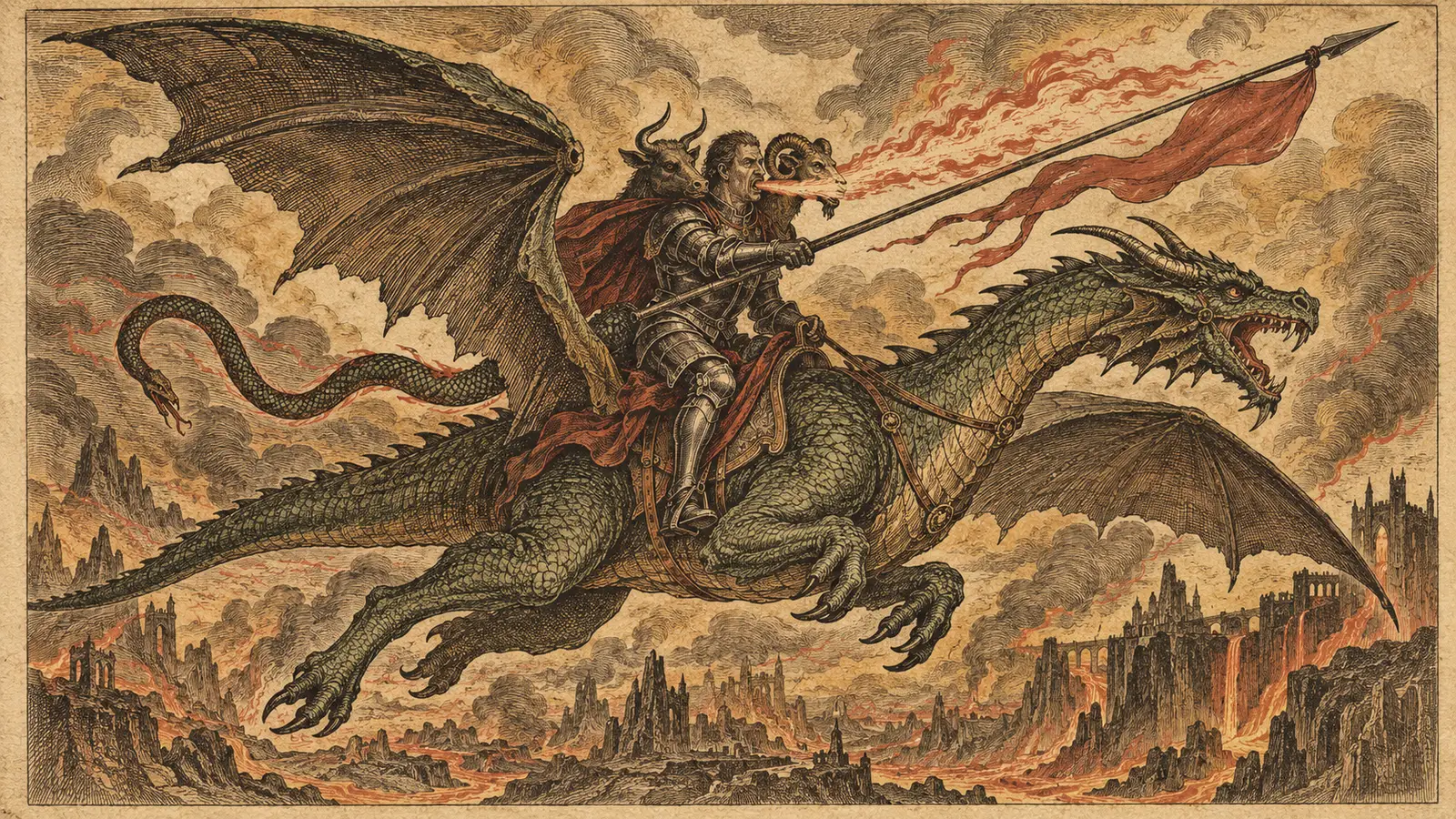
The fullest portrait comes in the Ars , the first book of the seventeenth-century compilation called the Lesser Key of Solomon, which reached a wide readership in an edition published in 1904. It lists seventy-two spirits, and Asmoday is the thirty-second, a Great King, strong and powerful. His appearance is unforgettable. He has three heads: the first like a bull, the second like a man, the third like a ram. He has a serpent's tail, flames come from his mouth, and his feet are webbed like a goose's. He rides an infernal dragon and carries a lance with a banner.
What he offers is just as telling. He gives the Ring of Virtues. He teaches arithmetic, astronomy, geometry and all the handicrafts. He gives true and full answers to whatever he's asked. He can make a man invisible. He shows where treasure is hidden, and he guards it. He commands seventy-two legions of spirits and serves under , king of the East, as the first and choicest of his officers. A conjurer who calls him must stand bareheaded, as a sign of respect, or the spirit may deceive him.
Look at the sum of all that. A great king with a ring, a teacher of measurement and order, a keeper of treasure, a commander of legions, a spirit who answers truly as long as the proper forms are observed. It isn't hard to see the ancestor of a devil-king who deals in contracts and keeps his word to the letter.
The poets added the last strokes. In the fourth book of Paradise Lost, published in 1667 and revised a few years later, John Milton compares Satan, slipping into Eden, to the spirit of Tobit. Satan comes on the garden more pleasantly than Asmodeus with the fishy fume, that drove him, though enamoured, from the spouse of Tobit's son, and with a vengeance sent from Media post to Egypt, there fast bound. Milton kept that word, enamoured. Even the great poet remembered that the demon had loved her.
A French novelist named gave him a sense of humour. In his novel of 1707, known in English as The Devil upon Two Sticks, Asmodeus is a lame and witty demon who lifts the roofs off the houses of Madrid at night. We'll come back to that book near the end of the evening, because it matters a great deal to the gentleman devil.
In 1818 the French writer published his , a great encyclopedia of demons. A later edition, illustrated by , gave Asmodeus his most famous picture: a man's chest, a rooster's leg, a serpent's tail and three heads, one a fire-breathing man, one a ram, one a bull. He rides a lion with a dragon's wings and neck, holding a lance and banner.
That was the inheritance waiting on the shelf in the middle of the twentieth century. There was a Persian spirit of wrath, a jealous lover driven off by smoke, a wise and chained king who wept at weddings, a prince of lust, a three-headed teacher of geometry riding a dragon, and a clever, sardonic guide over the rooftops of Madrid. All of it lay in old books, waiting for someone to sort it into a hierarchy.
Chapter II
The house is built, and the lord moves in
The game that would give his throne began in 1974, and for its first couple of years it didn't need a king of Hell. Its villains were orcs and dragons, wizards and the undead. But the rules had a question in them that would draw the devils in eventually: what does it mean for a creature to be good or evil, lawful or chaotic?
The first answer had been a single line, running from Law at one end through Neutrality to Chaos at the other. Over 1974 and 1975, a correspondent named Stephen Marsh wrote letters to Gary arguing that the system needed more room, and his ideas helped push it forward. In February 1976, in the sixth issue of TSR's small magazine The Strategic Review, Gygax published an article titled "The Meaning of Law and Chaos in Dungeons & Dragons and Their Relationships to Good and Evil."
It changed the shape of the moral world. Good and evil became a second axis, separate from law and chaos, so a creature could be lawful and good, chaotic and good, lawful and evil, or chaotic and evil. Gygax plotted examples on a chart. The paladin stood for lawful good, and elves for chaotic good. The vampire, cold and orderly in its hunger, stood for lawful evil. And the demon, in his words, was the very epitome of chaotic evil.
The article also matched planes of existence to the alignments, and it gave lawful evil a home of its own: Hell. You could say the foundations of the Nine Hells were poured on that page. The house had no tenant yet, no named lords and no layers. But there was now a place in the cosmos where order and evil met, where wickedness would be organized and patient rather than wild.
The Strategic Review only had one more issue in it. It came out in April 1976, and in its pages the editor Tim announced that the magazine would be replaced by a new one, The Dragon, which would go on to carry a great deal of the Nine Hells' lore. That last issue held no devils.
A month later came Eldritch Wizardry, the third supplement to the original game, by Gary Gygax and Brian Blume. It was a book of wonders: psionics, mind flayers, the druid, and the first great artifacts, including the relics whose history this channel has followed in an earlier evening. It also opened the Abyss.
Here the demons arrived as an army with ranks. The rank and file were numbered from Type One up to Type Six, and the succubus joined them. Above the ranks stood two demon princes. One was . The other was , with a reptilian body, tentacles for limbs and two baboon heads that quarrelled with each other. All of them were chaotic evil, native to the howling depths of the Abyss.
So the opposing side of the board was filled first. Before any devil had a name, the demons had a hierarchy and two princes to lead it. Hell stood empty on the alignment chart while the Abyss already roared. When the devils did arrive, they came as an answer to that roar: an orderly darkness to set against the chaotic one.
They arrived in December 1977, in the first hardcover of the new Advanced Dungeons & Dragons, Gary Gygax's Monster Manual. Among its pages was a section on devils, and with it the Nine Hells finally had people living in them. There were lemures, shapeless and miserable, the lowest of the damned. There were barbed devils and bone devils, and the erinyes, winged and terrible. Above them stood the greater devils: the horned devil, also called the malebranche, the ice devil and the pit fiend, the great winged generals of Hell. And at the very top were four arch-devils, the dukes of the infernal realm: , , and Asmodeus.
Asmodeus was the highest. The book called him the Overlord of all the Dukes of Hell. He ruled , the ninth and lowest layer of the Nine Hells, and from that deepest place he ruled every layer above. Of all the devils, he was the strongest, the most cunning and the most powerful.
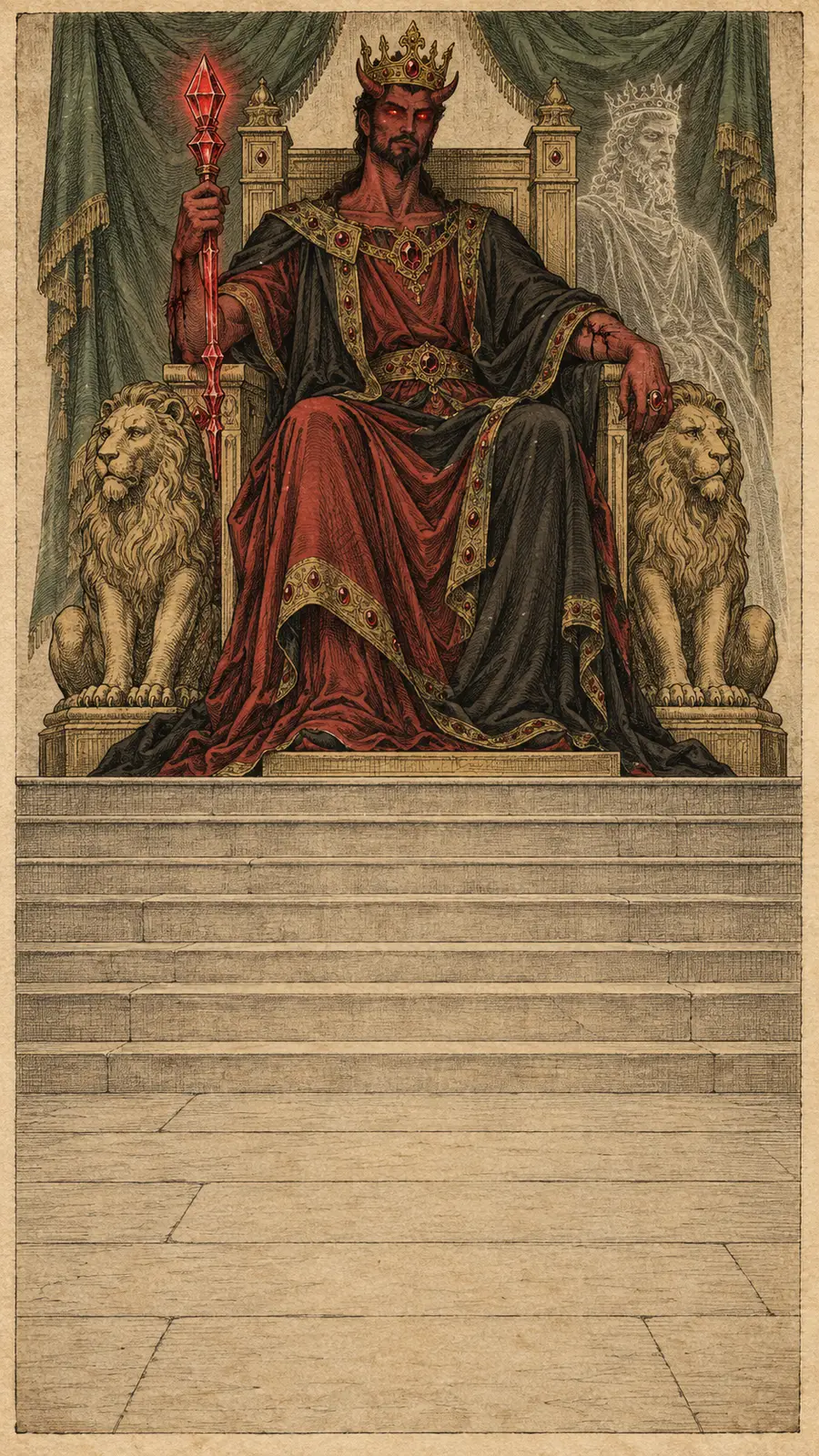
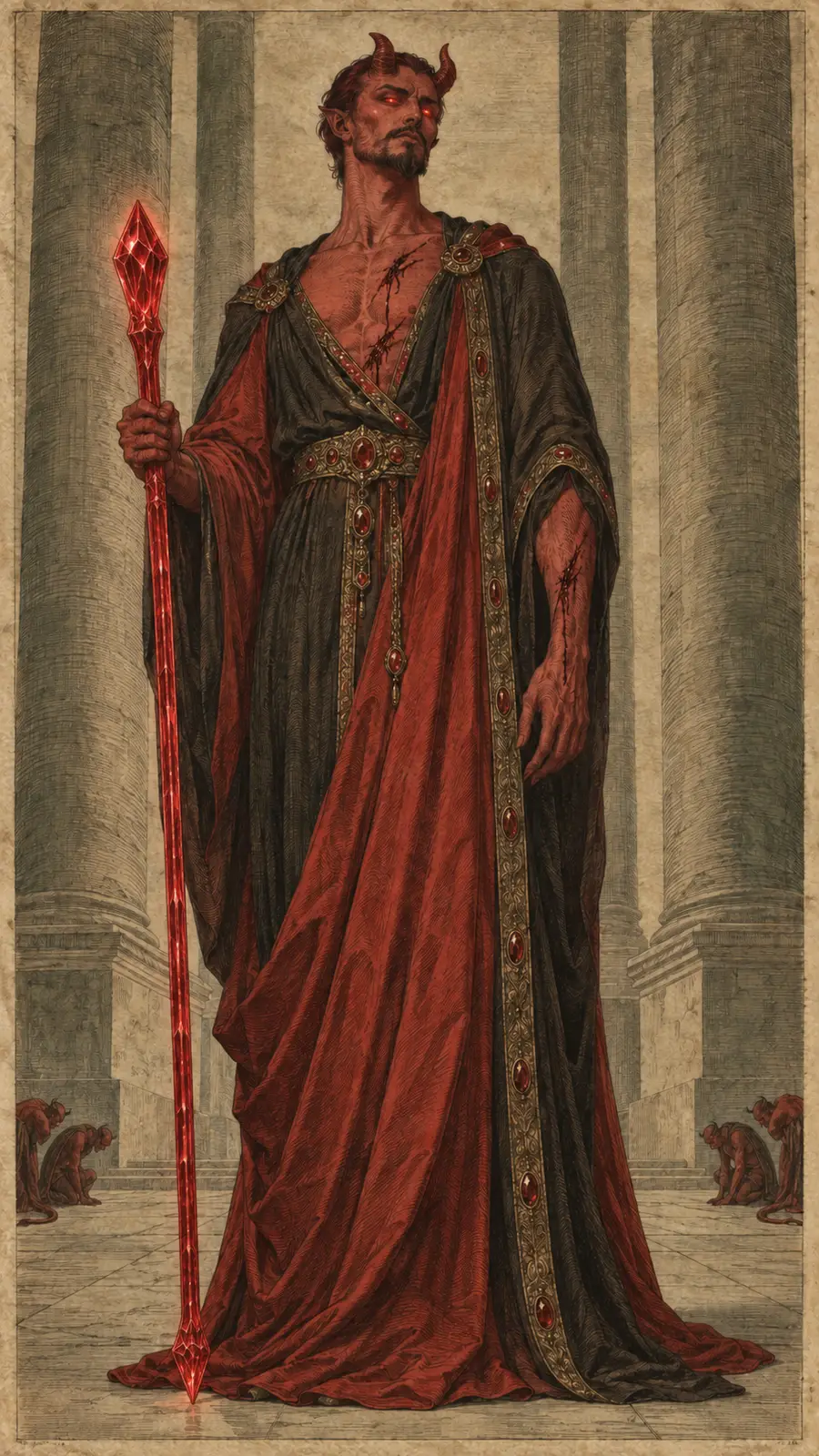
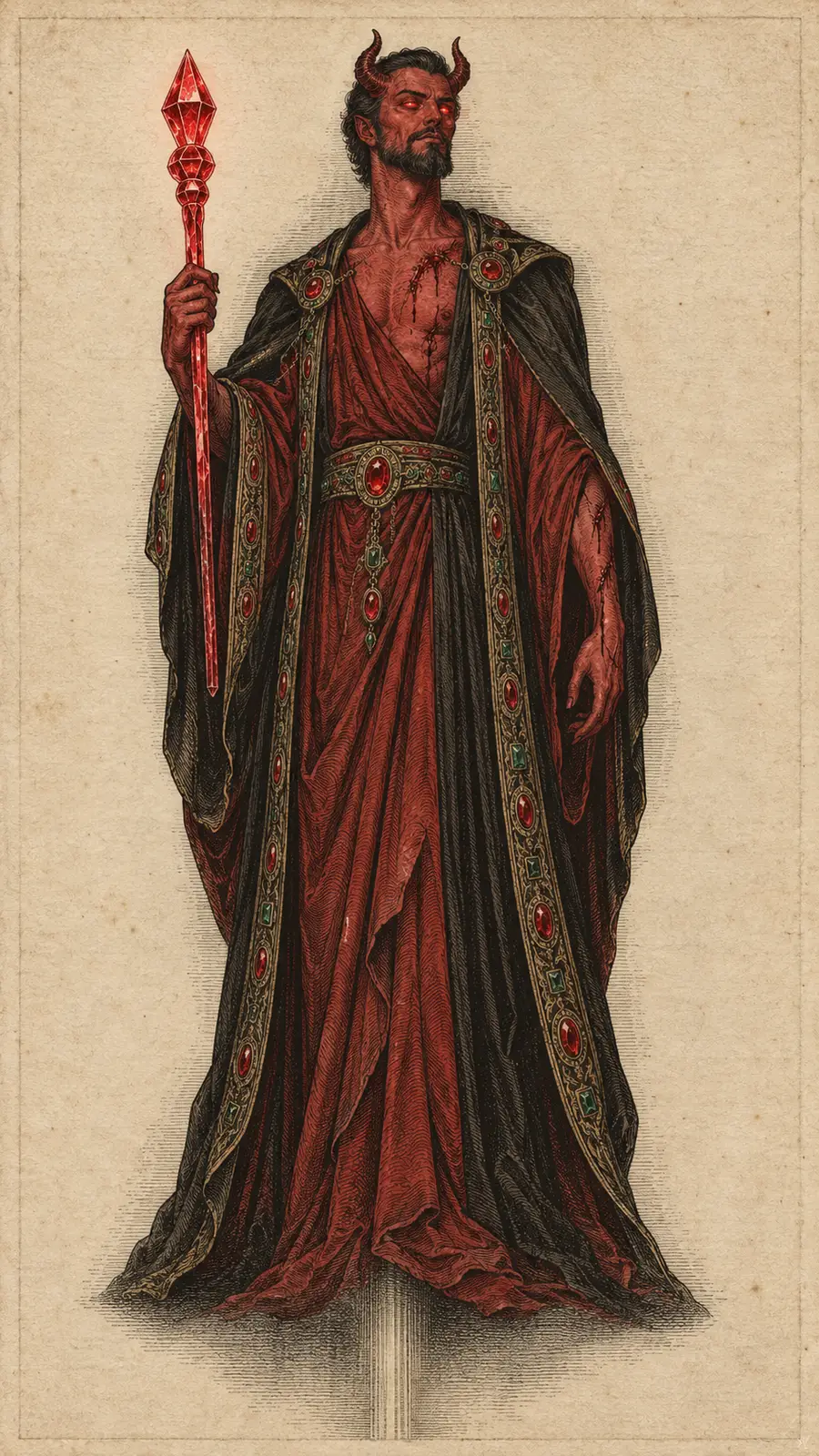
He also had a look that would stay with him, in one form or another, through every edition. Asmodeus appears as a giant human figure, more than thirteen feet tall, with dark skin and dark hair, eyes that burn red, and small horns on his brow. He is handsome. That matters more than you might expect. The demons of Eldritch Wizardry were monstrous things of tentacles and baboon heads. The lord of the devils looked almost like a man, a very tall, very beautiful man in regal finery, with only the horns and the red light in his eyes to give away what he was.
In his hand he held the Ruby Rod of Asmodeus, his weapon and his symbol of office. In those first rules it could hurl a long bolt of lightning, send out a long beam of acid, or breathe a cone of intense cold. It could also raise a strong shield around its master. A king's sceptre, then, but one that could strike.
The name came straight from the Book of . The new hierarchy also drew on names from the long Christian tradition, Baalzebul being a spelling of the old , and later on from the Faust legends. The devils of the game carry two old inheritances. One is the bargain, the devil who trades power for a soul and keeps the letter of the deal. The other is the punishing devils of Dante's Inferno, the guardians of a structured underworld where every sinner has a place. The game's Asmodeus stands where those two meet: a dealer in souls and a keeper of order, at the bottom of a carefully layered pit.
The pit fiends, his mightiest servants, were said to be native to Nessus itself, so the deepest layer was home to the deadliest devils as well as to their lord. And the lord himself, in those early days, was a remarkably quiet presence. The first book told you what he was and where he lived. It didn't tell you his story, his history or his heart. Those would come slowly, edition by edition, over almost fifty years.
So that's how he moved in. The house had been built in 1976, with a plane of lawful evil on a chart and an Abyss full of numbered demons across the way. At the end of 1977 the lord took his seat at the very bottom of it. From there, as we'll see, he would never really move. Everything else in Hell would shift around him.
Chapter III
The Nine Hells of the first edition
With the devils on the page, the next task was to map their country. The Dungeon Masters Guide of 1979 set the Nine Hells firmly in the larger cosmology as the outer plane of lawful evil, one of the great planes ringing the world of mortals. It was a map of the multiverse more than a portrait of any one place, but it settled the Hells into the cosmos as a lasting fixture.
That same year, in August 1979, The Dragon ran an article by Alexander von Thorn called "The Politics of Hell," and it's worth stopping on, because it told a story about that the official books never adopted, yet never quite forgot.
In von Thorn's account, Hell has had more than one king. The first was Satan himself. Satan was overthrown by , who took the throne. Then, in his turn, Baalzebul was overthrown by Asmodeus, and Asmodeus has reigned ever since. The exiled Satan is still out there somewhere. He's still more powerful than any other devil, but he has no followers left, nobody to command and nothing to rule. The article gave game statistics to Satan and to two other figures, and .
It's best taken as an old unofficial tale, the kind of story that gets whispered in the corridors of a palace. It was never part of the official canon. But it was reprinted in The Best of Dragon, Ed Greenwood later borrowed some of its ideas, and decades afterwards a faint nod to it turned up in a third-edition book. It also did something lasting for Asmodeus himself. By setting him beside Satan rather than equating him with Satan, it helped make the game's Asmodeus his own figure: a ruler of Hell with a history, rivals and a throne he had won.
Imagine that exiled first king for a moment. Stronger than anyone who might challenge him, and alone. It's a striking picture of how power works in a lawful Hell. Strength isn't enough. What counts is the loyalty of the many, the web of obligations, the army that will march when you call it. Asmodeus, in this old tale, won because he understood that.
The great mapping came four years later, from the young Canadian writer who'd go on to create the Forgotten Realms. In July 1983 Dragon published Ed Greenwood's "The Nine Hells, Part I," followed in August by "Part II." Between them, the two articles walked the reader down through every layer of Hell, one after another, and filled each with devils, dukes, courts and intrigues.
The first part covered the upper layers. There was , the first layer, the gateway. Then Dis, with its iron city. Then , a sinking, rain-soaked bog. Then , a layer of fire. Then , cold and dark. More than twenty high-ranking devils were described. Quietly, almost in passing, the first article introduced a figure named . Later lore would make her the daughter of Asmodeus and his consort , and one of the most important figures in his family. In 1983 she was just another name in a crowded court, waiting for her story.
The second part went deeper: , , and finally . Another twenty or so devils joined the cast, among them as the consort of . And at the bottom, Greenwood described the seat of all Hell's government.
Nessus, in his telling, is where Hell is ruled. Asmodeus's citadel rises from the bottom of a deep rift and climbs high above the plain. Think about that shape for a moment. The fortress doesn't sit on top of the land, looking down. It grows up out of a wound in the ground, out of the deepest crack in the deepest layer, and only then rises above the surface. The palace of the king of Hell has its roots in an abyss of its own.
Around him stand the pit fiends, his bodyguards and personal servants. Among them one has a name and a title: the pit fiend , Constable of Nessus, keeper of order in the court of the Overlord. In an illustration by Bob that ran with the material, a pit fiend stands guard on the approach to Asmodeus's palace, huge and winged, watching the road. It sums up how Asmodeus was seen in those years. You didn't meet him. You met his guards, and you looked past them toward a palace you'd probably never enter.
Some things we now take for granted about Nessus weren't there yet. The palace didn't have its famous name. The great rift had no name either, and the bleeding wounds of a fall from heaven were nowhere to be seen. In 1983 Asmodeus was a king without a backstory: powerful, guarded, deep and silent.
That same year 's Monster Manual II added four more arch-devils to the roster: Belial, , and Moloch. With the original four, , , Baalzebul and Asmodeus himself, the first-edition court of Hell was now complete, a ring of great dukes ranged layer by layer above the ninth.
Greenwood came back to the Hells in Dragon in November 1984 with "The Nine Hells Revisited." It added still more greater devils, with names out of old demonologies such as , and , and a new arch-devil called Gargoth. Hell was getting crowded and political, full of factions and ambitious dukes. And above all of it sat the one figure who never moved.
One more detail from these years matters. In the game's great book of gods, Deities & Demigods, published in 1980, Asmodeus wasn't treated as a god. He was an arch-devil, a creature of the planes, vastly powerful but not divine. That line, between the mightiest devil and a true god, would become one of the long threads of his story. Edition after edition, the question would come back: is the king of Hell a god? The first edition answered plainly that he was not. Later editions would answer differently.
So by the middle of the 1980s the shape of first-edition Hell was clear. Nine layers ran from the battlefield gate of Avernus down to the dark plain of Nessus. Each had a duke, each duke had a court, and the courts schemed against one another. At the bottom of it all, in a citadel growing out of a rift, Asmodeus watched it all with his red eyes, surrounded by pit fiends.
Then the world outside the game shifted, and for a while the devils went quiet.
Chapter IV
Baator, the Blood War and the Dark Lord of Nessus
In the 1980s the game drew fierce criticism. Religious critics, in the period now called the Satanic Panic, attacked it for its occult imagery, and the demons and devils of the Monster Manual were obvious targets. When the second edition of Advanced Dungeons & Dragons launched in 1989, its core books left the fiends out entirely. TSR stopped using the words "demon" and "devil" altogether.
The fiends were too much a part of the game's cosmos to stay away for long. In 1991 they came back, in the Monstrous Compendium Outer Planes Appendix, under new names. Devils were now the baatezu and demons the tanar'ri. The new names put some distance between the game and real-world religion, but they did something else too. They made the fiends feel like what they'd always been in the game: their own peoples, with their own natures and their own words for themselves.
The plane of the Nine Hells got a new name as well: . It was still the plane of lawful evil, still the home of the devils, still a stack of layers sinking into darkness. Its ninth and deepest layer was still .
And that book brought one more great idea, which shaped everything after it: the Blood War. The baatezu and the tanar'ri, it said, were locked in an endless war. Law against chaos, order against riot, the ranked legions of Baator against the boiling hordes of the Abyss. It had gone on for longer than anyone could remember, across the Lower Planes and sometimes spilling into other worlds, and it would never end, because neither side could ever win and neither could ever stop.
The Blood War gave something he hadn't had before: a reason. Before, he was simply the ruler of a lawful Hell. Now he was a commander in a cosmic war. His legions held back the tide of chaos. His pit fiends were generals, and his dukes were marshals of a long campaign. A king at war is a different kind of king, and much of his later story would grow from this.
In 1994 the game opened its widest window yet onto the planes. The Planescape Campaign Setting invited players to travel the whole multiverse from the great city of , at the centre of the planes. And in its picture of Baator, it did something surprising. It left the Lords of the Nine out.
In their place stood the Dark Eight. These were pit fiends, eight of them, who met on Nessus and ran the eight great bureaucracies that kept Baator working and fed the lawful side of the Blood War. Each held a ministry. was Master of Supply, keeping the legions fed and armed. was Minister of Mortal Relations, overseeing every dealing with the living. Corin was the Spymaster. was Marshal of the Pits. Zimimar was Minister of Morale. Zaebos was Minister of Promotions and Demotions, which in Baator is a terrible office, since a devil promoted or demoted is reshaped body and soul into a new form. Zapan was Minister of Immortal Relations, and Pearza was Minister of Research and Development.
It's a wonderfully bureaucratic picture of Hell: offices, ministries, a cabinet of fiends meeting in council on the lowest layer, running a war the way a vast civil service runs an empire. Above the Dark Eight, the setting hinted, sat the diabolic nobles. And above everyone, at the very top, was a figure the books barely named: the Dark Lord of Nessus, a mysterious being sometimes called Asmodeus.
That reticence was two things at once. In the real world it was caution, a careful step back from names that had drawn criticism. In the world of the game it became a mystery. In the lord of Baator was a rumour. Planewalkers in the taverns of Sigil might lower their voices and say that something sat on the throne at the bottom of the plane, something even the Dark Eight answered to, and that some called it Asmodeus. Nobody claimed to have seen it.
Many players missed the old lords, and over the following years they came back in stages. In 1995 Planes of Law gave Baator its own booklet, written by Colin , and the nobles began to return. Later that year, in November, Dragon ran an article called "Now You Know Their Names...," which brought the Lords of the Nine fully back into the light. All of them served Asmodeus, the Dark Lord of Nessus. Each held a share of his power, the way a governor holds a share of a king's authority. ruled , now the name of the eighth layer, the frozen one.
The lords had real power in their domains. Each commanded the natural forces of their own layer, could bend its elements to their will, and had a limited omniscience within their borders, sensing what happened in the land they ruled. Imagine standing on an ice field in Cania and knowing that the archdevil who rules it can feel your footsteps. Then remember that every one of those lords is a lesser power than the one below.
Colin McComb went on to become the line's great specialist on fiends. He contributed to Hellbound: The Blood War in 1996 and wrote Faces of Evil: The Fiends in 1997, which looked at what fiends are made of, what drives their lives and how their bodies and natures fit together. Hell was getting deeper, and not only in the number of its layers. It had more texture: the feel of devilish life, the grind of devilish politics, the long weight of an unending war.
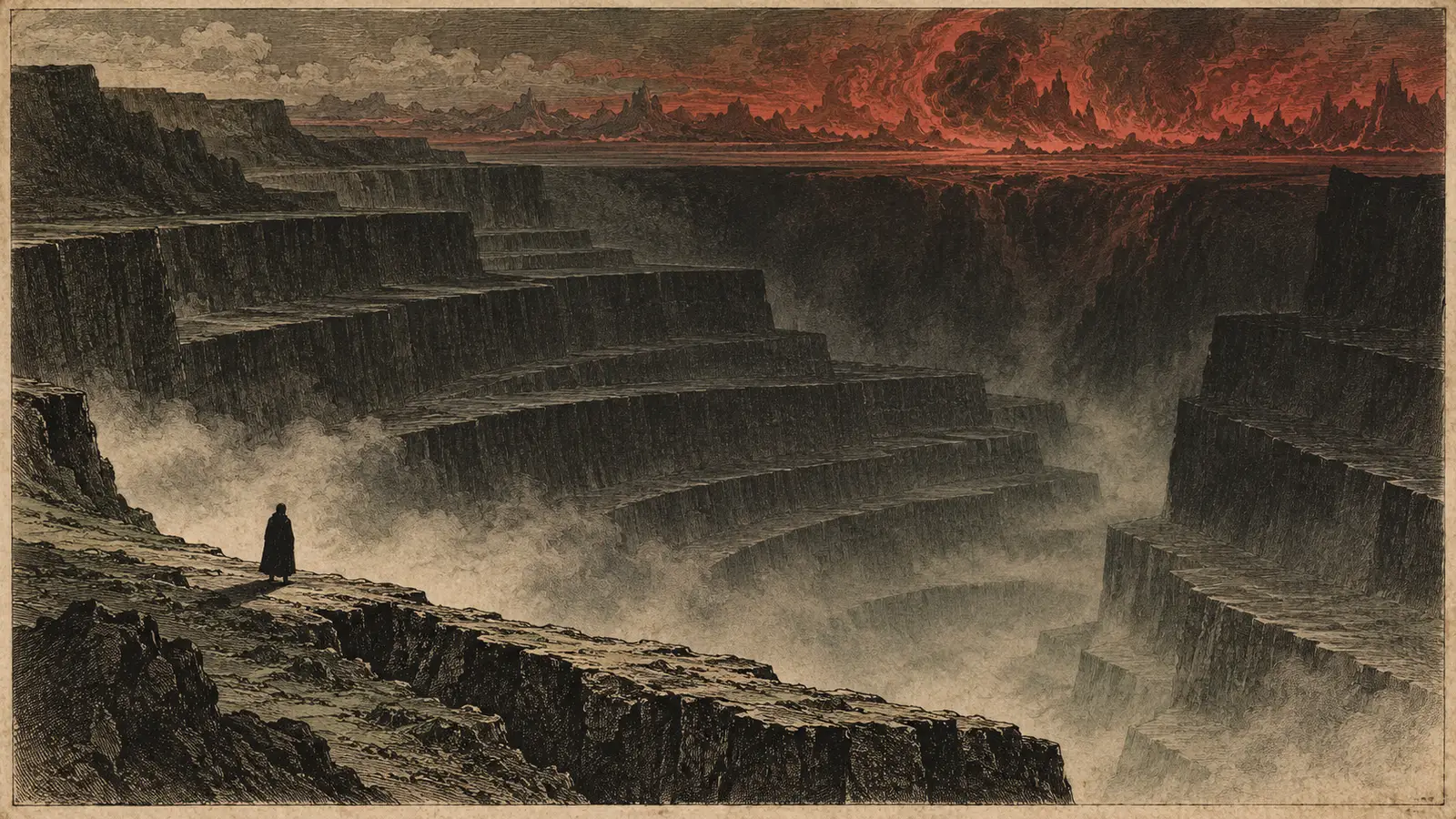
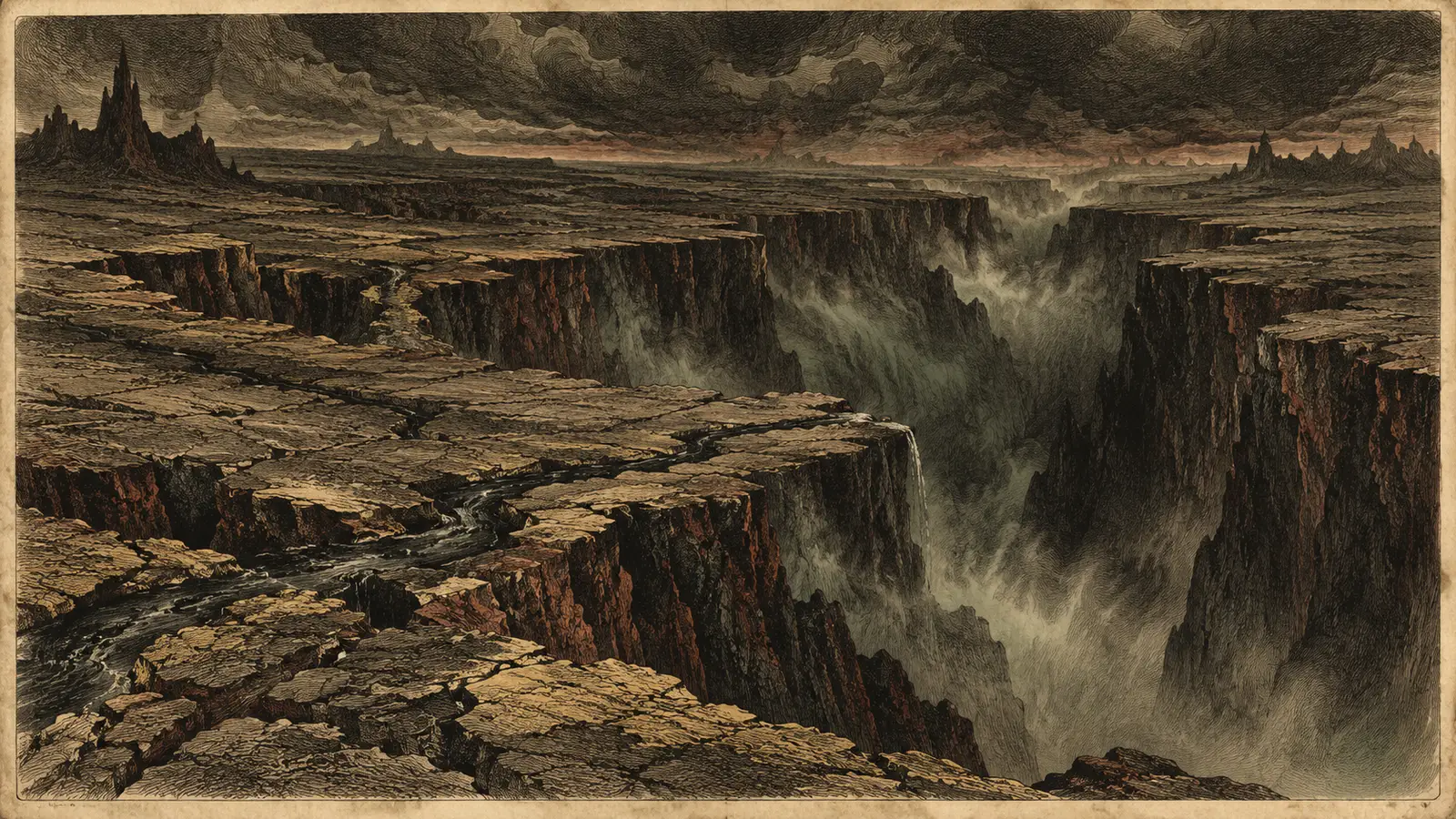
Nessus, in this era, gained the image that has stayed with it ever since. It's a dark plain, broken by rifts deeper than any ocean trench. Ravines and canyons cut thousands of miles down into dead, featureless stone. A rumour holds that an offshoot of the River , the dark river that winds through the Lower Planes and steals the memories of anyone who drinks from it, trickles across the layer and spills over into the trenches, falling away into the dark.
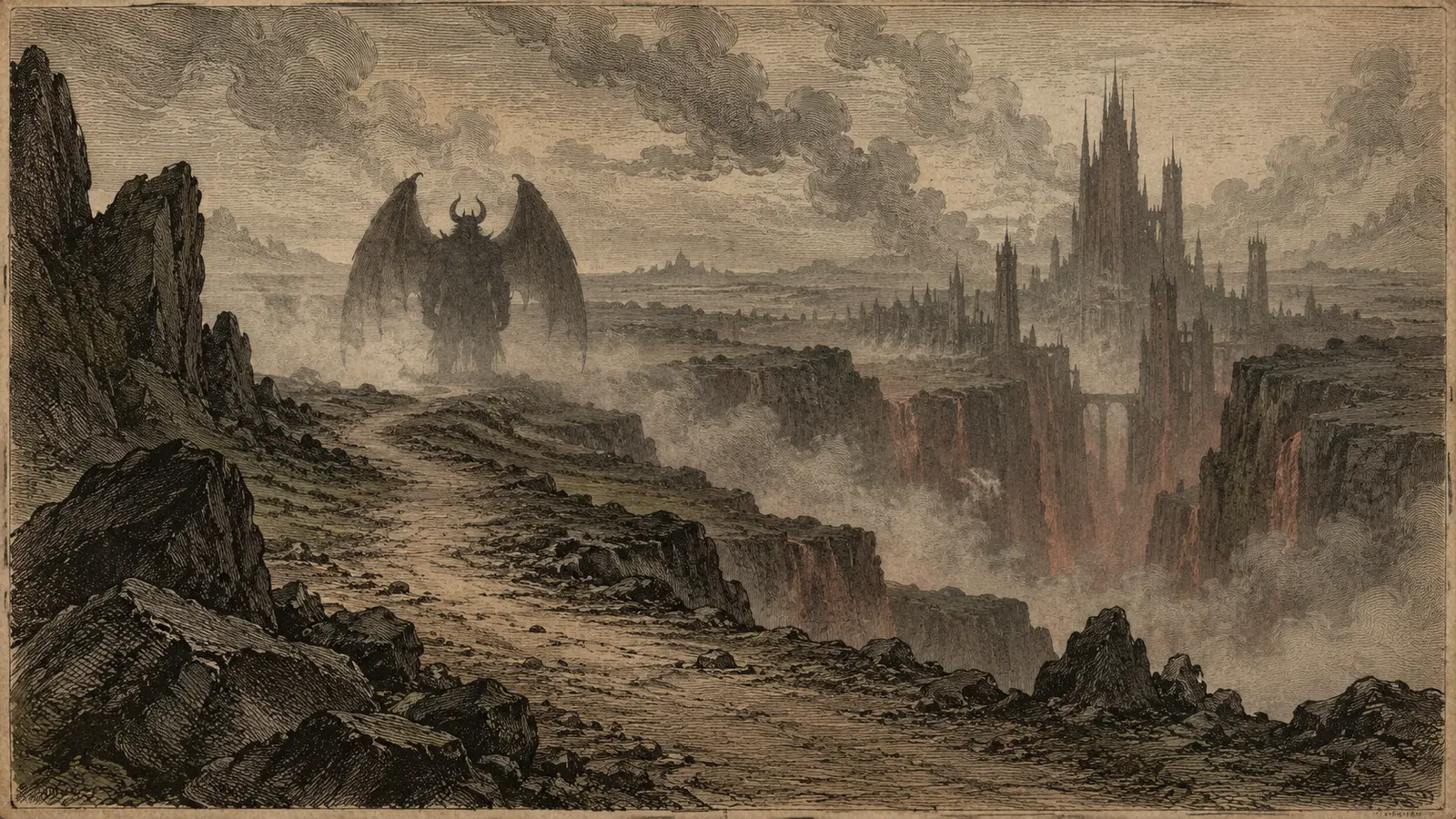
And out of a great trench rises , the Citadel of Hell. That is its name now. It rises, as one description puts it, in its dark, elegant, fiendish beauty. From there the Overlord of Hell rules all Baator. Malsheem was said to be the largest city in all the Outer Planes, a palace grown into a metropolis, its halls and towers home to uncountable devils, every one of them part of the machinery of the king.
You can picture it from the plain: a dark citadel rising out of a chasm, elegant and terrible, its towers climbing far above the broken ground. The palace Greenwood described growing up from a rift had become Malsheem, and the rift beneath it was waiting for a name and a story. Both would come at the very end of the second edition, in one of the most important books ever written about Asmodeus.
Chapter V
Serpents of Law and the Reckoning of Hell
In 1999, near the close of the second edition, TSR published Guide to Hell, written by Chris . At the time it was the most detailed book ever written about devils, and it did what the books had hesitated to do. It named openly, put him at the centre of everything, and told his secret history.
The book opens with a story, a short legend called "Serpents of Law," attributed to an in-world scholar named . It goes back to the very beginning.
In the beginning, the legend says, the multiverse was swirling Chaos. There was no shape, no direction and no rule. Slowly, within that chaos, the gods began to take form. Among them, the greatest champions of Law were two serpents, and . They were twins, and they lay coiled together in a great ring, each holding the other's tail in its mouth, an ouroboros wrapped around the forming cosmos.
Together the twin serpents set down the basic principles of the planes, the deep laws that would give the multiverse its shape. The legend names three of them: the Unity of Rings, the Rule of Threes and the Center of All. These are the old principles that thinkers among the planes had long talked about, the idea that things circle back on themselves, that things come in threes, and that wherever you stand can be seen as the centre. In this story they were laid down by two serpents biting each other's tails.
Then the twins quarrelled. They disagreed about the Center of All, and their argument broke the ring. The two serpents let go. Jazirian had wings and rose. Ahriman had none, and he fell. He fell a long way, down out of the high places, through the planes, all the way into Hell. There, at the bottom, he took a new name, Asmodeus. From him the whole race of the baatezu took its beginning.
It's a myth of a broken circle. Two powers of order, once joined, fall out over a principle and split forever, one rising and one falling. The one who falls doesn't give up law. He takes it with him into the dark. He builds a kingdom of law down there and fills it with devils who carry his nature.
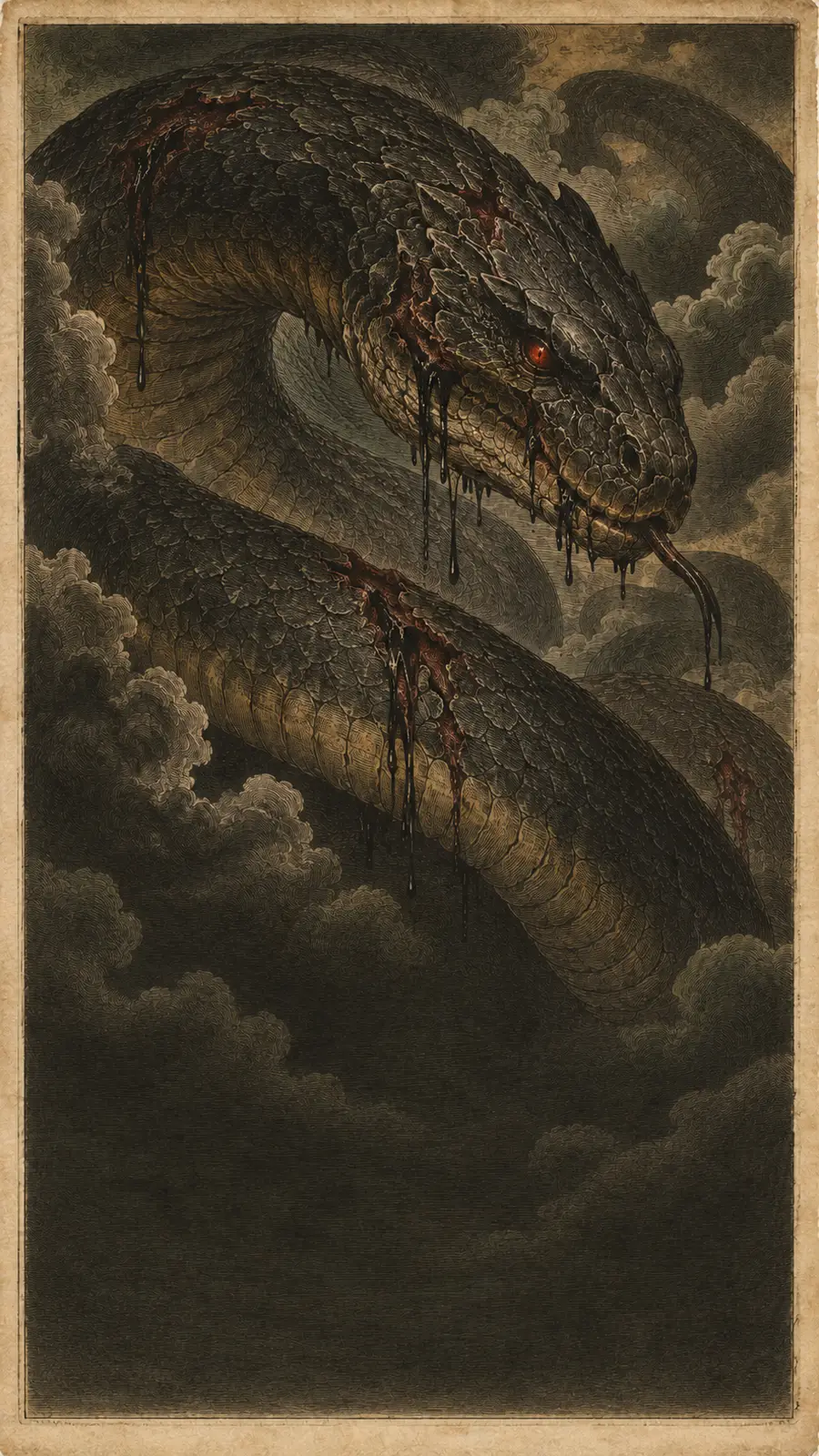
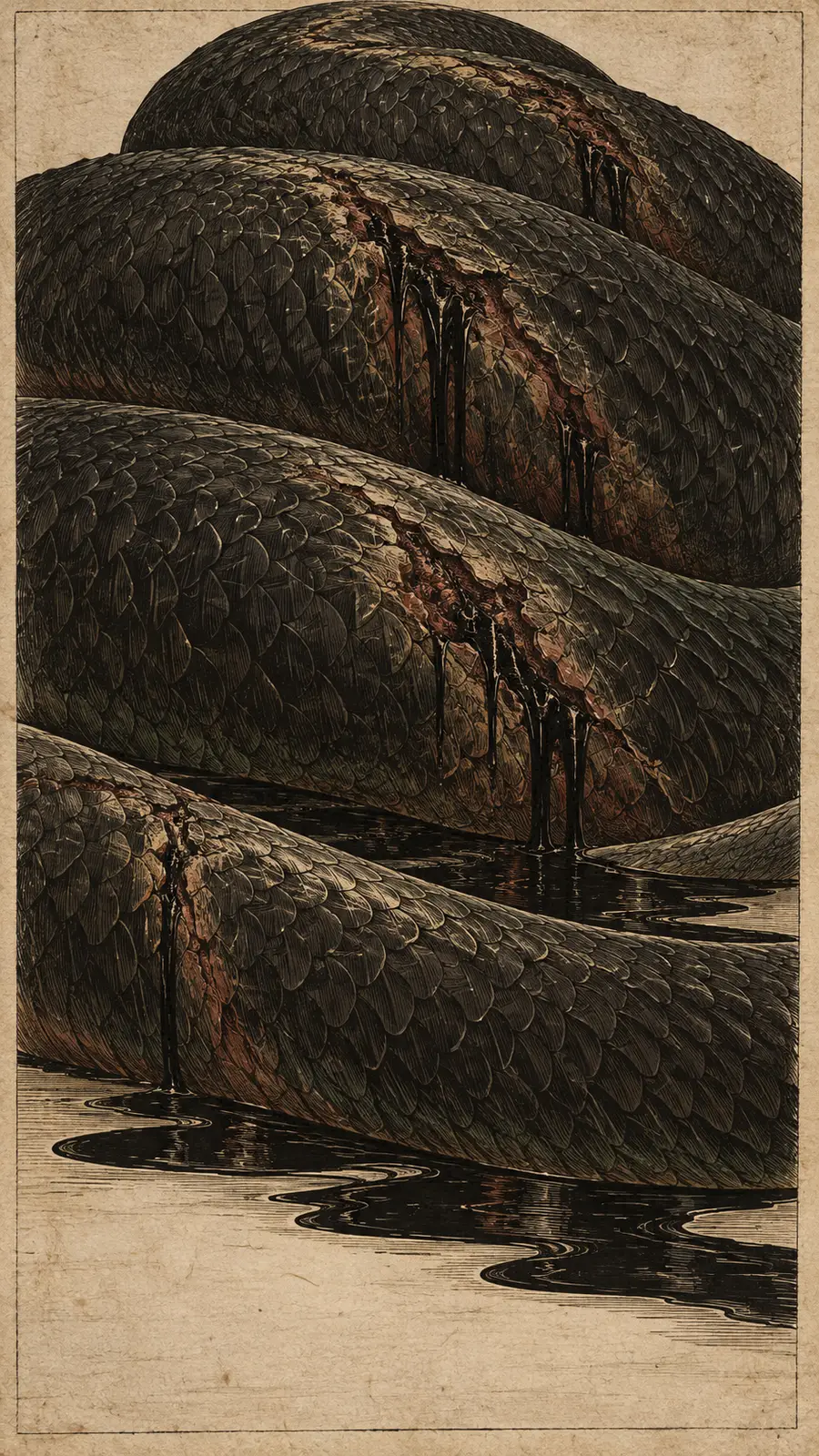
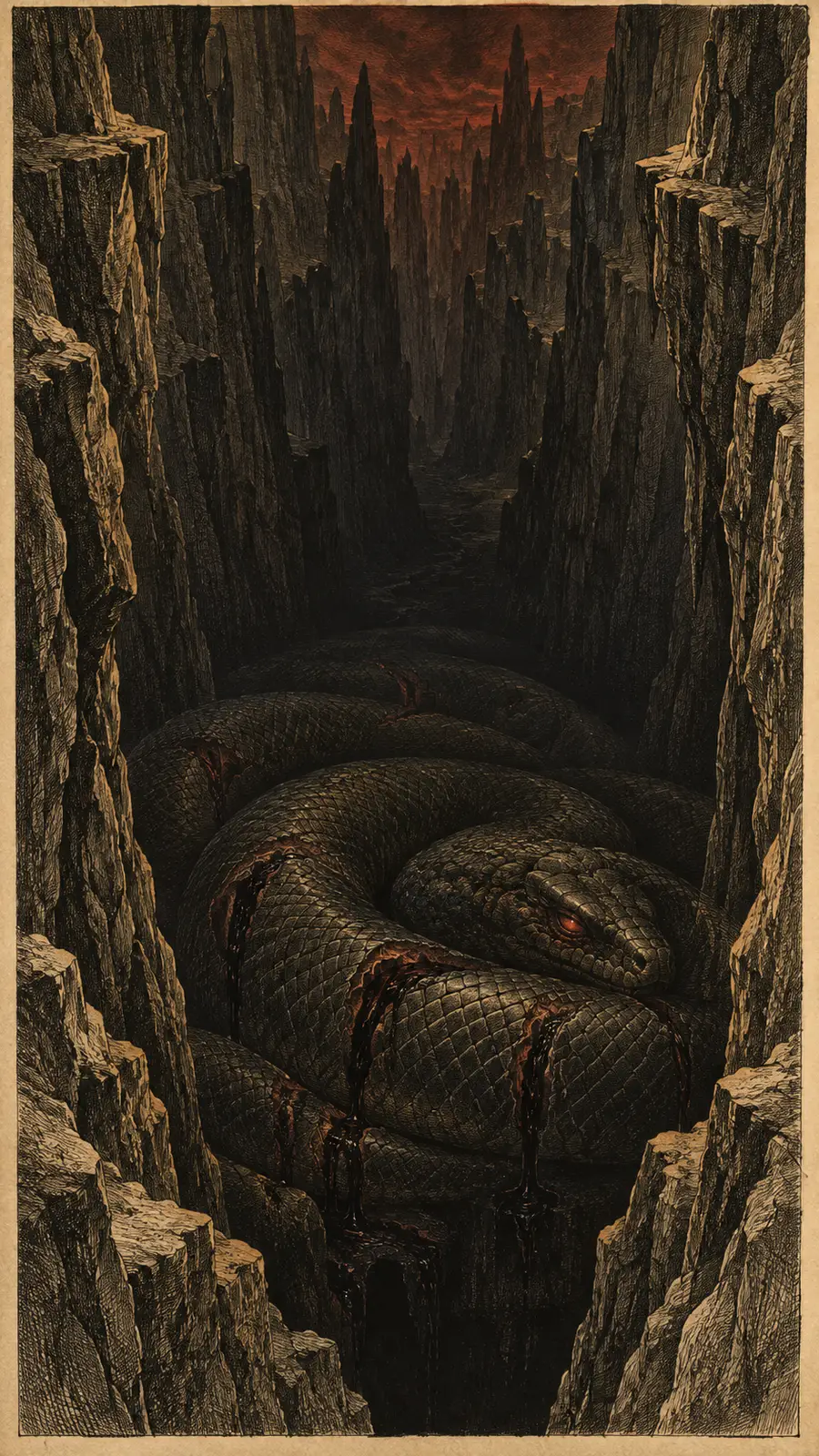
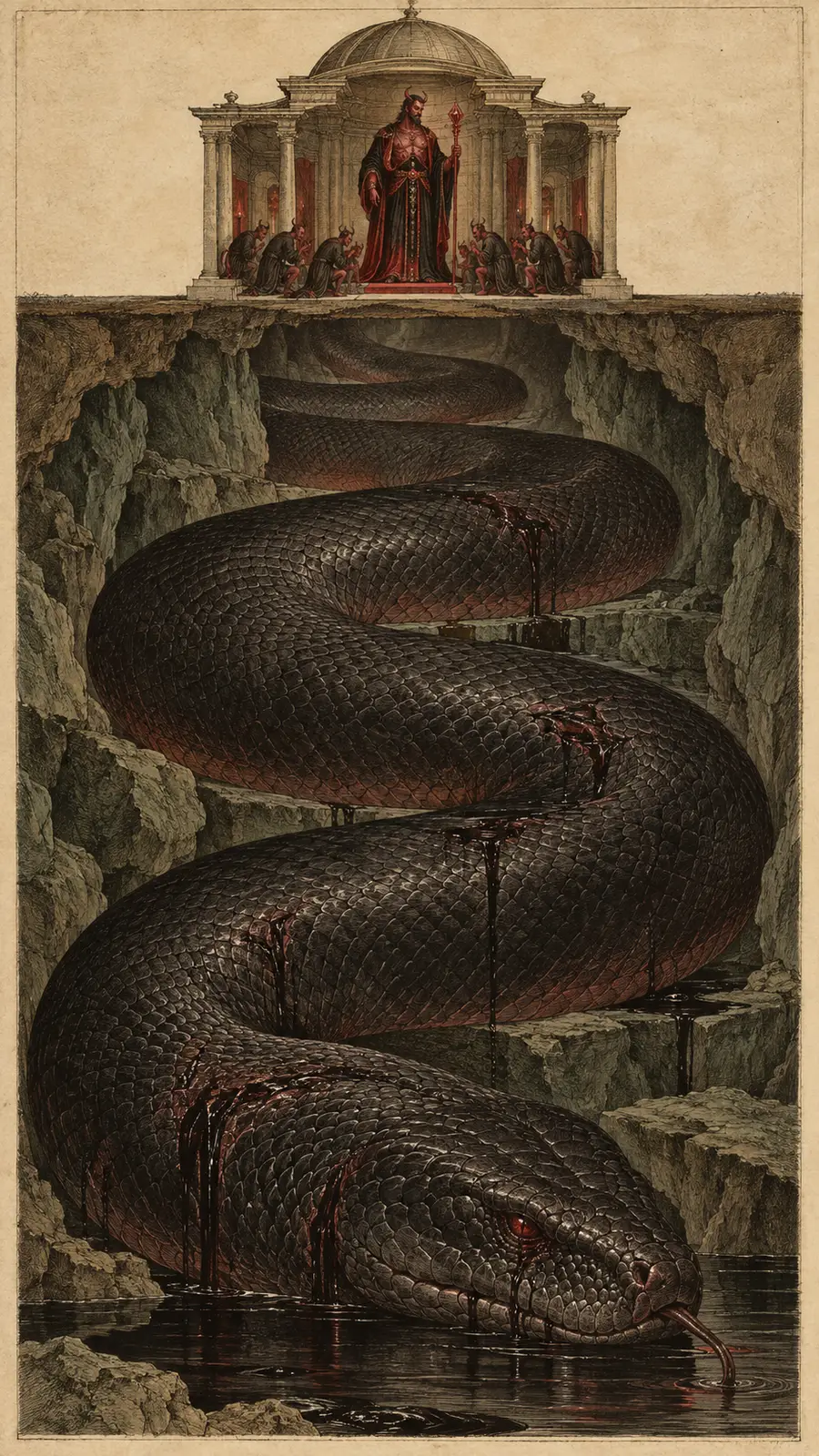
The Guide went further and described what lies under the throne. The tall, handsome figure the devils see in isn't Asmodeus's true body. It's an avatar, or a very advanced kind of projected image, a shape he puts forward so he can be seen and spoken to. His true form is a scaled serpent hundreds of miles long. Acid-black, foul blood seeps from wounds that are aeons old, wounds that have never healed since the fall. He's far too large to meet anyone or to hold a conversation, so he makes his avatars and speaks through them.
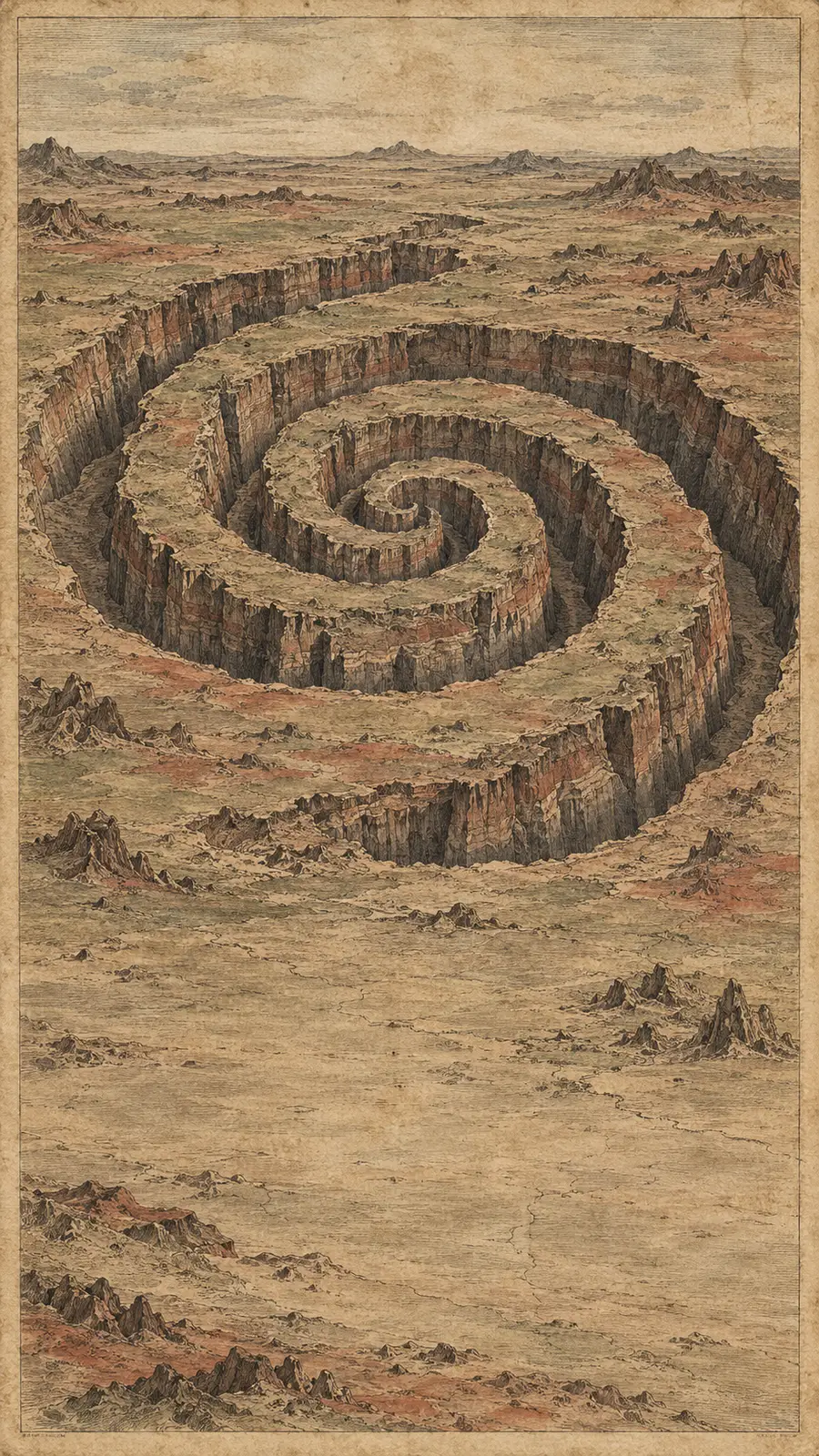
His body lies at the bottom of a rift in called the Serpent's Coil. It's a mile wide and spirals in on itself for hundreds of miles, winding inward like the coils of a resting snake, until it reaches about five miles down, the lowest point in all of Nessus and so the lowest point in all of Hell. There the serpent lies, unmoving, bleeding slowly into the dark.
Not even the devils of Hell know he's there. They bow to the figure in the palace and never guess that the true king rests in the rift beneath them, a coil hundreds of miles long. The deepest secret of the deepest layer is the shape of the king himself.
Guide to Hell told one more great story, and this one turned out to be a clever piece of storytelling for the real world as well as the imagined one. The archdevils of the second edition weren't quite the same as those of the first. Some lords had changed seats. Some had been diminished. A few names were different. The book explained all of it with a war, the Reckoning of Hell.
The Reckoning was a civil war among the archdevils. Two factions formed. One was led by , lord of , with of Dis, of and of beside him. The other was led by , lord of , with , who then ruled , of , and , Baalzebul's viceroy in . Moloch and Belial opened the fighting with surprise attacks on Stygia, and Hell went to war with itself.
Each leader had a secret purpose. Baalzebul and Mephistopheles each hoped that by wiping out the other side, they'd come out strong enough to challenge Asmodeus himself. The civil war was meant to be a prelude, a clearing of the board before the real game, a move on the throne at the bottom of Hell.
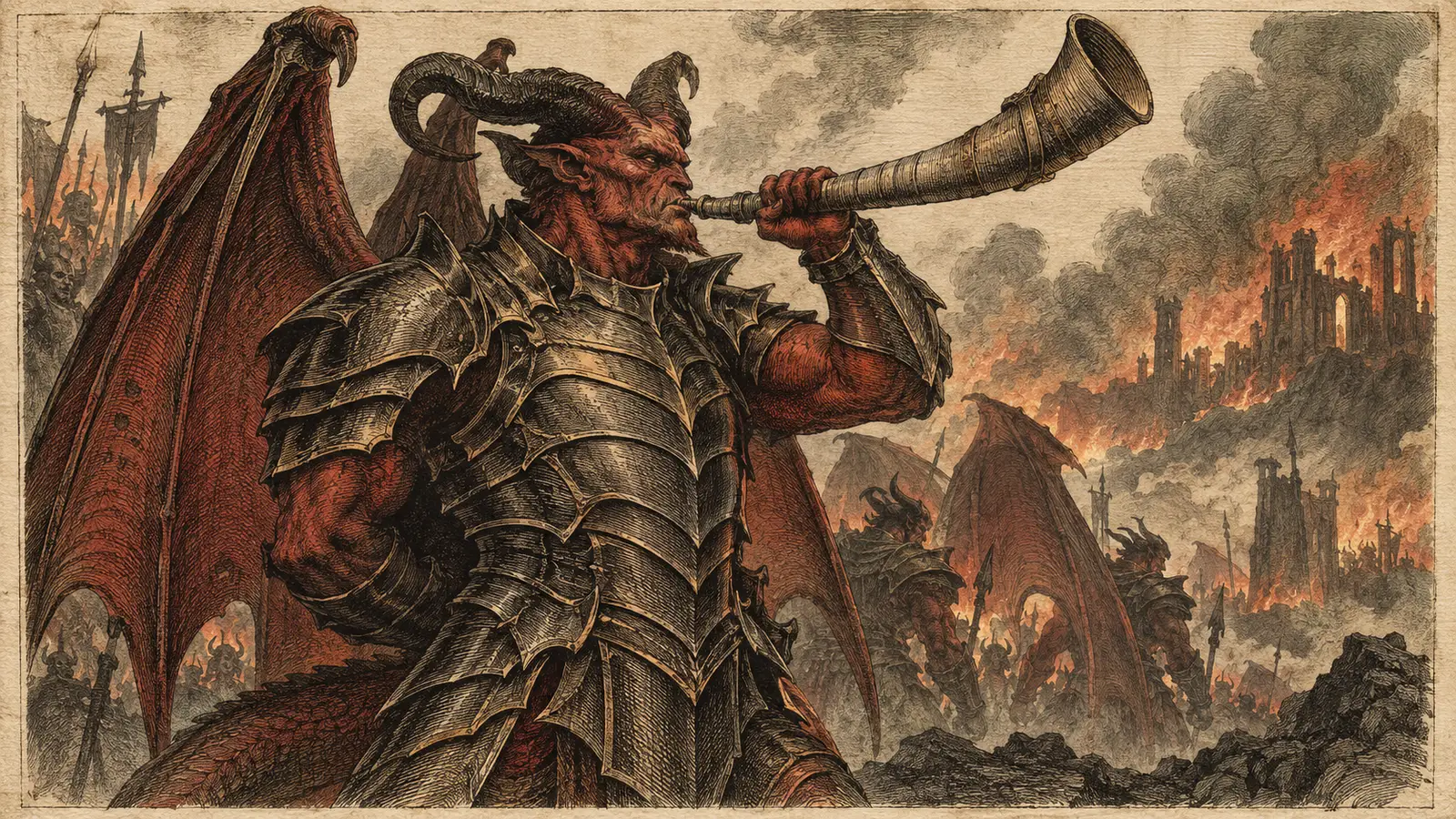
There was one thing neither side knew. Geryon had stayed secretly loyal to Asmodeus all along. With his master's help, he slipped into both armies and quietly won over their pit fiend generals, the great winged commanders who actually led the legions in the field. Then came the final battle. The two great hosts of Hell met, and at the decisive moment Geryon raised his horn and blew.
At that sound the pit fiend generals turned on their own lords. They had been Asmodeus's all along. The armies of both factions were torn apart from within, and the rebellion collapsed in a single hour.
Many devils came to suspect that the whole war had been Asmodeus's doing from the start: that he'd let the rebels gather, let them plot, let them march, so he could gather all his enemies in one place and break them at once. He never had to leave Nessus to do it. He arranged it, let his enemies do most of the work, and came out more firmly the king of Hell than ever.
The aftermath shows his peculiar justice. Most of the conspirators were punished but allowed to keep their seats. A king who replaces every rebel has to find new rulers he can't trust either. A king who keeps the rebels, humbled and watched, has rulers who know exactly what he can do. Baalzebul, the leader of the revolt, was transformed into a slug-like, wormy shape, a bloated, slimy thing in place of the beautiful form he'd once had. He lost his hold on Malbolge.
Then Asmodeus did something strange. He deposed his loyal Geryon, the very devil who had saved him, and put another in his place in Stygia. The new lord of Stygia was , and the choice was stranger still, because of what Levistus had once done.
Long before, Levistus had tried to force , Asmodeus's consort, to betray her husband. She refused, and he killed her. For that crime Asmodeus had sealed him in ice, frozen in a great glacier on Stygia, and left him there for millennia. Now, after the Reckoning, the king released the murderer of his consort and gave him back the frozen layer to rule, still imprisoned in his ice.
Why? The story doesn't say, and maybe that's the point. Asmodeus's choices often look like mistakes until much later, when the pattern shows itself. Perhaps a lord who hates him is more predictable than a lord who loves him. Perhaps loyalty like Geryon's, once proved, is a resource best kept in reserve. Perhaps it was simply a reminder that nobody in Hell, however faithful, holds their seat by anything except the king's pleasure.
Malbolge, the layer Baalzebul had lost, got a new ruler in time: , the daughter of Asmodeus and the murdered Bensozia. There was a condition. Glasya had to end her relationship with Mammon, lord of Minauros. A father's watchfulness, or a king's? With Asmodeus it's hard to tell the two apart.
So by the end of the second edition the King of Hell had a secret body, a coiled rift, an ancient wound, a murdered wife, a daughter in power, a court that had rebelled and been broken, and a reputation for planning a war just so he could end it. The next edition would set out to explain where the devils themselves came from.
Chapter VI
The Pact Primeval and the tyrants of the Nine Hells
The third edition of the game arrived in 2000, and for a few years waited in the background. The new Manual of the Planes of 2001 mentioned a story about him only briefly. In October 2002 came Monte Cook's Book of Vile Darkness, a sourcebook of corruption and dark power, which gave Asmodeus his first third-edition statistics alongside other archdevils and demon princes. The great third-edition treatment of the King of Hell came at the very end of 2006.
That December, Wizards of the Coast published Fiendish Codex II: Tyrants of the Nine Hells, by Robin D. Laws and Robert J. . It's one of the deepest books ever written about the devils. It tells where they came from, how Asmodeus rose to power and how he came to rule , and it walks layer by layer through the whole of the Hells, describing each one's land, its society, its ruler and that ruler's personality.
It started with the shape of the place. In the book's vision, the nine layers float in a black void of pure law and malice. Each one is vast, but none is infinite. They're great islands of torment hanging in a darkness made of order and cruelty, rather than endless planes stretching forever.
Then it told a new story of the beginning, which it called the Pact Primeval.
Long ago, the story goes, before the mortal races were fully made, the gods of law were at work shaping worlds. The Abyss was spewing out demons, endless and ravenous, and something had to hold them back while the gods did their work. So the lawful gods made a host of servants to fight the demons for them. Among those servants was Asmodeus. In some tellings he was an angel, the bravest, toughest, fiercest and most beautiful of all the angels.
The war against the demons was long, longer than any mortal could imagine, and it changed the angels who fought it. They grew harder and harsher. The work of holding back chaos year after year, age after age, wore away whatever softness they'd had. Asmodeus, their leader, saw where things were going and proposed an arrangement.
He persuaded the gods to sign a contract, the Pact Primeval. Under its terms, Asmodeus and his host would settle in the abandoned realm of Baator. They'd be given the task of punishing the souls of wicked mortals. And they would be allowed to draw magical energy from those souls, to fuel their own powers and the endless war against the demons. The gods agreed. They had worlds to make, and here was a servant offering to take the most unpleasant work off their hands.
So the angels went down into Baator, and they changed. They became the first devils. Baator, once a beautiful astral dominion, became the prison realm of the Nine Hells, a place of punishment. The gods were content with that for a long time.
Then they noticed something. Fewer and fewer souls were reaching the Upper Planes. The heavens were growing quieter, and the Hells were filling. Asmodeus and his devils weren't only punishing the wicked. They were making the wicked, tempting mortals into sin, coaxing them down the path to damnation, since every damned soul was more power for Hell.
The gods objected. They said this wasn't what they'd agreed to. But the contract held. Asmodeus had written the Pact, and its terms allowed exactly what he was doing. The loophole was his, and it always had been. The gods had signed, and a contract in Baator is a contract.
There's a quiet horror in that myth, and a dark kind of admiration. Asmodeus didn't overthrow heaven or storm its gates. He drafted a document, and he was cleverer than the gods who signed it. His entire kingdom rests on one well-worded agreement.
Fiendish Codex II was careful to present this as mythology rather than settled history. The Fall of Asmodeus, it said, is told differently on different worlds. In another telling, Asmodeus gathered angels to his side and led them in open rebellion before they were changed, a war in heaven rather than a contract. Each world has its own version, and each version tells you as much about the people telling it as about the king of Hell. Even his origin, it seems, is something he lets the multiverse argue about.
Whichever way the story goes, it ends with a fall. Asmodeus was cast out of the Upper Planes and fell into the Lower Planes. In some tellings he was hurled from the peak of , the great holy mountain of lawful good. He fell through the planes and came to rest, broken and bleeding, deep in Baator, under a vast heap of rubble at the lowest place in , a place that came to be called the Pit.
The Serpent's Coil, the book suggests, follows the spiral path of that fall. The great winding rift wasn't the bed of a serpent who had always been a serpent. It was the track of a falling body as it corkscrewed down into the deepest part of Hell. Asmodeus may once have looked like an angel. What lies in the Coil now is what the fall made of him.
He has never healed. The wounds he took in that fall are still open, after all the ages since. They bleed every day. They cause him great pain, and he never shows even the slightest sign of it. And every drop of blood that falls from him onto the ground of Hell grows into a powerful devil. The king's suffering is endless, and it endlessly feeds his kingdom. His wounds are a kind of fountain of Hell.
The avatar that walks got a portrait in this book that many readers remember. He stands a little over thirteen feet tall, with lustrous dark skin and dark hair. He is handsome in the same way that a thunderstorm is beautiful. His red eyes shine with the power of Hell. Small dark-red horns crown his brow. He's never seen without the Ruby Rod, a glowing rod of pure ruby, his badge of office, holding powers of attack and defence.
There's a legend about where the rod came from. It's said to have been cut from a single enormous ruby, bathed in the blood of a thousand mortal sacrifices, quenched in the acid drool of , queen of evil dragons, and polished with the tears of seven hundred and seventy-seven angels. Whether that's true, nobody in Hell will say. It's the kind of story that gathers around a crown.
His symbols, the marks his worshippers and servants use, are a clawed fist gripping a skull, a ruby-tipped rod and an inverted pentagram.
And his citadel, Malsheem, got its fullest description. It's a colossal stalagmite, many miles wide and just as tall, rising from a base shaped like a cross that stretches for miles in each direction, and inside it lives his army of infernal guardians. The descriptions of Malsheem from across the years blend into one picture. The citadel is a hollowed stalagmite standing on a treacherous lake of ice, its spires climbing for miles. Its outer shell is Baatorian green steel, cold and hard and faintly gleaming. Inside, the halls are marble veined with gold, lit by a golden light that never fades. It's big enough to hold millions of devils, and so intricate that nobody has ever mapped it.
Picture it if you like: the dark plain of Nessus, broken by rifts. A frozen lake, and rising from it a spire of green steel taller than mountains. Then, inside, warmth and gold, marble corridors lit by a steady glow, turning and branching forever. The coldest outside and the most luxurious inside. That's how Asmodeus presents himself.
Nessus is guarded by its geography too. Only one portal leads into it, from , the frozen eighth layer. And nobody enters Nessus or leaves it without Asmodeus's express permission.
Fiendish Codex II also set out the lords of the nine layers as they stood in its day. Bel held , the battlefield layer at the top. held Dis, the iron city. held , the sinking swamp. and his daughter shared , the layer of fire. held , still locked in his ice. held . , slug-shaped and resentful, held . held Cania, the frozen eighth. And Asmodeus held Nessus and was recognized as the lord of all Baator.
The book told how Glasya came to rule Malbolge. Before her, it had belonged to a figure called the Hag Countess, . The Countess reached for godhood and failed, and her failure was catastrophic. Her body swelled to an enormous size and split open, and in splitting it transformed the whole layer. Malbolge is now made of her body. Its slopes are her innards, its cliffs are her bones. Glasya, daughter of Asmodeus, overthrew her and rules a layer built from the corpse of her predecessor.
Glasya also nursed an old grief. Her mother had been murdered by Levistus, the same devil her father had released from punishment and set back on Stygia's throne. Fiendish Codex II made her slow, careful plan for revenge on Levistus one of its defining threads, a daughter's patience mirroring her father's.
There was one more new thing about Asmodeus in this book, and it was a measure of how high he now stood. In its game statistics he was among the most powerful beings ever given numbers in the game, a figure built for the very highest tiers of play, his Ruby Rod wielded like a terrible unholy club. We'll come back to what it felt like to face him when we reach the table.
By the end of the third edition, then, Asmodeus had a beginning as well as a past. He had been an angel, or something like one. He had made a deal with the gods and outwitted them. He had fallen, and his fall carved the deepest rift in Hell. His wounds bled devils. His palace was green steel outside and gold within. His daughter ruled a layer made of a corpse. And none of it was quite settled, since the book itself insisted that on different worlds the story is told differently.
The next edition would take one of those tellings and make it something much bigger.
Chapter VII
The god who slew a god
The fourth edition of the game arrived in 2008 with a new cosmology and a new answer to the old question. In its Dungeon Master's Guide, among the evil gods of the pantheon, stood .
He was in dark company. Bane, god of war and conquest, was there, and , the one-eyed god of the orcs. So was , the Spider Queen, whose web this channel followed down into the Underdark on an earlier evening. , the five-headed dragon queen, stood with them, and so did , the King that Crawls, god of the Underdark. was there, the lich who became a god of secrets, whose relics we've traced before. So were , the serpent god of poison and darkness, and the chained god , imprisoned for the sake of all worlds. And Asmodeus was among them, a true deity now, the evil god of tyranny and domination, who rules the Nine Hells.
His teaching followed from that. His followers were to seek power over others. They were to repay evil with evil. They were to treat kindness as weakness to be exploited for their own gain, and to show neither pity nor mercy to the weak they climbed over on their way to power. It's a creed of hierarchy at its most ruthless, and it fits the king of a realm built entirely on rank.
He was still lord of , the ninth layer, and his daughter still ruled , the sixth. But the Hells themselves had changed. In fourth edition the Nine Hells was no longer a plane at the bottom of a great wheel. It became a dominion, a realm floating in the Astral Sea, the silvery space where the gods make their homes. The game also stopped picturing the Hells as a pit, to set them apart from the Abyss, which remained a wound at the bottom of the elemental chaos. Travellers still came first to , but moving between the layers worked in new ways. And in this cosmology, which the game called the World Axis, the Great Wheel and the endless Blood War of earlier editions faded into the background.
Most of all, fourth edition told a new story about how Asmodeus came to be what he is, and it may be the darkest of them all.
Once, long ago, the Nine Hells weren't Hell. They were the dominion of another god, a god whose name is now forgotten. Asmodeus was one of that god's angels, mighty and trusted, a servant in the god's own house. Others served beside him, angels who would later be known by names like and .
Asmodeus rebelled. He plotted against his master, gathered others to his cause and, in the end, murdered his god.
As the god died, he cursed his killer with his final breath. The curse fell on Asmodeus and on every angel who had stood with him. They were transformed into the creatures we now call devils, twisted and horned, their angelic beauty soured. And they were imprisoned forever in the burning ruins of their master's realm, the very place they had betrayed. The god's dominion became the Nine Hells.
So in this telling the Hells are Asmodeus's kingdom and his prison at once. He rules every inch of it, and he can't leave it. Neither he nor his devils can freely pass out of the dominion. That's why devils work the way they do in this age of the world: through mortals, through pacts and bargains and cults, through warlocks who sign their names and worshippers who pray in secret. A devil can't walk out of Hell and take what it wants. It has to persuade someone outside to open the door.
But Asmodeus took one more thing when his master died. He seized the slain god's spark of divinity, the divine essence that makes a god a god, and took it for himself. So the murderer became a god, and the angel who rebelled against his deity became a deity in his turn.
The scene of the crime is still there. In this telling, the fourth layer of the Hells, , stands on the grave of the slain god, the very place where Asmodeus killed him. When the dying god's curse fell, it plunged the faithless angels into seething fire, and the fire never went out. The burning landscape of Phlegethos, its rivers of flame and its blazing skies, is the lingering heat of that curse, a fire lit by a god's last breath.
The god's name has been lost. In the stories, the devils themselves wiped out every trace of it, afraid that speaking it might somehow call him back. In the Nine Hells, the one word that can never be said is the name of the god who used to live there.
Fourth edition kept the image of the wounded king, too. His tall, handsome, horned form still bore wounds from his fall into the Hells, wounds that bled every day, and his blood still spawned devils where it fell. And he still carried the Ruby Rod.
This age of the game also told a new story about tieflings, the people with infernal blood in their veins. The fourth-edition Player's Handbook made the tiefling a core race of the game, as ordinary a choice for a hero as an elf or a dwarf. Tieflings knew that a pact struck generations ago had woven the essence of Asmodeus, overlord of the Nine Hells, and of the devils who serve him, into their bloodline. And the default world of the edition told how it happened, in the tale of .
Bael Turath was an ancient human empire. Its nobles were obsessed with power, gaining it and keeping it and never letting it slip. Word of their ambition reached the Nine Hells. The devils, always looking for a door, sent the nobles visions in their dreams. The visions held instructions for a ritual, a grisly rite lasting a full month, which promised rule into eternity.
The nobles performed it. When the month was over, devils appeared before them, and the nobles made their pacts. They got what they'd asked for: power. They also got horns and tails, sharp teeth and red skin. They had become the first tieflings.
Strengthened by its pacts, Bael Turath grew reckless. It expanded and expanded until it ran into another great empire, , the realm of the dragonborn. The two powers went to war, and the war lasted for centuries. armies, with their devil allies beside them, swallowed or razed whole dragonborn cities. In the end Bael Turath fell to Arkhosia, but it dragged Arkhosia down with it. Both empires collapsed, and their scattered heirs are the tieflings and dragonborn who walk the world of that edition, wandering peoples with lost kingdoms behind them.
It's a story that suits Asmodeus well. The nobles of Bael Turath wanted eternal rule and got eternal horns. The pact gave them exactly what it promised, and then came the reckoning the pact had never mentioned. Somewhere at the bottom of the Hells, a king who could not leave his prison had found a way to put his mark on an entire people.
The edition's magazines, published online in those years, added portraits of his court. A series called "Codex of Betrayal" profiled the archdevils who served as his vassals, the lords of the layers under him. There was , Prince of Imps, and there was Geryon, the Broken Beast, once mighty and now diminished, in five installments in all. Another column, "Channel Divinity," gave the worshippers of particular gods new prayers and powers. For the faithful of Asmodeus there was a power called Asmodeus's Fiery Command. It summed up his whole philosophy of rule in a single blessing. The god rewards those who please him and destroys those who fail. A follower touched by the command gains vitality if they strike an enemy soon after, and if they fail to strike, they burn.
Warlocks who bargained with infernal powers, and cults of Asmodeus working in secret in the cities of mortals, were constant themes of the edition. A god who can't leave his prison has to work through hands that can.
Not everyone welcomed his rise. Keith Baker, who created the world of , had built that setting's cosmos with no place for Asmodeus, and when fourth edition brought the King of Hell into Eberron as a full deity through the game's general cosmology, Baker said he disliked the change. We'll come back to Eberron's own devils shortly.
In one of the game's great settings, though, Asmodeus's ascent to godhood came with a story of its own, full of murdered gods, cursed bloodlines and, much later, a revelation that changed everything. We go now to , the world of the Forgotten Realms.
Chapter VIII
Toril's Lord of the Ninth
In the Forgotten Realms of the second and third editions, wasn't a god of . He was the archdevil who ruled the Nine Hells, the supreme lord of and master of , and the people of the Realms knew him by several names: the Lord of Nessus, the Lord Below and the Raging Fiend. Later lore would call him the god of sin. Each of his avatars carried its own Ruby Rod as a badge of office, and in battle the avatars fought with the rod's powers rather than their own.
Ed Greenwood, who had mapped the Nine Hells so carefully in Dragon years earlier, also wrote a novel in 2001 called Elminster in Hell. In it the old sage of Shadowdale, trying to close a rift between Toril and , is captured and tormented by the outcast archdevil , until , goddess of magic, sends agents to rescue him. The book stays among the outcasts and the upper layers. The king himself stays far below, unseen.
The Realms' great story about Asmodeus begins with a small group of mortals and a ritual.
In the Realms' reckoning of years, called Dale Reckoning, in the year 1358, a coven of warlocks performed a ritual somewhere on Toril. They were thirteen in number, all of them tieflings, and they came to be called the Toril Thirteen. The ritual they performed reached out to every tiefling in the world, every person of infernal blood no matter which fiend their ancestry led back to, and placed on all of them the mark of Asmodeus. Their bloodlines were rewritten. From then on, every tiefling in the Realms traced their ancestry to the Lord of the Ninth.
It was a gambit, a long one, in the style its beneficiary loved best. By making himself the ancestor of an entire people, Asmodeus gained something like a racial godhood, a foothold toward true divinity.
The novels of Erin M. Evans told the inside of that story. In them, the first thirteen warlocks made their pact with Asmodeus partly to appease the vanity of the Lord of the Ninth, and partly to spare those they loved from the yoke of the Raging Fiend. Their leader was a woman named , remembered as the original Brimstone Angel. It was she who offered Asmodeus the chance to become greater than an archdevil, a very god. Her price was that he spare the tiefling race and let tieflings be masters of their own souls.
So the mark was a curse and a bargain at once. Every tiefling on Toril would be tied to Asmodeus by blood, but their souls would be their own. Asmodeus accepted, as Asmodeus does when a deal favours him in the long run, and waited.
The plan bore fruit in 1385, in one of the great catastrophes of the Realms. Mystra, goddess of magic, was murdered by the gods and . Her death tore the Weave of magic apart and loosed the Spellplague, a storm of wild blue fire that reshaped continents, threw lands into the sky and swapped whole regions with other worlds. Almost every change to Toril between the third and fourth editions flows from that one murder.
Mystra's divine realm, , was destroyed along with her. Her loyal servant , god of wizards, was dying, and as Dweomerheart broke apart he was flung out of it, down through the planes, all the way into Nessus, the domain of Asmodeus.
What happened next was what most of the Realms believed for a long time. Asmodeus slew the dying Azuth and devoured his divine spark, and with that stolen essence, added to the foothold of the tieflings' mark, he became a full god.
In 2008 the game published the Forgotten Realms Campaign Guide, written by Bruce R. Cordell, Ed Greenwood, Chris Sims and Philip Athans, and with it a Player's Guide. Together they set the Realms about a century after the Spellplague, around the year 1479, and in that new age Asmodeus stood among the gods.
His worship had come out into the open. In the shattered years after the Spellplague, with the world torn and the magic broken, people everywhere were asking why the gods had abandoned them, why they were angry, why the heavens had gone so cruel. Small cults sprang up, each around some charismatic leader, and they offered answers. They offered a god who would forgive all your faults, every one of them. You didn't need to be good. You only needed to be his. His mortal following grew year by year.
For decades afterward the tieflings of Toril all looked much alike, because they shared one ancestor now. Most of them had reddish skin, a tail and horns. They were a family, in a sense, a whole people bearing the same mark, all of them distant children of the king of Hell.
The deepest Realms story about Asmodeus, though, belongs to Erin M. Evans and her six novels, the Brimstone Angels saga, which ran from 2011 to 2016: Brimstone Angels, Lesser Evils, The Adversary, Fire in the Blood, Ashes of the Tyrant and The Devil You Know.
Its heroines are twin sisters, and , tieflings who were abandoned as newborns and raised by a dragonborn foster father named in an isolated village. Farideh, the quieter of the two, makes a warlock pact with a cambion devil called , and that pact gets the whole family driven out of their home. They come to Neverwinter and make their living as bounty hunters, and from there the story spreads out across the Realms.
The twins have a secret in their blood. They descend from Bryseis Kakistos, the original Brimstone Angel, the woman who made the bargain that raised Asmodeus up. Farideh is one of only four of her known descendants.
Over the course of the saga, Farideh's connection to the King of Hell deepens. In Fire in the Blood, set in the kingdom of against the backdrop of a royal wedding and a struggle for the throne, she has to come to terms with something she never asked for: Asmodeus, the archdevil God of Sin, has marked her as one of his Chosen. A young woman from a small village now carries the attention of a god.
And then the novels revealed what had really happened when Azuth fell into Nessus. This was the later retcon of the Realms, told as story. Asmodeus hadn't simply consumed Azuth. The two gods had fused. Since the Spellplague they had lived on together in a single body, the King of Hell and the god of wizards sharing one divine form, one wrapped around the other.
By the year 1486, Azuth had regained most of his strength. He even chose a Chosen of his own, a wizard named Ilstan Nyaril. Inside that shared body, the two gods began to struggle for control, and the struggle threatened the whole order of the Nine Hells. If the hierarchy at the bottom of the multiverse cracked, the devils might pour out into every world.
Ilstan and Farideh, the Chosen of the two gods locked together, came up with a plan to separate them and prevent a devil invasion of the multiverse. They reached out to , a god of the old pantheon, through his Chosen, a man named Kepeshkmolik Dumuzi. Then they struck a bargain with Asmodeus himself.
The terms were these. Asmodeus would release Azuth. He would also restore , another Untheric god, raising him as an immortal who was no longer a god. In exchange, Enlil would allow Asmodeus to consume Nanna-Sin's divine spark, so that he would be a god in his own right, without needing to wear Azuth's power any longer.
The ritual took place in Djerad Thymar, the great pyramid city of the dragonborn in , in the middle of a war between Tymanther and , on the tenth day of the month of Hammer in the year 1487. Ilstan Nyaril gave his life so that Azuth could once again be a god of his own. Asmodeus came out of it still a god, his divinity now resting on Nanna-Sin's spark.
The saga ended with a final return. Bryseis Kakistos, the original Brimstone Angel, came back, and this time she meant to kill the king of the Hells rather than raise him up. The last book's title, The Devil You Know, points to the choice at its heart: to leave Asmodeus where he is, as the god of evil, because destroying him would throw the Nine Hells into chaos. Better the devil you know, the old saying goes. Better the king of Hell who keeps his contracts and his order than a war of succession at the bottom of everything.
Neverwinter, where Farideh and Havilar began their adventures, was home to another face of Asmodeus's worship: the , also called the Messengers of the Raging Fiend. Their name echoes the old Hebrew form of his name, Ashmadai, from the Talmud's tales of Solomon. They're a secretive cult that worships Asmodeus, active in Neverwinter in the late fifteenth century by Dale Reckoning.
The Ashmadai can summon devils out of the Nine Hells, but the way they do it is dreadful. A summoned devil's essence has to be bound into a mortal body, so the cult kidnapped people of Neverwinter to serve as vessels, ordinary citizens taken from the streets and filled with something from below.
Before Neverwinter's great cataclysm, the Ashmadai had served . In R. A. Salvatore's Neverwinter novels, they worked under the Sylora Salm, an agent of , the lich who rules Thay and whose long story this channel has followed before. They helped with her plan to raise a Dread Ring, one of Thay's vast circles of necromantic power. Afterward they broke free of Szass Tam and went their own way. The cult prized the Ruby Rod of Asmodeus above all things, and the staff carried by Thay's regent was a treasure they coveted.
The Neverwinter Campaign Setting of 2011, by Matt Sernett, Erik Scott de Bie and Ari Marmell, gave the cult a leader: Mordai Vell, Patriarch of Asmodeus. He's tall and dark, with luminous gold eyes, and he smoulders, as the book puts it, with the sort of confidence only a god's favourite mortal can know. His sect reads Asmodeus's edicts more liberally than some, and the cult had a long design: to corrupt Lord , the city's ambitious ruler, and send him home to , so the Ashmadai could run both cities through him.
When Neverwinter became an online game in 2013, the Ashmadai came with it. Players raided their fortress, and around the city the cult's symbol of Asmodeus was painted in blood or burned into the walls of buildings, a quiet mark that the Lord of the Ninth had followers here.
In the Realms of the fifth edition, the watchers of the Hells have names too. Sylvira Savikas, a tiefling archmage and one of the Great Readers of , the fortress-library on the Sword Coast, keeps a careful eye on devil worshippers in Baldur's Gate, in and across the Western Heartlands.
And the mark of Asmodeus loosened. After the Spellplague came another great upheaval, the Second Sundering, and the Sword Coast Adventurer's Guide of 2015 noted that not all tieflings carry the blood of Asmodeus after all. Their features began to vary again: small horns or none, fangs, a forked tongue, catlike eyes, cloven hooves, skin of red or dark blue, no shadow, or a faint smell of brimstone. The uniform family resemblance of a hundred years was fading, and Toril's tieflings were becoming many peoples again.
Asmodeus had been in other worlds as well. In , the setting Gary built from his own campaign, Asmodeus was the archdevil overlord of the Dukes of Hell, and his cult was active across the . Gygax himself mentioned it in his Gord the Rogue stories, where members of the cult bore a tattoo of a red ruby, the symbol of Asmodeus and his rod. It's a small, telling detail. Even in Greyhawk's back alleys, the rod was the king's sign.
went its own way. Its original third-edition books never mentioned Asmodeus, and its creator, Keith Baker, imagined its devils differently. In Baker's own Eberron, the devils belong to , a plane of eternal war, where they embody tyranny and cruelty as incarnations of war itself rather than as soldiers in a Blood War on a great wheel. When fourth edition carried Asmodeus into Eberron through the game's shared cosmology, Baker's devils already had their own nature. It's a reminder that the Lord of the Ninth, for all his reach, doesn't rule every world.
Chapter IX
The ruby rod and the fallen angel of Avernus
In 2014 the fifth edition of the game arrived, and with it a quieter, more open . In the new Player's Handbook, every tiefling carried the infernal essence of Asmodeus, ruler of the Nine Hells, and they all shared one set of gifts from that bloodline. Warlocks could make pacts with Fiend patrons, among them archdevils such as Asmodeus, trading something precious for a sliver of infernal power.
The new Dungeon Master's Guide offered a sample pantheon carried over from the fourth edition, the gods of the Dawn War, and Asmodeus was among them as a god of tyranny, lawful evil, with the domain of trickery. He rules the Nine Hells, it says, with an iron fist and a silver tongue. Devils serve him, and other evil beings pay him homage, such as the rakshasas, the tiger-headed fiends who come back to life in the Nine Hells when they die. Evil tieflings and warlocks are drawn to his dark cults.
Yet the core books of this edition left a question hanging over him. Is he truly a god? He has cults, but no organized churches. He has worshippers, but rules the Hells as their lord rather than sitting among the heavens. Fourth edition had answered firmly. Fifth edition let the question breathe again, and that suits him. The king of Hell has never minded people being unsure what he is.
His fullest portrait in this edition came in 2018, in Mordenkainen's Tome of Foes, a book written in the voice of the great wizard , who had travelled the planes for longer than most kingdoms have stood. It opens with the Blood War, the endless conflict between devils and demons, and reworks it for a new generation.
In the Tome, the nine layers each have a lord. rules . rules Dis. rules . and share . rules . rules . rules . rules . And Asmodeus rules , the deepest of all.
Every one of them owes him fealty. He can appoint any of them or cast any of them down whenever he likes. Their thrones are his to give.
And here the Tome adds a lovely and terrible detail. The other lords of the Hells each have a quota of souls to meet, a tally of the damned they must gather for the kingdom. Asmodeus has none, because every soul claimed by any devil, anywhere, is also pledged in his name. Every cult of any other devil is also, at bottom, a cult of Asmodeus. All the endless work of Hell, every bargain and temptation and signed parchment, flows down through the layers to the ninth.
Because he never has to court mortals himself, he spends his attention elsewhere, on demigods and beings of similar stature, the great powers of the multiverse. He's an unmatched strategist and orator. The Tome observes that if he were any less capable, his arrogance would have destroyed him long ago. Instead he still sits on his throne, and every plot against him has failed.
The Tome describes him carefully. He appears as a tall, slim, horned humanoid, a little over thirteen feet tall. In this edition his skin is red and his eyes are red too. He's strikingly handsome and charismatic, with a neatly trimmed beard, dressed in fine robes set with gemstones. His skin bears half-healed wounds from his ancient fall. He wields hellfire, and he's rarely seen without his ruby rod, which looks as if it had been carved from a single ruby.
The Tome also opened up the tiefling bloodlines. Asmodeus was still the default ancestor, but now a tiefling might trace their blood to any of the archdevils who rule a layer in his name, each bloodline with its own gifts. Those tied to Nessus, to Asmodeus himself, command fire and darkness and have a keener intellect, as suits the kin of the strategist at the bottom of Hell.
And the Tome told yet another story of the beginning, the Trial of Asmodeus.
In ancient times, the story goes, the angels of law and good brought Asmodeus to trial. They accused him of terrible crimes, of corrupting mortals, of dragging souls into darkness. The judge was , the ruler of the modrons, those clockwork beings of perfect order who live on the plane of absolute law. Who better to judge a case of law than law itself?
Asmodeus made his defence. Everything he had done, he said, he had done by the dictates of law and for the survival of the cosmos. Yes, he admitted, he swayed mortals toward evil. But he and his servants had never broken a contract. They had always explained the terms clearly. Every soul in Hell had come there by agreement.
He went further. The souls he gathered, he said, weren't idle. They served in the infernal legions, the great armies that hold back the endless tide of the Abyss. Without them the demon hordes would pour out and scour every trace of lawfulness and goodness from the universe. The angels who accused him, he suggested, owed their very existence to the work they were condemning.
At one point in the trial an angel named Zariel, outraged, started a brawl in the courtroom. Remember that name. It comes back.
Primus never delivered a formal verdict. He did, however, make one ruling. He ordered Asmodeus to carry the ruby rod forever. The rod grants devils the right to make contracts with mortals. And it brings an inescapable punishment on any devil who breaks one.
Think about what that means. The Ruby Rod, the oldest symbol of Asmodeus's power, is in this telling also a sentence passed on him. He carries it because he must. It's his sceptre and his shackle, the guarantee that Hell keeps its word. That's why devils never break a contract, and why they always explain the terms. Whatever trap a mortal walks into, it lies in their own choices, never in a broken promise.
The Tome laid out how that commerce works. When a devil persuades a mortal to sign a contract pledging their soul to the Nine Hells, that devil gets the credit. Not all souls are worth the same. A strong soul is worth more than a weak one, and a mighty warrior might rise in Hell as an ice devil while a simple peasant becomes a lemure, one of the shapeless, wretched masses at the bottom. Some contracts trade power for a soul outright. Others hold the soul in escrow: the devil keeps it if the signer breaks the terms, and gives it back unharmed if they keep them. And a mortal who willingly accepts a powerful devil's offer may arrive in the Hells after death as a lesser devil rather than a lemure, which is a kind of reward, if you look at it from far enough below.
A year later, in 2019, came an adventure that brought the Hells to life for a whole new generation of players, and the angel from the courtroom stood at its centre. It was Baldur's Gate: Descent into Avernus.
It begins in the great city of Baldur's Gate on the Sword Coast. The nearby holy city of has vanished, simply gone from the world, and refugees are flooding the roads. The city watch, the Flaming Fist, drafts the heroes to help. Before long the trail leads down into Avernus, the first layer of the Nine Hells, the great battlefield of the Blood War. And there, ruling Avernus and leading its devils against the demon lords, is Zariel.
Zariel's story is the heart of the adventure, and it's the story of how Asmodeus recruits.
She was an angel of . She was zealous, burning with the need to do good, and she chafed under the caution of her superiors, who watched the Blood War from a distance and didn't intervene. In the end she defied them. Gathering her most loyal warriors, the Hellriders of Elturel, mortal knights who loved her, she rode down into Avernus to break a demonic invasion. Beside her rode her companion Lulu, a small, golden, elephant-like celestial called a hollyphant.
She was defeated. The Hellriders were broken around her. In her most desperate hour, Asmodeus himself came to her.
He didn't mock her. He praised her. He told her she'd been right to fight, and that her superiors had been cowards. And he offered her something heaven had never given her: rulership of Avernus, command of its Blood Legions, the power to fight the demons on her own terms forever. All he asked in return was her fealty.
Between his manipulation and the corrupting nature of Hell itself, she accepted. Asmodeus made her an archdevil and named her his champion. The angel who had brawled in the courtroom at his trial was now his.
In one telling, the angel and the hollyphant Lulu saw Asmodeus make his offer. Before Zariel gave her answer, they fled with her sword, and hid it in the Bleeding Citadel, a fortress of positive energy in the wastes of Avernus, holding it there against demons led by . Much later the rakshasa took Lulu, washed away her memory with water from the River , and gave her to Zariel as a gift, a little golden reminder of a past the archdevil no longer wanted.
Elturel's part in the story is a contract too. About fifty years before the adventure, the city's High Overseer, , made an infernal deal with Zariel. In return, she gave the city the Companion, a second sun that hung in the sky over Elturel and drove the undead from its lands. It seemed a blessing. But the contract also gave Zariel a claim on Elturel and its people, and when the time came, she called it in. The city was torn from the world and dragged down into Avernus, where it hangs chained, its citizens destined to serve as soldiers in the Blood War.
Avernus itself is a wasteland of war. Warlords race across it in infernal war machines, roaring engines fuelled by soul coins, a currency minted from damned souls. A scrap dealer called Mad Maggie offers work to adventurers bold enough to take it. And somewhere in that red wasteland, Zariel's sword waits in the Bleeding Citadel, and Lulu waits with her lost memories.
The heroes can do something rare. They can redeem Zariel. If they bring her holy sword back to her, and reunite her with Lulu, she can take up the sword again and return to her angelic form, and Elturel can be saved. Other paths lead to other bargains: heroes agreeing to fight in the Blood War as devils, or offering themselves in sacrifice. Above all of it, Asmodeus remains the distant overlord, the king whose laws govern every one of these bargains, never a monster for the heroes to fight.
There's a small retcon folded into this tale. In older Realms lore, the charge of the Hellriders into Avernus had been a mortal story, with no angel leading it. The fifth edition retold it, and placed Zariel at its head. So the history of Elturel changed, and an old tale of mortal courage became the tale of an angel's fall, with the King of Hell waiting at the end of it.
Descent into Avernus was published as a prequel to a video game, and that game would carry these devils to millions. We'll come to it soon. First, though, there's one more great fifth-edition book about Asmodeus.
In October 2023 an official adventure called Chains of Asmodeus was released. It was produced by Arcanum Worlds, a studio founded by former BioWare developers, and written by James , who had helped make the classic Baldur's Gate games, Knights of the Old Republic and Dragon Age: Origins, together with the novelist Adrian , author of the Hugo Award-winning Children of Time. All of its proceeds went to Extra Life, a fundraiser for children's hospitals.
It was the descent into Hell that the game had long seemed to promise. It held a full adventure for heroes of great power, game statistics for Asmodeus and every one of the major archdevils, dozens of fearsome monsters, infernal treasures, a new way for items to be corrupted by Hell, and maps of every layer of the Nine Hells.
Its story is very much a story of Asmodeus. For many years, it says, he has quietly made pacts with some of the most powerful people in : nobles and wizards, clerics and heroes and adventurers, perhaps even the player characters themselves. He helped each of them in their time of need, and each time the price was their soul. Now he's calling in his debts. His elite assassins cross the Realms to kill his debtors and gather the souls they owe.
The heroes go down into the Hells to save the souls of the people they love, or their own. With help from a powerful faction, they travel by barge along the River Styx, which links the layers of the Hells together, and they try to stay hidden from Asmodeus, believing they are infiltrators working against him. They aren't. They're there by his design. Even the heroes' rebellion is one of his moves.
Ohlen described the book as Dante's Inferno meeting Heart of Darkness and Apocalypse Now, a long journey down a dark river into a kingdom of madness. He wanted an infernal descent in the line of the game's great horror and fairy-tale adventures, and in Chains of Asmodeus he wrote one, with the Lord of the Ninth waiting at the bottom, calm and patient and several steps ahead.
Chapter X
Echoes in Baldur's Gate and beyond
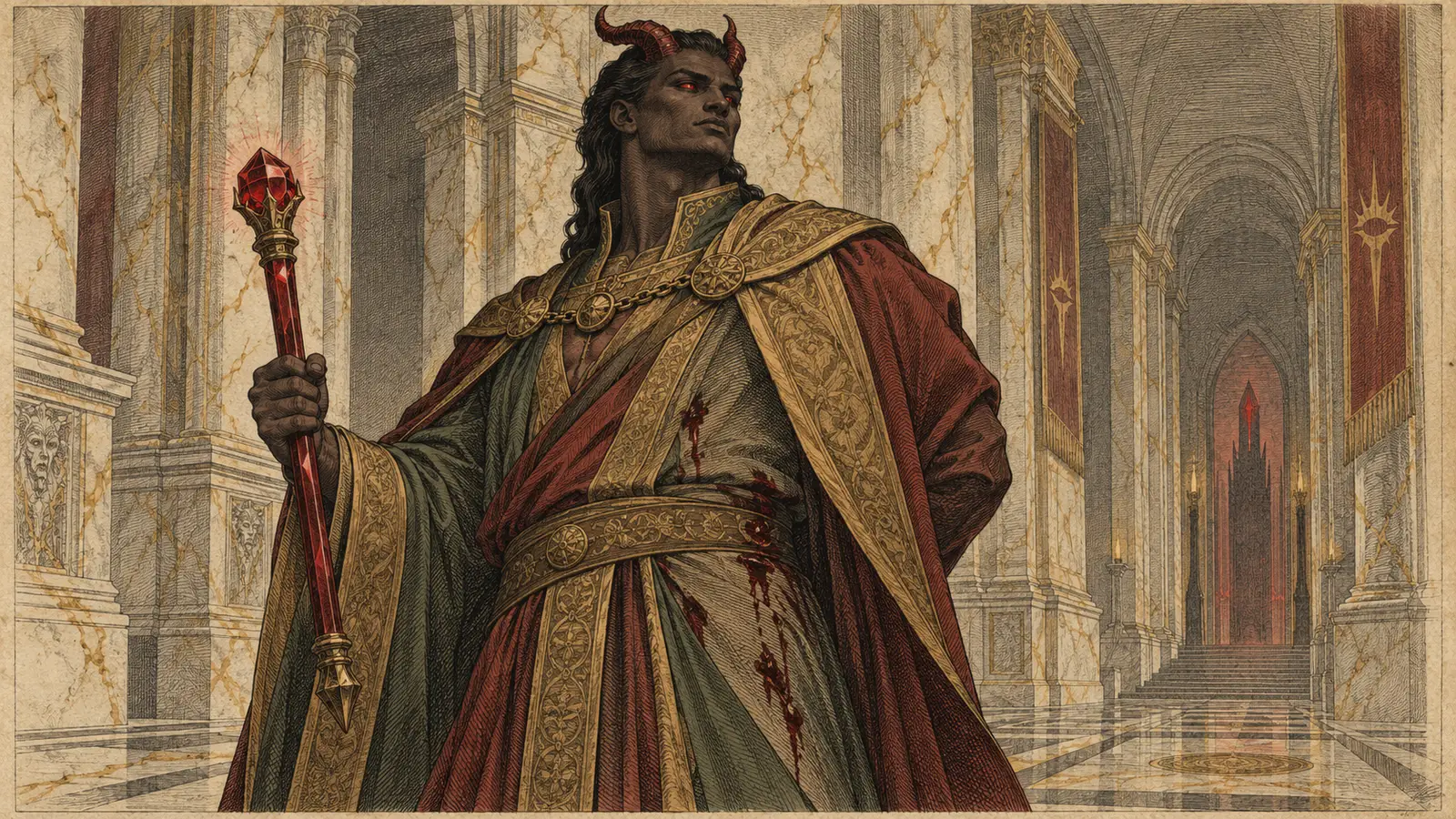
The Lord of the Ninth has always been at his strongest when he's barely seen. So it's fitting that his widest audience came from a game in which he never once appears.
Baldur's Gate 3, made by Studios and fully released in 2023, is set on the Sword Coast of the Forgotten Realms, in the years after 's return. Its heroes are travellers infected with the larvae of mind flayers, trying to rid themselves of the parasites before they turn. In its world the old cosmology holds. rules all the Nine Hells from . Each layer has its archduke, every one of them answerable to him. holds and fights the Blood War in his name. schemes in frozen .
The game's links to Descent into Avernus run deep. One companion, the barbarian , has a past bound up with Zariel's war machines and Zariel's service. Another, the warlock , made his pact with a devil named , who serves Zariel. The shadow of the first layer falls across the whole story.
You can carry the king's blood into the game yourself. A player can choose to be an Asmodeus tiefling, bound to Nessus, the deepest layer of the Hells, inheriting fire and darkness from his line. Such a tiefling first learns to call a flame into their palm, later to answer an attacker with a burst of hellfire, and then to wrap the world in magical darkness. Two other tiefling lines are open to the player as well, descended from Mephistopheles and from Zariel.
The game's great devil, though, is someone else. His name is . He's a cambion, half devil and half something else, and the son of Mephistopheles, lord of Cania. He's theatrical and alluring and dangerously polite, a devil lawyer in a fine suit, appearing at the most inconvenient moments with a smile and an offer.
His home is the House of Hope, a great mansion in the Hells that is also an archive of souls, every one of them bound to him by contract, and the hall where he makes his bargains. His central offer to the heroes is the Hammer, the only weapon that can break the chains of Prince , a prisoner held within the Astral Prism. His price is the Crown of , an ancient artifact that now controls the Elder Brain at the heart of the mind flayers' scheme.
Raphael has wanted that crown for a very long time. He watched the old empire of fall when the archwizard Karsus overreached and brought it down, and he would have taken the crown then, but his father Mephistopheles locked it away in a vault first. Now Raphael sees his chance again.
His purpose is simple, and enormous. With the crown he means to overthrow his father, then the other archdevils, then unite the whole of under his own rule, as its one true lord. In other words, his plan points straight up the hierarchy, past Cania, past every layer, at the throne in Nessus.
If the heroes give him the crown, the epilogue shows Raphael speaking of his growing power, his legions already mustering to assault Zariel's fortress in Avernus. He swore in his contract never to use the crown against mortals. But once the Hells are united, he could send their armies out without it, and the letter of the deal would still be kept. A very Asmodean kind of promise, from a devil who would like to replace Asmodeus.
Whether a cambion with a stolen crown could really topple the King of Hell is a question the game leaves alone. The Lord of the Ninth has outlasted the Reckoning, outlasted every plot against him, outwaited angels and gods. He doesn't even appear to be worried.
There's a gentle echo here, too. The best-known devil of Baldur's Gate 3 shares his name with the angel who bound Asmodeus in the Book of , the companion of young who taught him the remedy of the fish. It's only a parallel, but a pleasant one: the name of the angel who first drove off Asmodeus now belongs to a devil who'd like his throne.
The game's Raphael was voiced by Andrew , who drew on a background in classical theatre and won a BAFTA Games Award for the role in 2024. Through that performance the image of the courtly, contract-bearing devil reached more people than ever before, and every one of them was standing, without knowing it, in the long shadow of the king below.
Other games carried the Hells as well. In 2020 the Neverwinter online game added a chapter called Infernal Descent, adapting the story of Avernus. Players set out to stop Zariel's plan to sacrifice hundreds of innocent souls, working beside the paladin Alric Vallenhas and the bard Etrien Sael. Zariel was the focus there too, and Asmodeus the authority above her.
And in 2021 the king came to Magic: The Gathering, in a set called Adventures in the Forgotten Realms, as a card called Asmodeus the Archfiend, a Legendary Creature and a Devil God, painted by . Its rules tell his story in miniature. Under his influence, instead of drawing cards in the ordinary way, you set them aside face down, binding them in a contract. Later he can grant you a great flood of cards all at once. But when he returns everything held under the contract to your hand, you lose life for every card that comes back. It's a bargain with a hidden price, written into the rules of a game.
Asmodeus's long reach doesn't stop at the borders of Dungeons & Dragons. In a neighbouring world he became something new: a god with a nation built in his image.
Chapter XI
The Prince of Darkness of Golarion
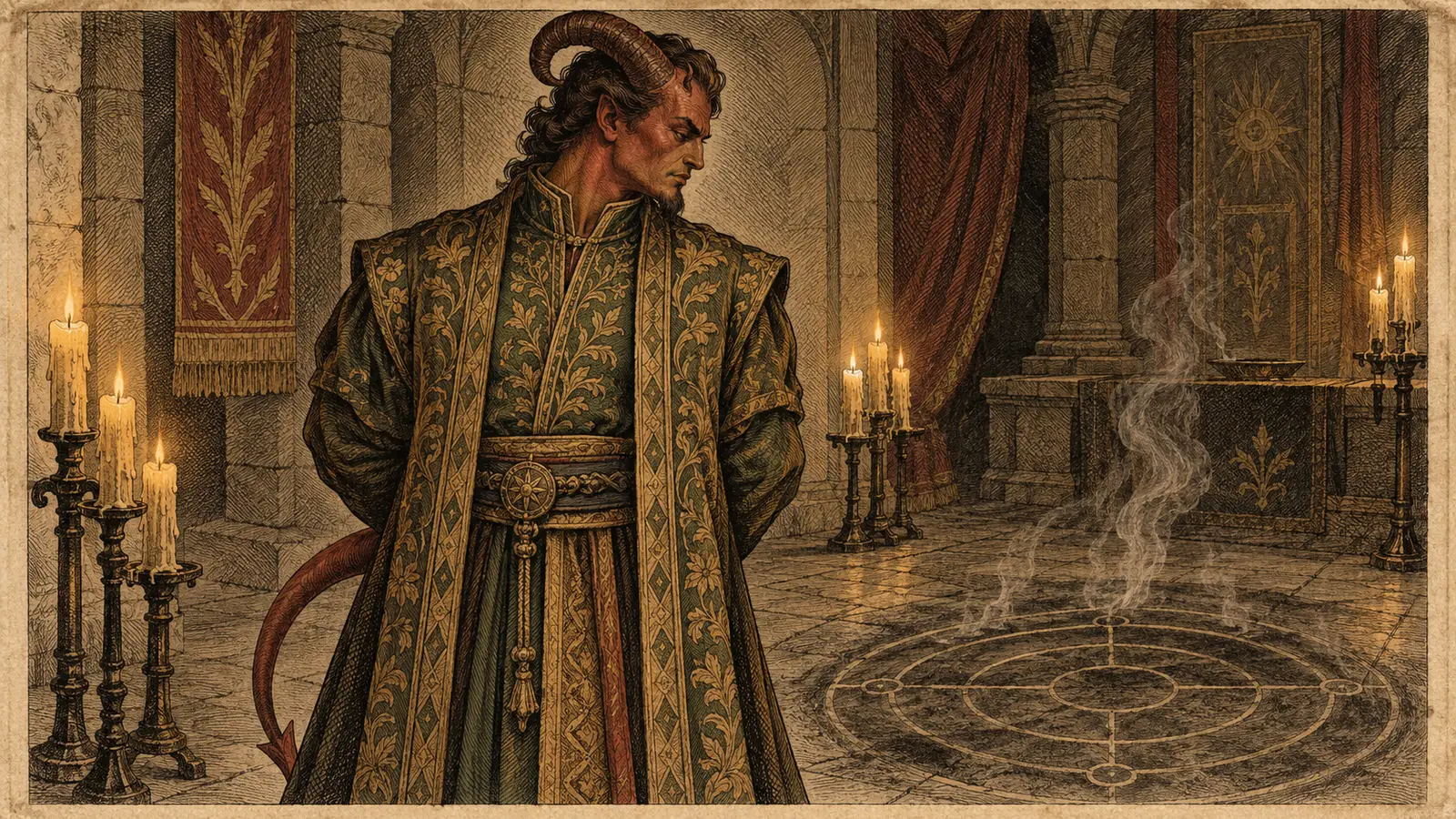
In the late 2000s, the publisher built its own fantasy world, , for its Pathfinder roleplaying game. Pathfinder grew out of the third edition of Dungeons & Dragons, and its cosmos kept many of the old shapes. Among them was a Hell of nine layers with a great king at the bottom. But in Golarion, became something the Nine Hells of the older game had only hinted at.
Here he's the mightiest of the nine archdevils who rule Hell, and the only ruler of Hell who claims full divinity. He's openly worshipped as a god. His titles are many: the Prince of Darkness, the Lord of Hell, the King of Hell, the Archfiend, the Dark Prince, the First. His concerns are contracts, oppression, pride, slavery and tyranny. His holy symbol is a red pentagram, and his favoured weapon is the mace.
In the game's second edition his priests serve him through the domains of confidence, fire, trickery and tyranny. His edicts are stern: negotiate contracts to your best advantage, rule tyrannically and torment weaker beings, and show subservience to your betters. What he forbids is just as revealing. A follower of Asmodeus must never break a contract. They must never share power with the weak. And they must never insult him by showing mercy to their enemies.
He can take any shape he likes, and often does. His most familiar form is a handsome, red-skinned humanoid with horns and red eyes, dressed in fine clothes. A gentleman, in other words, with horns.
Golarion gave him an origin all its own, told in fragments of forbidden books with names like the Asmodean Monograph, the Book of the Damned and the Script of Flies. These heretical texts say that Asmodeus once had a brother named Ihys, and that the two of them were among the powers who made the stars, the planets and the first mortal things.
Asmodeus wanted an orderly creation, a cosmos where everything had its place. Ihys gave mortals free will, and with that gift ruined his brother's dream of order. The two gods quarrelled over the fate of the souls they'd made together, and in the end Asmodeus killed his brother. Then he withdrew into Hell, where he has fought against chaos for ages ever since.
It's Golarion's own version of the fallen lawful power, built around the murder of a brother rather than a contract or a regicide. As in so many tellings, the king of Hell is a lover of order who couldn't bear what freedom did to creation.
When Asmodeus fell, he didn't fall alone. He led his followers down into Hell: his protégé , his own creation , and his lieutenants , and . And he brought a treasure, the Archstar, Golarion's version of the Ruby Rod. It was forged before the exodus from Heaven, bears his pentagram, and takes the form of a flaming ruby mace, rod or staff, whichever its master desires.
Golarion's Hell has nine layers, each with its own purpose in a great machine. , under the archdevil , is a volcanic wasteland where newly arrived souls gather, are judged and are sent on to the layers where they belong. Dis, under Dispater, is a vast city that supplies soldiers to the rest of Hell. , under , lies beneath Dis like sewers beneath a city, and in its counting houses the fortunes of Hell are recorded and its supplies catalogued. , under Belial, holds the hideous forges where unsuitable souls are melted down and recast. , under , is a place of temples and libraries of sin and heresy, where temptation is studied and practised as an art. , under Moloch, is a smouldering forest of false rewards and hunts of the damned. , under Baalzebul, is a land of glaciers and frozen seas, where the damned sit in cages of ice and watch devils feast. , under , is a realm of iron and torture, steel cages hanging over endless darkness.
And beneath them all lies , the deepest layer, the heart of Hell and the site of Asmodeus's palace. It's described as a desolate waste, apparently scorched by volcanic fire, a land of formless darkness. Almost nothing is known about it. Even in a Hell that has been catalogued and filed and written into ledgers, the ninth layer stays a mystery.
Golarion's Hell owes much of its depth to F. Wesley Schneider, one of the setting's central creators, who wrote Princes of Darkness, the first volume of the Book of the Damned, in 2009. He once said that in roleplaying games he'd always been far more interested in devils than in other fiends, and that diabolical leaders and histories had traditionally paled beside their demonic counterparts. His book set out to fix that. It looked unflinchingly at the methods, motives and goals of Asmodeus and the whole hierarchy of Hell, layer by layer, along with how devils are promoted, the infernal dukes, the herald of Asmodeus, the rules of infernal contracts, the true names and talismans of devils, and the diabolists who bargain with them.
Asmodeus's worshippers in Golarion are many, and some might surprise you. Slavers and tyrants, yes, and diabolists. But also bureaucrats and lawyers, and anyone who wants order, rule or discipline. His priests serve as legal counsel and political advisers to kings and aristocrats. They also take offerings from peasants who come looking for protection or advice. His temples often offer notary and legal services. Imagine stepping into a dim, beautifully kept temple to have a land deed witnessed, the parchment sealed under a red pentagram by a soft-spoken priest. Nothing in it is quite wrong, and nothing in it is quite safe.
His greatest mortal achievement in Golarion is a nation. In , a once-glorious empire, the patron god died unexpectedly in the year 4606 of the Absalom Reckoning, and the empire fell into thirty-four years of chaos and civil war. When it ended, in 4640, a noble family called House took the throne, sealed by the Treaty of . They called their rise the Thrune Ascendancy.
Under House Thrune, Asmodeus replaced Aroden as the patron of Cheliax. The nation's government is modelled on the laws of Hell. Devils serve openly, in many roles, as advisers and enforcers and functionaries. Most of the devils on Golarion live in and around Cheliax. And the house has made the past itself a matter of policy. Thrune's agents erased much of the country's earlier history. New history books are issued every three months, and an order called the Order of the Rack burns the old editions in what are called clarity pyres. In Cheliax, the past is whatever the current edition says it is.
Alongside this order stand the Hellknights, armoured orders devoted to discipline and law, admiring the perfect order of Hell.
Paizo built two mirrored campaigns around Asmodean Cheliax. In Hell's Rebels, which ran through 2015 and into early 2016, an inquisitor named Thrune puts the free-thinking city of under martial law, and the heroes organize a rebellion against the devil-binding government and the church of Asmodeus. Its fifth chapter is called The Kintargo Contract, as if even a revolution in Cheliax must end with a signature. Then in 2016 came Hell's Vengeance, Paizo's first campaign written for villainous heroes, who serve the thrice-damned House of Thrune and put down rebellions on its behalf. Two campaigns, two sides of the same infernal coin.
In Starfinder, Paizo's far-future successor to Golarion, Asmodeus endures. Ages later, among starships and distant worlds, he still rules Hell from its ninth layer as the god of hierarchy and tyrannical rule, still the Prince of Darkness and Lord of Hell, still lord of contracts, pride, slavery and tyranny. The Hellknights still venerate him and enforce his order by force. His strict hierarchy of devils works to win the whole Great Beyond for him. His worshippers are the ambitious elite, people willing to trade a little spiritual freedom for a great deal of worldly power. Where his rule isn't absolute, his churches hide what they are. But on , a world that devils invaded and conquered, his symbol is everywhere.
So in another game and another universe, among the stars, Asmodeus is still where he has always been: at the bottom of Hell, at the top of a hierarchy, patient and orderly and sure of himself.
Chapter XII
An audience in Nessus
What has it been like to meet him at the gaming table? The answer has changed with every edition, but one thread runs through it: has always been a strange thing to fight and a stranger thing to talk to.
In the first edition's Monster Manual he had full statistics as an arch-devil. His armour was formidable, magic slid off him most of the time, and he carried the Ruby Rod with its bolts of lightning, beams of acid and cones of cold, along with powers that made enemies cower in fear and gave its holder a field of healing and protection. But his hit points numbered just under two hundred. Over the years fans noticed that some high-level heroes had more. On the old forums a running joke grew up that Asmodeus was, for all his menace, a bit of a wimp. It's an affectionate joke about an early game that hadn't yet worked out how to measure the mightiest beings in its cosmos. Of course, a wise dungeon master might point out that the figure in was never really him at all.
By the third edition, the numbers had climbed to the sky. In Fiendish Codex II, Asmodeus, Lord of the Ninth, stood among the most powerful beings ever given game statistics. His Ruby Rod struck like a great unholy club, and his blows carried extra harm on top. And even that colossal figure was only an avatar, the form in which he walks the Hells. To reach it, heroes would have to cross every layer above, pass the only portal from with his permission or without it, and enter a citadel nobody has ever mapped.
The fourth edition made him a god and, in its core books, gave him no statistics at all.
The fifth edition chose the same restraint for a long time. Its core books from 2014 onward gave no official statistics for Asmodeus. Mordenkainen's Tome of Foes gave numbers to other archdevils, but not to him. The designers didn't want play to centre on killing gods or near-gods, and so the Lord of the Ninth, and his schemer , stayed beyond the measure of the rules. Only in 2023, in Chains of Asmodeus, did an official book finally set down numbers for him, for heroes at the very end of their careers who had come all the way down the .
There's a lesson in that long silence. Facing Asmodeus in the fifth edition meant facing something the rules chose not to measure. So dungeon masters learned to stage him as a scene, not a battle. An audience. An offer. A contract laid on a table.
Picture how such a scene might go. The heroes are led through gold-veined halls in a golden light that never fades. Pit fiends stand along the walls, silent. At the end of the hall is a figure more than twice the height of a man, handsome, robed in gems, with small horns and a neatly trimmed beard, and the faint red light of the rod in his hand. He doesn't rise. He doesn't raise his voice. He speaks softly, articulately, with complete confidence. He's never flustered. Even if something surprises him, he responds with the calm of someone who has already thought several steps beyond it. His plans run over centuries and millennia, across the whole multiverse, and the heroes standing before him are almost certainly a small part of one of them.
He enjoys this. He likes corrupting mortals with honeyed words, and he's very good at it.
What he offers will be real, and it will be exactly what was asked for. That's the trick of devils at the table, and the foundation of Asmodeus's realm. Since the Ruby Rod brings punishment on any devil who breaks a contract, devils don't cheat in the ordinary way. They explain their terms. The trap is always in what the mortal chooses: what they ask for, what they forget to ask for, what they're willing to give.
Advice for dungeon masters on how to play such a devil has grown up over the years. One well-known guide suggests playing a devil as half lawyer and half travelling salesman, with formal, legal-sounding language and a warm, persuasive manner. Make the deal personal, tied to family, reputation or a cherished dream. State clearly what happens if the contract is kept and what happens if it's broken. And scale the gifts to the devil. A pact with a minor devil brings minor gifts. A pact that reaches all the way up to an archdevil can bring legendary ones. And a pact with Asmodeus himself would be, in some sense, a pact with the whole of Hell.
Descent into Avernus shows the contract logic at work in a campaign. was lost through 's signature. herself was won by an offer of power at the moment of defeat. The heroes, in their turn, may bargain or redeem, and every choice runs along lines of law that Asmodeus laid down. He never needs to appear. His rules are already in every room.
Many players serve him without meeting him at all. A warlock might take an archdevil as a patron, receiving infernal power in exchange for a soul promised to the Hells at death, and at the table it's often understood that such a soul belongs, at the end of the ledger, to Asmodeus. A cleric might serve him as a god of tyranny and trickery, ruling with an iron fist and a silver tongue. And a tiefling hero, especially in the earlier years of the fifth edition, carries his essence in their very blood. A player who chooses a tiefling may find that their character's family tree, followed far enough back, ends at the throne in .
Who follows him in the stories? Slavers and tyrants, of course, diabolists and the ambitious. But also bureaucrats, lawyers, and people who simply long for rule and discipline, for a world where everything has its place. Some tales say his grandest scheme is to trick the gods into fighting one another, so that their own worshippers grow disillusioned and turn away from them, toward disbelief or toward the dark cults that always seem to have an answer.
At the very highest tiers of play, groups sometimes do take on one of his avatars in an epic clash. But even then, the old advice at the table holds: talk to him first. Listen to what he offers. The fight may be winnable. The conversation is the dangerous part.
Chapter XIII
The gentleman devil
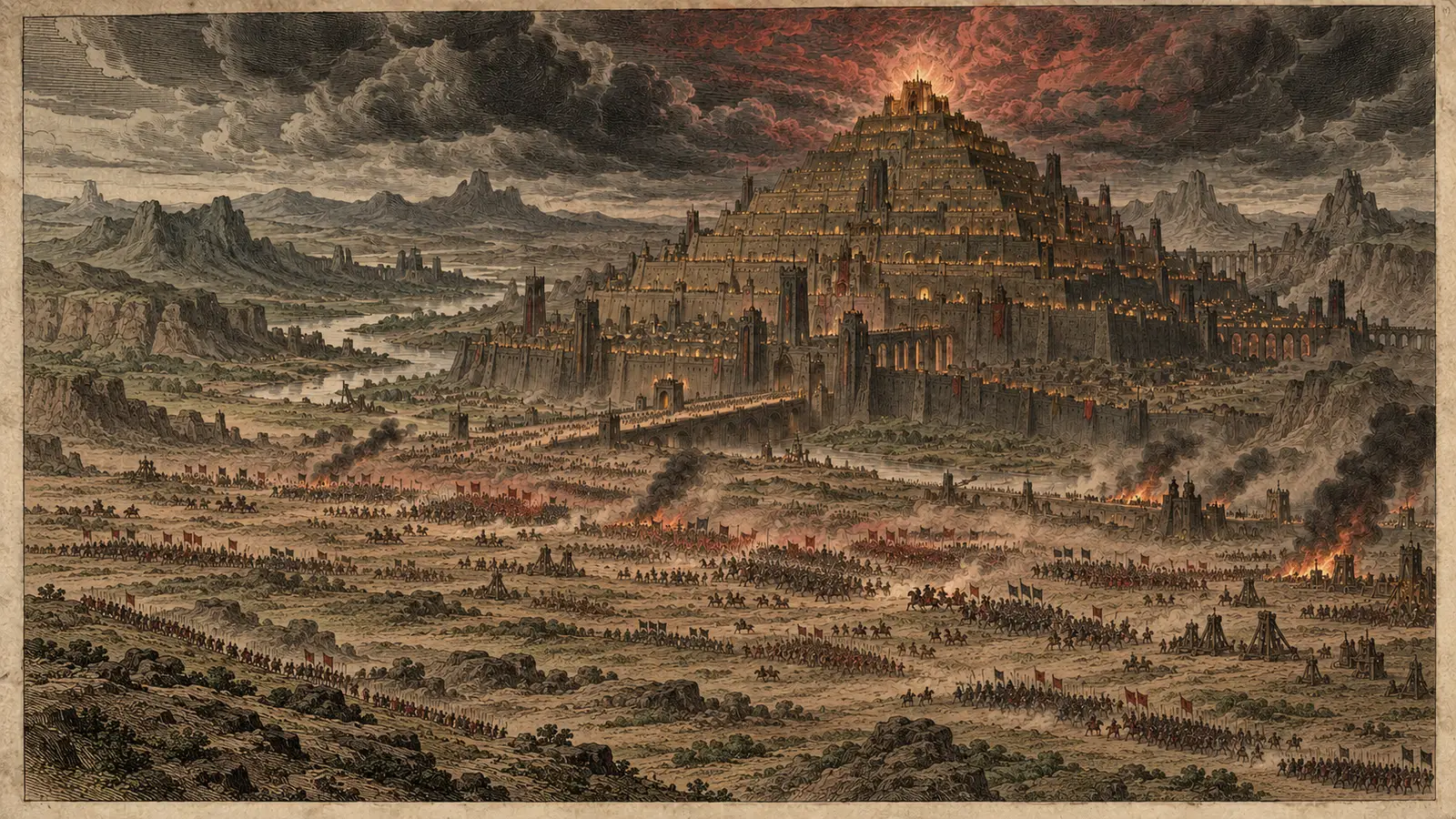
There's a line in Shakespeare's King Lear, spoken by Edgar while he pretends to be the madman Poor Tom out on the stormy heath: "The prince of darkness is a gentleman." Shakespeare borrowed the names of Edgar's imaginary devils from a book published in 1603 by Samuel , an attack on exorcism. But the idea behind the line is far older.
In medieval religious drama, devils and the personified vices were often staged as aristocrats, elegantly dressed and courtly, because the devil fell through pride, and pride was thought to be the characteristic sin of the noble. So the devil on the stage wore fine clothes and fine manners. He was polite, and he was dangerous because he was polite.
has grown into that role more completely than almost any other figure. We've already seen the threads come together over the course of this evening: the wise, chained who wept at weddings and knew where treasure lay, the Goetic king who taught geometry and gave true answers to anyone who called him correctly. But the most direct ancestor of the gentleman devil is 's novel.
Le Diable boiteux, The Lame Devil, was published by Lesage in 1707 and revised and expanded in 1725, adapted from an earlier Spanish novel by . In English it was known as The Devil upon Two Sticks. Its story begins with a young student, Don Leandro Perez Zambullo, who frees a small, lame demon from a magician's bottle. The demon is Asmodeus.
To thank him, Asmodeus takes Cleofas flying over Madrid for a single night. And as they float above the sleeping city, the demon lifts the roofs off the houses, so the student can look down into the private lives inside. They look into ordinary houses, into prisons and palaces, even into tombs. Everywhere they look, they see the small treacheries and self-deceptions of human life: the lies people tell each other and the lies they tell themselves. Asmodeus is a witty, worldly guide, never shocked, always amused, with something sharp to say about every author, actor, lawyer and lover they pass over.
Imagine it: the warm Spanish night, the student holding the demon's cloak, the roofs lifting gently away one after another like lids from boxes, the candlelight inside, the whispers. It's one of the calmest and most knowing images of a devil ever written.
The book reached English in 1708 and was enormously popular in eighteenth-century England. It inspired so many imitations, sequels and stage versions that scholars speak of a whole little genre, the Asmodeus flight. The novelist published a new translation in 1750 called The Devil upon Crutches, and in 1791 William Combe wrote a sequel bringing the lame devil to England. Over and over, readers enjoyed the company of a devil who knew everyone's secrets and wasn't troubled by any of them.
That's the figure the game's Asmodeus grew into. Across the editions he's the strongest and most cunning of the devils, and the most handsome. By the fifth edition he's tall and slender, in robes set with gems, strikingly handsome and charismatic, with a neatly trimmed beard. He carries a rod that looks carved from a single ruby. He's never flustered and never loud. And the game added its own twist to the old courtly devil. Beneath the polished surface, in the tellings of the later editions, lies something enormous and wounded: a serpent hundreds of miles long, bleeding in the deepest rift of Hell. The gentleman is the mask. The thing under the mask is vast.
The game also gave the gentleman devil a whole civil service. Contract devils, clerks, scribes and soul-bargainers serve Asmodeus and the archdevils, tracking the damned, managing Hell's endless regulations and tempting mortals into signing whenever they can. A good deal of the popular image of the devil as a lawyer holding out a contract and a pen owes something to this vision of Hell as an orderly, paper-filled bureaucracy with a courteous king at the top.
His shape spread beyond the game early. In NetHack, the classic computer roguelike whose demon princes were modelled on those of Dungeons & Dragons, Asmodeus is the most powerful demon ruler a player is sure to meet in , its version of Hell. He waits at the bottom of a cold branch of that underworld, breathing out cones of freezing cold. It's a small echo of the old Ruby Rod and its cold, carried into the earliest days of computer games.
The name had a life outside the game too, and it's worth remembering that not every Asmodeus descends from . In the television series Shadowhunters, adapted from Cassandra Clare's novels, Asmodeus is a Greater Demon, said to be the most powerful Prince of Hell and the father of the warlock , played in the show's third season by Jack J. Yang. In the thirteenth season of Supernatural, Asmodeus is one of four Princes of Hell made by Lucifer, alongside , and . These are cousins, not children. They grew from the same old roots in and the grimoires. But the courtly king of Nessus, with his rod and his contracts and his patience, is the game's own.
And of course, in our own time, Baldur's Gate 3 took the gentleman devil to an enormous audience, in the person of , theatrical and alluring, offering contracts in his House of Hope. That gentleman was a subordinate, a son of an archdevil plotting his way upward. Above him, out of sight, the true gentleman of Hell sat where he always sits, and didn't need to say a word.
Chapter XIV
The Lord of the Ninth today
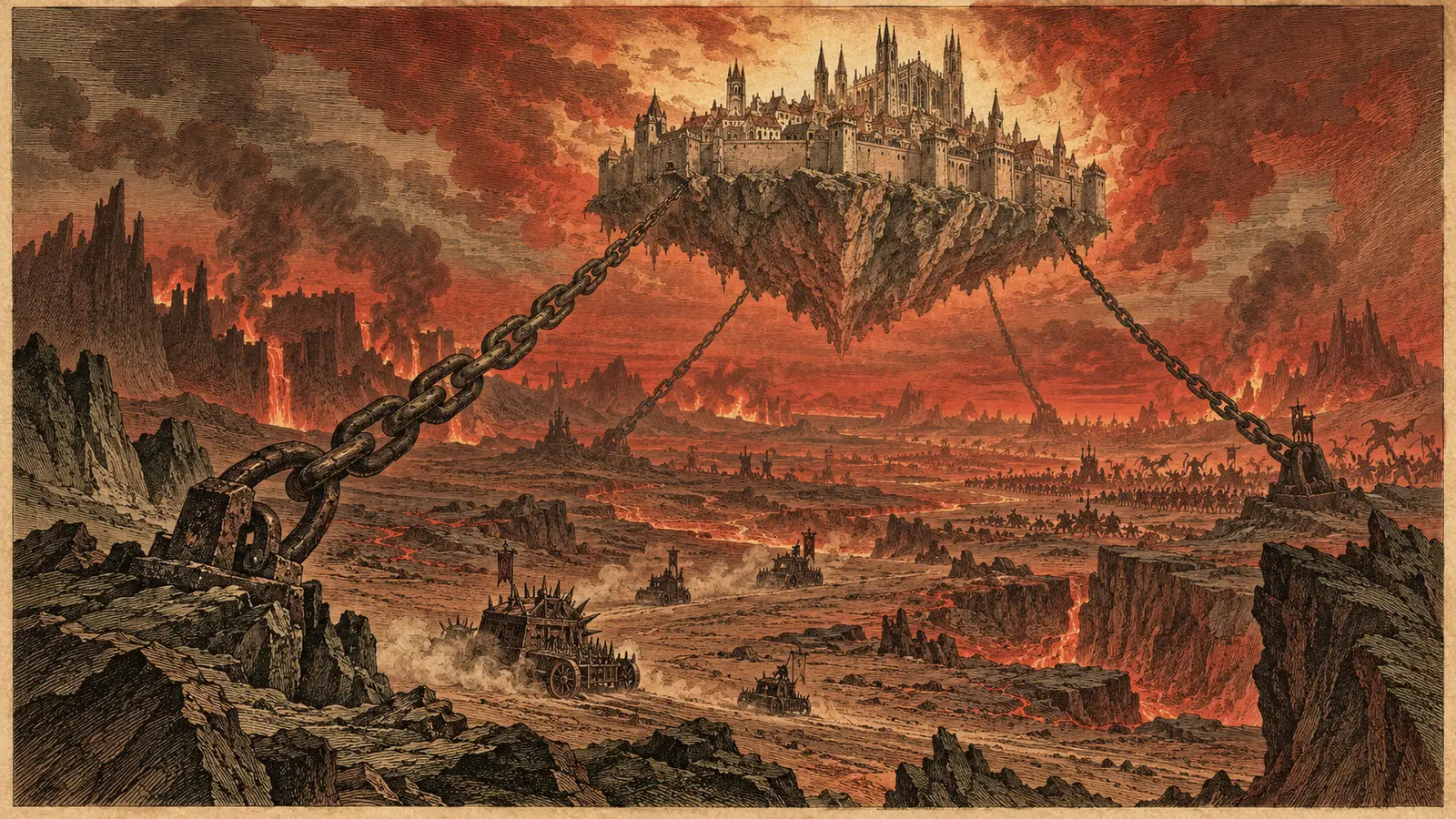
The game was revised in 2024, and the revision touched most in the blood of the tieflings.
For a long time, in the fifth edition, every tiefling had carried his essence. The 2024 Player's Handbook widened that inheritance. A tiefling's ancestry can now come from anywhere in the Lower Planes, and players choose a Fiendish Legacy. The legacy reaches back to the chaotic evil planes, such as the Abyss. The legacy reaches back to the neutral evil planes, such as or Hades. The Infernal legacy reaches back to the lawful evil planes, such as the Nine Hells. So Asmodeus no longer stands behind every tiefling in the game. His bond to them now runs mainly through the Infernal legacy, through those tieflings whose families carry the cold order of the Hells in their blood. A king who once claimed a whole people as his children now shares that claim with the rest of the Lower Planes.
The warlock's Fiend patron still names archdevils such as Asmodeus among the powers a warlock might serve, alongside demon lords like and and lesser fiends. A patron's aims are evil, the rules say, and a warlock's story is shaped by how far they strive against those aims. In the Hells, the familiar order holds: is the ninth layer, ruled by Asmodeus from , and the eight layers above are ruled by archdevils who answer to him.
In November 2025 came Forgotten Realms: Heroes of Faerûn, the Realms player's book for the new rules. Its pantheon of about forty gods was the third rearrangement of the divine order in the fifth edition alone, and Asmodeus was one of the few figures from the older Sword Coast list who carried over. He's described there as both a god of indulgence and an archdevil who rules his devilish kin from the very bottom layer of the Nine Hells. His typical worshippers are corrupt politicians and desperate folk, the powerful who want more and the powerless who have nothing left to lose. The domains suggested for his clerics are knowledge, order and trickery. A god of indulgence who rules from the bottom of Hell: it's a fitting place for him to stand now, as the patron of every quiet compromise, every forgiven fault, every "just this once."
As for what's ahead, there's one announcement worth mentioning. In February 2026, HBO announced a Baldur's Gate television series, created and written by Craig , who will also run and executive produce it. It's announced to continue the story after Baldur's Gate 3 rather than retell it, following new and initially weak heroes who meet familiar faces from the game, faces that have since become very powerful. Some of them, the announcement says, are heroes, some are villains, and some are literally devils. Mazin said that after putting nearly a thousand hours into the world of Baldur's Gate 3, it was a dream come true to be able to continue the story. No release date has been set, and the King of Hell isn't named among its figures. But the devils are coming to the screen, and every devil in that world, whatever its ambitions, still lives in a Hell with Asmodeus at the bottom of it.
The game's announced books for 2026 and 2027 turn to other horizons, to Ravenloft and arcane mysteries, to Dark Sun and other worlds. None of them is announced to centre on the Nine Hells.
That suits him. The Lord of the Ninth has never been in a hurry. He's waited out editions, panics, renamings, rebellions and the deaths of gods. He can wait out a few seasons of books.
Chapter XV
The patient king of Nessus
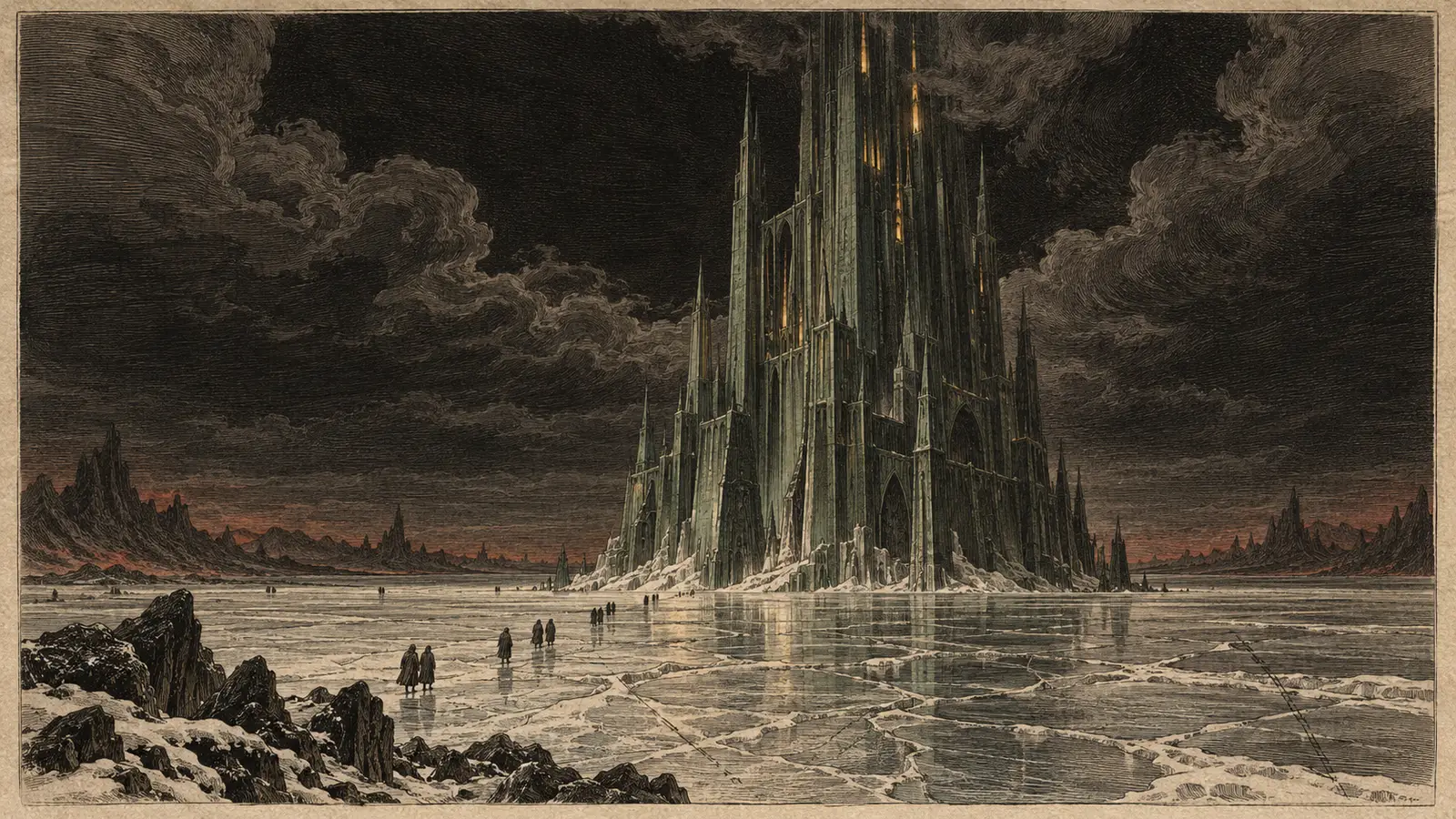
Let's go down one last time.
Past the red wastes of , where war machines race across the ground and an angel's sword waits in a bleeding citadel. Past the iron city of Dis, past the sinking bogs of , past the fires of burning on the grave of a god whose name nobody may say. Past the ice of , where a murderer sits frozen on his throne, and past , a land made from the body of a countess who reached too high. Past the courts of and the slow resentment of the lord who was once beautiful. Past the frozen silence of , where keeps his schemes and his single portal.
And then, with permission, because nobody comes here without permission, into .
A dark plain stretches away, broken by rifts deeper than any ocean trench, canyons that fall for thousands of miles into dead stone. A faint river trickles somewhere in the dark and spills over an edge into nothing. Out on the plain, on a lake of ice, a spire of green steel rises for miles, cold and gleaming faintly. Inside, beyond the guards, the halls are marble veined with gold, and the light is golden and warm and never fades. Millions of devils move through corridors no one has ever mapped. And at the heart of it all, a tall, handsome figure with small horns sits quietly, a ruby rod resting in his hand.
Under his fine robes are wounds that have never closed. They've bled every day since the fall, every one of them a pain he has never once shown. Where the drops touch the floor, devils rise.
And beneath the citadel, beneath the plain, in the deepest rift of all, a coil a mile wide spirals inward for hundreds of miles, down and down to the lowest point in all the Hells. Some say a serpent lies there, unimaginably long, bleeding slowly into the dark. Some say the coil is only the shape of his fall. There's an old whisper that anyone who tells the story of his true form doesn't live a day past the telling, and that the only records of it gather dust in the fortress of a demon prince far away. Maybe that's true. Maybe it's just one more contract, with terms nobody remembers signing.
He has no quota. He doesn't need to hurry. Every soul any devil anywhere ever claims is already pledged in his name. Every bargain struck in a candlelit room on any world, every signature in any ledger, every quiet "yes" to a soft voice offering exactly what was asked for, runs down through the layers like water through stone and settles, at last, here.
So he waits. He waited as a jealous spirit by a bridal chamber, until the smoke came. He waited chained beside a king, listening and knowing what the future held. He waited through the ages of the game, as books came and went and his story was told as a serpent, an angel, a contract, a murder, a trial. Each telling changed who he was, and none of them moved him from his seat.
Somewhere far above, on the surface of some world, a lamp burns low, and someone is reading over the terms one more time. Down at the bottom of everything, in the golden light, the king turns the ruby rod slowly in his hand. He isn't watching the door, because he already knows who's going to come through it.