Chapter I
Weavers, tricksters and the elves beneath the earth
Tonight we follow the Spider Queen down a long thread. We'll start with the old weavers and dark elves of myth, then descend with 's adventurers into a glittering cavern beneath the giants' halls. From there we'll travel to a web strung across the and to a city of spiders in the Forgotten Realms, and we'll watch her change across the editions from demon to goddess and back. At the end we'll come to rest at the centre of her web, where every strand trembles.
Before there was a , there were spiders in the stories people told, and most of those stories were about weaving. Long before anyone rolled dice in a basement in Wisconsin, people noticed the small patient animal that hangs its house between two branches, and they wondered what it meant. A thread spun from your own body, laid down strand by strand into a pattern that catches whatever wanders by, makes a good image for fate. It's also a good image for cunning, and for a mind that waits.
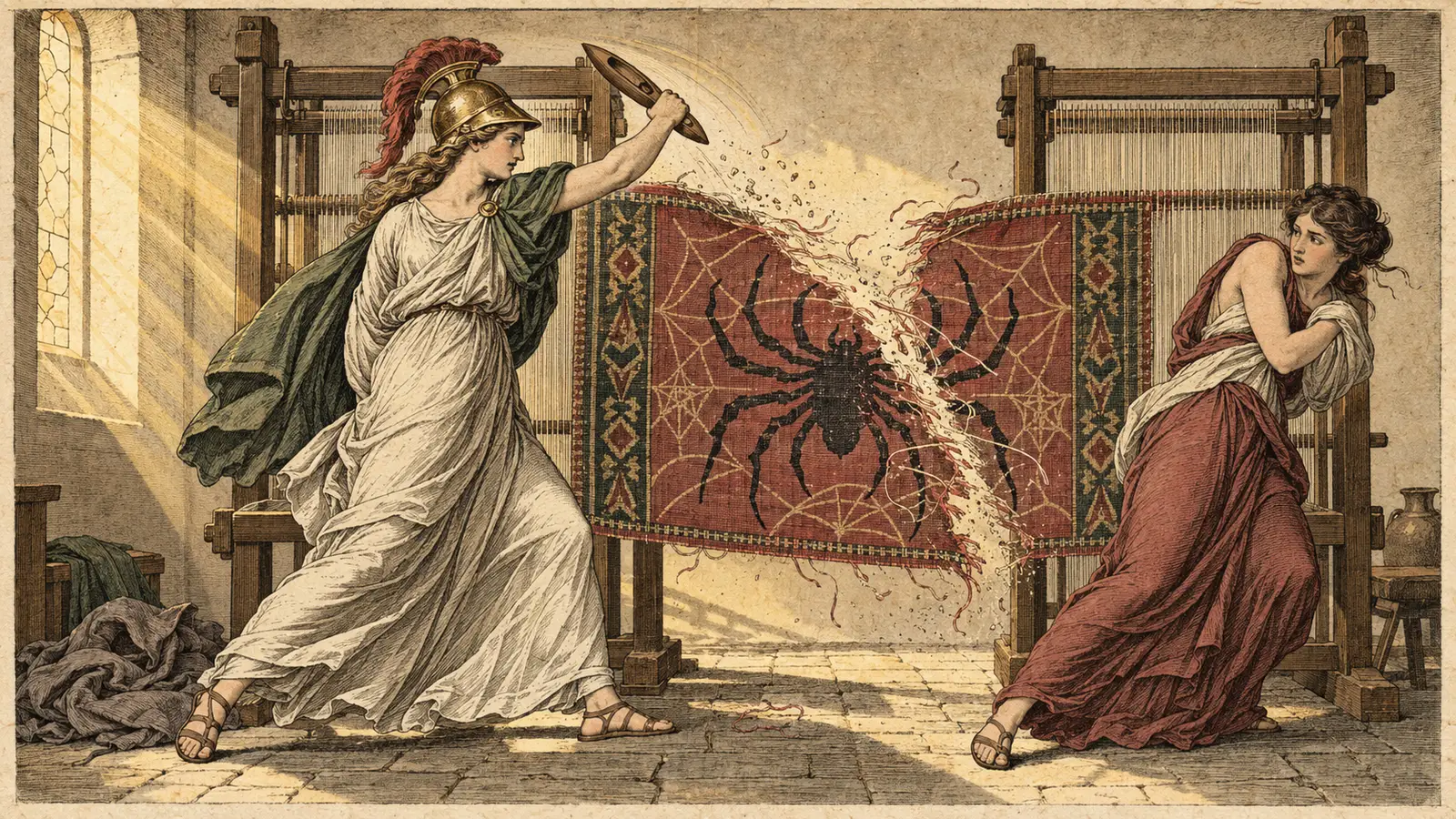
The best known of these stories comes from , in the sixth book of his Metamorphoses. It tells of a girl named , a shepherd's daughter in , who learned to weave when she was very young and grew so skilled that nymphs came out of the woods and rivers just to watch her hands. People said her gift must have come from , the goddess the Greeks called , patron of weaving and of every careful craft. Arachne wouldn't have it. Her skill was her own, she said, and she would gladly match it against the goddess's.
Minerva came to her disguised as an old woman, grey-haired and leaning on a staff. She gave the girl gentle advice: take all the praise mortals can give you, but yield to the goddess, and ask pardon for your boast. Arachne answered her rudely and repeated the challenge. So the goddess threw off her disguise, and the two of them set up their looms side by side.
Minerva wove the gods in their majesty, twelve of them seated in dignity, with small warning scenes in the corners of mortals who had challenged heaven and been turned into mountains and birds. Arachne wove the gods at their worst: their disguises, their seductions, their misdeeds, all rendered so finely that the bulls looked like real bulls and the waves like real water. Minerva looked at the work and could find no flaw in it. That was the trouble. In anger at the mockery, she tore the cloth and struck the girl with her shuttle. Arachne, in shame, put a noose around her neck. The goddess, moved at last to a cold kind of pity, let her live, but changed her. Her hair fell away, her head shrank, her fingers became thin legs, and she was left to hang and spin forever, a weaver still.
Keep that story close, because it will echo later tonight in a quieter way. A gifted weaver quarrels with a power above her, is cast down, and is made into a spider so that she can never again be what she was. The Spider Queen's own legend, as it grew over the decades, would come to rest on a very similar shape.
There are other weavers further back. In Egypt, the goddess was worshipped as a weaver of fate, a goddess of war and hunting and wisdom, and in one telling she wove the whole universe into being on her loom. Far from the Nile, among the and peoples of West Africa, the spider is , whose very name means spider. He is a clever, amoral trickster, the keeper of all stories, who outwits gods far stronger than himself. Storytellers sometimes pictured him as a man with spider parts, or as a spider with a human face, and you may notice, as many have, how much that second picture resembles the goddess we're about to meet.
In the American Southwest, among the and their neighbours, there is Spider Grandmother, and she is something else entirely. She is wise and kind, an earth goddess who worked beside the sun god to make the lesser gods and the world itself, and who shaped the first people out of clay. If Lolth is a spider who weaves traps, Spider Grandmother is a spider who weaves the world gently into being. It's worth holding both in mind. The spider has always been able to mean the patient mother as easily as the waiting predator.
And then, in 1977, the year before our story properly begins, came The Silmarillion. In it, J. R. R. described , a primordial spirit in the shape of an enormous spider, whose name is usually rendered as Gloomweaver. She drank light. She spun webs of what Tolkien called Unlight, a darkness so complete it smothered every glow, and together with the dark lord she drained the two shining Trees of until they withered. Her descendant waits in a pass above in The Lord of the Rings. Gary Gygax was later asked whether Shelob had inspired his Spider Queen. He said no. Lolth, he said, was strictly a creation of his own imagination. So we'll let Ungoliant stand only as part of the weather of those years, one more great spider in the air, and not as Lolth's ancestor.
The people Lolth would rule have their own old roots, and those run north.
In the , the Icelandic book of Norse myth, there's a passage that sets two kinds of elves side by side. The light elves, the , live in , and they are fairer than the sun to look at. The dark elves, the , live down in the earth, and they are blacker than pitch, unlike the light elves in appearance and still more unlike them in nature. Elsewhere the old poems speak of the svartálfar, the black elves of , and some scholars think these underground elves blur into the dwarves who forge treasures in the deep places of the world.
The word Gygax chose for his dark elves comes from further north still, from the islands of and . There, in the old folklore, a drow was a kind of fairy or spirit, mischievous at best and malignant at worst. Drow is simply the island way of saying trow, and trow comes down from the Old Norse word troll. It may also have been coloured along the way by an old island word for a restless dead thing, a cousin of the Norse draugr, the corpse that will not lie still in its barrow.
Gygax himself told the story of how the word came to him, and it's a gentle, bookish one. He didn't find it in a saga. He found it in his dictionary, the big unabridged Funk and Wagnalls, and from no other source at all. He wanted, he said, a most unusual race as the main power in the , so he used the dictionary's reference to dark elves to create the drow. The shorter editions of that same dictionary carry a matching little entry, marked as Scottish: in folklore, one of a race of underground elves, represented as skilful workers in metal. Everything else about the drow of the game, their cities and their cruelty and their goddess, Gygax built himself on top of that one old idea of elves who live beneath the ground.
Before the drow had a goddess, they were only a rumour. The first Monster Manual, published for Advanced Dungeons and Dragons in 1977, mentions them in a single passage inside its entry on elves. The black elves, or drow, it says, are only legend. The tales place them deep beneath the surface world in strange underground realms. They are as dark as faeries are bright, and as evil as faeries are good. In the stories they are poor fighters but powerful in magic.
That's all. No statistics, no cities, no goddess. You can picture the page as a kind of cavern mouth, with a cold draught coming up out of it and nothing yet to be seen below. There's an empty place in that book where the Spider Queen would later sit, and within a year, something would come up through it.
Chapter II
A name on a golden pin: the giants and the Vault of the Drow
The Spider Queen came into the game the way a spider comes into a room, quietly and at the edges, so that you notice her only after she's been there for some time.
In 1978, wrote a chain of adventures for TSR that was meant to be played as one long campaign, which was a new idea in those days. It began on the surface of his own world, the world of , with a crisis among the giants. Hill giants, frost giants and fire giants, who ordinarily kept apart and quarrelled among themselves, had begun raiding the lands of humans together, in concert, as if someone had taught them to cooperate. The kings and nobles of the threatened lands gathered a band of adventurers and sent them to put a stop to it.
So the heroes went first to the steading of the hill giant chief, a great timber hall full of brawling and feasting. Then they climbed to the glacial rift of the frost giant jarl, a crack in the ice where the giants kept their halls among the blue shadows of the glacier. And finally they came to the hall of the fire giant king, a fortress dug into the volcanic rock, warmed by deep fires, its corridors red with reflected light.
It's in that last hall, Hall of the Fire Giant King, that the true shape of the plot first shows itself. In the king's council room, among the maps and documents of a war, the heroes can find a scroll. It promises powerful help from the drow, and it is signed with a name: . On the deeper levels of the hall are the giants' places of worship, including a solemn hall where the dead fire giant kings are kept, and alongside these are chambers housing visitors who don't belong among giants at all: slender dark elves, drow clerics, here in the flesh for the first time in the game, with full statistics of their own.
One of those drow priestesses wears a pin. It's made of gold and shaped like a spider, and it's inscribed with runes in the drow tongue. If you can read them, they say this: , Death Queen Mother.
That's the Spider Queen's first appearance in print, a name engraved on a small jewel, carried by a servant deep inside someone else's fortress. There's no portrait yet, no realm, no voice, only the name and a hint of the power behind it. A careful player turns the pin over in the lamplight and wonders who would wear such a thing, and who is being honoured by it.
The fire giants' hall has a way down, and the heroes follow the trail of the dark elves into the earth. The next adventures, Descent into the Depths of the Earth and Shrine of the Kuo-Toa, carry the party through enormous natural caverns, passages that go on for miles, underground rivers and lakes, places where whole peoples live who have never seen the sky. They meet the deep gnomes, the svirfneblin, quiet and stone-coloured and wary. They meet the kuo-toa, fish-like creatures who worship a goddess called , the Sea Mother, a strange deity with the head of a lobster. Lolth isn't the centre of these chapters. But the world they open, this vast connected dark beneath the surface, is the beginning of what the game would come to call the , a dungeon that runs under the whole world. It's in that dark that her people live.
And then the road opens out, and we come to the Vault.
Vault of the Drow, also from 1978, is the heart of the matter, and it's one of the loveliest places Gygax ever described. Picture this as you lie there. The heroes come out of a narrow tunnel into a cavern so large that its far walls are lost from sight. Overhead, far above, the ceiling is set with crystals, mauve and violet and the deepest blue, and they glitter like stars in a night sky, though no sky has ever been over this place. Below, pale fungi grow in great forests and give off their own soft light, gold and sapphire and ruby. And all through the cavern there's a gentle sound, a hum like crickets on a summer evening, which comes from the native insects going about their small lives in the dark. For a moment, before you remember who lives here, the Vault is beautiful and still.
The Vault is divided in two. In the Lower Vault, on the cavern floor, lies the great city of Erelhei-Cinlu, an ancient metropolis of the dark elves, with merchants' villas and fungus forests and the strongholds of warriors around it. The Greyhawk lore says the city was built long ago, after the wars between the light elves and the dark elves, when the drow came down into the deep places and made a home there. It's crowded and old and full of trade, with slaves from many races, and with visitors from all over the underworld.
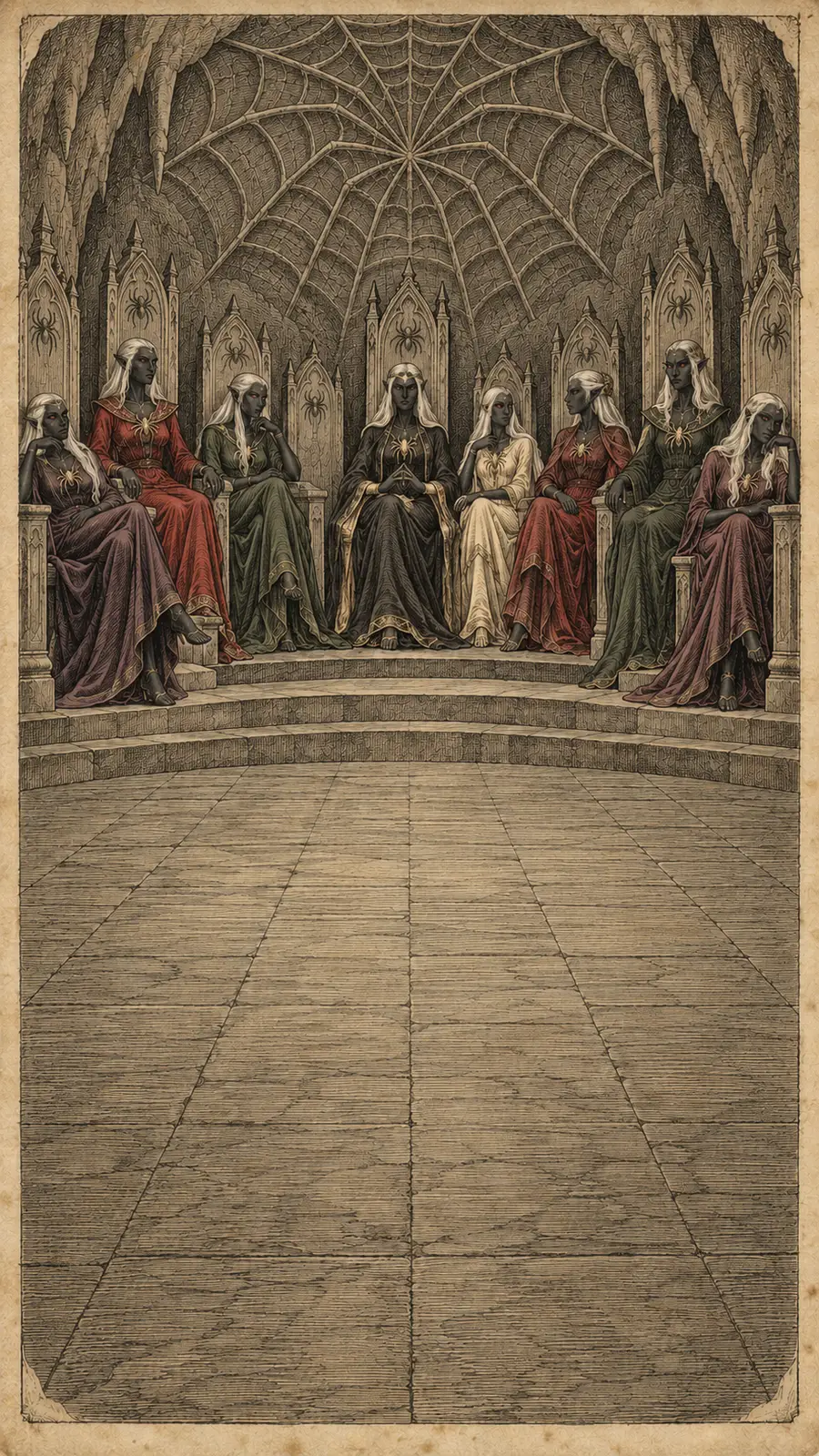
Above it, on a high plateau, lies the Upper Vault, where the noble houses of the drow keep their estates. These are the great families, and their quarrels are the true politics of the Vault. And beyond the nobles' plateau, in a cavern of its own, stands the Great Fane of Lolth.
The cavern of the Fane is enormous, and its walls are stained red and green with ochre, so that the light comes back off them strangely. In the middle stands the temple, and it's shaped twice over: once like a pagoda, rising in tiers, and once like a spider, crouched and waiting. It's described as cursed, which is fair. Behind the Fane a guarded passage leads further in, to a place called Lolth's Egg, her innermost temple chamber. And beneath the Egg there's a dungeon level, the deepest part of all, where a party bold enough to go so far may meet the demoness herself, walking in a mortal form, and try to fight her.
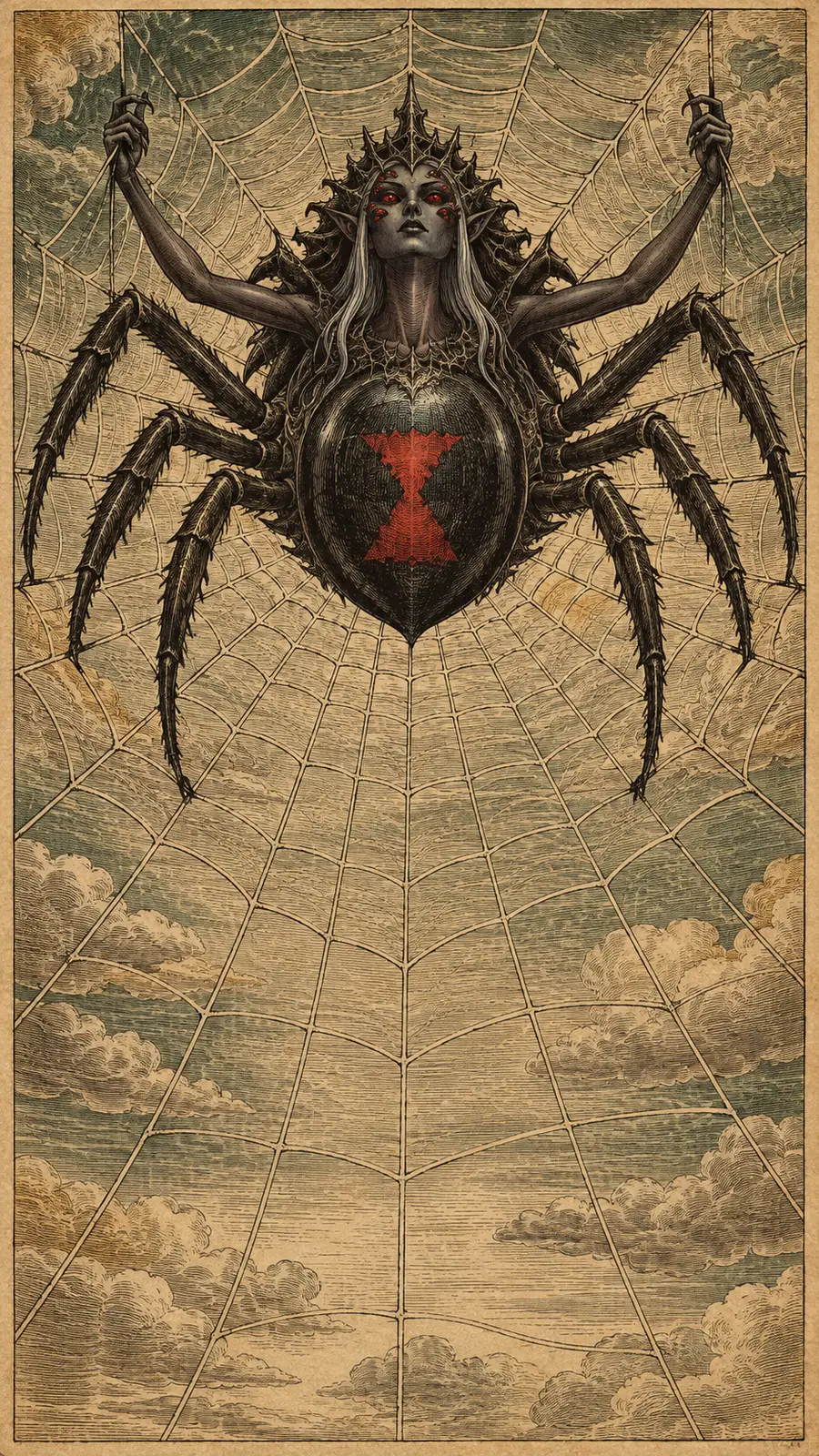
That gives us her first portrait. At the back of Vault of the Drow, Gygax gave Lolth her first statistics, and her first title: Demon Queen of Spiders. She has two forms. In one she is a hideous, bloated spider with the face of a beautiful woman. In the other she is an exquisitely beautiful drow, a dark elf woman of perfect grace. Those two faces, the spider and the elf, would stay with her through every edition that followed.
What makes the Vault so memorable, though, isn't the monster at the bottom of it. It's the politics in the middle. Gygax built Erelhei-Cinlu to be a living city that a Dungeon Master could run for many sessions, a place of intrigue as much as combat. And the intrigue explains the whole giant crisis.
The strongest of the noble families is House Eilservs. Its leading priestess is Eclavdra, the same name we saw signed on the scroll in the fire giants' hall. House Eilservs wanted the Vault ruled by a single queen, with Eclavdra wearing the crown. The other houses didn't want that, and neither did the priestesses of Lolth. Their leader, Matron Charinida, High Priestess of Lolth, opposed Eclavdra with particular force, because a single queen would have diminished her own position. So House Eilservs was blocked.
Eclavdra's answer was a terrible one, in drow terms. She and her house renounced Lolth altogether. They turned to another power, the , an ancient and mysterious being sometimes called the Elder Elemental Eye, and allied themselves with another family, House Tormtor, in defiance of everyone else. Lolth and the Elder Elemental God already had a long enmity between them, so to worship the Spider Queen's greatest enemy was the worst insult Eclavdra could possibly give. Later Greyhawk tales make it plainer still: before her turning, Eclavdra had been the most powerful of all Lolth's priestesses. Her fall was a fall from the very top of the goddess's favour.
Stirring up the giants on the surface was Eclavdra's bid for power. If she couldn't rule the Vault through the ordinary politics of the noble houses, she would build strength above ground, with giant armies to back her, and come down again with enough force that no one could refuse her.
So when the adventurers arrive in the Vault, following the giants' trail, they walk into a city already divided. And Lolth, in her first real role in the game, is a goddess whose own chosen people are split over her: a queen with a rebellious priestess, a cult with a rival, a temple standing in its ochre cavern while one of the great houses turns its back. That rivalry with the Elder Elemental God sets up everything that follows.
Players who returned to the Vault years later tended to remember it as a city more than a dungeon, a place to bargain and spy and play the houses against each other. And the gentlest thing in it, the starry crystal ceiling and the humming insects in the fungus forests, still glows in the memory long after the fights are forgotten.
But the Vault had a door in it that went somewhere else. Behind the Egg, beyond the dungeon where the demoness could be fought, was a gate. And for some time, that gate led nowhere at all.
Chapter III
The Demonweb Pits
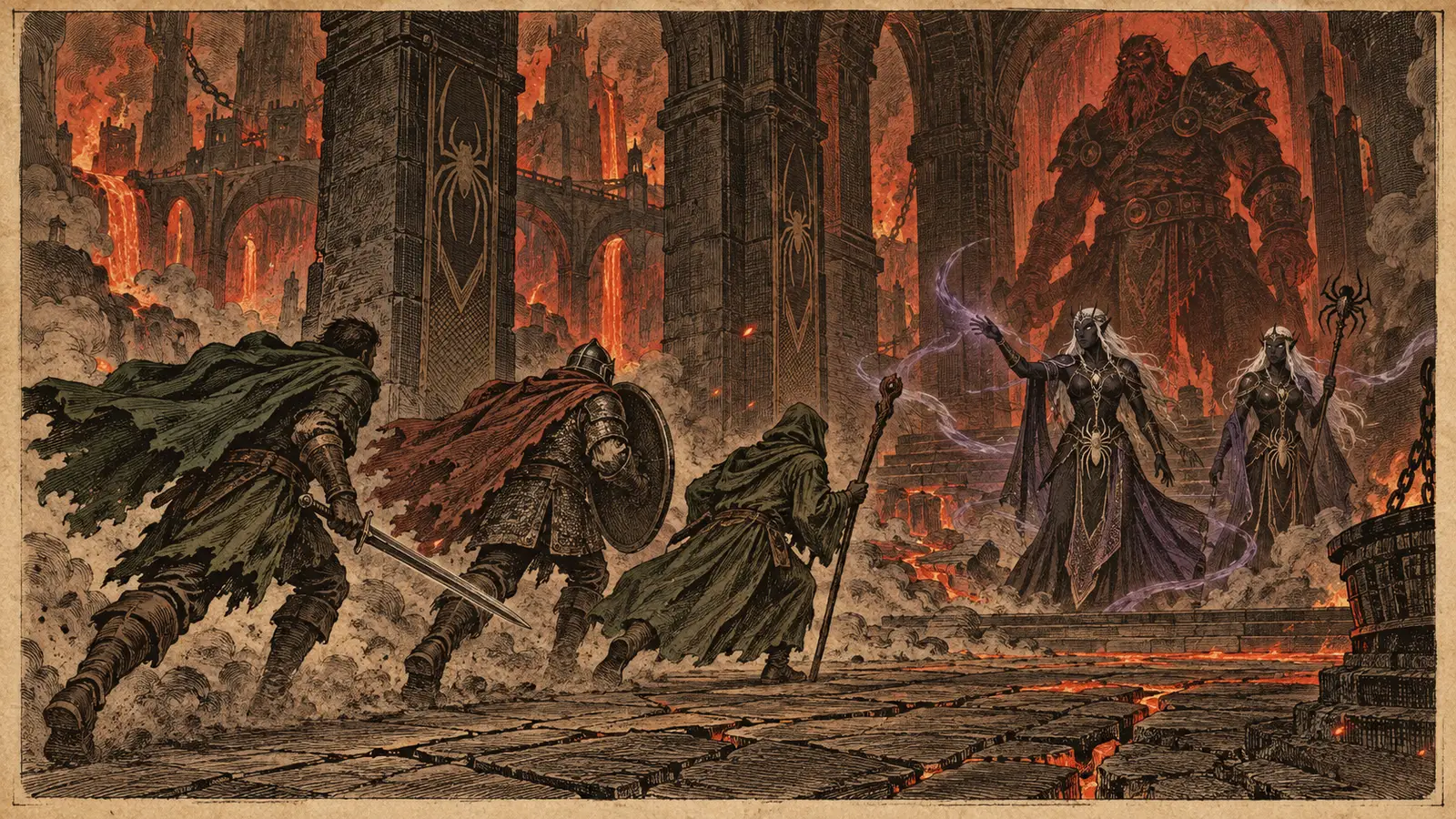
We come now to the place that gave her most famous title, and we come to it by way of a household object, which is one of the nicer stories in the history of the game.
The first six adventures of the giant and drow saga came out in 1978, and players went through them eagerly, down from the giants' halls into the Vault. At the end of the Vault, beyond the Egg, there was a gate to the , the infinite plane of demons, and the story was meant to go on through it. But the finale didn't come. found it difficult to write. The months went by, and then more months, and the gate stood in the dungeon leading to an adventure that didn't yet exist.
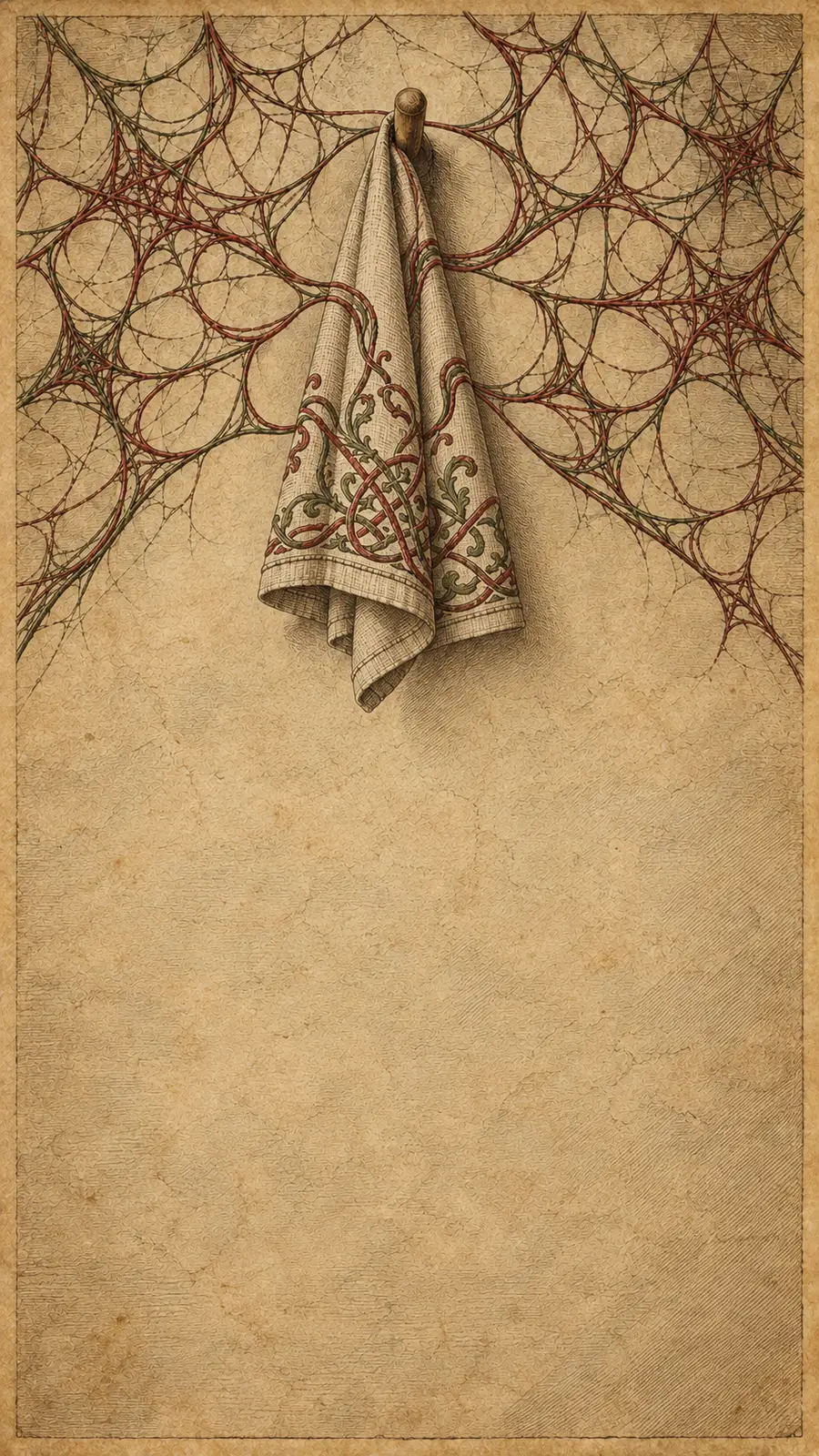
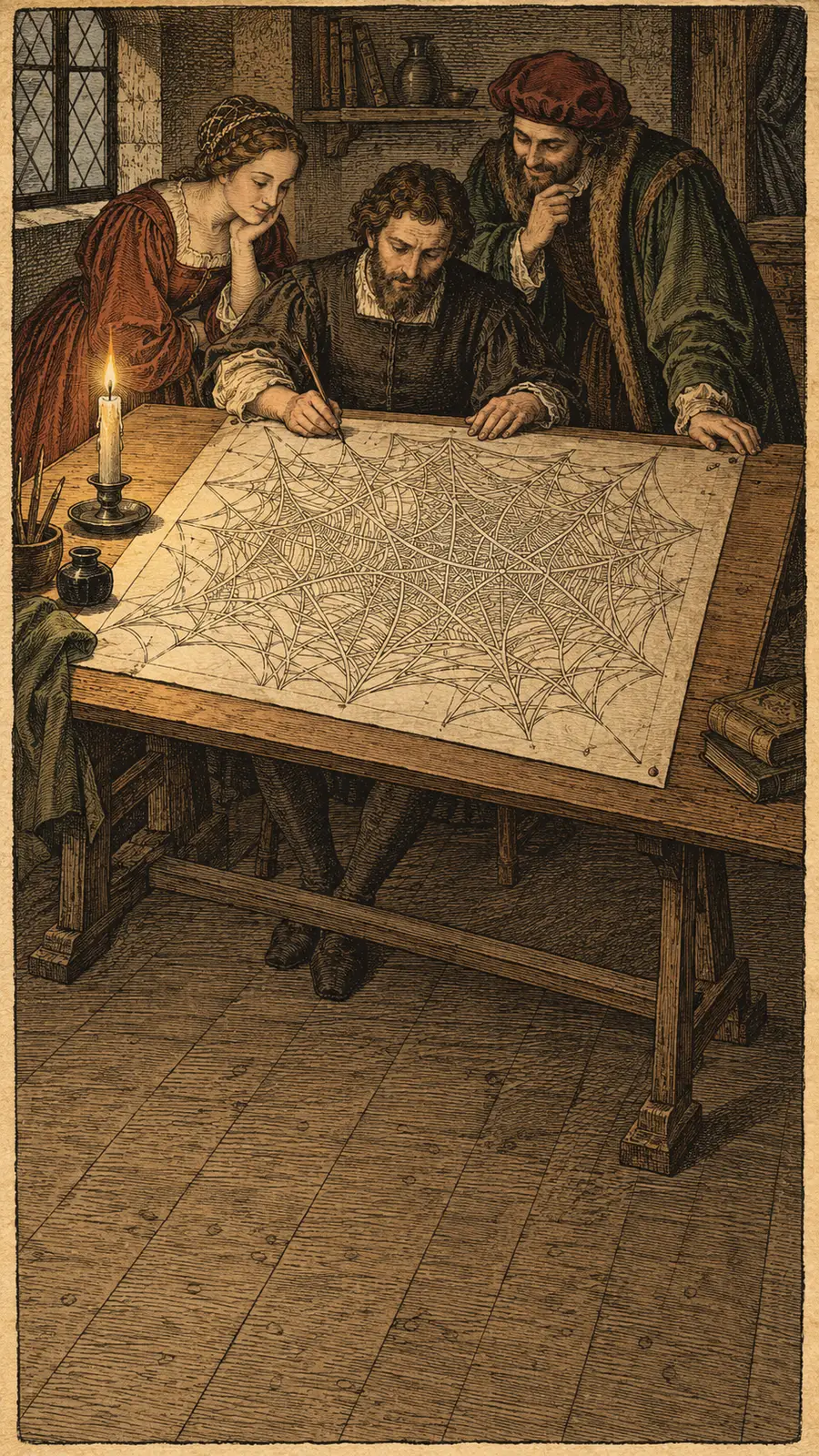
The solution came from an artist at TSR named C. the Third. One day Sutherland noticed the pattern on a hand towel, an interlaced design of curving lines that looked to him like a web, a demonic web, a whole maze of strands. He sketched out an idea for a finale built around it and showed it to the company. Gygax was impressed enough that he used the outline, and he later said, with a little ruefulness, that the project was taken out of his hands when Sutherland found the pattern in a hand towel and talked the TSR executive into using it as the theme of the last module. Many people have since told the story with a placemat, but Sutherland himself said it was a towel.
The adventure was first run at the Origins game convention in 1979, and it was published in October of 1980 as Queen of the Demonweb Pits, written by Sutherland with Gygax as co-author. The letter on its code stood for queen. It was meant for experienced characters, the kind of heroes who had already fought their way through the whole saga, and Jim Roslof painted its cover.
Something new happened in this adventure. For the first time, a published module took the players off their own world and onto another plane of existence entirely. Gygax had sketched the shape of the game's cosmos a few years before, in an early issue of Dragon magazine, imagining the planes arranged like a great wheel around the material world. Now someone actually went there. The heroes step through Lolth's gate and are carried to her realm, deep in the Abyss, on its sixty-sixth layer: the Demonweb Pits.
And here, at last, the whole plot comes clear. Lolth, Demon Queen of Spiders, goddess of the drow, was the architect of all of it. The giants and their raids, the kuo-toa in their shrine, the drow in their Vault and their bitter house wars: behind every move was the Spider Queen's hand, pulling threads. Even 's rebellion runs through her web somehow. The whole long campaign, from the timber steading of the hill giant chief to the ochre cavern of the Fane, turns out to have been a pattern woven around the adventurers before they ever knew it.
So what is it like, the Demonweb?
Imagine that you step through the gate and find yourself standing on a path, but the path isn't on anything. It floats. Around it and above it and beside it is fog, thick and grey, impenetrable, so that the path seems to be a tunnel though it has no walls. The surface underfoot isn't quite still. It moves slightly as you walk, as if it were alive, or as if it were stretched across a very long distance and something far away had touched it. The fog smells foul. And somewhere beyond the fog, all around you, is what the adventure calls a maelstrom of lost souls, the endless churning of the dead of the Abyss.
The paths cross and recross. They branch and interweave, and they form a labyrinth, the Demonweb itself, and the heroes are trapped in it. To get home they must find their way through and defeat the queen in her own lair.
Later lore, writing about the same place, describes the layer from outside. The Demonweb Pits look like a giant spiderweb strung across empty space, woven from strands of planar matter, and the strands are said to be made of the lost souls of the Abyss. The grey fog clings beside each strand, and that's why walking one feels like walking a tunnel. Still later writers described four great strands winding through endless mist, each looping round in a circle and passing over and under the others. Wherever you are on it, you're on the web.
There are doors in the Demonweb. Some open onto small pocket spaces, chambers hung off the strands like cocoons. Others open onto whole worlds. Lolth's web touches other planes of existence, other material worlds, and she sends her minions through some of those doors to invade and corrupt and scheme. One door opens onto a world of winter. Another opens onto a world where it is always night. On the last level of the web, the maze thins out into something more like a road, and along it are larger worlds still, each one a place the Spider Queen has her eye on. You might think of a spider who has spun her web across the corner of a window, and now, through the glass, watches a whole garden full of things she means to catch.
At the end of the road there's a great door. And beyond it is her palace.
Lolth's palace is a ship, and it's a spider. It is an enormous iron stronghold built in the shape of a spider, and it walks. It has eight great arched legs, and on them it strides along the strands of the web, and in one description across an alien desert as well. It's plated in brass. In its lower sections, steam engines labour to drive it. Inside, there are living quarters, power plants, temple chambers and control rooms, all the furnishings of a fortress that's also a machine. Where it is going, and why, the adventure never says. Its purpose and its destination are left inscrutable, which suits a goddess of chaos whose interests stretch across many worlds. It is simply moving, slowly, across the web, with the Spider Queen inside.
The climax of the whole saga takes place aboard it. The heroes fight Lolth in her lair, and they fight the mechanical spider she commands, and if they are clever and lucky they win and find their way home.
That ship has always divided people. A steam-powered brass spider walking across the Abyss felt to some players like a lovely surprise, and to others like a strange machine wandering in from a different kind of story. More than twenty years after it was published, some fans were still quietly rewriting the ending to take it out. Others loved it for exactly that strangeness. Either way, nobody forgot it, and it walked on into later books and novels again and again.
Queen of the Demonweb Pits gave Lolth more than a home. It gave her servants. At the back of the adventure appear the yochlol, described simply as Handmaidens of Lolth, demons who serve her personally and whom we'll meet again many times tonight. And it's from this era too that we have the drider, a creature with the body of a giant spider and the upper body of a drow, a dark elf fused to a spider's frame. Gygax later said plainly that Sutherland created the drider. In time, the lore would explain what a drider is: a drow who was tested by the Spider Queen and failed. That story comes later. For now, they're simply among her creatures in the dark.
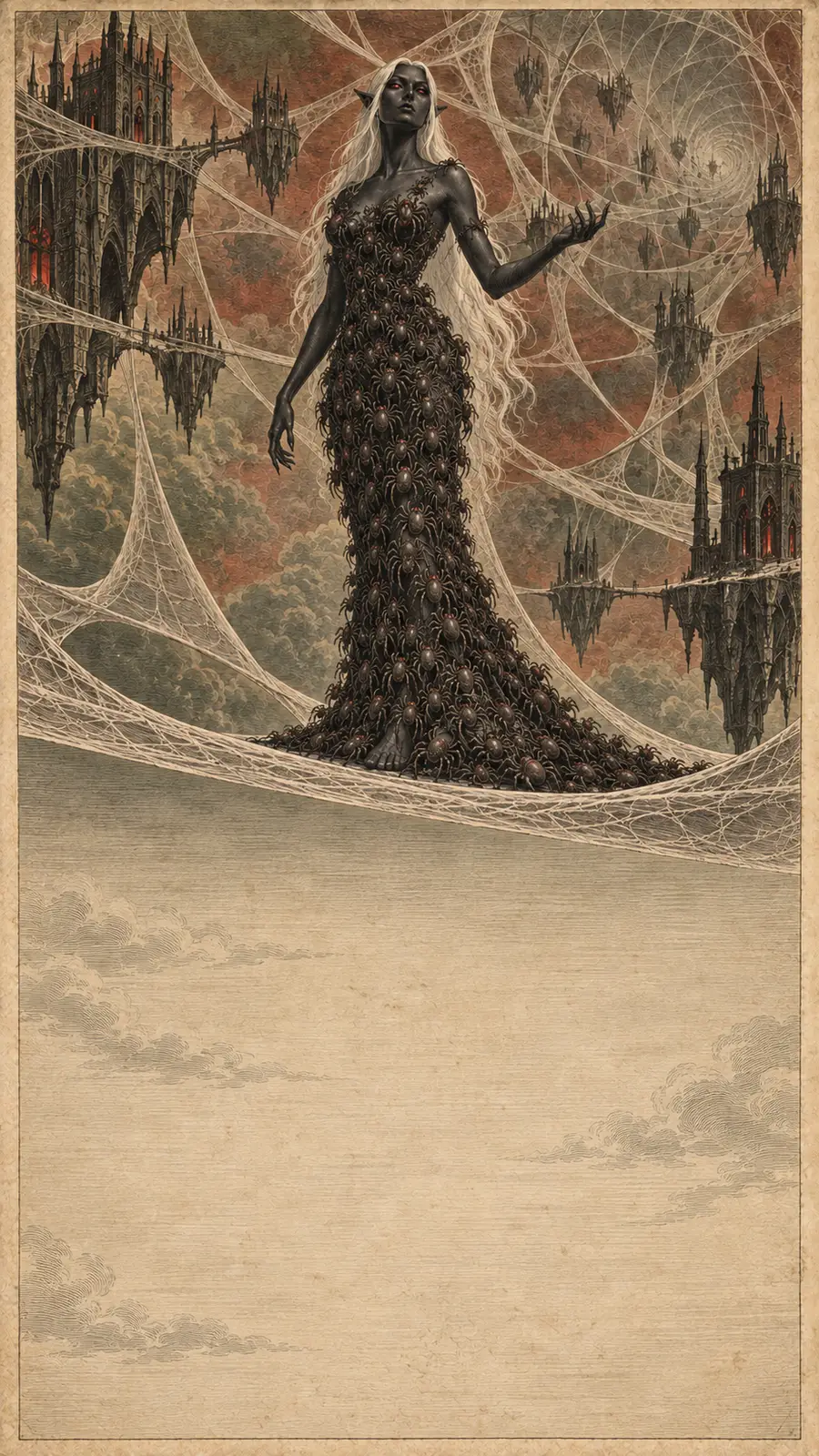
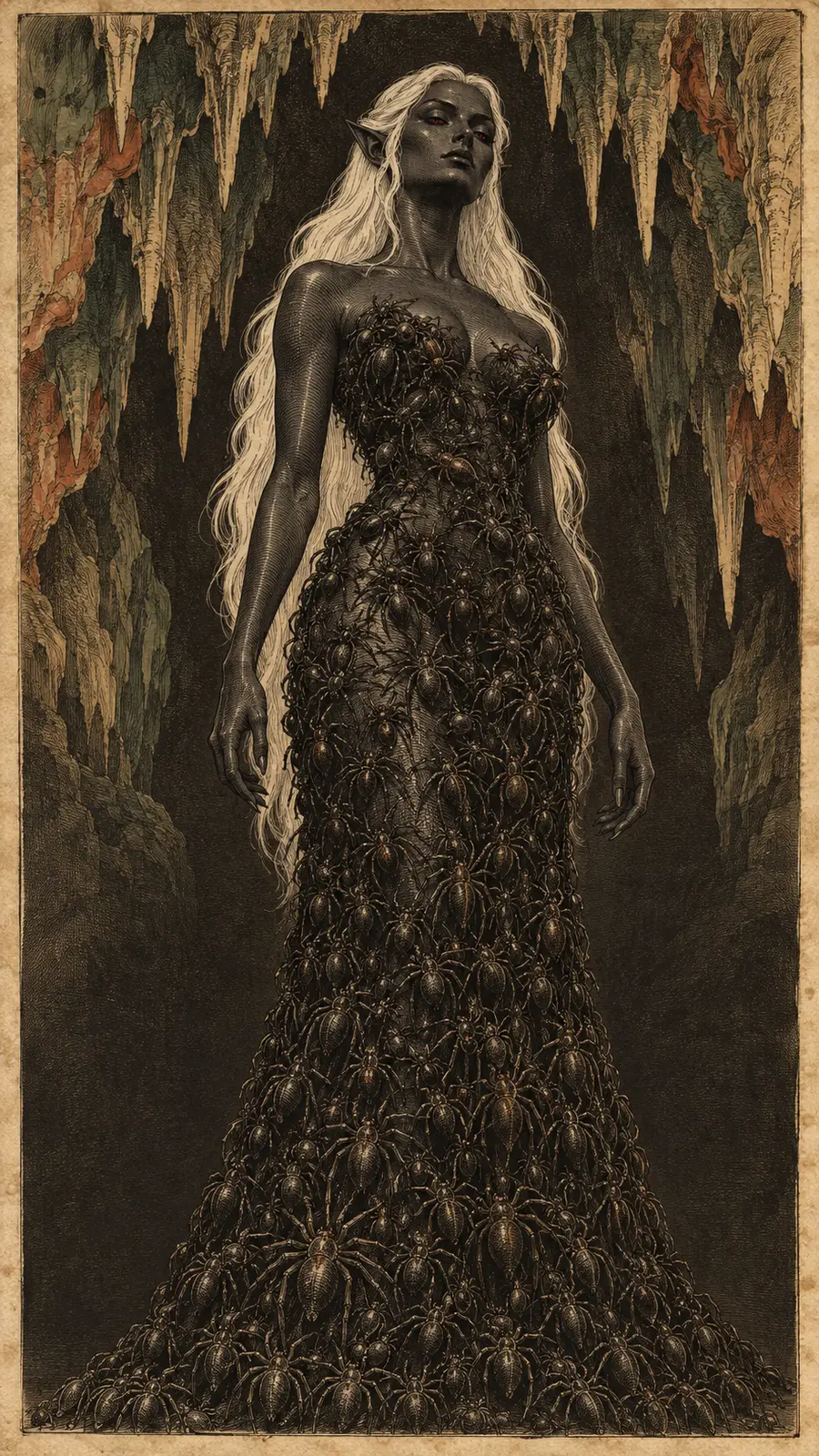
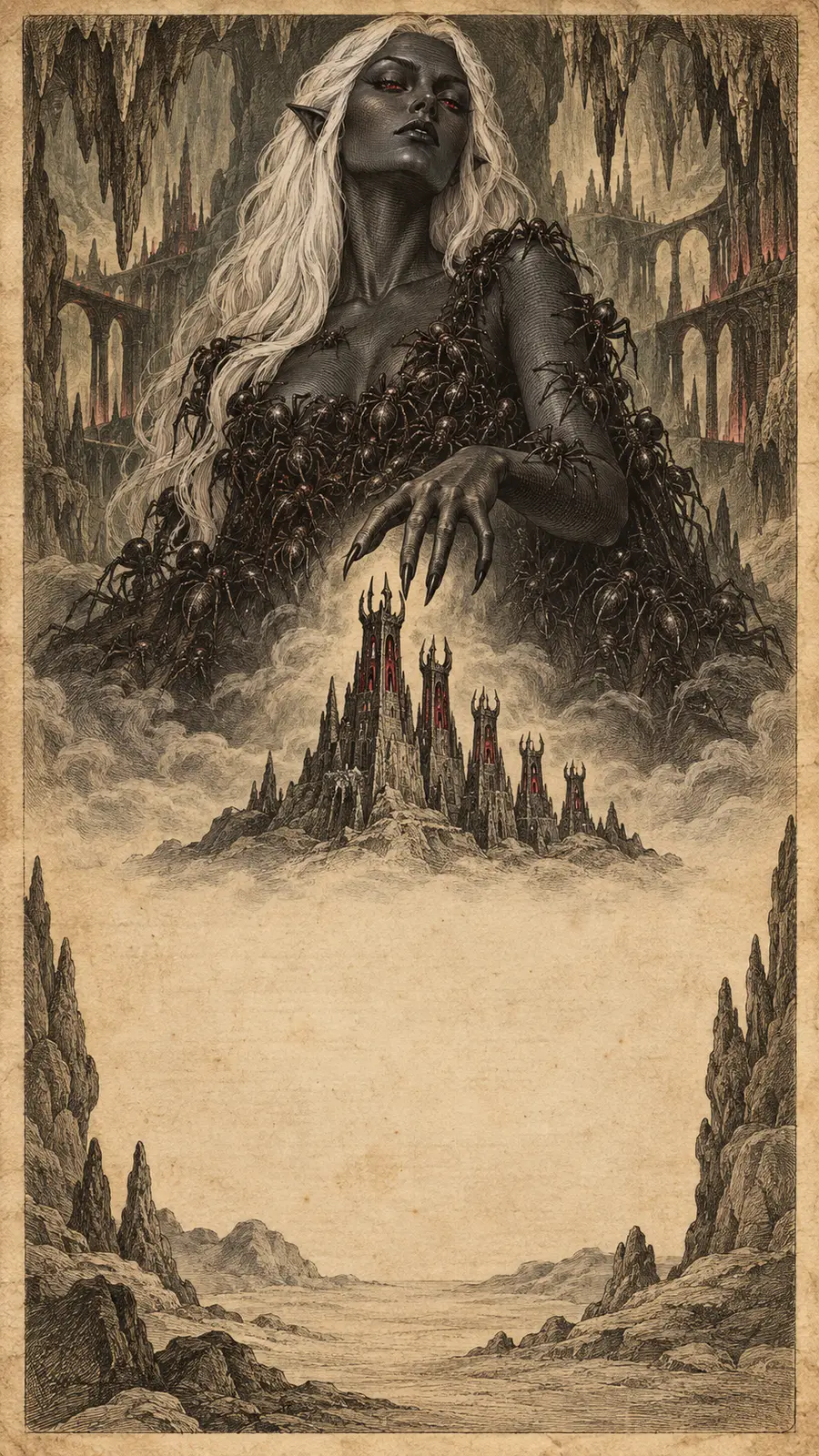
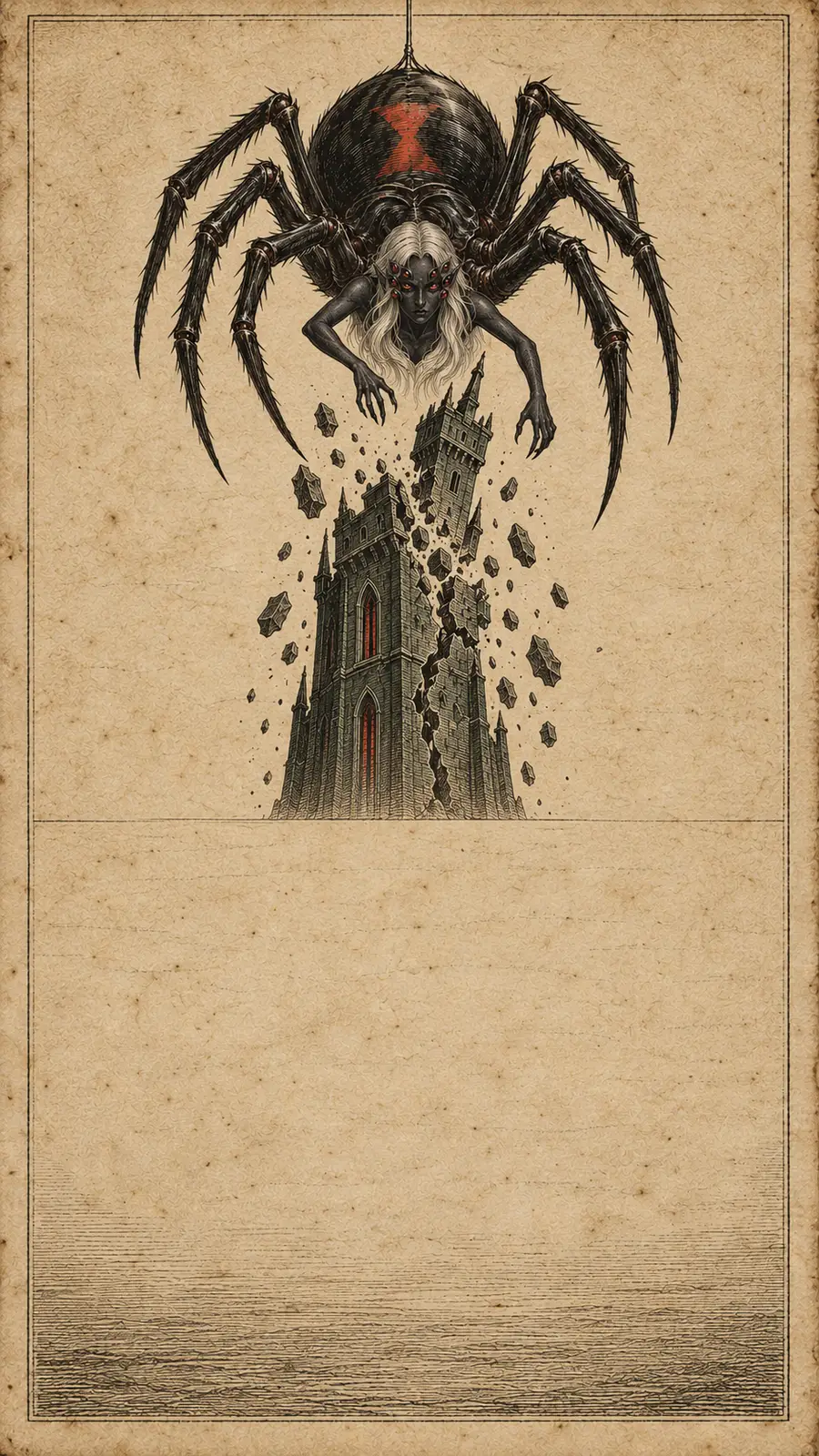
And the adventure fixed her appearance. In her drow form she is an exquisitely beautiful dark elf woman, sometimes covered all over in clinging spiders, the way another woman might wear a gown. In her spider form she is a giant black widow, and from between the eight spider eyes on its head looks out the face of a woman, a drow or a human. Those are the two shapes everyone would remember.
In 1986 TSR gathered the whole saga into a single volume called Queen of the Spiders, with all seven adventures together: the giants, the descent through the deep caverns, the Vault and the Demonweb, one long campaign beginning on the surface of and ending in the Abyss. The initials on its cover stood for Giants, Drow and Queen. Not every reviewer was charmed by a reprint at the time. But in 2004, for the game's thirtieth anniversary, Dungeon magazine ranked Queen of the Spiders the greatest Dungeons and Dragons adventure of all time.
So by the end of 1980, the Spider Queen had a name, two faces, a city of worshippers, a temple shaped like a spider, a web across the Abyss, a walking iron palace and a set of handmaidens. What she didn't yet have was a settled answer to a simple question: was she a demon, or was she a god?
Chapter IV
Demon queen or goddess
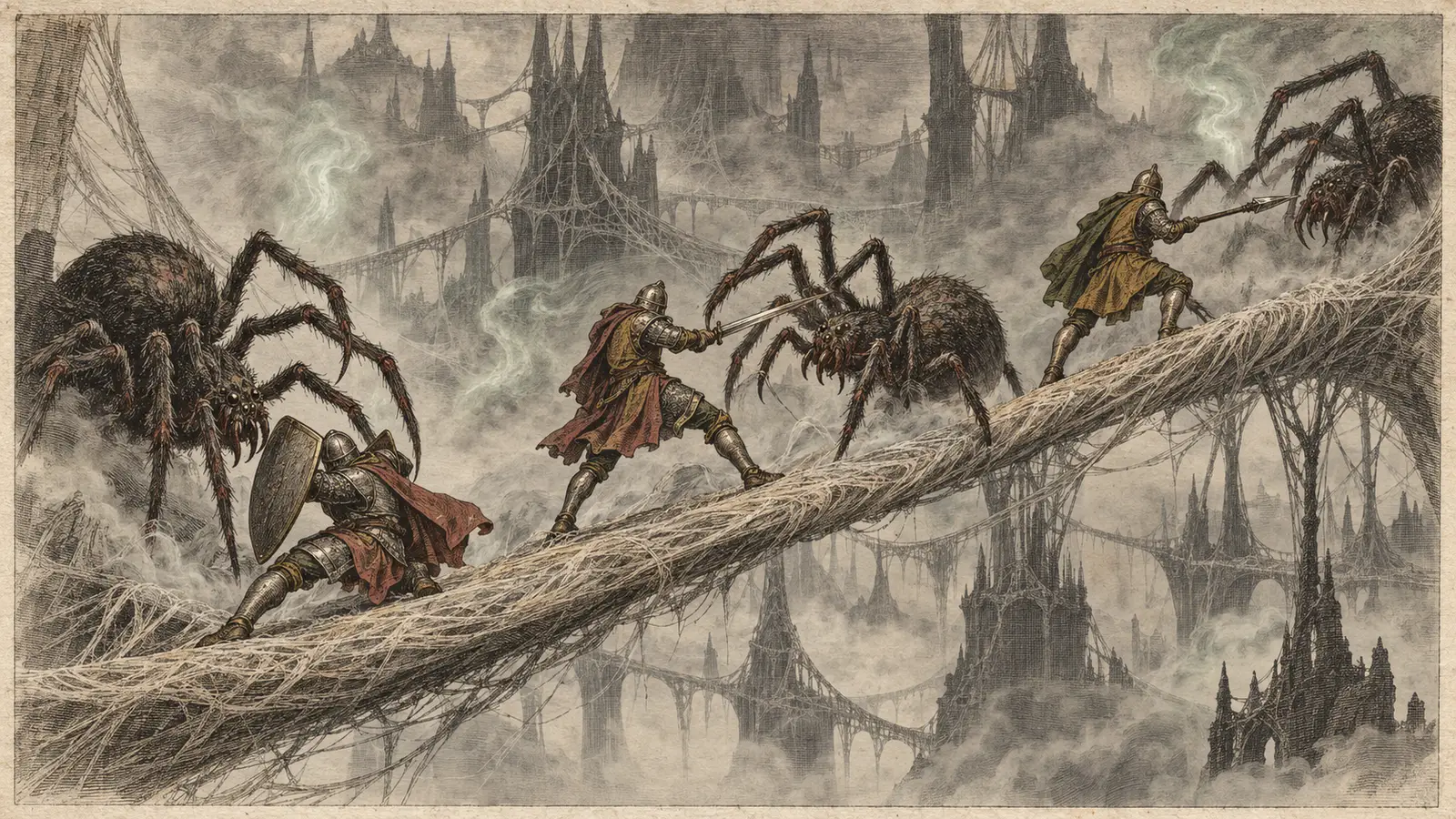
While the adventurers were still lost in the , the rulebooks of the early eighties were trying to decide what actually was, and they never quite managed it. That uncertainty, in the end, became one of the truest things about her.
The first book to treat her as a deity was Deities and Demigods, published in 1980. It was a large volume of gods from history and legend and fiction, with game statistics for each, and among its pages it gave the demon lords of the the rules status of lesser gods. Lolth was among them. And yet the text of her entry never calls her a goddess. It calls her a demoness, a demon lord, the Demon Queen. She's chief deity of the drow elves in practice, but in description she remains a demon of the Abyss whom people happen to worship. The book says it simply: the dark elves worship demon lords from the Abyss, and the best known example is the worship of the Demon Queen Lolth.
The same book notes that her name, in the dialect of the drow themselves, is spelled , with a doubled letter. You'll hear that spelling turn up now and then in later books, like a softer echo of the same word.
In 1981 came the Fiend Folio, a new book of monsters, and it was the first hardcover rulebook of the game to give the drow full statistics. Lolth went into it too, but not under the heading of gods. Her description from the Vault was reprinted under the heading Demon, as Lolth, the Demon Queen of Spiders, filed in among the other horrors of the Abyss.
The portrait there has one detail worth lingering on. In the Abyss, among the vast and hideous creatures that crowd that plane, Lolth looks delicate. Slender, graceful, almost fragile beside the hulking things around her. And yet she can destroy any number of those fiends with ease. It's a quietly unsettling idea, and it fits her. She doesn't need to be the largest thing in the room. She needs only to be the one holding the threads.
Then, in 1985, published Unearthed Arcana, a book of new rules for players, and it did something no book had done before. It let players be drow.
A drow player character, in those rules, is always an outsider. They are exiles from the cities of the Spider Queen. Either they left of their own will, because their hearts didn't lie with the cruelty of their people, or their family lost one of the endless power struggles of drow society and they were cast out with it. Either way, they come up from the dark alone, into a surface world that fears them. If that sounds familiar, it should. It's the first form of an idea that would become one of the most beloved stories in all of fantasy, though the dark elf who made it famous was still a few years in the future.
The same rules wrote Lolth's matriarchy right into the numbers. A drow woman could rise without limit as a cleric, a priestess of the goddess, as high as any player could ever take her. A drow man couldn't. Men were held to low rank in the clergy and couldn't climb far. But as wizards, drow men could go further than drow women could. So the shape of the society was there in the tables themselves: the priesthood belongs to the women, and the men find what power they can in arcane magic, in the sword, in the shadows. Later lore would keep that pattern almost unchanged. Lolth's clergy is nearly all female, and the priestesses rule the drow cities. Men serve, and men scheme, and men are never quite trusted.
Step back for a moment and look at those three books together. One gives her the rules of a god and the words of a demon. One files her among the demons in a book of monsters. One builds a whole society around her priestesses as if she were the most certain of deities. None of them settles what she is, and none of them needs to. She is a demon who is worshipped as a god, and a goddess who lives in the Abyss among demons. For the next forty years, books and novels would keep pulling at that double nature from one side or the other, and she would keep slipping between them.
Her story was about to move house, though. The world of had given her birth, but the next and largest chapter of her life would unfold on another world altogether, beneath the frozen north of the Forgotten Realms, in a city of spiders that a young novelist invented almost by accident.
Chapter V
The city of spiders: the Forgotten Realms and R. A. Salvatore
This chapter begins on a telephone.
In the late 1980s, a writer from Massachusetts named R. A. Salvatore had sent TSR a draft of his first novel, a story set in the frozen northern lands of the Forgotten Realms called The Crystal Shard. One day his editor, , rang him on her way into a marketing meeting about the book. One of his characters, she told him, couldn't be used. He'd have to replace it. Salvatore asked for some time to think, but she was already late for the meeting, and she needed an answer now.
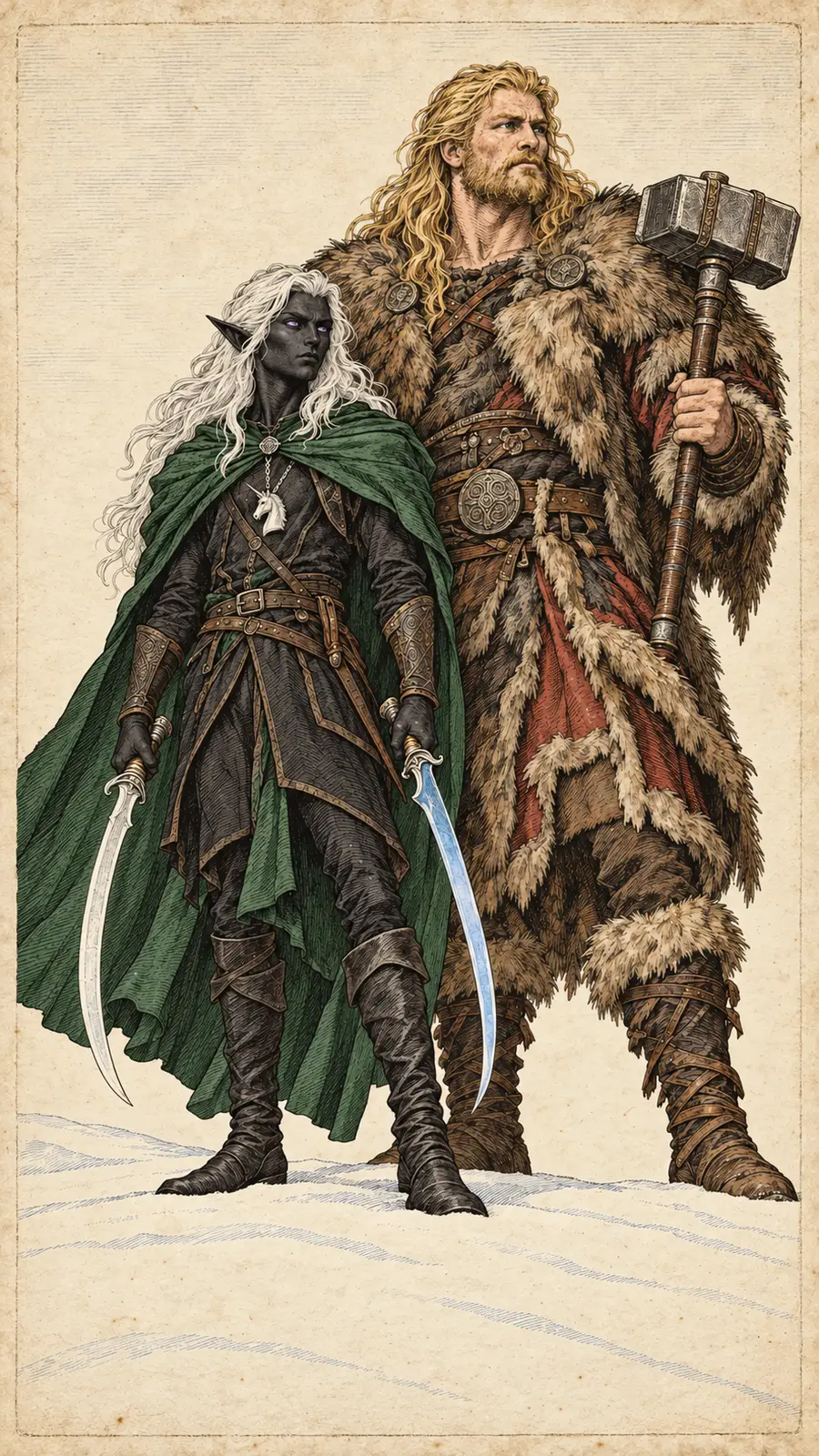
So, off the top of his head, he told her he had a dark elf. Kirchoff was doubtful, since dark elves were villains, after all. Salvatore assured her it would be fine. This one was only a sidekick, a companion for the barbarian hero . What was his name, she asked. , he said, of . Could he spell that, she asked. Not a chance, he said.
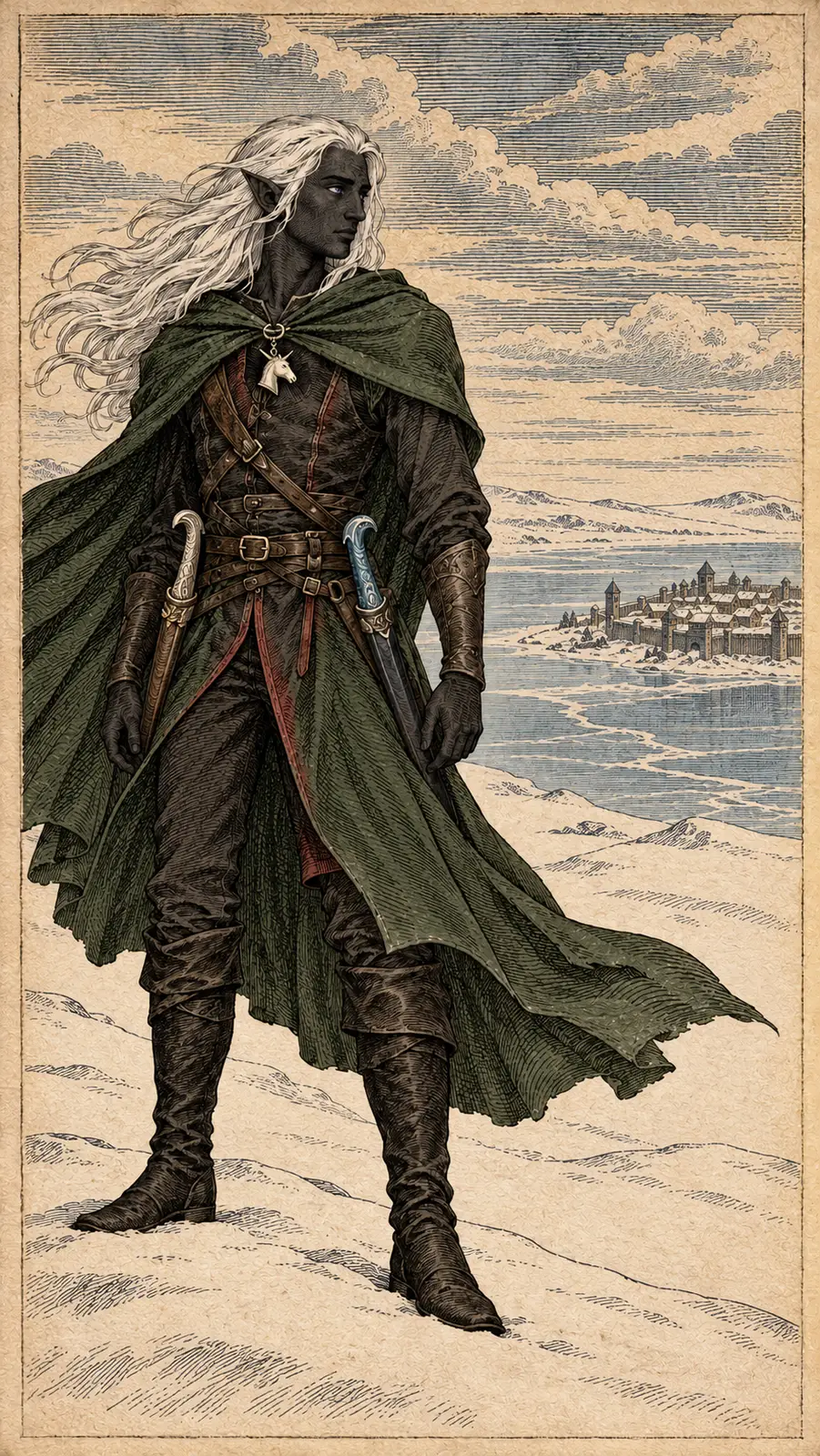
The Crystal Shard came out in 1988, and the sidekick walked off with the book. Drizzt Do'Urden, a drow ranger with two scimitars and a gentle heart, an exile from his own people living among the surface folk of Icewind Dale, became one of the most beloved characters the game ever produced. And readers wanted to know where he'd come from.
So in 1990 Salvatore went back to the beginning, with Homeland, the first book of what became The Dark Elf Trilogy, followed by Exile that same year and Sojourn in 1991. These books told Drizzt's life from his birth to his flight to the surface, and they put at the centre of the drow of the Realms a single great city: Menzoberranzan, the City of Spiders.
Let's go there now.
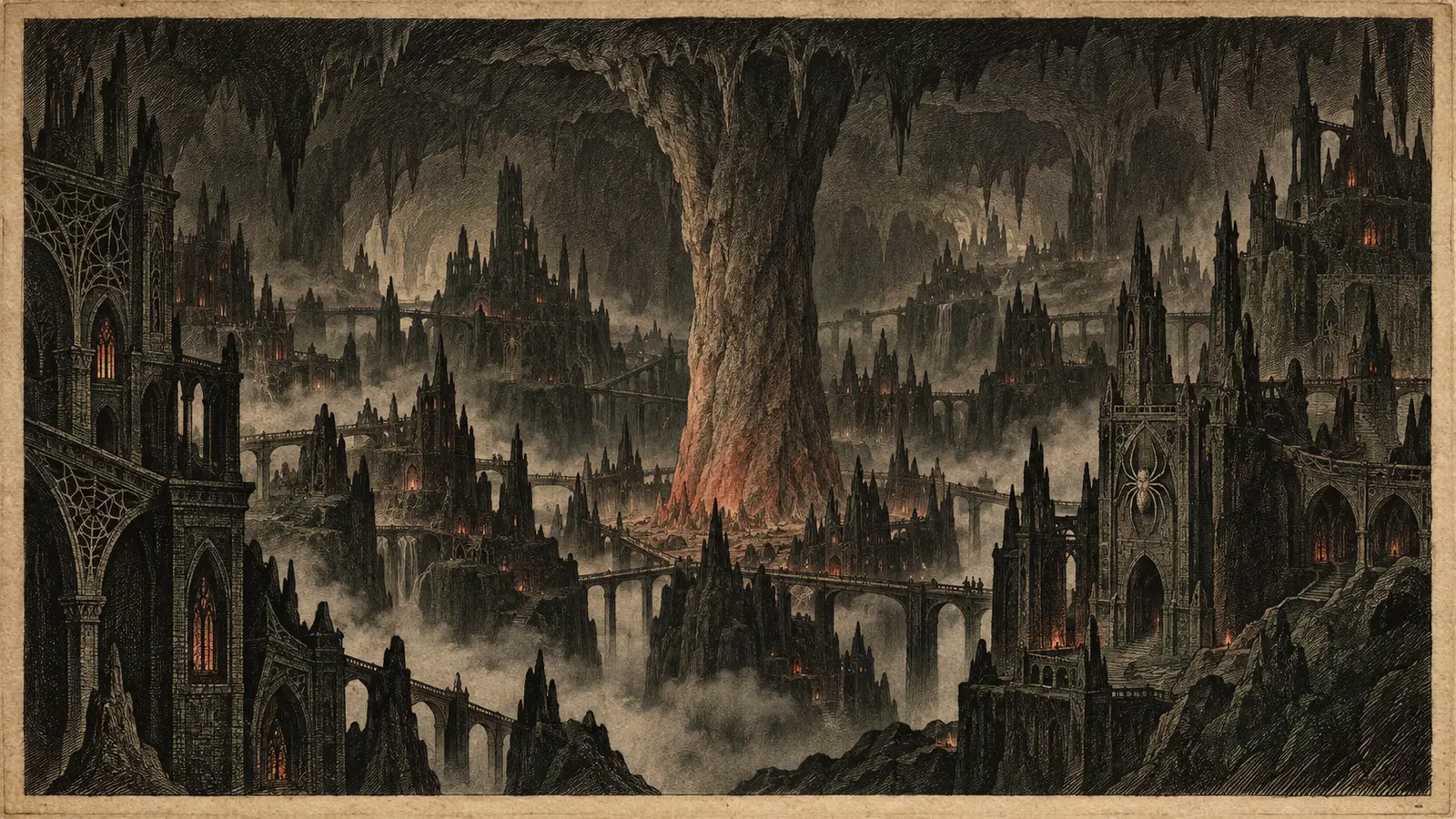
Menzoberranzan lies in an immense cavern far beneath the northern lands of , in the region of the called the . It's a city of tall stalagmites and hanging stalactites, carved and hollowed and lit with soft magical fire, so that the noble houses are castles grown out of living rock. In the middle of the city stands a great pillar called . Every morning, the Archmage of the city casts a spell into its base, and the heat of that magic climbs slowly up the stone, so that the pillar glows. Through the day the glow rises and then fades, and by watching it, the people of the city tell time in a place that has never seen the sun. You can imagine the whole city, in the dark hours, looking toward that one dimming column of light.
The city is ruled by its noble houses, and the houses are ruled by women. Each house is led by a matron mother, and each matron mother is a high priestess of . The matrons of the eight greatest houses sit together as the Ruling Council. The houses are ranked, first house down to the lowest, and what decides a house's rank isn't wealth or arms alone. It is Lolth's favour. A house in the goddess's favour rises. A house that loses it falls, and usually it falls all at once.
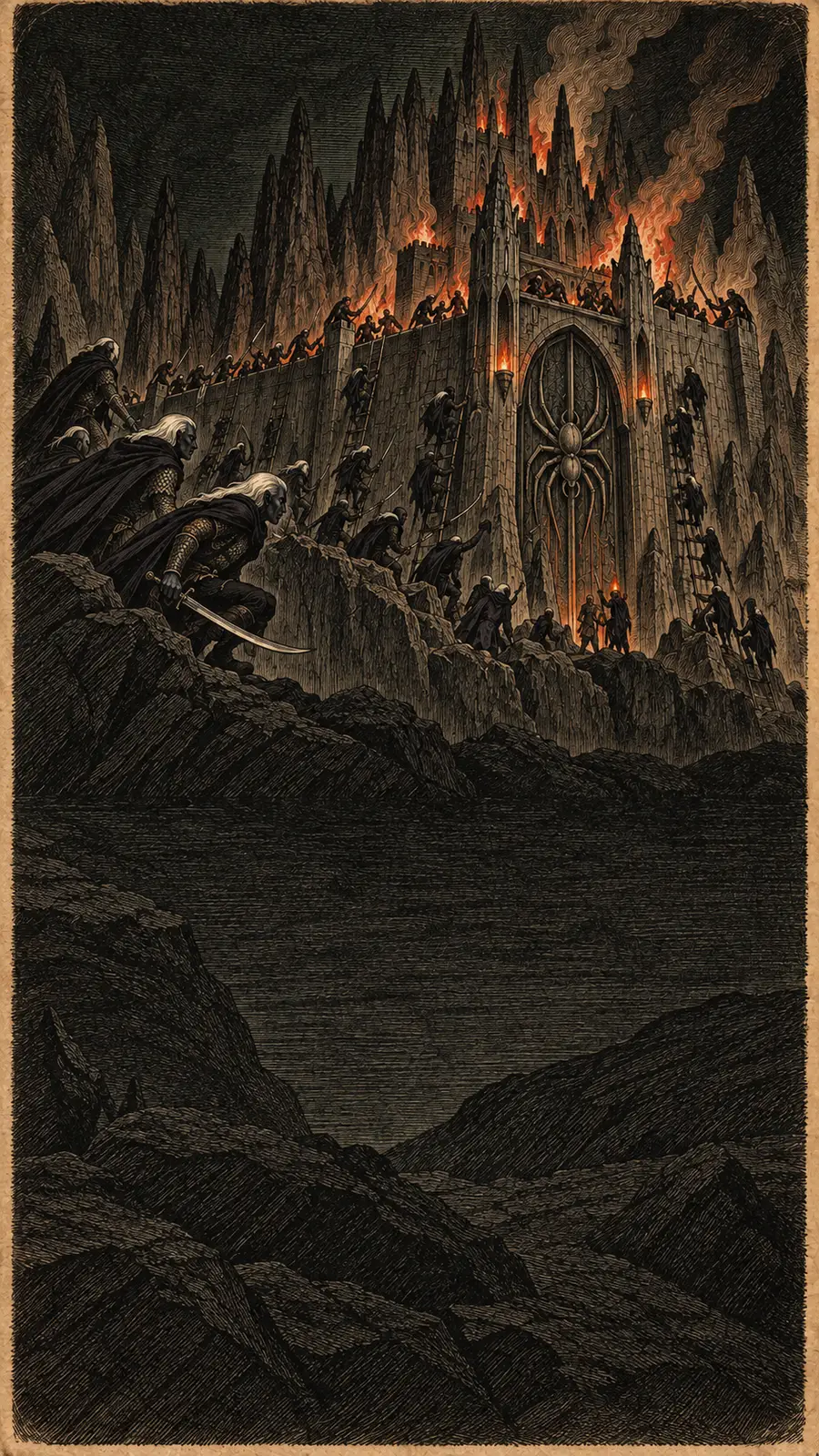
Because there's a law in Menzoberranzan, and it's the Spider Queen's law. One house may attack another. But the attack must be finished in a single night, and the rival house must be destroyed completely, with no witnesses left alive to accuse anyone. If that's done, the other houses must not interfere. Everyone knows, of course. But no one saw. And so it is permitted.
That's the deep logic of the city, and Salvatore drew it out beautifully. In Menzoberranzan almost every law carries the penalty of death, and yet citizens are expected, even encouraged, to break those laws, as long as they're never caught. Murder is a crime, unless you're good enough at it. The effect is a society that culls itself night after night, until only the most devious and ruthless of its people are left standing. Above it all, watching, sits a capricious goddess who keeps the great families at each other's throats.
Why would she want that? In the lore that grew from these books, Lolth says it's to weed out the weak, so that only the strongest and cruellest and most cunning remain to serve her. And she half believes it. But her deeper aims are control, total and unbroken, over her people; the prevention of any other faith or idea ever taking root among them; and the simple fact that a people kept frightened and fighting never grows complacent. It amuses her too. In Salvatore's drow there's an important idea, one readers have noticed ever since: they aren't born evil. They're raised that way, carefully, by a goddess who needs them to be.
House is the First House. It has been first for longer than any living drow can remember, for well over a thousand years, steadily, the most favoured of Lolth's houses and the source of her finest priestesses. In Drizzt's time its ruler is Yvonnel Baenre, called Old Matron Baenre, ancient beyond reckoning and one of the mightiest rulers in her family's long history.
The young of the city are trained at the Academy, which stands in a cavern of its own called Tier Breche. It has three schools. Melee-Magthere trains the warriors. trains the wizards, and is overseen by the Archmage of the city, Baenre, the matron's son, a man of enormous power who can never sit on the Ruling Council. And , the school of Lolth, trains the priestesses. Its building is shaped like a spider, crouched on the north side of the cavern, and in Drizzt's time its mistress is Baenre, another of the old matron's children.
Men rarely hold formal power here. But some of them hold a great deal of the informal kind. Gromph shapes events from his tower. And there's , a flamboyant mercenary with an eyepatch and a wide hat, leader of a band called Bregan D'aerthe, who sells his services to every house and belongs, as far as anyone can tell, to none of them.
Nearby, a little way through the tunnels of the Northdark, is , the city of the deep gnomes, who live in uneasy wariness of their drow neighbours. And in the temples of Menzoberranzan move the yochlols, the Handmaidens of Lolth, who in the Realms serve not only as messengers of the goddess but as midwives and guardians as well.
Now let's tell the story of Homeland, because Lolth is in it everywhere, though she never walks onstage.
The novel opens on the night House Do'Urden attacks House DeVir. Do'Urden is the tenth house of the city. DeVir is the fourth, and its matron has lost Lolth's favour, which makes it fair game. The matron of Do'Urden, , is heavily pregnant that night, and she's in labour as the attack begins. She turns the agony of childbirth into the power of a spell, and with it she shatters the chapel of House DeVir. Into that broken chapel walks , weapons master of House Do'Urden and the finest swordsman in the city, and alone he kills every DeVir priestess within. By morning House DeVir is gone, and House Do'Urden has risen.
The child born in the middle of that night is Drizzt. He is the son of Malice and of Zaknafein, her consort. And he is a third son, and in Menzoberranzan a third-born son is given to Lolth. His eldest sister, , prepares the sacrifice. But before it can happen, Drizzt's brother , in the confusion of the battle, stabs their elder brother in the back and takes his place as elderboy of the house. Nalfein's death is counted as the sacrifice the goddess was owed. Drizzt is spared, and given his name.
He grows up in the house, raised for his first years by his sister Vierna and cruelly treated by Briza, and he learns very young what it means to be male in Lolth's city. He goes to the Academy and trains as a warrior, and he's brilliant at it. But at Arach-Tinilith, the spider-shaped school of the goddess, he witnesses a demonic rite and flees from it, and in his heart he renounces the Spider Queen. He will not serve her.
His refusal costs him dearly. Malice, to appease the goddess, sacrifices Zaknafein to Lolth, the father who had taught him the sword and had, in his own quiet despair, shared his son's horror at their people. And Drizzt leaves Menzoberranzan, walking out into the wild Underdark alone.
In Exile, Malice tries to win her way back into Lolth's favour by bringing him home, or killing him. She summons a yochlol and begs for , which the drow call the Spider Queen's greatest gift. It's a terrible magic. It raises a corpse, filled with the dead person's own spirit and their fighting skill, but bound wholly to the will of the matron mother. Over seventy days, Malice and her family make Zaknafein's body into a spirit-wraith and send it out into the dark to hunt his son. And when the wraith finally finds Drizzt, something of the real Zaknafein surfaces. For one moment he takes back enough control of himself to choose, and he throws his own body into a pool of acid rather than strike his child.
The gift has failed, and Lolth does not forgive. She decrees that House Do'Urden must be destroyed, and House Baenre, her favoured house, carries out the sentence. Of all the family, only Vierna and Dinin survive.
Drizzt's story leaves the city then, and goes up into the light, to Icewind Dale and his friends. But the Spider Queen doesn't forget the one soul that escaped her. In The Legacy, published in 1992, Vierna, who has survived and still serves Lolth, comes after him. She hires Jarlaxle and his mercenaries, and the assassin is caught up in it too, and the whole design is to bring back to Lolth what she lost. In Starless Night, the next year, Drizzt goes back down to Menzoberranzan himself to try to stop the drow from marching on his friends at Hall.
And in Siege of Darkness, in 1994, the war comes. This book is set during an event the Forgotten Realms calls the Time of Troubles, when the gods were cast down from their heavens and forced to walk the world in mortal forms called avatars, and magic itself began to fail and misfire. Lolth schemed through it all to keep Matron Baenre in power, and to take Mithral Hall.
She saw her own weakness coming. Knowing that for a time she would be diminished, she asked the great demon to protect her worshippers, and she opened a portal for him and a host of demons to come through. And it was well she did. In the dead-magic chaos of those days, one of the great houses of the city, House Oblodra, the Third House, saw its chance. The Oblodrans had a strange power that didn't depend on the gods or on wizardry: psionics, the power of the mind, which kept working when spells failed. With it they reached for the position of First House.
The Troubles passed. Lolth's power came back. And when Matron Baenre prayed, an avatar of the Spider Queen herself answered, and came to Menzoberranzan in person, and crushed House Oblodra all by herself. What was left of their stronghold was pushed over the edge into a chasm called the . You can imagine the city watching, in the faint glow of Narbondel, as their goddess walked among them and finished an entire noble house in an evening. It's one of the rare moments in the lore when she comes all the way down.
Other writers came to Menzoberranzan in those years too. In 1995, published Daughter of the Drow, the first of a series called Starlight and Shadows. Its heroine is Baenre, a young noblewoman of the First House, who doesn't want the life laid out for her as a priestess of the Spider Queen. She finds an artifact called the Windwalker, which lets her carry her drow magic, which ordinarily fades away under the sun, up to the surface world. There she meets a young berserker named , and her story becomes a long journey out of Lolth's shadow. And in Cunningham's books there's another goddess waiting, a kinder one, a drow goddess of moonlight and song called . We'll meet her properly very soon.
For through these years, while the novels were bringing Lolth's city to life, the sourcebooks of the game's second edition were doing something else. They were giving the Spider Queen a theology, a family, and a past.
Chapter VI
Second edition: a priesthood, a pantheon and a fall from grace
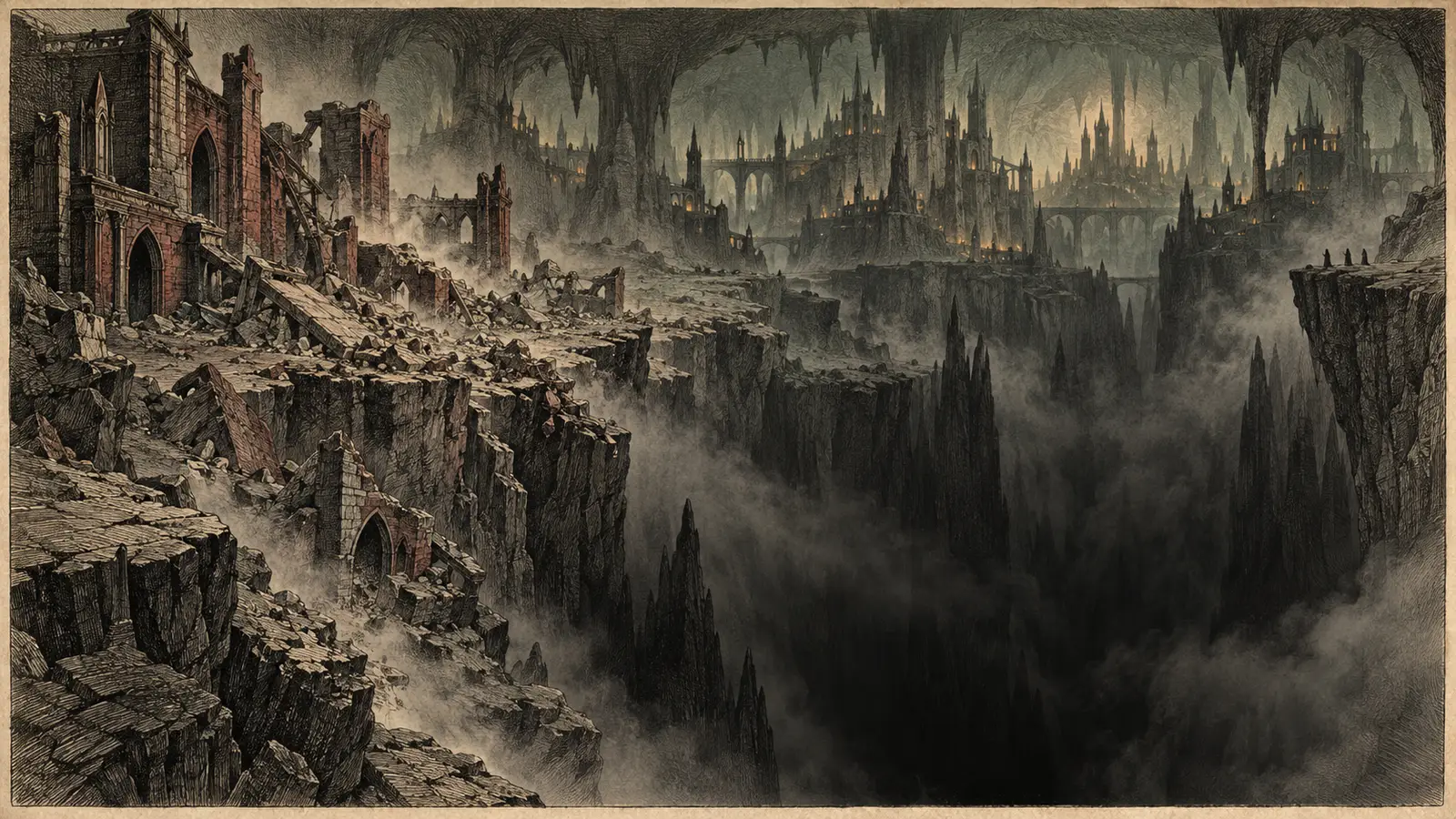
When the second edition of Advanced Dungeons and Dragons arrived at the end of the 1980s, was still mostly a demon queen with a famous adventure behind her. By the end of the 1990s she had become one of the most fully described goddesses in the game, with a church, a pantheon, a realm in the cosmology of the planes, and an origin story that would echo for decades. Most of that work happened in the Forgotten Realms.
The first step came from Ed , the creator of the Realms, in a sourcebook called Drow of the Underdark, published in 1991. Greenwood wrote it in his usual warm, conversational way, framed as if the author were learning everything second-hand from two people who knew the drow well. One was , the old sage of . The other was a drow lady named Susprina Arkhenneld, who had once been Elminster's apprentice. Between them, sitting together, they explain the dark elves to him: their nature and society, their spells and craftwork, their names and runes, and what Greenwood called their high history.
It was the first book to set out the Spider Queen's place in the Realms, and it gave her rivals. In its chapter on religion, Lolth is the dominant power of the drow, but she isn't the only one. There's , the Dark Maiden, a dancing goddess of song and moonlight who calls to good-hearted drow to come up out of the dark. There's , a male god of stealth and thievery and of drow ambitions on the surface, whose very existence is a quiet rebellion against a goddess who keeps men beneath her. And there's , a mad and oozing god of slimes and shapeless things, whom the Realms took as its own version of the , that same ancient enemy had turned to in the Vault so long before.
So Lolth now had rivals among her own people's gods. The society Greenwood described was strongly matriarchal. The priestesses of Lolth stand at the top. The men serve as warriors and wizards and merchants and functionaries, and they live in fear. And the Spider Queen asks for absolute loyalty, and for blood.
The next year, in 1992, Carl Sargent's Monster Mythology gave the gods of the non-human peoples their full treatment, and Lolth received a complete deity write-up, with her priesthood described in detail: what her priestesses wear and do, what they're permitted and forbidden. Her titles were set down together, the Demon Queen of Spiders, the Spider Queen, the Queen of the Pits, and her home in the Demonweb. In its chapter on the gods of the , the book named the drow powers as Lolth and three others: Vhaeraun, and . Kiaransalee is a goddess of the undead, a vengeful power of revenants and of the dead raised against the living. Zinzerena is a goddess of assassins and chaos and illusion, and this book is where she first appears. Eilistraee stands apart as the one good goddess among them.
And that same year, in December of 1992, came the boxed set that made Salvatore's city into a place you could play in: Menzoberranzan, written by Greenwood, Salvatore and Douglas Niles, and sold under the name The Famed City of the Drow. Inside the box were three books. The first toured the city, its districts and customs. The second described the houses, every one of them, eighteen great and lesser families, each with its matron mother and its kin. The third was an adventure that drew players into the city's intrigues. There were poster maps of the great cavern and of the compound, and a chart of all the rivalries and alliances among those eighteen houses, a web of grudges drawn out on paper. The city held some twenty thousand drow, and hundreds of thousands of slaves. And the priestesses of , as the box spelled her, demanded and received complete respect.
The city was given its founding myth in this era, and it's a story of exile. Long ago, nearly four thousand years before the Realms' common calendar begins, the drow of a southern city called Golothaer were caught in endless war, and the war was between the faithful of Lolth and the worshippers of Ghaunadaur. A high priestess of Lolth named , called the Kinless, led seven drow families away from it all, north through the deep tunnels into the . She did it at the wish of her goddess. And where they settled, they built the city that still carries her name. So the City of Spiders was founded by refugees from a holy war, with Lolth's blessing upon them, and the old rivalry with the god of oozes was there from the first night.
The second edition's god books gave Lolth a set of avatar forms, the shapes she takes when she comes into the world, and they're worth picturing slowly.
In one she is a black widow spider, about twelve feet across, with crimson eyes.
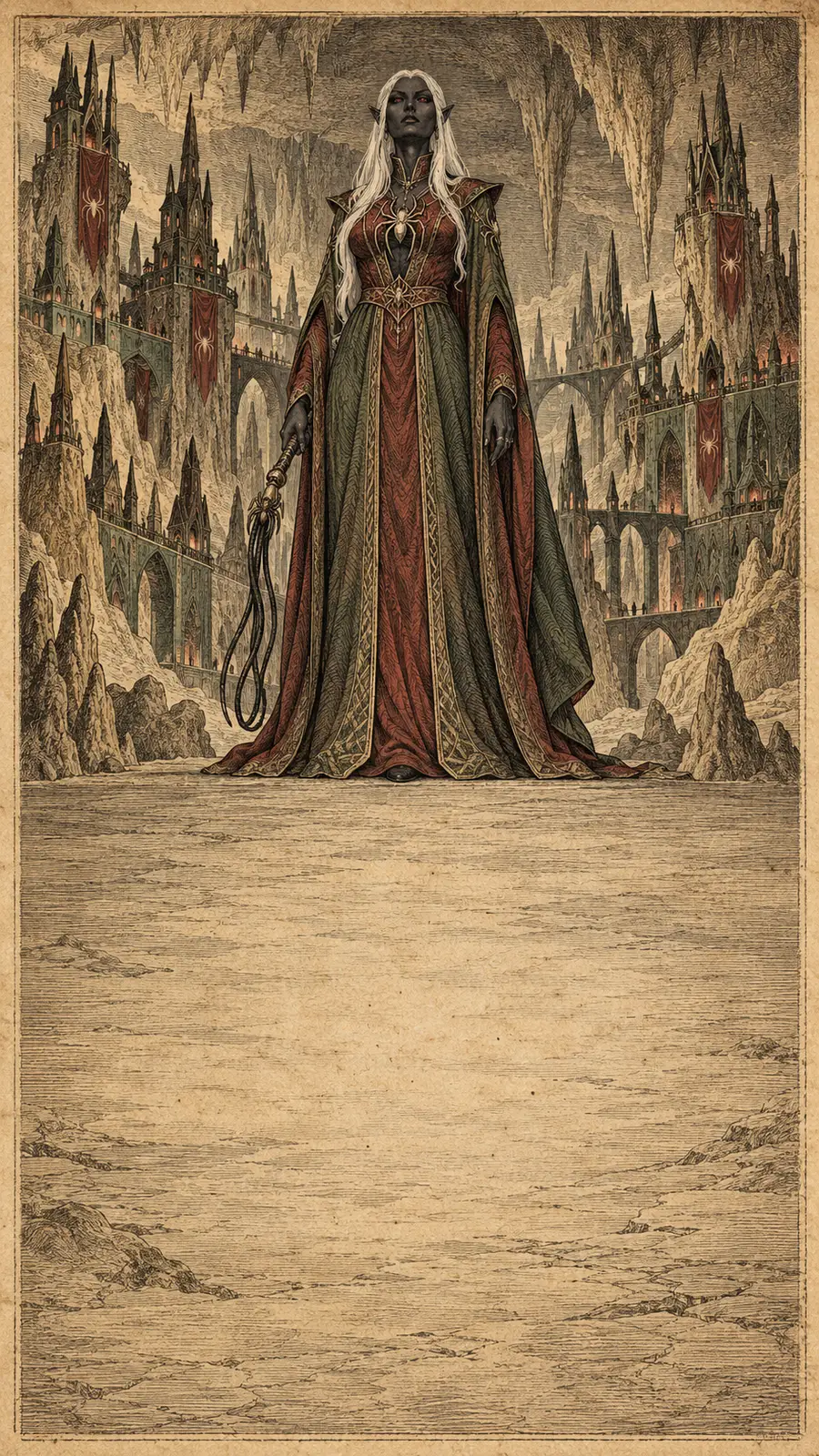
In another she is a drow woman, about six feet tall and very beautiful, often dressed in nothing but spiders, clinging and moving over her, or sometimes in artfully made drow chainmail, worn as a dress or a tunic.
And in the third, the one most often met in the itself, and thought to be her true form, she is a giant spider with the head of a drow woman, coldly and perfectly beautiful, looking out from among the spider's eyes.
Meanwhile, the game was building a new way to look at the planes. In 1994, the Planescape setting arrived, and its Planes of Chaos boxed set, designed by and Lester Smith, took players on a tour of the chaotic outer planes, the Abyss among them. In Planescape, Lolth is what the setting called a tanar'ri power. The tanar'ri were the demons of the Abyss, and Lolth was both one of them and a goddess, worshipped and sustained by faith. Much of the Abyss that Queen of the Demonweb Pits had imagined back in 1980 had passed down into the game's books about the planes, and from there into Planescape, so her realm was the one you might remember: the web strung across space, the strands of planar matter, the tunnels looping through mist, and the great iron fortress shaped like a spider crawling across the strands wherever its mistress willed.
The Planescape writers gave her an interesting temperament. For all her power, she has very little interest in ruling the other lords of the Abyss. She doesn't want to be queen of demons. What absorbs her is her worshippers. She spends her attention tormenting them and testing them, over and over, the drow first of all, but also the chitines, part-spider creatures of the deep places, and the araneas, shapeshifting spiders who can walk as people. She's a goddess whose great love is to watch what her children do when she pulls on their threads.
Her household in the Demonweb grew in this era too. Kiaransalee, the goddess of the undead, was counted as her thrall. Keptolo, a drow god from 's old lore, was her consort. , a drow god of warriors, was her champion. And all around her moved the yochlols, now counted as lesser tanar'ri, the Spider Queen's own personal demons. In 1996 Colin McComb's On Hallowed Ground set her firmly into the planar cosmology of gods and their realms, alongside every other power.
And then came the books that told her past.
The Forgotten Realms published a series of large volumes about its gods in the later 1990s. Faiths and Avatars came in 1996, written by Julia Martin and Eric L. Boyd. Powers and Pantheons followed in 1997. And in 1998 came Demihuman Deities, by Eric L. Boyd, which became the great second edition home of the drow pantheon. In that same year published a novel called Evermeet: Island of Elves, which opens with the earliest history of the elven gods. Between them, these books told a story that has never quite gone away.
Before she was Lolth, she was .
She was a goddess of the , the gods of the elves, who dwell in the realm of . She was a goddess of weavers and artisans, and of those who spin fate, and she was called the Weaver of Destiny. She was the consort of , the great father and creator of the elves, and Corellon loved her and trusted her so completely that he placed in her hands the destiny of the dark elves, the darker-skinned branch of his people. Together they had children, twins: a son, Vhaeraun, and a daughter, Eilistraee.
But Araushnee was not content. She grew jealous and greedy and ambitious, and then cruel. She wanted more than to stand beside Corellon. She wanted his place.
So she began, very quietly, to weave against him. She made an alliance with , the one-eyed god of the orcs, Corellon's oldest enemy. She enchanted the scabbard of Corellon's own sword, so that when he drew it in battle the blade would shatter. And with her son Vhaeraun she gathered a great alliance of evil gods to attack Arvandor: the beast lord, Ghaunadaur the god of oozes, the cold goddess of winter, and the gods of goblins and kobolds and giants, all of them, marching against the home of the elves.
Moonbow, the elven goddess of the moon and of dreams, discovered the plot. When she confronted Araushnee, the weaver goddess seized her and imprisoned her. But the plot unravelled all the same. The attack came, and Corellon was hard pressed, and in the end three goddesses together, Sehanine and , goddess of love and beauty, and , goddess of the air, joined their powers and brought Araushnee down.
There was a trial among the gods. Corellon heard what his consort had done, and he cast her out of Arvandor into the Abyss. And then he changed her. He twisted her into a bloated spider-demon, a tanar'ri, a creature of the Abyss, and he did it for a reason that's both terrible and very human. He did it so that her beauty could never again move him to reconsider his judgment. He didn't trust himself to look at her as she was and hold firm.
Her children's fates went two ways. Vhaeraun, who had fought beside her, was exiled. Eilistraee had done nothing wrong, and the gods cleared her of all guilt. But she chose to go into exile anyway, to share her mother's and brother's fate, because she knew that the dark elves would one day need her light.
In the Abyss, the weaver took a new name. She called herself Lolth. And she made the sixty-sixth layer of that endless plane her home, and spun it into the Demonweb.
So you can hear, perhaps, the old echo from the beginning of the evening. A weaver who quarrelled with a greater power was cast down and made into a spider so she could never be what she was. wove the gods' misdeeds into her cloth. Araushnee wove her treachery into a sword's scabbard. And both of them were left with nothing but the thread.
The story went further, into the history of the elves of the Realms. Long, long ago, in an age of wars among the elven kingdoms called the Crown Wars, Lolth sent servants out of the Abyss to tempt the dark elves who still lived on the surface. Chief among those servants was a balor lord, a demon of fire and shadow, named Wendonai. He went to the dark elves of a southern realm called and offered them power, and they took it, and in time they openly worshipped the Spider Queen. For what they did in those wars, the other elves and their gods cursed the . Their skin and souls were changed, they became the drow, and they were driven down beneath the earth into the dark. The elves call that event the Descent.
So by the end of the second edition, the Spider Queen had become something like a complete goddess. In 1991 she had a theology, set among rival gods. In 1992 she had a priesthood and a pantheon, and a living city ruled by her priestesses. By the middle of the decade she had a realm of crawling iron palaces and yochlol handmaidens in the planes of chaos. And by 1998 she had a past: a weaver of destiny, the beloved of the elven father, who betrayed him and was cast down. She was still counted, in the reckoning of the gods, as a power of the middle rank, ruling her layer of the Abyss.
That was about to change. In the next edition, the Spider Queen would fall silent, and when she spoke again she would be something greater than she had ever been.
Chapter VII
The Silence of Lolth: third edition
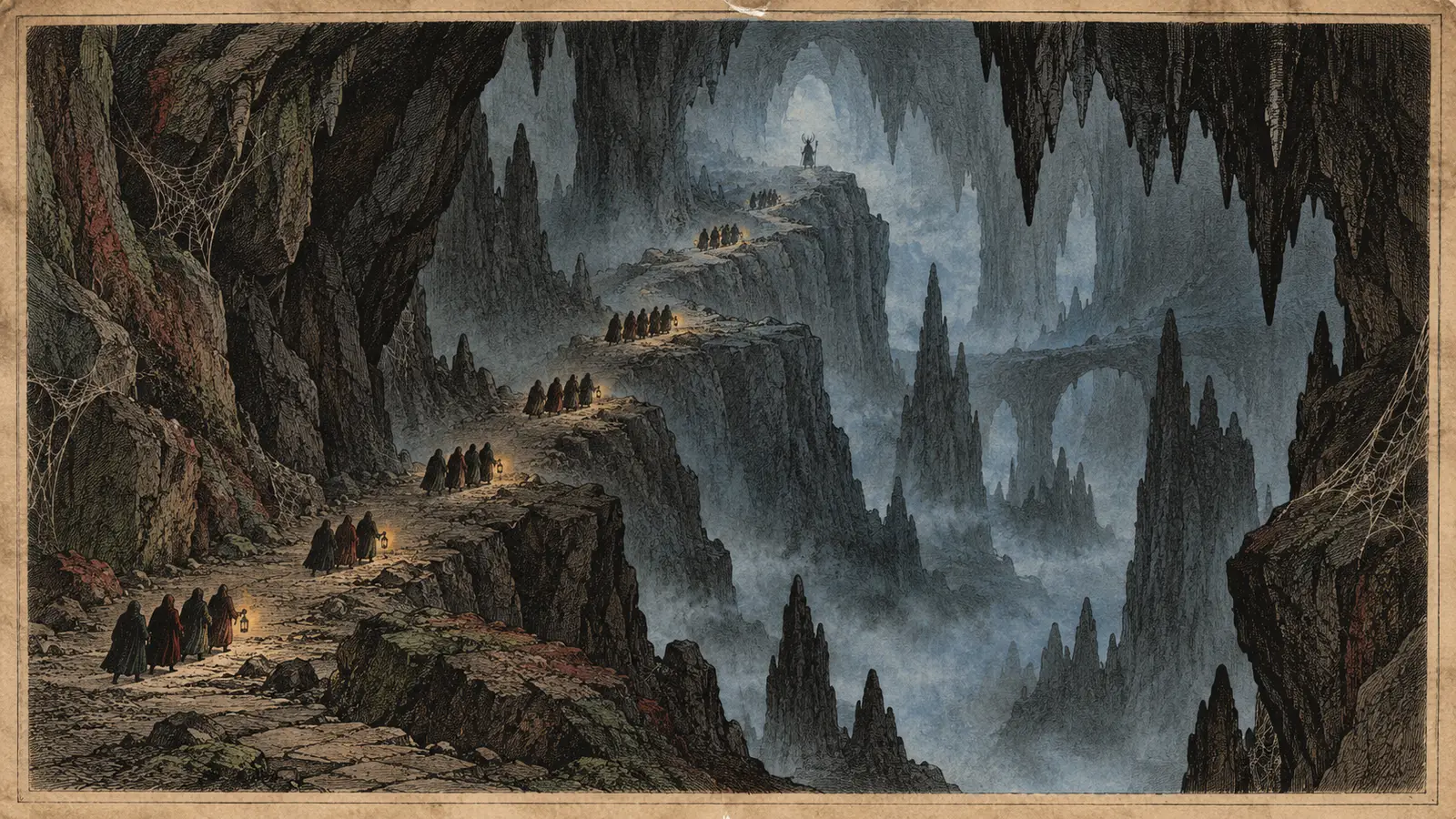
The third edition of the game arrived in 2000, published now by Wizards of the Coast, which had bought TSR a few years before. And in this edition stepped into the game's default pantheon, the set of gods that any campaign could use, no matter what world it was set in.
The new Deities and Demigods of 2002 described her as an intermediate deity, chaotic evil. Her portfolio covered spiders and evil, darkness and chaos, assassins and the drow. Her clerics could draw on the domains of Chaos, Darkness, Destruction, Evil, Trickery, the Drow and the Spider. The Realms' own god book of that year, Faiths and Pantheons, gave her the same rank. Her realm, the Pits, was still the sixty-sixth layer of the .
But before the great story of this era, there was a smaller one in , her first home, and it's one of the more cheerful things we'll meet tonight.
In 2001, published a novel called Queen of the Demonweb Pits, the last book in a trilogy that had begun with retellings of the old classic adventures. His heroes are an odd company. There's , a faerie princess with a sharp tongue. There's the , a grim and silent ranger. There's Enid, a sphinx, and Cinders, the sentient pelt of a hell hound, and Polk, who had been reincarnated as a badger, and a talking magic sword, and a young warrior named Henry. In the book before, they had gone down into the Vault of the Drow and defeated Lolth there, and she hadn't forgiven them.
So she takes her revenge. She opens gates and pours a demonic army into the lands of the Flanaess, and it sweeps through the kingdom of Furyondy. She gathers old enemies of Escalla and the Justicar to help her. And the companions go down into the Abyss, onto the Demonweb itself, and find their way to her steam-driven spider palace, the brass and iron walker from 1980 striding along the strands once more. At the end, Lolth is undone in a most undignified manner: she falls into a portable hole, a magical pocket of nothingness, which the heroes have filled with holy water. It's a comic and irreverent book, very unlike the solemn drow novels being written for the Realms at the same time, and it's pleasant to think of the Spider Queen, just once, losing to a badger and a faerie with a joke ready.
In the Realms, things were about to become very serious indeed.
In 2002 Wizards of the Coast ran what they called the Year of the Drow, a great event that tied together novels and adventures and game books around a single story. And the story was this. In the Year of Wild Magic, as the Realms count their years, Lolth stopped answering her priestesses.
Imagine it from a priestess's point of view. You've prayed to the Spider Queen your whole life. Every morning, kneeling in the temple, you've felt her answer, cold and sure, and with that answer came your spells. Your power to heal and to curse, to summon and to command, all of it comes from her, and all of drow society rests on it, because the priestesses rule by the goddess's gifts. And then one morning you pray, and there's nothing. You pray again. Still nothing. The next day, and the next. The spells don't come. The goddess doesn't answer. And slowly, the matron mothers of every drow city in the realise that it's the same for all of them.
The drow would call this the Silence of Lolth.
James Wyatt's adventure City of the Spider Queen, from that same year, shows what the Silence did to one city. Most of the drow cities held firm through their fear, keeping order with steel and wizardry. But one, a city called Maerimydra, fell into unrest. Its priestesses had nothing to hold it together, and enemies came pouring in, and the city was overrun. Desperate survivors began raiding the surface for whatever they could take. The heroes of the adventure follow those raids back down through the Underdark into the ruins, and at the bottom of it all they find a priestess of , the goddess of the undead, a rival power, waiting in the dark where Lolth's servants had been.
But the main story of the Silence was told in six novels, a series called War of the Spider Queen. R. A. Salvatore oversaw it, and each book had a different author: Dissolution by Richard Lee Byers and Insurrection by Thomas M. Reid, both in 2002; Condemnation by Richard Baker in 2003; Extinction by Lisa Smedman and Annihilation by Philip Athans in 2004; and finally Resurrection by Paul S. Kemp in 2005. Across them, a hand-picked band of drow sets out to discover where their goddess has gone. Let's follow them.
It begins in , in Dissolution. The city is frightened. The Archmage, , sends a wizard named , a master of the school of , sharp-witted and vain, to hunt down some renegade males who have been stirring up trouble. With him goes his friend , a weapons master, steady and quiet. What they uncover is a plot by renegade males to take the city, with an army of slaves behind them, thousands of kobolds and goblins and bugbears, and at the head of it all an illithid lich named Syrzan, a mind flayer that has outlived its own death. The revolt is put down. But the Silence goes on.
Other troubles are gathering. The caravans from , a sister city of the drow, have stopped arriving, and no one knows why. Ched Nasad's ambassador, Faeryl Zauvirr, has been betrayed to the Baenre matron and forbidden to leave. And within House Baenre itself, Gromph sends demons to kill his own sister, , the mistress of . She survives. At the end of the book a company is sent out to Ched Nasad to learn what has happened there: Pharaun and Ryld, Quenthel herself, her nephew , and Faeryl, the ambassador going home.
Jeggred deserves a word. He is a draegloth, a creature born of a demon and a drow priestess, eight feet tall, with four arms: great claws above and hands below. He is Quenthel's nephew, the son of her sister , and he follows his aunt like a terrible hound.
In Insurrection, they come to Ched Nasad, which is called the City of Shimmering Webs. It's built not on the floor of its cavern but hanging in the air within it, on enormous webs that have turned to stone over the centuries, so that its streets are calcified strands strung across a chasm. Picture a city of bridges, glowing faintly, with houses hung upon the threads like dew. But the Silence has torn the city apart. Refugees crowd its lower levels. The party takes rooms at an inn called the Flame and Serpent. And one matron, Ssipriina Zauvirr, Faeryl's mother, is plotting to destroy a rival house, House . She frames its matron for theft and hires mercenaries to finish the house off, grey dwarves of Clan .
The grey dwarves attack too early. And they bring with them stonefire bombs, firepots whose flames can burn even rock. In the fighting, the fire catches on the stone webs themselves. The calcified streets give way, strand after strand, and the City of Shimmering Webs falls into the chasm beneath it. Two survivors of House Melarn escape with the party through a portal: Melarn, a daughter of the house, and her servant Danifae Yauntyrr, a captive taken in battle, beautiful and patient and bound to her mistress by magic.
In Condemnation, the war comes to Menzoberranzan. A drow assassin named Nimor Imphraezl, of an order called the Jaezred Chaulssin who serve the god , has been working all along to bring down the city of Lolth. Disguised as a captain of one of the city's own houses, he leads Menzoberranzan's army, the Army of the Black Spider, into an ambush at a place called the Pillars of Woe. There a grey dwarf army waits, and beside it the horde of a half-demon warlord named Kaanyr Vhok, and one of the city's own houses turns its soldiers against their allies. The army falls back, and Menzoberranzan is besieged. Meanwhile the party visits a hidden drow house that worships Vhaeraun, where a priest named Tzirik shows them another way of being drow.
In Extinction, the party begins to look for a road to the Abyss itself. Pharaun summons and binds the demon who fathered Jeggred, a glabrezu named Belshazu, and from him learns of a demon ship that sails the Plane of Shadow and can carry them to the Abyss. But the company is fraying. Ryld and Halisstra leave it together and go up to the surface world, and there something remarkable happens. Halisstra, priestess of Lolth, turns to , the Dark Maiden, goddess of song and dance and moonlight. She turns out to be one of Eilistraee's chosen, and she's sent on a quest to find the Crescent Blade, a sword said to be able to cut off Lolth's head.
In Annihilation, Quenthel's company goes down through the Abyss at last and reaches the Demonweb Pits. And they find them empty.
This is one of the strangest and stillest images in all of Lolth's long story, so let it settle for a moment. The great web strung across the Abyss, which for so long had been thick with the lost souls of the plane flowing like a river toward their queen, is empty of souls. The strands hang in the mist. Across them lie dead and dying monsters and demons, especially goristros, huge horned demons sprawled on the web like flies that have been forgotten. There's no court here. No handmaidens. No queen. Only the web, very quiet, and something moving away beyond it. What the party finds there leads them out of the Abyss altogether, to another plane.
Back in Menzoberranzan, the Archmage Gromph duels a lichdrow, an undead drow lord named , the hidden master of the house that betrayed the city's army. Dyrr turns himself into a giant, and Gromph is turned to stone.
And then comes Resurrection.
The truth of the Silence was this. Lolth hadn't abandoned her people, nor had she been destroyed. She had gone into something like a hibernation. She had wrapped herself away, as a spider wraps itself in a cocoon, or as a creature in a chrysalis waits to become something else. And inside it, she was changing. She meant to make herself a greater goddess, and she meant to pull the Demonweb Pits out of the Abyss entirely, so that her realm would be no longer one layer among hundreds but a plane of her own.
While she slept, she was guarded. Her champion stood over her. Selvetarm was the son of Vhaeraun, and so Lolth's own grandson, though he was called the Son of Lolth, and he was her champion by his own choice. And Vhaeraun came. The Masked Lord saw his mother weak and wrapped away, and he tried to destroy her. Selvetarm fought him off and saved her. And in saving her, he gave up his own last chance to break free of her forever.
So the new Demonweb Pits is now its own plane, among the Lower Planes. It's barren, a wide and empty land, and it swarms with feral spiders tearing at each other. There are new creatures at its gate, the Abyssal widows, which had been prophesied to appear when the Silence ended, and they guard the passage from Lolth's ruined temple in the old Abyss to the new realm.
Across that barren land walk Quenthel, Pharaun, Jeggred and Danifae, toward Lolth's temple, where one of the women will be chosen as the Yor'thae, the Chosen of Lolth, the vessel through which the goddess will return. And behind them comes Halisstra with the Crescent Blade, and with her two priestesses of Eilistraee, Feliane and Uluyara, hoping to strike the Spider Queen down before her resurrection is complete.
It doesn't go as they hope. Danifae, the patient servant, kills Feliane and Uluyara and strikes Halisstra down and leaves her for dead. Halisstra wakes in a bitter rage, and her new faith breaks, and she turns back to Lolth. Of the three women who came to the temple, it is Danifae who becomes the Yor'thae. The goddess takes her into herself, and the servant girl from Ched Nasad becomes the new body of the Spider Queen. Quenthel goes home to Menzoberranzan as high priestess. And Halisstra is made into something new: the Lady Penitent, a slave of Lolth, demonic and sorrowful.
Lolth comes out of the Silence a greater goddess than she had ever been, with a plane of her own.
The story went on in a second trilogy, by Lisa Smedman, called The Lady Penitent: Sacrifice of the Widow and Storm of the Dead in 2007, and Ascendancy of the Last in 2008. In it, the Spider Queen, awake and stronger, wages war against her daughter Eilistraee for the souls of the drow of , and her chosen weapon is Halisstra, the Lady Penitent, who had once been Eilistraee's own.
In those years, the drow pantheon shattered. Vhaeraun went into his sister's realm to assassinate her, and lost, and was defeated, and Eilistraee took his portfolio and the souls of his worshippers into herself. Selvetarm, the champion who had saved Lolth in her cocoon, was slain by a follower of Eilistraee carrying the Crescent Blade. Kiaransalee, the goddess of the undead, was destroyed by Lolth and Eilistraee together, working side by side against her, each unwillingly. And at the very end, Halisstra herself, with the Crescent Blade in her hand, struck down Eilistraee while the goddess was manifesting in the body of her high priestess, Qilué Veladorn. The Dark Maiden died.
But there's a quiet turn at the very last. Lolth learned, too late, that before her death Eilistraee had redeemed a great many of the drow, about one in five of them, and turned them back into dark elves, the people they had been before the Descent. himself took up Eilistraee's realm and her mission of saving the drow. And Halisstra, at the end of her long road, was reborn as a demigod.
So the third edition era ends with the Spider Queen at the height of her power, alone above her people, her rivals scattered or dead, her realm a plane of its own. And that's where the next edition found her.
Chapter VIII
Fourth edition: the goddess of shadow and lies
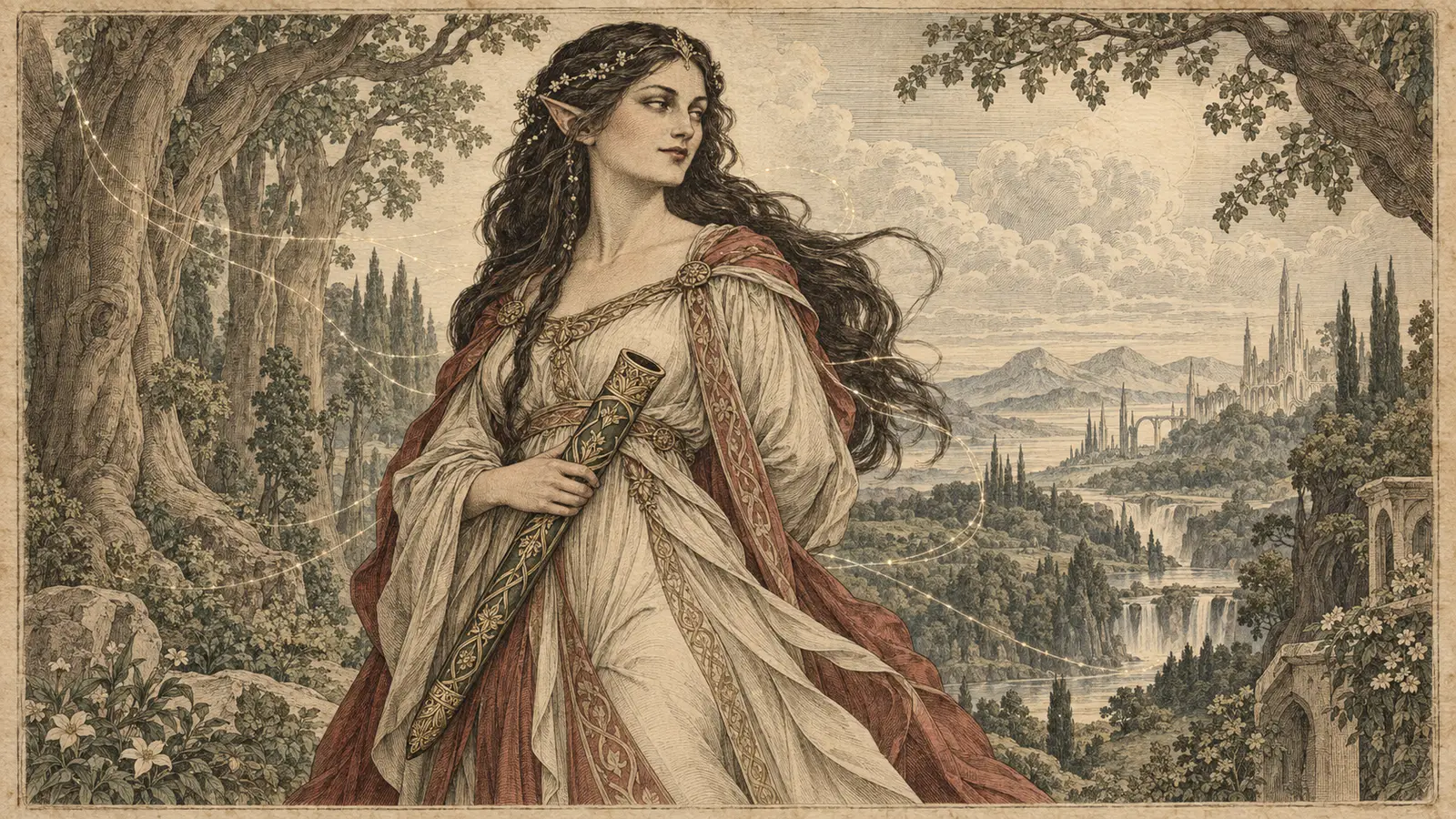
In 2008, the fourth edition of the game rearranged the whole cosmos. Gone was the great wheel of outer planes that had carried 's web for thirty years. In its place stood a new model, sometimes called the World Axis. The world sat at the centre. Beside it lay two echoes of it: the , bright and wild, where the fey and the eladrin dwell, and the , grey and sorrowful, the realm of shadow and death. Below, there was the Elemental Chaos, a boiling sea of raw elements, and at the very bottom of it, like a wound, lay the . And above everything stretched the Astral Sea, a silver ocean of thought, where the gods kept their dominions.
In this new cosmos, Lolth was one of the core gods named in the Player's Handbook of 2008, and her portfolio had a darker poetry to it. She was the chaotic evil god of shadow, of lies, and of spiders, patron of the drow. She kept all her old titles, the Spider Queen, the Queen of the Pits, even the Demon Queen of Spiders, though she was now a god among gods. Her commands were scheming and treachery. Her clerics were always women, and they ruled drow society, and they stabbed one another in the back for power and for her favour. The book called them a constant force of disruption in the otherwise stable society of the evil drow. That's a wry phrase, and an accurate one. Without the priestesses, the drow might have settled into a merely ordinary wickedness. With them, nothing ever settles at all.
Her realm, the Demonweb Pits, now stood apart from the Abyss, in keeping with the story of the Silence. Fourth edition's planar books placed it among the dominions of the gods, out in the Astral Sea, rather than at the bottom of the Elemental Chaos with the demons. She had climbed out.
Fourth edition told the elven myth again, in its own key. In an article in Dragon magazine in 2010, the elves of this cosmos were said to have arisen from the tears of . He wept them in the days before Lolth's fall, when he lived in perfect harmony with her and her sister . He wept tears of sorrow, of beauty and of mirth. From the tears of sorrow came the dark elves. From the tears of beauty came the high elves. From the tears of mirth came the wood elves. So in this telling Lolth is Sehanine's sister, and the drow are born from grief, and you can picture the three of them, long ago, sitting together in the first light of the world before anything went wrong.
There were shadowy tellings too, of a great war among the fey, an Elfwar in the Feywild that began as the gods fought the primordial titans, and ended when Lolth fled with her people down into the dark beneath the world. But the clearest picture this edition gave of her was a portrait in the field.
In 2010, the Monster Manual 3 chose Lolth as its emblem, and gave her, for the first time in this edition, a full set of statistics as a creature to be faced. She was meant to be the final opponent of the most powerful heroes the game could produce, and indeed a little beyond them, since she was set above the highest level a character could reach. And she was fought in two stages. First the heroes meet the drow form, the beautiful dark elf, subtle and elusive, a lurker who strikes from the shadows. When that form is overcome, it isn't the end. She becomes Lolth the Spider Queen, a huge demonic spider, and the fight begins again against a brute of terrible strength. The book that carried her also refreshed the lore of the drow around her.
Her handmaidens, the yochlols, came too, shapeshifting demons who could wear the forms of drow or spiders, and whose true shape looked like a mass of something half-melted, like molten wax or slime, with a hateful eye glaring out of it.
The adventures of this edition sent heroes into her territory. Demon Queen's Enclave, by Noonan and Chris Sims, published in 2008, takes them to Phaervorul, a small drow settlement deep in the , where Lolth's minions are spinning plots. But Phaervorul is under siege, by an army of demons and undead sent by a follower of , the demon prince of the dead, and the drow inside have split into rival factions. A clever party can play those factions against one another, which is, after all, exactly what Lolth would do.
In the Forgotten Realms, a disaster called the had torn through the world, and the setting had leapt forward a whole century in time. When the story picked up again, the drow pantheon was nearly gone.
We saw it break in the last chapter. , defeated by his sister. , slain by the Crescent Blade. , destroyed. , struck down by the Lady Penitent. had left the Demonweb and gone his own way. And , the goddess of assassins and illusion, had already been swallowed up long before, during the Time of Troubles, when Lolth took her role as her own, so that the Spider Queen added assassins and chaos to the things she ruled.
So by the new century of the Realms, a hundred years after the Silence, Lolth stood alone. She was, in effect, the only goddess of the drow. There was no Dark Maiden calling her people to the moonlight. No Masked Lord whispering to the men. No mad god of oozes waiting in the deep. Only her.
A late book of this era, Menzoberranzan: City of Intrigue, by R. James and Eric Menge, published in 2012, brought the City of Spiders forward through all these changes, showing how the war of the Spider Queen had reshaped it. It had a chapter called "The Way of Lolth", and another called "Be a Drow", which invited players to live as dark elves in the city themselves. Salvatore, meanwhile, carried forward into this changed world in a series of novels beginning with Gauntlgrym in 2010.
And there's one more story at the end of this era, a quiet and very ambitious one.
In the Spellplague, , the goddess of magic, had died, and the Weave, the great fabric of magic that she tended, was torn. And Lolth, the Weaver of Destiny who had become the Spider Queen, saw something she understood very well: a web, broken, waiting for a new weaver. So she tried to weave a new one. She called it the Demon Weave, and with it she meant to make herself the goddess of all arcane magic.
She sent her avatar out into the drow cities, and that avatar was Danifae, the Yor'thae, the servant girl from who had become the goddess's body. Lolth's followers went up to the surface and gathered things of power: relics from before the Spellplague, items touched by the blue fire of that disaster, things sacred to Mystra, places where primordial energy still pooled. All of it, they were told, would go into the Demon Weave.
But in truth, she was only leeching at what was left of Mystra's Weave, the last remaining strands, and those strands were holding back another catastrophe. Pulling at them was dangerous for everyone. And then Mystra came back, and the plan unravelled.
It's a fitting ending for the edition, in its way. The Spider Queen reached for the great web of magic itself, the thread underneath everything, and almost had it.
Chapter IX
Fifth edition: out of the Abyss, and the oldest quarrel retold
The fifth edition of the game arrived in 2014, and in its Player's Handbook the drow were a branch of the elves that players could choose. The book told the old story in a few lines: the drow had been banished from the surface world for following the goddess down the path to evil and corruption, and they had built their civilisation in the , shaped by what the book called the Way of Lolth. A drow, in these pages, has skin black as polished obsidian, hair of stark white or pale yellow, and pale eyes, lilac or silver, pink or red or blue. They see in the dark with uncanny clarity. They carry a little innate magic, the power to call up dancing lights and to wrap an enemy in faerie fire or in darkness. And they suffer in the sun, half-blinded by daylight, the long inheritance of a people who've lived beneath the earth for thousands of years.
The great story of Lolth in this edition arrived the next year, in 2015, in an adventure called Out of the Abyss. It was made by Wizards of the Coast with Green Ronin Publishing, with Christopher Perkins among its lead designers, and it was part of a wider tale called Rage of Demons, which ran through novels and a video game and the tables of organised play all at once.
Here's how it begins. The Underdark is full of a strange ambient magic called the faerzress, a kind of faint radiance that soaks the stone, bending spells and confusing the senses. And in , , the Archmage, who has been the most powerful male wizard in the city for centuries, feels held down and betrayed by Lolth and her priestesses. He had hoped, it's said, to rise at last to equal standing with them. Then he learned that the goddess wanted women to be wizards too, so that the men would stay beneath forever. In his anger, he worked a great spell through the faerzress. It opened the way to the .
And up through it came the demon lords. Eight of them were pulled from their Abyssal realms into the Underdark: , the horned lord of beasts; , the two-headed Prince of Demons, whose long road through myth we followed in an earlier episode; , the prince of deception; , the dark prince; , the faceless lord of slime; , the prince of undeath; , the gnoll lord; and , the lady of fungi. Each of them came into the deep places of the world, and madness spread out from them through the caverns like rot.
Lolth wasn't summoned. Of all the great lords of the Abyss, she alone stayed home.
That's the secret at the heart of Out of the Abyss. Lolth was the hidden mastermind of the whole disaster. She had steered Gromph all along, the angry archmage dancing on her threads. With the other demon lords drawn up out of the Abyss and stranded in the Underdark, their layers lay empty, and she meant to fill them with her own spawn and make the Abyss hers. And she had prepared for one more thing. Ordinarily, when a demon is slain outside the Abyss, it isn't truly destroyed; its essence is flung home and must wait a hundred years before it can return. Lolth used the Underdark's own deep magic to undo that rule, but only there. If a demon lord died in the Underdark, it would be destroyed for good. She had, in other words, built a trap for her rivals as large as the underworld itself.
The heroes begin as prisoners, which is a lovely, uncomfortable place to start. They wake in cages in a drow outpost called Velkynvelve, a cluster of chambers hung among the stalactites above an underground lake, waiting to be taken to Menzoberranzan as slaves. Their jailer is a cruel priestess of Lolth, Mistress Ilvara of House . They escape, of course, and then they're running through an Underdark that the Abyss is slowly seeping into.
Their road winds through many places. , the city of the deep gnomes. , an ancient library of stone where the dreams of stone giants are kept. And at last, perhaps, Menzoberranzan itself. Along the way they meet Vizeran DeVir, an exiled drow archmage who lives in a tower called Araj. He's the last of House DeVir, the house that fell on the night was born, and he has never stopped planning his revenge on the City of Spiders. Vizeran has worked out that Lolth is behind it all. He offers the heroes a ritual, the Dark Heart, which can gather the demon lords together and send them home. He tells them it will require the life of an innocent. The adventure hints that this may be a lie, a little cruelty of his own folded into the plan. If the heroes follow his road, the last battles with the demon lords take place in Menzoberranzan, in the very heart of Lolth's city.
And beyond that, if a Dungeon Master wishes, the heroes can go on, all the way to the Pits, to face Lolth herself. The Demonweb, by now, is still called the sixty-sixth layer of the Abyss, but only by old habit. Since the Silence, it has grown away from the Abyss into its own place, the way a web strung between two branches might, over time, find itself hanging free.
Through most of Out of the Abyss, though, Lolth never appears at all. She's the unseen one. The demon lords stamp and roar through the caverns, and above them, out of sight, the threads tremble.
Salvatore told the same events from inside the drow city in his Homecoming novels: Archmage in 2015, and Maestro and Hero in 2016. In them, a psionicist named Kimmuriel teaches Gromph the powerful spell that, in the end, calls Demogorgon himself up into the region of Menzoberranzan. Drizzt goes back to the city of his birth. And when the demon hordes at last withdraw and an uneasy peace returns to the Underdark, the matron mothers argue over what is to be done with him. Behind all of it, again, is the Spider Queen's scheming.
In 2018 came Mordenkainen's Tome of Foes, a book about the great conflicts of the multiverse: demons against devils, githyanki against githzerai, dwarves against grey dwarves, and elves against drow. And in its chapter on the elves, it told the oldest quarrel once more, in a new way. This is a later retelling, and it's best simply to hear it as a story told by a different voice.
In the beginning, it says, had no fixed form. Corellon could be a flock of birds, or a river, or a woman, or a man, or a chuckling stream, a teasing breeze, a beam of light, whatever the moment called for. When Corellon fought the orc god , in a great war long ago, drops of Corellon's blood fell, and from them came the first elves. And like Corellon, those first elves had no fixed shape. They were primal and ever-changing. They could become whatever they chose.
Lolth was one of them, raised above the rest into the company of the elven gods. But she was unhappy as Corellon's subject. And so she did something none of them had done. She took a fixed form, and kept it. She named herself Lolth, in defiance of the name she'd been given. And she went among the other elves and urged them to do the same. Fix your forms, she told them. Choose a shape and hold it. Give up this endless changing, and you'll have power, and weight, and mastery over every other kind of life. It would cost them only their freedom, the shifting, flowing liberty that Corellon embodied.
Gods and elves divided into two camps over it. Those who would become the drow gathered around Lolth. And then, one day, when Corellon was lost in thought, Lolth crept up and tried to strike a killing blow. The elves loyal to Corellon threw themselves in the way and blunted the strike. Lolth's followers stood aloof and did nothing at all.
Lolth and Corellon parted then, forever. Lolth became a demon lord of the Abyss, banished to the Demonweb, a layer made of one vast spider web. And Corellon, wounded by the betrayal, could no longer trust any of his children, not even those who had defended him. So Corellon cast all the elves out of . They fell into the , and as they fell their forms became fixed, the shapes they still wear today. From the Feywild, curious and restless and hungry for experience, they spread out to and to other worlds. And the elves who had most revered Lolth became the drow, and went down into the harsh dark of the Underdark.
It's a different story from the tale of and the shattering sword, but you can feel the same bones in it. A beloved companion of the elven father, a betrayal, an attack, a fall into the Abyss, and a people cast out with her.
The Tome of Foes also described drow life under Lolth in this age, and it gave her a particular quality. She is, the book says, a hands-on parent. She sometimes tests her most faithful by drawing their spirits to her in the Demonweb to undergo her judgment. Followers never know when or if they are to be tested. Think about that as you drift. Any night, any priestess of Menzoberranzan might close her eyes and find herself somewhere else, on a strand of web in the mist, being weighed.
Drow society in these pages is a strict matriarchy, the men subordinate, the whole people preoccupied with Lolth's favour. She sanctions murder, and the wiping out of whole noble houses as they compete for rank. The matron mothers, high priestesses all, stand second only to Lolth herself. The book gave them a form to match: the drow matron mother, one of the most formidable creatures of her kind, attended by servants and demons, and touched by something called Lolth's Fickle Favor, a blessing she can lay on one of her own allies. It wounds the ally, and at the same time sharpens their next strike. That's the Spider Queen's love in miniature. It always draws blood.
The Realms, meanwhile, had passed through another great upheaval, the Second Sundering, in which the overgod Ao rewrote the Tablets of Fate and set the world back into a shape closer to its old one. Lost gods came home. Among them were and . Both, it turned out, had never truly perished. They had been held in stasis within the Weave of magic, sleeping, like flies wrapped in silk, until the world was ready for them again. And when they returned, the old enemies came back to a truce, and even something like friendship, though their followers still clash. Ed has said they're allies now. Eilistraee moved her realm back to Arvandor, among the gods of the elves, keeping only a small, mostly empty realm within the Demonweb. And , the champion who had once saved Lolth from her own son, was restored as well.
So in this age, the Spider Queen is no longer alone. Her daughter dances again in the moonlight, and her son walks again in his mask, and they walk together. And in 2022, Monsters of the Multiverse gathered and revised the drow and their matron mothers for a new generation of tables, keeping her servants close at hand.
We've followed Lolth's main thread from the Vault through the Silence and into this new age. Before we come to the present day, let's step sideways for a while and look at some of the other threads in her web: the different worlds she has touched, the gods who stand beside her and against her, and the strange family of spider-creatures who serve her.
Chapter X
Variants and offshoots: other worlds, other gods, and the spider kin
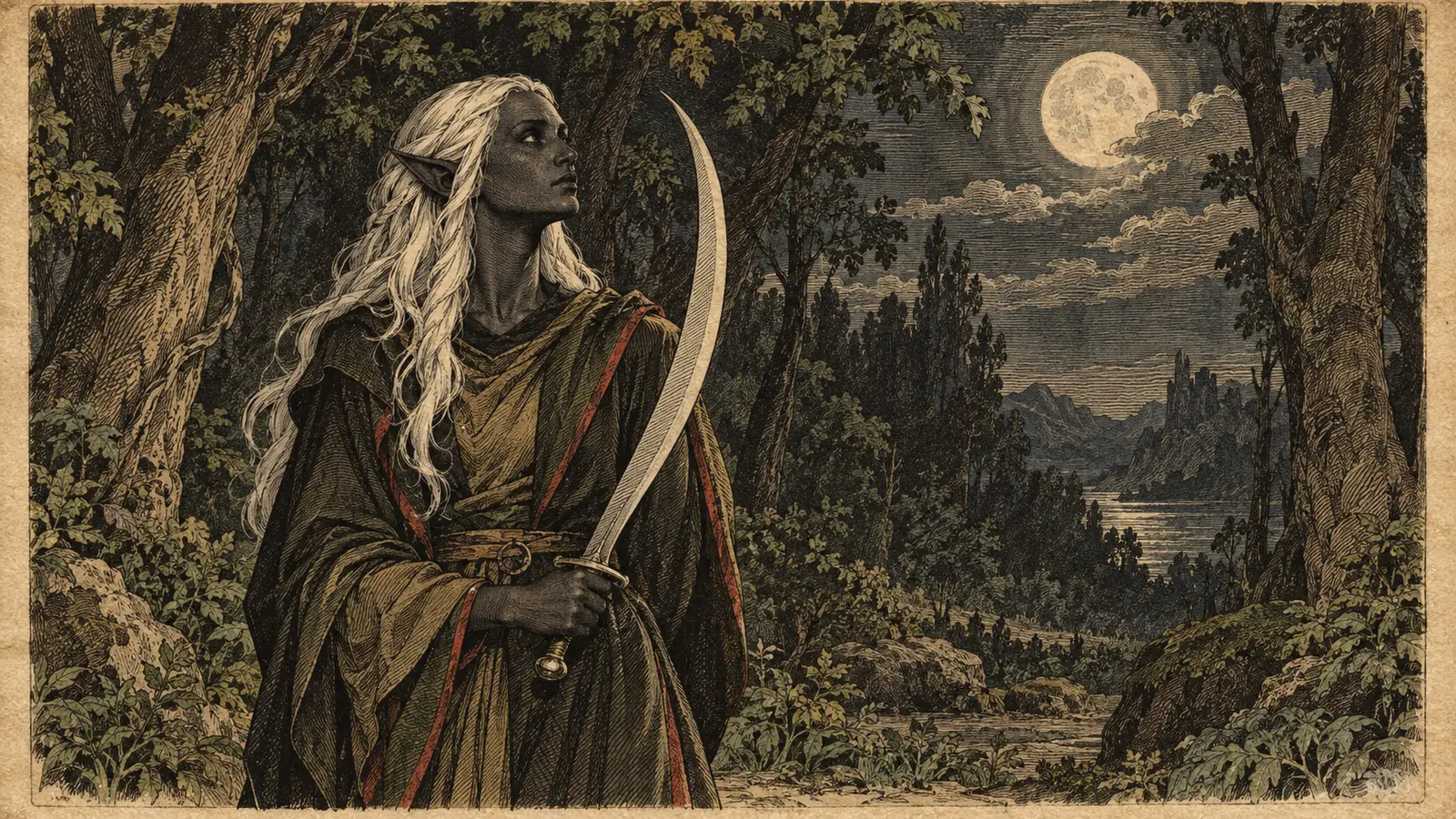
began in , and in Greyhawk she has a life of her own, somewhat apart from the great story of the Realms.
On , Greyhawk's world, her city remains Erelhei-Cinlu, in the Vault of the Drow, and her temple remains the Fane, standing in its ochre cavern above the city. The quarrel we met in 1978 went on there after the adventurers had come and gone. With House Eilservs fallen, its ally House Tormtor stepped forward. Tormtor made war on the other houses of the Vault, and announced that it too had turned away from the Spider Queen, this time not to the but to , the goddess of the undead, newly militant and hungry for followers. So the Vault, which had already given Lolth one rebellion, gave her another.
himself returned to these questions in his later writing about Oerth, and he added a shadow behind them. All along, he suggested, Lolth and the demon lord Iuz and , the lady of fungi, and the Elder Elemental Eye had all been fooled by a ruse. The trick was played by , the imprisoned Dark God of decay and entropy and madness, chained away in some forgotten place, who had used them all as unknowing instruments. In the end, only the Elder Elemental Eye still serves as a funnel for Tharizdun's power. Lolth remains alive and active on Oerth, a schemer who once found herself, just for a while, inside someone else's web.
Greyhawk's is the old one: the sixty-sixth layer of the , the web across space, the iron spider fortress crawling along the strands. Three powers live there: Lolth herself, her consort Keptolo, a drow god of that world, and her champion . And Greyhawk's drow pantheon has Lolth as its leader, with Kiaransalee, and beneath her, and one good goddess, , apart from the rest. In the Realms, by contrast, Zinzerena was destroyed or banished by Lolth long ago.
In the Realms, the drow gods are called the Dark , a dark mirror of the elven gods of . But it's a pantheon in name only. Its members are Eilistraee, , who is called That Which Lurks, Kiaransalee, who is called the Revenancer, Selvetarm, who is called the Spider that Waits, and Vhaeraun, the Masked Lord. Lolth dominates them all. Only the two weakest, Kiaransalee and Selvetarm, ever accepted her as their leader and served her as allies. And even they weren't much regarded. Most drow who had heard of Kiaransalee thought her an undead madwoman, a goddess only in her own imagination. Selvetarm was almost forgotten.
Her rivals have their own stories.
Ghaunadaur was the only rival most drow could feel at all. Lolth feared that he might one day draw her people over to his side, though in truth he cared too little for drow affairs to win many followers. There's a strange little story about the two of them. Once, when they shared a realm, Ghaunadaur declared his love for Lolth. She prized beauty above almost everything, and he, a vast and shapeless thing of slime, had none. She rejected him. Perhaps that's where the enmity began, or perhaps it only sharpened it. Either way, it ran deep. In the old drow city of Llurth Dreier, the faithful of Lolth and of Ghaunadaur fought a long religious war called the Webfire Wars, and it lasted nearly three hundred years.
Another rival was a demon lord named Zanassu, who challenged Lolth's rule over spiders, which was not something she would tolerate. She didn't deal with him herself. Instead she went to Selvetarm. Selvetarm, in those days, had met Eilistraee, and admired her, and had begun, a little, to turn toward the good. Lolth told him that if he killed Zanassu, Eilistraee would be grateful. So he did. He slew the demon lord and absorbed his essence. And the demon's essence overwhelmed him, and weakened him, and in his weakness Lolth bound him to her will. That's how she came by her champion. It's a very Lolthian kind of victory: one rival destroyed, one rival enslaved, and all of it done with a single kind word.
Her oldest enmity of all is with and the gods of the elves. , the orc god, was once her ally, in the days of 's treachery, though there's no love between them now.
Then there are her children. Vhaeraun, the Masked Lord, her son, has been her rival for as long as there have been drow, the god of the men who resist her. Eilistraee, the Dark Maiden, her daughter, has been her opposite, a goddess of moonlight and dance and swords and kindness, calling the drow up out of the dark. And Selvetarm, the Spider that Waits, her grandson by Vhaeraun, is the one she captured.
And then there are the creatures of her household, her servants and her spider kin, and they make a strange and memorable family.
The yochlols, the Handmaidens of Lolth, are lesser demons who serve her personally. Priestesses summon them to witness sacrifices. Outside the Abyss they may appear as beautiful drow women or as monstrous spiders. But their true form, in their own place, is something stranger: a pillar of slime with a single malevolent eye. And in the Spider Queen's realm, they outrank even demons far more powerful than themselves, because they are hers.
There's also an order of priestesses called the Handmaidens of the Spider Queen, or the Daughters of the Yochlol. They belong to no single city. Lolth sends them when an entire city needs bringing back into line, and they arrive, and the city remembers its goddess.
There's an order of men too, which is rare enough to be worth noticing. The Militant Myrlochar, the Order of Soul Spiders, are male crusaders of Lolth, an elite fighting order found only in those few drow cities where she allows men into her priesthood at all.
The driders have a sorrowful story. When a drow shows great promise, Lolth may summon them to the Demonweb Pits for a test of faith and strength. Those who pass return honoured. Those who fail are changed. Their lower bodies swell into the body of a giant spider, and they are sent back as driders, half drow and half spider, each one a failure in the Spider Queen's eyes, cast out from the society that once held them up. When you picture a drider in the dark, you might remember that each one was once someone who tried very hard to please her.
The draegloths are something else: half-demon, half-drow, born when a glabrezu demon is joined with a newly ordained high priestess of Lolth. They stand about eight feet tall, with four arms, great claws above and smaller hands below, and their birth is taken as a sign of the goddess's favour. , whom we met on the road through the Silence, is the best known of them.
Deeper still are the chitines and choldriths, part-elf and part-spider, made by magic. The chitines began as failed experiments of the drow, small creatures with four double-jointed arms. The choldriths are their priests, bloated, sickly white spiders with humanoid heads, whose front legs serve them as arms. They live in the and build everything from web: their homes, their traps, their clothing and their weapons. And in her realm there are other spiders too, songspiders and stranger things, and the Abyssal widows who guard her gate.
Lolth has crossed into other worlds beyond Greyhawk and the Realms. In , the world of the Critical Role games, as described in Matthew Mercer's Explorer's Guide to Wildemount, Lolth the Spider Queen is one of the Betrayer Gods, alongside Tharizdun, the Chained Oblivion. In an ancient age called the Age of Arcanum, the Betrayer Gods rose in rebellion against the Prime Deities, and their war brought about the Calamity, a catastrophe that nearly ended that world. They were exiled after, but they still reach in.
And there are worlds where she isn't, which tell us something too. In , Keith Baker's world of airships and lightning rail, the drow fled long ago into the jungles of a southern continent called and built traditions of their own. Most of them worship Vulkoor, an evil god in the shape of a scorpion, and others revere the primal spirits. Baker has advised that in his world it's the scorpion, not the spider. There, at least, the drow have never heard her name.
Now let's come to the table, where all this lore turns into an evening's play, and see what it's like to face the Spider Queen, or to serve her, or to walk away.
Chapter XI
Lolth at the table
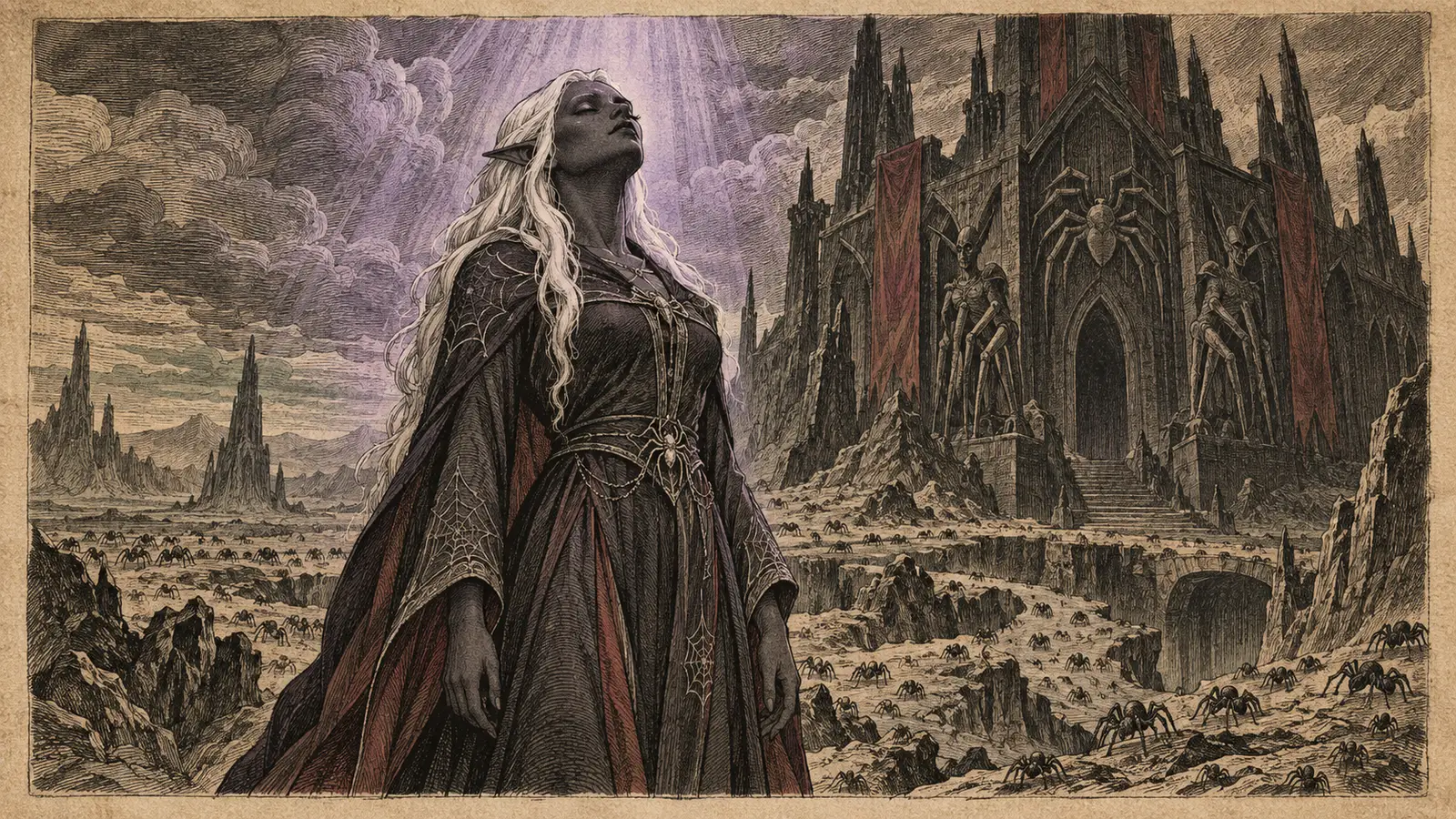
The first thing to say about playing beneath the Spider Queen is that, for a while, her door was a death sentence.
When Vault of the Drow came out in 1978, it carried a gate to the , beyond the Egg, meant to lead into the next adventure. But the next adventure didn't come for two years. And so, around the world, in game after game, adventurers who had fought their way down through the giants and the deep caverns and the drow city stepped bravely through 's gate, and the Dungeon Master, with no sequel to send them to, simply told them they were dead. You can imagine the long faces around the table. It's one of the odder rites of passage in the game's early years.
When Queen of the Pits did arrive, it was a hard and peculiar place to play. The heroes are trapped in the maze of the Demonweb, and the adventure warns that its rules aren't the rules of home. Many spells and magical effects don't behave as expected on the web. A wizard reaching for a familiar spell might find it twisting in their hands. The levels of the maze are long corridors of fog-bound strands, and some players found them wearyingly alike, endless passages about twenty feet wide with little to explore. Others loved the doors to other worlds, and especially the finale aboard the walking iron spider, whose layout players have praised ever since.
Lolth herself, in that first fight, was a curious opponent. She was terribly hard to strike, with a magical armour beyond nearly anything else in the game at the time. And yet she had only sixty-six hit points, a modest number for a goddess. A Dungeon Master who used her powers cleverly could destroy a whole party of the recommended level. A careless one might see her fall in a single round. So she was a test of the Dungeon Master as much as of the players, a queen whose danger lay in how she was played.
In third edition, she came to the table mostly through her priests. A cleric of Lolth chose from her domains: Chaos, Darkness, Destruction, Evil, Trickery, the Drow and the Spider. You could build a priestess wrapped in shadow and lies, or one who called down destruction, or one who walked with spiders.
In fourth edition she became the ultimate battle, the two-stage fight from the Monster Manual 3: first the beautiful drow, elusive and commanding, then the great demonic spider. And true to her nature she was written to slip away rather than be destroyed when the fight turned against her. The heroes might win, but the Spider Queen doesn't stay dead.
In fifth edition, most tables meet her through her servants, and they're a vivid lot. The drow priestess of Lolth, from the 2014 Monster Manual, carries a poisoned scourge and a store of spells, and she can try to summon a demon. Most of the time the summoning fails, and the priestess pays for it with a jolt of psychic pain. But sometimes, perhaps three times in ten, the call is answered, and a yochlol arrives, a handmaiden of the goddess far more dangerous than the priestess who called it. It can spin webs at will and take hold of a mind, and it can stand between the heroes and the priestess while she slips away. It's a lovely piece of design, because it captures the gamble of serving Lolth. You call, and sometimes she answers, and you never know which it will be.
The Tome of Foes added more. There's the drow house captain, a warrior who fights with a blade and a hand crossbow or a whip. There's the drow inquisitor, a priestess whose duty is to root out traitors to the faith. And there's the matron mother, one of the most powerful creatures a drow-themed campaign can offer, second only to the goddess herself. She casts her spells first, and fights second, and surrounds herself with servants and demons. Her gift of Lolth's Fickle Favor, which wounds an ally even as it strengthens them, gives a table a small, sharp taste of what it means to be loved by the Spider Queen.
Out of the Abyss gives perhaps the fullest experience of Lolth at the table, because she's never there. The players begin in cages in Velkynvelve, under the eye of Mistress Ilvara. They escape into the with no gear and few friends, scrounging for food and light, and as the demon lords move through the caverns, madness spreads. The adventure asks players to let their characters' minds crack a little, to play out strange fears and compulsions as the Abyss seeps in. And all the while the real villain is somewhere above them, unseen, pulling threads. A table can play the whole campaign and never once see her face, and still feel her everywhere.
Then there's the other side of the table: serving her, or refusing to.
Since 1985 and Unearthed Arcana, players have been able to take on the role of a drow, and from the first that role has carried an exile's story. In fifth edition, a drow character comes with darkvision that pierces the deepest gloom, with the old innate magics of dancing lights and faerie fire and darkness, and with sensitivity to sunlight that makes the surface world hard going. Players grumble about that last part, sometimes, in campaigns spent mostly out of doors, but it's the weight of a people who've lived too long in the dark.
Many of those characters are renegades in 's mould, drow who walked away from the Spider Queen and came up into a world that fears them. Some players go the other way and play a priestess of Lolth, scheming and proud, perhaps a cleric of the trickery domain, wrapped in invisibility and lies. If you play one, the lore gives you plenty to work with. Lolth drives her worshippers to fight among themselves, saying it culls the weak, while her true aim is total control and the silencing of any other faith. Her clergy is almost all women, because those who most resemble her image are the most honoured. And the cities revolve around the priestesses who channel her favour. A priestess of Lolth is always one prayer away from glory, and one failure away from becoming a drider.
From the table, then, let's step out into the wider world, and look at how far the Spider Queen's web has reached beyond the game.
Chapter XII
Legacy: the Spider Queen beyond the table
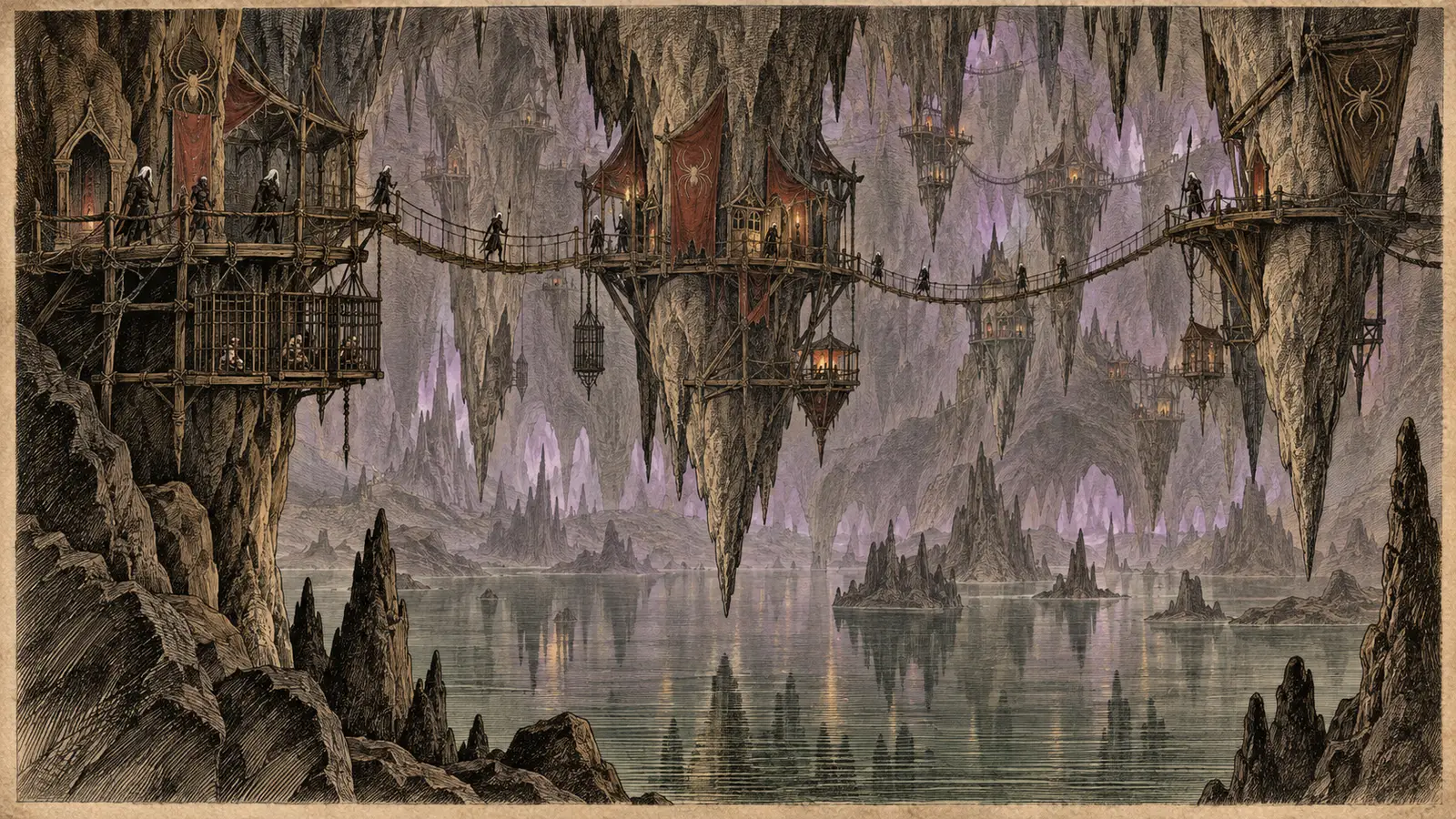
When Salvatore's editor asked him whether he could spell , and he said not a chance, neither of them could have guessed what would follow. Over the decades, the story of the drow ranger who walked away from the Spider Queen became one of the best-loved threads in all of fantasy fiction. And in a way that's quietly remarkable, it changed how many readers thought about the drow.
In Salvatore's books the drow aren't simply monsters. They're people raised inside a terrible system, by a goddess who needs them cruel. That idea opened up long conversations among readers about prejudice and identity, about what you're born to and what you choose. And it set in her lasting place in the story: she's the force a hero defies. Drizzt's whole life is a refusal of her, and every reader who has followed him has followed that refusal too.
Homeland was adapted into a comic, written by Andrew Dabb and drawn by Tim Seeley under Salvatore's guidance, and collected as a graphic novel in 2005. It opens, as the book does, with the third son meant for Lolth.
's Starlight and Shadows books, Daughter of the Drow, Tangled Webs and Windwalker, followed out of the shadow of the Spider Queen. The War of the Spider Queen told the Silence in six novels, and Lisa Smedman's Lady Penitent books carried it on into war between Lolth and her daughter.
And Salvatore returned to in a trilogy called The Way of the Drow: Starlight Enclave in 2021, Glacier's Edge in 2022, and Lolth's Warrior in 2023. In that last book, the City of Spiders is restless. Drizzt's legend has grown so large that it has reached even there, and many drow, including those of the most powerful house and its matron mother, have begun to question the Spider Queen's influence over them, and even the history of the city's founding. Open conflict breaks out between Lolth's faithful and those drow who, as the book puts it, demand more, and demand better. The memory of Yvonnel the Eternal, the long-dead Baenre matron, lies at the heart of the goddess's anger. It's a long way from the night Drizzt was born, when no one in the city would have dreamed of asking such questions aloud.
The Spider Queen has walked through video games too.
In 1994, a game called Menzoberranzan, made by SSI and DreamForge, took players into the drow city. It begins with a raid: dark elves come up out of the earth in the night, burn the heroes' village, and carry the villagers away. The heroes follow them down and down into the great cavern, drawing on the boxed set of the city made two years before.
A few years later came Descent to Undermountain, set in the great dungeon beneath the city of . In it, the heroes hunt for the eight pieces of an amulet that controls a weapon called the Flame Sword of Lolth. In the finale, a statue is put back together, and the Spider Goddess comes through it as a giant drider avatar, and the heroes must defeat her. The game itself was not kindly remembered, but its image of Lolth bursting from a restored statue in the depths has a certain grandeur.
In 2000, Baldur's Gate II: Shadows of Amn sent its heroes down into the , to the drow city of Ust Natha. To go there safely, they had to wear a disguise: a silver dragon named Adalon wove an illusion over them, so that they walked among the drow looking like drow themselves. Ust Natha has a Temple of Lolth, and in it a Handmaiden of Lolth named Imrae gives the party their first task. The city's matron is Ardulace, and her daughter Phaere orders the disguised heroes to kill a drow named Solaufein, who has been their contact. But Solaufein has his own quiet plot against the city's cruelty, and the heroes can choose to join him instead. It's a small mirror of Drizzt's story, set inside the game: a drow who doesn't belong to the Spider Queen, waiting for someone to help.
The online game Neverwinter has carried Salvatore's drow for years, and in 2023 it went all the way to the bottom. Its module called Menzoberranzan, announced that March, shows the City of Spiders near civil war, Lolth's loyalists fighting a drow rebellion, while a long-forgotten artifact threatens to turn everything the goddess's way. Its next module, Demonweb Pits, opened in July 2023 and closed the story, with players saving Menzoberranzan from Lolth herself.
And then, in August 2023, came Baldur's Gate 3, made by Studios. It became one of the most celebrated games of its time, winning Game of the Year at The Game Awards and gathering well over ten million players. And through it, the Spider Queen reached more people than ever before.
A player who chooses to be a drow in that game must choose between two kinds. One is the Lolth-sworn drow, with red eyes, raised in the Spider Queen's faith. When a Lolth-sworn character speaks, they're offered words that are cruel, threats and coldness, the habits of a people taught to be hard. The other is the drow, those who turned away from Lolth toward the gods of the elves. It's Drizzt's choice, offered to every player at the very first screen.
The game describes the goddess in its own words: the much-reviled matriarch of the drow pantheon, Lolth holds sway over spiders, the Underdark, and the wicked creatures of the Pits; her primary goal is to corrupt all drow, transforming them into heartless cultists.
Its most memorable drow is Baenre, of the First House of Menzoberranzan, voiced and performed by Emma Gregory. Minthara is a paladin of vengeance, raised in Lolth's faith and sworn to hunt down her goddess's enemies. She grew up surrounded by assassination attempts, from the cradle onward, and her own mother was among those who tried. When cultists of a new and strange power called the Absolute came to Menzoberranzan, she killed them and questioned their corpses to learn where they'd come from. But a man named welcomed her to a feast and offered an alliance, and she let down her guard, and her mind was turned. Because she broke her oath to Lolth in that turning, she calls herself an oathbreaker. And as a companion, she can come, in time, to reject divine masters altogether. In one line she says it plainly. , Lolth, the Absolute: they do not have followers, they only have victims, and they reward devotion with death.
The Spider Queen has found her way onto cards as well. In 2021, the Magic: The Gathering set Adventures in the Forgotten Realms included Lolth, Spider Queen, a powerful planeswalker who grows stronger whenever one of your creatures dies, and who can bring forth spiders to defend you. It's a neat little portrait of her, in a few lines of rules: she feeds on loss, and she answers with spiders. She even appears as a final opponent in at least one of the old dungeon-crawling computer games descended from NetHack.
And underneath all of these, the drow themselves, a matriarchy of spider-worshippers in an underground city, with one famous rebel walking out into the snow, have become one of the most recognisable things the game has ever given to the wider world of fantasy. Most of that recognition rests on her.
Chapter XIII
The present day
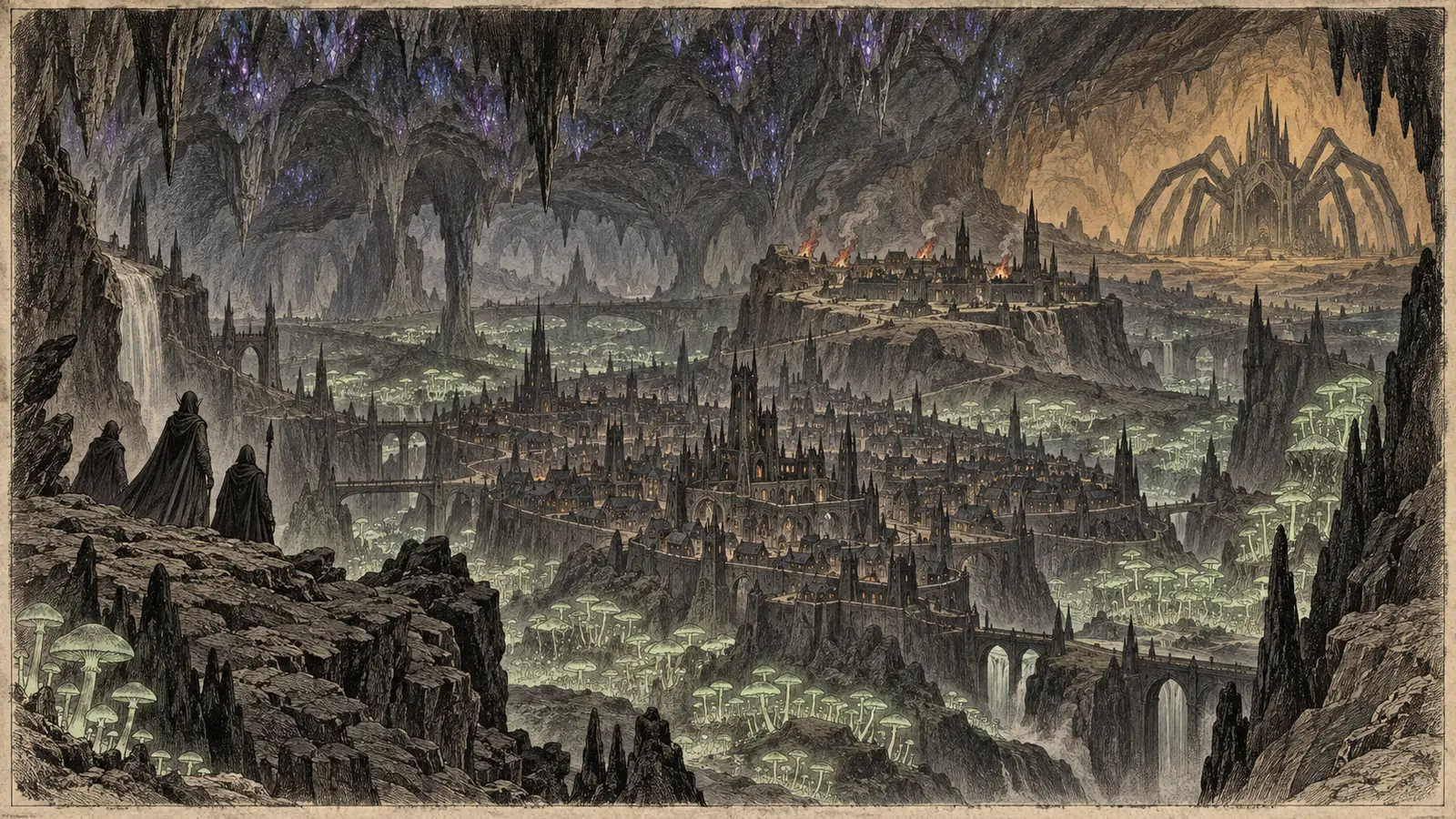
We come now to where the thread runs today.
In 2024, the game's core rules were revised, and the new Player's Handbook changed the relationship between the drow and their old goddess in a quiet but lasting way. Drow, in its pages, are one of the lineages of the elves, alongside high elves and wood elves. They are elves infused with the magic of the , at home in the shadows, with magic of their own, and they tend to have stark white hair and greyish skin in many hues. Each branch of the elves, the book says, is shaped by a place: wood elves by forests, high elves by places of ancient magic, sea elves by the oceans, eladrin by the , shadar-kai by the . And drow by the Underdark.
What unites the drow, in this telling, isn't worship. It's their ancestral connection to that deep place beneath the world. The cult of , the Queen of Spiders, has corrupted some of the oldest drow cities, the book says, especially on the worlds of and , and the Forgotten Realms. But other worlds, and and more, escaped her influence. On those worlds drow heroes stand on the front lines of the war against her cult. And some drow have never heard of her at all.
So Lolth, in the present lore, is something slightly different from what she was. She's no longer the goddess of every dark elf, everywhere. She's a cult that took hold of certain great cities on certain worlds, and the drow as a people are larger than her web.
In 2025, the new Monster Manual left out the old stat blocks for ordinary drow, along with several other peoples whom players could now choose to be. In their place it offered stat blocks for roles, the cultist and the warrior and the priest, which a Dungeon Master could dress in whatever face they liked. Lead designer Jeremy Crawford promised that more tailored villains would come in the setting books. And they did. In November 2025, two books for the Forgotten Realms arrived together: Heroes of Faerûn, for players, and Adventures in Faerûn, for Dungeon Masters. And in Adventures in Faerûn, the villainous drow returned by name. They are called the Drow of Lolth, and they come as a warrior, an elite warrior, a mage, and a priestess, each marked plainly with the goddess they serve.
So the picture today is clear. Drow, as a people, are free, and any player may take one as a hero. But in the Forgotten Realms, the servants of the Spider Queen are once again official villains, waiting in the dark. And , the City of Spiders, still lies in the Underdark beneath the lands between and Hall, the centre of her worship, ruled by her priestesses and their rival houses, famous for deception and intrigue and the taking of slaves.
Salvatore's story goes on. After Lolth's Warrior left Menzoberranzan in turmoil, he began a new series in October 2025 with The Finest Edge of Twilight, which follows Brie , called Breezy, the half-drow daughter of and . She trains at the Monastery of the Yellow Rose and studies the Way of Shadow, with guiding her as a sort of uncle. The daughter of the drow who refused the Spider Queen is walking her own road now, and it doesn't begin in Lolth's city.
The seasons Wizards of the Coast has announced for 2026 turn toward other places: the mists of , a season of arcane magic, and a season of champions yet to be described. None of them belongs to the Spider Queen. For now, her story rests where these last books have left it: her chosen people restless and questioning, her daughter dancing in the moonlight again, her servants arming themselves in the dark of , and Lolth herself at the centre of it all, as she has always been, waiting.
Chapter XIV
The web at the bottom of the world
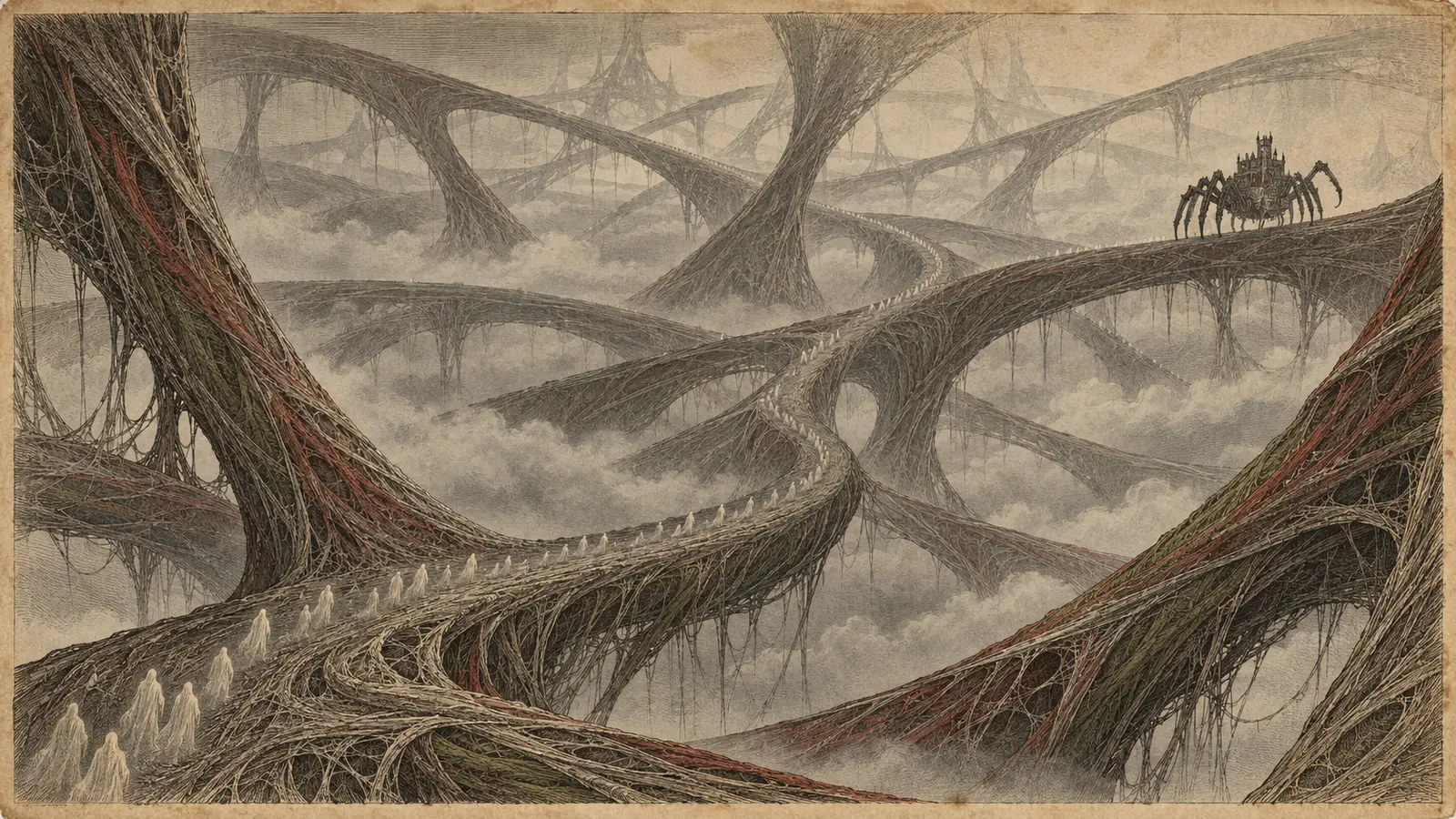
Let's come back, at the end, to where she lives.
Picture it once more, slowly. There's no ground and no sky. There's only mist, grey and soft and endless, and through the mist run strands, great cables of planar stuff, each wide enough to walk on, crossing and recrossing, looping over and under one another, all of them joined. If you could stand far enough away, you'd see that the whole thing is a web, strung across nothing, larger than any world.
Along the strands drift the lost souls, a slow river of them, moving inward. And at the end of their drifting, on the web, there's a fortress of iron, built in the shape of a spider, walking. It moves on its eight great legs, carefully, one strand to the next, toward somewhere it has never explained. Inside, in a chamber at its heart, sits the one who spun all this.
She was a weaver once, in the oldest telling. She sat beside the father of the elves and spun the destiny of the dark elves on her loom, and he trusted her with it. Or, in another telling, she was the first of the changing ones to choose a single shape and hold it. Either way, what she wanted was more. And now she has a web instead of a loom, and the threads she spins are people.
Every strand of her web ends at a door. Behind one door is a world of winter. Behind another, a world of night. Behind others are cities of stone deep under the earth, where her priestesses kneel in the dark and pray, and feel her answer them, or don't. Every so often one of them closes her eyes and wakes on the web, being weighed. Every so often a son is born who will one day walk away. And every so often the whole web trembles, very slightly, the way a web does when something far off has touched it, and down in the her people lift their heads and feel for which thread moved.
The web is very quiet. The mist drifts. The iron spider takes another slow step along the strand. And at the centre, patient as she has always been, the Spider Queen waits, with her hands resting lightly on the threads.