Chapter I
The old roads downward: Virgil, Dante, Milton and Faust
Tonight we follow the Nine Hells of Dungeons and Dragons from the old poems and legends that laid its foundations, through the game's first slim pages, and on through every edition that added a layer, a lord, a war or a betrayal. Along the way we'll meet the devils who serve it and the demons who fight it, and the mortals who bargain with it and sometimes slip free. By the end we'll have walked the whole descent, from the ash plains of to the deepest rift of , where something very old lies coiled and quiet.
Long before anyone rolled a die, people believed the underworld had a door. In Roman Italy, near the old Greek colony of , there is a lake set in the round bowl of an ancient volcano. Its waters are still and dark, and in Roman times people said the fumes rising from it were so foul that birds flying over it dropped from the sky. They called it Lake Avernus, and they believed it was an entrance to the realm of the dead. When wrote the Aeneid in the last century before the common era, he sent his hero down through a cave near that lake. A prophetess, the Cumaean , walked beside him as his guide. Over time the name of the lake came loose from its shore and drifted into the language as a word for the underworld itself. To speak of Avernus was to speak of the place below.
Hold on to that word, because it will be the first thing we hear when we arrive. The game would one day take the old lake's name for the topmost layer of its Hells, the gateway layer, the place every damned soul must cross before it goes any deeper.
The Romans had a god of that lower country too. They called him , the rich father, and sometimes , the king below. His name came from the Latin word for wealthy, and it echoed the Greek name , which came from a word for riches. The logic was gentle and practical. Gold and silver and every precious ore came out of the ground, so the lord of the underground must be the richest of all the gods. As the centuries went by, the short name Dis became a way of naming the underworld itself, or a part of it. When the game later needed a lord for an iron city, it borrowed this old title almost whole, and called him .
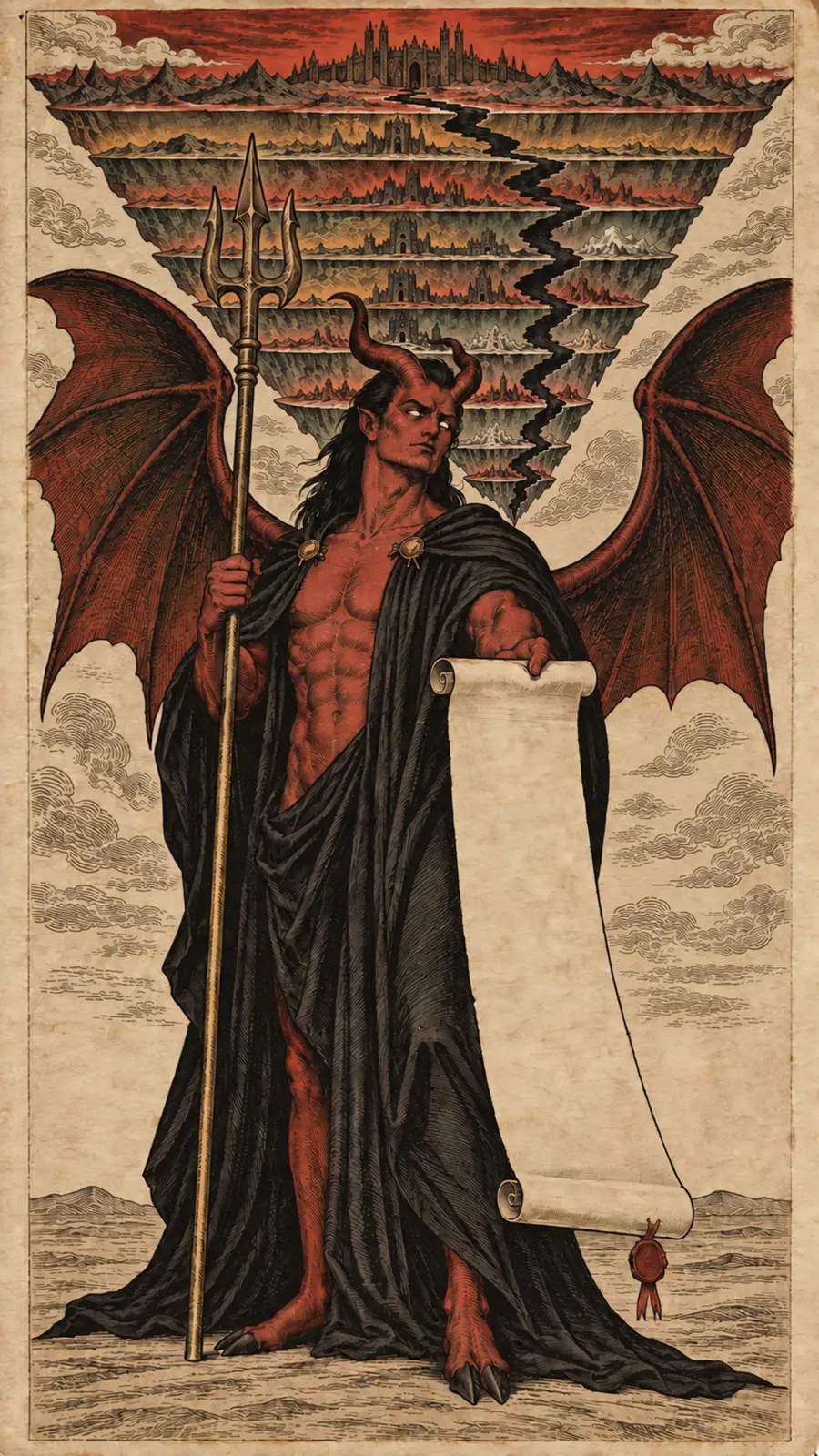
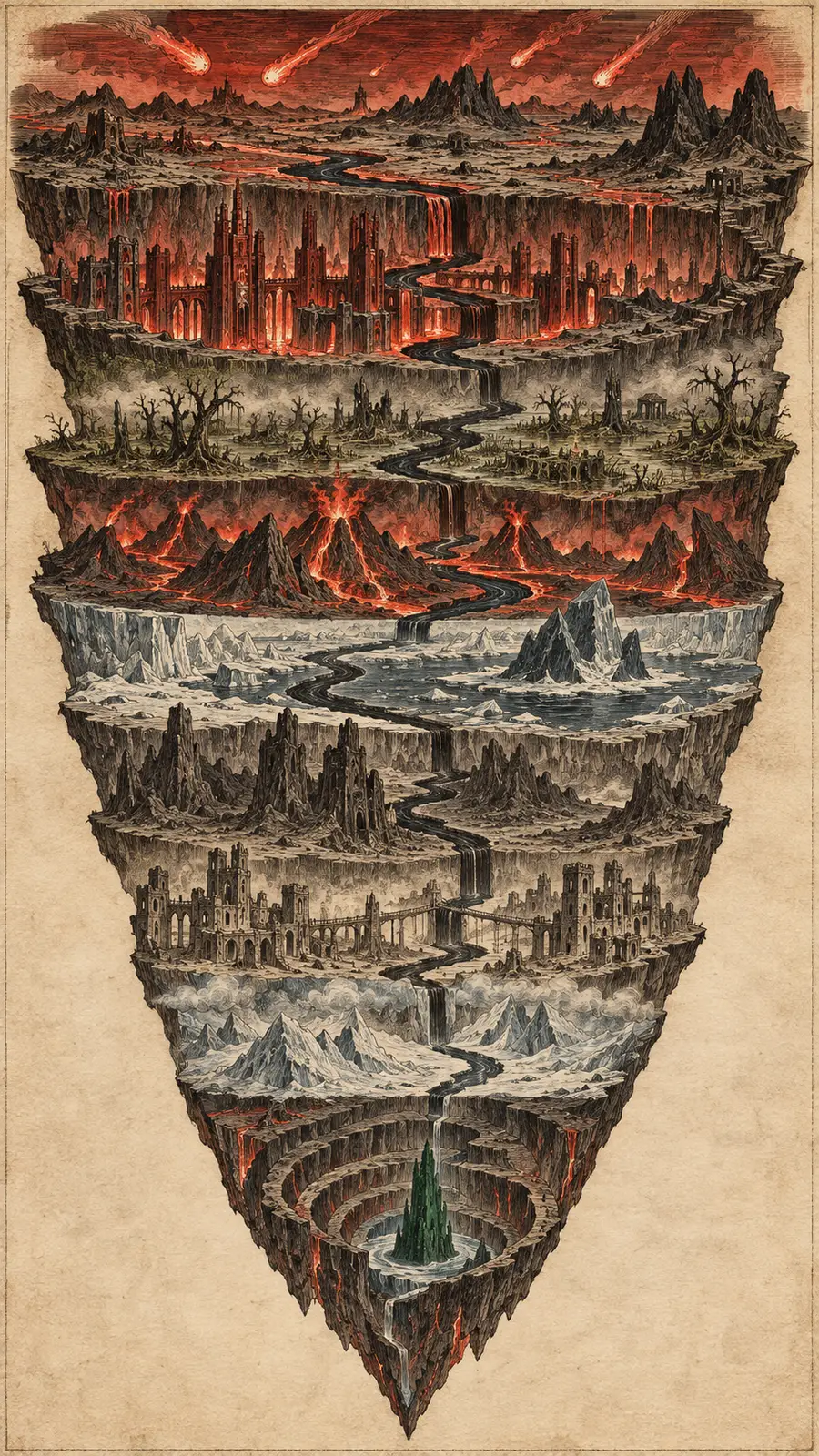
Then, early in the fourteenth century, an exiled Florentine poet wrote the map that almost every later Hell would follow. 's Inferno, the first part of his Divine Comedy, imagines Hell as a vast funnel-shaped pit sunk beneath the earth. Its sides fall away in nine great rings, and each ring holds a different kind of sinner. The sins grow graver as you go down: lust near the top, then gluttony and greed, wrath, heresy, violence, fraud, and at the very bottom, treachery. The punishment always fits the sin, and so the whole pit is a moral geography, a landscape built out of judgement. Dante does not walk it alone. His guide is Virgil, the same poet who had once sent Aeneas down by the shores of Avernus, so that Dante's journey quietly echoes that older descent.
You could almost read Dante's pit as a guidebook to the Hells we'll be walking tonight. The wrathful fight one another forever in the stagnant marsh of the River , a name that will return to us as a river winding through every lower plane of the game. Below that marsh rises the City of Dis, with walls of iron, towers and gates and bridges, guarded by fallen angels and the Furies and Medusa. Inside those iron walls the gentler sins give way to the sins of malice, and lower Hell begins. Further down runs , a river of boiling blood, where those who were violent against their neighbours are kept. Centaurs patrol its banks with their bows, and one of them, Nessus, carries Dante and Virgil across. In Greek myth Nessus was the centaur slain by ' poisoned arrow, who took his revenge through a poisoned cloak. His name will become the name of the ninth and deepest layer of the game's Hells, and the river's name will become , the fourth.
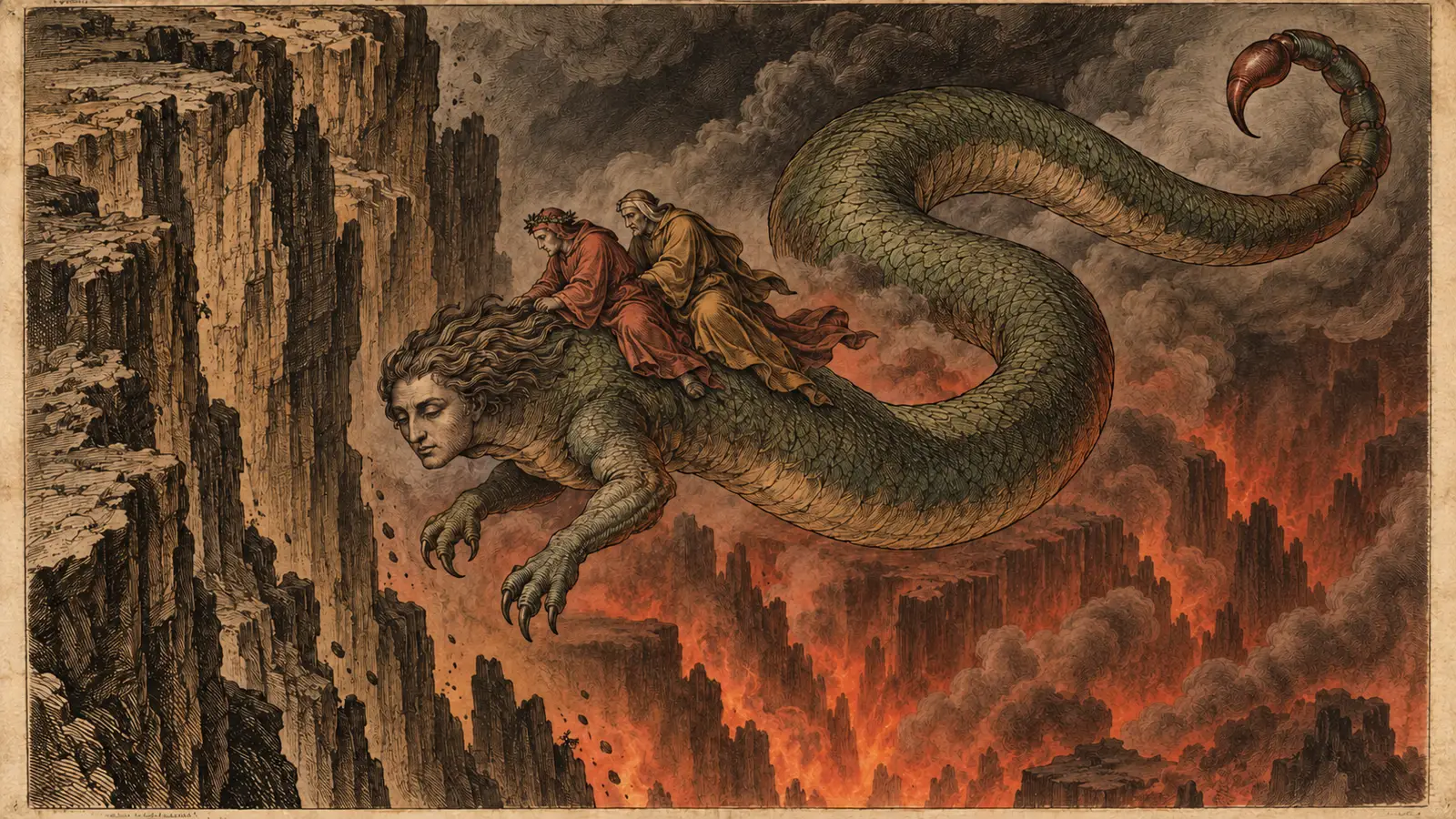
There is a creature in Dante's pit worth lingering on. , the Monster of Fraud, has the face of an honest man, kindly and trustworthy to look at. Below that face his body is a serpent's, with clawed paws and a scorpion's sting at the end of a long tail. He rises out of the abyss beneath a cliff, and he carries the two poets down on his back, circling slowly into the eighth ring. The game would take Geryon too, and make him an archdevil, a lord of one of its layers for a long time, and then a lord without a layer.
That eighth ring is called , which means evil pouches, a series of stony ditches where the fraudulent are kept. The game's sixth layer, , takes its name from it. The demons who guard those ditches with their hooks are called the , the evil claws, and that word will turn up as a second name for one of the game's devils.
And at the very bottom of Dante's Hell there is no fire at all. There is ice. The ninth circle is , a frozen lake where traitors are locked in place. Its rings carry names of their own, and the first of them, where traitors to their kin are held, is called . At the centre, frozen to his chest, stands Lucifer, a vast and weeping figure. The game would remember that the deepest places are the coldest. Its fifth and eighth layers, and , are lands of ice, and Cania's name is a soft echo of Dante's Caina.
Dante gave the game other gifts too. His Hell is crowded with creatures from the classical world, and many of them found their way into the game's roster of lower-planar monsters: centaurs, giants, harpies, medusae and minotaurs, along with the Furies, the Greek goddesses of vengeance, whom the game would call the erinyes.
Three and a half centuries after Dante, in 1667, John published Paradise Lost, and his Hell is a different kind of place. Dante's is a prison. Milton's is a kingdom. After their fall the rebel angels gather themselves on the burning lake and decide to build. They raise a capital and a council hall called , a name Milton coined from the Greek for all the demons. The angel who suggested it is , and Milton gives him a lovely, telling detail. Even in Heaven, Mammon walked with his eyes on the ground, admiring the golden pavement more than anything holy. The architect is , who had once built palaces in Heaven and now builds one in Hell.
In the second book of the poem the princes of Hell meet in council, with Satan high on his throne. Each speaks in turn. argues for open war. , smooth and persuasive, argues for patience and waiting. Mammon proposes that they forget Heaven altogether and build Hell into a prosperous empire of its own. Then rises and offers the plan Satan wanted all along, to strike at God's new creation, the race of humankind. The council looks like a free debate, but it has been staged from the start, and the autocrat on the throne gets exactly what he intended. It is in the first book that Satan speaks his most famous line: better to reign in Hell than serve in Heaven.
If you listen closely, you can hear the game's Hells in that council hall. would become the name of one of the lower planes. Mammon, Belial, Moloch and would all become archdevils of the Nine Hells. Mammon would rule a layer of greed, and Belial a layer where persuasion and seduction are the weapons of choice. Moloch would become a fallen lord, cast out for rebellion. Above all, the picture of a Hell run by a hierarchy of scheming princes, all under one supreme ruler who stages their politics for his own ends, would one day describe the game's almost exactly.
There is one more thread, and it may be the most important. In 1587 a German chapbook told the story of Doctor , a scholar who sells his soul to the devil. The devil in that book is named . One reading of the name is Greek for not a lover of light, the one who shuns the light. In 1886 a scholar named Karl Julius suggested Hebrew roots instead, meaning destroyer and liar. Medieval demonologists counted among the seven chief devils.
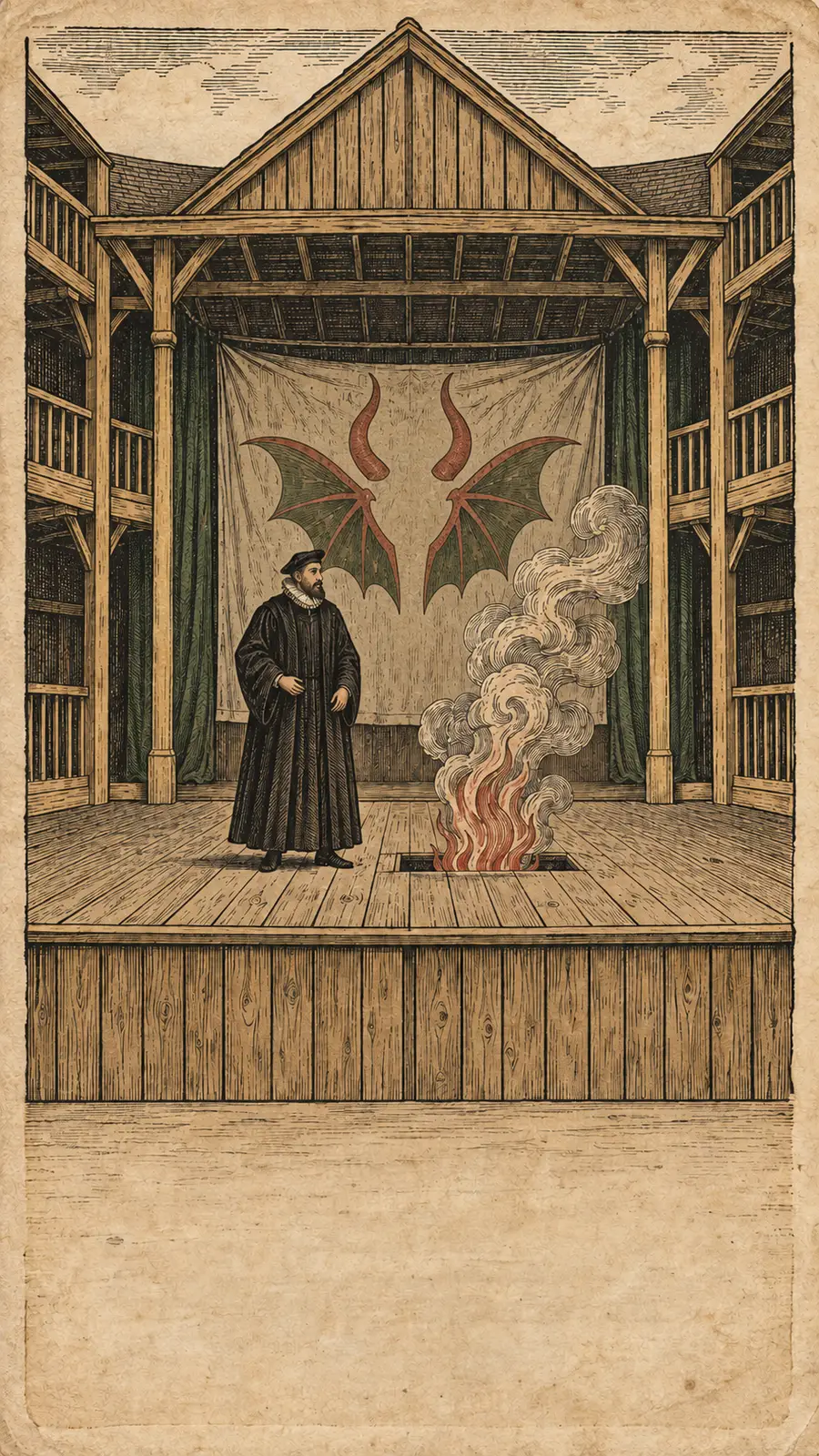
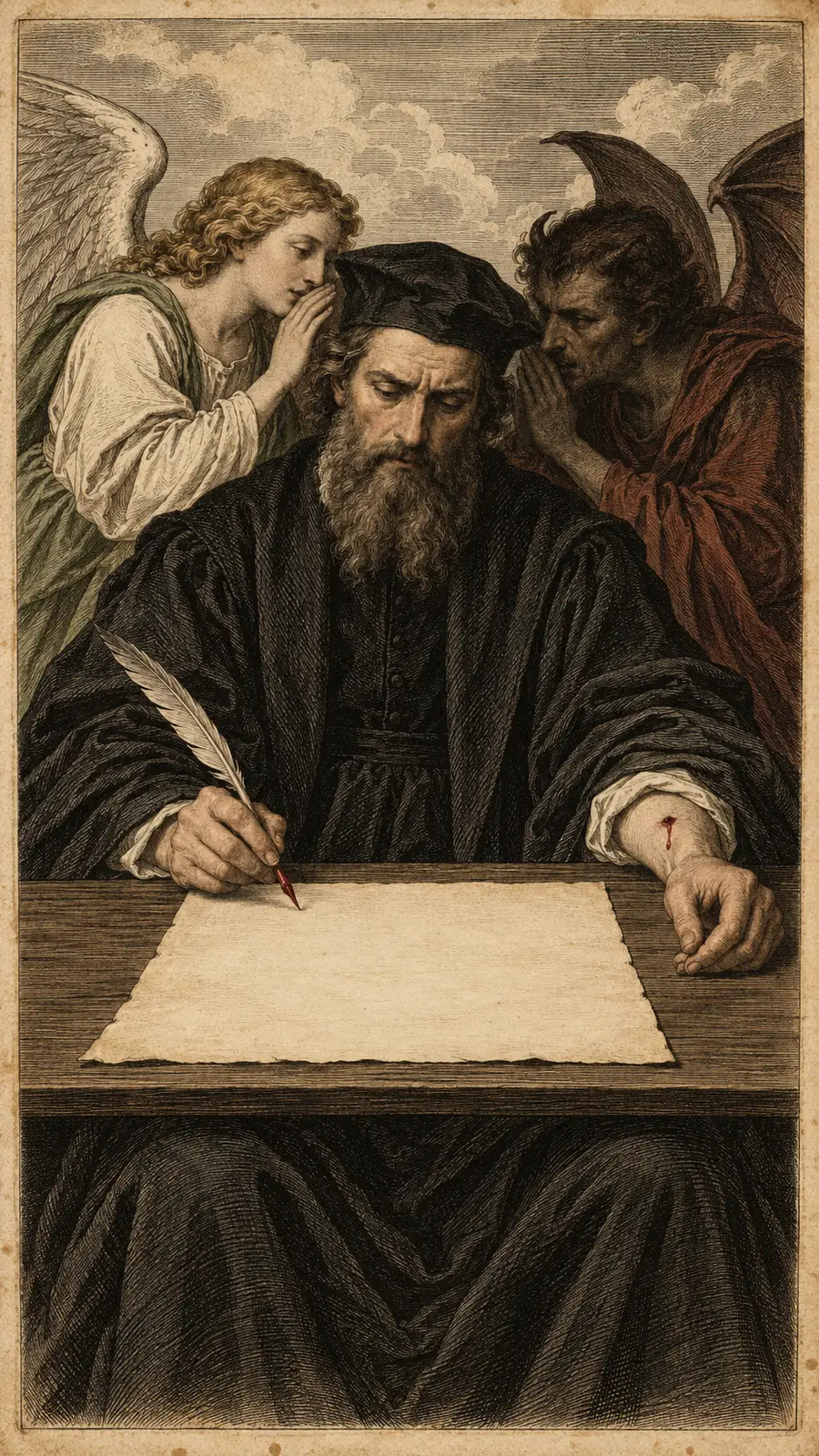
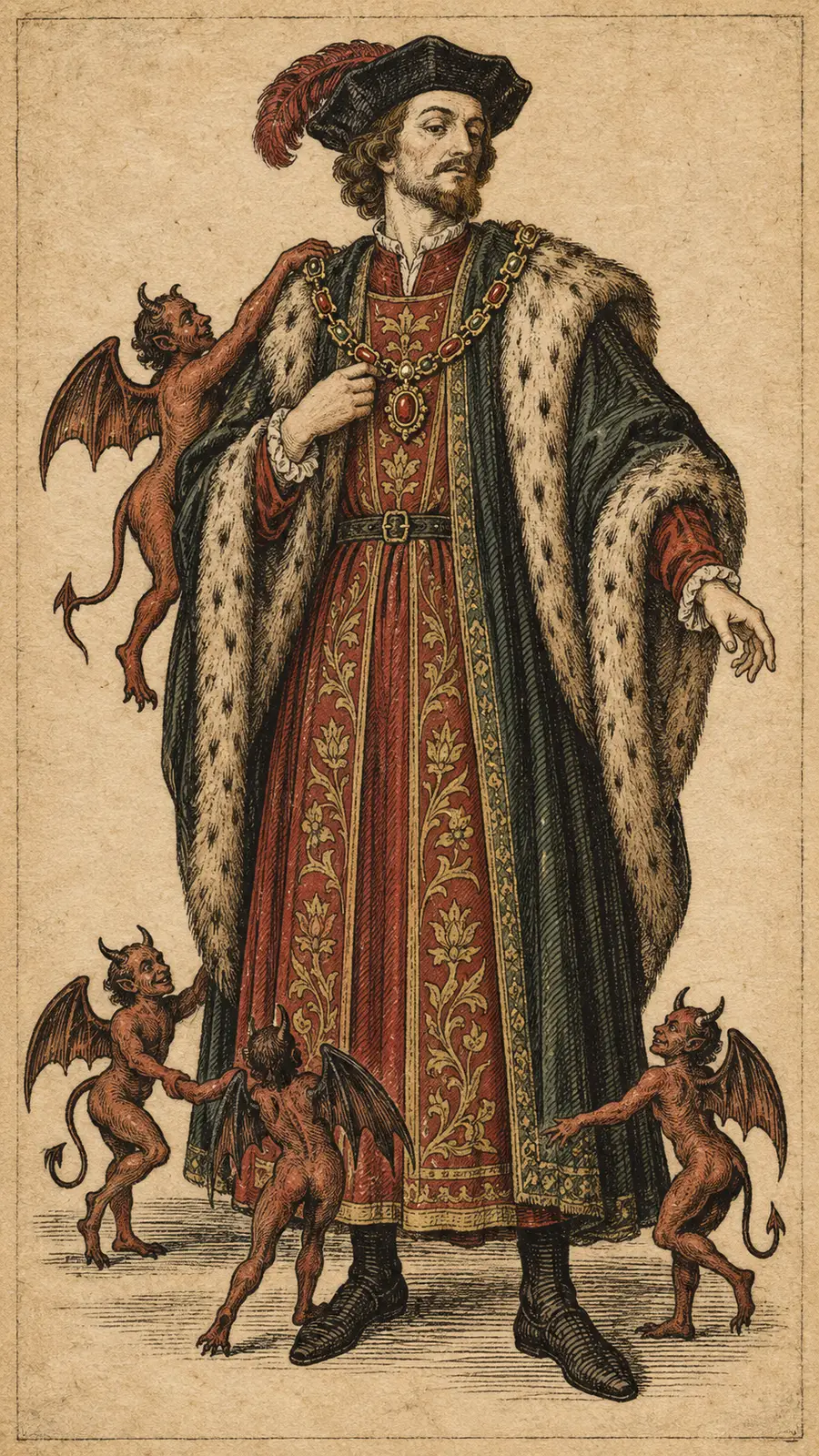
Christopher turned the legend into a play, Doctor Faustus, first performed around 1594. Faustus makes his pact with Lucifer through Mephistopheles, trading his soul for twenty-four years of pleasure and power. He signs the contract in his own blood, while a Good Angel and a Bad Angel whisper on either side of him. Afterwards devils dress him in rich robes and dance for him. And Mephistopheles, asked how he can be out of Hell while he walks the earth, gives one of the most haunting answers in the English stage: "Why, this is hell, nor am I out of it. Think'st thou that I, who saw the face of God and tasted the eternal joys of heaven, am not tormented with ten thousand hells in being deprived of everlasting bliss?" would later carry the legend on into the nineteenth century.
The soul bargained away, signed in blood, binding to the letter: that is the beating heart of the game's devils. Where demons rage, devils negotiate. And Mephistopheles himself would become an archdevil of the game, lord of frozen Cania, second in power only to the ruler of all the Hells, and forever plotting to take his place.
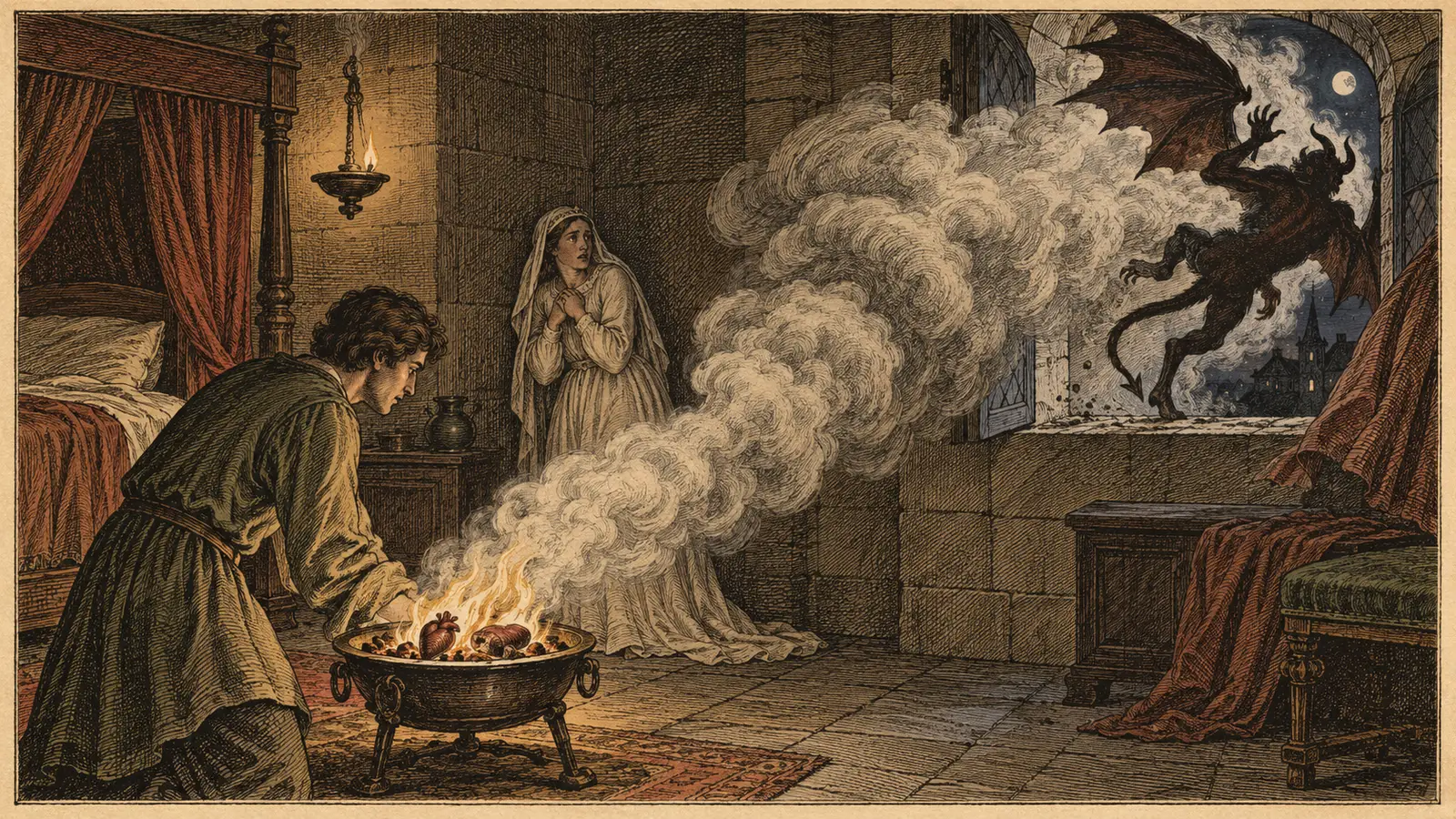
That ruler's name comes from older scripture still. In the Book of , part of the deuterocanonical writings, a young woman named Sarah is haunted by a demon called Asmodeus. Seven times she marries, and seven times Asmodeus kills her husband on the wedding night. Then God sends the angel , disguised as a man, to guide young . On Raphael's advice Tobias marries Sarah, and on their wedding night he burns the heart and liver of a fish. The smoke drives Asmodeus away. In other writings, such as the Testament of Solomon, Asmodeus sows discord between husbands and wives. In Talmudic stories he appears as , king of the shedim, the demons, and is bound up in tales of King Solomon. There's a small, pleasing irony waiting at the far end of our journey. Much later, a devil named Raphael will serve the interests of the Hells, the angel's name turned around to stand on the other side.
The last of the great names is , lord of the flies, once the god of the Philistine city of . Whether he drove flies away or commanded them, no one quite remembers. Later traditions made him a great demon, the New Testament calls the prince of demons, and Milton made him Satan's second. The game would spell him Baalzebul and make him Lord of the Flies and Lord of Lies.
Behind all of these stood a long tradition of books that catalogued Hell like a royal court: the sixteenth-century Pseudomonarchia Daemonum, the seventeenth-century Lesser Key of Solomon, and in 1818 Jacques 's Dictionnaire Infernal, whose later edition carried engraved portraits of the princes and dukes of Hell. These books taught the Western imagination to think of Hell as an ordered hierarchy, with titles and ranks and a chain of command. That idea hung in the cultural air the game's designers breathed.
The final thread came from fantasy fiction. Michael 's stories and Poul Anderson's Three Hearts and Three Lions imagined a cosmos balanced between Law and Chaos. The early game took that axis and made it part of its bones. And once Law and Chaos were set against each other, the fiends could divide along that line. Devils could become creatures of law, of contract and rank and order, while demons stood on the other side as creatures of chaos. In the very first edition of the game in 1974, the word demon doesn't even appear among the monsters.
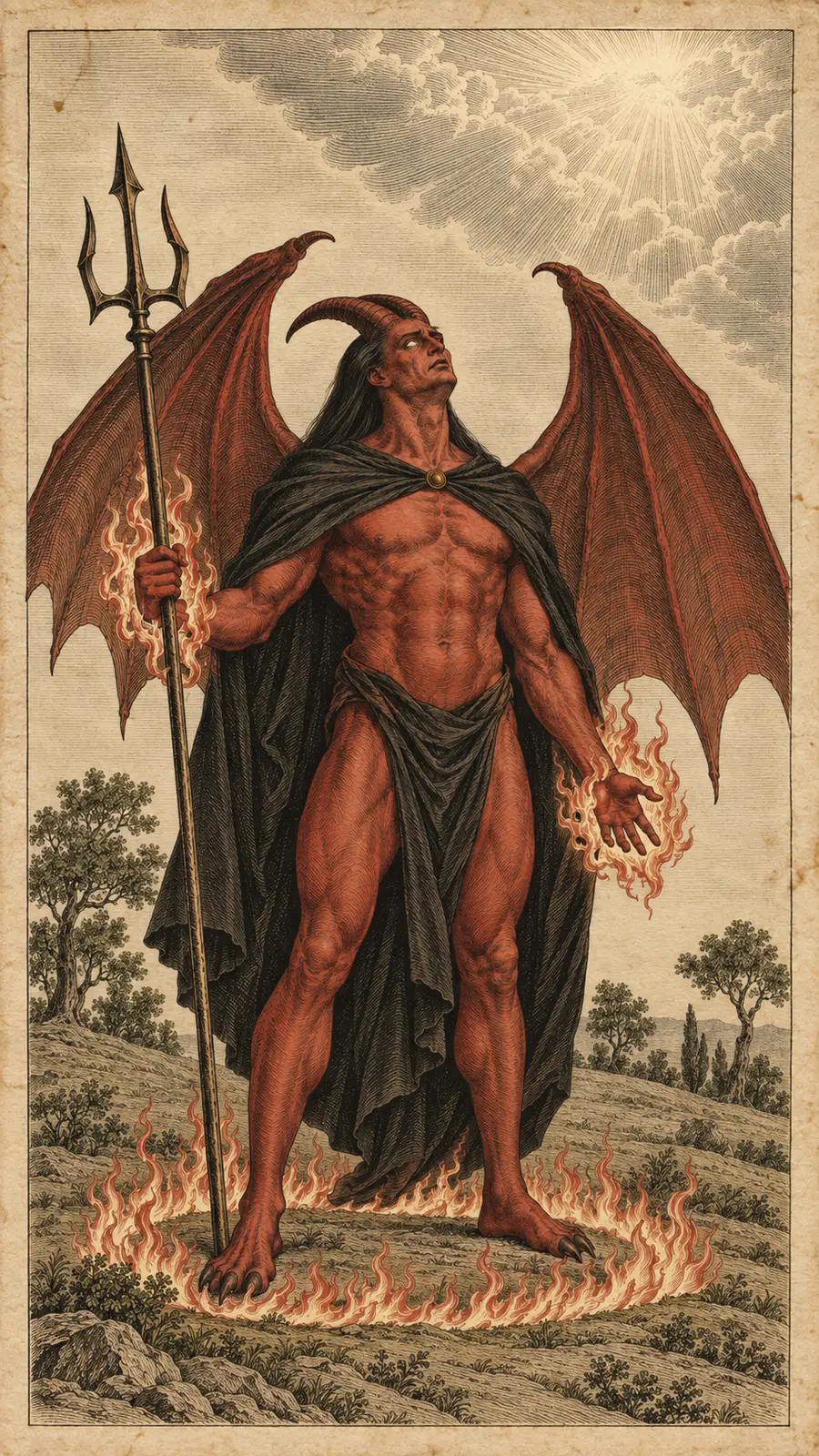
So the pieces lay waiting. Virgil gave the gateway. Dante gave the nine-ringed descent, the iron city, the river of blood and the frozen deep, and the honest-faced Geryon. Milton gave the capital and the council of princes. Faust gave the contract signed in blood. All the game had to do was gather these threads and file them under Law. And in the late 1970s, it did.
Chapter II
A plane of absolute lawful evil: the first devils
Demons arrived in the game first. In 1976 a slim supplement called Eldritch Wizardry brought them in, with the demon prince and among them, and they quickly became a staple of every dangerous dungeon. It was the same little book, as you may remember from our evening with the Hand and Eye of , that first introduced so many of the game's great artefacts. Devils came a little later, and they arrived as a group of their own.
The first map came in the summer of 1977. In the July issue of The Dragon, Gary published an article with a rather grand title: "Planes: The Concepts of Spatial, Temporal and Physical Relationships in D&D." It was the first time the game's cosmology had ever been set down in print, and it is the seed from which the great wheel of planes would later grow. Gygax described sixteen Outer Planes. Among the higher planes he named the Seven Heavens, the Twin Paradises and . was the plane of ultimate Law, and the plane of ultimate Chaos. And among the typical lower planes he listed three: the three glooms of , the six hundred and sixty-six layers of the Abyss, and the Nine Hells.
That's where our subject first appears, as a line in a list. The Nine Hells sat in Gygax's scheme as the plane of absolute lawful evil, the place where order and cruelty met at their purest. He drew a diagram for the article in coloured pencil, a flat drawing of what he cheerfully admitted was a four-dimensional idea. If you picture it, you can imagine the Hells as a small coloured region on a hand-drawn map, waiting to be filled in.
In December of that year, TSR published the Monster Manual. Gygax wrote the whole of it. It was the first hardcover book the game had ever had, the first core book of the new Advanced Dungeons and Dragons, and it held more than three hundred and fifty monsters. David Sutherland painted its cover and some of its full-page pictures, and David and Tom Wham drew for it as well. And it was in this book that the devils took the shape they would keep.
The Monster Manual split the fiends for good. Demons were chaotic evil. Devils were lawful evil. That division has lasted through every edition since, and almost everything we'll hear tonight grows out of it. A demon is hunger and rage and ruin. A devil is a creature of hierarchy, contracts and patience, a thing that wants you to sign.
The devils of that first book came in ranks. At the very bottom crawled the lemures, the lowest of all devils, shapeless things named for the restless spirits of the dead in Roman belief. Above them stood the lesser devils: the barbed devil, the bone devil, and the erinyes, who took their name from the Greek goddesses of vengeance that had placed at the gates of Dis. Above those stood the greater devils: the ice devil, the pit fiend, and the horned devil, which carried a second name borrowed straight from Dante's ditches, the malebranche. The imp appeared here for the first time too, a small and common servant of devils, the kind of creature a wicked wizard might keep on his shoulder.
The book also introduced the rules of true names and talismans. A devil, it said, could be summoned or controlled through its true name, or through a talisman bound to it. That idea runs deep in older magic, the notion that to know a thing's real name is to hold a kind of power over it, and the game would never let it go. We'll hear it again in a computer game, in a dragon's prison and in the way a soul gets its name when it first climbs out of a black river.
Above all the ranked devils, the Monster Manual gave four arch-devils entries of their own: , , and . Here, for the first time, the game imagined named overlords ruling the devils and their Hells. The chain of command was rigid and ruthless. Each arch-devil ruled one of the planes of Hell, and at the very bottom, on the ninth plane, sat Asmodeus as overlord of them all. From that first entry onward, through every edition, Asmodeus would remain the strongest of the devils, the most cunning, and the most handsome.
There's a quiet detail about how the Hells were named in this first book. They weren't named at all, not individually. The layers were simply numbered: the first plane, the ninth plane. You can imagine a dungeon master in 1978 reading these entries by lamplight, knowing only that there were nine levels below, each ruled by someone terrible, and that the deepest held Asmodeus. Everything else lay in shadow.
One layer did get a ruler named outright. The game already had a five-headed dragon, a queen of the chromatic dragons. The Monster Manual gave her the name , borrowing it from the ancient Babylonian goddess of the primeval sea, and said that she ruled the first plane of the Nine Hells, where she spawned all of evil dragonkind. So the very first ruler of the topmost layer of Hell, in the oldest account, was a dragon. We'll see her again much later, in a very different situation, deep inside a mountain on that same layer.
In June 1978 the Players Handbook repeated the cosmic map in an appendix, with an abstract diagram and sixteen Outer Planes, and there again were the Nine Hells of absolute lawful evil. The idea had settled into the foundations of the game.
In those early years, then, the Nine Hells were a small but certain thing. They were a plane, nine levels deep, home to a race of lawful devils who served in strict ranks under four named lords and a dragon queen. The devils could be bargained with and bound by their names. They stood opposite the demons, who were chaos itself. It was a sketch, drawn with confidence, and it left room for someone to come along and fill in the landscape.
It's also worth remembering, gently, that the devils and demons of the Monster Manual, along with some of its more daring illustrations, later drew the attention of people who worried about the game. That worry would grow through the 1980s, and it would one day reshape the way the Hells were named. But before that, someone was about to take the whole game on a guided tour.
Chapter III
The grand tour: Ed Greenwood's nine layers
By the early 1980s a young Canadian writer named Ed Greenwood had been running a home campaign set in a world of his own invention, a world he called the Forgotten Realms. His players travelled far, and some of them, it seems, wanted to travel very far indeed. So Greenwood worked out what lay below. He imagined every layer of the Nine Hells, gave each a landscape and a ruler and a court, and wrote it all down. With Gary 's blessing, he set it before the whole readership of Dragon magazine.
"The Nine Hells, Part I" appeared in issue seventy-five of Dragon, in July 1983. It covered the first five layers and more than twenty high-ranking devils, among them dukes and princesses of Hell. "Part II" followed in August, covering the last four layers and some twenty more devils. Before these two articles, all that was really known about Hell, as one later reprint put it, was that it had nine levels and was home to the race of devils. After them, the Hells were a place you could visit, with roads and palaces and weather. Years later, Wizards of the Coast would look back and say that Greenwood "took readers on an unforgettable tour, filled with vistas of infernal grandeur and dozens of the most fully realized villains to be found anywhere in the multiverse," and would call his articles the game's "first great vision for extraplanar adventure."
So let's take that tour, the way a reader in the summer of 1983 might have taken it.
The first thing Greenwood gave the layers was names, and he took many of them from . The first layer became , the old Roman lake turned into a doorway. The second became Dis, the iron city. The third was . The fourth was , after Dante's river of boiling blood. The fifth was , after the . The sixth was , after the evil ditches. The seventh was . The eighth was spelled in those first articles, after the first ring of Dante's frozen lake, and would later be spelled , which is how we'll say it tonight. And the ninth and deepest kept the name of the centaur who ferried Dante across the river of blood: .
Each layer, Greenwood decided, has its own climate, and they couldn't be more different from one another, from the blistering heat of some to the bog rot of others. And the Hells were isolated. Their only real connection to the outside was the River Styx, which wound down through them and out into the other lower planes, all the way to the Abyss.
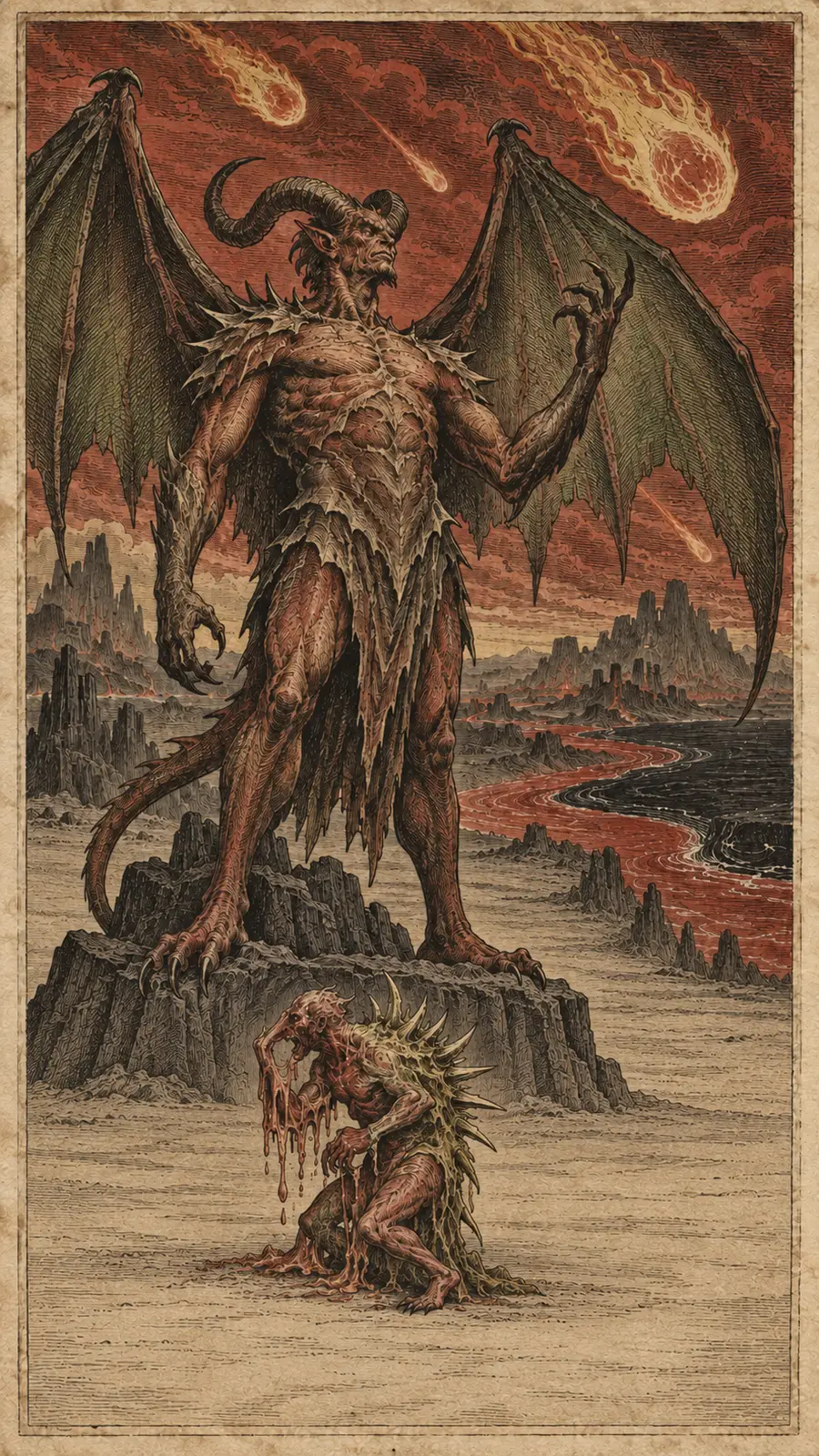
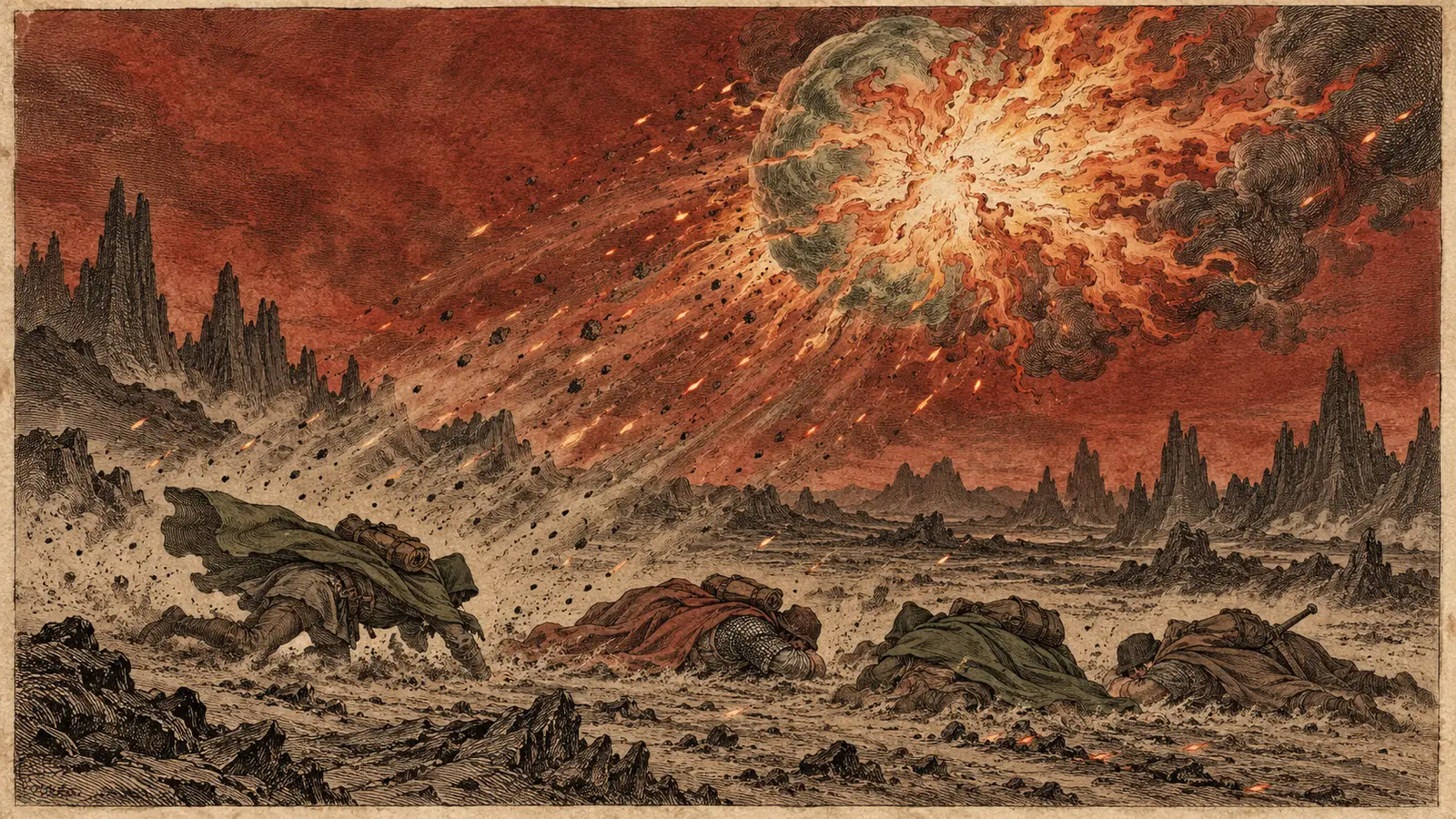
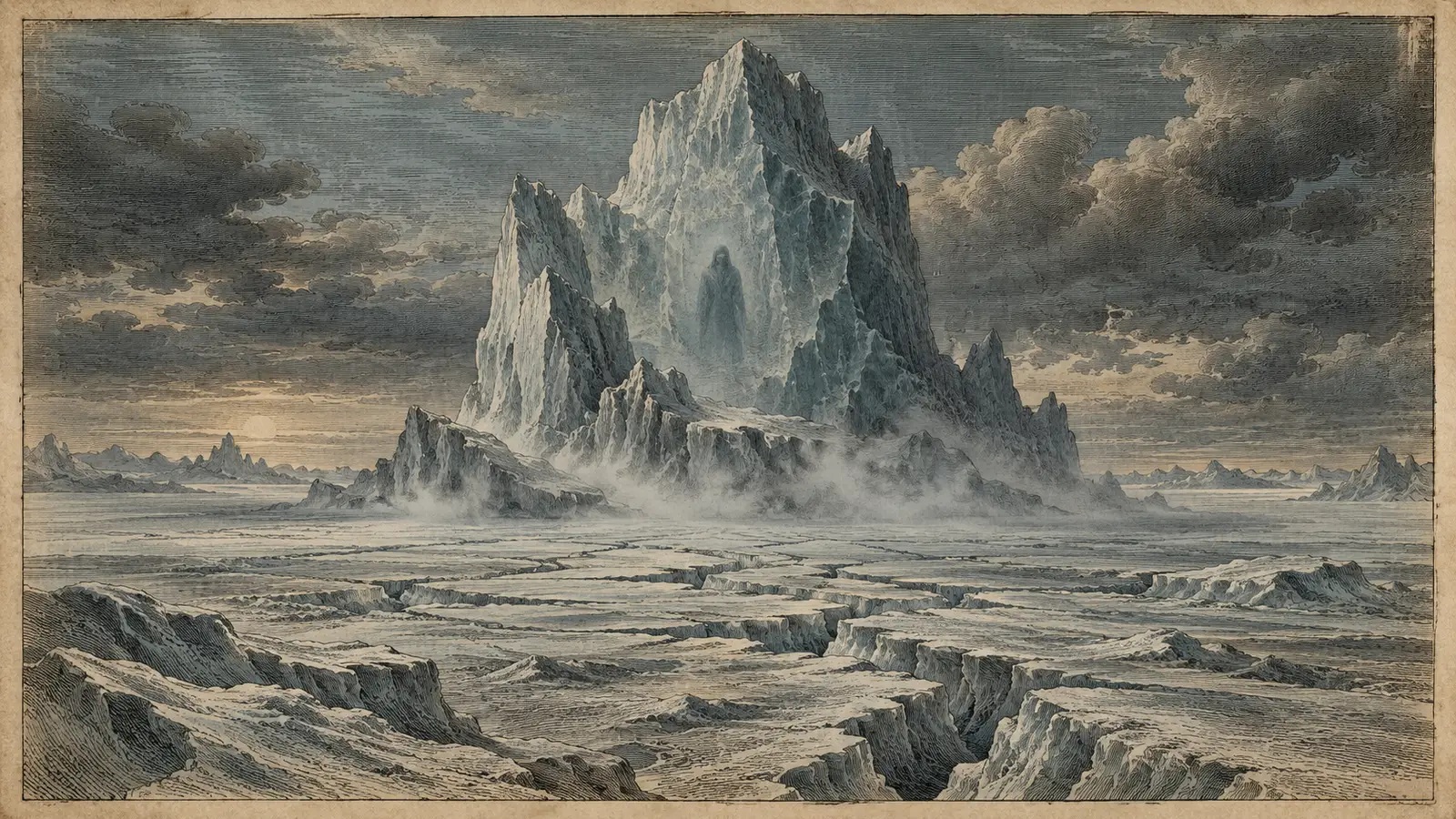
In Avernus, the first layer, the sky is starless. It is full of choking smoke, and it glows a dark and sullen red. Through that sky drift balls of flammable gas, sometimes floating slowly, sometimes streaking across the gloom, and every so often one of them bursts at random like a fireball. Imagine standing on that plain, the air thick, the light the colour of embers, and watching a slow globe of gas drift overhead before it blooms into flame. The ruler of Avernus in those days was , the dragon queen, and her lair held the only known entrance down to Dis.
Dis, the second layer, is ruled by from a high tower in the city of Dis itself, the Iron City. In the earliest descriptions his tower was stone, and later it became iron, like the rest of the city. Later writers would make the city vast, hundreds of miles across and miles high, an iron metropolis that never stops growing and never stops burning.
Minauros, the third layer, is ruled by , the archdevil of greed and treachery, the same Mammon who once walked in Heaven with his eyes on the golden pavement. His layer is an endless, decaying, stinking bog. Wealth flows through it, and so does rot.
Phlegethos, the fourth layer, is a land of blistering fire, and its ruler is . He keeps his court in a basalt palace called , the Mount of Leaping Flames, built inside the caldera of an extinct volcano. Belial is 's smooth speaker, the one who argued for patience, and in Greenwood's Hell he sits in a stone hall ringed by fire.
Stygia, the fifth layer, was ruled in those days by , Dante's honest-faced monster, from a castle-city named . Geryon would not keep Stygia forever, but in 1983 it was his.
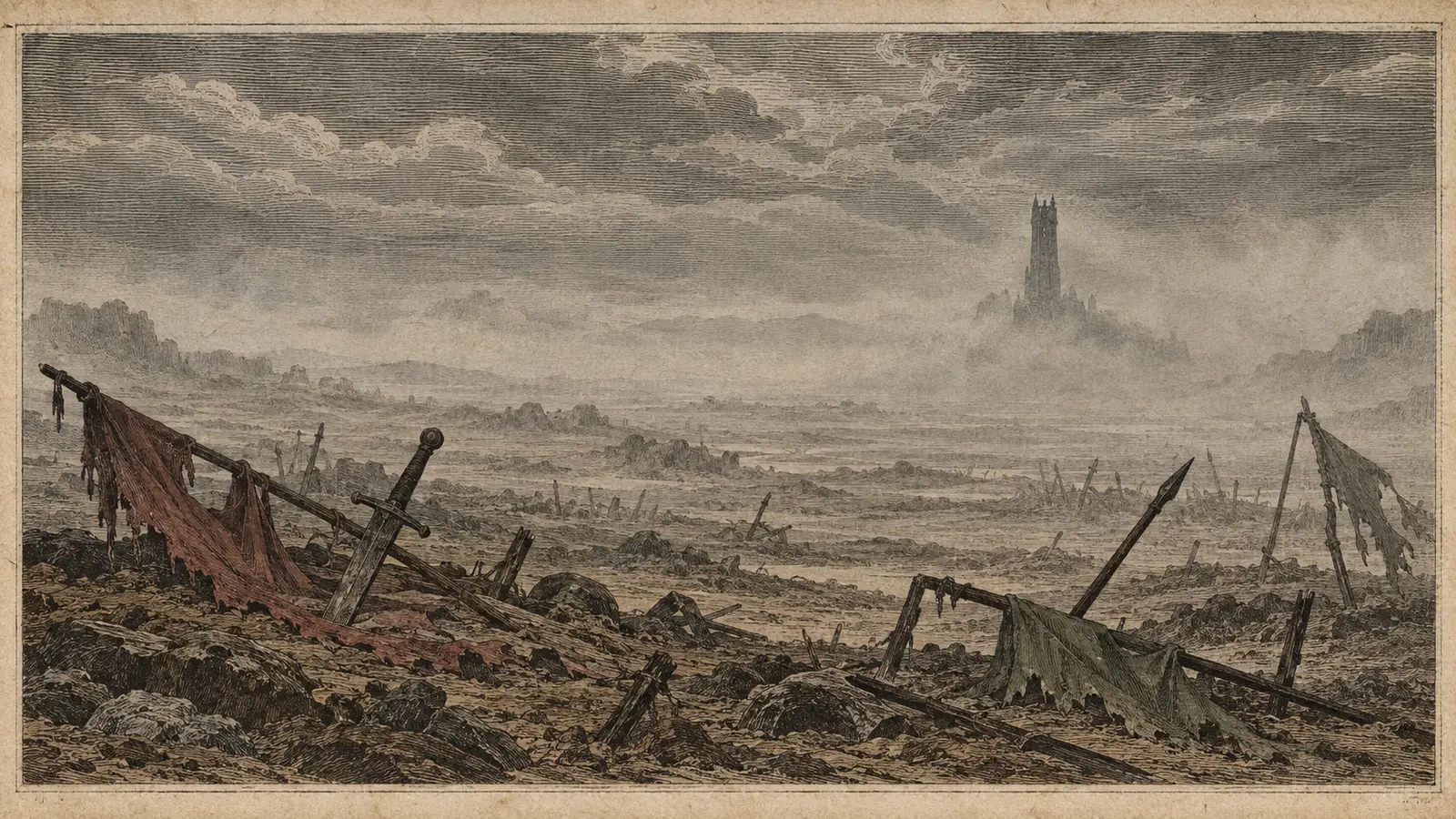
Malbolge, the sixth layer, is one of the grimmest stops on the tour. Greenwood wrote that nothing grows there. It is a plane of craggy, tumbled black stone and ash, filled with stinking vapours, smoke, fire pits and huge caves and caverns. It's noisy, crowded with tormented lemures and malebranche and the occasional spined devil, all of whom suffer at the hands of their cruel lord. In this era Malbolge wasn't ruled directly by its own archdevil. It belonged to , the lord of the seventh layer, who held it through his Grand Viceroy, . Here we meet one of the small, sharp stories Greenwood loved to tell. Moloch once had a consort, a princess of Hell named . Baalzebul took her for his own. Moloch kept his viceroy's chair, and kept his silence, and you can imagine how warmly he felt about his master afterwards.
Maladomini, the seventh layer, was Baalzebul's own seat.
Cania, the eighth layer, is a frozen wasteland of ice and despair, haunted by gelugons, the ice devils. It is ruled by , the Faustian tempter, now a lord of the cold.
And Nessus, the ninth and deepest layer, is the seat of . He rules from , a gargantuan citadel set in the lowest rift of that deepest plane. In this period he also had a consort, . Remember her name. Her fate will matter to the fifth layer, and to a prince who sits frozen in the ice.
Greenwood's articles were crowded with these noble devils, and that was perhaps their greatest gift. Part I introduced the princesses , Lilis and Naome. Every layer had a court, every court had schemes, and the Hells began to feel like a real place with a real society, the kind of place where a clever adventurer might find an ally in the enemy of an enemy.
In that same July issue, Gary Gygax ran a column of his own called "New Denizens of Devildom." It previewed the devils coming in the Monster Manual II, which appeared later that year with a cover by Jeff Easley. Gygax's column brought the abishai, a family of winged devils in five colours, black, blue, green, red and white, along with the bearded devil and the small spined devil. It introduced a princess of Hell named . It introduced a handful of dukes: , , Bitru, and . And it gave statistics to four new arch-devils, the remaining names from the old council hall: Belial, Mammon, Mephistopheles and Moloch. The Monster Manual II printed about a dozen of these new devils, and it added one more humble rank near the bottom, the nupperibo, a least devil. So in a single summer, between Greenwood's tour and Gygax's preview, the Hells went from four named lords and a numbered staircase to a full nine-layered kingdom with a crowded nobility.
A year later, in November 1984, Greenwood returned with "The Nine Hells Revisited" in issue ninety-one of Dragon. This time he looked into the corners: outcast devils who had fallen from favour, hidden treasures tucked away in the infernal realms, and diabolical deals. The Hells now had exiles and secrets and fine print.
Greenwood had written all of this for his own table, as part of his own Forgotten Realms campaign. He never presented it as official canon for every world. But because Gygax had blessed it, and because it was so thorough, it took on a near-official standing that lasted for decades. Books published more than twenty years later still drew on ideas he had set down in 1983. Commentators have called those articles a work of remarkable scholarship, and you can see why. They were faithful to what the game already had, and they reached back into myth and literature in clever, sometimes surprising ways.
So, as the 1980s went on, the Nine Hells had a map. You could stand under Avernus's red sky, walk Dispater's iron streets, wade through Mammon's bog, and look up at Belial's volcano. And then, for a little while, the Hells went quiet.
Chapter IV
Baator and the Blood War
In 1989 the second edition of Advanced Dungeons and Dragons arrived, built by a team led by David "Zeb" Cook. It came out of a decade in which the game had faced a good deal of worried attention. During the 1980s some people had come to believe that the game led players toward dark things, and one group, founded by a grieving mother named Patricia Pulling after the death of her son, blamed the game for real tragedies. TSR had been working to present a gentler, more family-friendly face. So when the second edition's core books appeared, the demons and devils were simply missing. So were a few other things that had drawn criticism, like the assassin class and the half-orc.
The fiends were gone for about two years. Then, in 1991, they came back in the Monstrous Compendium Outer Planes Appendix, under new names. TSR had asked Zeb Cook to invent them. Devils became the baatezu, and demons became the tanar'ri. The Nine Hells themselves received a new name too. They became , or the Nine Hells of Baator. The words devil and demon disappeared from monster descriptions throughout the edition. The creatures themselves were much the same as before, but a story went around for years afterward that TSR had taken the devils out of the game. In a sense they had only changed their coats.
The new names gave the Hells an alien, otherworldly feel, and that same appendix brought something else, something that would define the lower planes for decades. It described the fiends as beasts of ultimate evil locked in an endless, bitter Blood War.
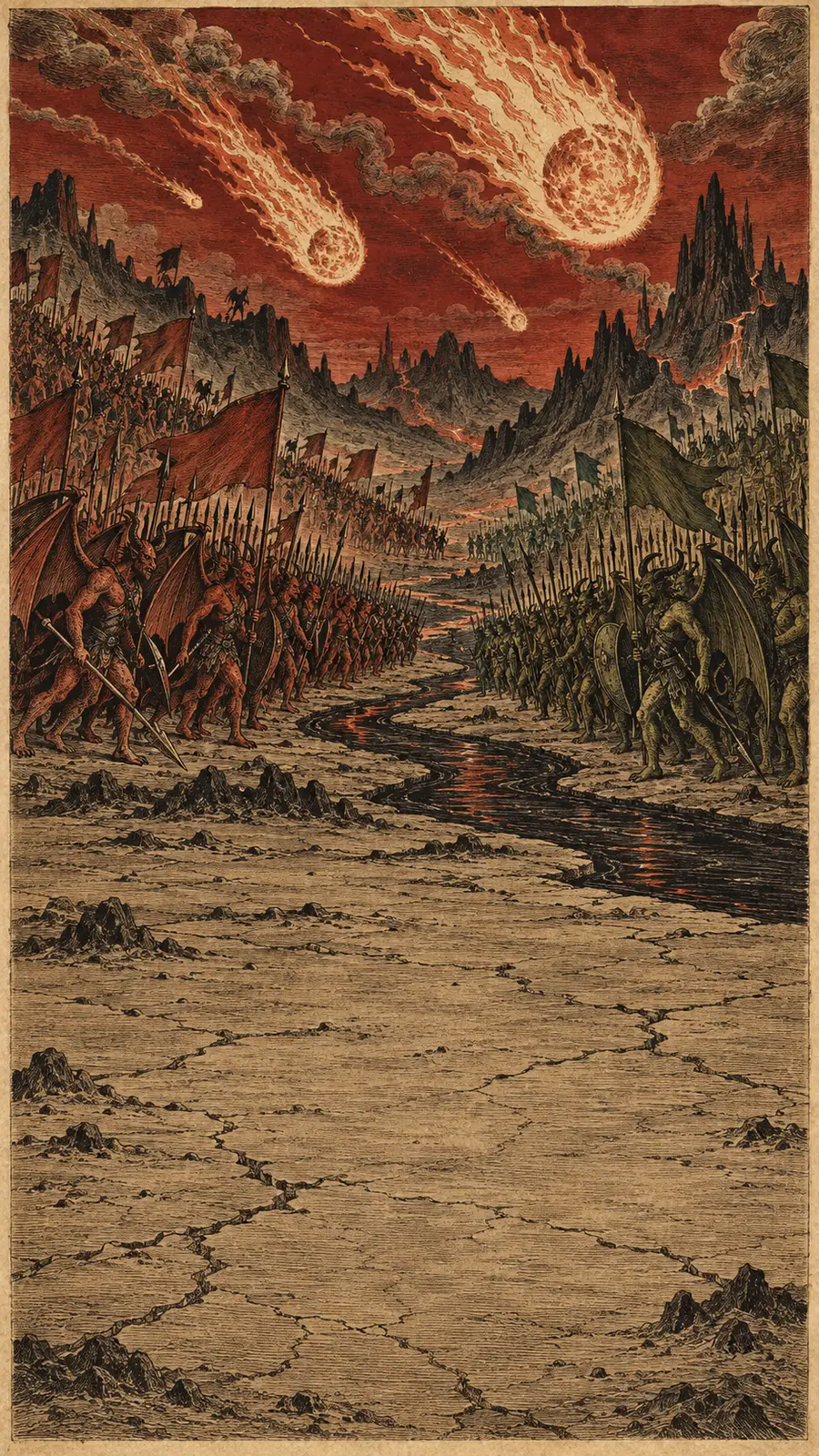
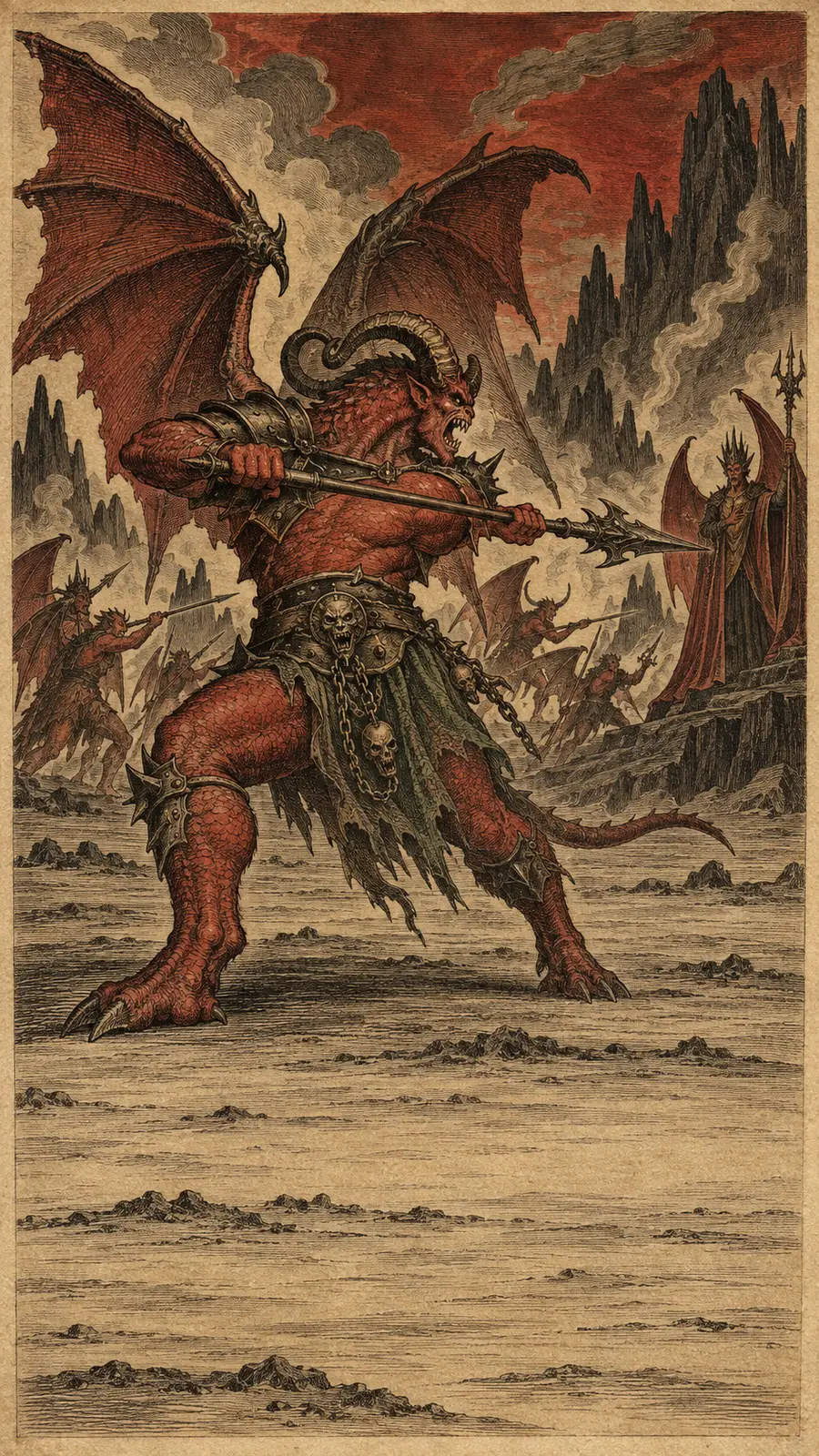
The Blood War is the great quarrel between law and chaos, fought out in its cruellest form. On one side stand the baatezu of Baator, regimented, ranked and lawful. On the other stand the tanar'ri of the Abyss, chaotic, numberless and ever-changing. They hate each other more than they hate anything else in creation. Their war is fought across all of the lower planes, and it has no end. Battlefronts shift, armies are spent, and neither side ever wins outright. There is a quiet mercy hidden in it, if you look at it the right way. Because the fiends are so busy fighting each other, they don't have the strength to overrun the mortal worlds. The war that is a nightmare for everyone caught in it is also, in its way, a shield for everyone else.
The war needs a road, and the road is the River . Its black waters wind through all the lower planes, carrying armies from one front to the next. And the war needs a field, and the greatest of its battlefields lies not in Baator or the Abyss but between them, in the Gray Waste of . The first layer of that colourless plane, called , holds most of the Blood War's battlefields. It also holds a tower called Khin-Oin, the Wasting Tower, home to the leaders of a third kind of fiend.
These are the yugoloths, neutral evil creatures of the Gray Waste and . They take no side in the Blood War. Instead they sell their services to both, as greedy and treacherous mercenaries, switching banners whenever the pay is better. They see the whole war as a vast experiment into the nature of evil, one they may have started and now keep carefully in balance. Their own legend goes further still. The yugoloths say that long ago, at the instruction of the ancient baernaloths, they themselves made the baatezu and the tanar'ri, shaping them from the impurities within the yugoloth race. One telling credits the first ultroloth, the General of Gehenna, with the work. It's a legend, told by mercenaries who profit from everyone believing them important, and the devils of Baator certainly don't tell the story that way.
Meanwhile the shape of the whole multiverse was being drawn with more care. In 1987 Jeff Grubb's Manual of the Planes had built out the great wheel of planes, with each of the Outer Planes in its place around the rim. In 1994 TSR released the Planescape Campaign Setting, designed by Zeb Cook. Its heart was , the City of Doors, a city that the setting described as built on the inside of a tire that hovers over the top of a gods-know-how-tall spike. From Sigil's countless doorways you could step into any plane, and so for the first time the Outer Planes became a setting in their own right, a place to live and travel and adventure. The Blood War moved to the centre of the game's cosmology in these years.
Here's a curious thing about that first box. It left the nine rulers of Hell out entirely. Fans felt that was a mistake, because the lords were too central to Baator to erase. So when Planes of Law appeared in 1995, written by Wolfgang Baur and Colin McComb, its booklet on Baator brought them partly back. Colin McComb also wrote "The Lords of the Nine" for Dragon magazine. And when the lords returned, there was one change at the very top. no longer ruled . In her place stood Bel, a pit fiend, a soldier who had climbed the ranks and now held the gateway layer, the front line of the war.
In the Planescape years, Baator gained its fullest character as a place. It was the plane where Law and Evil are bound together, as the books put it, in a sometimes uneasy alliance of foul politics and corruption. It had other names besides Baator: the Land of Broken Promises, and simply the Pit. Its nine layers were pictured as an inverted mountain, a peak turned upside down and driven into the dark, so that each step down took you into a narrower and more terrible place.
Avernus, at the top, was a battlefield scarred by endless war. Dis was iron, paranoia, oppression and the dread of a city that watches you. was a swamp of corruption and decay. burned. was ice. was treacherous. was ruins. was a frozen waste. And , the deepest, was the seat of , Overlord of Hell, who ruled all of Baator from below.
The baatezu themselves were given a clear social order in the Planescape books. At the bottom were the least baatezu: lemures, nupperibos and spinagons, the spined devils. Above them came the lesser baatezu, the abishai and the barbazu, which were the bearded devils, the erinyes, the hamatula, which were the barbed devils, and the osyluths, the bone devils. At the top were the greater baatezu: the amnizu, the cornugons or horned devils, the gelugons or ice devils, and the pit fiends.
And here's where the lore of this era becomes strangely moving. Devils aren't born into their ranks. They are promoted and demoted from one form to another, reshaped as reward or punishment. A damned soul begins as a lemure, a formless thing, and if it serves well it may one day be made into something higher. The nupperibo is the saddest case. It obeys every command it's given, perfectly, to lessen its torment, and so it ranks a little above a lemure. But a nupperibo can never rise any higher unless it is first demoted back to a lemure. When a nupperibo is destroyed, there's a one-in-a-hundred chance that it returns as a lemure. That's a step down, of course. And yet it's also the only door forward, because a lemure can hope, someday, to become a spinagon. There's a whole philosophy of Hell in that small rule: obedience without hope of reward, and a ladder whose first step goes down.
In 1996 came Hellbound: The Blood War, a boxed set by Colin McComb and Monte Cook. It held a book for dungeon masters on the nature of the fiends and the history of the war, its war magic, ranks and strategies. It held three adventures that dropped player characters right into the fighting, a book of background for players, a book of illustrations, and even a short colour comic.
Hellbound also gave Baator a government beneath its lords. Day to day, Baator is run by eight pit fiends called the Dark Eight. They are the generals of the Blood War, and each holds a ministry. is Master of Supply. is Minister of Mortal Relations. Corin is the Spymaster of Baator. is Marshal of the Pits. Zimimar is Minister of Morale. Zaebos is Minister of Promotions and Demotions, which must be a busy office in a place where everyone is always being reshaped. Zapan is Minister of Immortal Relations. And Pearza is Minister of Research and Development.
They weren't always eight. Long ago a pit fiend named founded the council, and in those days it was the Dark Nine. Cantrum was assassinated, and the remaining members chose not to replace him. Instead they became the Dark Eight, and they named their meeting place Cantrum's Circle in his memory. Not every one of the present members is an original, either. Some, like Zaebos and Zimimar, rose to fill seats once held by others. For a long time the Dark Eight worked out of sight. They only stepped into the open after a great upheaval in the Hells, a civil war that the lore of this era had not yet told.
A year later, Faces of Evil: The Fiends explored the hierarchies of all the fiends and the strange process by which they change from one form to another.
So, by the late 1990s, the Nine Hells had become Baator, a land of ranks and ministries at endless war with the Abyss, its armies riding the Styx toward the grey fields of Oinos while yugoloth mercenaries counted their pay. The lords had returned, though some of the faces on the thrones had changed. Somebody needed to explain why.
Chapter V
The Reckoning: a civil war in Hell
In 1999 TSR published Guide to Hell, written by Chris . It didn't wear the banner. It was a general guide to the game's Hell, meant for any campaign in any world, though it still used the Planescape words, and baatezu. It offered new paths for heroes who wanted to fight devils: the Devil Slayer, the Thaumaturgist, the Inquisitor and the Hellblade. It offered the devilkin, a half-devil people that players could choose. It gave full statistics for the Lords of the Nine. It held an invasion scenario in which the devils break into the mortal world. And it promised, in its own words, the secret history of Hell and the Dark Lord of , .
The heart of that secret history is the Reckoning. It is the story of how the archdevils rose against their master, and how their master never needed to lift a hand.
Long ago, the story goes, the Lords of the Nine grew tired of kneeling. Each of them dreamed of the throne at the bottom of Nessus. But they didn't trust one another, so instead of rising together they split into two factions. Each faction planned first to destroy the other, and only then to turn on Asmodeus.
The first faction was led by , lord of icy . With him stood of Dis, of , and of . The second faction was led by of . With him stood of , , who ruled as Baalzebul's viceroy, and the lord of , whose name was . In this oldest telling, Zariel was a male archdevil, and the story would change a great deal in later years. We'll meet a very different Zariel before the evening is out.
The war began with a march. Zariel led a vast army, an army that should have been turned against the demons, down into Dis instead. At the same time Moloch and Belial marched their forces into Stygia. Across two layers, devil armies prepared to throw themselves at devil armies, and the whole of Hell held its breath.
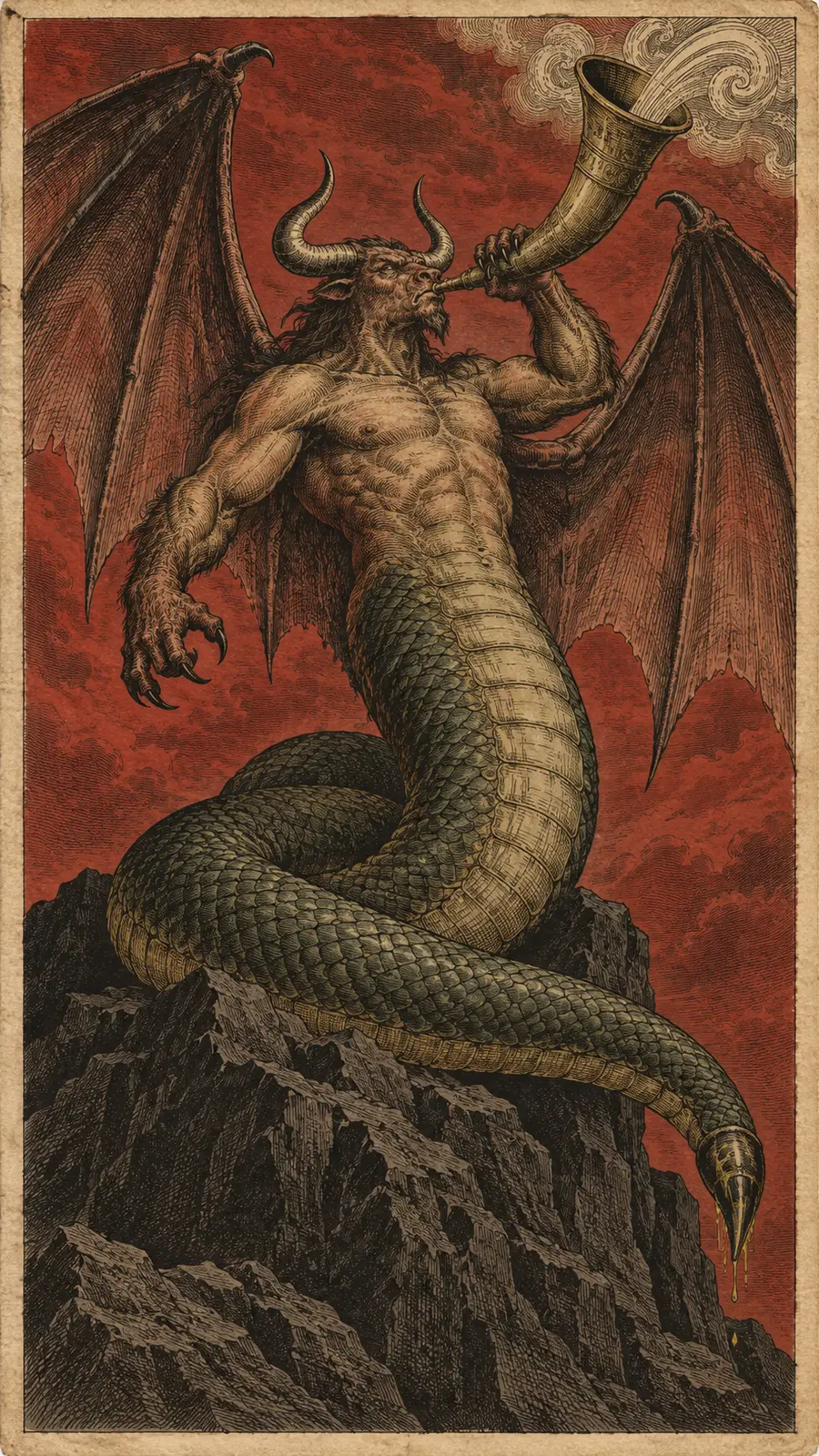
But there was a secret at the centre of it. Geryon, the honest-faced lord of Stygia, had never truly betrayed his master. He had stayed loyal to Asmodeus all along. With Asmodeus's help, he had planted agents in both armies. And just before the final clash, at the moment when everything hung in the balance, Geryon raised his horn and blew.
At that sound, the pit fiend generals turned. In both armies, on both layers, they wheeled around and fell upon their own masters. They had been loyal to Asmodeus from the very beginning. The rebel lords were overthrown by the soldiers they thought they commanded, and when the dust settled, Asmodeus sat on his throne unchallenged, exactly where he had always been.
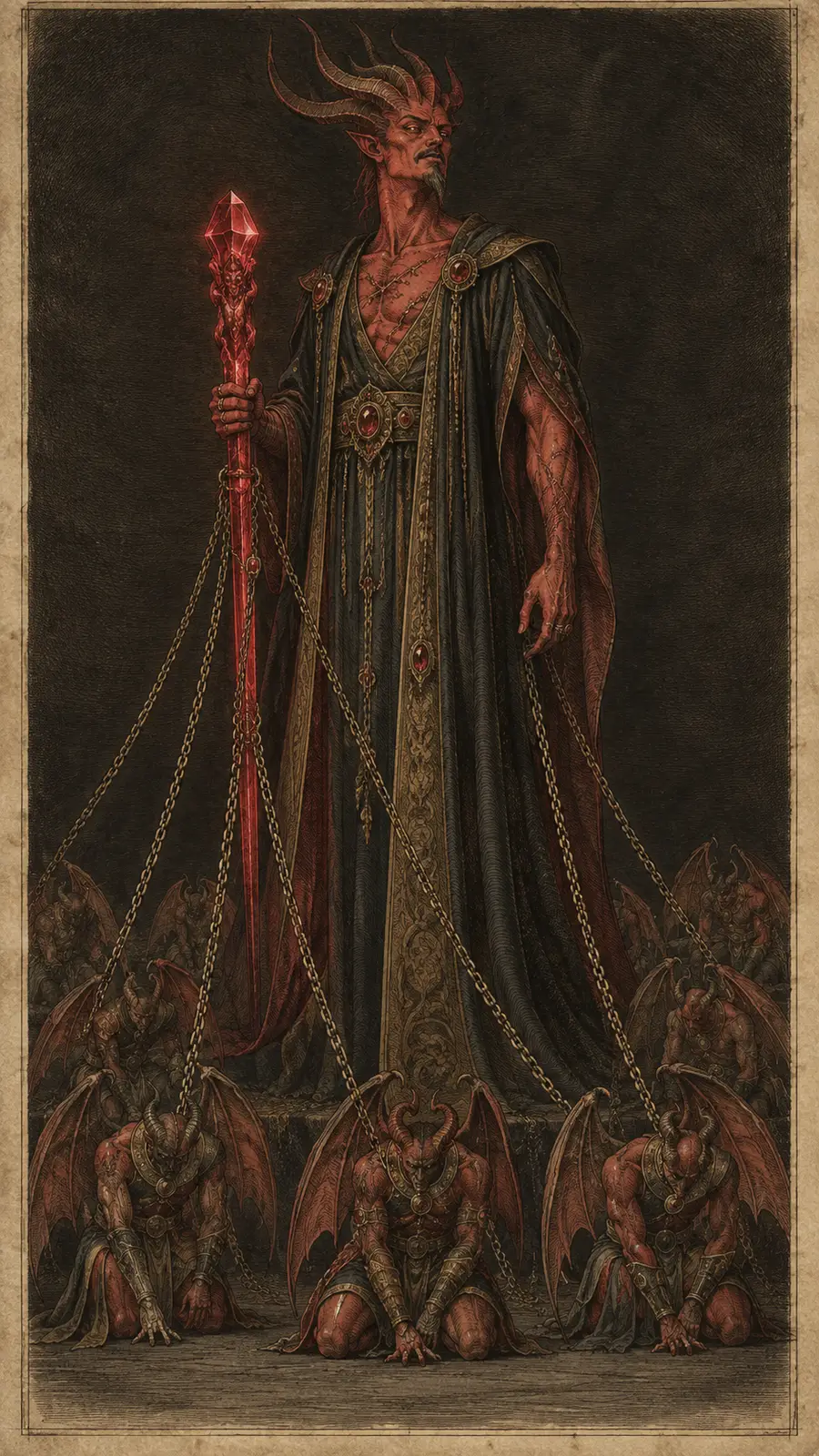
It's worth pausing on how perfectly lawful that victory was. Asmodeus didn't win by being stronger than his lords, though perhaps he was. He won because the structure of Hell itself, its chain of command, its generals and its loyalties, belonged to him. The archdevils thought they owned armies. Asmodeus owned the officers.
Then came the judgements, layer by layer.
In Avernus, the pit fiend generals hunted Zariel down and imprisoned the fallen lord. Bel, the soldier, took the first layer in Zariel's place.
In Phlegethos, Belial withdrew into the shadows. With Asmodeus's approval, his daughter took up the rule of the burning layer, while her father lingered behind her throne.
In Minauros, Mammon took on a new form after the Reckoning. In Hell itself, the reasons are whispered three different ways. Some say Mammon chose the new shape himself, to show Asmodeus that he was a new devil, changed and harmless. Some say Asmodeus forced it on him as a punishment. And some say it was a gift, a sign that Asmodeus believed Mammon had truly turned from treachery. In a place where every word is chosen carefully, it's fitting that no one quite agrees.
In Stygia, something stranger happened. Geryon, the only lord who had stayed loyal, the one whose horn had won the war, was removed from power anyway. He faded into anonymity. If you're looking for a single image that sums up the Nine Hells, you could do worse than this one: the faithful servant who saves his master's throne, and is quietly set aside for it.
Stygia went back to an older ruler, Prince . Long before, Levistus had held the fifth layer, until he committed a crime that Asmodeus would not forgive. He killed , the consort of Asmodeus, along with her pit fiend bodyguards. For that, Asmodeus sealed him inside an iceberg, and there he had stayed for ages, frozen and furious. Now Asmodeus gave him his layer back, but he didn't let him out. Levistus rules Stygia from within the ice, a prince who can scheme and command and reach out through his servants, but cannot move.
In Malbolge, the story turned on a hag. Moloch had a lover, a night hag known as the Hag Countess. It was she who had urged him to join Baalzebul's rebellion. But all the while she was speaking secretly with Geryon, and she arranged for Moloch's own armies to betray him. When the rebellion collapsed and the other lords fled before Asmodeus, Moloch alone stood his ground and refused to run. For that defiance, Asmodeus gave Malbolge to the Hag Countess. And the first thing she did as ruler was banish Moloch from the Hells.
In Maladomini, Asmodeus punished Baalzebul for leading the second faction. Baalzebul had once been beautiful, with an angelic body. Asmodeus melted it into a slug-like form. From then on Baalzebul was the Lord of the Flies in more than name, a brooding archdevil who had lost his master's favour and would spend a very long time trying to win it back.
Dispater and Mephistopheles, the iron lord and the lord of the cold, kept their layers, though one imagines they walked a little more carefully afterwards.
And in Nessus, Asmodeus ruled on from , the Citadel of Hell. It's a fortress the size of a mountain, said to hold millions of devils, reaching from warrens deep in a trench up to spires miles high. Picture it as a single dark shape filling the bottom of the world, lit from within by countless windows, every one of them a devil at work.
The Reckoning also explains the Dark Eight. After the war, Asmodeus rewarded the loyal pit fiend generals. He gave them command of the baatezu armies in the Blood War, and that was when the Dark Eight stepped out of secrecy. A great deal of the power the Lords of the Nine once held passed into the hands of this small council of pit fiends, meeting in Malsheem. They rank below the lords, and they answer to Asmodeus alone. Since they are perfectly loyal to him, most of the devils of Baator are now, in practice, his.
So after the Reckoning the faces on the thrones were new. Bel held Avernus. Fierna held Phlegethos. Levistus held Stygia from his iceberg. The Hag Countess held Malbolge. Baalzebul sat melted in Maladomini. And beneath them all, the bureaucracy of the Dark Eight hummed along like clockwork. This was the Hell that the next edition would inherit.
Not everyone loved Guide to Hell when it came out. One reviewer thought it never quite captured the magic of Greenwood's old articles. But its story stuck. The Reckoning became the hinge of Hell's history, and the game would keep coming back to it for the next twenty years.
Chapter VI
Pillars of skulls and sealed doors: Hell in the computer games
As the 1990s closed, the Nine Hells stepped onto computer screens, and one of the first and finest of those appearances came in a game set in itself.
Planescape: Torment was released in December 1999 by Black Isle Studios and Interplay. Chris was its lead designer and writer, and it is famous for its words, some eight hundred thousand of them. Its hero is the Nameless One, a scarred man who wakes on a slab in a mortuary with no memory of who he is. The Nine Hells hang over his whole story, though we only visit them once.
Here's why. Long ago, in his first life, the Nameless One did terrible things. When he understood what he'd done, he also understood what awaited him after death. The only atonement for crimes like his would be service in the Blood War, an eternity of fighting on the lower planes. To escape that fate, he went to the night hag Ravel and asked her to make him immortal. The magic went wrong. He became unable to die, but each time he is killed he loses his memories and wakes up a stranger to himself. So the Blood War, and the Hells that fight it, are the thing he has been running from all along, life after forgotten life.
His visit to begins in the Outlands, near a gate-town called . There, in a house, hides a fiend named Fhjull Forked-Tongue. He is a cornugon, one of the horned devils, and he is in a very strange position for a devil. A fallen deva named has bound him to do good deeds for anyone in need. So this creature of Baator must help everyone who asks, without a contract, without a price, and he hates it. He calls Trias the Betrayer. It's a lovely joke that runs right through the lore of devils. A devil compelled to help freely is a devil in torment.
Fhjull knows that the Nameless One's lost mortality lies in a place called the Fortress of Regrets, but he doesn't know where it is. He knows who might. Through a portal just outside his house, he sends the hero down into , to speak with the Pillar of Skulls.
Avernus in Torment is a place where everything wants you dead. Lemures shamble across it, nupperibos crawl, abishai in red and green and black wheel overhead, and cornugons stalk the ash. One small scene there captures the devils perfectly. You come upon a young woman, a damsel in distress, apparently attacked by a green abishai. If you rush to her rescue, she turns out to be a green abishai herself, and lemures rise around you. In the Hells, even a cry for help can be a contract you didn't read.
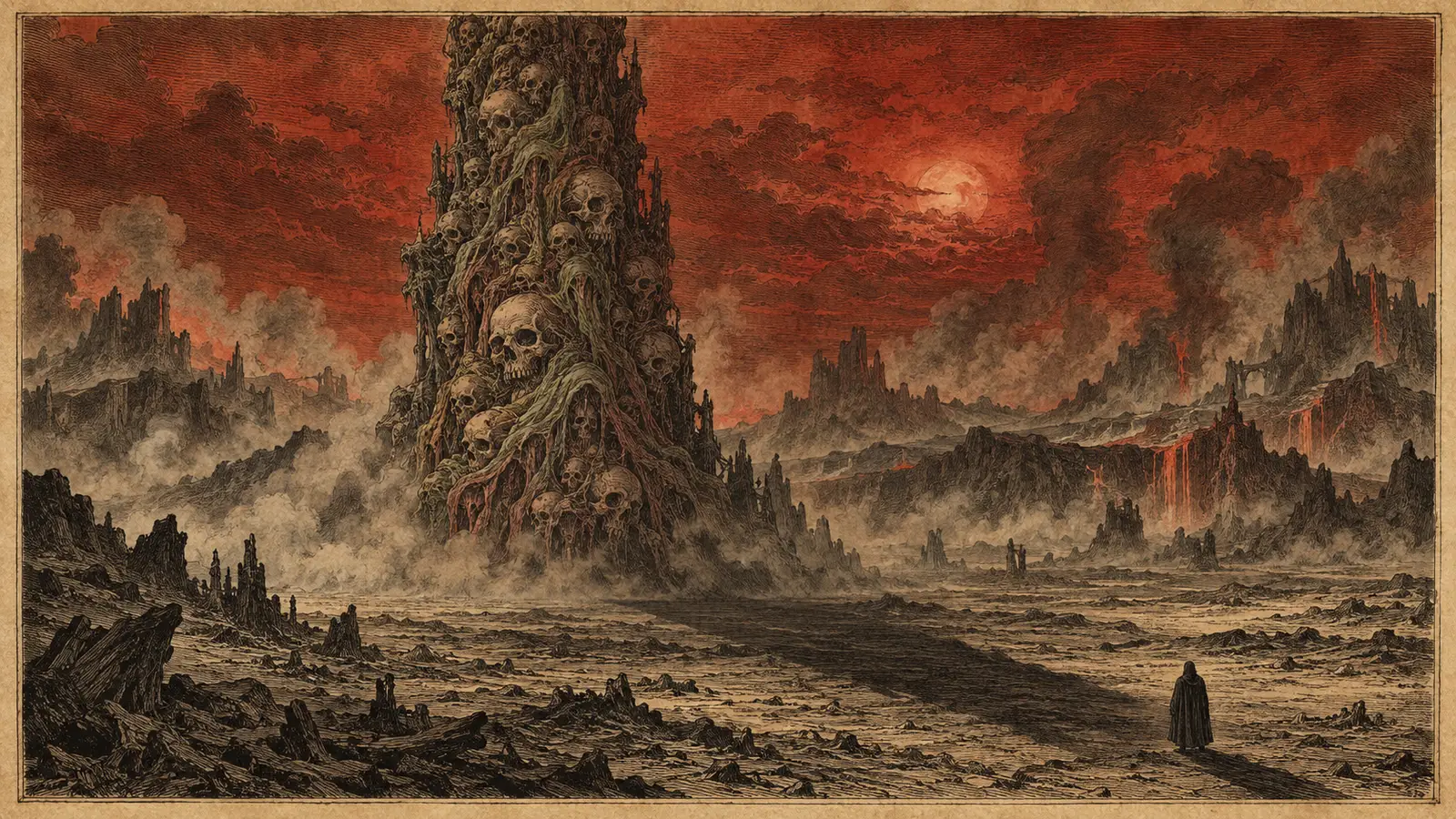
And then you reach the Pillar. It is a great column of skulls and writhing, rotting flesh, rising out of the plain. Every head in it belonged to someone who had knowledge, and lied, and whose lies led to the deaths of others or caused great harm. The Pillar knows a great deal, because it is made of people who knew things. But it demands a price for every answer. If the hero can't lie convincingly about where Fhjull is hiding, the Pillar sends a cornugon and red abishai and lemures up into the Outlands to kill him.
The Nameless One's closest companion has a history with this place. is a floating, talking skull, cheerful and crude, and he was once one of the Pillar's heads. An earlier incarnation of the Nameless One pulled him free in exchange for information, which Morte promptly lost the moment he left the Pillar. Morte's place there wasn't a mistake. In life he lied to the Nameless One himself, telling him that Ravel could make him immortal. So he carries guilt for the hero's whole cursed condition, and he grows nervous and quiet near the Pillar. If the hero forgives him, his torment eases, and he grows stronger. There's something gentle in that, deep in Hell: a lie that damned a man, answered with forgiveness.
The game's story around Curst carries the Blood War further. Trias of the Seven Peals, the fallen deva who bound Fhjull, had been charged by his god Tyr with redeeming the town. Instead, he spent years turning its people against one another. Once Trias is freed, Curst slides from the Outlands down into , and it becomes a launching point for a great baatezu offensive. From Carceri, the devils can slip around the tanar'ri defences on the borders of the Gray Waste. Suddenly the endless war threatens to spill into places it was never meant to reach.
Torment has fiends among its companions too, but they belong elsewhere. Fall-From-Grace is a succubus, a tanar'ri of the Abyss, and is a tiefling of Sigil. Neither comes from Baator, and seeing them beside the devils of Avernus shows how different the two sides of the Blood War can be.
A year later, in 2000, Black Isle released Icewind Dale, set in the frozen north of the Forgotten Realms around the settlements called Ten Towns. Its story rests on an old sacrifice. Long ago a priest of named Jerrod gave his life to seal a portal to the Nine Hells beneath the town of , and the seal became known as Jerrod's Stone. In the game a feud between a demon and a devil threatens the whole region. The marilith Yxunomei works from a lair beneath the volcano called Dragon's Eye. But the true villain is someone kindly. A man named , gentle and helpful, is really Belhifet, a devil of Avernus. He means to reopen Jerrod's Stone and conquer the North with an army of devils. The heroes unmask and defeat him, and he's banished back to the Hells.
Then comes the quiet twist at the very end. The voice that has narrated the whole game, telling you the story as an old tale, turns out to be Belhifet himself. He hints that the century of imprisonment owed for his defeat is nearly over, and that soon he will walk the mortal world again. It fits an old rule of the lore beautifully. A devil slain away from the Hells isn't truly destroyed. It's sent home and bound there for a time, and devils are very good at waiting.
And in 2003 BioWare's Neverwinter Nights: Hordes of the Underdark took players deep below the surface. If you heard our evening in the Underdark, you'll know how far down that world goes. There, a drow ruler called the Valsharess has done something remarkable. She has enslaved an archdevil, himself, Lord of . When he's freed, and the Valsharess is dead, Mephistopheles reveals what he truly wants: to use her armies to conquer the surface, beginning with the great city of , and to turn the whole world into another hell. The hero can learn his true name and speak it against him, which takes us right back to that old rule from 1977. To know a devil's true name is to hold a thread of its power.
So by the early 2000s, the Hells had become a place players could visit with their own eyes: a pillar of lying heads under a red sky, a devil's voice telling you a bedtime story, an archdevil bound by a single secret word.
Chapter VII
The Pact Primeval: third edition rewrites the beginning
In 2000 the third edition of the game arrived, published by Wizards of the Coast, and the old words came home. Its Monster Manual called the devils devils again, the bearded devil and the horned devil and the ice devil and the bone devil, while keeping baatezu as a name for one particular group of them. Familiar faces returned in its pages: the barbazu, the cornugon, the erinyes, the gelugon, the hamatula, the imp, the lemure and the osyluth, along with the hellcat and the chain-wrapped kyton. The Manual of the Planes followed in 2001 and gave the Nine Hells of a place in the new edition's cosmos.
In this era Bel still ruled , and was still his prisoner. The lore of the time painted that arrangement in a striking way. Bel ruled from a fortress called the Bronze Citadel, and deep inside it he kept the fallen Zariel, drawing off the prisoner's power for his own use. Those balls of fire that had drifted and burst across Avernus's red sky since Greenwood's day were said, in this telling, to be Zariel's helpless rage made visible, spilling out of the citadel into the sky. It's a haunting image, and later lore would change it entirely, but for a while that's what the fireballs of Avernus were: the fury of a captive.
In 2002 came the Book of Vile Darkness, written by Monte Cook. It was billed as a close study of the nature of evil, and it was the first book for the game to carry a label for mature audiences. Its seventh chapter, "The Lords of Evil," brought the great demon princes and the Lords of the Nine into the new edition. Each lord received a cult of mortal worshippers and a few chosen servants. The older devil nobles mostly stood in the background, though and a figure called Martinet earned brief mentions. The lineup on the thrones was the one the Reckoning had left: Bel, , , with , , the Hag Countess, , and . Cook later said the book had a hard time finding its readers. Some thought it too tame, and others thought it went much too far.
Then, in December 2006, came the book that would shape the Hells for a long time afterward. Fiendish Codex II: Tyrants of the Nine Hells was written by Robin Laws and Robert Schwalb. It was meant to be the definitive word on devils, and it covered almost everything: where devils came from, how their bodies and minds and society work, how they trade, how they relate to demons, how they harvest mortal souls, and every one of the nine layers in turn, with its terrain, its society and the temperament of its ruler.
And it opened with a story. Its preface, "The Pact Primeval," gave the Nine Hells a new beginning. It's the greatest retelling of Hell's origin the game has ever offered, and it's worth hearing slowly.
In the beginning, the story says, the lawful gods were busy. They had worlds to make and peoples to shape. But the Abyss was already there, and its demons were already spilling out, undoing whatever the gods built. So the gods made servants to fight them. Asmodeus was one of these servants, and some versions of the myth call him an angel: the bravest, toughest, fiercest and most beautiful of all the angels. He and his companions were sent against the demons so the gods could get on with the work of creation.
They fought for eons. And over those long ages of war, something happened to them. They changed. They came to resemble the very demons they fought, in their looks and in their methods. Their work grew brutal. The good gods, watching from above, began to find them distasteful, and wished them gone.
Asmodeus answered calmly that he was only doing his job. And then, in that tense moment, he made an offer. He proposed an agreement, which became known as the Pact Primeval, or the Ancient Compact. Under its terms, he and his companions would take on a new task. They would punish the souls of the wicked. And in return, they would be allowed to draw divine energy from the souls they tormented. It seemed tidy and just. Evil would be punished, the gods would be spared the unpleasant work, and the warriors would be paid. The gods signed.
But the contract was full of loopholes. And through those loopholes, Asmodeus began to work. He didn't wait for wicked souls to come to him. He went out among mortals and tempted them, subverted them, trapped them. Slowly, over ages, the gods noticed that fewer and fewer souls were reaching the Upper Planes. When at last they came down to Baator to see what was happening, they found that Asmodeus had turned it into a world of endless suffering, crowded with countless new devils, all fed by souls he had won through his clever reading of the Pact.
The gods put him on trial. They demanded that he be cast out. And Asmodeus argued that neither he nor his followers had broken the Law. Every soul had been won within the terms of the agreement. The gods had signed it themselves. And he was acquitted.
They threw him out of the Upper Planes anyway. And so he fell, down and down through Baator, and the force of his fall carved the deepest places of Hell.
There are other stories from this era that fit around that one. Asmodeus is said to have once walked into , the holy mountain of law and goodness, and come back out alive on nothing but his words and his wits. He has survived every attempt to overthrow him. He has been acquitted at every trial. And there's a small, quiet detail that the grander tellings tend to leave out. Asmodeus still carries wounds from his fall. They are half-healed, and they break open on his skin like the canyons that scar .
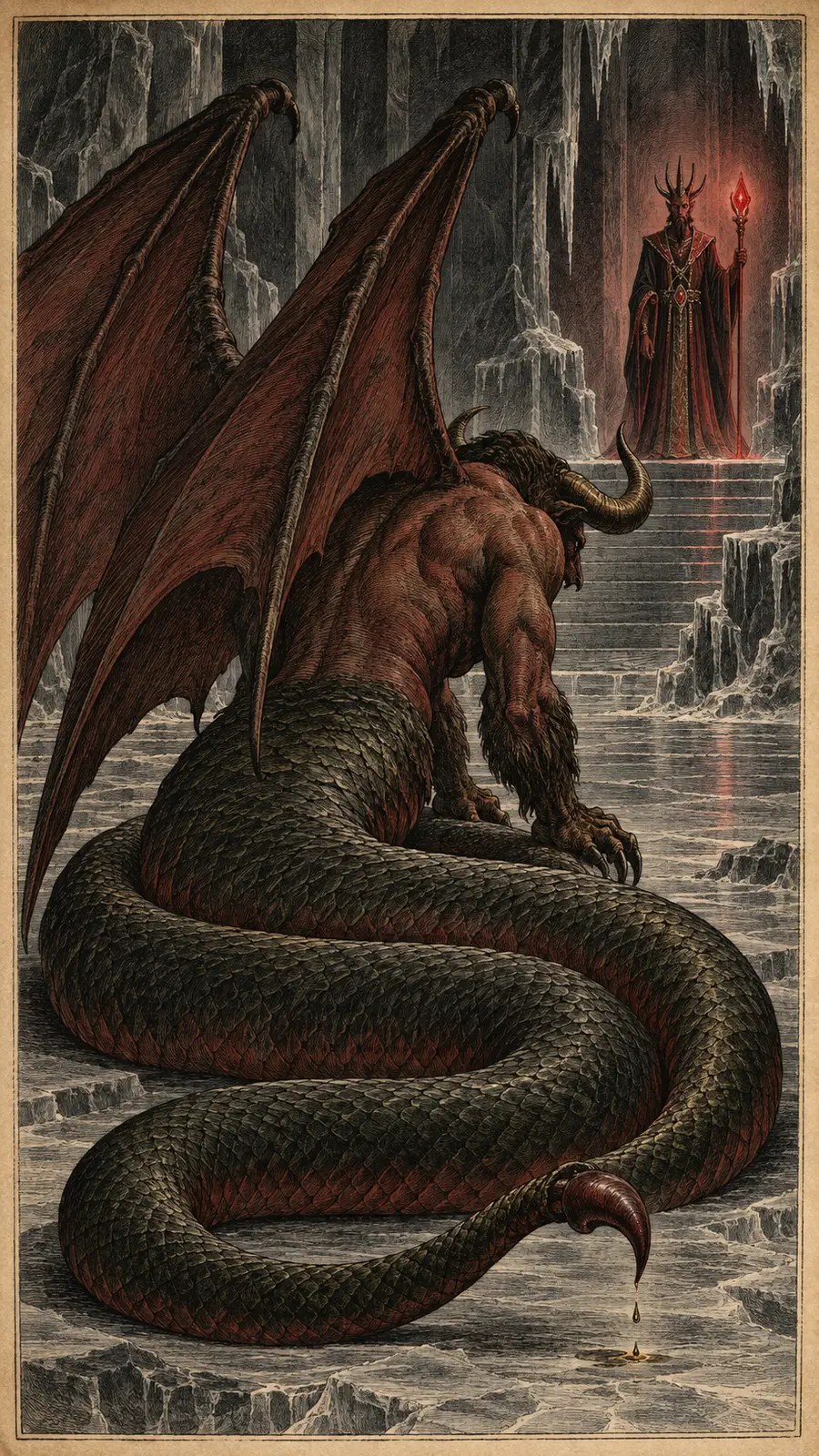
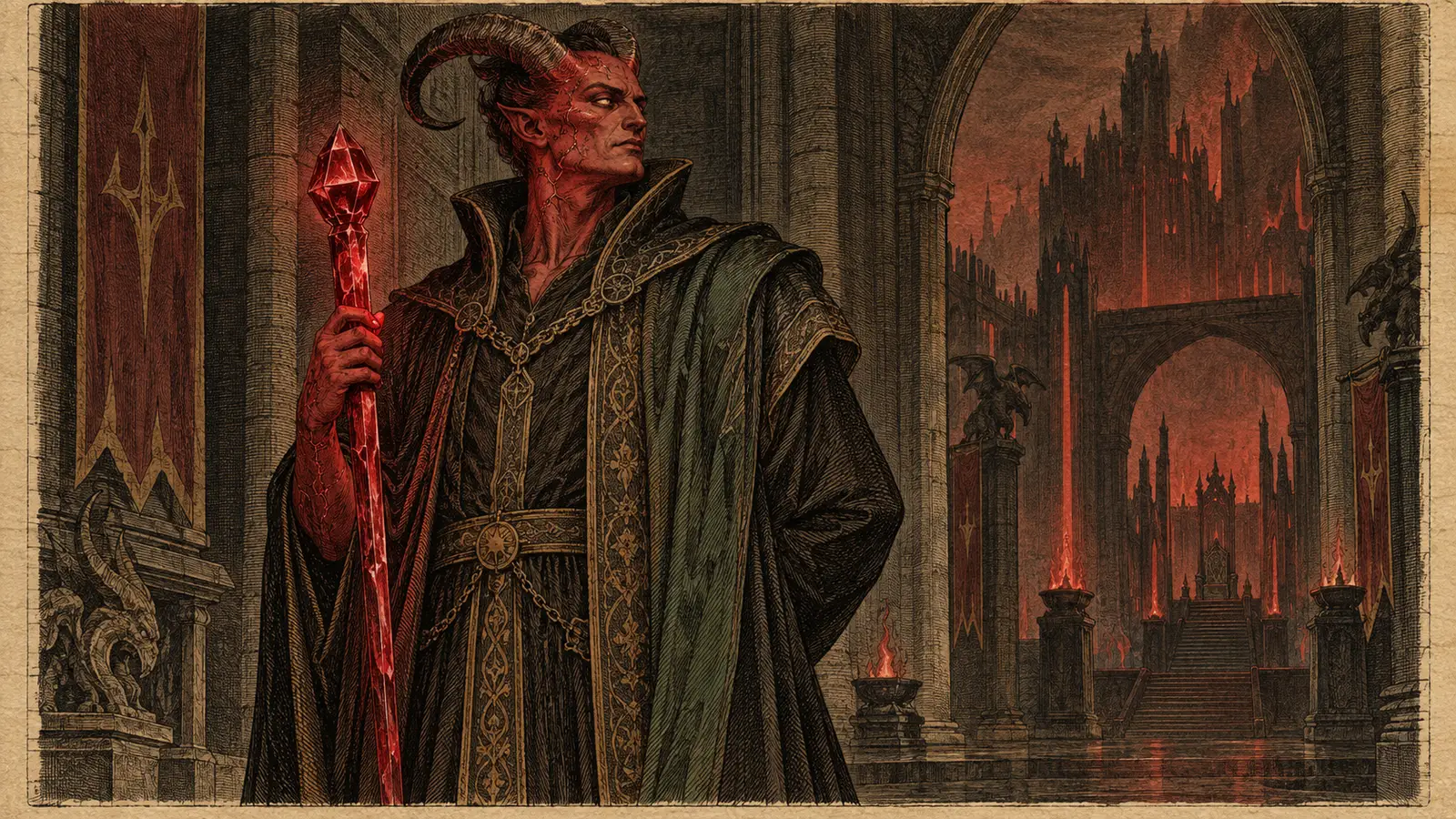
Because Nessus remembers the fall too. Across that deepest layer runs a vast canyon called the Serpent's Coil. It follows the spiralling path Asmodeus took as he plunged down, and it winds inward and downward like a great stone shell. At its very bottom sits his fortress, . And in this telling, the tall, handsome, red-skinned figure that the world knows as Asmodeus is not his true shape at all. It's an illusion, an avatar. His real form is a vast serpent, lying at the lowest point of the Coil, at the lowest point of all Hell.
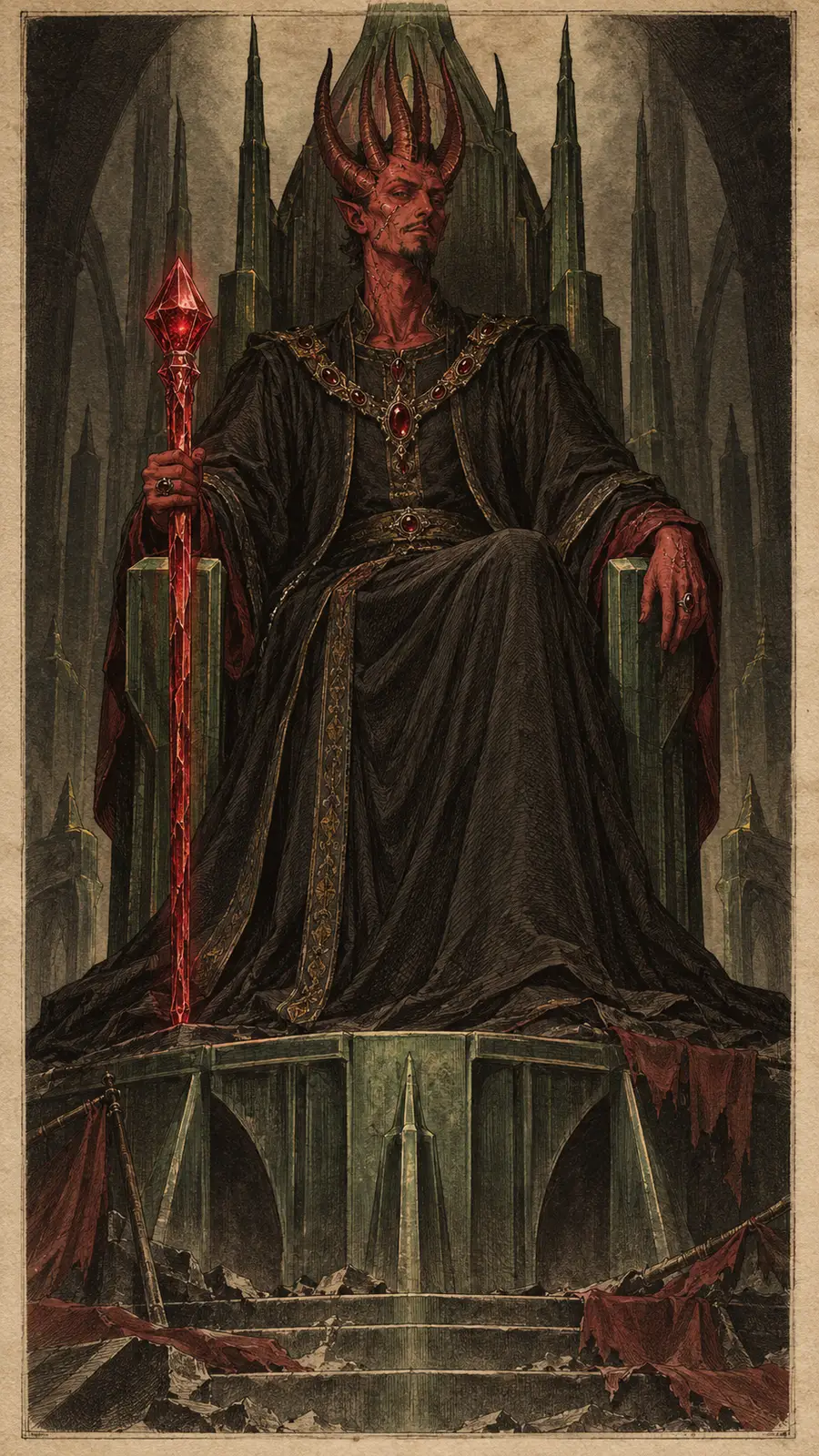
In his hand, or in the hand of his avatar, he carries the Ruby Rod. It looks as if it was carved from a single enormous ruby, and it shines with the power of Hell.
The Pact also explained what happens to a damned soul. In Baator, souls are called petitioners. Their torment is slow, and its purpose is precise. Bit by bit it strips away every trace of who they were. As their individuality wears away, it releases a kind of magical energy, and that energy flows to the ruler of the layer where they suffer, just as the Pact Primeval says it should. Hell isn't only a punishment. It's an economy, and the currency is the self.
The book rebuilt one layer completely. , the sixth, had been given to the Hag Countess after the Reckoning, and she had ambitions beyond it. She tried to rise to godhood. She failed. Her body swelled enormously, grew and grew, and then split open, and the layer itself was changed. Malbolge became her body. Its slopes and caverns are her innards and bones. If you walked there, you'd be walking through the remains of a night hag who reached too high.
And the layer needed a new ruler. Glasya, Asmodeus's daughter, had waited in the background of Hell for a very long time, ever since first named her as a princess of Hell in 1983. Now she became Lord of the Sixth, and ruled a layer made from the body of the hag who came before her. Her rise tied back to the politics of the Reckoning, which had cleared the way by removing one of the old lords.
Fiendish Codex II also gave adventurers new ways to face the Hells, which we'll come back to when we sit down at the table. But its lasting legacy was the Pact. From now on, Asmodeus wasn't simply the strongest devil. He was a lawyer who had out-argued the gods, a fallen angel who had won his case and lost his heaven, and a serpent lying wounded at the bottom of a spiral he carved with his own fall.
Chapter VIII
A dominion in the Astral Sea: fourth edition
In 2008 the fourth edition arrived, and it rearranged the whole shape of the cosmos. The great wheel of Outer Planes was set aside. In its place stood a new arrangement called the World Axis. The world sat at the centre, with the Feywild and the Shadowfell as its bright and dark reflections. Below lay the roiling Elemental Chaos. Above stretched the Astral Sea, a silvery void in which the dominions of the gods floated like islands.
And the Nine Hells were one of those islands. They became an astral dominion, a divine realm drifting in the Astral Sea alongside the homes of the other gods. They were no longer an endless Outer Plane stretching forever in every direction. They had become a finite realm, something you could almost picture from far off, a dark world hanging in silver. Its nine layers remained, still stacked one beneath another, still descending from to . But the whole of it could now be seen as a single place, owned by a single power.
Because in fourth edition, was a god. The edition's Dungeon Master's Guide listed him among the evil gods, as the god of tyranny and domination. He was the resident deity of his dominion, and the eight archdevils below him were his vassals.
The demons, meanwhile, now lived in the Abyss, which lay deep in the Elemental Chaos. So the Blood War had to cross between the Astral Sea and the churning elements below. Avernus remained what it had always been in the game's imagination, the blood-red wasteland on the front line of that war.
The edition's Manual of the Planes, published at the end of 2008, was written by Richard Baker, James Wyatt, Rob Schwalb and John Rogers. Baker wrote the chapter on the Astral Sea, where the Hells floated. The writers said their aim was maximum playability, that every plane should be reachable by player characters and full of adventure. And the Hells got generous attention. Later books, The Plane Above and the Demonomicon, both in 2010, deepened the story further.
Fourth edition told the origin of the Hells in a new way. It's darker and more violent than the Pact Primeval, and it's told as a myth of murder.
In the earliest times, the story goes, Asmodeus was an angel in the service of a god. That god's name has been lost, and later tellings call him only He Who Was. His realm was beautiful, an astral dominion called . But Asmodeus grew dissatisfied. One telling, from the Demonomicon, says that he went down to the very bottom of the Abyss, where a shard of pure evil called the Seed of Evil lies at the heart of everything demonic. He broke off a small piece of it and set it in his ruby rod. And its evil seeped into him, and drove him to rebel.
So Asmodeus gathered other angels of He Who Was, and they rose against their master. Among them were and , and an angel named who would later fall even further, into the Abyss, to become the demon queen of succubi. Asmodeus led them, and he murdered his god. In that killing, he took divine power for himself.
But He Who Was did not die quietly. With his last breath he cursed them. Every rebel angel was twisted into a devil. And his beautiful dominion, Baathion, became a nightmare prison, the Nine Hells of , and the new devils were bound to it forever. In this telling, the devils are fallen angels locked inside the heaven they conquered. They won it, and it became their cage.
This murder took place in the age of the Dawn War, the primeval struggle in which the gods overthrew the primordials, the great elemental titans who had shaped the world. Among all the upheavals of that ancient time, Asmodeus slaying his god and rising to godhood stands as one of the great events.
In fourth edition the lords of the layers were the same as in the third edition's Fiendish Codex. Bel held Avernus, with now remembered as an earlier ruler. held Dis. held . and held . held . held . held . Mephistopheles held . And Asmodeus ruled from his fortress of in Nessus.
What fourth edition added was the sense that all of these lords had once been angels together. Every archdevil was a fellow conspirator in the murder of He Who Was, every one of them cursed alongside Asmodeus. They owed their fall to him. They resented him for it. And they schemed against him, and against each other, forever.
The layers gained new details in this era. In Avernus, there were cinderstorms, which soldiers called battle's bane. Fireballs rain down in them, again and again, drawn to blood and to the cries of the wounded, and they don't stop falling until no one is left bleeding. In Dis, beneath the great tower, lie caverns called the Pits of Dis. Minauros was described as a broad, low-vaulted cavern connected to Dis. And in Cania, ice storms howl with enough force to strip flesh from bone.
Dragon and Dungeon had by now become digital magazines, and they ran a series called "Codex of Betrayal," which explored Hell's lords and nobles one at a time. It alternated with a series on the demon lords, so that most months brought some new piece of the lower planes. , the Prince of Imps, came first in 2008. Then came , the Butcher of Nessus. Then came Geryon, under a title that says everything about him: the Broken Beast. Geryon, 's honest-faced monster, had once ruled Stygia after Levistus was sealed in the ice. He had lost his title after the civil war, and Levistus had his layer back. In fourth edition he is deposed, broken and humbled, a lord without a land. Then came Glasya, Princess of the Nine Hells, written by Robert Schwalb, keeping her rule over the sixth layer that had once been the Hag Countess. And finally Levistus, Prince of Stygia, still in his ice.
Fourth edition also told a new story about the tieflings, the people with infernal blood. Long ago, the story goes, there was a human empire called . Its nobles were obsessed with gaining power and keeping it forever. And the devils of the Nine Hells sent them dreams. The dreams described a grisly ritual, a month long, that would make their rule last forever. Then the devils appeared, and the nobles gladly signed the pacts, pacts tied to Asmodeus. Their bloodlines were marked forever after with devilish features: horns, tails, strange eyes. Bael Turath later fought a long war against the dragonborn empire of , and both empires fell. The tieflings of the present day are the descendants of those nobles, carrying a pact their ancestors signed.
In the Forgotten Realms, fourth edition also explained how Asmodeus became a god in that world specifically. The Realms had suffered a catastrophe. , the goddess of magic, had died, and a disaster called the Spellplague had torn through reality. , the realm of , god of wizards, was destroyed. And Azuth fell. He fell through the cosmos, down into the Nine Hells, where Asmodeus was waiting. Asmodeus consumed Azuth's divine essence, and with it he became a full god.
Later lore, in the fifth edition years, told this story differently. It turned out that Asmodeus hadn't destroyed Azuth after all. Azuth had been lying dormant inside him all that time. Around the year 1487 in the Realms' reckoning, Asmodeus released Azuth, and took instead the divine spark of , a god of the ancient land of , with the agreement of the god . Nanna-Sin was restored as an immortal, though no longer a god. It's a later retcon, and a very devilish one: even when Asmodeus gives something back, it's because he's found a better deal.
So in fourth edition, the Hells were a dark world drifting in a silver sea, the stolen heaven of a murdered god, ruled by a god who had once been an angel and now owned everything that fell into his reach.
Chapter IX
Fifth edition: Mordenkainen's notes on the Great Dance
In 2014 the fifth edition arrived, and with it the great wheel came back. The Nine Hells were once again an Outer Plane, nine layers stacked one upon another, from at the top to at the bottom. Each layer was shaped by the personality of its ruler, a landscape built from one mind's obsessions. And , once more a fallen angel, ruled from Nessus.
The fullest look at the Hells in those first years came in 2018, in Mordenkainen's Tome of Foes. The book is framed as the notes of the wizard , a scholar of the multiverse who has seen more than most. Its first chapter is called "The Blood War," and it gives the devils a long and careful study.
The Blood War is the same endless struggle as before, the lawful evil devils of the regimented Hells against the chaotic evil demons of the Abyss's countless layers. Fronts shift, neither side wins outright, and the war spills across the lower planes and sometimes, terribly, into the mortal world.
But Mordenkainen gives the politics of Hell a lovely name. He calls it the Great Dance. It's the endless manoeuvring among the archdevils, each trying to rise, each trying to bring down a rival, all of them watched by Asmodeus. And Asmodeus, in Mordenkainen's telling, is the undisputed master of the Nine Hells, running schemes within schemes. He protects his reign in a surprising way. He keeps his enemies close. He hands most of the authority in Hell to the very devils who most want to replace him. They're so busy using that power, and plotting with it, and watching each other, that they never quite manage to turn it against him. The book gives statistics for many devils, but not for Asmodeus, and you can feel the quiet implication in that silence. You don't defeat Asmodeus.
The book also revisits the trial theme. Once, the story goes, angels brought charges against Asmodeus. He asked that the case be judged by , the ruler of the modrons, the perfectly orderly creatures of the plane of absolute law. Asmodeus argued that everything he had done was by the book. And Primus, who cares for nothing but the law, ruled in his favour. The Ruby Rod he carries is part of that bargain too, for it binds him to law. Even the master of Hell has terms he must keep.
The Lords of the Nine, in Mordenkainen's day, stand like this. rules Avernus. rules Dis. rules . rules . rules , still trapped in his icy tomb by Asmodeus's will. rules . rules . rules . And Asmodeus rules Nessus.
That first name will be new to you, if you've only been listening to the older stories tonight. Bel no longer holds Avernus. Zariel does, and she is no longer a prisoner. Fifth edition remade her completely. She is a fallen angel, an exile from the heavens who defied the celestial council to invade the lower planes. Her story is long enough that it deserves its own chapter, and we'll come to it next. But Mordenkainen gives us the outline. She was an angel set to watch the Blood War, forbidden to join it. She was drawn into the fighting anyway, and led mortals into battle against the fiends. And Asmodeus noticed her initiative, and made her an archdevil with a layer of Hell to rule.
The book also retells the Reckoning, with a new beginning. In fifth edition, it was Zariel's actions that set the failed rebellion in motion, and it was still who betrayed the rebels and stood with Asmodeus.
The book's devils include a handful of the old nobles, now given full shape. Geryon is here, and his story has moved on. He is no longer quietly faded. He's locked in a war with Levistus for control of Stygia, the layer that was taken from him, battling a rival who can't even leave his iceberg. is here, a servant of Mephistopheles nearly as powerful as his master, with a deadly poison in his strikes. is here, the lord who stood his ground during the Reckoning and was exiled from the Nine Hells for scheming against Asmodeus. And is here, Dispater's most treasured advisor, who talks his master into schemes and has quietly taken over most of his duties. You can imagine the paranoid lord of Dis in his iron tower, trusting no one, and leaning more and more on the one voice that whispers to him.
New devils appear too, with names that sound like the clang of a forge: the amnizu, the hellfire engine, the merregon, the narzugon, the orthon, alongside the old nupperibo and the five-coloured abishai.
And the book tied the tieflings to all nine lords. In fifth edition's first Player's Handbook, the tiefling's infernal heritage traced back to Asmodeus. Mordenkainen's notes offered eight more lines, one for each of the other lords. A tiefling doesn't have to be the child of one of these rulers. Instead, they're shaped by a particular lord's influence, and by the nature of that lord's layer.
The line of Baalzebul, lord of crumbling Maladomini, carries a gift for corruption, of the body and of the mind. The line of Dispater, lord of the Iron City, leans toward disguise and the reading of thoughts, fitting for a ruler who suspects everyone. The line of Fierna, the charming ruler of Phlegethos, leans toward charm. Glasya, who runs the criminal underworld of the Hells, gives her line a thief's quick hands. Mephistopheles, who hoards arcane secrets in his frozen citadel, gives his line a talent for spellcraft. And Zariel's line is built for war, because she herself is an angel who fell fighting demons.
You can picture a whole tapestry of tieflings across the worlds, each carrying a faint trace of a different layer: a sly smile from Phlegethos, a watchful stillness from Dis, a battlefield's heat from Avernus.
Reviewers praised the book for its detail in the devils, and it set the stage for the greatest Hell adventure the game had yet published. That adventure began in a city on a river, with a second sun hanging in its sky.
Chapter X
The Hellriders of Elturel and the fall of Zariel
East of Baldur's Gate, on the River , in the region of the Forgotten Realms called the Western Heartlands, there stands a city named . In the middle of the fourteenth century by the Realms' reckoning, it was a place of farming and trade, a solid and prosperous city with a castle called the High Hall. And it was famous across the land for its cavalry.
They were called the Hellriders, or sometimes just the Riders. They were the elite horsemen of Elturel, its main armed force, and they were led by the High Rider, who also ruled the city. They were renowned across the Realms as a city guard that could outmatch the armies of whole kingdoms. They rode in crimson and white armour. Their banners would later carry a sun with a smaller, blazing companion beside it, though that second sun came later in the story.
Every telling agrees on why they were called Hellriders. Long ago, a company of the Riders rode into , into the first layer of the Nine Hells itself. But the reason has changed with each telling. The earliest legend says they rode in to rescue one of their own, out of simple loyalty to one another. A later version says they rode through a gate to hunt down devils that had been harrying Elturel. And fifth edition told the whole story anew, and tied it to an angel.
was an angel, a radiant being of the celestial hosts. She believed, with all her heart, that the forces of good could destroy the fiends wherever they appeared. She believed that a single great assault by the armies of the heavens could wipe them out forever. But angels were forbidden to join the Blood War. Her superiors would not act. And she grew frustrated, and fought demons and devils wherever she could anyway.
Then came the Battle of . , the demon lord of gnolls, led a horde of gnolls and demons against lands Zariel protected. The battle raged, and when it seemed at last to be over, Yeenoghu seized one of Zariel's generals, a woman named , and fled through a portal. Zariel did not hesitate. She rode after him on her mount, , a hollyphant, a small celestial creature shaped like a little golden mastodon, and she led her army through the portal. They came out on the plains of Avernus. And from that day, Zariel couldn't stop thinking about how evil seeped out of the lower planes and spread across everything.
So she came to Elturel. She declared that she had found the gate through which the devils were pouring into the world, out in the Fields of the Dead west of the city. And she said that she would lead the cavalry through it and defeat the fiends where they gathered. She trained an army, thousands of knights. Among them were Yael, , , and a man named , whom some of you may know from older stories as a vampire.
In the Year of the Bow, which the Realms count as 1354, Zariel rode out at the head of her knights on her golden hollyphant. They charged through the gate into Avernus. It became known simply as the Ride.
It went badly. The armies of Avernus were waiting. Some of the knights panicked. They turned their horses, rode back through the gate, and sealed it behind them, trapping everyone else on the other side. Jander Sunstar seems to have been among those who sealed it. The few who returned told Elturel that Zariel and her army had been defeated, and the city honoured everyone who had ridden as the Hellriders. The secret of what the survivors had done, how they had shut the door on their comrades, they kept to themselves.
In Avernus, Zariel was found beaten and unconscious beneath a mountain of the dead. She was carried before . And Asmodeus offered her the one thing she had always wanted: a place in the Blood War. Command of his armies against the demons. And Avernus to rule, in place of Bel. She accepted. She fell. She became an archdevil, and Avernus became hers.
Not everyone followed her. Haruman and Olanthius stayed loyal through her fall, and became her servants in Hell. But Yael did not. Yael took Zariel's holy sword, the blade she had carried as an angel, and buried it in Avernus, where no devil could reach it. Where the sword lay, its holy power created a place called the Bleeding Citadel, a fortress of positive energy in the middle of Hell. In one telling, Lulu helped Yael hide it, to keep it away from Yeenoghu's demons.
The knights who had fled through the gate weren't forgotten either. Hellriders who ran were later found on a hill in Avernus, Haruman's Hill, impaled on trees of iron thorns. Jander Sunstar hangs there among them, kept alive by his vampiric nature, because he knows where the Bleeding Citadel lies.
And Bel, the pit fiend who had ruled Avernus since the Reckoning, now serves Zariel. He does it resentfully, in the name of defending the Hells, and all the while he schemes with his allies to take back his throne and win back Asmodeus's favour.
Now we go forward ninety years. In the Year of the Seductive Cambion, which the Realms count as 1444, a horror was uncovered in Elturel. The High Rider, the city's ruler, was revealed to be a vampire. Undead spread through the streets. And then a miracle. A second sun appeared in the sky over Elturel. People called it the Companion. Its light destroyed the vampire lord and all his spawn, and it went on shining, day and night, over the city and the lands around it.
A priest of named took credit for the miracle. The grateful people acclaimed him High Observer. Elturel and its surrounding lands became , a realm devoted to Torm the True, defended by a paladin order called the Order of the Companion. The Hellriders' banners now showed the sun and its smaller blazing companion together. And only the High Observer knew what the Companion really was.
It was a contract. In the city's darkest hour, Kreeg had bargained with Zariel. The Companion was an infernal device, given to save Elturel from the undead. And the price was the city. The whole of Elturel and its oathbound defenders, to be collected after a set term of about fifty years, to serve as Zariel's army in the Blood War. Kreeg led a secret cult of Zariel inside the government, and he waited for the term to run out.
When it did, Kreeg slipped out of the city shortly before the end. And then the Companion turned black. It became a dark orb in the sky, and it tore Elturel from the world. The whole city, its walls and temples and people, was dragged down into Avernus, leaving only a crater behind. They call it the Damnation of Elturel.
In Avernus the city hangs in chains above the River . Zariel means to lower it into those black waters. If no one intervenes, Elturel will sink into the Styx. Its people will lose their memories, the way everyone who touches that river does, and their souls will be made into devils, soldiers for the Blood War. That's what Zariel does with cities. She captures them, and spends them.
And back on the surface, refugees from the lands around Elturel stream westward along the river toward Baldur's Gate.
That's where the adventure begins. Baldur's Gate: Descent into Avernus was published on the seventeenth of September, 2019. It takes characters from their very first steps as adventurers to the heights of their power, and it opens in a crowded Baldur's Gate, with the Flaming Fist, the city's mercenary guard, drafting the heroes into service amid the refugee crisis. Their path leads them down to Avernus.
Adam Lee was the lead story designer, and he's said the whole thing began with a single image from a film, the war rig in Mad Max: Fury Road driving straight into a sandstorm. He told his team that it was like Mad Max: Fury Road in Hell. He pictured Avernus as a giant blasted battlefield where demons and devils fight forever, and Christopher Perkins called the result Dungeons and Dragons meets Mad Max: Fury Road. The actor Joe worked on it as a story consultant, and his own character, a dragonborn paladin named the Cruel, has a tower in Avernus. The book sold strongly, landing on a bestseller list in its first week.
The Avernus of this adventure is a vast wasteland, warped by eons of demonic invasion. It confuses the senses. You can't judge distances there, and places sometimes shift when you aren't looking. The map won't stay still. Across that wasteland roar infernal war machines, armoured vehicles that burn souls for fuel, driven by warlords through the ash. The heroes can take their own, customise it, and drive it across Hell.
There's a strange, bright company in that wasteland. Fort Knucklebone is usually the first stop, a ramshackle outpost whose kenku hold a clue to the buried sword. Mad Maggie runs her own business. A rakshasa named keeps a Wandering Emporium, a shop that travels across Hell selling strange wares. Bel keeps a forge. There's the Dock of Fallen Cities and the Stygian Dock along the river. And deep in a mountain, reached through the mouth of an enormous dragon's skull, lies , the dragon queen who once ruled this very layer, now a prisoner in it. Arkhan camps nearby with the Hand of , trying to free her. Perhaps you remember the Hand from our evening with Vecna. It has travelled a long way.
And the heroes don't travel alone. Lulu, the little golden hollyphant, is in Avernus too. But she has splashed in the Styx, and her memories are clouded. She doesn't remember Idyllglen, or the Ride, or what happened to her angel. As the heroes cross Hell, a vision from the god Torm and fragments of Lulu's returning memories lead them, piece by piece, toward Zariel's buried sword.
The adventure has no single road to victory. It's a web of choices. The heroes might bargain with Bel. They might deal with Tiamat. In one ending, the dragon queen is freed and breathes on the chains that hold Elturel, breaking them.
And in the rarest and gentlest ending, the heroes find the sword and bring it to Zariel, with Lulu at their side. In that last moment, Asmodeus makes Zariel an offer, as he did once before. And the heroes can argue against him. They can remind her of who she was, the angel who wanted only to protect the innocent. They can make an emotional appeal, and it works best of all when it comes from Lulu, the friend who carried her into her first battle. If they succeed, Zariel refuses Asmodeus. She takes back her sword. Her devilish form melts away, and she becomes an angel once more. And Elturel is saved.
It's a slim chance. Things have to go very well, or very badly, for it to happen. But it's there, a single thread of light running through the darkest layer, and it's the thread most people remember.
The adventure was the tabletop prelude to something else, a story told on a much larger stage, where a devil with a pleasant smile would offer a deal to millions of players.
Chapter XI
Baldur's Gate 3: a devil with a pleasant smile
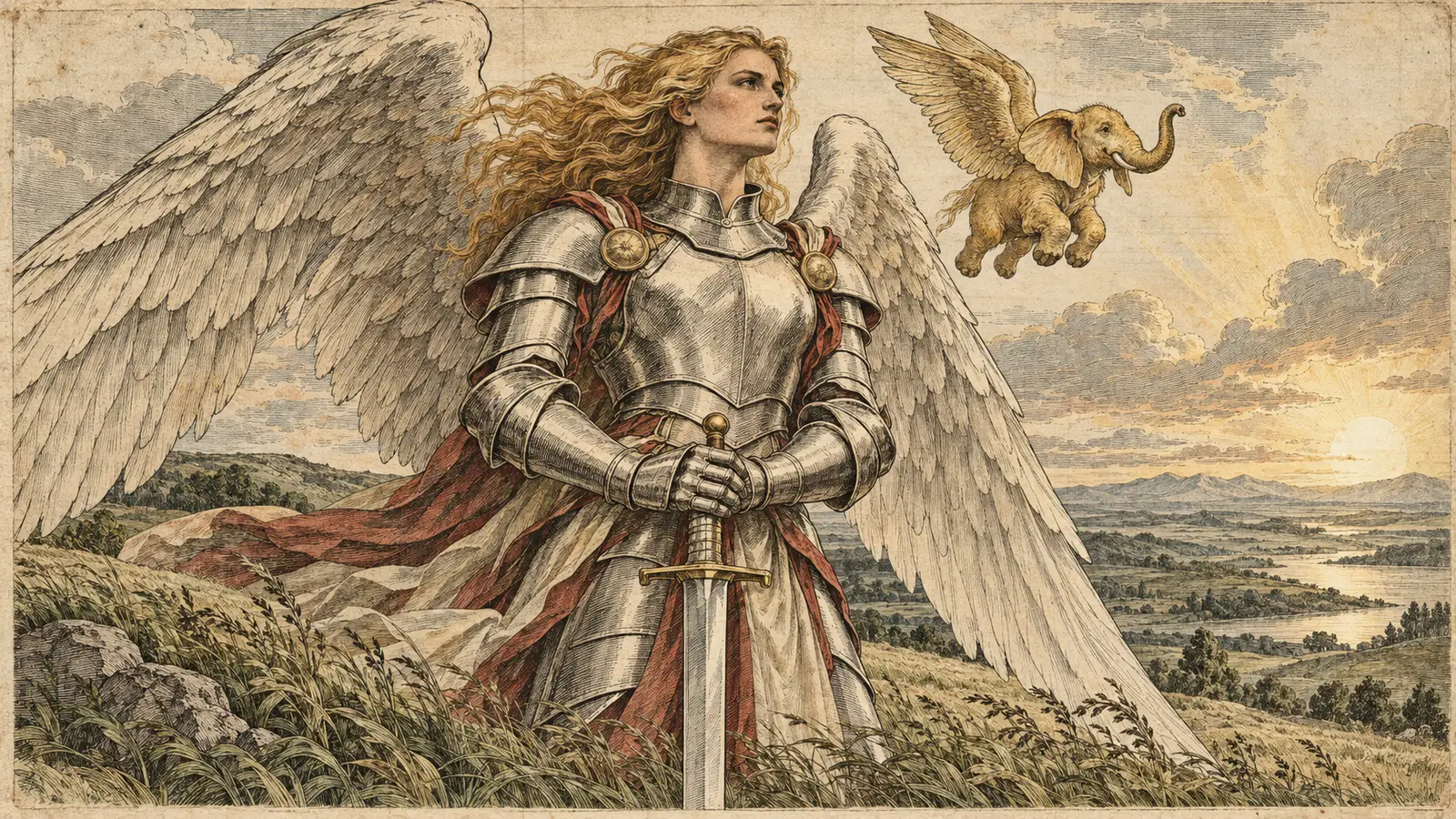
Baldur's Gate 3, made by Studios under licence from Wizards of the Coast, opened to the public in an early form in October 2020, and was fully released on the third of August, 2023. It's set in the Forgotten Realms, around the same troubled city where Descent into Avernus began, and the Nine Hells run all through it.
The game begins with a glimpse of Hell itself. You wake aboard a mind flayer ship, a nautiloid, with a tadpole of a mind flayer squirming behind your eye. Githyanki warriors attack the ship, and the creature piloting it flees, dragging the vessel through plane after plane. For a short, terrible while, it passes through , 's layer, and you can see the red sky and the burning wastes. Imps board the ship, and you fight them off before the nautiloid tears free and crashes on the Sword Coast. It's only a few minutes, but it sets the tone. Hell is close, and it's watching.
And then, out in the wilderness of the first act, you meet .
He looks like a man. A refined, elegant, well-dressed man with a pleasant smile and a beautiful voice, the kind of person who seems perfectly at ease anywhere. He offers to remove your tadpole. For a price, of course. He's always happy to talk about a price.
Raphael is a cambion, a half-fiend. His father is , the archdevil of , lord of the cold, and his mother was a human woman. He comes from Avernus. Beneath his human seeming, his true form has thick, ornate, curving horns and wide, bat-like wings. And when he finally reveals the fullest version of himself, his ascended fiendish form, he's something else again: a head blending three animal faces with skin stretched tight over bone, three glowing yellow eyes, tusked gums, and a body that burns from within with hellfire.
His ambition is old and enormous. Long ago, in the Realms' distant past, a wizard named tried to make himself a god, and the attempt brought down the floating empire of . Raphael watched it happen. He has wanted the Crown of Karsus ever since. He dreams of using it to unite all the Nine Hells under his own rule, as Archdevil Supreme. But before he could claim it, his father locked it away in one of his vaults. Raphael watched over it patiently, and then he saw servants of the Dead Three, the gods of murder and tyranny and death, steal it. The cult of the Absolute used the crown to command the tadpoles. And so the crown was in the world again, and Raphael began to move.
In the third act he meets you in the Lower City of Baldur's Gate, in a brothel called ' Caress, and he makes his finest offer. He'll give you the Orphic Hammer, a weapon that can break the chains holding a prisoner named Prince . He'll cure your tadpole. And all he wants in return is the Crown of Karsus, once you've gathered the stones that control it. If you sign, the Soul-Sworn Contract binds you, and you'll need to find a way out. If you keep the bargain to the end, Raphael thanks you sincerely for the crown. With it he'll push the war in the Hells forward, take Avernus, and go on to conquer the other layers.
He has a home in Hell, and it's one of the game's great journeys. It's called the House of Hope, Raphael's personal domain in Avernus. To get there, you visit a shop in the Lower City called the Devil's Fee, run by a diabolist named . Up on the shop's top floor is a ritual circle, and through the Helsik Ritual you open a portal to Avernus.
The House of Hope is grand and cold. The people inside are called the Debtors, the damned whose pacts with Raphael brought them here. There's an Archive where he keeps his contracts, and if you're careful you can sneak there to recover your own. The Orphic Hammer is kept in the house too.
And the house takes its name from a prisoner. Her name is Hope. She is the sister of a gold dwarf named Korilla . Long ago Raphael offered both sisters places in his service. Korilla accepted, and Hope refused. So Hope is kept in chains, and Korilla serves Raphael only because her sister is still his prisoner. Only the Orphic Hammer can break those chains. Hope helps you, in her quiet way. She uses her magic to dress you as Debtors, and while you're disguised the house leaves you alone. There's a devil's whole philosophy in that small kindness. In Raphael's house, the only safe thing to be is someone who owes him.
Raphael keeps another resident. Mephistopheles sent his son an incubus named , perhaps to distract him from something, perhaps from his designs on the crown. Haarlep lives in Raphael's bedchamber, magically bound to wear Raphael's exact appearance. It's a living picture of Raphael's vanity. Elsewhere in the house, an orthon devil named is tied to Raphael against his will, and if you've treated him well, he may turn on his master when the moment comes.
Two of your companions carry the Hells with them. is a tiefling, warm and loud and kind, who loves a good fight and a good meal. Years ago a man named sold her to Zariel for money. Zariel took her down to Avernus and replaced her heart with an experimental Infernal Engine. Karlach fought in the Blood War, and made a name for herself there, and in the end the war drove her to escape. But away from Avernus, her engine runs hot, overheating and threatening to burn her up from inside. A tiefling smith named helps her, repairing it in stages with infernal iron. And in one ending, she goes back to Avernus, the only place she can survive, to keep fighting.
is a warlock, a young hero of Baldur's Gate who made a pact with a cambion named , one of Zariel's servants. In the third act Mizora offers him a terrible bargain. She'll reveal where his father, Grand Duke , is being held, and if his father is dead, she'll bring him back. All Wyll has to do is pledge his soul to her and to Zariel. If he accepts, he becomes the Blade of Avernus, and he may offer to go down to Avernus with Karlach, promising to hunt only demons and devils for his patron.
The people who made the game thought carefully about what kind of place the Hells should be. Larian's leader, , said he suspected Wizards of the Coast had modelled the devils on lawyers, with a whole code of laws in which pacts are sacred, and every word of a contract must be watched. Larian imagined Hell as a place of constant fear and competition, with a strict hierarchy and holy law as the absolute rule. And Raphael makes an offer to every member of your party, every one of which might carry a heavy cost.
Raphael was played by Andrew , an actor with a long background in theatre and radio. Wincott saw him as a theatrical creature, someone who shares the stage with the audience, speaking to them in asides and soliloquies the way Shakespeare's characters do. That brings us right back to where the evening began, to 's Doctor Faustus and its Mephistopheles, the devil of the English stage. Wincott won a BAFTA in 2024 for the role, and he called Raphael the devil we love to hate, or hate to love.
And when you finally face Raphael in his house, he sings. The battle against him is set to a song called "Raphael's Final Act," composed by and sung by Wincott in character. Swen Vincke came up with the idea about half a year before release. It's a grand, theatrical number, and listeners compared it to the showpiece songs of animated film villains. Of course Raphael would sing his own battle music. He loves an audience more than anything, except perhaps a signature.
Chapter XII
Variants and offshoots: other Hells under other skies
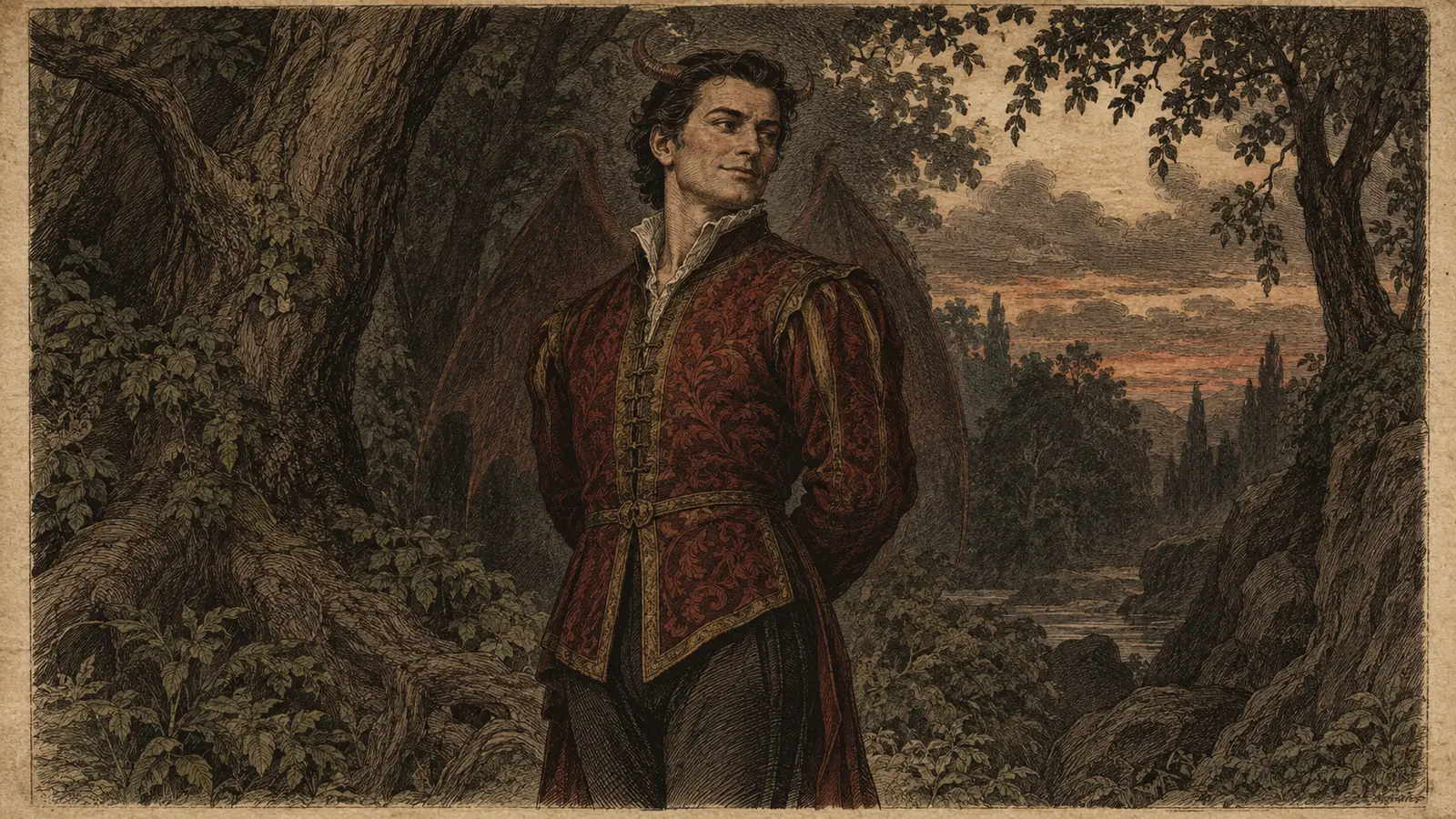
The Nine Hells have travelled far beyond the worlds where we've mostly met them, and in some places they've taken on new shapes entirely.
The oldest home of the game's cosmology is Greyhawk, Gary 's own campaign world, the world of . There the great wheel turns in its original form. The Nine Hells sit among the Outer Planes, between and , touching the Concordant Opposition and the Astral Plane. In the Infernal tongue they're called , the plane of lawful evil, and each of their nine layers stretches without end and keeps its own physical laws. is the overlord of the dukes of Hell and the leader of all devils. He rules from , and his portfolio is power, domination and tyranny.
On Oerth, Asmodeus has a cult. It works across the lands of the Flanaess and even in the City of Greyhawk, its members marked by a small tattoo of a red ruby, the stone of his rod. His great scheme among the gods is a patient one. He stirs up long feuds between them, trying to trick them into fighting each other, so that their worshippers lose faith. Some of those worshippers drift into unbelief, and some of them drift toward the diabolic cults instead. Either way, Asmodeus gains. And in the Great Kingdom of , where an undead ruler reigns in the city of Rauxes, devils have a hand in that reign. If you were looking for tieflings on Oerth, that's where you'd be most likely to find them.
The most complete reimagining of the Hells came from outside the game altogether. In 2009 the publisher Paizo, which had made its own fantasy roleplaying game called Pathfinder, published Princes of Darkness, the first volume of a series called Book of the Damned. F. Wesley Schneider wrote it. It describes Hell layer by layer, along with how devils are promoted, what each kind of devil does, infernal contracts, devil talismans and true names. Its world is called , and its Hell grew from the same roots as the game's, but it grew a different shape.
Pathfinder's Hell has a creation myth of its own. In the beginning, the goddess used the Seal to will reality into being. Among the very first gods were two brothers, Asmodeus and , together called the First. Ihys made the first mortals, and discovered souls, and gave mortals free will to shape their own destinies. Asmodeus believed existence was best served by absolute order and discipline. The brothers quarrelled over the fate of mortal souls, and Asmodeus killed Ihys.
In that world, Hell is something built: nine overlapping planes made for torment and for the purification of souls. Asmodeus won it in a war against creatures called asuras, and won it through betrayal, when turned traitor and devoured many of his own asura followers. Pharasma judges the dead, and some souls she sends on to Hell.
Pathfinder's layers mostly take their names from and classical myth, and each is a place with a purpose. belongs to , a volcanic waste where souls are judged and sorted. Dis belongs to , a vast city that supplies soldiers to the other layers. belongs to , the sewers beneath Dis, where Hell's counting house tallies every fortune. belongs to , the forges of Hell, where souls found unsuitable are recast into something more fitting. belongs to Geryon, with temples and libraries of sin, where temptation is studied as an art. belongs to , a smouldering forest of false rewards where the damned are hunted. belongs to , a land of glaciers and frozen seas, where the damned sit in cages of ice and watch devils feast. belongs to , a realm of iron, with steel cages hanging over endless darkness. And Nessus, the heart of it all, holds the palace of Asmodeus. In that Hell there's no and no , no and no . Below the archdevils come the infernal dukes, many of them promoted from among the pit fiends.
Golarion even has a nation that worships Hell. In Cheliax, after the death of the god , more than thirty years of civil war followed, and at the end of it an old noble house called took the throne. House Thrune had been dealing with devils long before. Its rule was won by a promise of glory and stability, at a heavy price. Under Queen , worship of Asmodeus became the state religion, enforced by the imperial bureaucracy, and Thrune's armies march with bound devils in their ranks.
And Golarion has the Hellknights, orders of armoured knights who model themselves on Hell's order and discipline. They don't worship devils. They study Hell's tenets, and even summon devils sometimes, as tools to frighten others and harden their own resolve. Their code is called the Measure and the Chain. The Measure is the great collection of their laws, and the Chain names their virtues: order, discipline and mercilessness. The first order was founded by a man named , whose followers broke him out of prison and fled to a ruined fortress that became Citadel , the oldest Hellknight citadel. Other orders followed, like the Order of the Rack and the Order of the Chain, which never gives up a pursuit.
Paizo told two mirror-image stories about Cheliax. In Hell's Rebels, players are heroes rising against House Thrune. In Hell's Vengeance, which ran in 2016, they are Thrune's evil servants, sent to crush a rebellion.
In 2023 Paizo revised its game under a new licence of its own, and gave many of the devils that had come from the older game new names. The bearded devils became vordines, infantry devils, Hell's shock troops. The lemures became orts, drudge devils. And the pit fiends became nessaris, tyrant devils, towering more than sixteen feet tall, with wings wider than twenty feet, each able to reshape up to a hundred orts a day into stronger devils. Asmodeus and the archdevils with names from old myth stayed exactly where they were.
Some worlds of the game have no Nine Hells at all. Keith Baker's is one. Its fiends belong to its own planes. In , the plane of war, a pit fiend is a spirit of battle in heavy armour engraved with burning runes. In , the plane of fire, a pit fiend is a figure of shadow wrapped in flame. Eberron's most common fiends are the rakshasas, and its greatest are the Overlords, the first children of the dark realm called , who ruled in the Age of Demons. Fiends called the Lords of Dust work to free them, and one member of their Bleak Council is of the Gray Flame, a mad pit fiend who came from Fernia.
Dragonlance, the world of , has no standard Nine Hells either. Its Abyss is the home of the gods of darkness, and it's sometimes called the Infernal Realms, or even Baator. The goddess is bound up with that Abyss. But in the years, the planar books gave her a realm inside Avernus, called , the Nether Reaches, a strange little pocket where one world's dark queen kept a foothold in another world's Hell.
So the Nine Hells have offspring and cousins and distant echoes, from the counting houses beneath Golarion's Dis to the burning-runed war spirits of Eberron. But wherever they appear, the same idea seems to hold: law turned cruel, order without mercy, and a contract that always reads a little differently than you thought.
Chapter XIII
The Nine Hells at the table
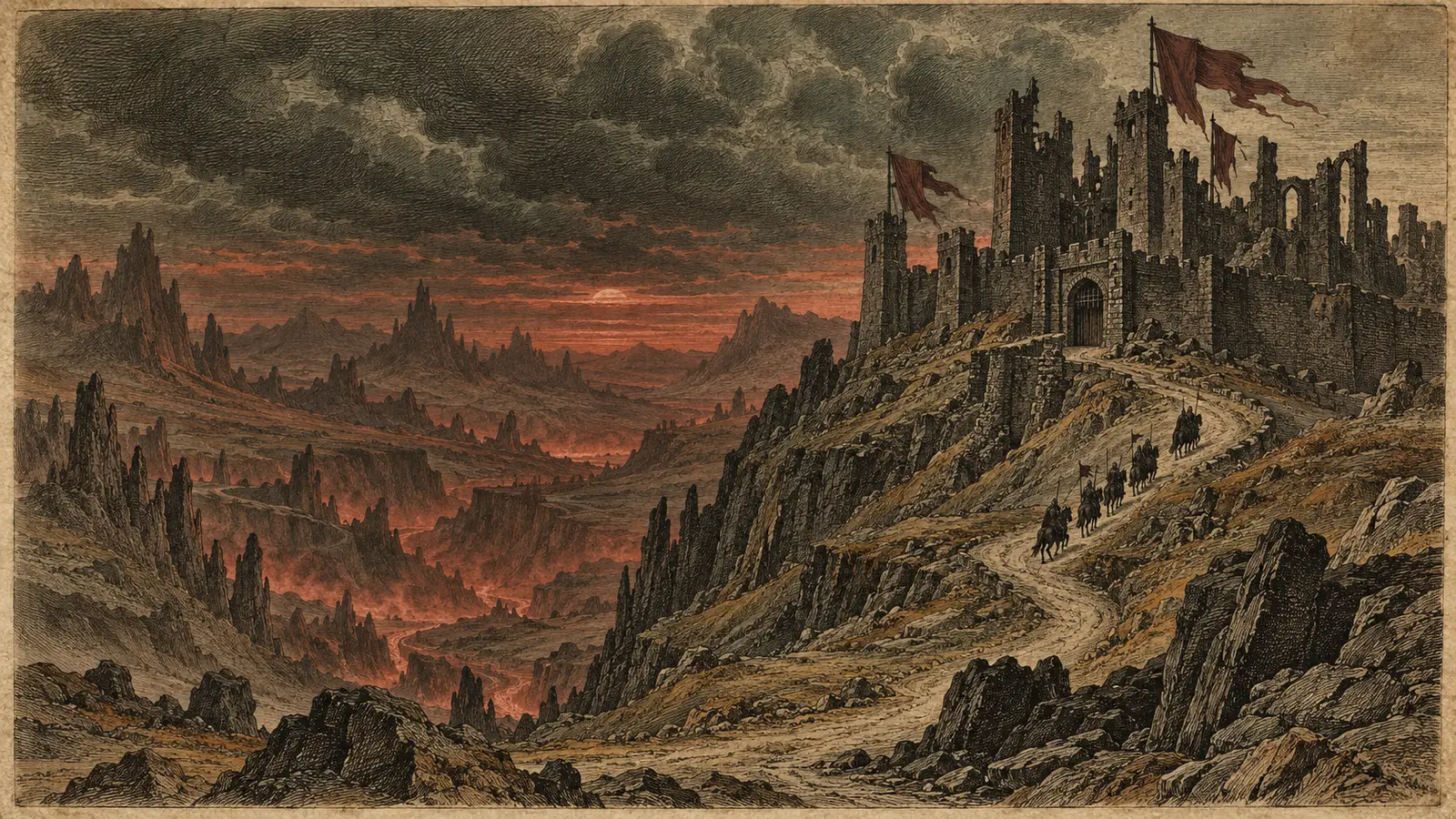
It's one thing to hear about the Hells. It's another to sit at a table on a quiet evening, dice in hand, and feel them close in. So let's imagine what it's like to meet them in play.
The first thing you'll notice about devils is that they rarely rush you. A demon will tear down your door. A devil will knock, and ask politely whether you have a moment to talk. Devils are lawful evil. They work through contracts, hierarchy and long, patient schemes. What they offer can be great power, granted by signing an infernal contract, or something smaller and stranger, a twisted favour that follows a whispered pledge.
Behind every devil you meet is a ladder. In fifth edition's telling, a damned soul begins as a lemure and climbs, if it serves well, through the ranks. A lemure's first hope is to become an imp. From there the climb goes on, to bearded devil, to erinyes, toward the pit fiends at the top and the archdevils beyond them. Each promotion brings a new epithet, a title granted by the devil who raised it. The greatest pit fiends command whole infernal armies. And one of the surest ways for a devil to climb is to strike a good deal with a mortal. When a devil offers you something, you're helping it toward its next promotion.
Then there's the matter of names. Every devil has a common name, the one it gives you, and a true name, which it guards with its whole being. Speaking a devil's true name aloud can help summon it, or strip it of power. There's a lovely, melancholy detail about where those names come from. When a damned soul climbs out of the River , its past life has become a muddled memory, and the first word it speaks in Infernal becomes its true name forever. A good dungeon master can build a whole adventure around a single word.
The fullest set of rules for bargaining with devils came in Descent into Avernus. Either the devil or the character raises the subject and makes an offer. At the very least, the devil offers a gift and the character agrees to a price. If either side dislikes the terms, they can haggle, sweeten the offer, or simply walk away. And the gifts are real: a minor magic item, a sum of gold, a reprieve from death itself. Not every deal asks for a soul right away. Some ask only for a service, or an oath of fealty, especially when the deal is with an archdevil, and these draw the character gently, step by step, down the road of temptation. Once a deal is signed, it's very hard to wriggle out of. That's when the table often goes quiet, as everyone realises what they've agreed to.
Hell has its own money, too. Souls damned to Hell are forged into coins on , the third layer. Each soul coin is minted from infernal iron, about a hand's breadth across and a finger thick, and inscribed in Infernal with a spell that binds one soul inside it. They're the currency of the Hells, used for goods and services, for deals and bribes. A coin can be spent in small ways. You can drain a little of the soul's essence for a rush of vitality, or ask the trapped soul a question and hear its whispered answer. But a creature that isn't evil can only carry a few soul coins safely. Carry too many, and the weight of all those souls drags at everything you do. You'd feel it in your shoulders, the way you feel a heavy pack at the end of a long day, only it's people.
Those coins also fuel the infernal war machines. These are battle vehicles, armoured and roaring, which burn a single charge from a soul coin each day. The adventure gives rules for building and driving them, with sample vehicles, and the players can take one and customise it and drive it across the wastes. Picture a party of adventurers in a rattling iron machine, bolting on spikes and harpoons, steering across ash dunes under a red sky, with the Blood War thundering on the horizon.
And itself fights back against being known. The map of the layer shows a vast wasteland warped by eons of demonic invasion. But in play, the hellscape confuses the senses. You can't judge distances. Places shift when you're not looking. Fort Knucklebone is usually the first stop, a rough place to catch your breath and ask questions. , the stolen city, can hang anywhere the dungeon master likes, and it often becomes the starting point for exploring. From there, the heroes go out among the docks and the emporium and the hill of iron thorns.
At the heart of that campaign is , the little hollyphant, 's old companion, her memory clouded by the Styx. She's truly good, and she can help any party that believes Zariel might be redeemed. That hope is the soft centre of the whole adventure, and the table can feel it growing as the memories come back.
Long before Avernus became a campaign, the game had sent heroes into Hell at the very height of their powers. In 1998 TSR published A Paladin in Hell, written by Monte Cook, for heroes of the highest levels. Its title and cover came from a famous black-and-white picture in the original Players Handbook, a lone knight standing his ground among devils. The adventure begins at the funeral of an illustrious paladin. In the middle of the service, the whole temple, the Temple of , and everyone inside it are carried away into the Nine Hells. The heroes must find the temple and bring it home, along with all the innocents trapped inside. Their search leads them to the Chaotic, a figure from another picture in that same old handbook, now a powerful wild mage whose fortress is surrounded by a storm of whirling metal. He tells them, grudgingly, that the temple is stuck between two layers of Hell, and the only way to reach it is aboard a special ship sailing down the River Styx. Its crew is demonic, and they may mutiny. It's a story about carrying a holy place through the darkest country there is.
In third edition, Fiendish Codex II gave heroes new ways to face Hell. The hellbreaker was a daring infiltrator, someone who slips into devils' strongholds to steal their treasures, learning the techniques to fight Hell's forces along the way. The hellfire warlock belonged to a secretive order that had mastered hellfire, a dangerous energy found only in , and could pour it into their magic and their weapons.
For players who want to carry a bit of Hell with them, fifth edition offers the warlock with a Fiend patron, a direct pact with a devil or demon lord, steeped in fire, fear and survival. And Mordenkainen's Tome of Foes gave players the tiefling bloodlines, first tested in public playtests, each touched by a different lord of the Nine. It also gave dungeon masters tables for building infernal cults, with their goals, their resources, their organisation and their hardships, and tables for customising devils and cambions.
So that's how the Hells feel at the table: a pleasant voice making an offer, an iron coin that whispers when you hold it, a map that won't stay still, and somewhere deep in the campaign, a little golden creature trying to remember a friend.
Chapter XIV
Echoes beyond the game
As the Nine Hells grew, they spread beyond the books and into the wider world, and their story gathered some surprising chapters along the way.
The first of those chapters is quiet and a little sad. In the 1980s some people truly believed the game was dangerous, that it drew young players toward dark worship. The devils and demons of the Monster Manual were part of what worried them. When TSR renamed the fiends in its second edition, the creatures themselves didn't change, but a story went around that the devils and demons had been taken out of the game. The years helped carry the game out of that shadow, giving its cosmology a new home among the planes, and giving the fiends a war of their own. And in 2000, the old words came home again. Many years later, the third edition's Fiendish Codex II was still finding new readers, its pages still sought after nearly two decades on.
In May 2019, the Hells came to Los Angeles. Wizards of the Coast held a live event called The Descent, a three-day performance streamed across several channels, to introduce Descent into Avernus. Actors and storytellers played the game on stage, among them Joe , Deborah Ann Woll and Matthew Lillard, with Matthew Mercer taking part too. The bands The Mountain Goats and Magic Sword played music. Manganiello's character the Cruel, the dragonborn paladin who would later camp in beside 's prison, came from his own table.
The online game Neverwinter followed the adventure down into the Hells. Its "Infernal Descent" chapter in 2020 told how a manor house called Manor was torn out of the world and dragged into Avernus, and how players worked to stop 's plan to sacrifice hundreds of innocent souls. Their allies were a paladin named Alric Vallenhas and a bard named . A few months later the "Avernus" chapter let players drive infernal war machines across the wastes and uncover Zariel's past. Breaking the chains of the Infernal Citadel brought Bel after them, and the final trial was called Zariel's Challenge.
In Idle Champions of the Forgotten Realms, a gentler game, players follow 's dreams and memories across Avernus to find the sword of her lost friend, while Zariel herself watches over them as a patron with her own designs.
The Hells even reached the card tables of Magic: The Gathering. In 2021, the set Adventures in the Forgotten Realms included a card called Zariel, Archduke of Avernus, a red planeswalker. Her powers echo her story. One urges creatures into battle and makes them swift, for her hunger for war. One creates small devil tokens, for the souls she drags down to become devils. And her greatest power grants extra combat phases, for a war that never ends. A year later, Commander Legends: Battle for Baldur's Gate showed the city under attack by the forces of Avernus and the Dead Three, and included , Fiendish Savior, a leader for devils and demons, imps and tieflings.
And then there was Baldur's Gate 3. At the end of 2023 it won Game of the Year at The Game Awards, among half a dozen honours that night. It went on to sell more than fifteen million copies. And among all its characters, a devil with a pleasant smile found his way into an enormous number of hearts. Andrew 's BAFTA, the song that went everywhere, the theatrical asides that reached back across four centuries to 's stage, all turned Raphael into one of the best-loved villains of his time.
It's a curious thing, if you think about it. Four hundred years after Marlowe's stood on a wooden stage and spoke of the ten thousand hells he carried with him, a cambion son of Mephistopheles sang his own battle hymn to an audience of millions. The same old bargain, signed in blood, still works its spell on anyone who hears it.
Chapter XV
The Hells today
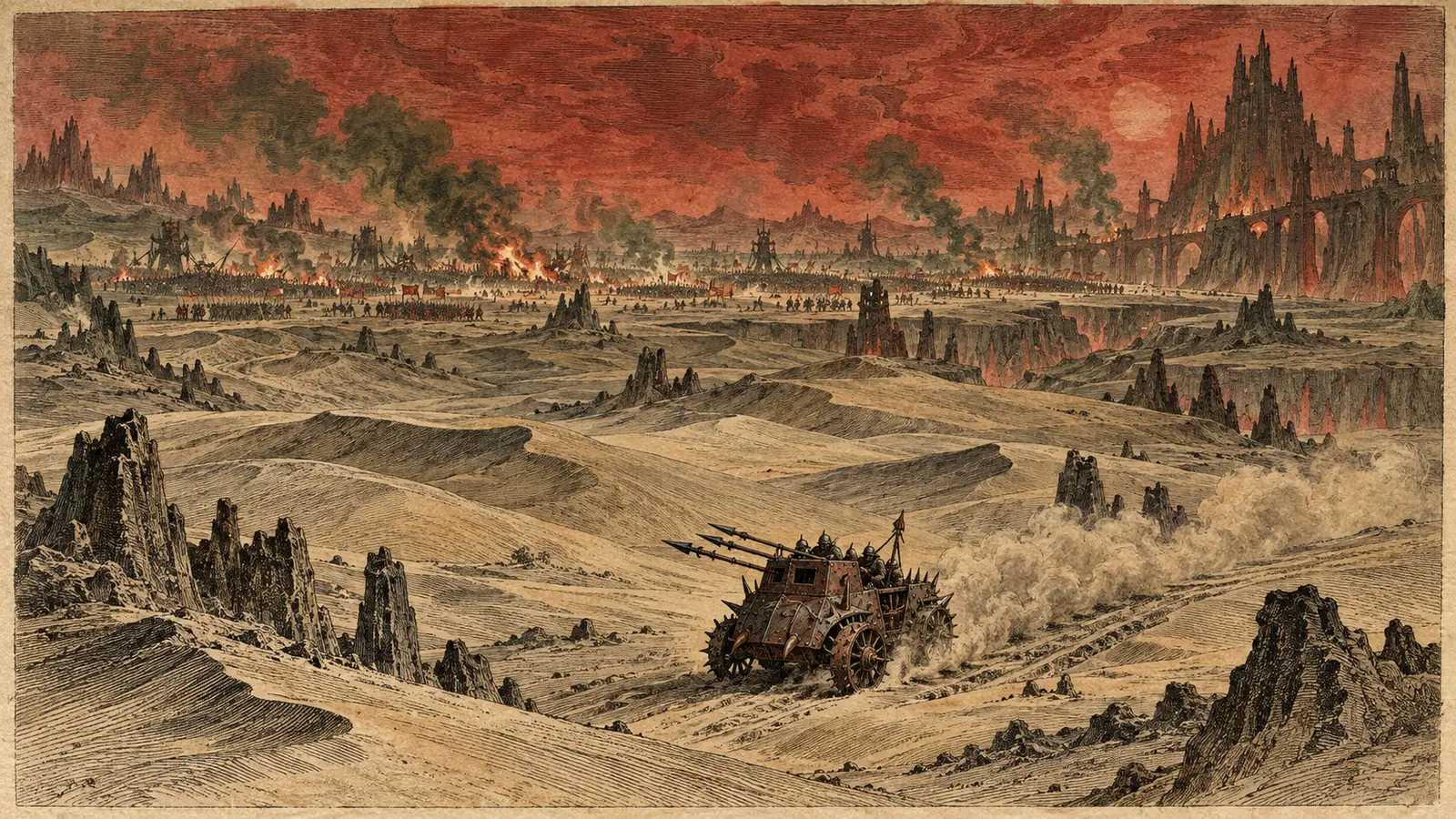
Where do the Nine Hells stand now, in the autumn of 2026?
In 2024 and 2025, Wizards of the Coast published revised versions of the game's three core books. The new Player's Handbook came first, in September 2024, then the Dungeon Master's Guide that November, and finally a new Monster Manual in February 2025.
The tiefling is still there among the peoples a player can choose. Rather than a list of bloodlines, the new book offers a choice of fiendish legacies, and the infernal legacy ties a tiefling to the Nine Hells and to . Tieflings of that legacy often have horns, spines, tails, golden eyes, and a faint smell of sulphur or smoke about them, and most of them descend from devils. Their heritage gives them a resistance to fire and a handful of small infernal magics: a spark of fire to throw, a burst of flame that answers anyone who harms them, and a cloak of magical darkness.
The great wheel remains the default shape of the cosmos, and the Hells keep their old place on it. In the new Dungeon Master's Guide, the planes have a chapter of their own called "Cosmology," written by James Wyatt. He set out to make the planes practical for building adventures, so that the Outer Planes, the Nine Hells among them, read almost like a second campaign setting of their own. Some of the general lore about fiends moved there from the bestiary.
The new Monster Manual holds eleven kinds of devil. The chain devil has been reimagined, its chains now sentient and alive, coiling to bind and torment. Bone devils are described as enforcers within the Nine Hells. One reviewer called the fiends the most classic villains of the game's multiverse.
And the standing lore holds steady. rules , a fallen angel with scorched skin, Hell's general against the demons, where the Blood War rages across battlefields of corpses and the wrecks of hellish war machines. Iron roads run through deep canyons to the Iron City of Dis, where the paranoid watches from his tower. And , fallen angel and Overlord of the Nine Hells, still rules from the citadel of at the bottom of , listed now as a gargantuan lawful evil fiend, the Lord of the Nine Hells.
In 2023 the setting returned in a three-book set, Planescape: Adventures in the Multiverse, with and the Outlands at the centre of the Outer Planes once more, and a bestiary named Morte's Planar Parade, in a friendly nod to the floating skull who once lay in the Pillar of Skulls.
Wizards has announced a good deal of new material for the year ahead and the year after, among them a book, a book of strange arcane magic, and a return to Greyhawk announced for 2027, though none of these is about the Hells. For now, the Nine Hells rest where they've rested for half a century, a fixed point on the great wheel, nine layers deep, waiting for the next adventurer to find the door.
Chapter XVI
The long spiral down to Nessus
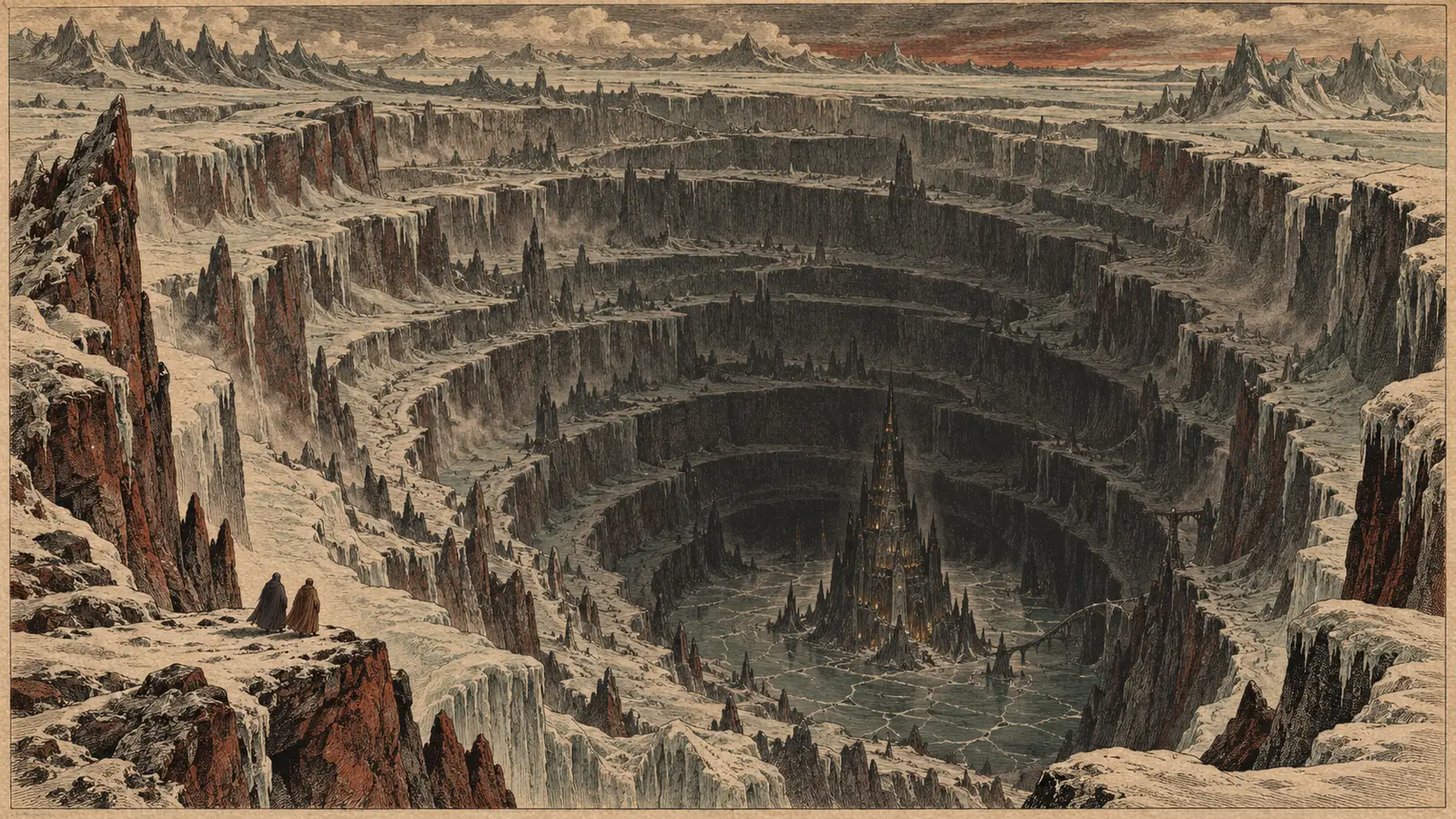
Let's make the journey one last time, slowly, the way you might walk through a house at night, room by room, before you turn out the lights.
The easiest way down is the river. The winds into the Hells and drops deeper as it flows, from one layer to the next. Its currents can't be predicted. It forms whirlpools and eddies and slow, pulling undertows. Devils patrol its banks, the dead drift toward anything living on its waters, and it throws up mirages to lead travellers astray. Anyone who touches it may forget. But it always goes down.
Every soul begins in . You come out of the river, or through some door, onto a plain of ash scattered with rubble, under a red sky. Most souls arrive as lemures, shapeless and slow, and a few strong-willed ones begin a step higher, as spinagons. Fire falls from the sky here, and once it was said to be the rage of a captive angel. Now that angel rules the plain, and the fire just falls. Somewhere on the horizon, a city hangs in chains above the water.
Below lies Dis, the iron city, hundreds of miles across and miles high, and it burns, always. Somewhere at its heart sits in his iron tower and trusts no one, while his advisor whispers.
Below that is , a rotting swamp under acid rain and hail, where the coins are struck, one soul to each, and counts them.
Then , where volcanoes rise and lava pours down from the caverns above, and holds court with her father in the shadows behind her.
Then , a frozen sea with islands scattered across it, and the Styx cutting one dark channel through the ice. Somewhere out on that sea there's an iceberg with a prince inside it. can't move. He can only think, and he has had a very long time to think.
Then , whose hills are the bones of a hag who tried to become a god, ruled now by , the daughter of , who waited a long time for her turn.
Then , a country of ruined cities, abandoned mines, broken aqueducts and stagnant rivers. builds here. He builds a city, and it isn't perfect, so he leaves it and builds another, and that one isn't perfect either. Later lore remembers him as an angel named , who always wanted everything to be just right. His largest and most beautiful city is , a sprawl of towers and fortresses joined by countless webbed bridges. He will never finish it. He will never stop.
Then , far colder than Stygia, where ice storms scour the glaciers. On one great glacier stands , the citadel of , carved from gleaming, translucent ice. He controls the slow movement of the glacier beneath it. And here is a strange and gentle thing: inside the ice, the citadel feels warm, almost welcoming, because of the hellfire he studies there. A soft thermal fog hangs around it, and through that fog the walls glow faintly, like a lantern seen through frost.
And then . It is the deepest and darkest of all the layers, a plain broken by rifts deeper than any ocean trench, some of them running thousands of miles down into dead stone. The Dark Eight gather here, the pit fiends who keep Hell running, meeting in their circle.
Among those rifts there is one that coils. The Serpent's Coil is a mile wide, and it spirals in upon itself for hundreds of miles, winding down and down, five miles deep at its lowest point, which is the lowest point in all the Hells. At the bottom lies a frozen lake. And rising out of that lake, like a hollowed stalagmite climbing for miles toward a sky it can never see, stands , the Citadel of Hell.
In the old stories, the tall red figure who walks those halls is only a seeming. The true shape lies below, at the very bottom of the spiral, in the stillness beneath the ice: a serpent, vast and wounded, resting in the curve of the path its own fall carved. It doesn't need to move. Everything comes down to it eventually, every soul and every coin, every contract signed on some faraway night by candlelight. The river carries it all down, layer by layer, and the spiral gathers it in.
Far above, on the ash plains of Avernus, a lemure stirs in the grey, newly arrived, not yet remembering anything. It turns its shapeless head toward the red sky. And somewhere in the dark below it, very slowly, the river keeps on flowing down.