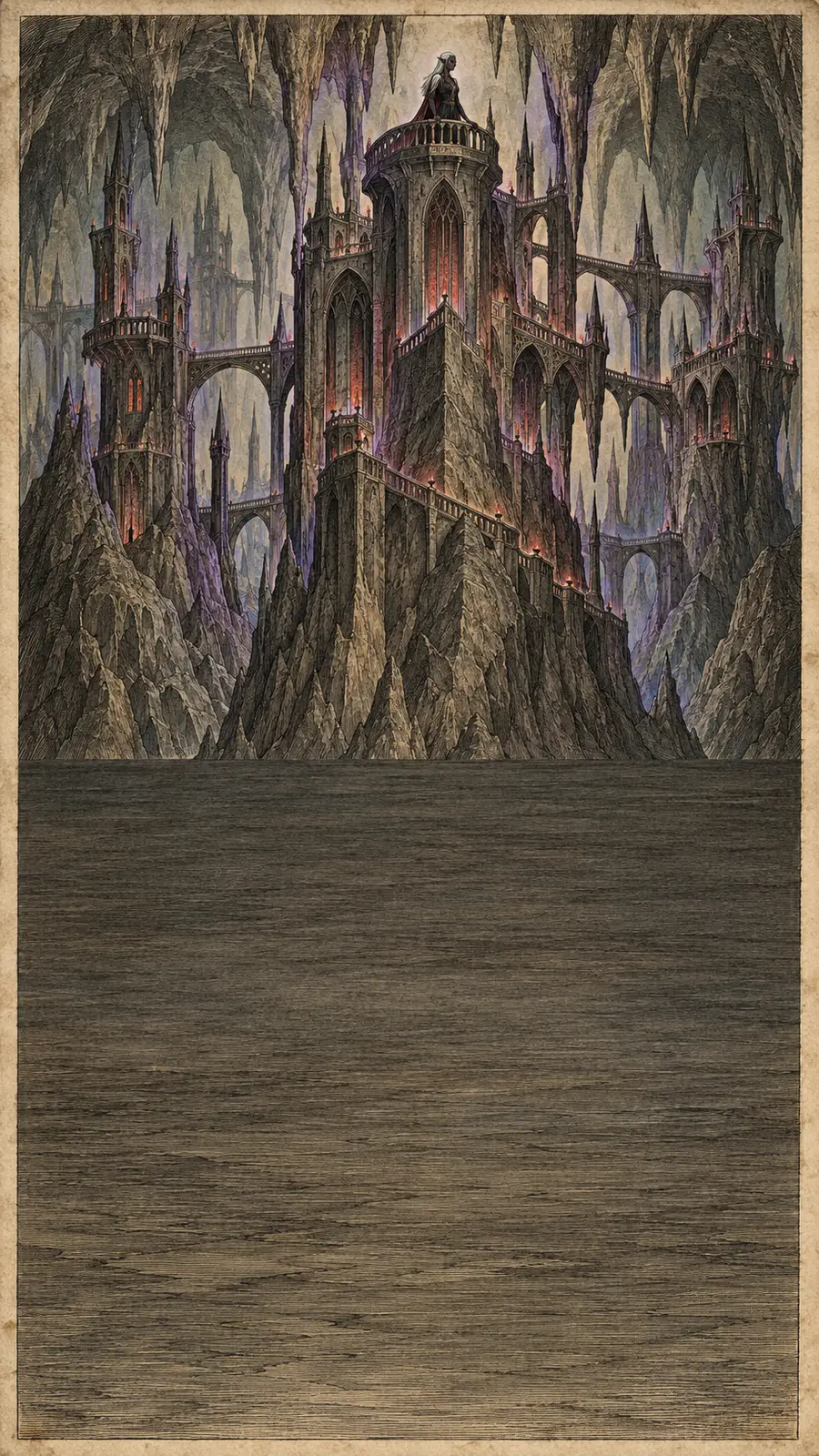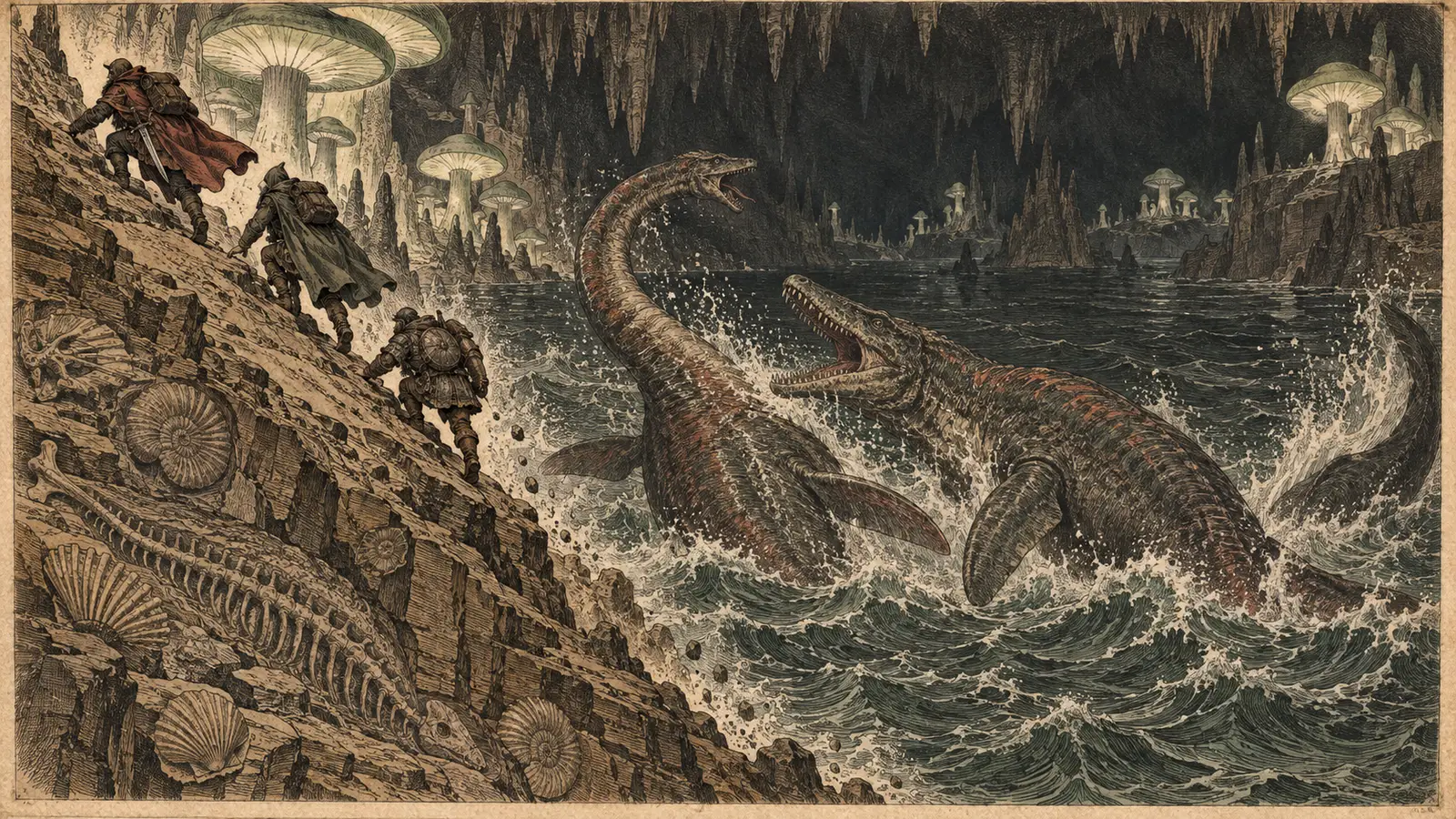
Chapter I
Before the dark had a name
Tonight we go down, slowly, into the . We start with the old stories of hollow worlds and dark elves that came before it, then follow it from the Greyhawk caverns where it first opened, through the City of Spiders and the long ages of the Forgotten Realms, and on through each edition of the game to where the deep world stands today. On the way we'll meet its peoples and its gods, the travellers who crossed it, and a few who came back up into the light to tell of it.
Every underworld starts as a feeling before it becomes a place. People have always looked at caves, at the black mouths of wells and the cold air rising from cracks in a hillside, and wondered what lay further in. Long before anyone drew a map of the Underdark, the old tellers had already put whole nations under the ground.
The oldest of those nations, for our purposes, belongs to the Norse. In their cosmology the world is held in the branches and roots of a great tree, , and , the world of people, sits partway up it. Somewhere beneath Midgard lies , home of the dark elves, the svartálfar or dökkálfar. They lived in great caverns and halls of stone. They were craftsmen, and the stories say they forged wonderful things for the gods: treasures of metal and magic that the bright powers above could never have made themselves. The realm of the dead lay down there as well, somewhere below the middle world, so the deep places were at once a workshop and a grave.
Most of what we know of these dark elves comes from the Prose Edda, written in the thirteenth century by the Icelandic scholar . Even in his pages they are hard to see clearly. Many scholars think "svartálfr" may simply have been another word for a dwarf, a name for the same small, clever smiths under the mountains. Others are less sure. It's an old, unresolved question, and the dark elves have kept a little of that uncertainty ever since. They are elves, and they are not quite elves. They belong to the earth more than to the forest.
The idea passed down into dictionaries and folklore collections. An abridged edition of the Funk and Wagnalls Standard Dictionary gives a short, plain definition of a dark elf: "In folk-lore, one of a race of underground elves represented as skillful workers in metal." Far to the north of Britain, in and Shetland, the islanders told of the trows, small uncanny folk of the mounds and hills, cousins in name to the troll. In the old dialect of those islands, the word sometimes came out as "drow."
Hold onto that word, because it is about to travel a very long way.
There's a second root to our story, and this one comes from inside the game itself. When Gary and Dave published the first boxed set of Dungeons & Dragons in 1974, the third little booklet was called The Underworld & Wilderness Adventures. From the start, the dungeon was called the underworld. It wasn't a single cellar under a ruined keep. It was a place that kept going. The booklet told referees to build at least three levels at once, and said a good dungeon should have no fewer than a dozen levels reaching downward, with passages sprawling in every direction instead of stacking neatly one atop another. Its sample level was the first dungeon ever published. So from the game's first year the idea was already there, waiting: the deeper you go, the stranger it gets, and you can always go deeper.
Gygax read widely, and in the 1979 Dungeon Masters Guide he named the authors who had "the most immediate influence" on him. They were de Camp and Pratt, Robert E. Howard, Fritz Leiber, Jack Vance, H. P. and A. . Merritt was one of his favourites, and Merritt had written one of the great lost-world stories of the underground.
That story is The Moon Pool. It first ran in the pulp magazine All-Story Weekly in 1918, with a sequel the next year, and became a novel in 1919. A scientist named Dr. Walter Goodwin follows the trail of a vanished expedition to the ruins of Nan-Matal on the Pacific island of . Beneath those ruins he finds a way down into , a hidden world deep in the earth where the descendants of lost still live. Muria is lit and ruled by something called the Dweller, or the Shining One, a luminous being created long ago by a vanished race and since broken free of its makers. Only three of that ancient race remain, the Silent Ones, immortal and sworn to destroy what they made. Readers have called the book a bridge between the adventure romances of H. Rider Haggard and the cosmic dread of Lovecraft, and you can feel both in it: the excitement of a hidden kingdom, and the chill of a power too old to understand.
Lovecraft himself went further down. Around the turn of 1930 he ghostwrote a long story for Zealia Bishop called "The Mound." In it, an ordinary-looking mound in Oklahoma hides a gateway to K'n-yan, a vast underground nation under a "sky" of glowing blue light, something like the northern lights trapped in stone. Its people were ancient and had sealed themselves away from the surface long ago. Beneath K'n-yan lies Yoth, a red-lit world of enormous ruins. And beneath Yoth lies N'kai, where there is no light at all, a black realm where, legend says, great civilizations and strange gods once dwelt. Each world sits below the last, darker and older. If you wanted a picture of how the Underdark would one day be layered, Upperdark above, Lowerdark below, you could hardly do better than those three nested worlds.
Then there's Tolkien's , the lost dwarven kingdom under the Misty Mountains where the miners delved too deep and woke a . It's easy to see Moria's long dark halls echoing in the endless labyrinths of early dungeons, though those first dungeons were lighter, more of a funhouse than a tomb. Gygax himself always insisted that Tolkien's influence on the game was mostly cosmetic. He enjoyed The Hobbit, he said, but found the Ring trilogy tedious. Still, the image of the dwarf-hall gone silent stayed in the culture, and the deep world of the game would be full of abandoned dwarven halls.
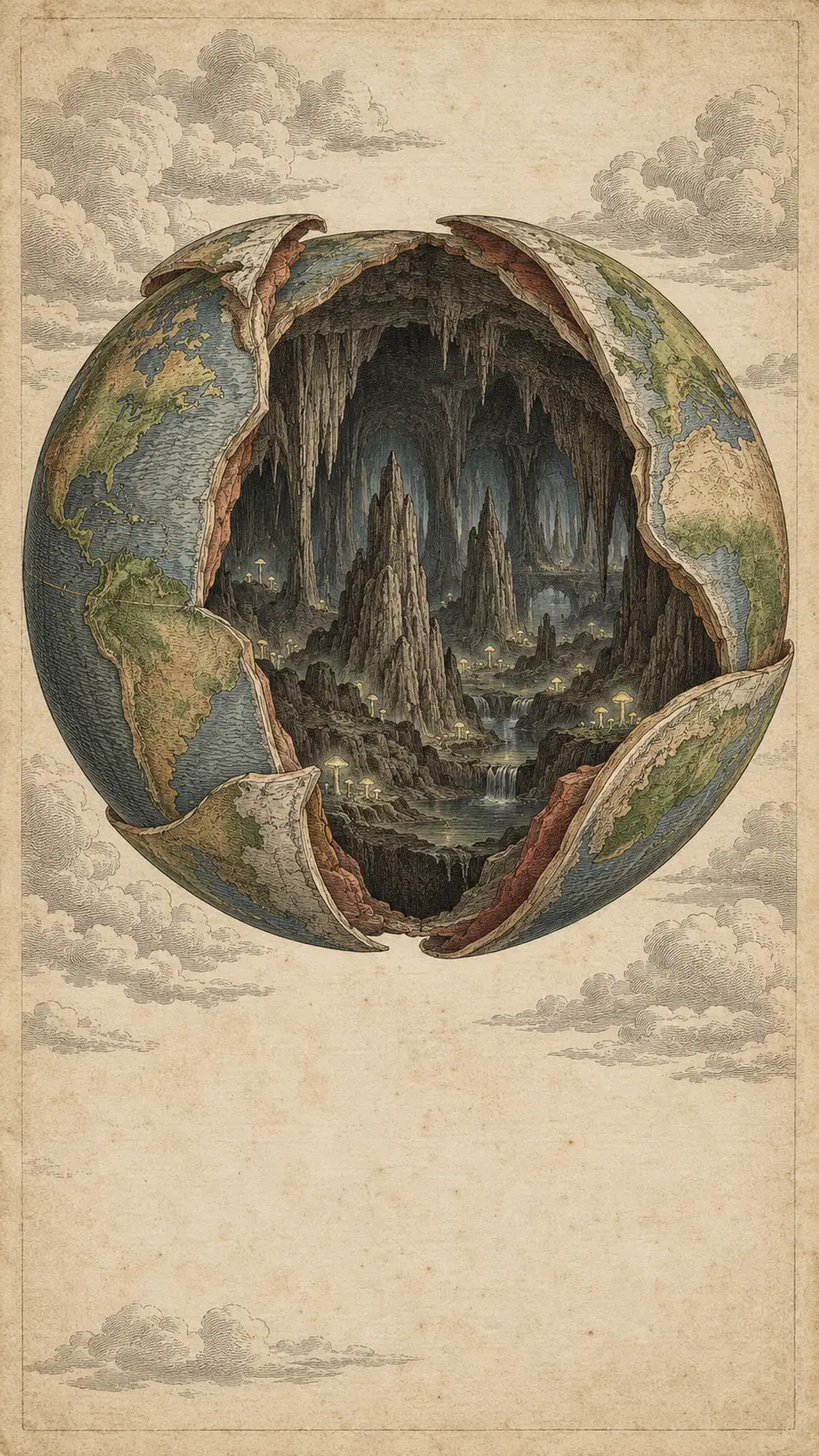
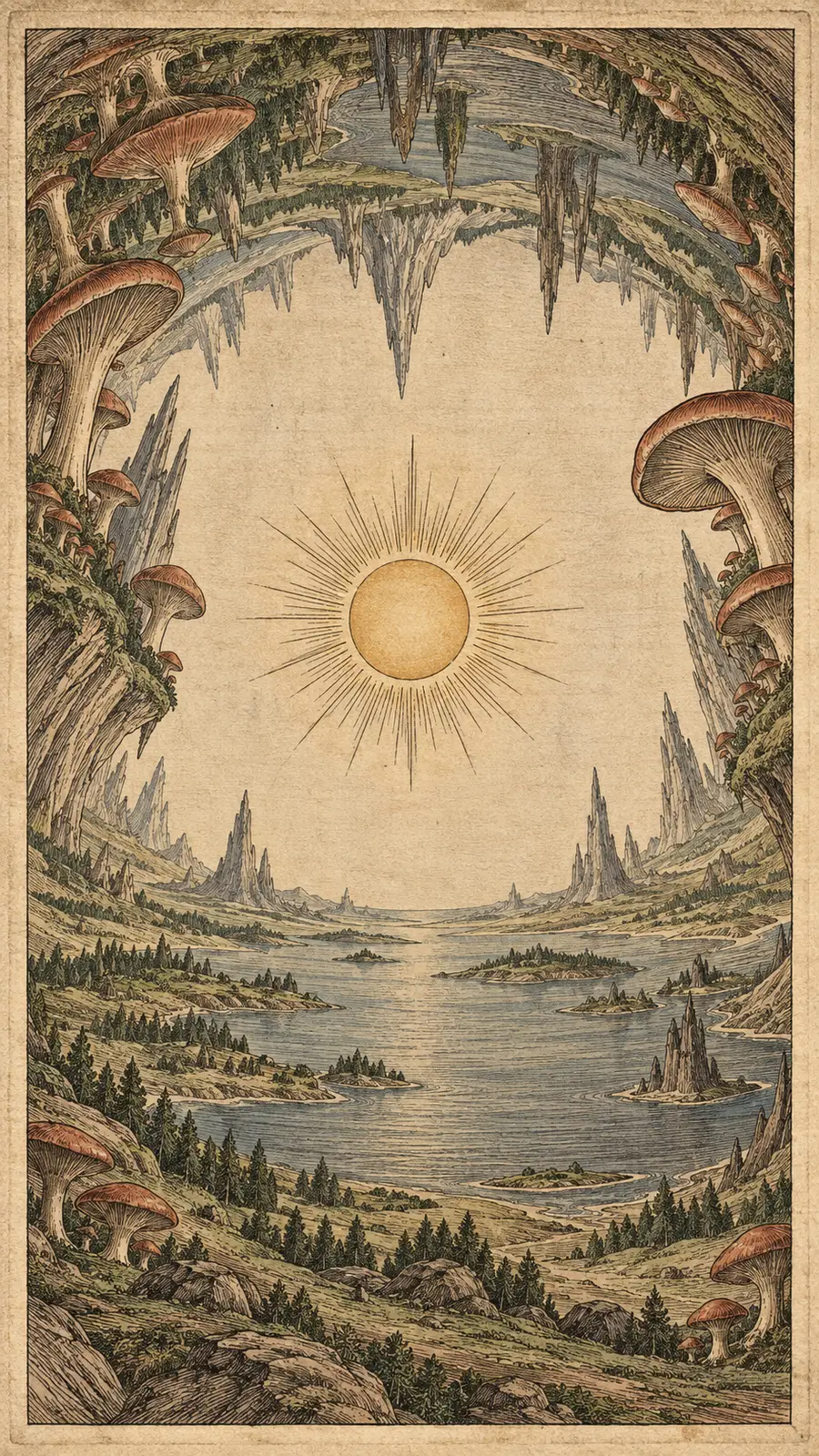
There was one more tradition behind all of this, older and odder than any of these stories. People once seriously believed the earth itself might be hollow.
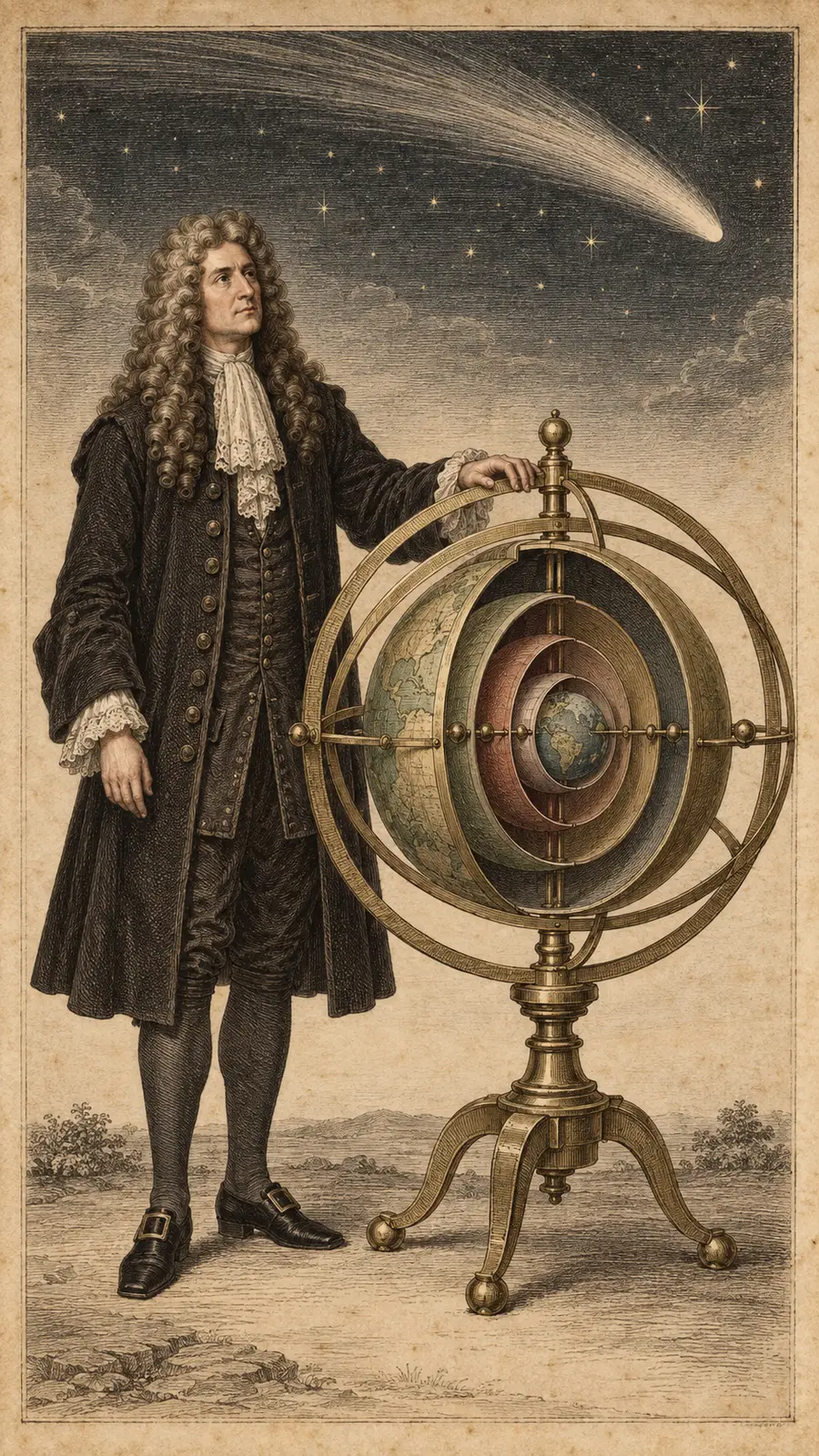
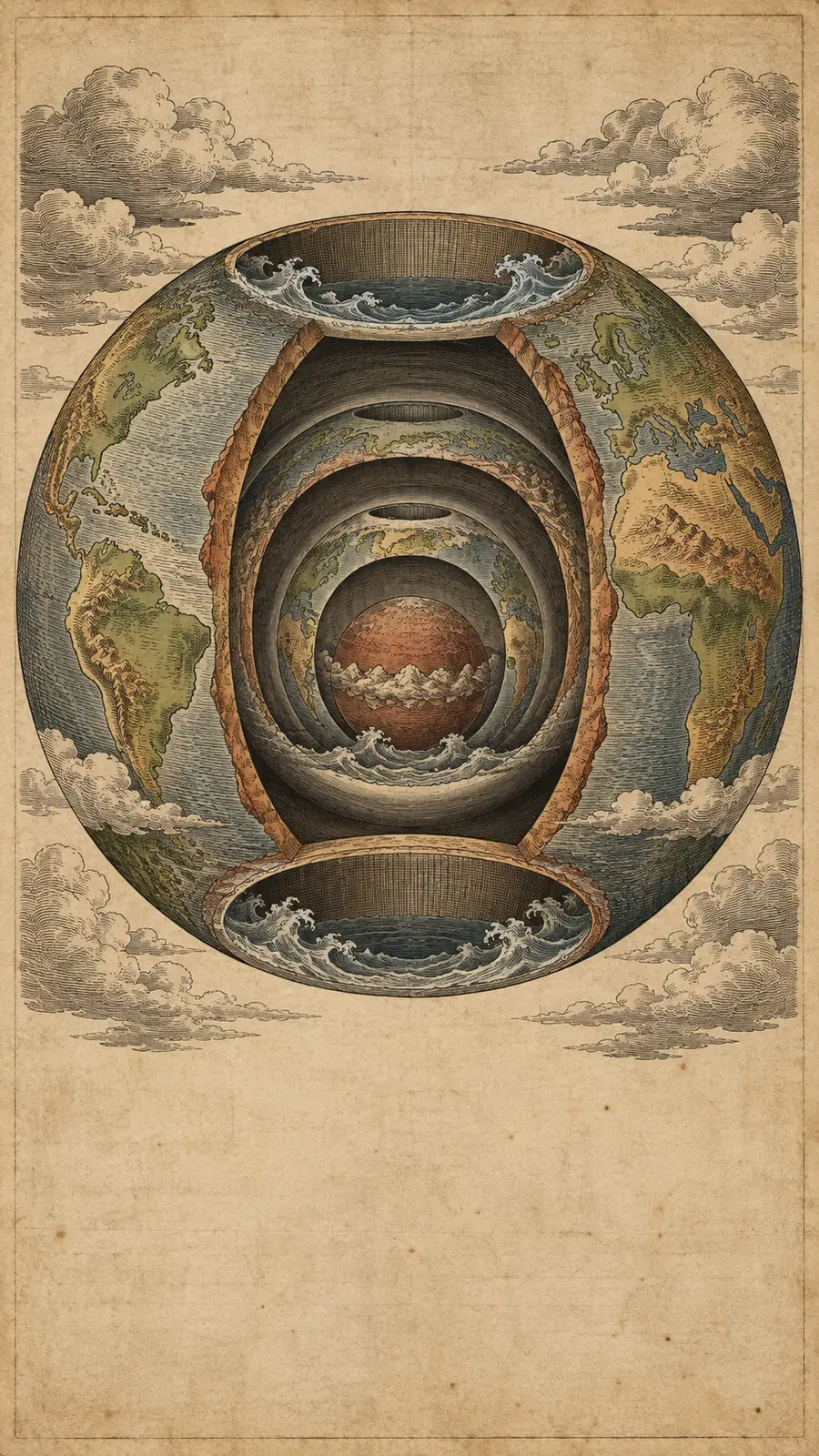
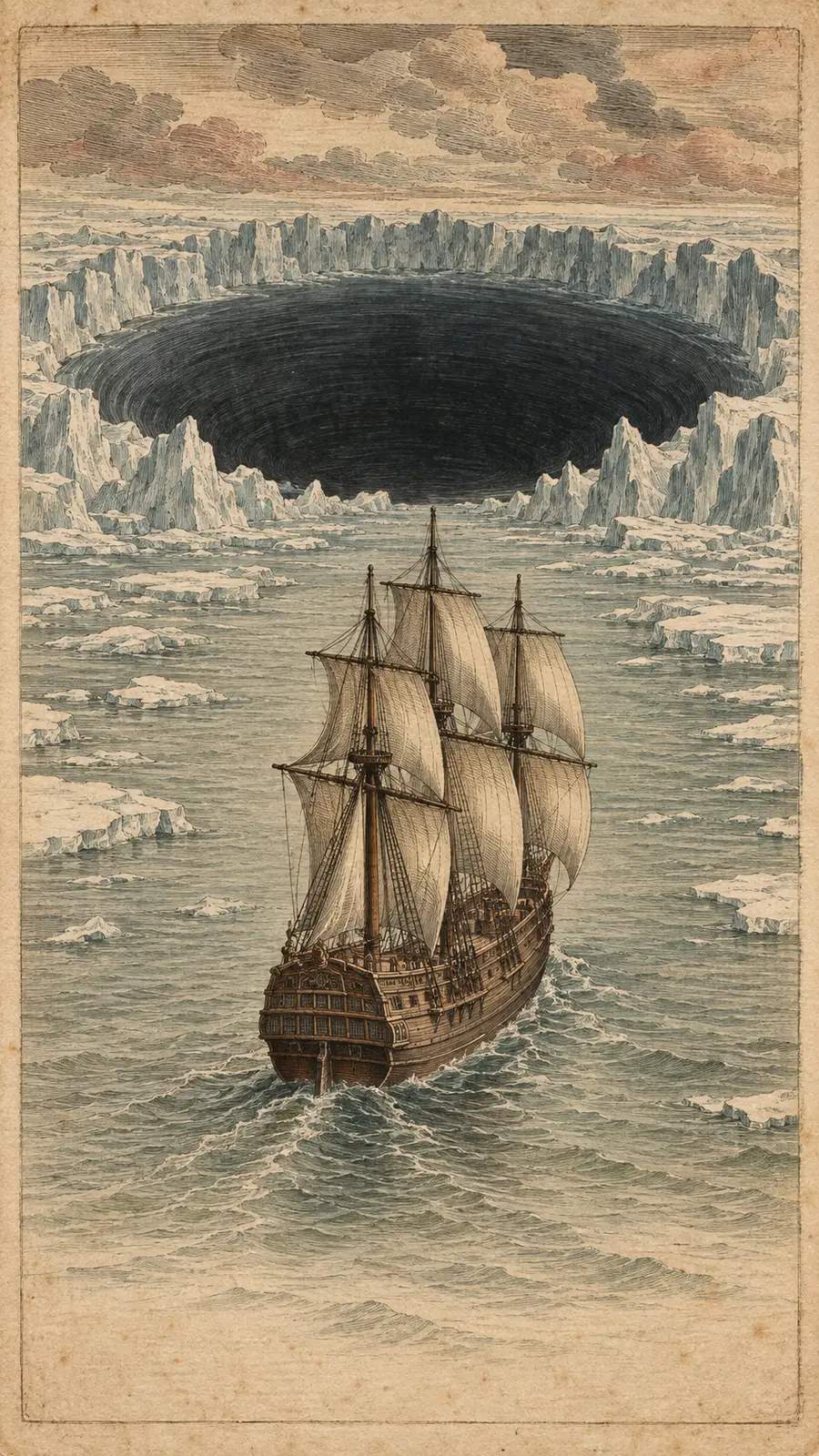
In the late seventeenth century the astronomer Edmund , the man remembered for his comet, proposed that the earth might contain a series of nested shells, one inside another. In 1818 a trader in St. Louis named John Cleves published a circular declaring that "the earth is hollow and habitable within," with concentric spheres and great openings at the poles. Later versions of the idea settled on a single inner world, warmed and lit by a small central sun. Symmes spent years trying to raise an expedition to sail into the polar opening. He never went, but the idea sailed on without him.
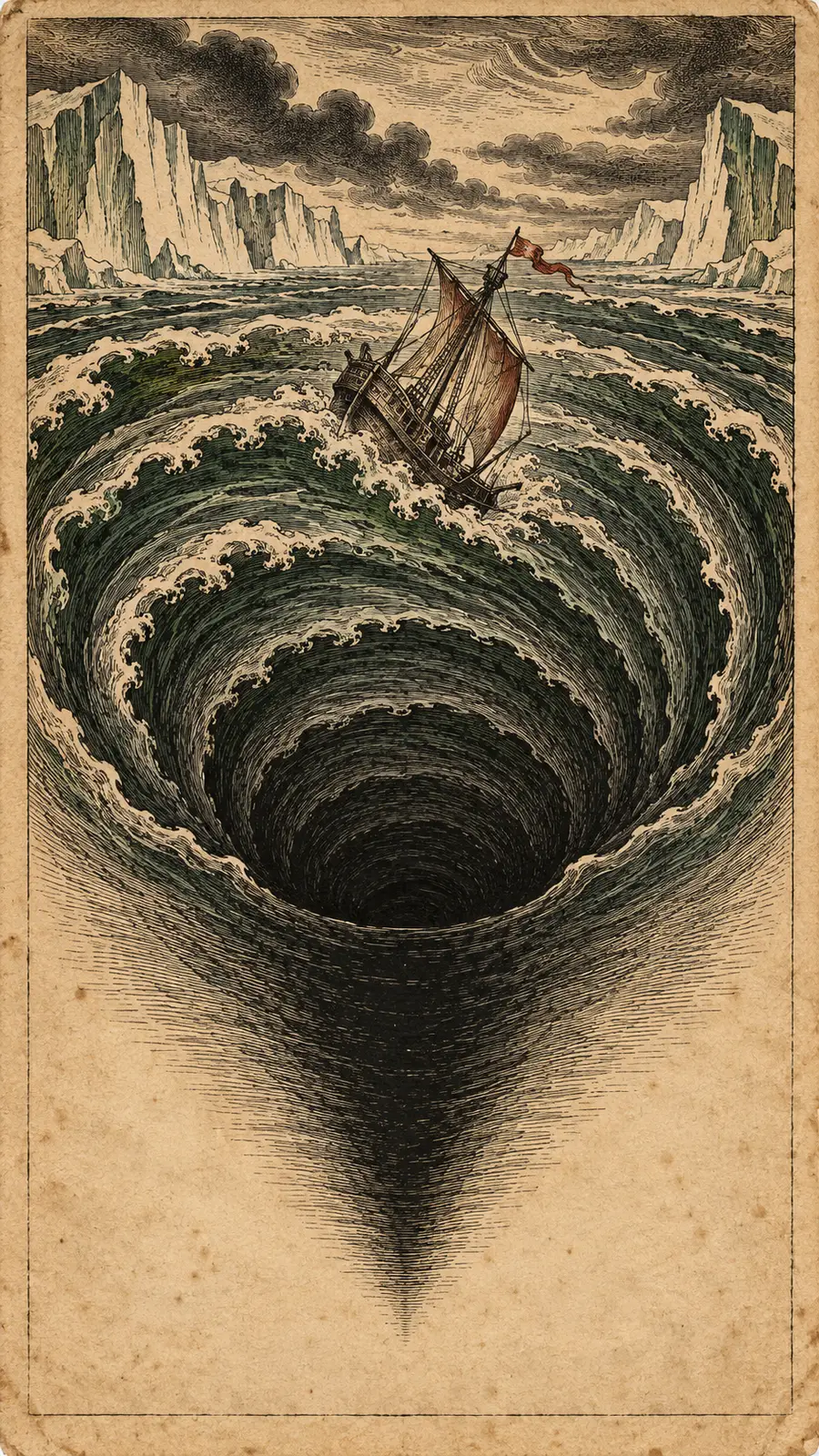
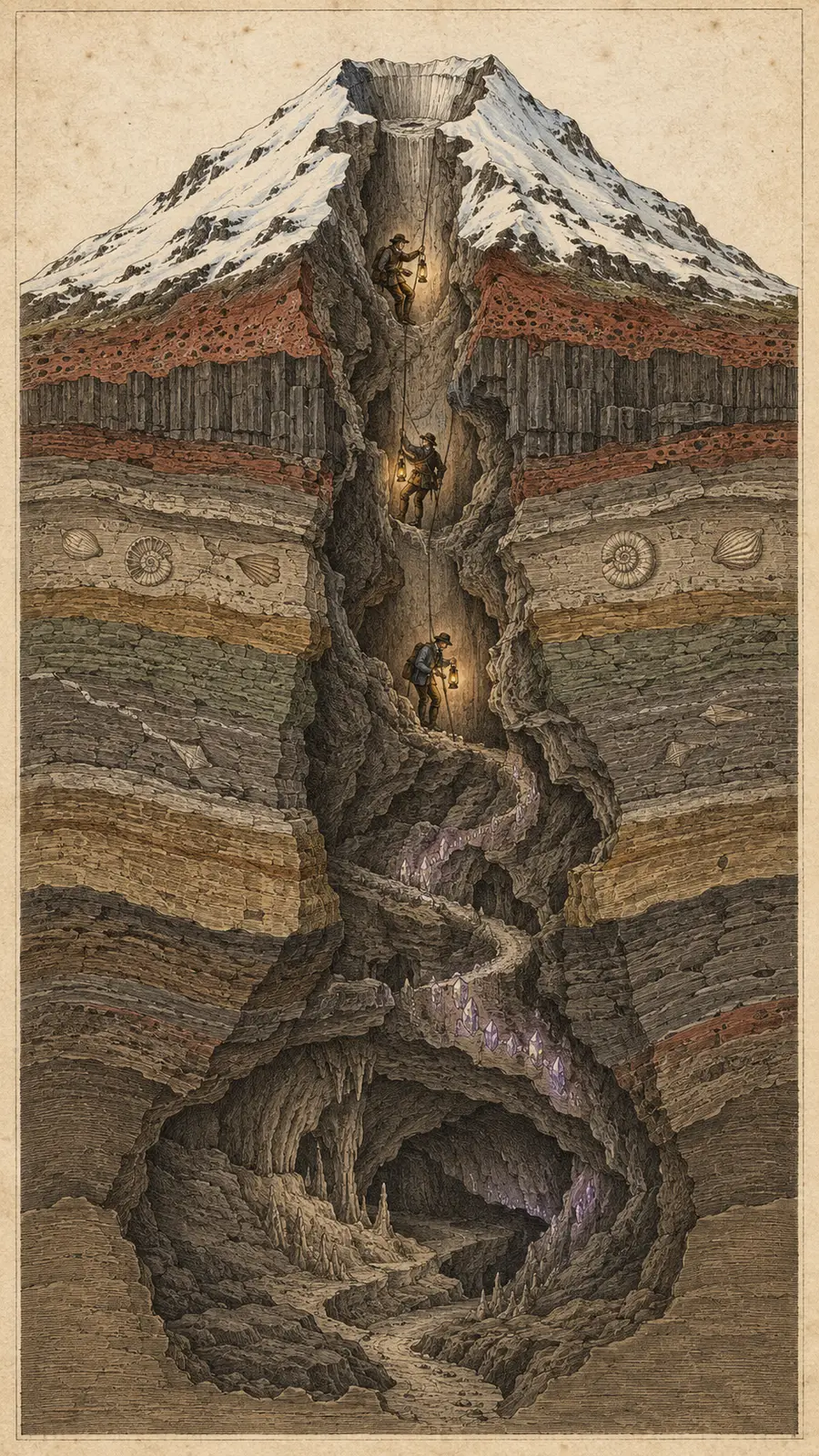
Edgar Allan Poe picked it up. In his story "Ms. Found in a Bottle," a traveller is drawn into a vast whirlpool near the South Pole, spiralling down toward something unknown. Poe came back to the idea in The Narrative of Arthur Gordon Pym, and that book in turn caught the imagination of Jules . Verne's Journey to the Center of the Earth, published in 1864, gave up the inner shell and the hidden sun. In their place it offered a descent the science of his day could at least half believe: down through an Icelandic volcano, along tunnels and past fossil seas, into a world of giant mushrooms and prehistoric beasts.
A few years later, in 1871, Edward published The Coming Race, in which a narrator stumbles into an underground civilization called the , advanced far beyond the surface world and quietly unsettling. That book opened the gate for dozens more, in which travellers reached lit netherworlds through polar holes, whirlpools and tunnels. Edgar Rice Burroughs gave the tradition its most famous pulp form with At the Earth's Core in 1914 and Pellucidar the following year. His inner world lies under an unmoving sun, where it is always noon. In one later book even Tarzan reaches it, by zeppelin, through a polar opening the story calls Symmes's Hole.
The last of these older strands is the strangest. In the 1940s a former welder named Richard Sharpe Shaver began to claim that voices had told him of vast caverns beneath the earth, home to beings he called the deros. They were degenerate and sadistic, he said, the remnants of a great elder race that had fled the earth long ago, and they used the forgotten machines of their ancestors to torment the people above. The editor Ray Palmer published Shaver's tales in Amazing Stories, beginning with "I Remember Lemuria" in March 1945. They caused a sensation. In Shaver's invented language the syllables of "dero" meant something like a harmful force and a slave. Years later, the game would fill its own deep tunnels with derro, mad and cruel little folk who whisper among themselves in the dark, and it's hard not to hear an echo of Shaver's caverns in them.
So by the middle of the twentieth century the idea of the deep world was everywhere. There were elves who lived underground and worked metal. There were nested kingdoms going down into blackness, lost races and luminous gods, inner suns, polar holes and mushroom forests. All of it lay waiting, like ore in a seam, for someone to dig it out.
When that happened, the old folk word came with it. Gygax later described how he took the idea of dark elves from an old dictionary entry and built the rest himself. "I wanted a most unusual race," he said, "as the main power in the Underdark." Apart from that first spark, the idea of dark elves, everything about the game's drow would be his invention. He called them "an ideal basis for the creation of a unique new mythos designed especially for the AD&D game."
And that new mythos began, as many good stories do, with a hint.
Chapter II
A whisper in the Monster Manual, and a road leading down
In 1977 TSR published the Monster Manual, the first hardcover book of Advanced Dungeons & Dragons. Tucked inside its entry on elves was a single line that must have puzzled many readers: "The 'Black Elves,' or drow, are only legend." That was all. There were no statistics and no description. The drow were a rumour inside a monster book, a door painted onto a wall.
The next year, the door opened.
In 1978 wrote a run of tournament adventures that would become one of the most famous campaigns in the game's history. It began with the giants. In Steading of the Hill Giant Chief, Glacial Rift of the Frost Giant Jarl and Hall of the Fire Giant King, the heroes are sent to deal with an alliance of giants raiding the lands of humans and their allies. Hill giants, frost giants and fire giants, normally rivals who'd never work together, have been striking in concert. Something has drawn them into one purpose.
Deep in the fire giants' hall, under the volcanic halls of King , the heroes find out what. The drow are real. They appear in that module with statistics for the first time, slim and dark and dangerous, and the heroes learn that the dark elves started the giant alliance and set its war against the surface in motion. When Snurre falls, the drow behind him slip away. They flee northwest, through a passage that looks natural, about thirty feet wide, which slopes steadily downward into the depths of the earth.
If you were sitting at that table in 1978, you would have looked at that passage on the map and realized it didn't end. It just went down.
The heroes follow. Their quarry is the priestess , who has escaped the giants' ruin, and the trail leads them into the series Gygax called the D modules: Descent into the Depths of the Earth, Shrine of the Kuo-Toa and Vault of the Drow. All three appeared in 1978. They were meant for seasoned heroes, roughly ninth to fourteenth level, and set in the World of Greyhawk. Gygax said later that he wrote them "as sort of a relaxation to get away from writing rules," which is a lovely thought. He was working on the great rulebooks of the game, and when he needed to rest, he went underground.
The world below didn't have its famous name yet. Greyhawk would sometimes call it Deepearth, or the Underoerth, and those first modules simply showed a vast network of caverns and tunnels running beneath the surface. Without quite announcing it, they revealed a whole second world under the first, as wide as the land above.
Descent into the Depths of the Earth is exactly what its title promises: a long trek through a maze of passages, and the module was built to make that maze feel real. It came with a large map for the referee and a partial, matching map for the players, so the heroes would see only what they had already walked and the rest stayed dark. There were special rules for exploration and encounters down here, and a large map of one cavern region in detail.
The deep tunnels are not empty. On the cavern floors the heroes meet bugbears, troglodytes and trolls, and worse things come in the long dark between. Those who have walked these passages describe a world that is hard to cross and full of monsters, but also a world with a personality of its own: with its own politics and quarrels, its own powers jostling for position far from any surface king. People who played it often compare its mood to , the slow sense of going down and down past things no surface traveller has seen. Others remember it as a long string of battles on the way to the main event, and that's true too. The descent is a journey, and like most journeys, much of it is just walking, and fighting, and walking again.
And somewhere along the way, if the heroes search carefully, they may find a small golden pin shaped like a spider. On it, in drow runes, are the words ", Death Queen Mother."
That's the first time her name is spoken. It sits there quietly in the treasure, a little gleam of gold in the dark, telling you that the dark elves are not alone, and that something they worship waits at the bottom.
The second module takes the heroes further. In Shrine of the Kuo-Toa, still on the trail of the drow, they come to a great underground river, wide and black and moving slowly through the stone. They can't simply wade it. Instead a lone figure offers help, a rogue kuo-toa working as a monitor, who will ferry the party across for a fee. Many players remember him fondly, this solitary fish-man poling his boat through the dark, half outcast and half merchant, willing to carry strangers over the water for coin.
On the far bank, other figures approach: a party of svirfneblin, the deep gnomes. They are small, grey-skinned and wary, at home in the stone in a way surface gnomes never quite are. They'll appear again and again in the long history of the deep, often as the one people below who might be a friend.
Then the heroes come into the lands of the kuo-toa themselves. Here the old shadow of falls across the game most clearly. The kuo-toa are fish-frog folk, wet and bulging-eyed, and they're widely seen as cousins in spirit to the Deep Ones of Lovecraft's stories. They worship a goddess called , the Sea Mother, who takes the shape of a vast woman with the head and claws of a lobster. They are ruled by a Priest-Prince named Va-Guulgh.
What's remarkable about the kuo-toa shrine is that it isn't simply a lair to clear. If the heroes are careful, if they pay proper homage at the shrine and respect the customs of the kuo-toa, the fish-folk remain evil but are not openly hostile. They can be dealt with. They can be passed. If the heroes blunder in, it ends in battle. That small choice tells you something about the deep world from its very first year. It is full of peoples, and peoples have customs, and a traveller who listens may walk where a traveller who doesn't would have to fight.
The shrine of the Sea Mother and the lonely ferryman are the parts players remember best. Some have even said they love this second module more than the first. It's quieter and stranger. It has a river and a temple and a goddess with a lobster's head, and the slow, sideways feeling of having arrived somewhere truly foreign.
The drawings that went with these modules were by TSR artists such as David C. Sutherland the third and Dave Trampier. Their black-and-white pictures of drow, giants and fish-men in deep caverns gave a whole generation its first image of the world below. When the first two modules were later gathered into one book in 1981, more artists added their own visions. But the shape was set in that first year. A long road leads down. A river crosses the dark. Strange folk live along the banks. And at the bottom of it all, under a sky made of stone, lies the city of the dark elves.
Chapter III
The plum moon of the Vault and the web between worlds
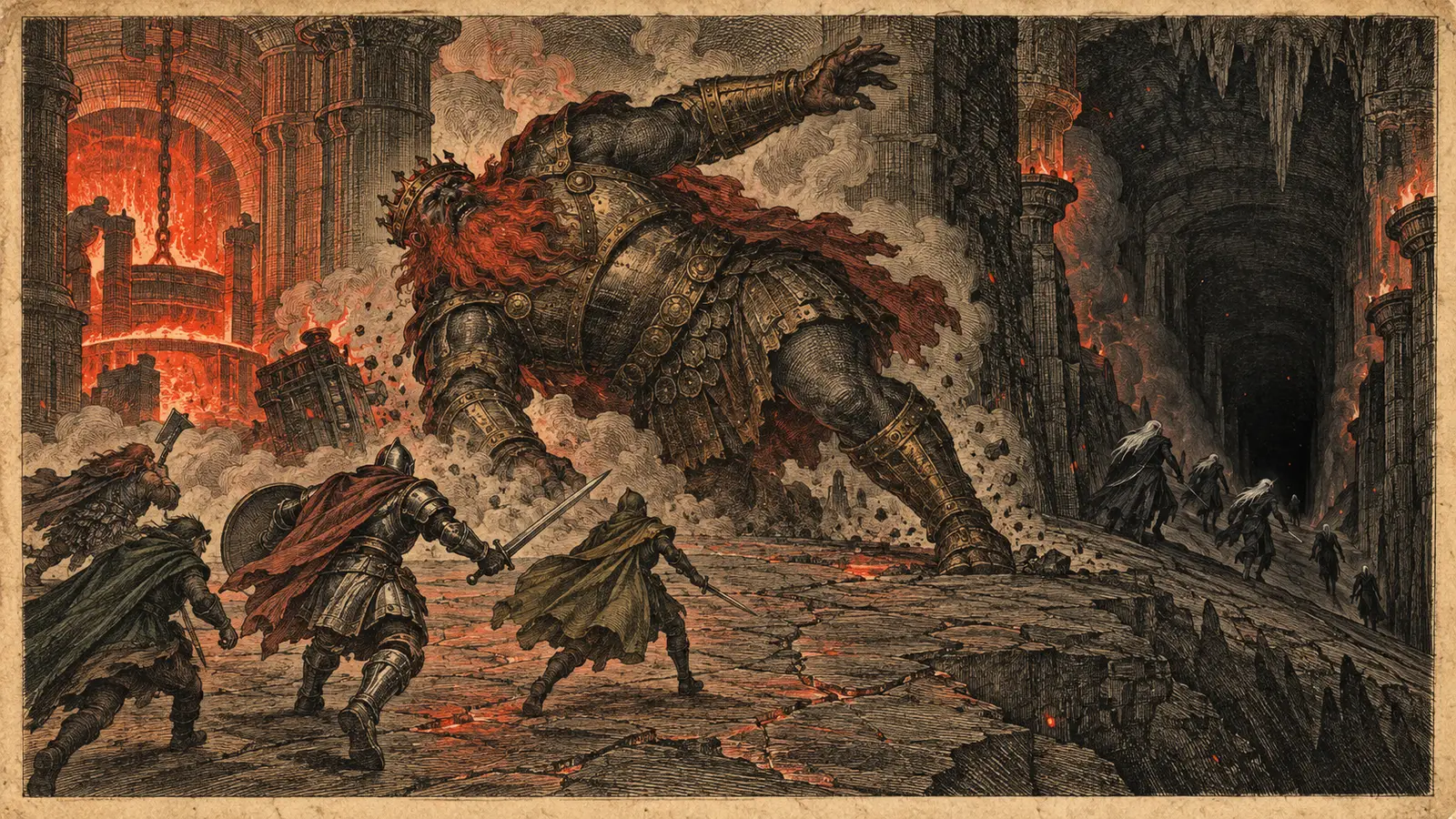
At the end of the long descent the heroes come at last to the Vault.
Picture a cavern so vast it doesn't feel like a cavern at all. Its ceiling, veined with minerals, rises more than a thousand fathoms overhead, well over a mile above the floor, and the floor below is strewn with crystals. Near the top of that enormous dome hangs a great mass of a radiant mineral the module calls tumkeoite. Slowly, over ages, it decays into another mineral, lacofcite, and as it decays it glows. To anyone standing on the floor of the Vault it looks like a moon, a ghostly, plum-coloured moon hanging in a sky that is really solid rock. Around it, smaller nodes of phosphorescent stone gleam like scattered stars.
This false sky has water beneath it. A dark river called the Pitchy Flow winds across the floor, and there's a spring called the Weeping Spring, and in both of them the plum moon shines back up, faint and wavering. In a lake called the Mere of Glooms the whole canopy of false stars is caught and distorted on the black water, as though the sky had been drowned. In that dim violet light a traveller with ordinary eyes can see clearly for about forty yards, and faintly perhaps twice that far. Beyond, everything melts into purple dusk.
A road runs across the floor of the Vault. It passes the manors and farms of the drow, where slaves tend whatever grows in that lightless country, and it leads to a massive wall and a gate. Behind the gate lies , the great city of the dark elves of that region, countless centuries old.
The Vault itself has an upper and a lower part. In the Lower Vault, the heroes might pass merchant villas, warehouses and the tunnels of troglodytes, the caves where bugbears live, and an old stronghold called the Black Tower. There are fighting societies too, one for male warriors and one for female, where the drow train in arms. Across the river, reached by a leering span called the Flying Bridge, rises a plateau, the Upper Vault, where the great noble houses keep their estates.
named eight of them. They were Aleval, , , Everhate, Godeep, Kilsek, Noquar and . Even the names have a certain dark music. Each house had its own estate, its own soldiers and slaves and secrets, and each watched the others the way cats watch one another across a garden.
At the highest point of all the drow have built their temple. It's called the Fane of , and it stands within a great structure known as the Egg of Lolth.
The module was unusually open for its time. It didn't lay the city out as a dungeon to be cleared room by room. Instead it gave the referee a broad overview of how drow power worked: who ruled, who resented whom, what each house wanted. Then it left the referee free to build adventures of intrigue inside the city. Heroes could disguise themselves, play the houses against one another, slip into estates by night, bargain and betray. Many referees spent whole campaigns in Erelhei-Cinlu without ever exhausting it.
And there was a great secret at the heart of it, the hidden thread that tied all seven modules together.
, the priestess the heroes have chased since the fire giants' hall, rules House Eilservs, the leading house of the Vault. She has turned away from Lolth. Eclavdra worships another power entirely, a being the module calls the Elder Elemental God, sometimes the Elder Elemental Eye. A temple to this god stands hidden on the Eilservs estates. Eclavdra has bound her house in alliance with House Tormtor, and together they stand against the other families, who remain loyal to the Spider Queen.
This explains everything the heroes have seen. The giant raids on the surface were Eilservs work. Eclavdra's plan was to raise a puppet kingdom on the surface in the name of the Elder Elemental Eye, using the giants as her hammer. When the heroes broke the giants, they broke her plan, and House Eilservs had to draw back into the dark and retrench. So the whole long adventure, from the hill giant's steading to the drowned stars of the Mere of Glooms, is really one story of a schism among the dark elves, a quarrel between two gods carried out through other people's wars.
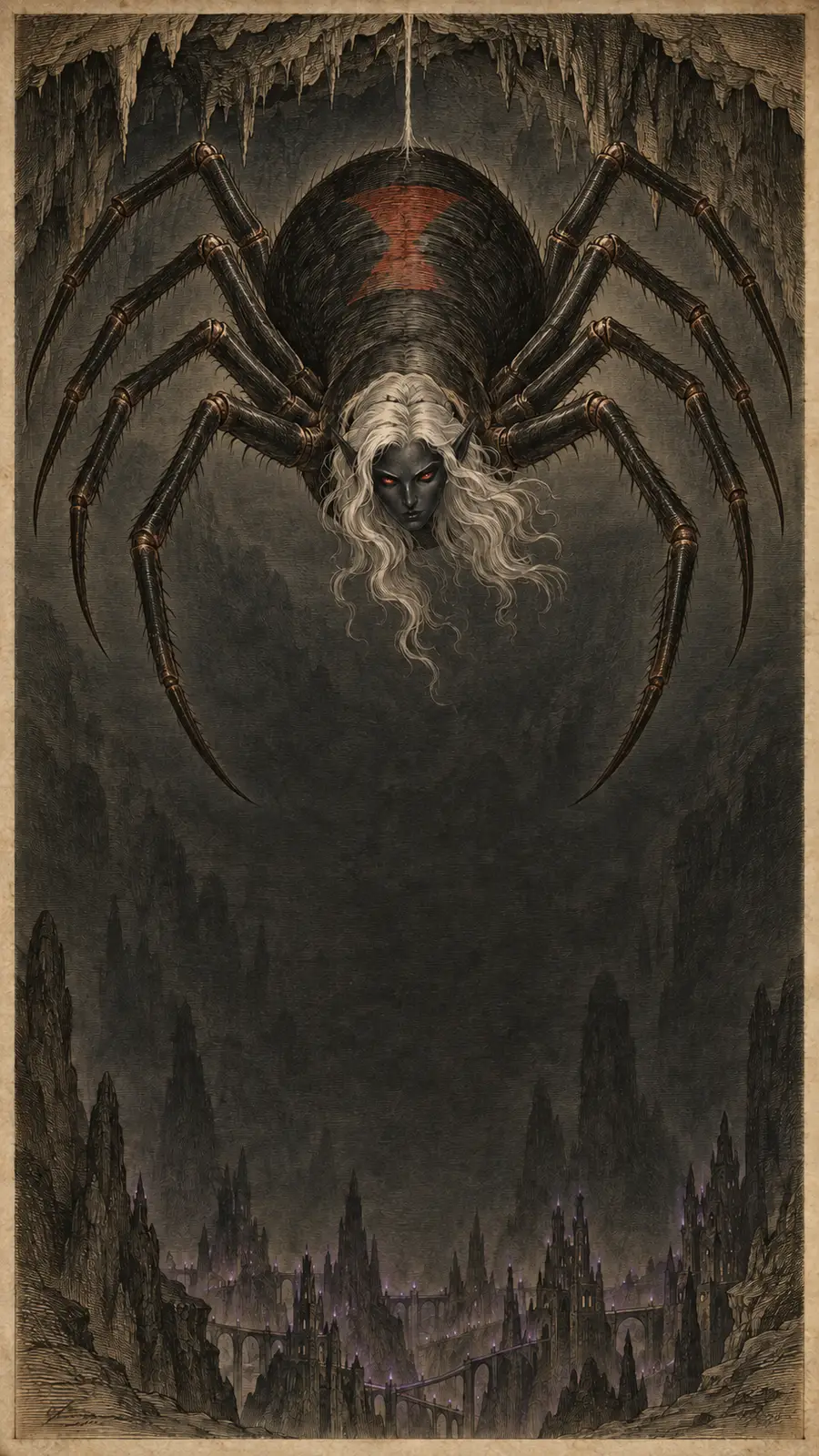
As for Lolth herself, in the Vault she becomes real at last. The module describes her fully and gives her the statistics of a demoness, a being of the Abyss who dwells among her worshippers in spider shape and drow shape both. In the Egg of Lolth the heroes may actually face her. One of the drawings in the module shows her lowering herself from the ceiling above the adventurers, the way a spider drops silently onto a thread, and that image stayed with players for decades. Gygax was always clear that she was his own creation. She was, he said, "strictly a creation of [his] own imagination," and not borrowed from Tolkien's great spider Shelob. A few years later her description would be reprinted among the demons of the Fiend Folio, in 1981, settling her place in the game's cosmology.
But the Vault's last surprise is a picture on a wall. In Lolth's temple there's a mural, and the mural is a gate. The module explains that it leads "to the plane of the Abyss, where Lolth actually dwells," and it promises that the journey through it will be told in a future adventure.
Players waited about two years.
Gygax had already sketched a great wheel of planes around the material world in the pages of Dragon back in 1977, but no adventure had yet taken anyone there. The mural in the Fane of Lolth sat on tables and in imaginations, an open door with nothing visible on the other side. When the answer finally came, in October 1980, it was called Queen of the Pits. It was written by David C. Sutherland the third, the TSR artist whose drawings had first shown the drow, with design input from Gygax.
The heroes step through the mural and into the Abyss.
Lolth's realm, the module explains, is the sixty-sixth layer of that endless chaos, and it is called the Demonweb Pits. Imagine a vast web of strands stretched across nothing, hanging over pits that seem to go down forever. The strands are wide enough to walk on, and the heroes must walk them, with the drop on either side. Lolth's purpose is revenge. She has not forgiven the setback the heroes dealt her in the Vault, and she plans to gate a demonic army into the lands of the surface and sweep it across the kingdom of . The heroes have come to stop her on her own ground.
Her palace is an iron fortress shaped like a giant spider, and it moves. It crawls slowly across the strands of the web on great jointed legs. At the climax of the adventure the fortress shows its strangest nature. It is a ship, a brass-plated mechanical spider driven by steam, able to sail between the planes. It's a gloriously odd picture: an engine of brass and iron hissing quietly in the dark of the Abyss, with a demon queen at its heart.
The web also holds doorways. Scattered along the strands are portals to other worlds that Lolth means to conquer, or has already begun to infiltrate. Through one there's a world of clouds. Through others are a frozen tundra, a jungle, a wide savanna, a quiet woodland and a world much like any ordinary fantasy land, with castles and towns. Each portal is a window onto someone else's sky, and each is quietly threatened by the patient spider at the centre of the web. Through this one adventure the drow, who had been a rumour in a monster book three years earlier, were tied to the whole multiverse.
In 1986, TSR gathered all seven adventures, the three giant modules, the three drow modules and the queen's web, into a single great volume called Queen of the Spiders. Much later, in 2004, when the game turned thirty, Dungeon magazine looked back over everything published and named it the greatest adventure in the game's history.
Later storytellers came back to the Vault and changed it, as later storytellers do. In time, Greyhawk lore came to hint that the Elder Elemental God whom Eclavdra served was connected to , a dark and imprisoned power far older than the drow. Later histories of the Vault told how House Eilservs slowly fell from its high place among the houses, sinking from first to seventh over the years that followed the heroes' visit. Later still, in the era of the Planescape setting, the Vault was imagined torn by a new civil war. This one pitted Lolth's faithful, Houses Despana, Noquar, Kilsek and Godeep, backed by mind flayers, against followers of the death goddess in Houses Tormtor, Everhate and Aleval, who were backed by githyanki. Later Greyhawk material also put a number to the city, nearly ten thousand drow, with about twice that many others living among them as slaves, servants and outsiders.
Those are later chapters in the city's life, told by later hands. In 1978 it was simpler, and maybe more haunting: a city under a plum-coloured moon, eight proud houses, a priestess who had changed her god, and a picture on a temple wall that opened onto a web.
Chapter IV
Naming the dark: the Dungeoneer's Survival Guide
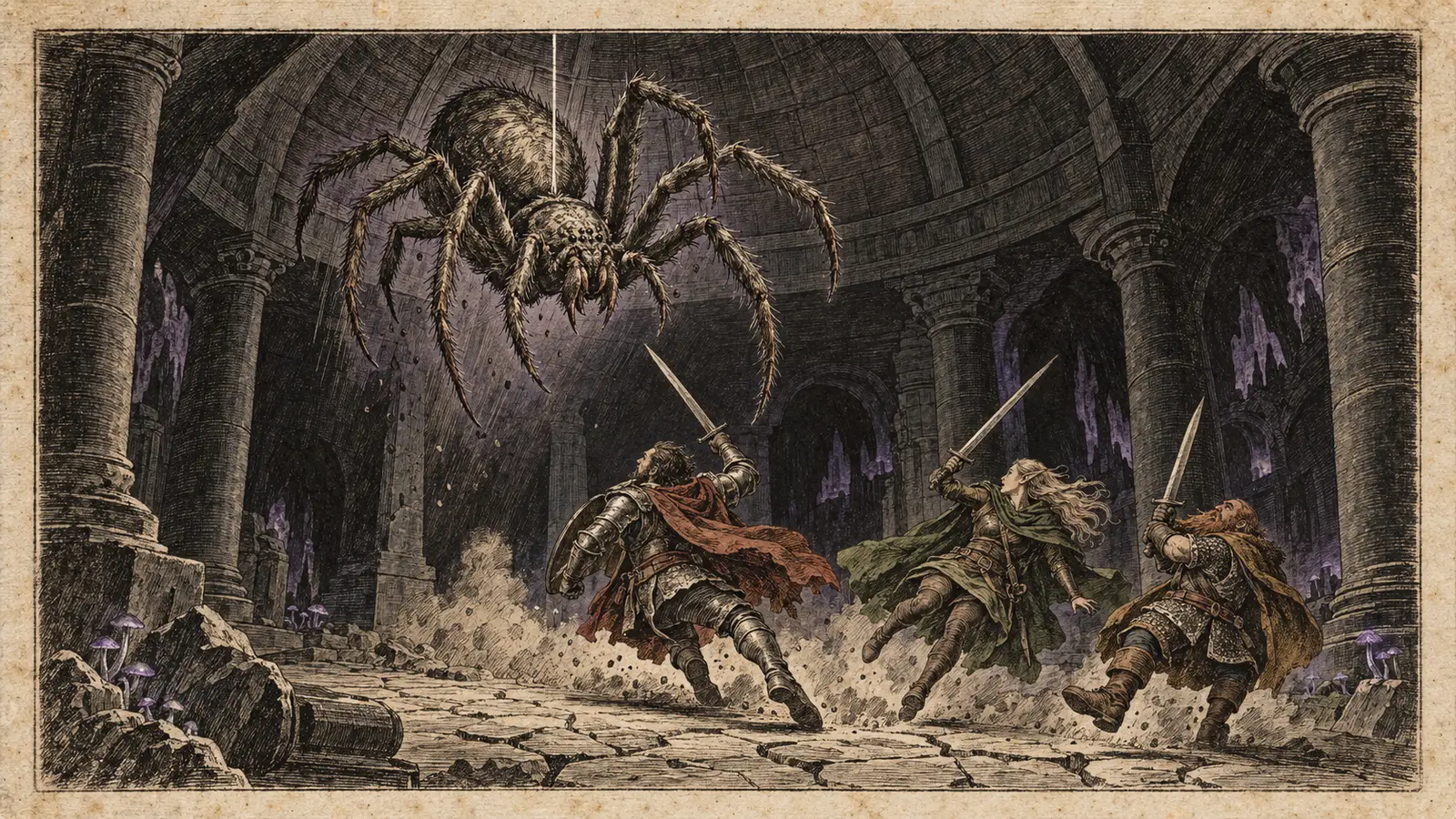
For eight years the world below had no proper name. It was the deep tunnels, the depths of the earth, Deepearth, the Underoerth. In 1986 it got the name it still carries.
That year TSR published a hardcover called the Dungeoneer's Survival Guide, written by Douglas Niles, with a cover painted by Jeff Easley. Inside, the deep world was finally called the .
It's worth pausing on how much changed with that word. In the Greyhawk modules the world below had been the setting of one particular campaign, a road the heroes walked while chasing particular villains. Niles lifted it free of any single world. He presented the Underdark as a general region of adventure, something every campaign might have beneath it, wherever its surface lay. In his book it is "that little-known region of dungeons and caverns far beneath the sunlit world of everyday existence," and he promised "grand new vistas in the realms of the underdark." The Underdark sits below the ordinary dungeon, beyond the bottom level, beneath even the deepest crypt. It is a great network of caverns and tunnels and vast cave systems, a second world with its own geography.
The book treated that world seriously, almost like a natural historian. It explained the kinds of caverns that exist, how they form, how a traveller finds them and gets into them, and what kind of life they hold. It described the hazards of the deep: cave-ins and sudden floods, underground streams that could sweep a careless traveller away, pockets of poisonous gas, volcanic heat, and air so thin that a party might slowly suffocate without noticing. It taught referees how to draw caves in three dimensions, using perspective grids at different angles, so that a passage might climb, twist and plunge beneath another passage the way real caves do.
Then it turned to the peoples of the deep. In a section on their "values and objectives," it looked at what the great underground races wanted, beyond simply being monsters for heroes to fight. The drow were there, and the kuo-toa from the Shrine of the Sea Mother. Beside them stood the duergar, the grey dwarves of the deep, sullen and hard-working; the mind flayers, or illithids, who feed on thought; the aboleth, vast and ancient fish-like masters of the underground waters; the derro, those mad little folk of the tunnels; and the cloakers, which hang in the dark like discarded garments until they move. Each was given a place in the Underdark's ecology and politics.
And then, as a gift to referees, Niles drew a map.
The sample region is called Deepearth, and it spreads across two full pages. If you trace your finger over it, you go down through the layers of the world. At the top are the Surface Lands, the ordinary world of sun and rain. Below them lie the Upper Caverns, and then the great spaces open out. There are the Cathedral Caverns, with their soaring roofs, and the Enclosed Caverns, sealed and secret, and the Caverns of the Ancients, where older things have left their traces. There's a Great Lake. There's a Grand Canyon of Deepearth, and below it a Lower Grand Canyon, a chasm inside a chasm. There's a Fungus Forest, and a Sunken Swamp, and somewhere the ominously named Caverns of Doom. And across all this territory the peoples of the deep have their lands: the Lands of the Deep Gnomes, the Domain of the Duergar, an Outpost of the Illithids, and the Realm of the Drow.
Laid out that way, the Underdark stopped being a single dungeon. It became a world of many nations and many landscapes, layered one beneath another, with forests and lakes and canyons of its own, where travel itself was an adventure and politics ran as deep as the stone.
The book also introduced something new to the game as a whole: non-weapon proficiencies, a way for characters to be skilled at things other than fighting. Down here it mattered a great deal whether you knew how to climb, or swim, or read the rock. Not everyone loved it. Roughly a third of the book was given over to detailed rules for moving, climbing, falling, breathing and mining, with eight pages on mining alone, and some players found that play could slow to a crawl under the weight of it. People who look back on it today often call it a mixed bag. Yet those same people credit it with giving the Underdark its name and its first map, and they call it the grandfather of every Underdark book that came after.
There's one small thread worth following out of it. The book's guidance on the deep was framed as the wisdom of a sage named Winninger, and his name echoed quietly through the years. A Greyhawk book of lore came to be called Winninger's Guide to the Underdark. More than a decade later, when the Forgotten Realms produced its own grand survey of the deep, it tipped its hat to him by name, as though the old sage's notebook had been passed down from guide to guide.
By the end of 1986 the deep world had a name and a shape. All it needed now was a city that everyone would remember, and someone to walk out of that city into the light.
Chapter V
The City of Spiders, and a drow who walked away
In 1988 TSR published a novel called The Crystal Shard. It was the first book by a young writer from Massachusetts named R. A. , set in the frozen north of the Forgotten Realms, in a place called Icewind Dale. It was meant to be the story of a barbarian named and his friends. And in it, almost by accident, was a dark elf.
Salvatore told the story of that accident many times. hadn't been in the original outline of the book. His editor needed a new character to stand at Wulfgar's side, and Salvatore said, on the spot, that he had a dark elf. She was doubtful. A drow, after all, was a villain, one of the cruel spider-folk from under the earth. He talked her round by promising it was "just a sidekick." Asked later where the idea came from, he said simply, "I guess that Gary just did such an amazing job in creating the drow elves that something about them got stuck in the back of my head."
The sidekick became one of the most beloved heroes in fantasy. Readers loved him so much that Salvatore was asked to write the story of where he came from. And that meant going down, into the , to the city Drizzt had fled. Its name had appeared in The Crystal Shard as his homeland: .
When Salvatore looked back at the old modules for guidance, he found the drow sketched only in outline. They were a matriarchal society living in the dark, ruled by priestesses of the Spider Queen. Almost everything else was his to invent. And invent he did. The result was The Dark Elf Trilogy: Homeland and Exile, both in 1990, and Sojourn, in 1991. Through it, Menzoberranzan became perhaps the most famous city of the deep in any world.
So let's walk into it, the way you might if you came on it from one of the long tunnels.
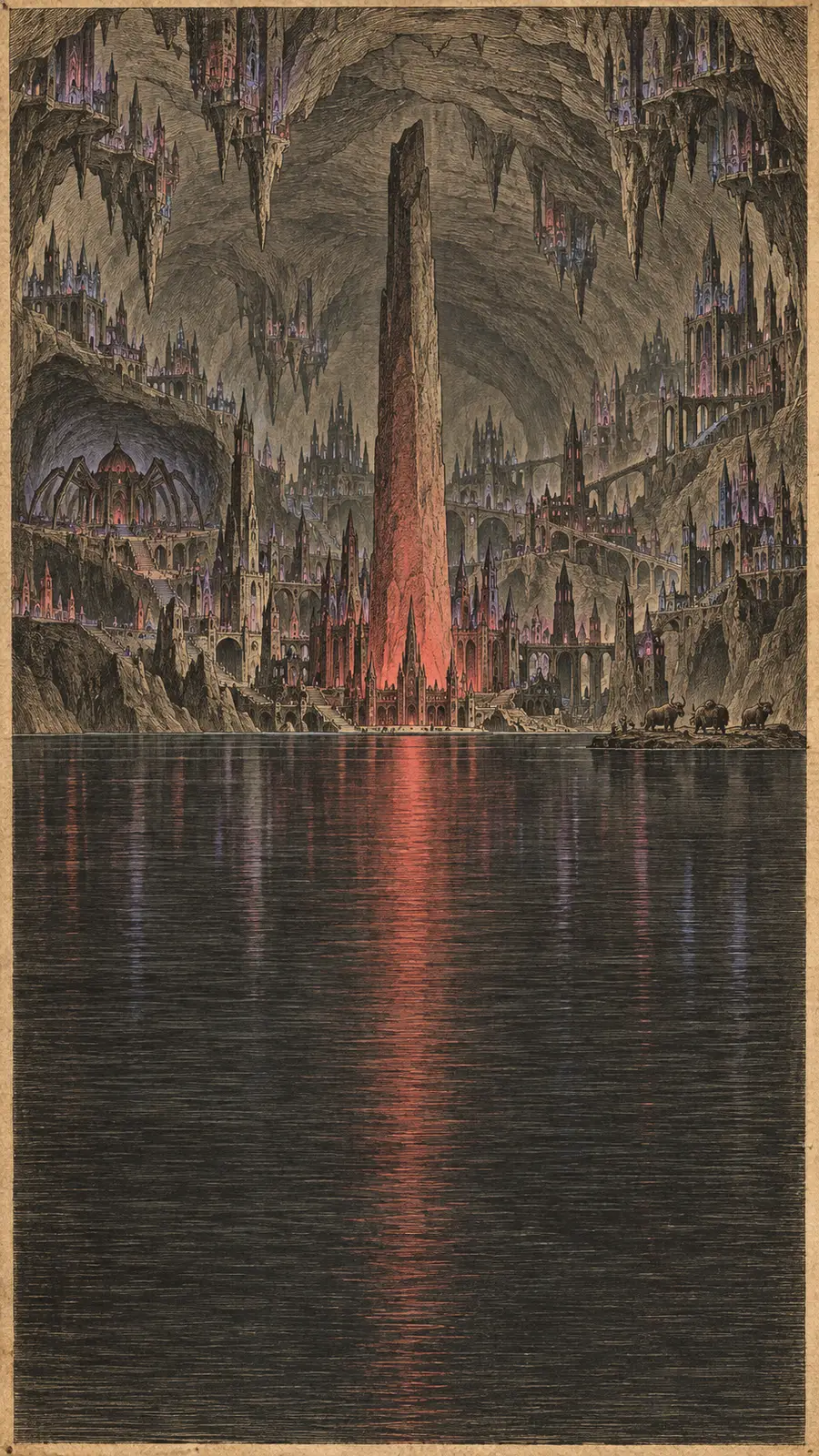
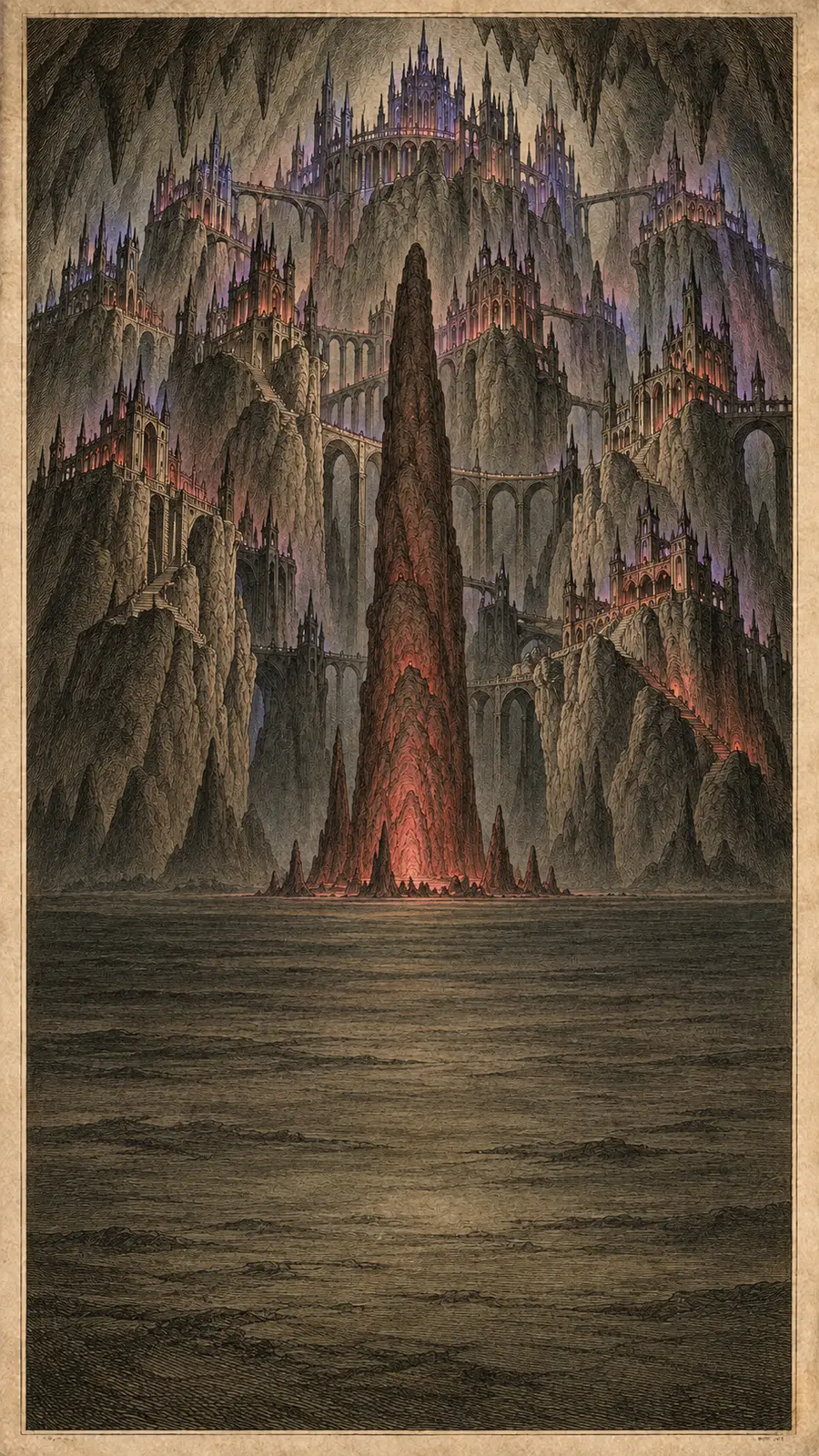
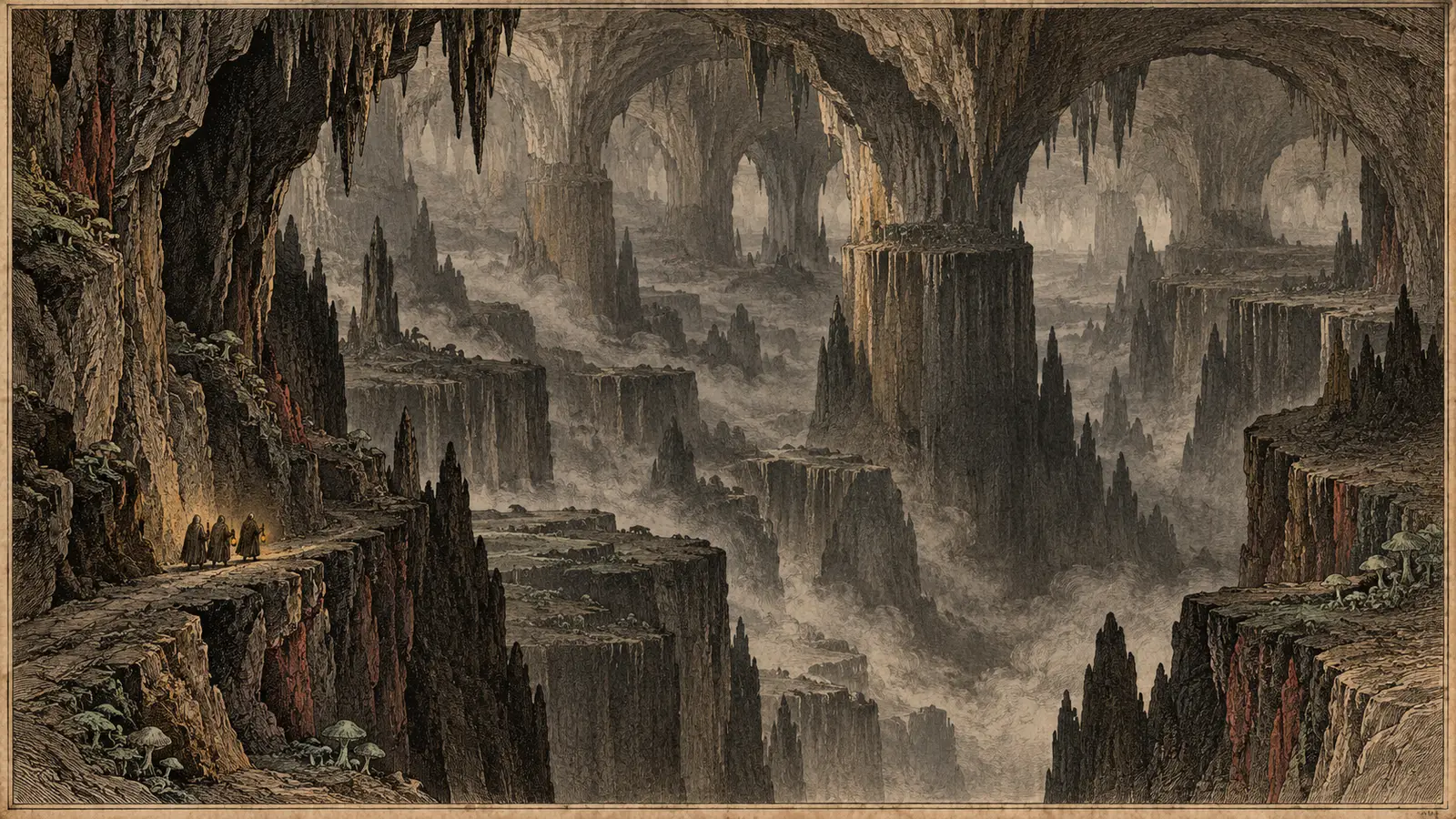
Menzoberranzan lies in the Northdark, the region of the Underdark that runs beneath the cold North of , about two miles below the surface, between the Moonwood and the Frost Hills. You come out of a passage, and the darkness opens around you into a cavern two miles across at its widest, with a ceiling about a thousand feet overhead. The floor is a forest of stalagmites, great spires of stone rising up, and from the ceiling hang stalactites like stone icicles. The drow have carved them all. Inside those pillars of rock are castles, with balconies and spires and stairways, sculpted over centuries. Along their edges, softly, glows faerie fire, a magical light of gentle colours, violet and blue and red. The whole city shimmers faintly in the dark like a jewel box half-opened. It's beautiful, and the people who live inside that beauty are among the most dangerous in all the Realms.
In the centre of the city stands a great stone pillar called . Every day, the Archmage of Menzoberranzan lays a spell upon its base, and the pillar begins to glow with magical heat. Slowly, through the hours, the glow climbs and then fades, and the people of the city tell time by it. There's no sun down here, so Narbondel is their sun. When its light has entirely gone, it's midnight in the City of Spiders, a time some drow call Narbondel's Black Death.
At the high end of the cavern, in a side chamber of its own, lies , the home of the Academy. Three great schools stand there. , shaped like a vast spider, trains the priestesses of , and it's the most important of the three, as you might expect in a city ruled by priestesses. , a tower of graceful spires, trains the wizards. trains the warriors. Every noble drow passes through one of them, and many don't come out quite the same.
On a raised plateau called Qu'ellarz'orl stand the great houses of the high nobility, among them , , Barrison Del'Armgo and Agrach Dyrr. At the far side of the cavern lies Lake , with an island in the middle called the Isle of Rothé, where herds of rothé, shaggy cattle of the underground, graze on fungus. The lake and its herds are tended by House Hunzrin, and between the rothé and the fish and the fungus farms, they feed the city.
Menzoberranzan is ruled by the Ruling Council, made up of the matron mothers of the eight highest-ranked houses. That's the law. The deeper truth is that the city runs on ambition. A house rises by destroying the houses above it, and this is perfectly accepted, even admired, so long as no one survives to bear witness. A house that's caught in such an attack, with witnesses left alive, will be destroyed by the others for breaking the rules. A house that leaves no witnesses simply moves up in rank, and everyone agrees to pretend nothing happened. Lolth, the goddess of chaos, finds all this very pleasing.
At the very top, for centuries, stands House Baenre, First House of Menzoberranzan.
The city's founding was told in the lore as a kind of scripture. Nearly four thousand years before the Realms' reckoning of years began, a priestess of Lolth named the Kinless led seven drow families northward out of Golothaer, a drow holding in the great southern region called . They were fleeing endless war between those who worshipped Lolth and those who worshipped , an ancient god of slimes and oozes. Lolth wished them to go north, and so they went. She guided them through dreams, but only when all hope seemed lost, never before, which is very like her.
The journey was terrible. They fought the natives of the Underdark all along the way, and in a clash with a clan of dwarves they lost half their number. At last they came to a vast cavern where a beholder had made its lair. They killed the beholder, took the cavern, and named it for their leader: Menzoberranzan. And then, having no outside enemy left to fight, the seven families turned on one another, the very strife they had fled from. Their goddess of chaos was delighted. Not long after, one house, House Nasadra, left the city entirely and travelled away to found a city of its own, . Many centuries later, shortly before the Realms' count of years began, House Baenre rose to power under a matron named Baenre, and its rule lasted ever after.
Into this world, much later, Drizzt was born.
His house was House Do'Urden, which also bore the old, formal name Daermon N'a'shezbaernon. The name Do'Urden is said to mean "walkers in the darkness." Drizzt was born in the year 1297 by the Realms' reckoning, the third son of Matron Do'Urden. Custom held that a third-born son should be sacrificed to Lolth, and he was meant to be. But on the very day of his birth Malice used the power of that birth to fuel a spell, and with it House Do'Urden helped destroy House DeVir, which was then the Fourth House of the city. In the turmoil, the sacrifice was set aside. Drizzt lived. Do'Urden climbed to Ninth House. And the boy grew up among his siblings, his brother Dinin and his sisters , Briza and Maya. Vierna raised him through his earliest years.
Homeland tells of that upbringing. His teacher at arms is , the weapons master of the house. Zaknafein is the finest swordsman in the city, and secretly he is Drizzt's father, and he despises the cruelty of drow society with a quiet, burning contempt. He teaches the boy to fight with two blades, and he teaches him something else too, without ever quite saying it: that it's possible to be drow and still see what is wrong.
At the Academy Drizzt makes enemies, as everyone there does. A young wizard named Masoj Hun'ett summons a great black panther from the Astral Plane, , to serve as a distraction while Alton DeVir, last survivor of the house Do'Urden destroyed, attacks Drizzt. But the panther and the young drow take to each other. When Masoj finally orders Guenhwyvar to kill Drizzt, she fights the command, and together the two of them defeat both Masoj and Alton. From that day on, Guenhwyvar is Drizzt's companion, summoned from a small onyx figurine, and she will walk beside him for the rest of his story.
The cruelty of the city finally breaks his home apart. On a raid against the surface elves, Drizzt shows mercy to an elven child and hides her from the slaughter. When the house learns of it, Zaknafein is sacrificed to Lolth to atone for his son's mercy. Matron Malice then offers Drizzt Zaknafein's place as weapons master, if he will obey. He refuses. He crushes one of Zak's old light pellets, a little stone that bursts into dazzling brightness, blinding his family in their dark-adapted eyes, and he flees out of Menzoberranzan into the wild Underdark.
Exile follows him there. Ten years pass. Drizzt has become a feral wanderer, alone but for the panther, surviving in the tunnels by instinct and blade. Something savage grows in him during those years, a second self he comes to call the Hunter, cold and ruthless and quick. It is perhaps the loneliest stretch of any story set in the deep.
Eventually he comes near , the city of the svirfneblin, about forty-five miles west of Menzoberranzan. The deep gnomes fear him at first, and who could blame them, with a drow emerging from the dark. But one of them, the Burrow-Warden , remembers that Drizzt once spared his life on a raid long ago. Belwar lost his hands that day, and the gnomes have fitted him with a hammer and a pick in their place. He takes Drizzt in. Their friendship is gentle and gruff, and it's one of the warmest things in all these books.
There's a third companion too, and a sad one. Clacker was once a pech, one of the quiet stone-shaping folk of the deep, until magic turned him into a hook horror, a great beaked creature with hooks for arms. Slowly his mind is slipping away into the beast's. He travels with Drizzt and Belwar, holding onto himself as long as he can.
Meanwhile, Matron Malice cannot catch her son, and her failure shames her before the goddess. So she does something terrible. She summons a yochlol, a handmaiden of Lolth, and asks for , the Spider Queen's greatest gift. Zaknafein's body is raised as a spirit-wraith, keeping every bit of his skill with the blade and obeying the matron's will, and he is sent to hunt his own son. In the end, at the last, Zak's true spirit rises up inside that body and refuses. Clacker dies in the struggles of the story and, in death, returns to his peaceful pech form. Drizzt decides to go up to the surface. Belwar offers to come, and Drizzt gently turns him down, telling him the surface is no place for a svirfneblin.
Somewhere in those years, Salvatore gave Drizzt a line that sums up the whole long trial. "My enemy was solitude," he says, "the interminable, incessant silence of hushed corridors."
Sojourn is the story of what happens next. After more than forty years in the Underdark, Drizzt climbs into a world of sunlight that hates and fears him. He is hunted and turned away, until he meets an old blind ranger named Montolio DeBrouchee, who teaches him the ways of the ranger and shows him kindness. And in Montolio's grove a unicorn appears, and Drizzt comes to understand that , goddess of the forest and of rangers, has accepted him. The drow who walked away from the Spider Queen has found another god.
That's where the Icewind Dale story picks him up. But the city he left was not finished with him.
In the books that followed, gathered as Legacy of the Drow, Menzoberranzan reached up into the light after him. In The Legacy, published in 1992, his sister Vierna hires and his mercenary band, , the foremost company of sellswords in the City of Spiders, and pursues Drizzt to Mithral Hall, the dwarven home of his friends, with the assassin Artemis . Jarlaxle is a wonderful creation: a bald, flamboyant drow with an eyepatch and a great plumed hat, a male who has made himself powerful in a city ruled by women, who belongs to no house and is somehow always one step ahead of everyone.
In Starless Night, Drizzt goes back down to Menzoberranzan himself, hoping to protect his friends by drawing danger away from them. He is captured by House Baenre, and his friend follows him into the dark. In Siege of Darkness, the whole might of Menzoberranzan rises and marches on Mithral Hall. It is driven back with heavy losses on both sides, and the great Matron Yvonnel Baenre, who had ruled the city for so long that she seemed eternal, dies in the attempt.
Those same troubled years saw another story in the City of Spiders. It was the time the Realms remember as the Time of Troubles, when the gods themselves were cast down to walk the world in mortal form. House , the Third House, held a rare and feared gift: psionics, the power of the mind. While the gods were weakened, Oblodra reached for First House. Matron Baenre prayed, and an avatar of Lolth answered. The goddess opened a portal and let demons pour through to besiege Oblodra, and then she crushed the house herself. It's one of the clearest pictures in the lore of what Lolth is to her city: patron and terror both.
After Yvonnel's death, her eldest daughter Triel became Matron Mother of House Baenre. Much later Quenthel would follow her, and much later still Sos'Umptu, after the city had passed through a civil war.
As for House Do'Urden, it did not survive Drizzt's leaving. It was destroyed by House Baenre and Bregan D'aerthe together, and in the ruin Jarlaxle offered Drizzt's brother Dinin a choice: a place in the band, or death. Dinin chose death. Even in a city of ambition, some pride runs deeper than survival.
The novels made Menzoberranzan a living place. But the game's books would soon go further, and lay out the whole city, house by house, street by street.
Chapter VI
Second edition and the long history of the dark elves
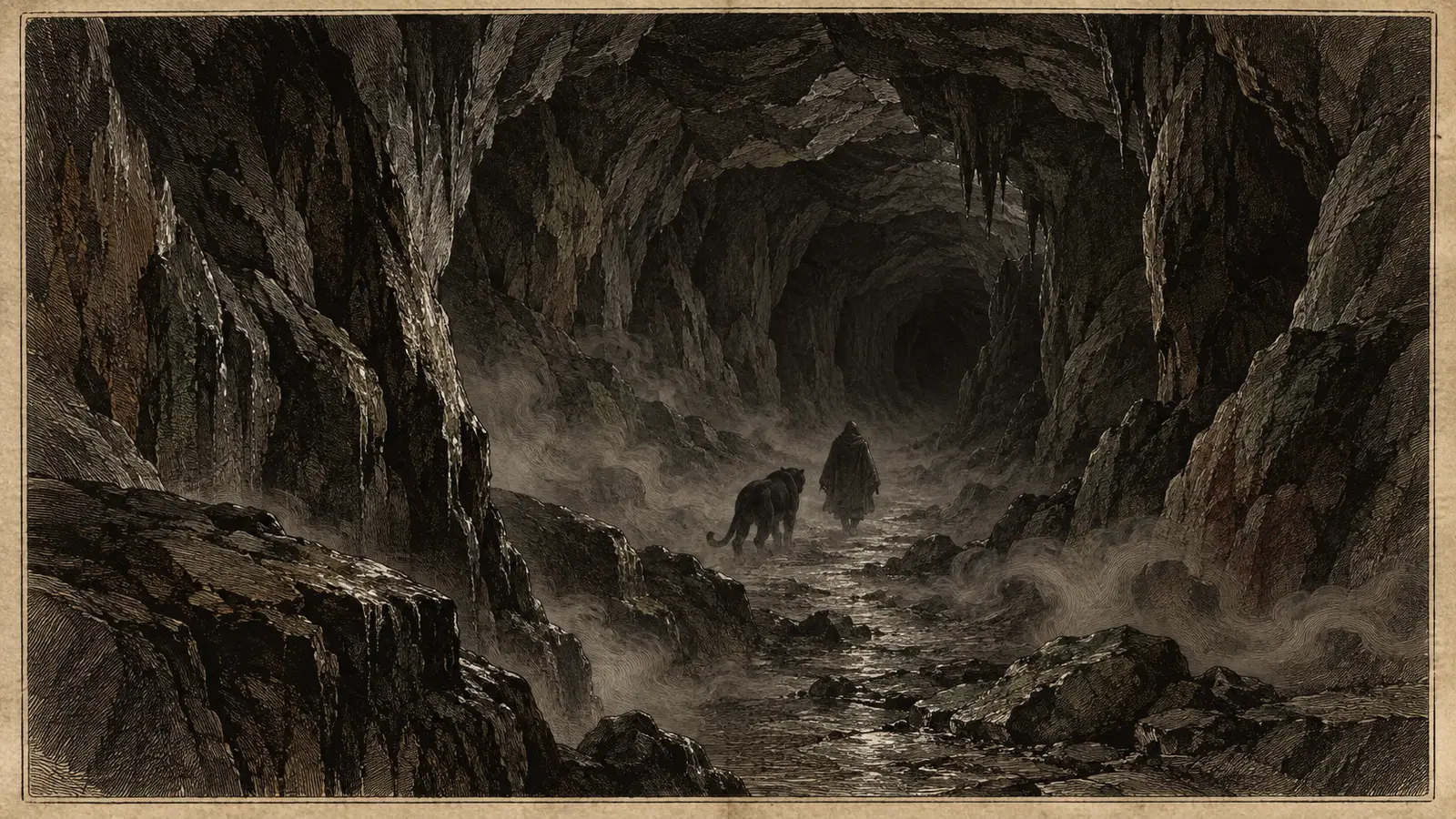
In 1989 a new edition of Advanced Dungeons & Dragons arrived, and through its years the grew mostly in the Forgotten Realms. Ed Greenwood, the creator of the Realms, came down into the dark to write its history.
In July 1991 TSR published Drow of the Underdark, by Greenwood, with another dark, glowing cover by Jeff Easley. It's a strange and lovely book, and it opens in a way only Greenwood would think of. In its introduction he tells us that he learned all of this from , the old sage of Shadowdale, during a conversation, and from a chance meeting with a former apprentice of Elminster's, a drow lady named Susprina Arkhenneld. Between them, he says, the two explained the drow to him. So the whole book reads as though a wizard and a dark elf sat by the fire with a curious writer from our world and told him how things are below.
What they told him was a great deal. The book lays out drow society and customs, their crafts, their languages, their names and how they're given, and the runes they carve. It covers their magic and the wonders they make, and adds new spells and items and creatures of the deep. And it tells what the book calls the high history of the drow.
Here's that history, as the Realms came to tell it.
Long ago, before there were drow at all, there were dark-skinned elves who lived in the jungles of the far south. They were called the , the elves of the South, and they were proud, warlike and very advanced. In that age the elven nations fought among themselves in a long series of struggles called the Crown Wars. And , who was then still among the elven gods but already turning against them, saw her chance. She sent a demon to the Ilythiiri, a balor named . Wendonai came to their rulers and offered them power, and the price of that power was corruption. They accepted.
Their raids grew crueller and wider. At last the other elves, along with humans and dwarves and others, joined in an alliance against them, and in great battles of magic the Ilythiiri were broken. They fled into the underground warrens they had found long before, down into the dark, and they never came back up as a people. The Realms remember this as the Descent. From then on, they were the drow.
It is a sad story, and the book tells it as one. Then, crucially, it broadens the heavens above the drow. Before this, readers had mostly known Lolth, and the mysterious Elder Elemental God from the Vault. Now there were others.
There was Lolth herself, Queen of Spiders and Queen of the Pits, still the great goddess of the dark elves. But beside her there was , the Dark Maiden, goddess of drow who seek goodness, a goddess of song and dance and the moonlight of the surface world. Her followers came up out of the dark to dance under the moon. There was , a male god of stealth and thieves, who taught that drow men need not bow to the priestesses, and who stood as a rival to Lolth's rule of women. And there was , called That Which Lurks, an oozing, mad god of slimes and the things that crawl, who in the Realms took up the title of the Elder Elemental God. There's a quiet bridge there back to 's hidden temple in the Vault.
From these few pages, much would grow. In later Realms stories, Eilistraee's faithful would gather into sects of their own under a great priestess, Veladorn, and the drow who sought the moon would become one of the most loved threads in the setting. Somewhere in that book is the first glimmer of the idea that a drow need not be what Lolth wants.
A year later, in December 1992, came the city.
The Menzoberranzan boxed set, subtitled The Famed City of the Drow, was written by Ed Greenwood, R. A. and Douglas Niles, the man who had named the Underdark. Opening the box was like being handed the keys to the city. There was a book called The City, which walked through the streets and districts and described daily life for every class of drow, from matron to slave. There was a book called The Houses, which set out all eighteen houses of , major and minor, with their matron mothers, their families and their advisers. There was a book called The Adventure, which invited players into the city's web of deceit. There was a little booklet looking back at House , 's fallen house. And there were maps: four great poster maps that fitted together into the whole cavern, another showing the compound of House , and a poster tracing the rivalries and alliances among the eighteen houses, all the lines of hatred and convenience that held the city together and pulled it apart.
The box described Menzoberranzan as home to some twenty thousand drow, with hundreds of thousands of slaves beneath them. It described countless secrets and simmering rivalries, ruled over by feared houses and their matron mothers. Here we meet Baenre, Archmage of the city, master of , son of the great Matron Baenre, and the one who lights each day. Here too is 's , quietly tied to both Matron Baenre and Gromph, working for the powerful in ways that are never written down.
It was the first game book to lay the city out in such detail, and it made Menzoberranzan a place people could truly play in. Two years later the city would even become a computer game, but we'll save the screen for its own chapter.
Not all of second edition's Underdark was in the Realms. In 1995 TSR published one of the great long campaigns of its era, Night Below: An Underdark Campaign, written by Carl Sargent. It was built to fit any world. It begins somewhere very far from the dark, and very peaceful: a quiet rural region called Haranshire, with villages named Milborne and Thurmaster, fields and farms and little roads.
Into that peace comes a kidnapping. Someone tries to carry off one or more of the heroes who can cast spells. As the heroes follow the trail, they uncover gangs at work across the countryside, quietly seizing wizards and priests. The gangs serve someone, and the someone is far below.
In the second part of the campaign the heroes go down into the Underdark. They meet derro, deep gnomes, mind flayers and the rockseer elves, a reclusive people of the deep. Many of these meetings are not fights at all. The campaign leans on diplomacy and intrigue as much as the sword, and the heroes slowly gather allies and strength among the peoples below. Their goal is to attack the City of the Glass Pool, a settlement of kuo-toa that guards the way down to something larger.
In the third part, they reach it: the Sunless Sea, a great lightless ocean under the earth. In it lies Great Shaboath, a city of the aboleth.
Aboleth are among the most ancient things in the game, vast fish-like creatures with tentacles and great slow minds, older than most of the gods' quarrels, who remember everything their ancestors ever knew. At the bottom of the Sunless Sea, aboleth savants are building an artifact. With it they mean to extend their power to dominate minds across hundreds of miles. All the kidnapped spellcasters in all those quiet villages were being gathered for that purpose. The campaign ends with the heroes facing the aboleth in their own black waters. The box even described the gods of the aboleth and of the ixitxachitls, the ray-like creatures of the deep seas, so the Sunless Sea had heavens of its own.
People still talk about Night Below as the definitive Underdark campaign of its time. One well-known reviewer called it "marred in the execution," and then, in the same breath, still a classic. Players still bring it forward into newer editions, because its shape is so satisfying. It begins with a village, and ends at the bottom of the world.
In 1998 the mind flayers had their turn. Bruce R. Cordell wrote The Illithiad, a book devoted to the illithids, those tentacle-faced eaters of brains. It added new horrors to their kind: the elder brain, the great pulsing mind at the heart of each illithid city; the neothelid, a vast and terrible worm; the arcane illithids, who practise wizardry; and the urophion, a strange hybrid. It gave the illithids a past. Long ago, it said, they had ruled an empire across many worlds, enslaving or destroying whole races, until a rebellion of their slaves brought it down.
A trilogy of adventures followed that same year. The first was A Darkness Gathering. In the second, Masters of Eternal Night, the heroes cross a frozen land to stop the mind flayers from snuffing out the sun itself, and in a snow-covered crater they must dig out an ancient object that came from elsewhere. In the third, Dawn of the Overmind, the scale grows dizzying. A hundred suns are burning toward their end, their light stolen by the flayers, who mean to use it to remake the past. It's a long way from the Underdark's tunnels, but the illithids always carry the deep with them, wherever they go.
And in November 1999, as the century closed, the Underdark of the Realms received its great guidebook. Drizzt Do'Urden's Guide to the Underdark, written by Eric L. Boyd, is presented as though Drizzt himself had compiled it, the old wanderer writing down what he knew of the world he grew up in and escaped. It describes the Underdark beneath the north and west of : the races that live there, how a traveller might survive, and more than a dozen of its cities, with maps. And, as we said, it nods to Winninger, the sage of the old survival guide, whose name had crossed from one world's lore to another's.
In these years the lands beneath the North came into focus. There's , the svirfneblin city where once took in a lonely drow. There's , the City of Blades, a city of the duergar on the shore of a vast underground water called the . Derro live there too, and durzagon, the half-fiend children of duergar and devils, and orogs and stone giants, and about a third of all its people are slaves. Gracklstugh is famous for its forges and its steel.
The Darklake is one of the great features of the northern deep. It isn't one lake but a chain of connected waters, lying in a cavern more than a hundred miles across, in places about a thousand feet high and in others so low the ceiling nearly touches the water. Waterfalls once joined the lakes one to another, and later, dwarven engineers built locks to control the flow. The water is unnaturally dark. Even magical light reaches only about ten feet into it, and darkvision, the sight that lets the deep peoples see without light, doesn't help at all. Great columns and stalagmites rise out of it. Duergar boats out of Gracklstugh patrol its surface.
Across the water from Gracklstugh, about three miles beneath the surface, hidden on the Darklake shore, lies . It's a secret trading cavern where peoples who would otherwise kill one another come to trade, and where several races, among them the duergar of Gracklstugh, keep representatives. The boat crossing from Mantol-Derith to Gracklstugh takes more than two days.
And somewhere above all this, lying a mile to three miles beneath the High Forest of the surface, is the . Its name is Dwarvish for "Great Fungus." It is a single living fungus, one organism, spreading for hundreds of square miles through the upper Underdark, immune to magic and resistant even to the powers of the mind. It grows quietly under the forest above, a forest of its own, mirrored in the dark.
So by the end of the second edition the Underdark of the Realms had a history going back to the fall of the southern elves, a pantheon of quarrelling gods, a famous city with eighteen houses, a sunless sea in one corner of the multiverse and a great fungus in another. And it had a guide, a dark elf who had walked away. In the next era, the goddess at the centre of it all would fall silent.
Chapter VII
Third edition and the silence of the Spider Queen
In 2002, in the third edition of the game, Wizards of the Coast declared a Year of the Drow. It was a gathering of many things at once. There was a new series of novels, a great adventure, a new book from called The Thousand Orcs, a boxed set of miniatures, and articles in Dragon and Dungeon. All of them looked down into the dark at the same time, and all of them were tied to one event. The Spider Queen had stopped speaking.
The adventure was City of the Spider Queen, written by James Wyatt. It begins on the surface with raids, attacks by drow out of the dark. The heroes follow the raiders down through the and come to , a drow city that has been invaded by enemy creatures and lies in turmoil and ruin. Something has gone badly wrong in the drow world. Cities that should be strong are falling. The heroes explore the broken city, fight the things that have taken it, and at the end face a priestess of , the drow goddess of vengeance and the undead, a rival of 's who has seen her moment. The adventure won the Origins Award for best roleplaying adventure that year.
The novels told the larger story. The series was called War of the Spider Queen, and it ran across six books from 2002 to 2005, overseen by Salvatore and written by a different author each time, with covers painted by Gerald Brom. The books were Dissolution by Richard Lee Byers, Insurrection by Thomas M. Reid, Condemnation by Richard Baker, Extinction by Lisa Smedman, Annihilation by Philip Athans and Resurrection by Paul S. Kemp.
The story begins in , in the year 1372 by the Realms' reckoning, the Year of Wild Magic. And it begins with nothing. Lolth does not answer. Her priestesses pray, and there is silence. They call on her for spells, and no spells come. No visions, no communion, no sign. This is the Silence of Lolth.
Think about what that means in a city like Menzoberranzan. The whole order of drow society rests on the priestesses, and the priestesses' power rests on the goddess. Suddenly that power is gone. And in the lower orders of the city, among the slaves and the lesser folk and the men who have always been kept down, a new thought begins to spread. Perhaps the drow are not unquestioned masters after all.
In Dissolution, some of those men act on that thought. Renegade drow males plot to take the city with an army of thousands of slaves, kobolds and goblins and bugbears, and behind them stands a strange leader: Syrzan, a mind flayer who has become a lich, an undead illithid. Two of the city's finest, the wizard and the weapons master Ryld Argith, find their way into the rebels' hideout and are captured. Pharaun escapes by trickery and leaves his companion behind. Ryld fights his own way out.
Then the Matron Mother of House , Triel, sends an expedition to find out why the goddess has gone silent. It's a dangerous little company. There's Quenthel Baenre, Triel's sister, a high priestess without her powers. There's Pharaun the wizard, clever and vain, and Ryld the swordsman, and Valas Hune, a quiet scout who knows the deep roads. And there's Jeggred Baenre, a draegloth, a half-demon child of a priestess and a demon, enormous and four-armed, Quenthel's savage bodyguard.
Their first stop is , the City of Shimmering Webs, the city that House Nasadra went off to found long ago. It's one of the loveliest places in the deep. Ched Nasad fills a great V-shaped cavern, and its buildings don't stand on the floor. They hang, cocoon-like, in vast layers of webbing that has calcified over the centuries into something like glittering stone. The whole city glimmers, a web of light strung across the dark. There the company is joined by two more: Melarn, a priestess of House Melarn, and her battle-captive Yauntyrr, bound to House Melarn by magic.
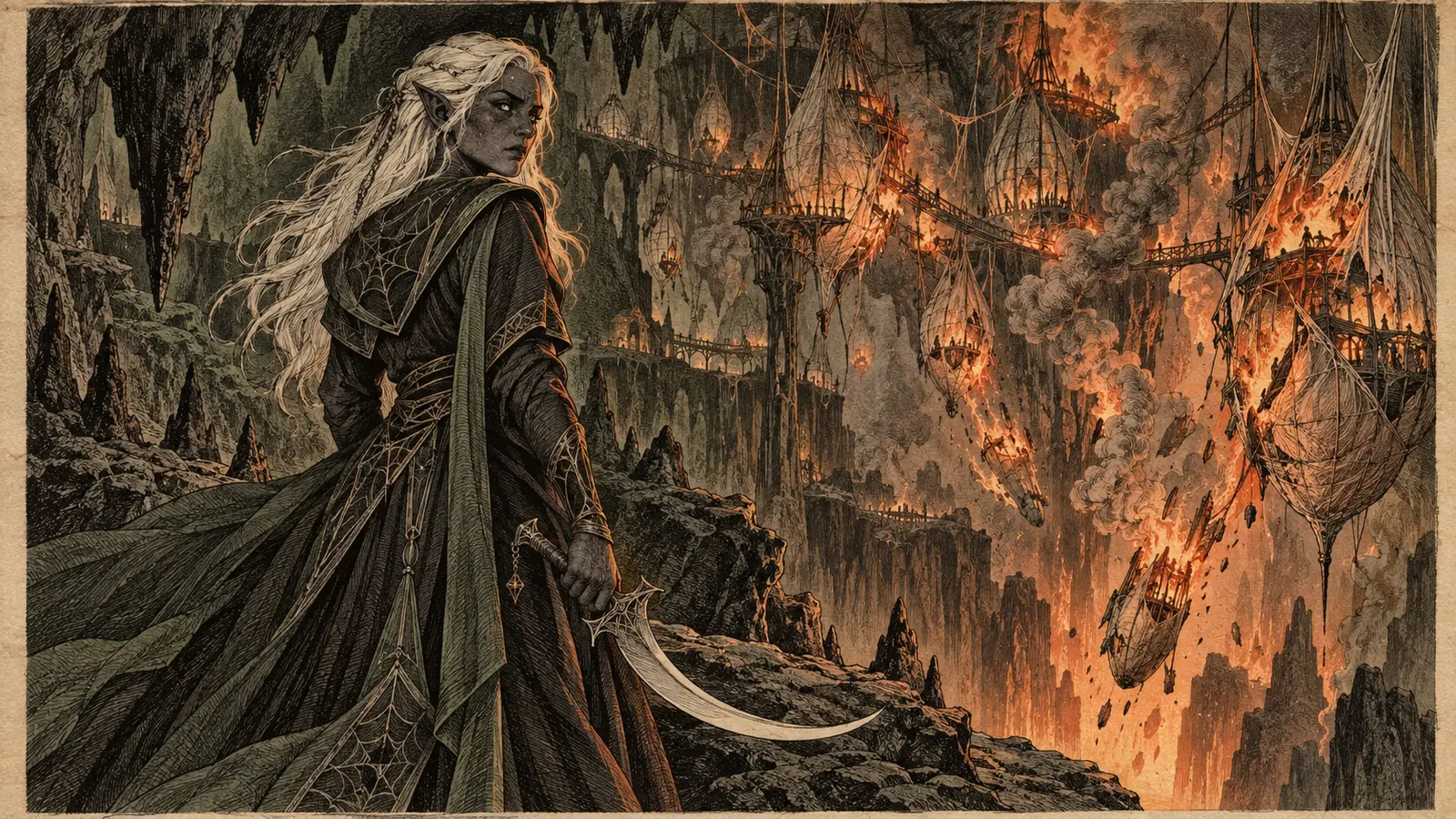
And then Ched Nasad burns. A duergar army comes against it, armed with alchemical weapons called stonefire bombs. The fire catches the calcified webbing that the whole city rests on, and the webs burn and break, and the hanging city falls into the chasm below. The company escapes through a portal as the City of Shimmering Webs comes down around them. Of all the cities lost in the long history of the Underdark, this may be the saddest.
The journey goes on, and the company frays. Halisstra, without her goddess, begins to feel the pull of another: , the Dark Maiden of the moonlight. Her faith in Lolth begins to waver. Ryld is eventually killed by Jeggred, on Danifae's orders. Valas, the scout, leaves them.
Back in Menzoberranzan the city is besieged. A duergar invasion is crushed, and in the chaos, House Xorlarrin, on Triel Baenre's orders, lays siege to House Agrach Dyrr, which has betrayed the city.
At last the company reaches the Pits themselves, Lolth's home in the Abyss, the realm the heroes of the old Greyhawk adventure once crossed on strands of web. Now it's nearly empty of souls. It's a place of black emptiness and giant webs, very hot, with an acrid smell in the air, and the bodies of monsters and demons lying everywhere, many of them goristros, the great bull-headed demons. Spiders move through it, the abyssal widows, and they're terribly beautiful. When Pharaun sees the first of them, he mistakes it for Lolth herself.
In Resurrection, the remaining company crosses a killing ground swarming with spiders to reach the temple of their goddess, who is waking at last. Danifae has a secret task: to kill Halisstra. And Halisstra carries a sword called the Crescent Blade, a weapon she believes can kill Lolth.
Lolth woke in 1373. She had not been dead, or idle. She had been changing. She called three candidates to become her Chosen, the Yor'thae, to complete her transformation: Danifae Yauntyrr, Quenthel Baenre and Halisstra Melarn. And when she emerged, her realm had changed with her. For all of its long history the Demonweb Pits had been the sixty-sixth layer of the Abyss. Now Lolth drew her domain out of the Abyss altogether, into a planar space of its own. At its centre is a huge iron fortress that walks on spider legs wherever she wills, a quiet echo of the crawling spider-palace of 1980.
Later novels carried the story's consequences further. , Lolth's champion and consort, who dwelt with her in the Demonweb, was killed by Cavatina Xarann, a priestess of Eilistraee, wielding the Crescent Blade with the help of Halisstra Melarn. But Halisstra had been transformed, and she became a mad, minor goddess called the Lady Penitent. In the end, using the Crescent Blade, she killed Eilistraee herself, while the Dark Maiden was dwelling in the body of her great priestess, Veladorn. The silence of one goddess, it turned out, led to the death of another.
The year after the Year of the Drow, in October 2003, came a book that gathered the whole deep world of the Realms in one place. It was called simply Underdark, a full-colour hardcover by Bruce R. Cordell, Gwendolyn F. M. Kestrel and Jeff Quick. It described the entire world beneath , and it gave that world a shape that has lasted ever since.
The Underdark, it explained, has three great depths. The first is the Upperdark, reaching down to about three miles below the surface. This is where the deep peoples and the surface peoples meet most often, where drow raiders slip up toward the light and adventurers come down from old dungeons, and where you find goblins and orcs, dwarves and deep gnomes, chitines and drow and wererats. Below that, from about three miles to about ten, lies the Middledark, and that's where most of the great cities stand. Below ten miles lies the Lowerdark. Even the hardiest Underdark travellers avoid it.
The Underdark is also divided the way the surface is divided, into something like continents, regions the book calls domains. Within a domain you can travel, with difficulty, but few passages link one domain to another, so each is a world apart. Their names are worth hearing in a row, slowly. There's the Northdark, under the North, where Menzoberranzan lies. Old Shanatar is the ancient underground realm of the dwarves. Great lies to the south, where 's people came from. There are the Darklands, the Buried Realms, the Deep Wastes, the Earthroot and the Glimmersea. Each one is as large as a surface kingdom, and each lies in its own darkness, cut off from the others by miles of stone.
All through the deep runs faerzress. The drow gave it that name. It's a strange magical radiation that soaks parts of the Underdark, a faint shimmer in the stone. Native plants use it and thrive on it. It interferes with magic that sees from afar, so that wizards scrying into the Underdark find their visions clouded, and it scrambles magic that carries a traveller across distance, so that teleporting into or out of a faerzress region is uncertain at best. It's one reason the Underdark keeps its secrets so well. In the Lowerdark faerzress grows rare, and teleportation works fairly reliably there. So the deepest places are, oddly, the easiest to reach by magic, if you know where you want to go and dare to go there.
The book did something else, too. It let players be the people of the deep. Alongside the drow, it offered sixteen other underground races as characters: the duergar, the kuo-toa, the grimlocks, the chitines, the gloamings, and the deep , descendants of an ancient empire hiding far below. Remember that last name. It will come back at the very end of our story. The book added new paths for characters, among them the drow judicator, a kind of executioner-priest of the drow, and it described about sixty cities and sites of interest. A deep gnome could set out from . A grey dwarf could leave . The Underdark was no longer just a place you visited. It was a place you could come from.
The third edition's era closed with two more journeys into old places. In April 2007 came Expedition to the Demonweb Pits, by Wolfgang Baur and Gwendolyn F. M. Kestrel, which brought heroes back to the web, drawing heavily on the old adventure of 1980, and wove in the schemes of Lolth and another demon lord, . And in May of that year came a new Drow of the Underdark, by Ari Marmell, Anthony Pryor, Robert J. Schwalb and Greg A. Vaughan, a book of dark elves and their world for any setting, carrying the same name as Greenwood's book of sixteen years before.
Then the world above began to change, and the world below changed with it.
Chapter VIII
Fourth edition: the Spellplague and the god who crawls
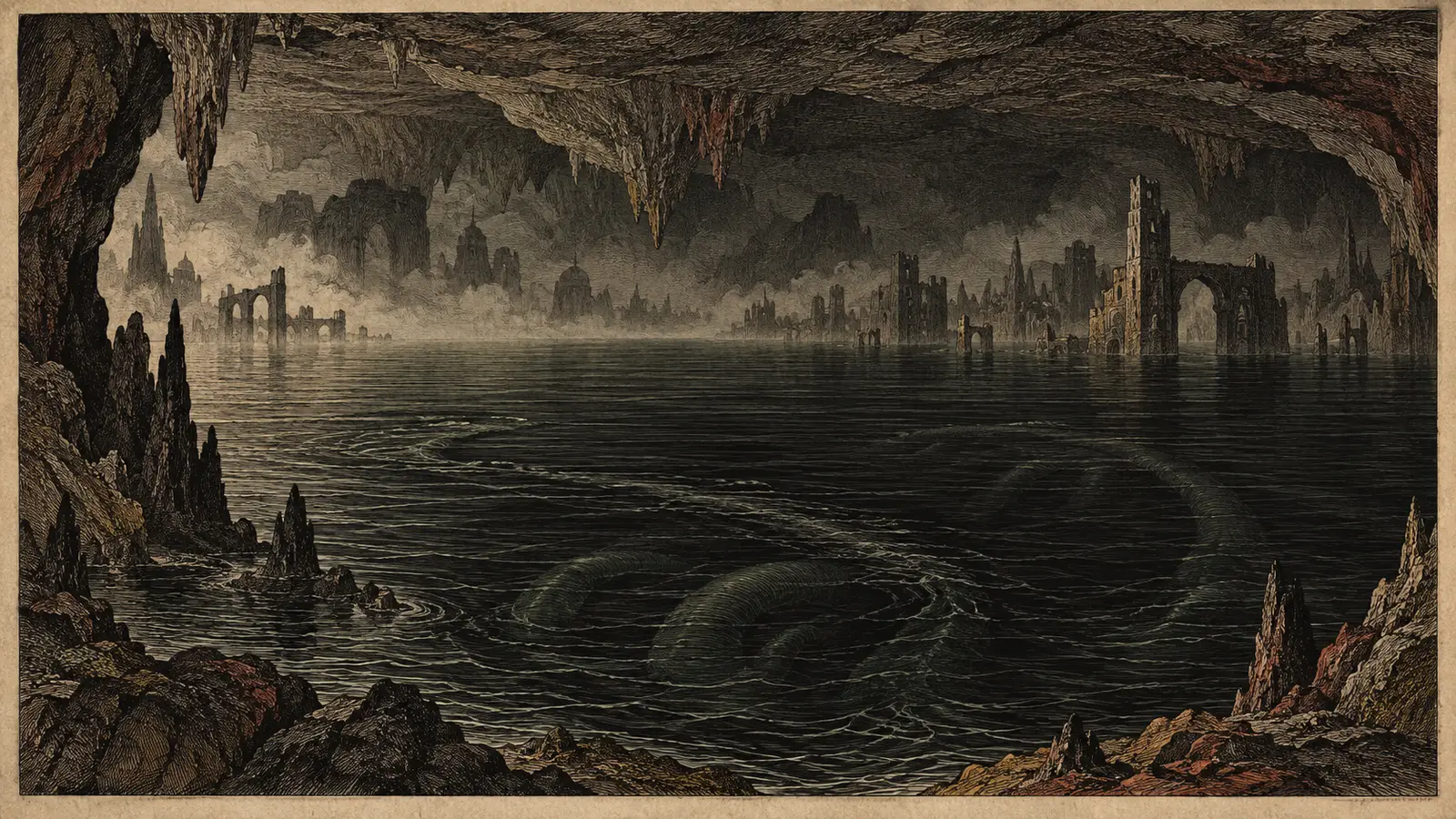
In 2008 the fourth edition arrived, and with it a new Forgotten Realms Campaign Guide, credited to Bruce R. Cordell, Chris Sims, Ed Greenwood and Philip Athans. It did something bold. It leapt the Realms forward almost a century, to the year 1479, and showed a world transformed by catastrophe. Among the things that had changed, it said, was the , which was now "more open to the surface."
To understand why, we have to go back to the catastrophe.
In the year 1385, , goddess of magic, was murdered. When she died, the Weave of magic that she held together tore, and a blue fire swept across the world. It's called the Spellplague. It changed creatures and ruined nations. Whole lands were swapped with lands from , a lost twin world of that had been separated from it at the dawn of time. Places that had always been solid simply came apart.
Under the western , a great southern grassland, the Underdark collapsed. The land fell in. Where a long cliff called the Landrise had once run, there was now a pit miles deep and as large as a country, stretching roughly from north to south, from the new land of Akanûl toward the borders of magical . It reached right down into the Underdark. People called it the Underchasm. Imagine standing on its rim and looking down into a wound in the world, with the old tunnels and caverns of the deep broken open to the sky for the first time in their long existence. Dragons and other flying monsters came to live in its upper reaches, circling in the open air over what had been the roofs of caves.
The drow who had lived down there were driven from their homes. They came against the dwarven city of Underhome, which the collapse had damaged too, and they drove the dwarves out, up to the surface. The deep world had been cracked open, and its peoples spilled out into the light.
Further north, beneath the city of Neverwinter, the Spellplague left a small poisoned region of its own, a little plagueland in the Underdark. Many years later, in 1451, the volcano Mount Hotenow erupted. Most of Neverwinter was destroyed, and where whole districts of the city had stood, a vast chasm opened. Out of it came the energies of the Spellplague, and the plague-changed creatures that had been living in the dark below. told the story of what woke the mountain in his 2010 novel Gauntlgrym: a great primordial of fire, bound for ages beneath the ancient dwarven city of that name.
And at the bottom of that chasm, in a lake, a cell of the Abolethic Sovereignty kept its hidden headquarters.
The Abolethic Sovereignty is the great nightmare of the fourth edition's deep. It's the dominion of the aboleths and their slaves, centred on a city called , ruled by an ancient aboleth called the Eldest. In a trilogy of novels by Bruce R. Cordell, Plague of Spells, City of Torment and Key of Stars, Xxiphu rises out of the deep and floats in the air above the Sea of Fallen Stars, and the Sovereignty schemes with an artifact called the Dreamheart. By the time of the new Realms, some sages had begun to suspect that the aboleths themselves had caused the Spellplague, though no one had ever proven it. It's a quietly unsettling thought, that the catastrophe of the age might have been planned in the dark by creatures far older than the gods' quarrels.
In the new Realms the drow came up toward the surface in another way, too. The Forgotten Realms Player's Guide, published alongside the campaign guide, made the drow a race any player could choose, as ordinary a choice as an elf or a dwarf.
A few years later, in 2011, came the Neverwinter Campaign Setting, and in August 2012 a new book about the City of Spiders, Menzoberranzan: City of Intrigue, by Brian R. James and Eric Menge. It could be used in any edition and any era, and it updated the city after the War of the Spider Queen and the Spellplague. It also looked at the lands around it in the Northdark: Mithral Hall above, the ruins of Hellgate Keep, and a place called the Dungeon of Death. That same year a player's book called Into the Unknown: The Dungeon Survival Handbook let heroes play deep gnomes, kobolds and goblins, and gave them themes fit for life below.
But the most striking thing fourth edition did for the Underdark wasn't in the Realms at all. In January 2010 it published a book called Underdark, written by Rob Heinsoo and Andy Collins with Brian R. James, Robin D. Laws and Matthew Sernett. It was meant for any world. And it gave the Underdark something it had never had before: a creation myth.
Here it is.
Long ago, at the beginning of things, before the great war between gods and primordials that the fourth edition called the Dawn War, there was a god named . He was a hunter. He hunted a monstrous primordial named , his rival, down into the depths of the world. Then the Dawn War broke out above, and the two of them were left behind, far below, still fighting in the dark.
Torog won. But as Gargash died, he cursed his killer. Torog's wounds would never heal, and he could never leave the Underdark.
So Torog tried to leave. Again and again, over ages, broken and bleeding, he dragged himself through the stone, trying to find a way out. And he never could. He only crawled. And where he crawled, he left tunnels. Over countless ages of failed escape, Torog carved out the Underdark itself, a web of writhing, connected passages, the trail of a wounded god who can't stop moving. He became the god of the Underdark, and the god of torture and imprisonment, because those are the things he knows. People call him the King that Crawls.
On the surface, parents warn their children about him. Be good, they say, or the King that Crawls may burrow up beneath your bed and drag you down into endless imprisonment.
It's a terrible and moving story. It makes the Underdark something like a scar, or a prison cell scratched out by its own prisoner. The book describes the substance of the deep as raw and unfinished, still mutating, as though creation never quite finished down here. Surface travellers slowly come to feel how alien it is. The paths Torog crawled still run through it, a network called Torog's Highway, and the highway takes a different form in each part of the deep. In the shallows it is godsdream. In the deeper places it is godsrage. In the fey depths it is godsblood, and in the shadow depths it is godsrock.
Because the book described four regions of the deep, each with its own peoples and terrain and places of interest.
The first was the Shallows, lying just below the caves and dungeons of the surface, the place of lesser monsters. There stands Forgehome, a dwarven city of mines, and there lies Maelbrathyr, a ruined city of the tieflings, called the Taken Place.
Below lie the Deeps, the home of the drow and the more powerful aberrations. And here the book came full circle. In the Deeps it detailed , with a full map of the city: the old city of the Vault of the Drow, from the very first year, drawn once more for a new generation.
The other two regions were something new. The fourth edition imagined worlds that echo our own: the , a bright and wild realm of fey magic, and the , a grey and sorrowful land where the dead pass. Each of them had its own Underdark.
The Feydark is the Underdark of the Feywild. It's more compact than ours, and far more alive. There are trees growing in its caverns, and plants, and reptiles and rodents and insects, life crowding the dark. Its tyrants are the fomorians, huge and cruel and twisted giants who rule over dark fey from underground kingdoms as large as any surface realm. One of them is Inbharann, a rich fomorian kingdom near the border where the Feydark meets the ordinary Underdark. There's also Drochdan, a kingdom of gnomes.
The Shadowdark lies beneath the Shadowfell, and it's colder and emptier, as you might expect beneath a land of the dead. Glimmer is there, the incunabulum City of Secrets, and Esarham, called the graveyard of demons. And there's Lathan, the River of Souls, flowing somewhere in the grey dark.
The book ended with a few pages on Torog himself, the King that Crawls, at the bottom of everything. People who read it at the time said it made the Underdark frightening again, each region worse than the last, with real reasons to go down.
Through all this, remained the great goddess of the drow, now a greater power, changed by everything that happened in the War of the Spider Queen, her web a realm of its own. And the fourth edition told the story of the drow's origin in a simpler, more mythic way than the history of the Crown Wars. Lolth, it said, tried to murder , the great god of the elves. That act split the elven people. The drow are the descendants of the elves who followed her into exile underground.
The world had broken. In the next edition, it would be put back together, and the Underdark would be filled with demons.
Chapter IX
Fifth edition: the demon lords in the deep
The fifth edition came in 2014. Within a year, it went down.
In May 2015 Wizards of the Coast announced a storyline called Rage of Demons. It would run across several things at once: novels, video games and a great tabletop adventure. The adventure came out in September 2015, and it was called Out of the Abyss.
It was written by Green Ronin on commission from Wizards, and its lead designers were Christopher Perkins and Adam Lee. They wanted the itself to be the enemy, the darkness and hunger and madness of the place as much as any monster. It's a long campaign, one of the longest the fifth edition ever published, taking heroes from their very first adventures to great power.
By now the Realms had passed through another upheaval, called the Second Sundering, and in its aftermath much of what the Spellplague broke was mended. The land was restored to its older shape. The great Underchasm, that country-sized wound beneath the , closed, and the world above looked much as it once had. So the story of Out of the Abyss takes place in a familiar Underdark again, late in the fifteenth century of the Realms' reckoning.
It begins in , with .
Gromph is Archmage of the city, master of , keeper of 's light. He is perhaps the most powerful male drow wizard in all the Realms. And he's tired of being nothing more than a tool of the priestesses. He feels subjugated, slighted, betrayed by and her servants. So he casts a spell, a great working that draws on the faerzress, the strange radiation of the Underdark. The spell tears open doors to the Abyss.
What comes through surprises even him.
Eight demon lords pass through into the Underdark. There's , the Horned King, lord of minotaurs, and , the two-headed Prince of Demons, whose long road from a copyist's slip to the Abyss we followed in an earlier episode. There's Fraz-Urb'luu, the Prince of Deception, and , the Dark Prince, beautiful and cruel. is the Faceless Lord, a vast heap of ooze, and is the Prince of Undeath. is the Gnoll Lord, the Beast of Butchery, and is the Demon Queen of Fungi.
Lolth does not come. She stays behind in the Abyss.
From that moment the madness that already haunted the deep grows worse. Demons stalk the tunnels, cults spring up, and peoples who had lived uneasily alongside one another for centuries begin to break.
Christopher Perkins explained the absence of the Spider Queen before the adventure came out. Lolth isn't among the rampaging demon lords, he said, because the whole thing is her scheme. In the story, her plan is revealed slowly. With all the other great lords of the Abyss pulled out of it and loosed into the Underdark, the Abyss is far easier for her to rule. She used Gromph as her pawn. And she used the Underdark's own magic to do something else: ordinarily a demon slain outside the Abyss is barred from leaving it again for a hundred years, but here, so long as the demons stay in the Underdark, that rule is undone. They can't easily be sent home. They'll stay and ravage the deep while the Spider Queen sits in the emptied Abyss.
The heroes know none of this at first. They know only that they've woken in a cage.
They're prisoners at Velkynvelve, a drow outpost commanded by a cruel priestess, Ilvara , who keeps order with a scourge in her hand. They're bound for slavery, or worse. And they aren't alone. The other prisoners in those cages are one of the best-loved casts in any adventure.
Eldeth Feldrun is a shield dwarf scout who has memorized every detail of the outpost and knows every drow guard by name, and she wants nothing more than to escape and get home to . Prince Derendil is a quaggoth, a great shaggy white beast of the deep, who insists he is really an elf, a gold elf prince of a kingdom called Nelrindenvane in the High Forest, cursed into this shape by an evil wizard who stole his crown. Sarith Kzekarit is a drow accused of a murder he can't remember, because a fungus is growing inside his mind. Stool is a myconid sprout, a little mushroom child taken far from home, who speaks through puffs of spores. Topsy and Turvy are deep gnome twins with a secret: both are novice wererats, terrified of being found out. Turvy mutters darkly to himself, and his sister translates.
Jimjar is a deep gnome who'll bet on anything. Ront is an orc, a bully. Shuushar the Awakened is a kuo-toa, but a calm one. He knows his people are known for madness, and he says he's spent his whole life meditating to rise above it. And then there's Buppido, a cheerful, chatty derro who urges everyone to stick together, and who explains away his every misfortune as part of a divine plan. Buppido is secretly a murderer.
They escape together, out into the wild dark, and the journey begins.
Their road runs along the , those black and endless waters, to a kuo-toa village called Sloobludop on its shore. Something has happened there. One faction of the kuo-toa had a vision in the Darklake of a vast being rising from the waters, and they've begun to worship it under a name of their own making: Leemooggoogoon. The name is a garbled attempt at Demogorgon. And the vision was true. Players remember the moment well: the kuo-toa chanting that strange, burbling name, louder and louder, and the waters of the Darklake heaving, and the Prince of Demons rising out of them, two-headed and enormous, and Sloobludop breaking apart. The heroes aren't meant to fight him. They're meant to run, and they do.
West around the Darklake lies , the city of the deep gnomes. It's troubled by a mad figure called the Pudding King, who leads oozes and has fallen under the sway of Juiblex. Deep gnome factions may hire the heroes to deal with him.
East around the Darklake lies , the City of Blades. Each city is about twenty days' walk from where the heroes began. Gracklstugh hides one of the strangest sights in the deep: a red dragon named , called the Wyrmsmith. The duergar use him as a living furnace. His fiery breath heats their forges and tempers their famous steel, and they pay him in treasure, and he believes himself an honoured partner. He doesn't understand that he's a slave. He's grown fat on his tribute, lounging in the heat of the forges, a dragon who has mistaken a gilded cage for a palace.
Then there's Neverlight Grove.
Neverlight Grove is a colony of myconids, the fungus folk, and in ordinary times it's one of the gentlest places in the deep. Streams flow through it, and the myconids give shelter and safe passage to travellers who come in peace. About a hundred and fifty myconids and their spore servants live there, and their days run in a slow, even cycle: eight hours working the fungus farms, eight hours of melding, when they join their minds together in a shared telepathic dream, and eight hours of rest. Small circles of myconids are led by circle leaders, and the whole colony by sovereigns.
But Zuggtmoy has come to Neverlight Grove. The Demon Queen of Fungi has enthralled two of its sovereigns, Phylo and Yestabrod, and the colony has split, with the corrupted on one side and Sovereign Basidia and the faithful on the other. Zuggtmoy has taken up residence in Yggmorgus, a giant towering mushroom.
And she's planning a wedding.
Her groom is the , the Great Fungus, the vast single organism spread for hundreds of square miles through the upper Underdark beneath the High Forest. The Araumycos is an unwilling groom, and there's a grotesque courtship, with a rehearsal dinner held in Neverlight Grove, the wedding itself to be held at the Araumycos. Underneath the trappings of a marriage it's a ritual of demonic domination. If it succeeds, Zuggtmoy will hold an enormous part of the Underdark in her grip. And Juiblex, the Faceless Lord, would very much like to simply eat the Araumycos instead.
The first half of the adventure ends when the heroes finally climb out into the daylight.
The second half sends them back down.
King , now ruler of Gauntlgrym, hears of what they've survived and calls them to a feast in the Vault of Kings. Gathered there are representatives of all the great factions of the North: the Harpers, the Order of the Gauntlet, the Emerald Enclave, the Lords' Alliance, and even the Zhentarim. Demons are loose beneath their feet. Madness is rising toward the surface. And so the heroes are given a war band and sent back into the dark to stop the demon lords before it's too late.
Their unlikely ally is Vizeran DeVir, an exiled drow archmage, of the very house that 's mother helped destroy on the day he was born. Vizeran wants revenge on Gromph and on Lolth both. He understands what the Spider Queen has done, and he proposes a ritual. It will create a dark heart, a lure that plays on the demon lords' hunger for power and draws them together, so that they turn on one another. The demon lords will fight until only weakened survivors remain, and then the heroes can finish them, or banish them.
Before the end Demogorgon goes rampaging through Menzoberranzan itself, and the City of Spiders feels what it's like to be on the other side of cruelty. And in the end, if the heroes are clever and brave and lucky, they set the lords of the Abyss against one another, and defeat or drive out the wounded ones that are left.
The fifth edition went on deepening the peoples of the dark in other books, too. In 2018, Mordenkainen's Tome of Foes retold the story of how the elves were sundered, the third telling in our long journey, each a little different. In this version the elves were born from drops of 's blood, shed in the god's great battle with , god of the orcs. Lolth was one of the , the elven gods. Elves and their gods were once changeable beings, flowing from one form to another, but Lolth took a single fixed shape, and she urged the others to do the same, and that quarrel divided the elves. At last she tried to kill Corellon, and failed. Corellon cast all the elves out of , the elven heaven, into the .
The same book told the history of the duergar. Long ago they were dwarves, enslaved by a planar empire of mind flayers, and the illithids changed them, grafting psionic powers onto their minds. The duergar rose against their masters under their god Laduguer, and threw them off. But the revolt had a cost. In that uprising the other dwarven gods were purged from their souls, and the grey dwarves have been a people apart ever since. The book also let players be deep gnomes, the svirfneblin, for the first time in this edition.
The Underdark had never been richer in stories. And meanwhile, it had been glowing on screens for more than twenty years.
Chapter X
Into the screen
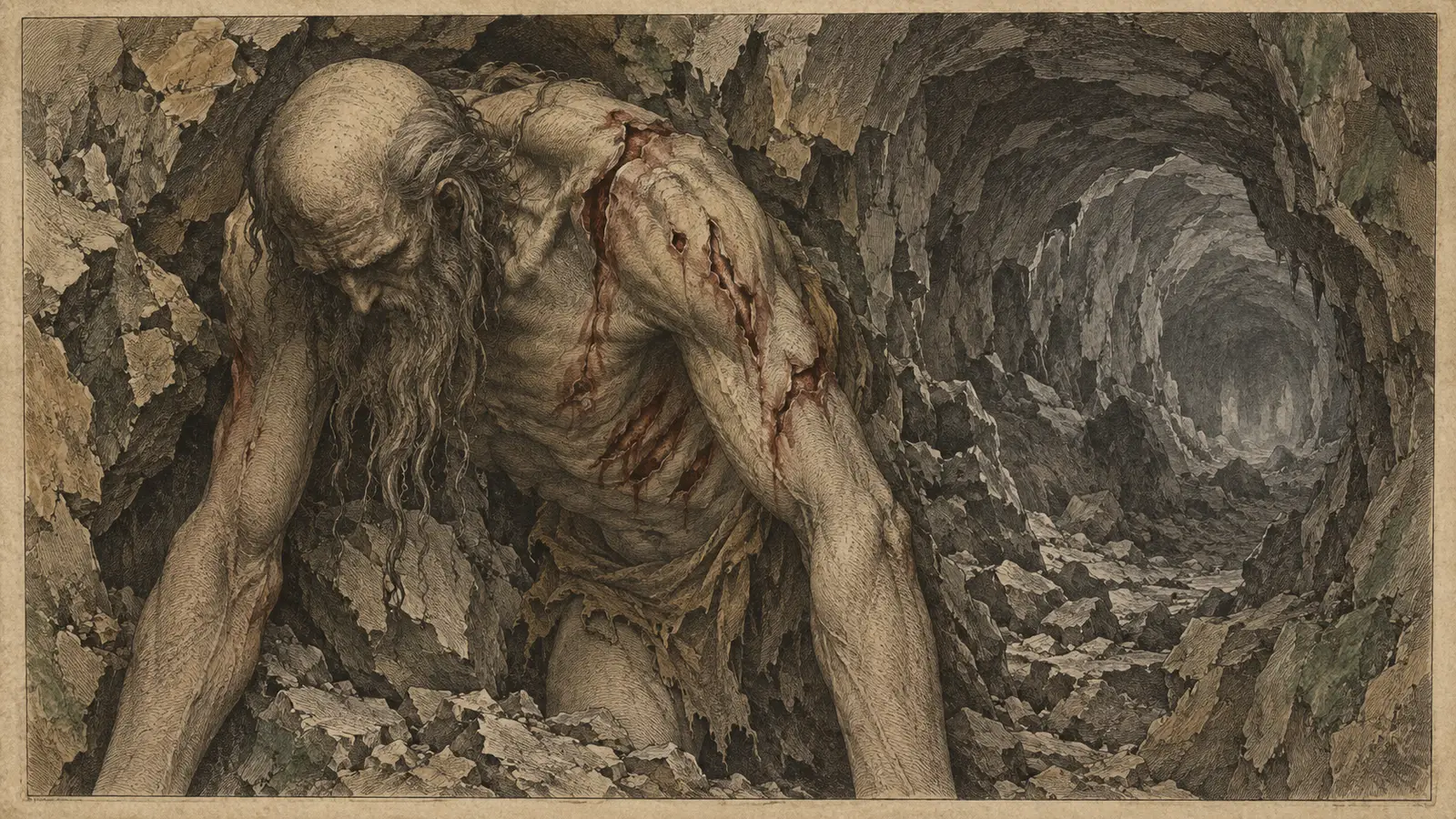
Before the ever had a city on screen, it had a trapdoor.
In 1991 Westwood Associates and the publisher SSI released Eye of the Beholder, a game in which you look out through the eyes of your party, step by step, through grid-lined corridors. The lords of Waterdeep hire four adventurers to investigate an evil rising beneath the city. The party goes down into the sewers, and the way out collapses behind them. They've been sealed in by , a beholder who has made a stronghold beneath the city. There's nothing for it but to go down, through dwarven outposts, drow caverns and abandoned temples, level by level, until they reach the beholder's chamber at the bottom. It's the old idea from 1974, the underworld that keeps going, given pictures and sound.
In 1994 SSI and DreamForge made the first game named for the City of Spiders: Menzoberranzan. It begins in a surface village where adventurers are staying. Drow raiders, hunting their renegade kinsman , attack the village, destroy it and carry off villagers as hostages. The player makes two heroes and, with Drizzt among their companions, goes down into the Underdark to bring the hostages home. The road ends in itself. Along the way other companions may join, among them a drow fighter, a gnome thief, and, rather delightfully, a bird who is a fighter, a thief and a mage all at once. People remember it as a handsome game with a great deal of fighting.
In 2000, BioWare's Baldur's Gate II: Shadows of Amn took players down for one of its most memorable chapters. Chasing the sorcerer and the vampire Bodhi, the heroes find themselves in the Underdark, near a drow city called , with its Temple of . Around it live mind flayers, beholders and kuo-toa, and the svirfneblin. Three deep gnomes tell the party that Irenicus and Bodhi have gone into the drow city, and Goldander Blackenrock of the svirfneblin settlement offers to help them get in, in exchange for a favour.
The key to the city is a silver dragon named Adalon. Irenicus and Bodhi have stolen her eggs. She casts an illusion over the party that makes them look like drow, and so the heroes walk into Ust Natha in disguise, among the dark elves, taking orders from priestesses, trying not to give themselves away. Some of the tasks the drow set them are terrible, among them an order to kill svirfneblin. It's the old intrigue of the Vault, the masquerade inside the dark elves' city, brought to life.
In December 2003 came Neverwinter Nights: Hordes of the Underdark, a long campaign for very powerful characters, set in Waterdeep, in the great dungeon of Undermountain beneath it, and in the Underdark below that. The heroes must save Waterdeep from an ancient evil buried in the deep. At the end the archdevil tries to turn their own allies against them. It let characters grow far beyond their old limits, to the very edge of godhood.
In 2012 the online world of Dungeons & Dragons Online moved into the Realms with an expansion called Menace of the Underdark. Players defended the town of Eveningstar in the King's Forest against Lolth's drow, then went down into the Underdark to a city called Sschindylryn, and at last into the itself, where Lolth waited as the final foe of a great twelve-player battle.
The Rage of Demons of 2015 reached the screen too. 's novel Archmage, published that September, opened the story. In it 's spell turns against him, and demons spill into the Underdark. In November the online game Neverwinter opened its Underdark module, with a questline written by Salvatore himself. Players went down with Drizzt and , explored the drow realms and Menzoberranzan, and stood against in a ten-player battle. The game Sword Coast Legends, released that same year, took its players deep into the Underdark, with Drizzt added after its launch, and in 2016 it opened a full expansion, also called Rage of Demons.
Drizzt himself kept stepping onto screens. He has appeared in the Baldur's Gate games and in Forgotten Realms: Demon Stone. In 2021 he walked the frozen tundra of Icewind Dale with his old friends in Dark Alliance, far from the dark of his youth.
Then, in August 2023, came Baldur's Gate 3.
Larian Studios' great game sends its players into the Underdark in its first act. It's a region of caverns and tunnels where no sunlight ever reaches, filled with dangerous creatures and giant mushrooms. One way down runs through a ruined dwarven village on the surface called the Decrepit Village. Below, the dark opens up, and it's alive with soft fungal light.
Ebonlake Grotto is a colony of myconids. They share one mind, joined to their Sovereign, a myconid called Spaw, who has a rival sovereign named Glut. There's a ruined Outpost, built by followers of the moon goddess, with an old defence mechanism that still strikes at anyone approaching its front door. There's an arcane tower in a far corner. And far to the west lies Dread Hollow, where the Sussur Tree grows, whose bark and blooms quiet magic itself.
Near the Selûnite Outpost, set in stone, is a sword named Phalar Aluve. It sings. On it, in drow script that looks freshly carved, are the words: "Though I have to leave you, I will dance forever in 's Light." It's a small thing in an enormous game, and it carries the whole history of the Dark Maiden, of the drow who went up to dance under the moon.
From a little beach in the Underdark, a skiff carries the party across the black water of the Ebonlake to , the ruins of an ancient underground fortress built around a great Adamantine Forge. The forge is guarded by an adamantine golem named Grym. To defeat him, the heroes flood the arena with lava, and while he stands in the heat they strike him with the great forge hammer. Then they can use the forge to turn mithral ore into adamantine. When the party arrives, duergar are camped in Grymforge as an outpost of a cult called the Absolute, some of them swayed by a drow named Nere, one of the cult's True Souls.
The game has drow of both kinds. There are drow sworn to Lolth, and drow who follow the , the old elven gods. And the game was received with an affection few games ever know. It won Game of the Year at The Game Awards in 2023, among several honours that night. For millions of players who had never opened a rulebook, the Underdark of mushroom light and black lakes and singing swords was their first visit to the world below.
Chapter XI
Other worlds, other depths
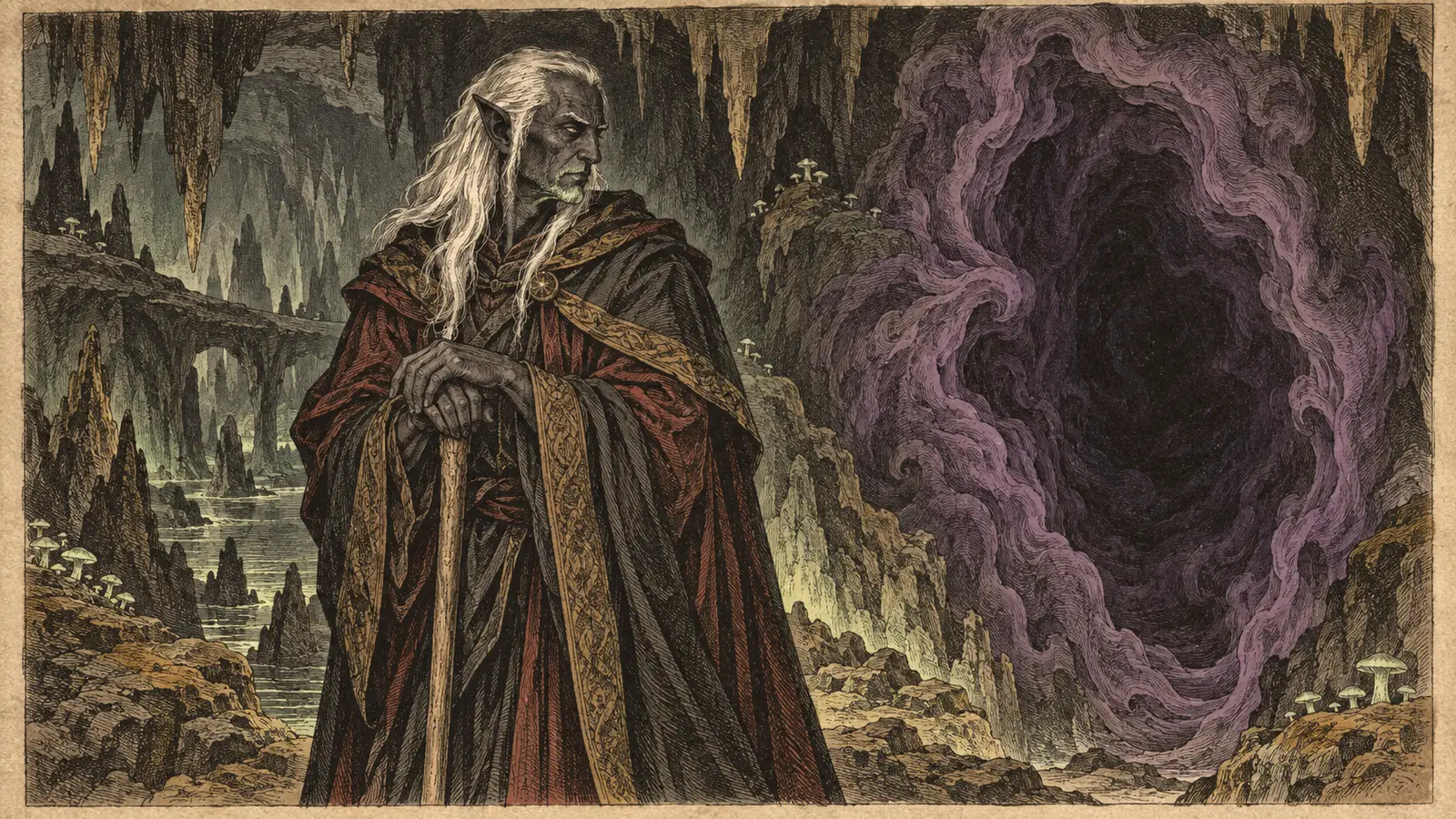
The belongs most famously to the Forgotten Realms and to Greyhawk. But nearly every world the game has visited has something under it. Let's walk through a few of those other depths, the cousins and descendants of the deep world.
In Greyhawk, where it all began, the world beneath has its own names. It's called the Underoerth, or Deepearth, though Greyhawk folk use the word Underdark too. It's the land of the Vault, and of under its plum moon.
In , a world created by Keith Baker, the deep world is something older and stranger: the body of a god.
Eberron's creation myth tells of three great dragons at the beginning of all things, the Progenitors. was the Dragon Above. Eberron was the Dragon Between. was the Dragon Below. Together they made the planes of existence, and the last thing they made was the material world. Then Khyber turned on Siberys and tore her body apart. In grief and anger their sibling Eberron wrapped Khyber in coils and held it fast, imprisoned.
The three bodies became the three parts of the world. The shattered body of Siberys became a great glittering ring that circles the sky, the source of magic. Eberron became the surface, the land of living things. And Khyber became the underworld, which is still straining against its bonds. From Khyber come fiends and aberrations, born out of the deep. Even the crystals of the world remember the three dragons. Each part of the world produces its own kind of dragonshard, a crystal charged with magic, and Khyber shards come from below.
The upper reaches of Khyber are ordinary enough: stone and soil, natural caverns, and the ruins of the ancient goblin Empire of Dhakaan and of old dwarven holds. But the further down you go, the more you find pockets of other places, demiplanes sealed inside the dark, and in them, imprisoned fiends and the daelkyr.
The daelkyr are lords of , the plane of madness. About nine thousand years ago Xoriat drew close to the world, and the daelkyr came through and invaded the continent of . They battered the Empire and laid waste to most of the west. The last of the Dhakaani and the druids called the Gatekeepers drove them back, and sealed them and their twisted creations beneath the earth, in Khyber. Cults of the Dragon Below still worship Khyber and the things it hides. One daelkyr, Belashyrra, waits in a place called the Citadel of Lidless Eyes, and commands mind flayers, aboleths and beholders.
And there's the Realm Below. Early in the Last War, the great war of Eberron's recent past, dwarf miners of the Mror Holds broke into vast halls deep under the Ironroot Mountains, the remains of an ancient dwarven empire called Sol Udar. Digging deeper still, they woke Dyrrn the Corruptor, a daelkyr imprisoned in a demiplane that touches the deepest reaches of Sol Udar. Out of the lower galleries came hordes of twisted things, mind flayers and derro and creatures with no names. For decades since, the dwarves have held the upper galleries, and the aberrations the deep. Baker returned to these depths in his book Exploring Eberron, and the old myth of the three dragons also lies at the heart of a video game he wrote the story for, Dragonshard.
In the world of there's a deep world that is something else again: a sunlit one. In 1990 TSR published the Hollow World boxed set by Aaron Allston, and with it, Mystara turned out to be hollow, exactly the way John Cleves once dreamed our own earth might be.
Inside, at the world's centre, hangs an eternal red sun. It never sets. Floating continents drift slowly beneath it, and the shadows they cast are the only night the Hollow World knows. On the inner surface lie four great continents, Aercial, Iciria, Jomphur and Suridal. The Hollow World was found long ago by an Immortal named Ka the Preserver, who in his first life, ages before, was a carnosaur, a great dinosaur. Ka made the inner world a refuge for creatures on the edge of extinction, and with other Immortals, Ixion and Ordana and Korotiku, he turned it into a preserve for cultures dying out on the outer surface.
It's a living museum. A magic called the Spell of Preservation holds its cultures in place, so that a people of the stone age stay forever in the stone age and never move on to bronze. Many spells from the outer world fail there, and travellers from the surface find their magic badly weakened. Its peoples include Azcans and Oltecs, Nithians and Milenians, Kogolor dwarves and Krugel orcs. The Azcans and Oltecs live side by side, swinging between war and trade for centuries. And among them are the , shadow elves, who came down into the Hollow World long ago, inspired by an Immortal named Atzanteotl, and fought the Kogolor dwarves, and were driven off to settle in caverns of their own.
Mystara has its dark elves of a gentler kind, too. That same year, in The Shadow Elves by Carl Sargent and Gary Thomas, we meet the elves who live in caverns beneath a rugged region called the Broken Lands. Their kingdom runs for countless miles through tunnels and caves they have reshaped over thousands of years. Some tunnels they have flooded, so that boats can glide between their four great cities: the City of the Stars, Alfmyr, Losetrel and New Grunland. Fungal forests fill the larger caverns, some natural, some grown by magic, and the shadow elves harvest them for food. Their shamans give their lives to the service of an Immortal called Rafiel. They are not 's people. They're simply elves who live underground, and have made a home of it.
Beyond the game's own worlds, its deep places have children. In Pathfinder's world of , made by Paizo, the world below is called the Darklands, and it falls into three layers. Nar-Voth is the uppermost, the wilderness of the Darklands, made of cave networks joined by long winding tunnels. Below it lies Sekamina, the largest, whose warrens span continents, with great underground rivers and lakes. Deepest of all is Orv.
Orv holds the Vaults. They are dozens of immense enchanted chambers, thousands of feet high and large enough to hold nations. Some contain underground oceans. Some contain jungles, growing beneath artificial suns. Some hold mountain ranges, or deserts, or whole warring kingdoms. They are thought to be the work of an ancient race known only as the Vault Keepers, who seem to have vanished and left nothing behind but the Vaults themselves. Their names are lovely to hear in the dark: the Sightless Sea, by far the largest, and the Midnight Mountains, the Crystal Womb, the Land of Black Blood, the Black Desert. A book called Into the Darklands laid them out in 2008.
The Darklands once had drow, and the story of how they lost them is one of the more curious tales in any setting. In Golarion's first telling, the drow were elves who refused to leave the world before a great cataclysm called Earthfall, and hid in the Darklands instead, and were twisted by the evil stirring there. Later the world's makers set the drow aside. And they did it within the world itself. A scholar of that world named Koriah Azmeren revised her writings and declared that everything she had written about the drow had been a fabrication, meant to hide a greater threat. The elves who went underground to escape Earthfall were now someone else: the Ayindilar, the cavern elves. It's an elegant way to change a world, letting a character in it take back her words.
In the world of , known to many from the show Critical Role, the deep beneath the continent of is largely held by the Kryn Dynasty. These drow broke from Lolth long ago, and their Aurora Watch commands purple worms, the great burrowing monsters of the deep, controlled by magic. In Exandria's lore, Lolth's blood pooled in the dark caverns beneath the world, and the drow who stayed loyal to her drank it and became driders, half drow and half spider.
And on the world of , in Dragonlance, there's , the great underground kingdom of the dwarves, carved inside a mountain. It isn't a dark world of horrors, but it is a whole realm under the stone, with its own clans and politics and long history, and heroes who walk its halls feel the same weight of rock overhead.
So there are many underworlds. One is a dragon's body. One has a red sun at its heart. Some hold oceans and jungles, and some hold an elf who wrote the drow out of her history. But they all share the old feeling we started with. There's another world underneath this one, and it's waiting.
Chapter XII
The Underdark at the table
Now let's think about what it's like to actually go there, sitting around a table with dice and friends, and a map that's mostly dark.
The very first time the game put rules to the deep, in the 1986 Dungeoneer's Survival Guide, it tried to capture every hardship. There were rules for moving through cramped passages, for climbing and falling, for breathing when the air grows thin. There were rules for the cold that settles into your bones underground, for casting spells in darkness, for digging through rock. They could be heavy. But they were trying to say something true. The isn't a dungeon you leave at the end of the night. It's a country, and travel through it is hard.
The great guides to the Realms Underdark gave players a sense of depth they could feel. You start in the Upperdark, the first few miles down, where surface folk and deep folk mingle and you might still meet an orc or a goblin who knows the way up. You go down into the Middledark, among the great cities. And you know, the whole time, that beneath you lies the Lowerdark, where even the natives won't go.
The third edition changed things in another way. It let you be from there. You could sit down at the table as a deep gnome from or a grey dwarf from , or as a drow. For the first time, the Underdark was somebody's home in the party. Its darkness was familiar to someone, and that someone might be you.
Nothing captured the feeling of the deep at the table quite like Out of the Abyss. It begins with an extraordinary gap in power. The heroes are just beginning, newly freed from a drow cage, with nothing but what they can scavenge. And the demon lords who walk the dark are among the mightiest beings in the game. When rises from the at Sloobludop, there's no question of fighting. You run. You learn very quickly that the Underdark is not something you conquer. It's something you survive.
Travel slows to a crawl. Movement in the deep is far slower than across open country, and the adventure has its own table of travel paces. Move quickly and you notice less, and you can't forage at all as you go. Move slowly and you might gather food, or creep past danger unseen. Every day matters. Food matters, and water, and how much you can carry. Foraging is possible, but never certain. Each day the referee rolls for what you meet, while travelling and while resting, and some of those meetings are creatures and some are the land itself. You might come upon the Silken Paths, great networks of spiderweb strung through the tunnels. You might find a region of faerzress, where quartz in the walls gives off a faint glow. You might find a patch of fire lichen.
Hunger becomes part of the story, and so the fungi of the Underdark become old friends. You learn their names the way a traveller in a strange land learns the local food.
There's barrelstalk, a big cask-shaped fungus you can tap for fresh water. There's ripplebark, a shelf fungus that looks unappetizingly like a mass of rotting flesh but is perfectly edible. Trillimac grows four or five feet tall with a broad grey-green cap. The cap is leathery, and it can be cut and cleaned to make maps and hats and even scrolls, and the stalk can be soaked and dried into a kind of bread. Waterorb grows in shallow water, round and bulbous, and when a ripe one is squeezed like a sponge it gives you about a gallon of drinkable water and a pound of chewy, tasteless food. Nightlight is a tall tube-shaped mushroom, five to ten feet high, that glows, casting real light around it in the dark, a little lamp grown out of the ground.
And there's zurkhwood. Zurkhwood is a giant mushroom, thirty or forty feet tall. Its large spores can be eaten, but what makes it precious is its stalk, which is hard and woody. Zurkhwood is the timber of the Underdark. It's what the deep peoples build with, and carve, and burn. A whole civilization's furniture comes from mushrooms.
Then there's madness.
In Out of the Abyss, madness creeps in as the heroes go deeper. It can come from looking upon a demon lord. It can come from lingering too long in faerzress. It can come from the horrors of the deep, like the dreadful wedding feast at Neverlight Grove. Each time a hero's mind gives way, the madness climbs a step. At first it's brief, lasting only minutes. Then it lasts hours. At last it becomes lasting, staying until it's cured by powerful magic. And the madness often starts small. A hero begins biting her nails. Another starts to mutter. Over long weeks in the dark these little tics grow into deeper flaws, new parts of a character that weren't there when they first woke in the cage. Players who ran the campaign tell stories of these madnesses, some of them sad and some of them very funny, the way people tell stories of a long, hard journey once they're safely home.
And always there are the peoples of the deep. Some are dangerous, and some are kind, and you rarely know which until you've spoken. The drow are proud and many-sided, and their cities are intricate as webs. The duergar are dour and disciplined, their forges always burning. The svirfneblin are often the friendliest faces in the deep, most of them good-hearted, careful and wise to the dark, and over and over they turn out to be the travellers' allies. The kuo-toa are strange and unsteady of mind. Hook horrors click their great hooked arms in the deepest places, using the echoes to see. And the myconids, the fungus folk, are mostly gentle, sharing their dreams in their quiet groves, offering shelter to those who come in peace.
What the Underdark gives a table, in the end, is a long, slow kind of story. It's a story about the road home, about the friends you meet in cages and lose along the way, and about a world that is enormous and indifferent, full of wonders and horrors in about equal measure.
Chapter XIII
Out of the dark and into the wider world
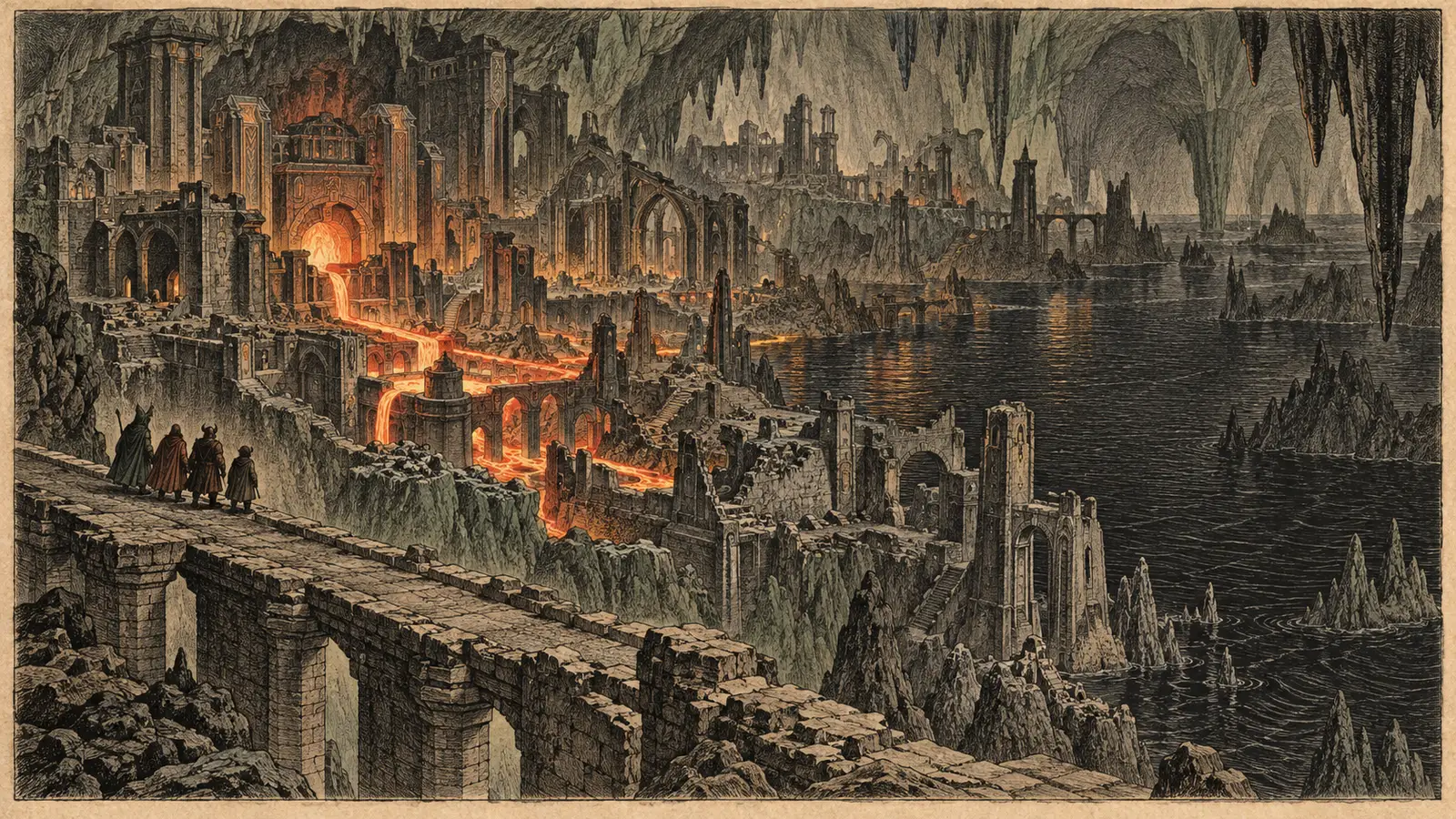
Of all the things that came up out of the into the wider world, the first and greatest was .
The sidekick who wasn't in the outline became the hero of a long series of novels, The Legend of Drizzt, that has run for decades. Every one of the Drizzt novels has made the New York Times bestseller list, and 's books have sold more than ten million copies. His publishers have called Drizzt "one of the fantasy genre's most enduring heroes," and his story a journey "from the shadows of the Underdark to the light of the surface." That's a fair description. His story begins in a city of stone, under the false sun of , and it reaches the real sun. Some of the novels have been retold as graphic novels, too.
Through Drizzt, and through all the books behind him, the game's drow quietly became the dark elves of modern fantasy. When people imagine dark elves now, they often imagine the drow of the game: a people who live underground, ruled by women, serving a spider goddess, prizing cunning and domination. took a word from an old dictionary and built a whole people out of it, and now that people is the picture many readers carry. Drizzt became just as influential in his own way, the model of the good dark elf who stands apart from his people.
That picture changed over time, as the game's makers looked again at their own stories. Later books moved away from describing the drow as always evil, and away from assigning a fixed nature to whole peoples. On June 17, 2020, Wizards of the Coast published a statement called "Diversity and Dungeons & Dragons." It acknowledged that orcs and drow had been described as monstrous and evil in ways "painfully reminiscent of how real-world ethnic groups have been and continue to be denigrated," and it pointed to books like Eberron: Rising from the Last War and Explorer's Guide to Wildemount, where those peoples are "just as morally and culturally complex as other peoples." In those books, and in many after, there are drow who have never knelt to .
The creatures of the deep found their way into the wider culture too. The mind flayer, who has appeared in every edition of the game and is bound to the Underdark, lent its name to the great villain of the television show Stranger Things, beginning with its second season in 2017. In the show, the Mind Flayer is a vast, spider-like shadow that seeks to control other minds, and its children take the name of the monster they know from their own game.
In 2023 the Underdark appeared on cinema screens in Dungeons & Dragons: Honor Among Thieves. In the film, a paladin named Xenk Yendar, played by Page, has hidden a powerful artifact, the Helm of Disjunction, deep in the Underdark. Xenk is a man who fled after Szass Tam turned the into an army of the dead. He guides the heroes down through the dark to the helm. There they're attacked by Thayan assassins, and they have to flee from himself, the fat red dragon of , now lumbering through the tunnels after them. On screen the Underdark glows with magma and jagged rock, a volcanic version of the deep, and people who know the game's darker, quieter caverns smiled at how much more of it there is to show. Drizzt had once been planned to appear in the film, and Xenk took his place.
The deep has passed through other games, too. In 2016 the board game Tyrants of the Underdark, designed by Peter Lee and Rodney Thompson, let two to four players each lead a drow house, gathering monsters and cultists and demons into their service and spreading their influence through places like and . It's the eighteen-house poster from the 1992 boxed set, made into a contest around a table. In 2021 the card game Magic: The Gathering visited the Forgotten Realms, and Drizzt arrived with his twin blades, bringing with him as he entered play. Lolth came too.
And then there was Baldur's Gate 3, which became the biggest game of its year, and carried the Underdark's mushroom light and black lakes to more people than any book ever had. For a whole new generation the first descent into the deep began on a beach by the Ebonlake, with a skiff waiting in the dark water.
There have been dreams of more. A live-action series set in the Forgotten Realms was announced for Netflix in early 2025, and many fans hoped it might bring Drizzt to the screen at last. In September 2026, Netflix said that series was no longer in development, and announced a different one instead, set in the misty land of Ravenloft. For now, Drizzt's walk out of the dark remains on the page, at the table and in the games.
Chapter XIV
The deep world today
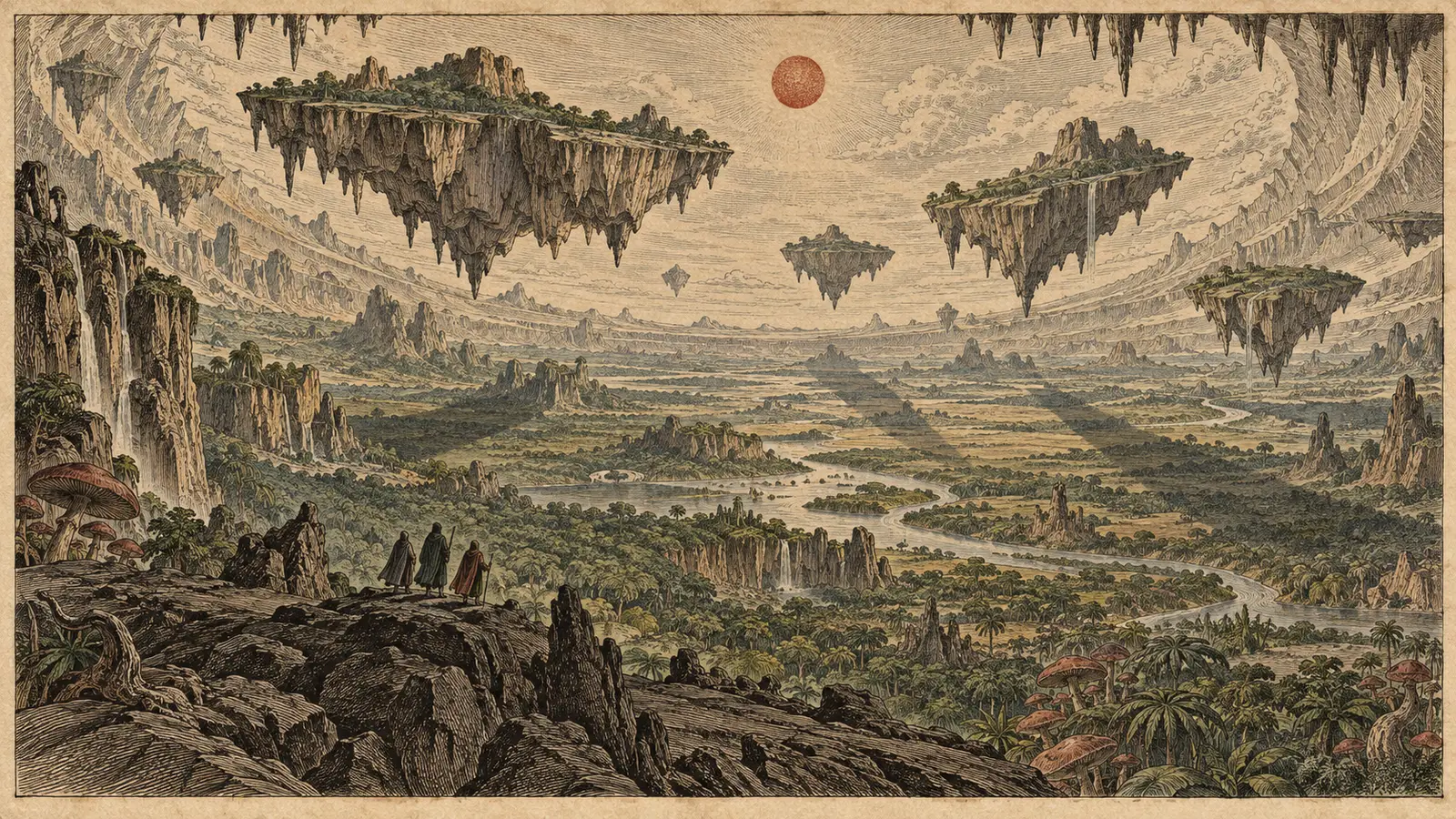
So where does the stand now, as we come up toward the present?
In 2024 and 2025, the core books of the game were revised: a new Player's Handbook, a new Dungeon Master's Guide and a new Monster Manual. They're still the fifth edition, able to sit beside the older books, and none has its own chapter on the Underdark. But each of them changed the deep world a little.
The drow themselves are described differently now. The official text reads: "As a drow, you are infused with the magic of the Underdark, an underground realm of wonders and horrors rarely seen on the surface above. You are at home in shadows and, thanks to your innate magic, learn to conjure forth both light and darkness. Your kin tend to have stark white hair and grayish skin of many hues." It first appeared as an update to the older Player's Handbook, and the new one carries the same spirit.
The way the lore now tells it, 's grip is a cult, not the nature of a people. Her cult has corrupted some of the oldest drow cities, above all on , the world of Greyhawk, and on , the world of the Forgotten Realms. Other worlds, and among them, escaped it. And drow heroes, the new text says, "stand on the front lines in the war against it." So and are cities held by the Spider Queen's cult, and the drow who live there are its subjects, and sometimes its prisoners.
The new Dungeon Master's Guide uses Greyhawk as its example world, with maps of the old lands of the and the City of Greyhawk. And one cover of that book, sold in hobby shops, shows Lolth herself, the Spider Queen, looking out from the place where she first appeared, nearly half a century before.
The new Monster Manual has no drow in it at all. The drow are a people, it explains, like humans and dwarves and halflings, none of whom have monster entries. The creatures of the deep have changed too. Aberrations, the mind flayers and beholders and aboleths and stranger things, are now all tied to the Far Realm, the alien beyond outside the ordinary planes, either coming from it or changed by it. The mind flayers stay truly alien, apart from the rare few who have escaped their elder brain, and referees are asked to keep them that way, never letting one become a human in a monster suit. And the beholders have a lovely, eerie new piece of lore. They are products of their own dreams. A beholder sleeping in its lair may dream another beholder into being, or spawn other aberrations from its nightmares. Somewhere far below, in a sealed chamber, a great eye is closed in sleep, and the dark around it is slowly filling with what it dreams.
In November 2025 the Forgotten Realms returned in two books, Heroes of Faerûn for players and Adventures in Faerûn for referees. In them, Menzoberranzan is still the City of Spiders, carved from the pillars of a great cavern in the Underdark, between Silverymoon and Mithral Hall. It is still the centre of Lolth's worship in , still known for deception and manipulation and for enslaving those who live above. But the books describe something new on the surface too. Drow who have no tie to Lolth, they say, "can increasingly be found living peacefully among other folk in the North, the Dalelands, and other areas with ready access to the Underdark." It's a quiet change, and a large one. More and more drow have walked the road walked, and found homes in the light. The old gods of the drow are still there in the Realms' lore: Lolth, and the Dark Maiden, and the masked lord of thieves, and the god of slimes.
The Northdark itself still holds its old cities. Menzoberranzan is there, and , the City of Blades, a duergar stronghold famed for forge magic and military discipline. And there's , the city of the deep gnomes, beneath a mountain called Firstpeak. In recent years the svirfneblin have reclaimed it and are rebuilding, under constant threat. 's city, where a lonely drow once found friendship, is lit again.
And in 2026, the Underdark began to stir in the game's public workshop. Wizards of the Coast releases playtest material called Unearthed Arcana, which it describes as designed for upcoming products. In August 2026 it released a set called Underdark Options, and in September, a second.
The first set went to the very bottom. It described Deep , a hidden city in one of the lowest levels of the Underdark, where the descendants of the ancient empire live. You may remember them from the third edition's book, the deep Imaskari, waiting all this time. They wield a magic called Unlight, taught to them by the Imaskarcana, sentient grimoires written by the wizard-kings of lost Imaskar. Unlight lights the darkness, and burns and blinds enemies. There's a strand of it that heals and a strand that harms, and it's fuelled by the life of the one who wields it. The playtest offered barbarians infused with Unlight, wizards who keep Deep Imaskar's knowledge of great wards, among them something called the Great Seal, and rogues who serve as spies for the great drow houses of Menzoberranzan. And it offered a path for a hero to slowly become a mind flayer, step by step, a transformation more than a fall.
The second set offered clerics of a Freedom Domain, devoted to escape and movement, which feels exactly right for anyone who has ever woken in a cage at Velkynvelve. It offered druids of the Circle of Spores, and sorcerers whose power comes from faerzress itself, the strange radiation of the deep that changes those who live long within it. And it offered new peoples to play: Deep Imaskari, driders, kuo-toa, myconids, and illithidkin, creatures changed by the mind flayers' experiments.
No Underdark book has been announced yet. But the material is out there in the open, being tried at tables, and the game's makers have said what such material is for.
Chapter XV
Hushed corridors and the plum-coloured moon
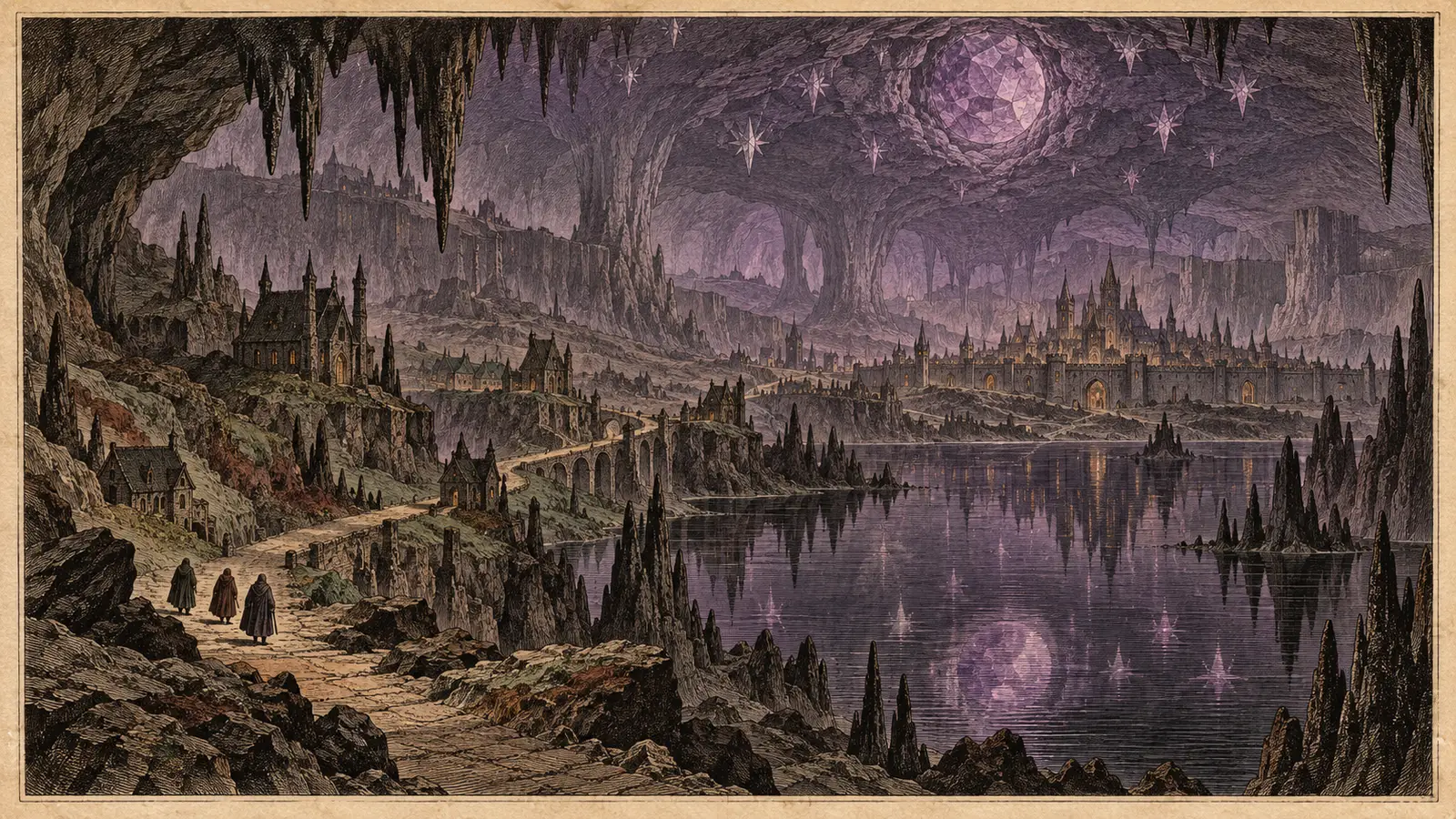
We've come a long way down tonight. We started with the dark elves of the Norse, working metal in their halls beneath the world tree, and with and his dream of a hollow earth, and 's travellers walking among giant mushrooms. We followed a passage thirty feet wide down from a fire giant's hall, and crossed a black river with a kuo-toa ferryman, and saw the city of the drow under its false moon. We watched a sidekick become a hero, and a goddess fall silent, and a city of webs burn. We heard how a wounded god crawled out the tunnels of the world, and saw a demon prince rise from the , and a fungus queen plan her wedding. And we've come up again, nearly to the present day.
Let's go back down, just once more, slowly.
Begin at the edge of the light, where a cave mouth opens on a hillside and the air coming out of it is cool and still. Step inside. The light behind you fades. This is the Upperdark, where the surface world still sends its travellers and the deep world sends its raiders, and both are equally careful. A few miles on, the passages widen and the cities begin: the Middledark, where the drow and the duergar and the deep gnomes have built their lives in stone. And far below, past ten miles, lies the Lowerdark, where no one goes if they can help it, and where nobody knows quite what lives.
In the walls, here and there, there's a faint shimmer, the faerzress, glowing softly in the quartz. It hides the deep places from the eyes of wizards far away. Whatever happens down here, nobody above can see.
The paths run through every kind of country. In some places the passages are so narrow you would have to crawl. In others they open onto wide black water hiding caves of coral. Some stalagmites are as large as mountains. Chasms drop away into the deepest dark. There are fields of soft lichen like moss and whole forests of fungus, where myconids tend their farms and share their slow, communal dreams. Somewhere, a mile or two beneath the trees of the High Forest, the Great Fungus grows. It's one living thing as wide as a kingdom, spreading so slowly that no one has ever seen it move, a forest under the forest.
The Darklake lies in its enormous cavern, black and still. A lantern held over its surface lights only a few strides into the water, and then the dark simply swallows it. Somewhere out on that water a duergar boat moves slowly, with no light at all.
In , the glow of is fading. All day it has climbed and dimmed, and now the last warmth is leaving the stone. Around it the carved castles shimmer faintly in their faerie fire, violet and blue. Soon the pillar will be dark, and in the City of Spiders it will be midnight.
And far away, beneath another world, under the of , in a cavern more than a mile high, an old mass of stone near the top of the dome goes on glowing as it slowly turns from one mineral into another. It looks like a moon, plum-coloured and gentle, and its light falls on the drow manors and the long road and the gate. It falls on the Mere of Glooms too, where the whole false sky lies drowned and trembling on the black water.
once said that his great enemy down here was solitude, "the interminable, incessant silence of hushed corridors." For a lonely young wanderer it was. But silence isn't always an enemy. Down in the deep, beneath all the noise of the world above, the corridors go on for thousands of miles in the dark. Water drips somewhere a long way off. A mushroom glows softly by itself in a cavern no one will ever visit. Under the stone it's very quiet, and the quiet has been there longer than any city or god, and it will stay there.