Chapter I
The mother of the salt waters
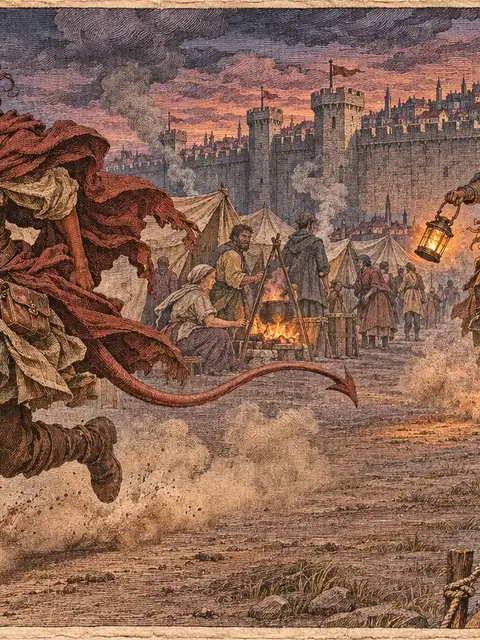
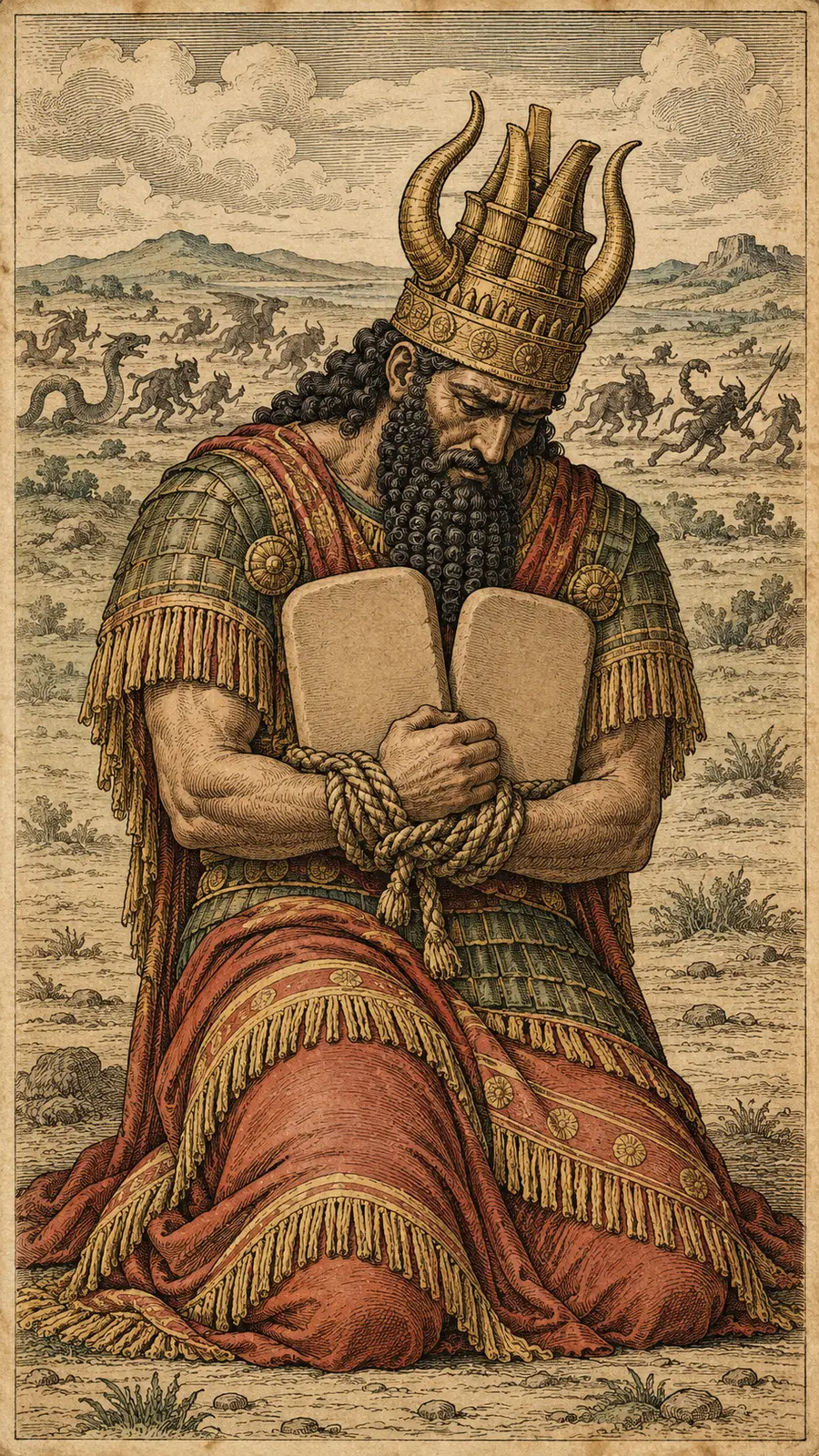
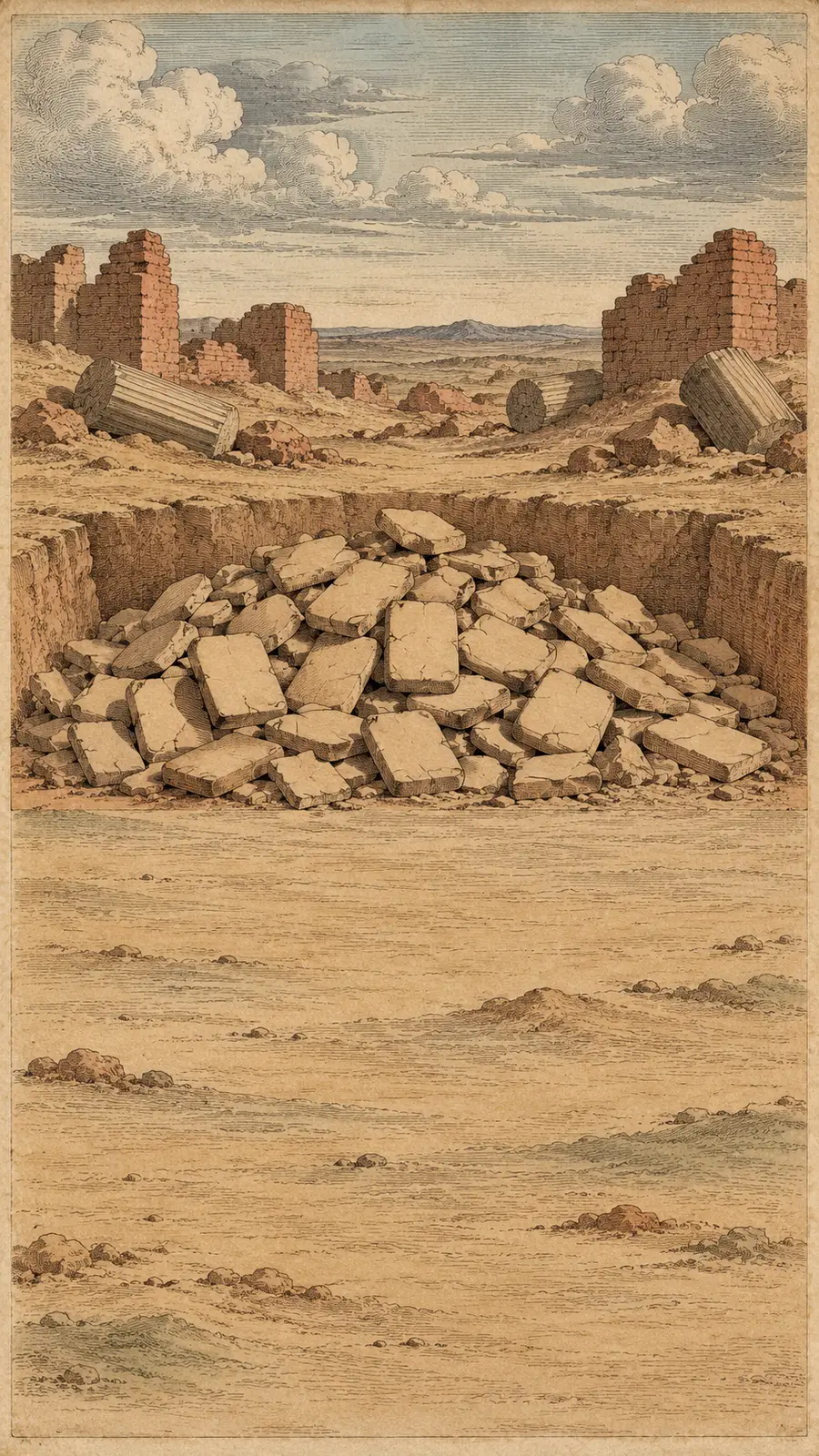
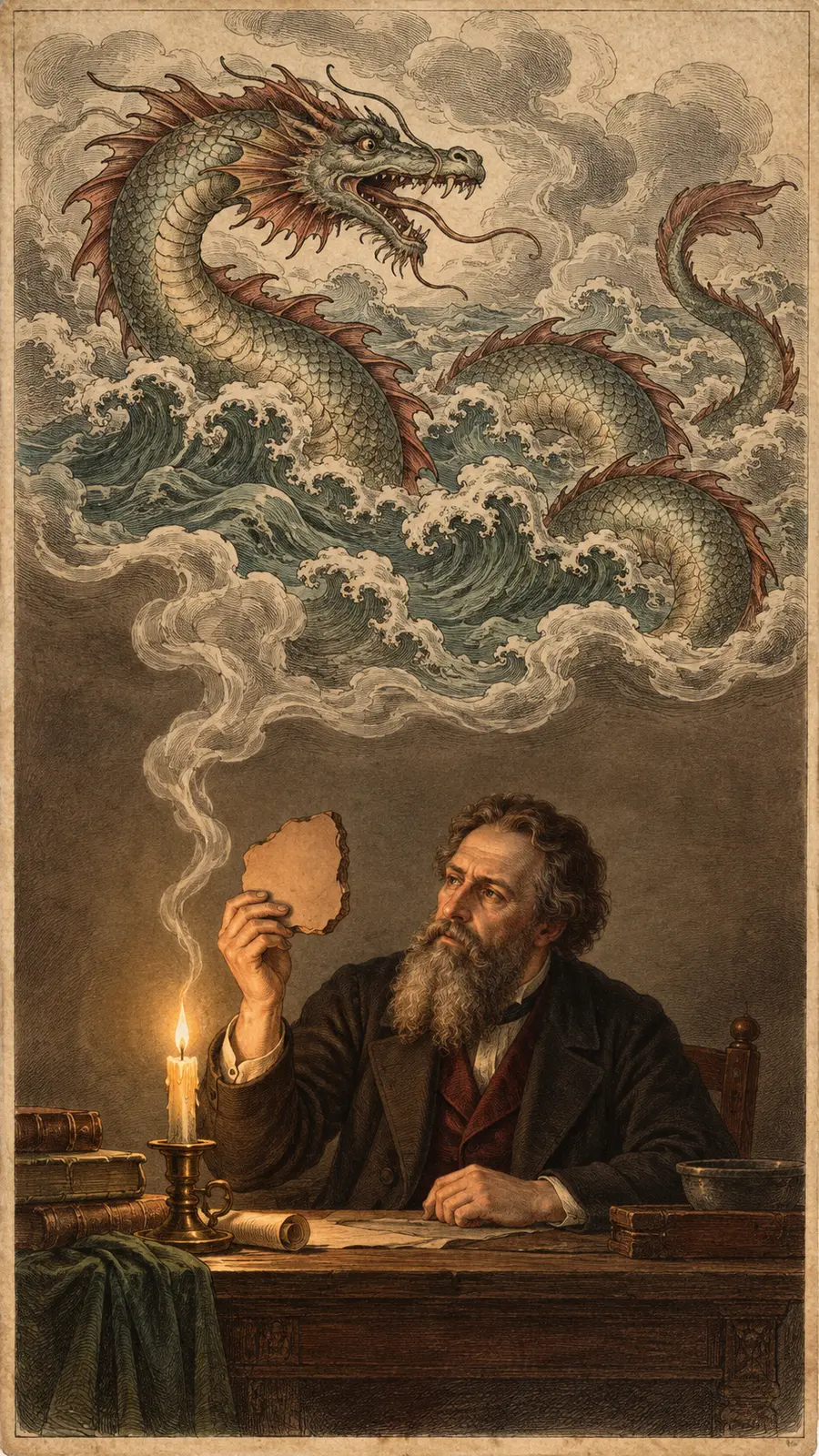
Our story begins a long time before any game, beside two rivers in the land between them, where the Babylonians told of how the world was made. Their creation epic is called the Enuma Elish, which means "When on high," after its first words. It was written across seven clay tablets, and the story it tells is more than three thousand years old. It begins with the birth of the gods and ends with the ordering of the world, the making of humankind, and the god raised up as king over all the rest.
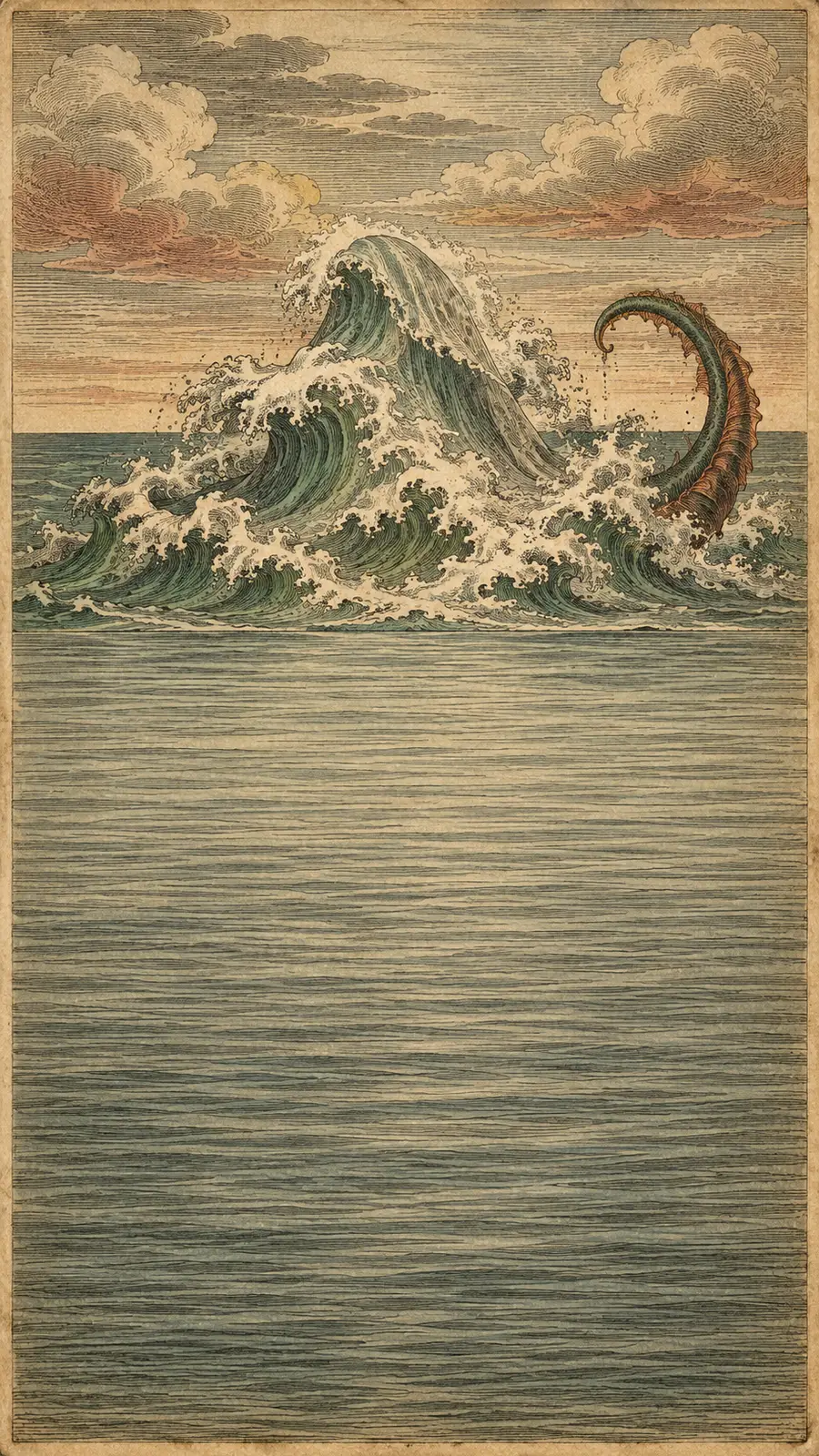
In the beginning, the poem says, there was only water. It was undivided and swirling, with no land and no sky, no names and no gods. In time that water divided into two. One part was , the sweet fresh water, the kind that falls as rain and runs in springs. The other was , the salt water, bitter and deep, the primordial sea. She was a goddess of the ocean and of chaos, of everything unshaped and unordered. Apsu and Tiamat mingled their waters, and from that mingling the first generations of gods were born. So before she was ever a dragon, and before she was ever an enemy, Tiamat was a mother. An early English rendering called her "the producing-mother of the whole of them." Even her name carries the sea in it, since it is tied to the old Akkadian word for sea, tâmtu.
The young gods were restless and loud. They moved about inside their mother's body, and their noise troubled the peace of the deep. Apsu grew weary of them and plotted to destroy his own children. Before he could act, the wise god Ea learned of the plan and killed him. That was the moment the story turned. Tiamat had lost her consort, and the poem now shows her rising in grief and fury. She took a new consort, a god named , set him at the head of an army, and gave him the Tablets of Destiny, which carried command over the whole universe.
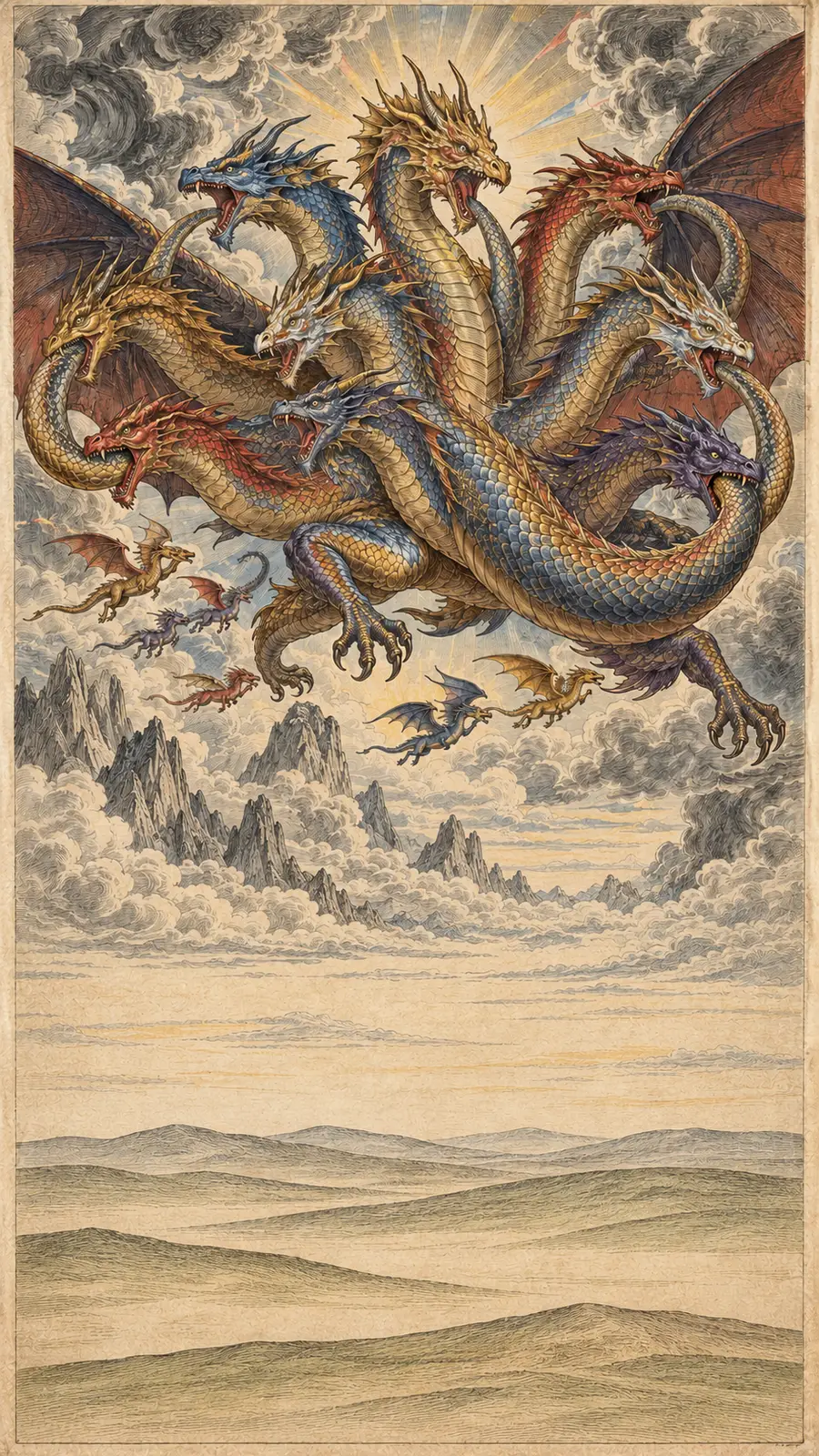
Then she began to give birth to monsters. The poem names eleven of them, and it lists her brood more than once, like a refrain sung around a fire. There was Basmu, the venomous snake, and Mushmahhu, the exalted serpent. There was Mushussu, the furious snake, a creature with a lion's body, an eagle's talons, horns and a crest. There was Ushumgallu, the great dragon, and Lahmu, the hairy one. There was Ugallu, the lion-demon, and Uridimmu, the mad lion. There was Girtablullu, the scorpion-man, and Umu Dabrutu, the violent storm, and Kulullu, the fish-man, and Kusarikku, the bull-man. Serpents, dragons, storms and strange hybrids came from her in a long procession out of the dark water. You can already see, in that list, the shape of something to come.
The younger gods were afraid. None of them wanted to face the mother of chaos, and so they turned to Marduk, the patron god of the city of Babylon. He agreed to be their champion on one condition. If he won, he would be their king.
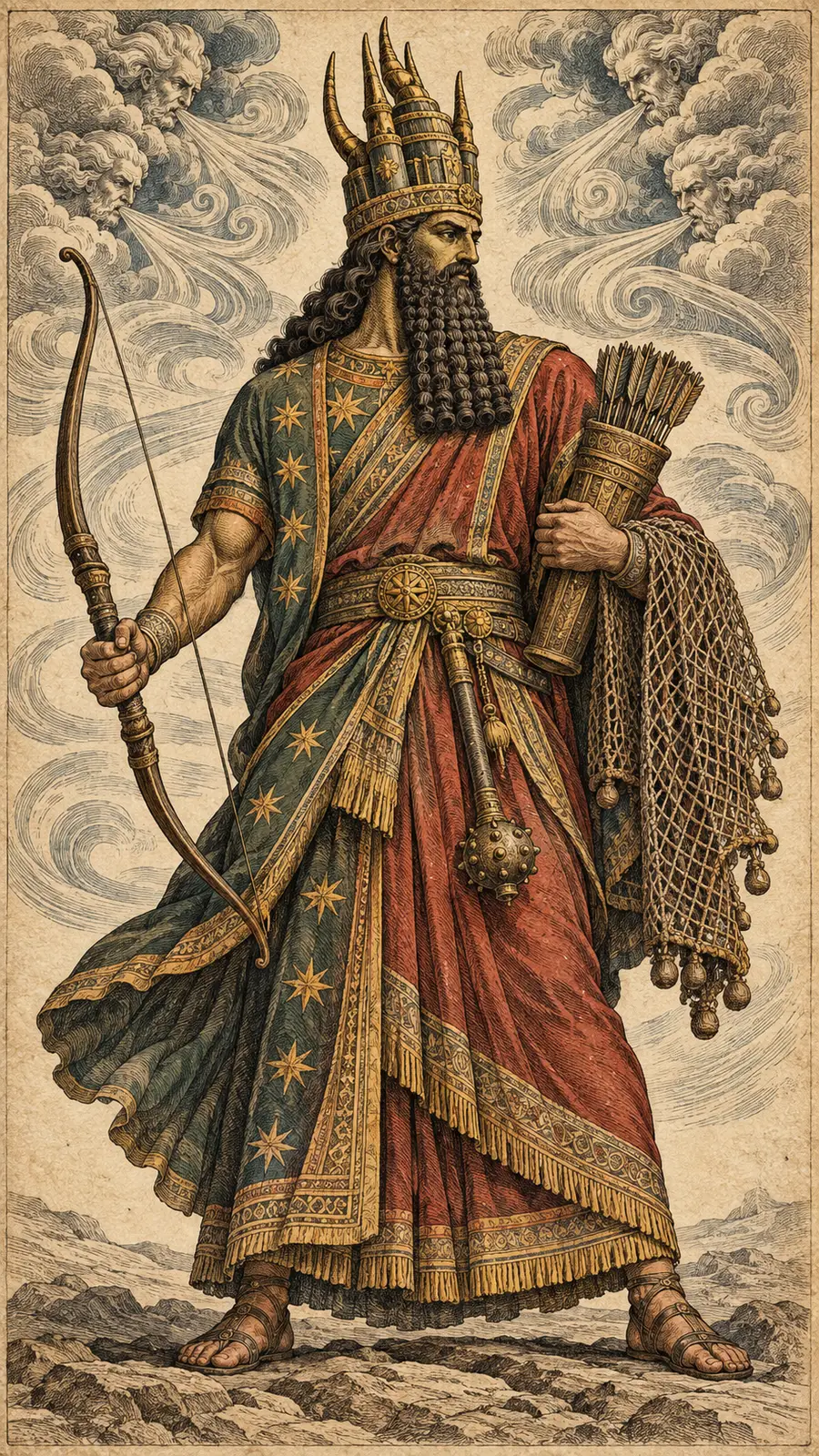
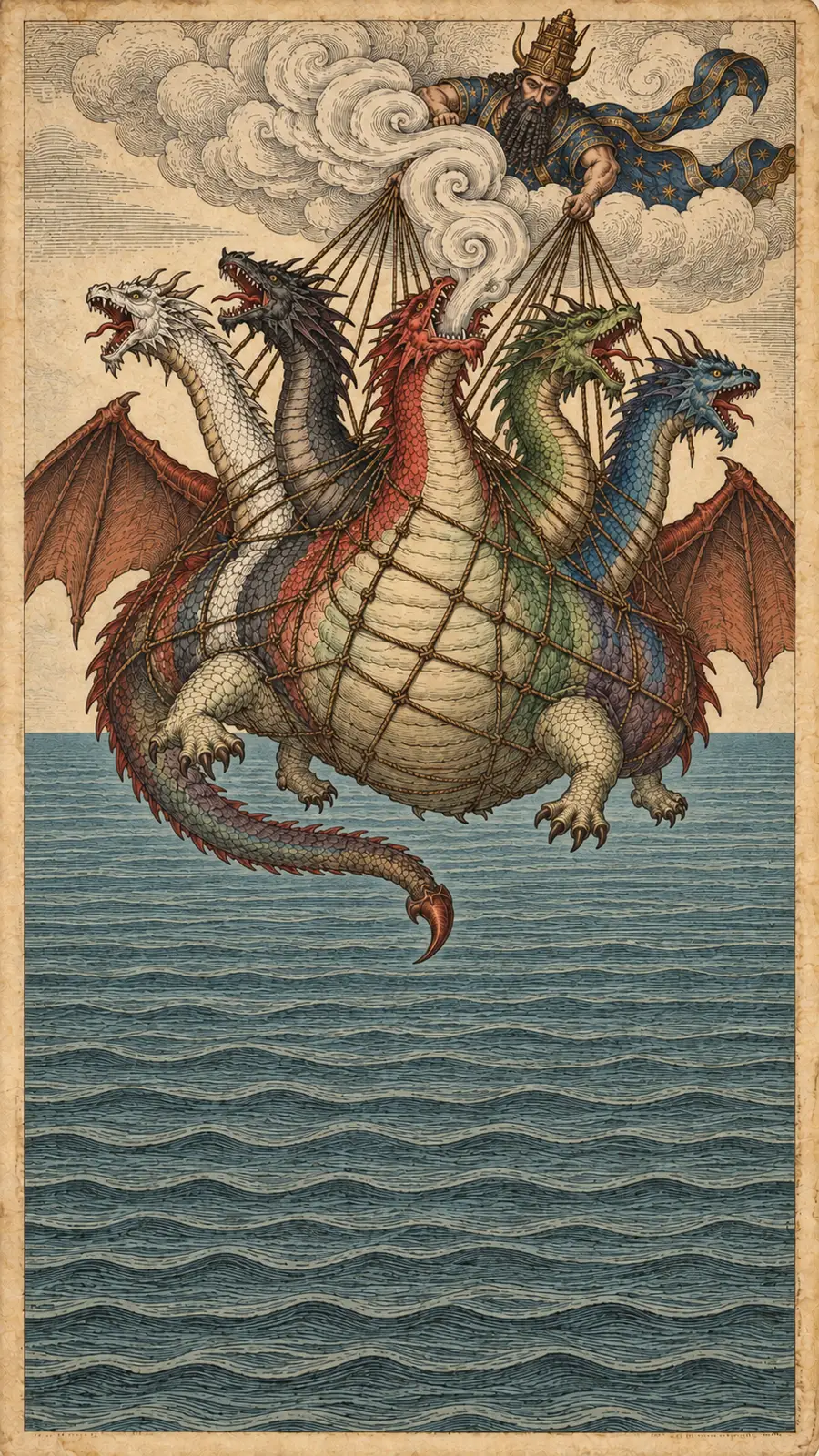
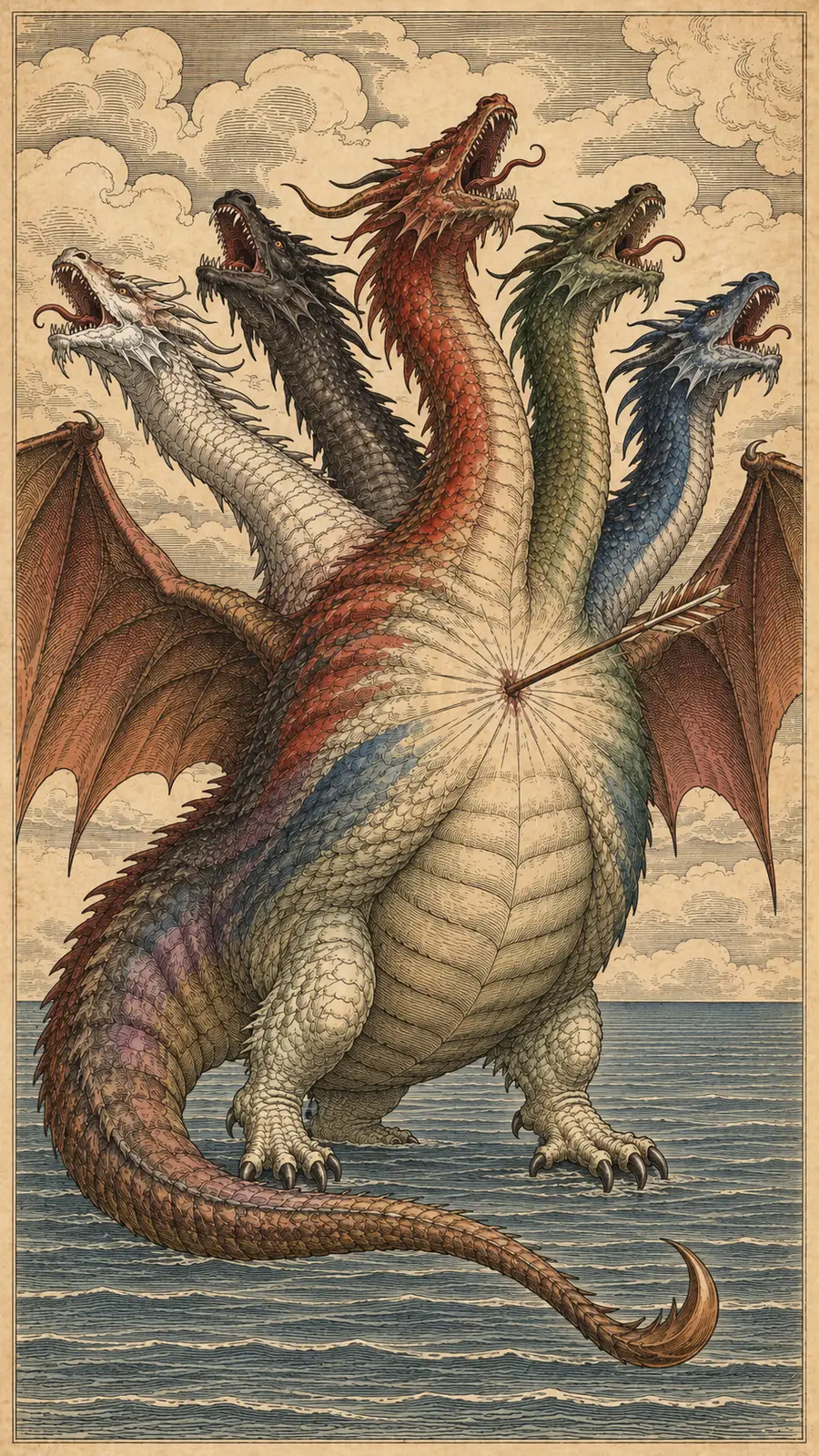
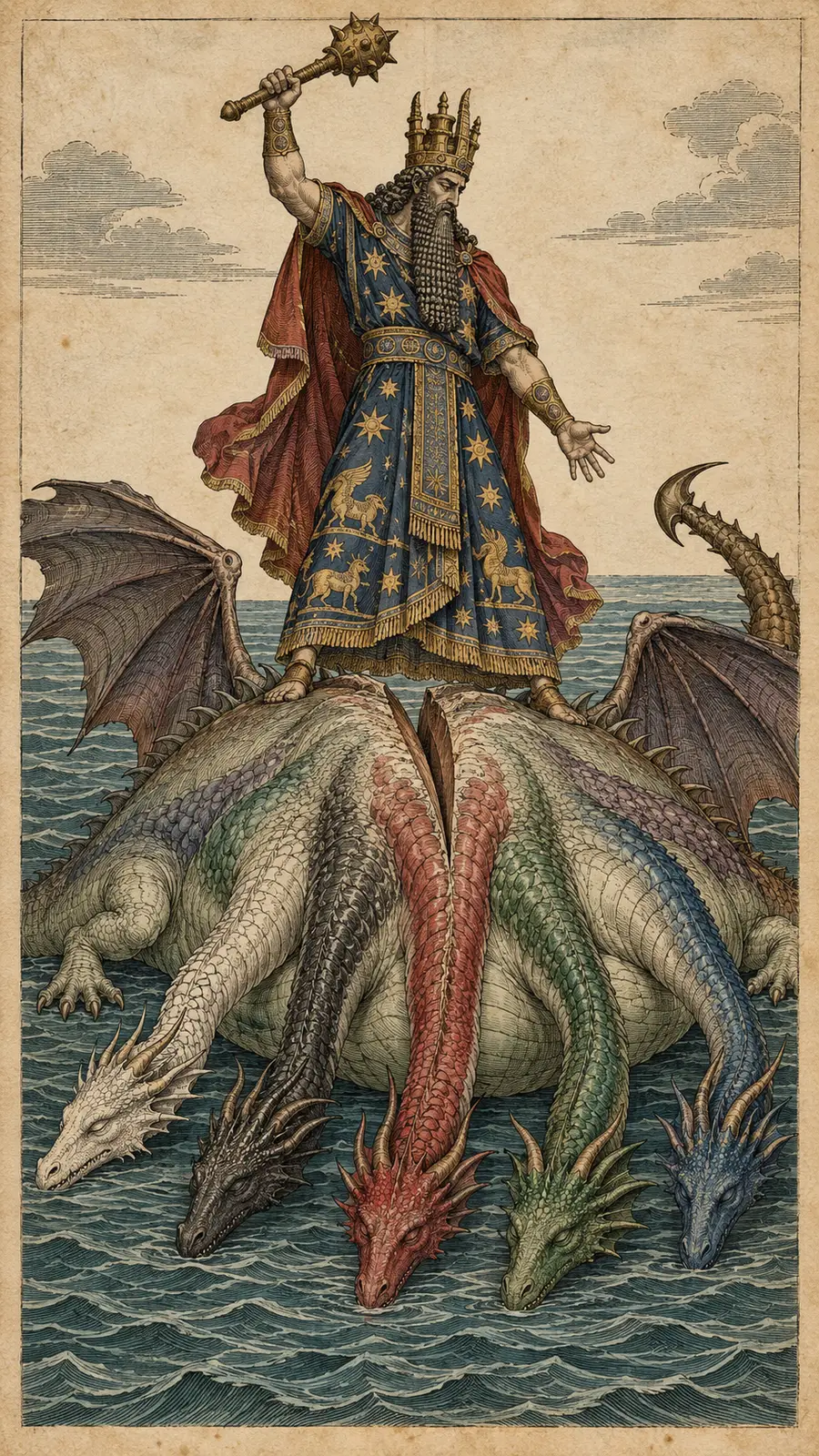
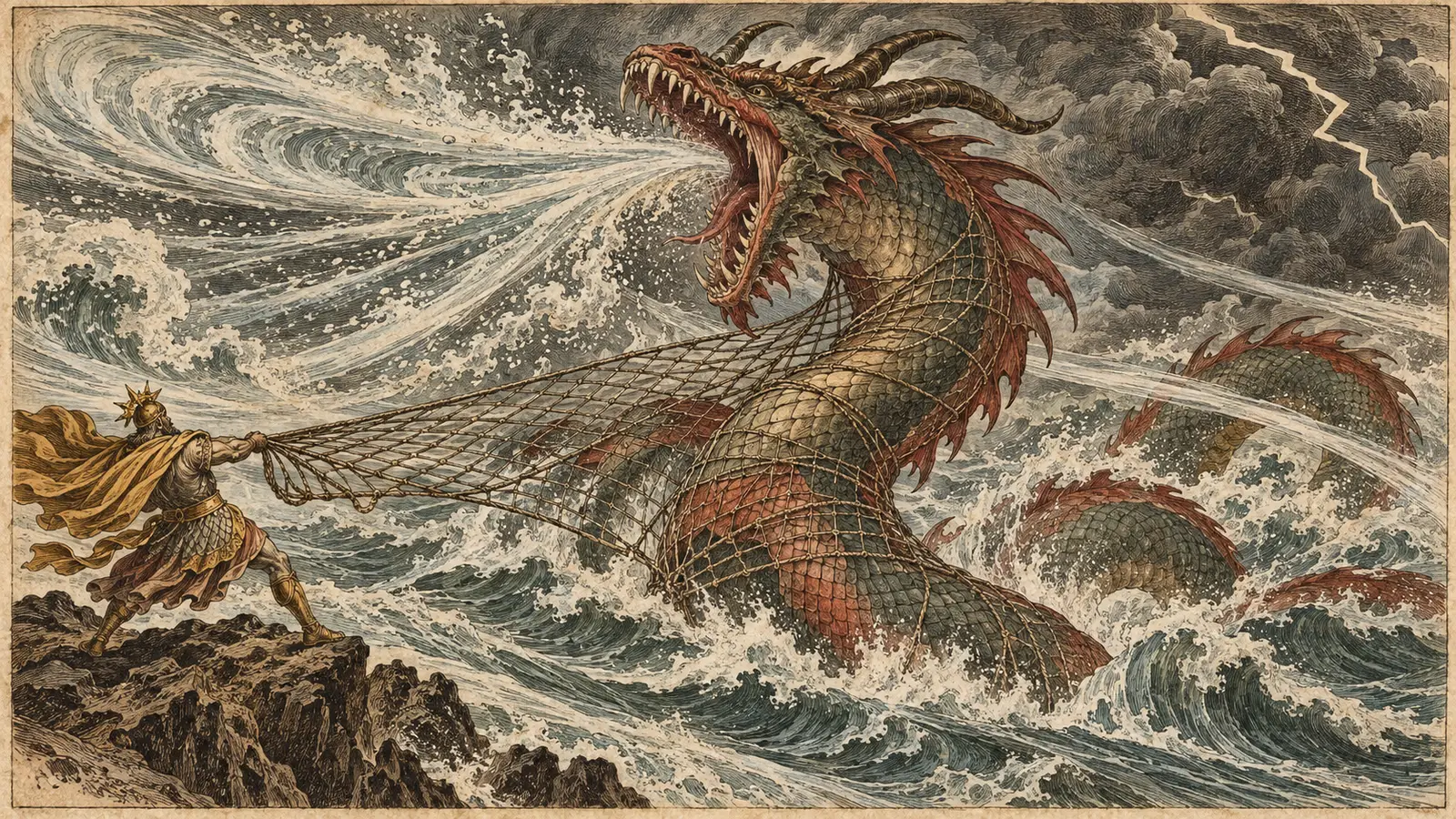
Marduk armed himself with a bow and arrows, a mace, and a net, and he brought the four winds and a storm along with him. When he came before Tiamat, he cast his net around her. She opened her mouth to swallow him, and he drove the Evil Wind straight into it so that she could not close her lips. The wind filled her and swelled her body. Then Marduk loosed an arrow that split her heart. Her army broke and fled, and Kingu was taken captive.
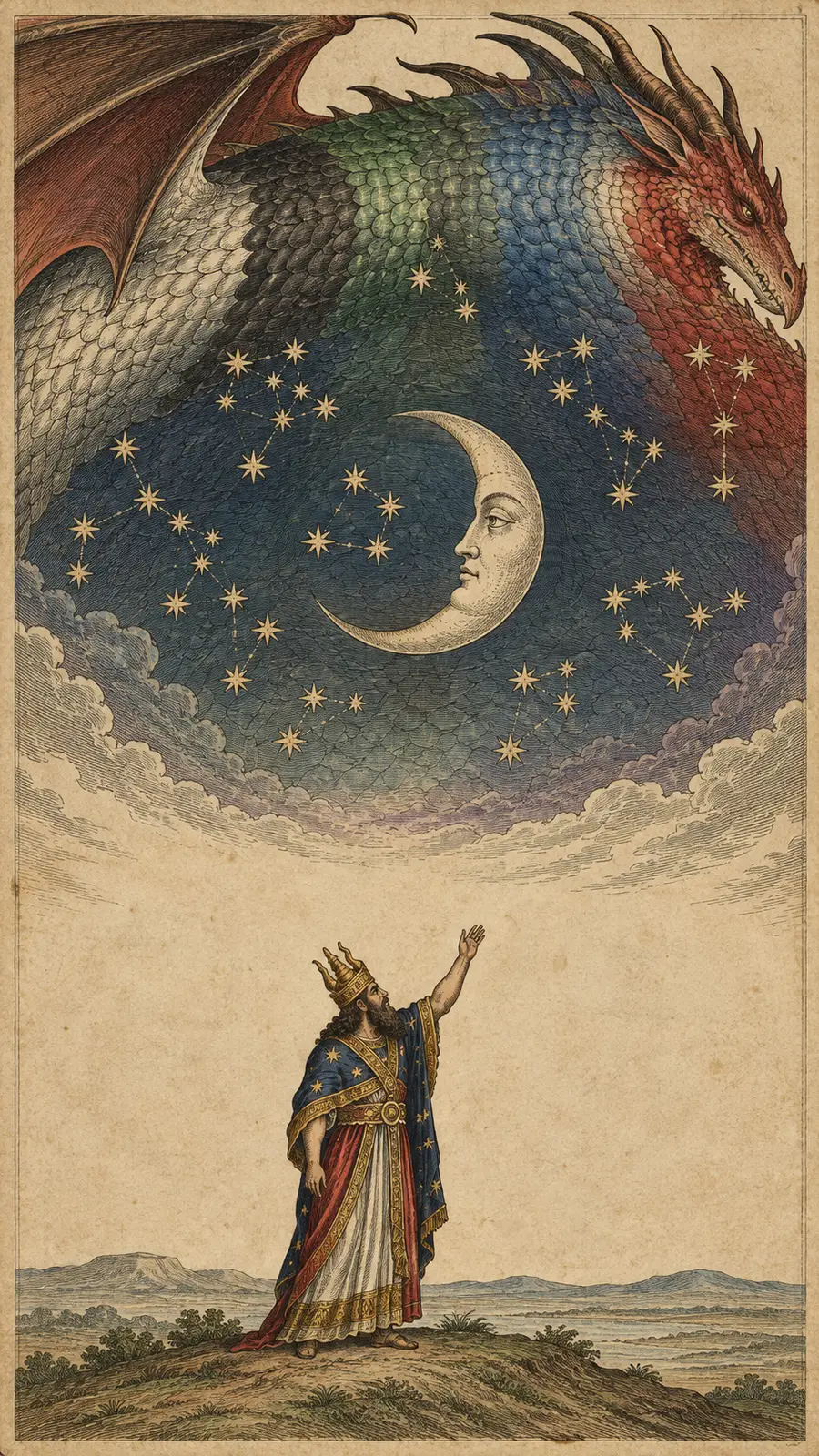
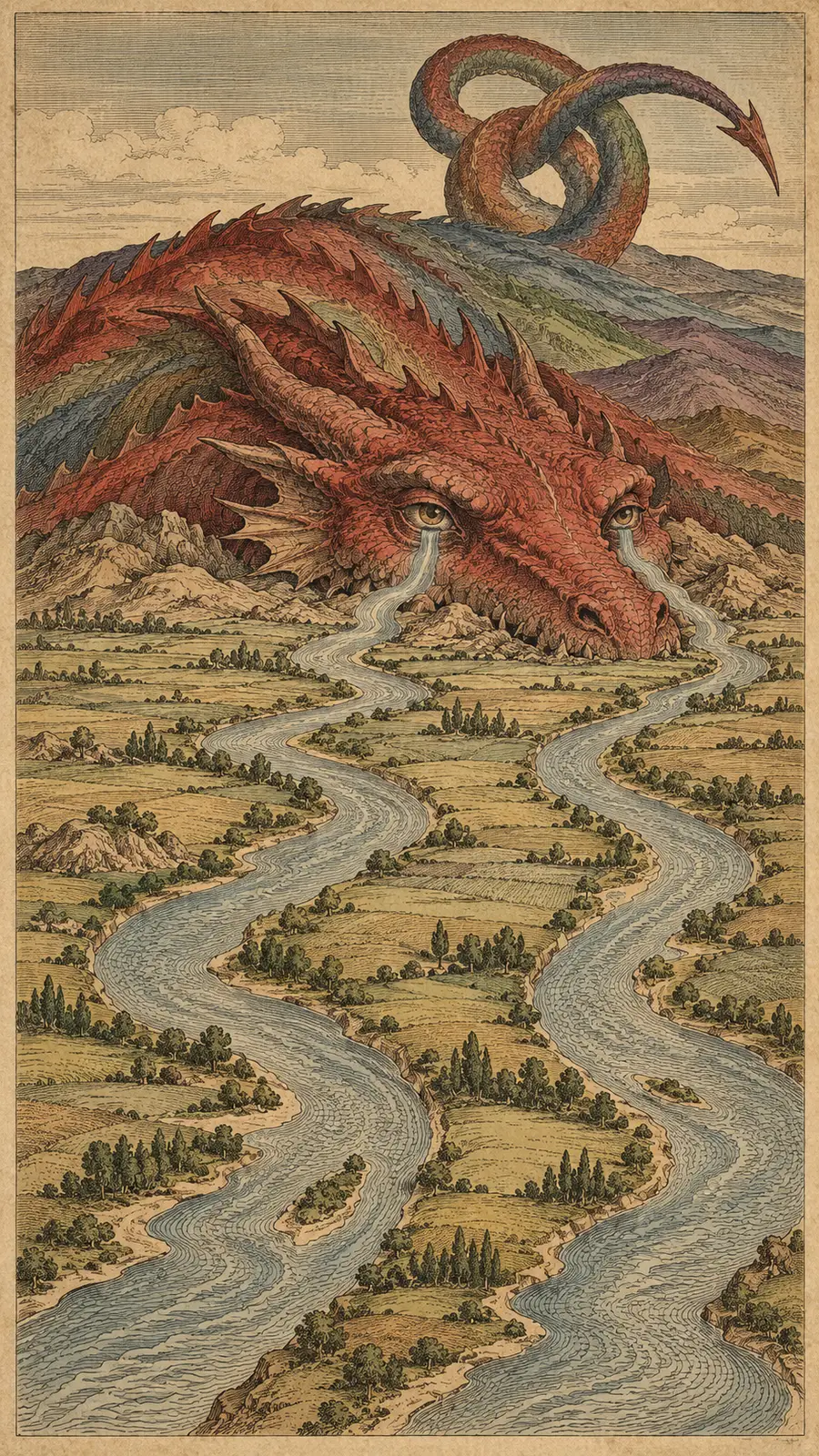
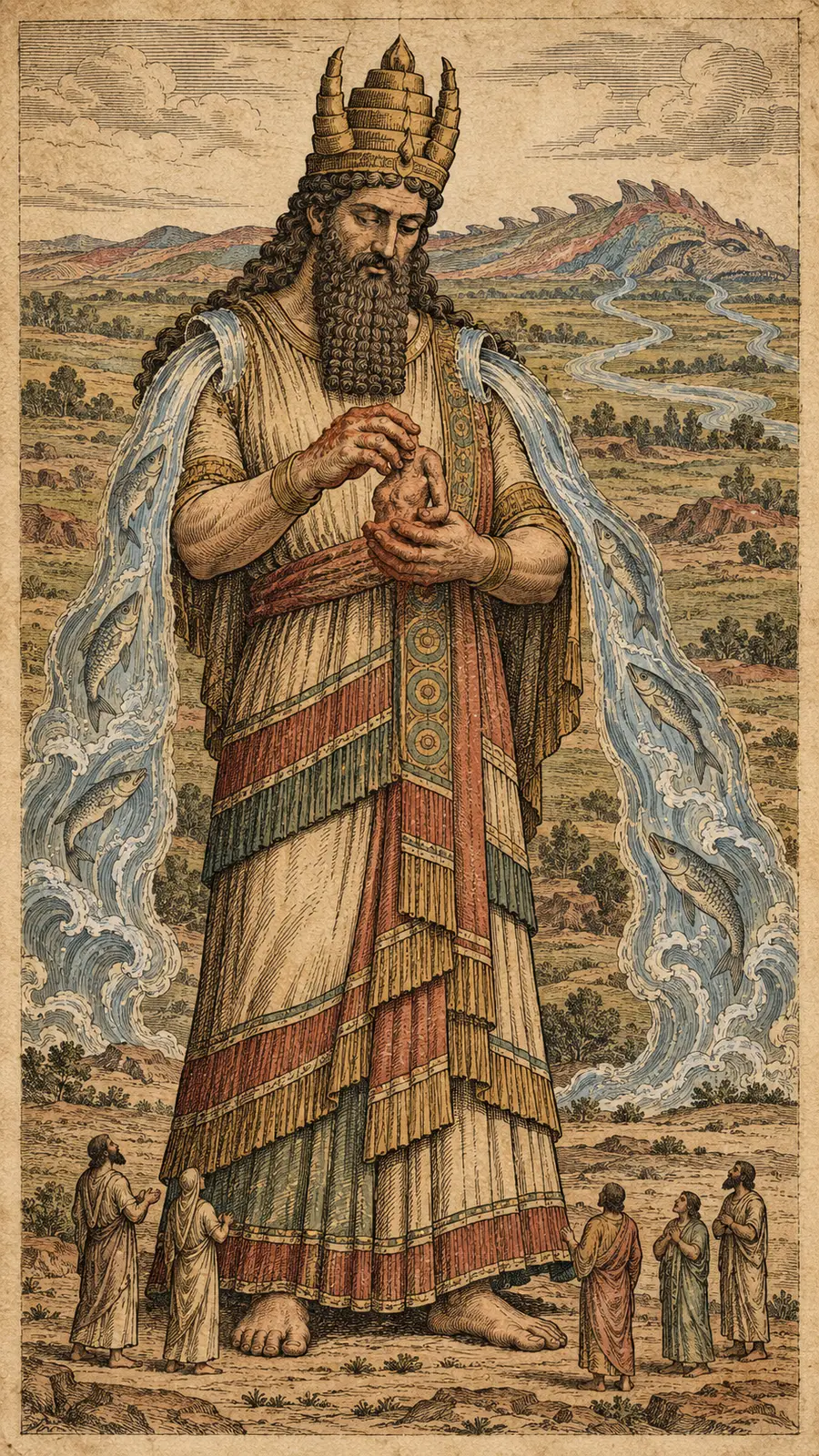
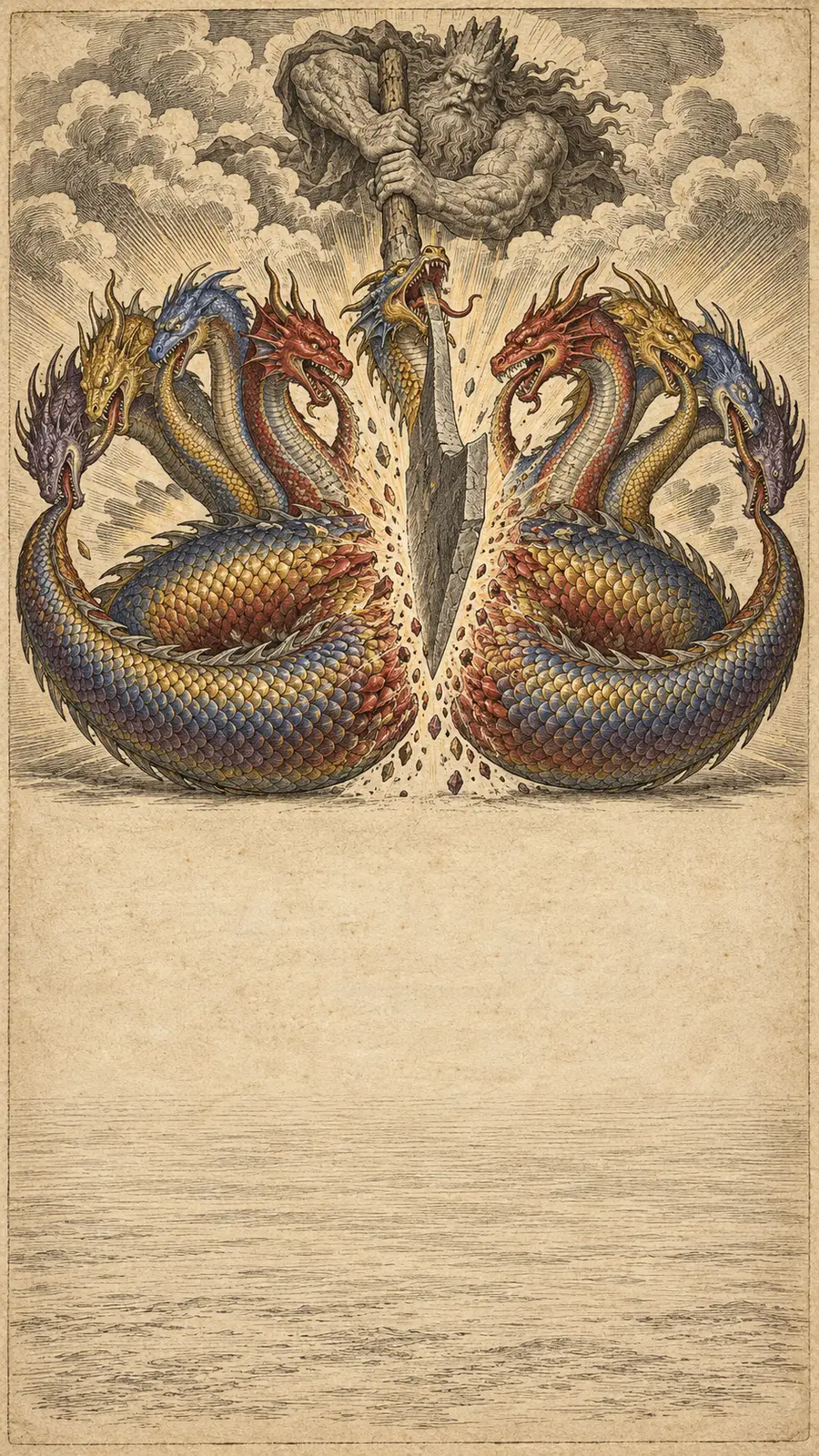
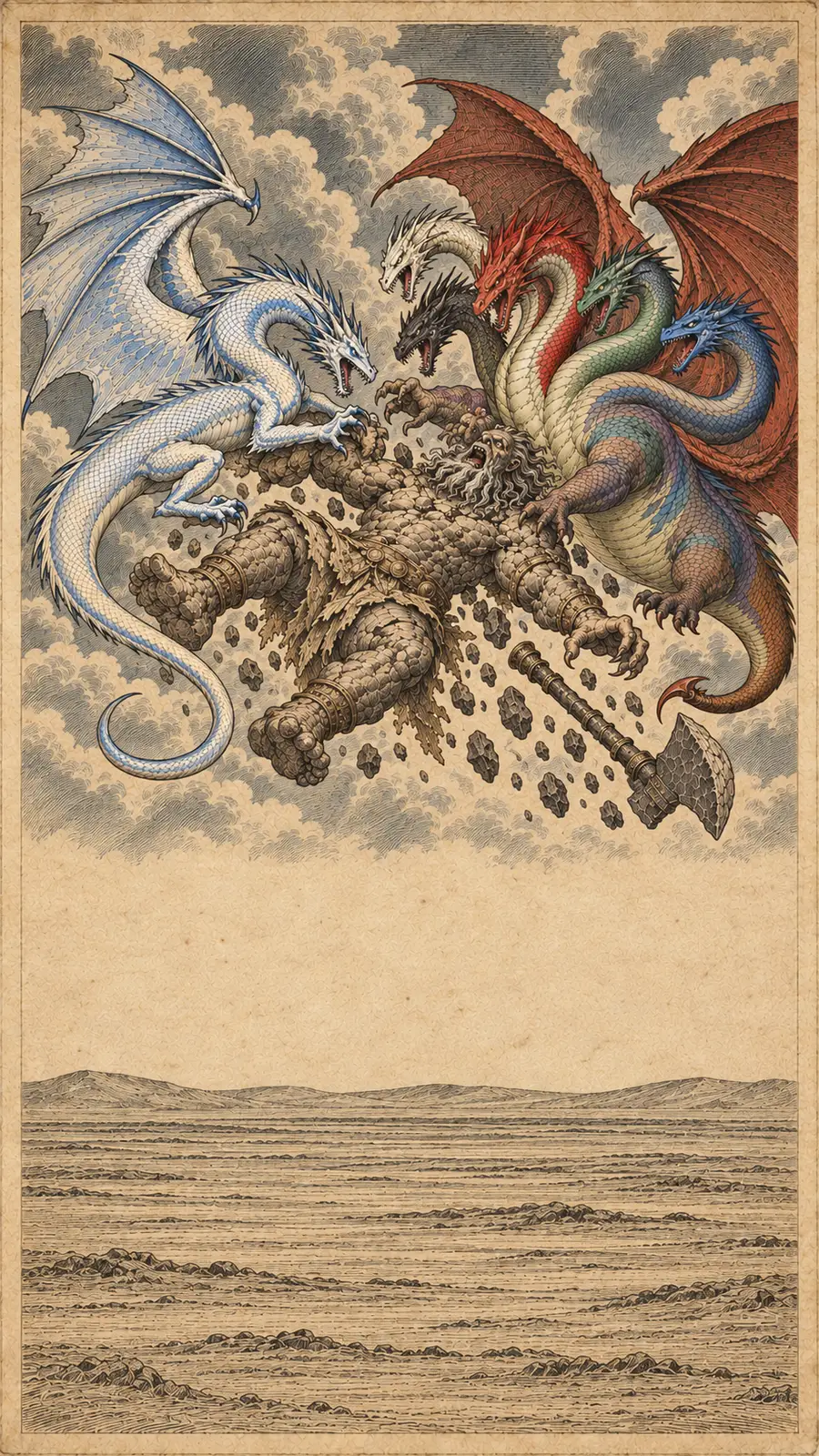
What came next is the part of the story that stays with people. Marduk stood over the body of the salt sea and cut her in two. The old translations compare it to the opening of a shellfish, and newer ones say he split her like a dried fish. From one half of her he made the heavens, and from the other half the earth. He set the stations of the great gods and hung the constellations, fixed the year and its divisions, and placed the heights of heaven within her belly. He made the moon to rule the night. The and the , the two great rivers of that land, flowed from her eyes. He twisted her tail and bound it into the great cosmic bond that holds everything together, and her other half he stretched out and made firm as the ground. Afterward Ea made humankind from the blood of Kingu. So the world that the Babylonians walked on each morning was, in their telling, the body of Tiamat, and the rivers that watered their fields were her eyes, still flowing.
This poem was recited at the , the Babylonian New Year festival, to renew the order of the world each year and to honor Marduk's rule. It was a story about keeping chaos at bay by retelling, once a year, how it had been defeated.
Here is something gentle and a little surprising. For all that we picture her as a dragon, the poem never quite says that she was one. It describes her vaguely. Sometimes she seems like a woman-shaped goddess, and sometimes she is simply the sea itself, and at one point she has a tail. No ancient image of her is known for certain. The dragon Tiamat grew later, in the imaginations of the people who read the poem, built from those faint hints and from the serpents and dragons she bore.
That later reading came quickly once the tablets were found again. Copies turned up among the ruins of the library of at , and in 1876 a scholar named George Smith published them in English. He wrote of "the dragon Tiamat, or the dragon of the sea." Smith died that same year, on an expedition to recover more of the library. A generation later, Leonard William King's translation, The Seven Tablets of Creation, became the standard English version of its day.
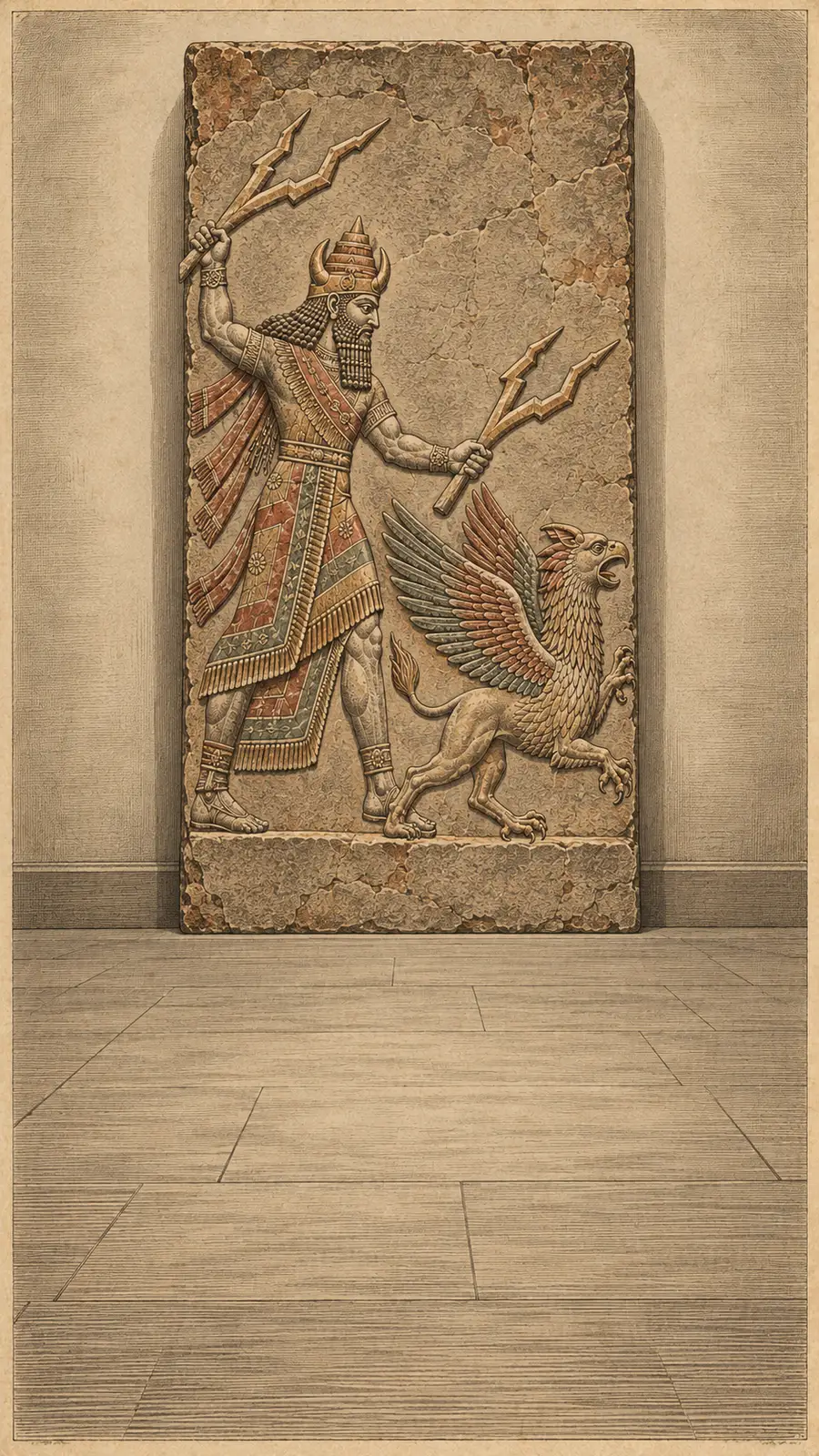
Around the same time, a carved stone relief from the ancient city of was put on display in the British Museum. It showed a god holding thunderbolts, chasing a winged monster with the body of a lion, and for decades it was labeled as Marduk fighting Tiamat. It actually shows a different god, , pursuing a different creature, . But for a long time, when people thought of Tiamat, that winged beast is what came to mind, and the dragon settled in.
Scholars also gave the story a larger family. The German scholar , writing in the 1890s, set out the idea later called the , "the battle against chaos." It's the ancient pattern of a hero-god who slays a monster of the deep so that the ordered world can exist. Gunkel linked Tiamat to the deep waters at the start of Genesis, and paired her and Kingu with the great biblical beasts and . Across the old writings of that region, chaos kept appearing as a sea-dragon who had to be overcome before the world could begin.
So by the middle of the twentieth century, the name Tiamat meant a primordial dragon of the sea, a mother of monsters, and the great enemy of order. That was the name waiting on the shelf when two young game designers in Wisconsin went looking for a queen for their dragons. They would give her something the ancient poem never did, which was five heads, each a different color. And so we leave the rivers of Babylon and travel north and west, and forward some thousands of years, to a small town beside a lake.
Chapter II
A queen in a cavern beneath the earth
We come now to Lake Geneva, Wisconsin, in the middle of the nineteen-seventies. The Dungeons & Dragons game was new, and its creators were still filling it in, one supplement at a time. The first of those supplements was called Greyhawk, and it appeared in 1975. Gary and Rob wrote it, drawing on the home campaign they ran together in their imagined world of Greyhawk, and TSR published it. It was full of new monsters, new spells, and new treasures, and tucked into its pages on dragons was a pair of creatures unlike anything else in the book.
The first was not yet called . She had no personal name at all. The book called her the Dragon Queen, and the Chromatic Dragon, and it described her as queen of the Chaotic dragons. In those early days the game's alignments were only three: Law, Neutrality and Chaos. The evil colored dragons, the white and black and green and blue and red, were grouped together as the Chaotic dragons, and she was their sovereign.
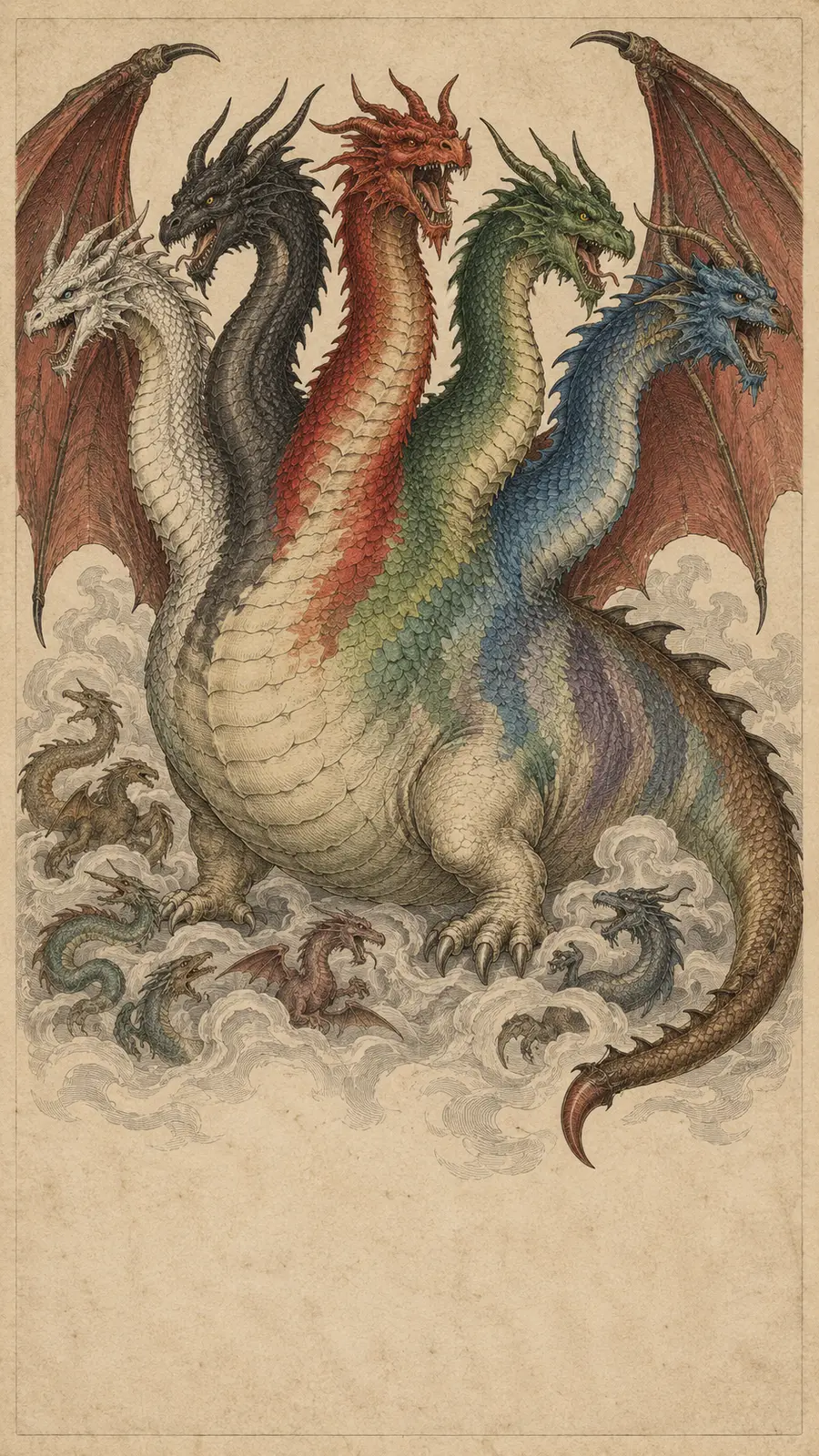
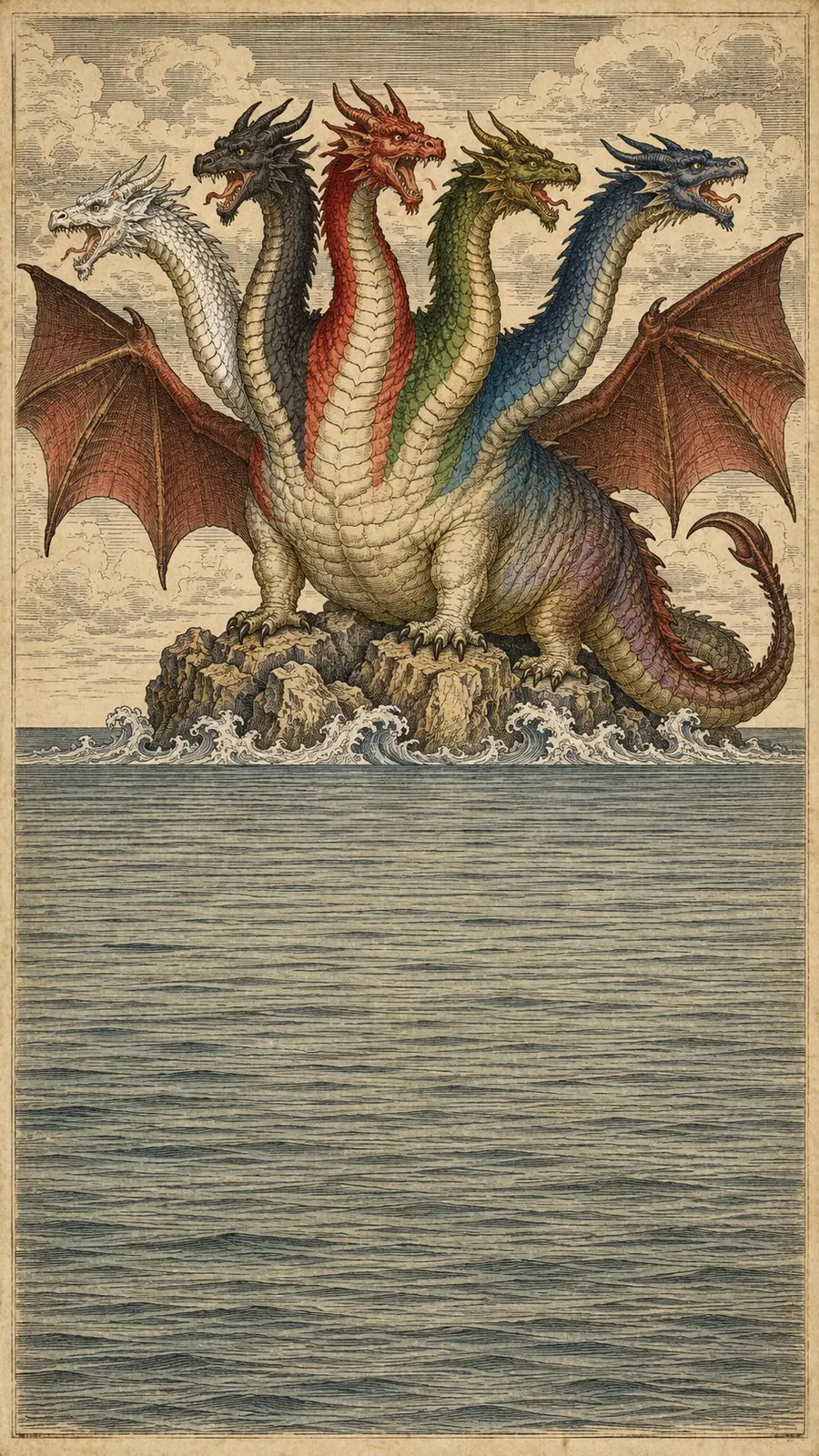
The book described her in a few plain sentences, and they are worth hearing as they were written. "The Chromatic Dragon is a huge creature with five heads, one of each color of the five Chaotic Dragons. Her body is striped in these same colors, and her tail is that of a ." It went on: "She can employ all heads at once, either to breath or cast spells."
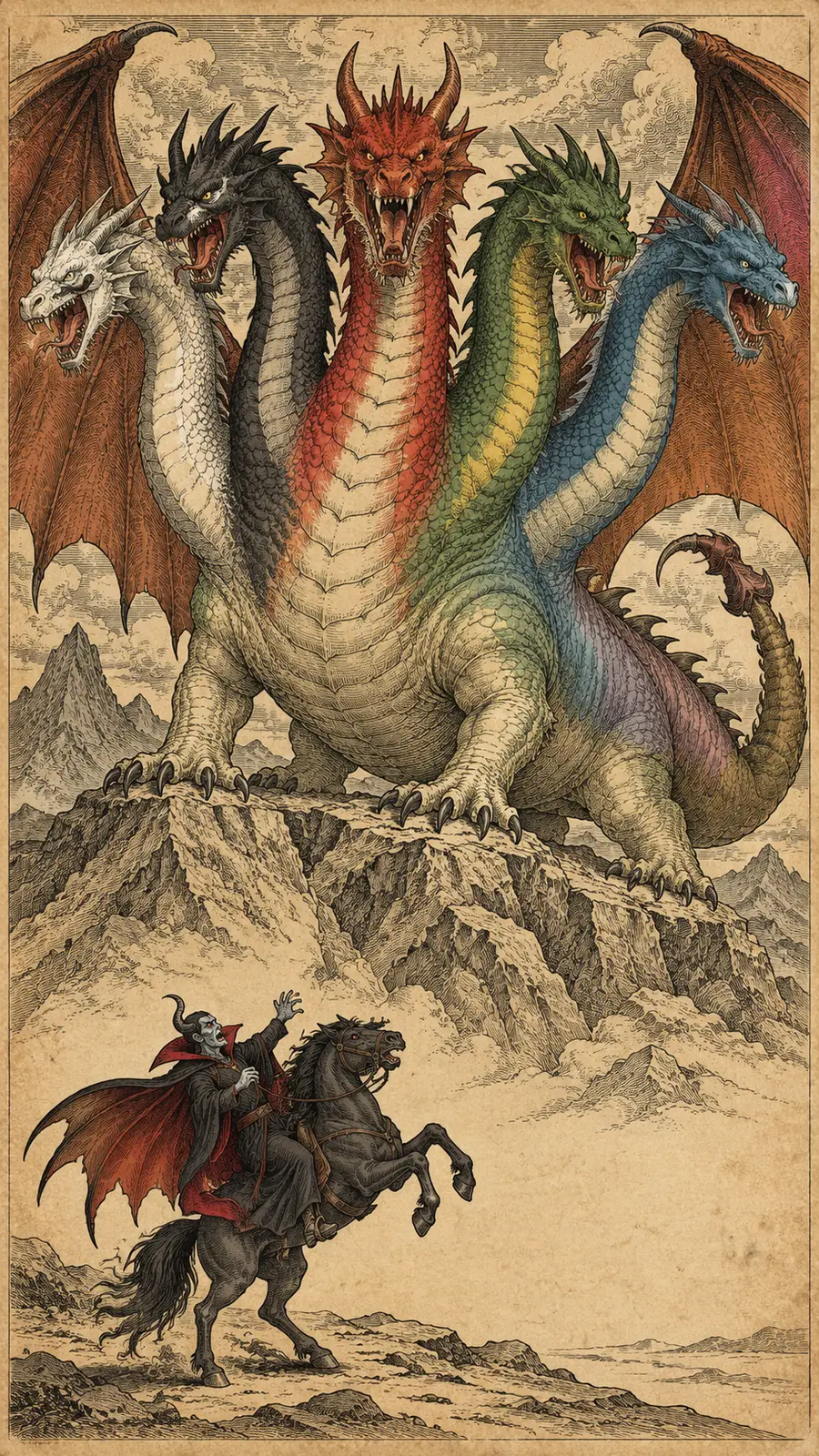
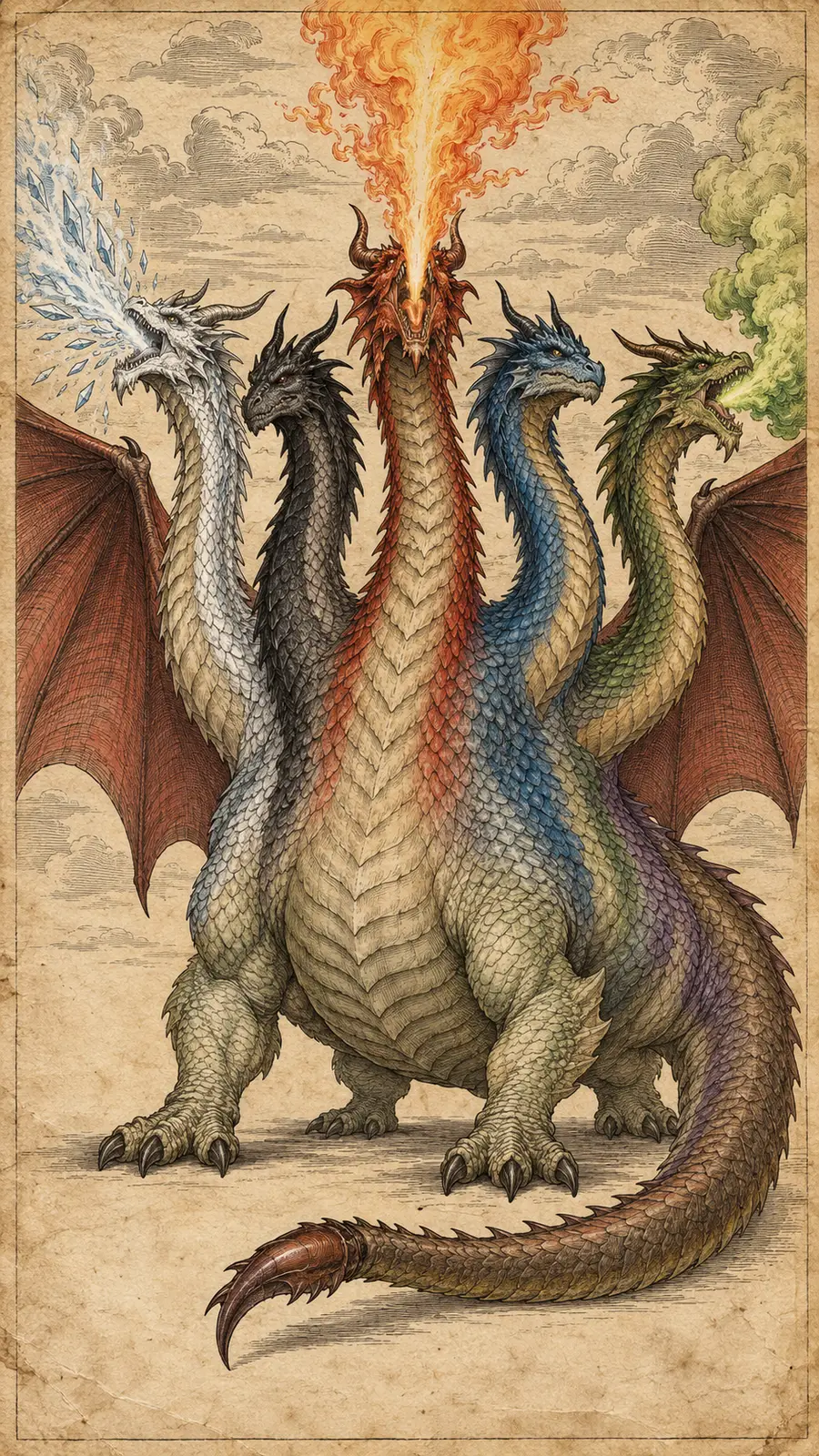
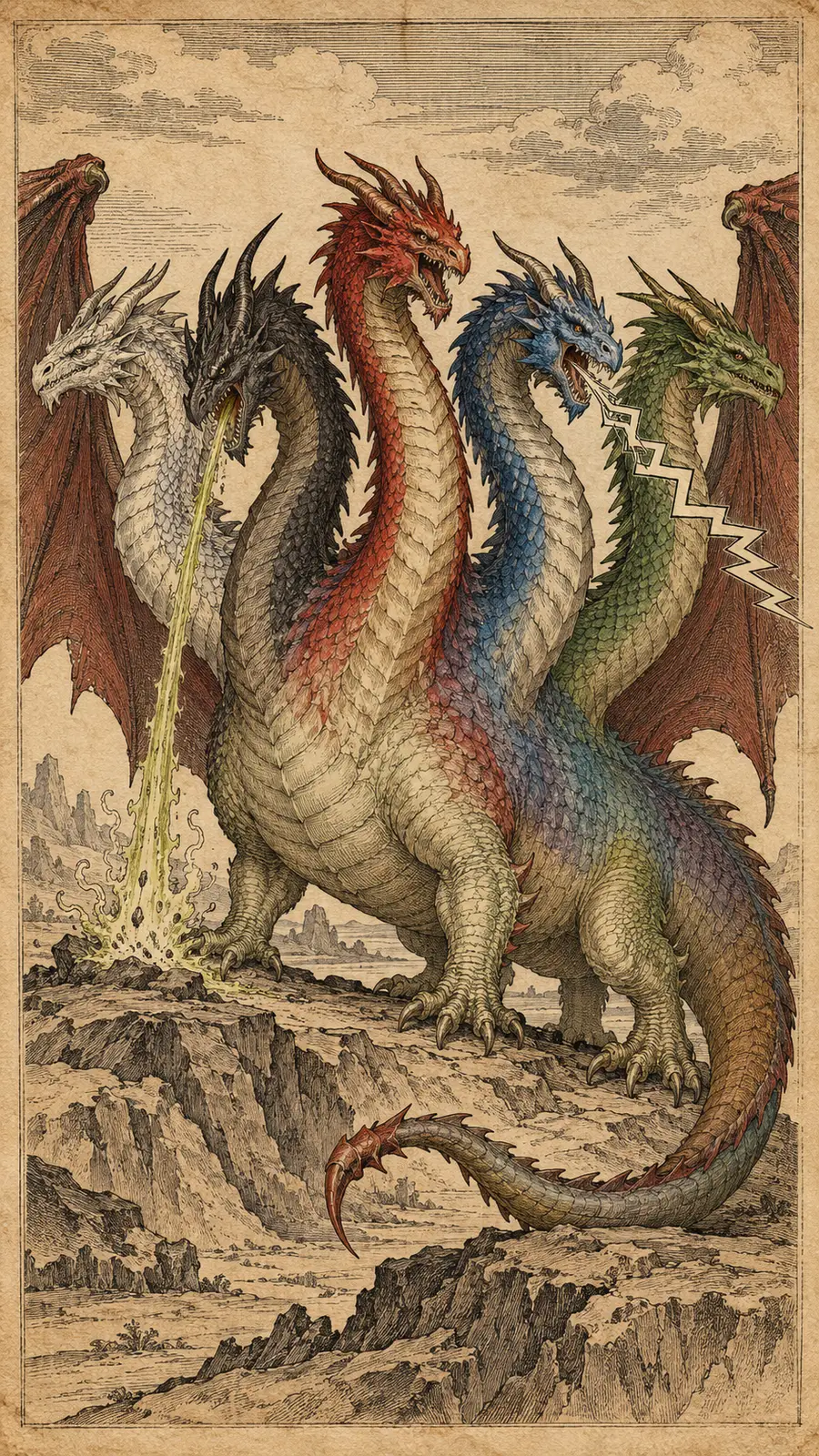
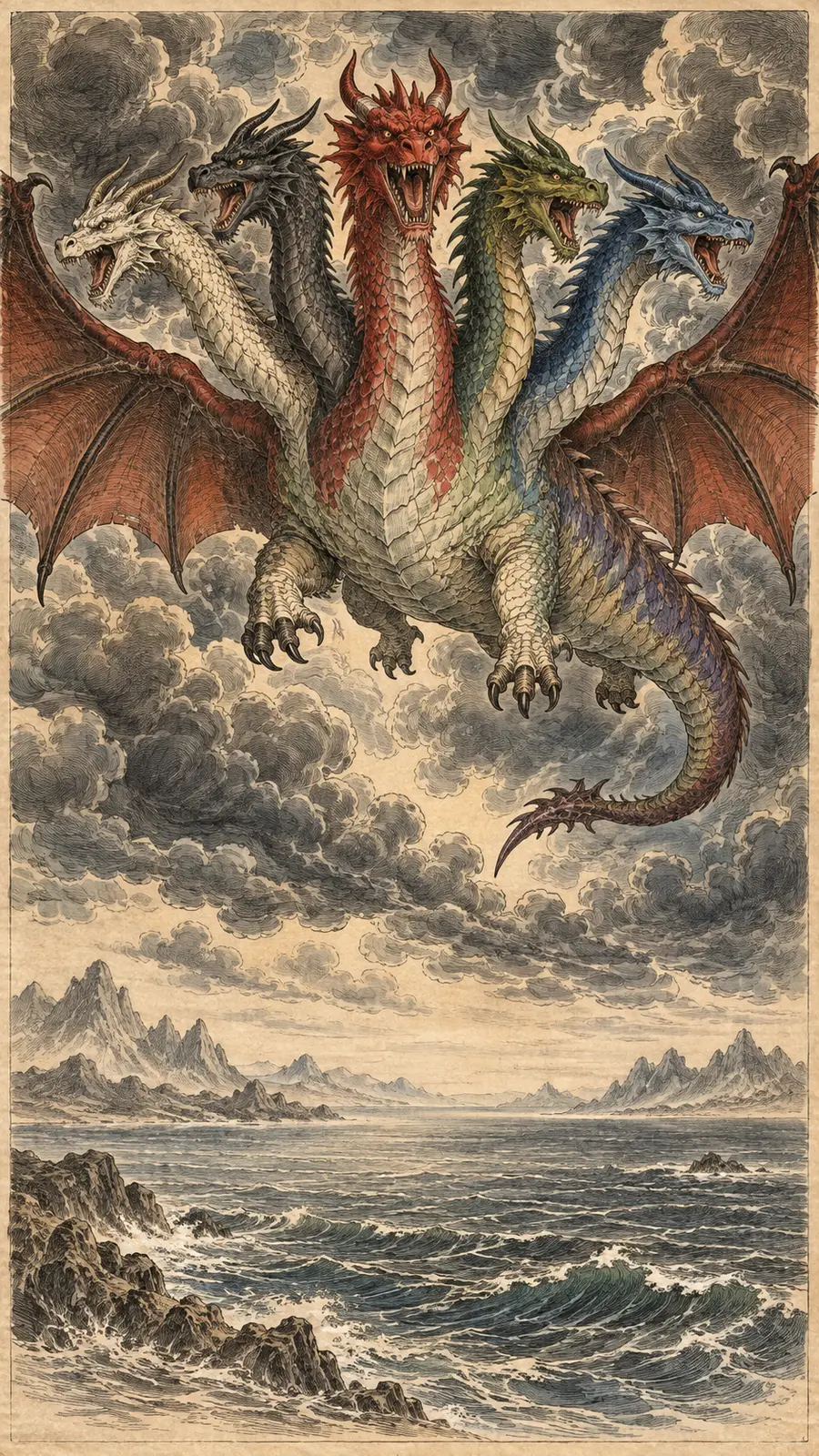
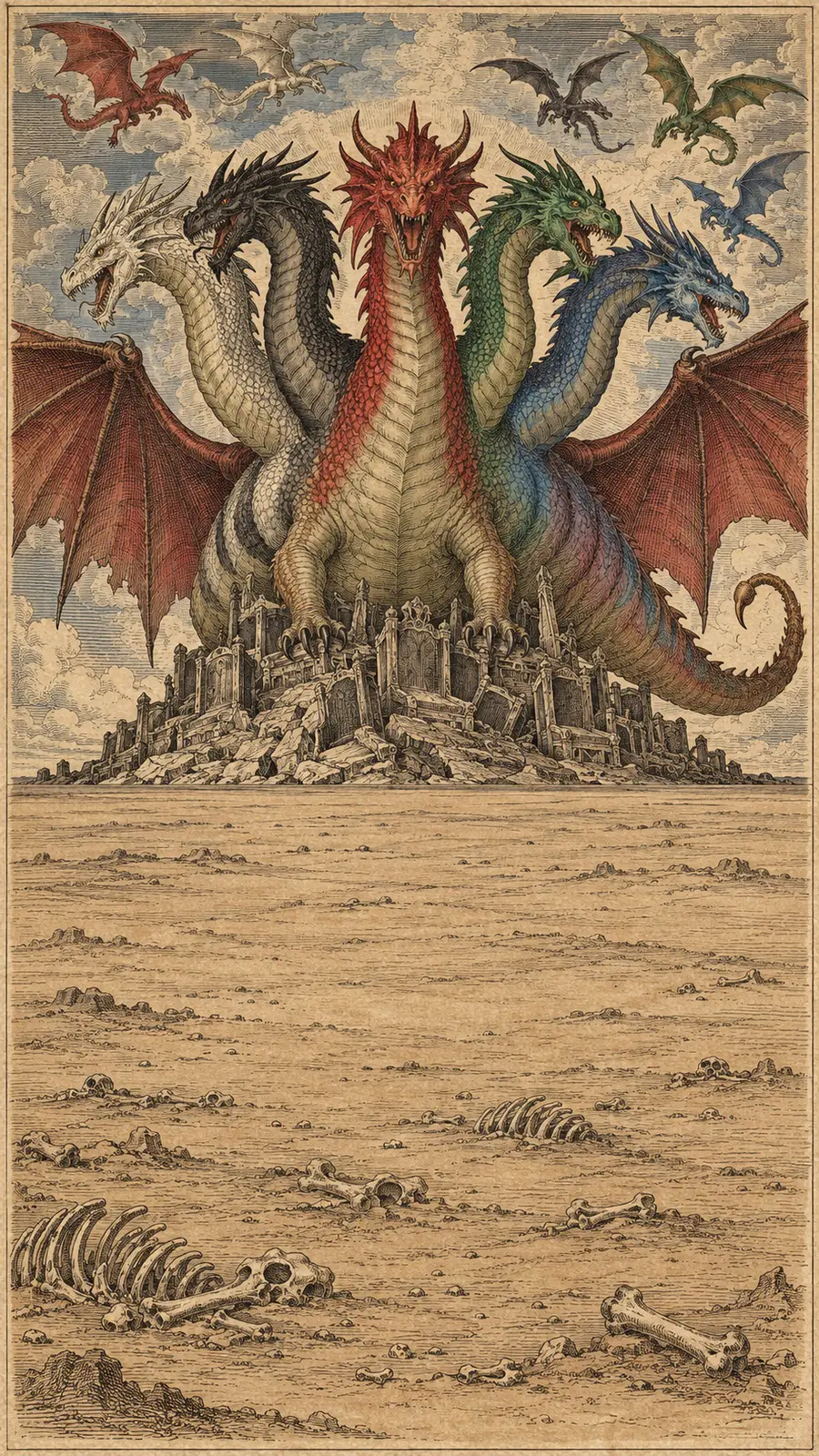
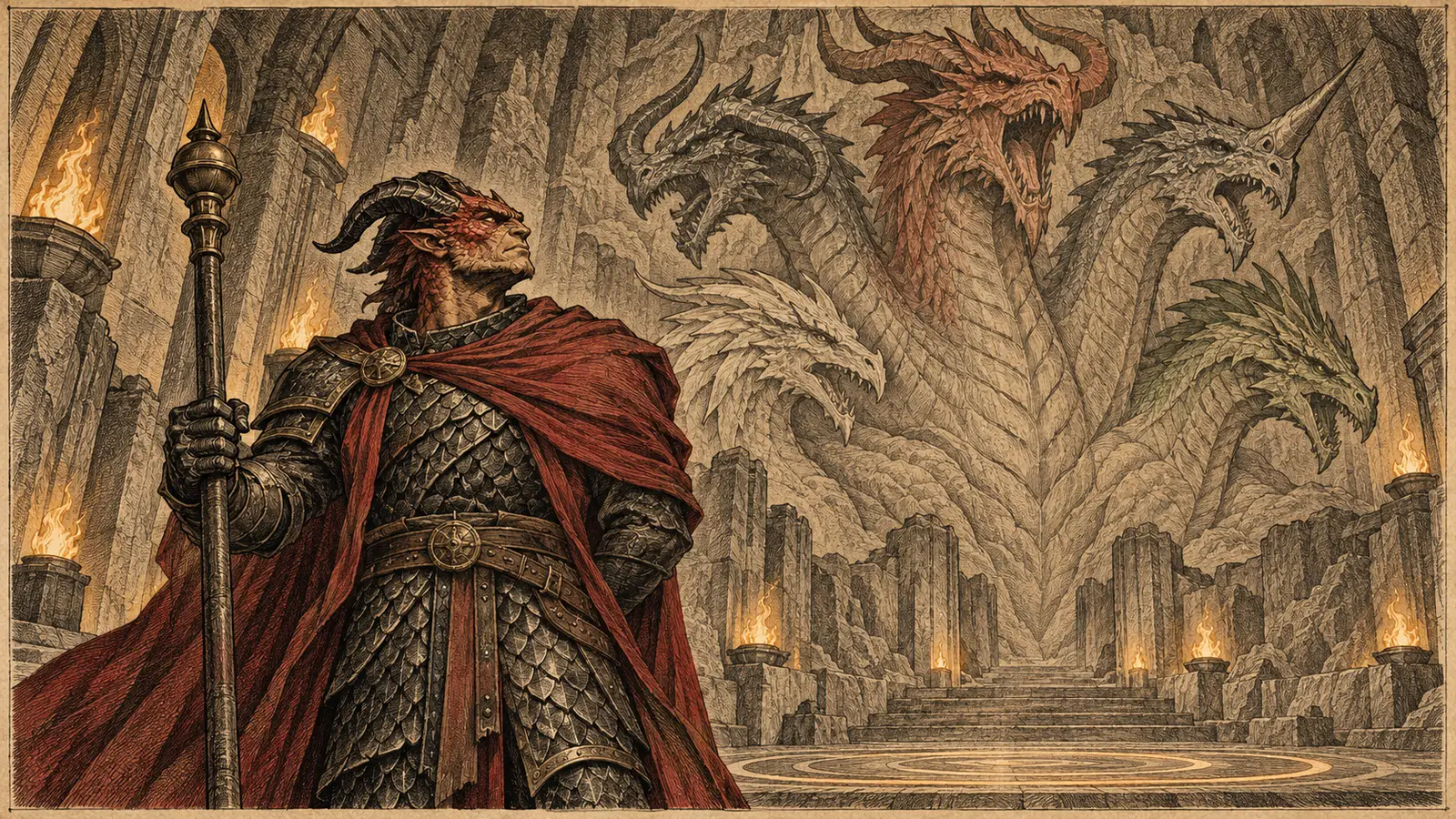
Picture her as those first players might have. She is vast. Five long necks rise from one body, and each ends in the head of a different dragon. There's a white head, cold and pale, and a black head that drips acid. There's a green head that breathes poisonous gas, a blue head crackling with lightning, and a red head with fire behind its teeth. Down her body run stripes of all five colors, as though each head had painted its own hue along her flanks. Behind her trails the long, lean tail of a wyvern, the lesser cousin of dragons, ending in a stinger full of poison. Each head carries the breath and the powers of its own kind of dragon, and all five can act together.
Where did she live? Not in any Hell, not yet. The words of that first book were simple. "Her major abode is in a stupendous cavern far beneath the earth." You can imagine it: a vault of stone so large its roof is lost in darkness, deep below the roots of the mountains, where the only light comes from her own breath. "Her guard consists of five dragons, each of largest size, of the five Chaotic types of dragons." So around her, in that cavern, lie five enormous dragons, one of each color, her guards and her court.
And what did she want? The book gave her purpose in one line. "Her major aim is to spread evil." It's a very early sentence, from a time when a monster's motives could be summed up quickly, and it would take many years and many writers to fill in what that evil looked like and why she pursued it.
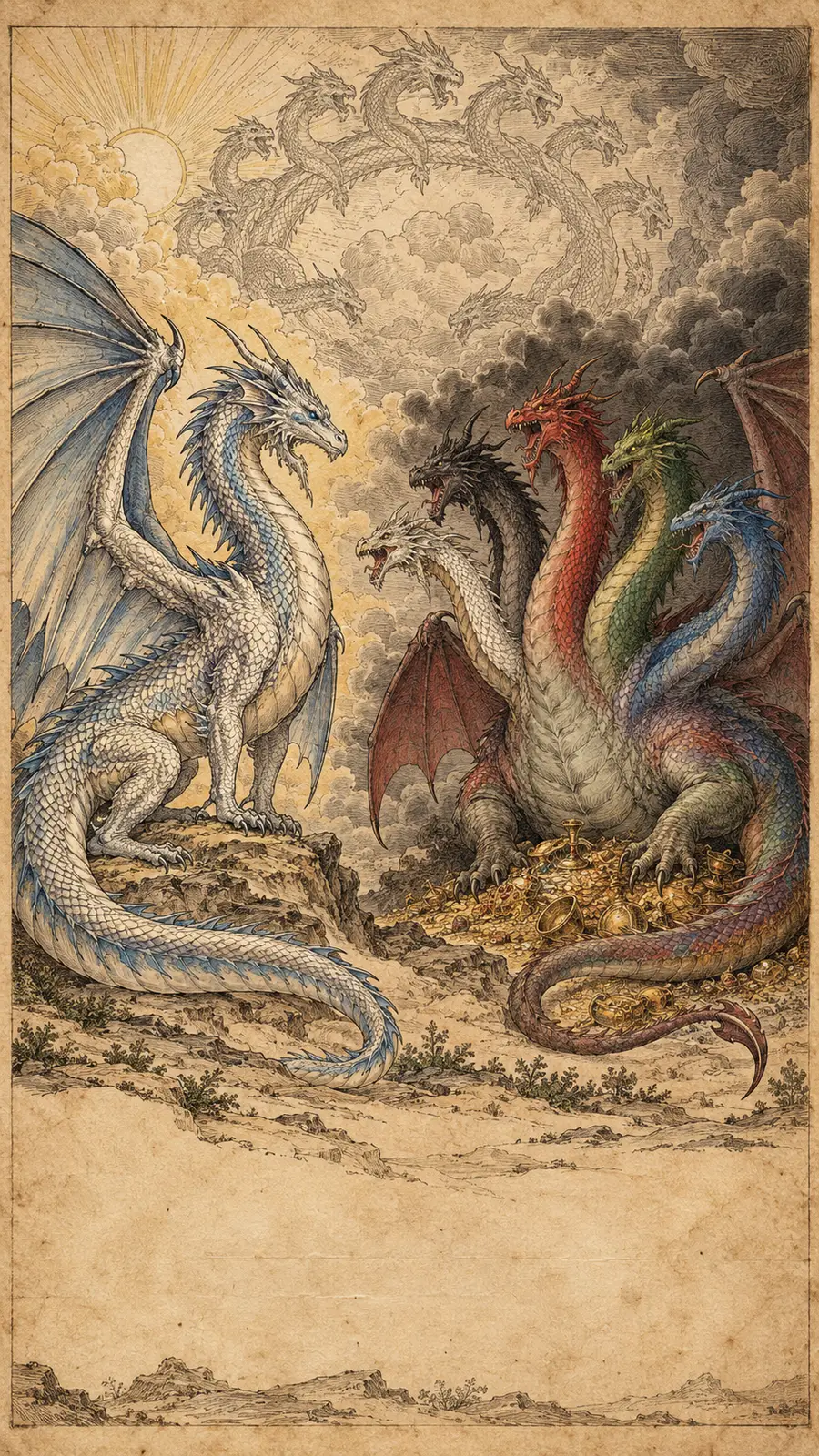
Standing opposite her in the same pages was her counterpart, the Platinum Dragon. He was king of the Lawful dragons, and he lived somewhere far more distant and fair, in a great palace behind the east wind, attended by seven gold dragons. His main purpose was to oppose, confront and defeat the Dragon Queen and her Chaotic hosts. So from the very first moment the two appeared, they appeared as a pair. There was never a Dragon Queen without a Platinum Dragon standing against her. He would later be named , and their rivalry would run through every edition that followed, and in time it would become a family story as well.
It's pleasant to notice how the Babylonian roots and the new invention were already sitting side by side, though neither yet knew about the other. The old Tiamat had been a mother who birthed dragons and serpents out of chaos. This new Dragon Queen ruled over dragons and dwelt in the dark beneath the world. The five heads, the five colors and the wyvern's tail belonged entirely to the game. Nothing in the old poem gives Tiamat five heads. That idea was born in Wisconsin, out of the plain logic of a game that had five kinds of evil dragon and wanted one creature to crown them all.
For a year or two, that is all she was: a name on a page, a queen beneath the earth, and a challenge for the boldest players at the Greyhawk table. But the game was growing into something larger. Its creators were preparing a new and more complete version, with hardcover books and a whole structured cosmos of planes beyond the world. When that version came, the Dragon Queen would get her name, and she would move house.
Chapter III
A name and a throne in Hell
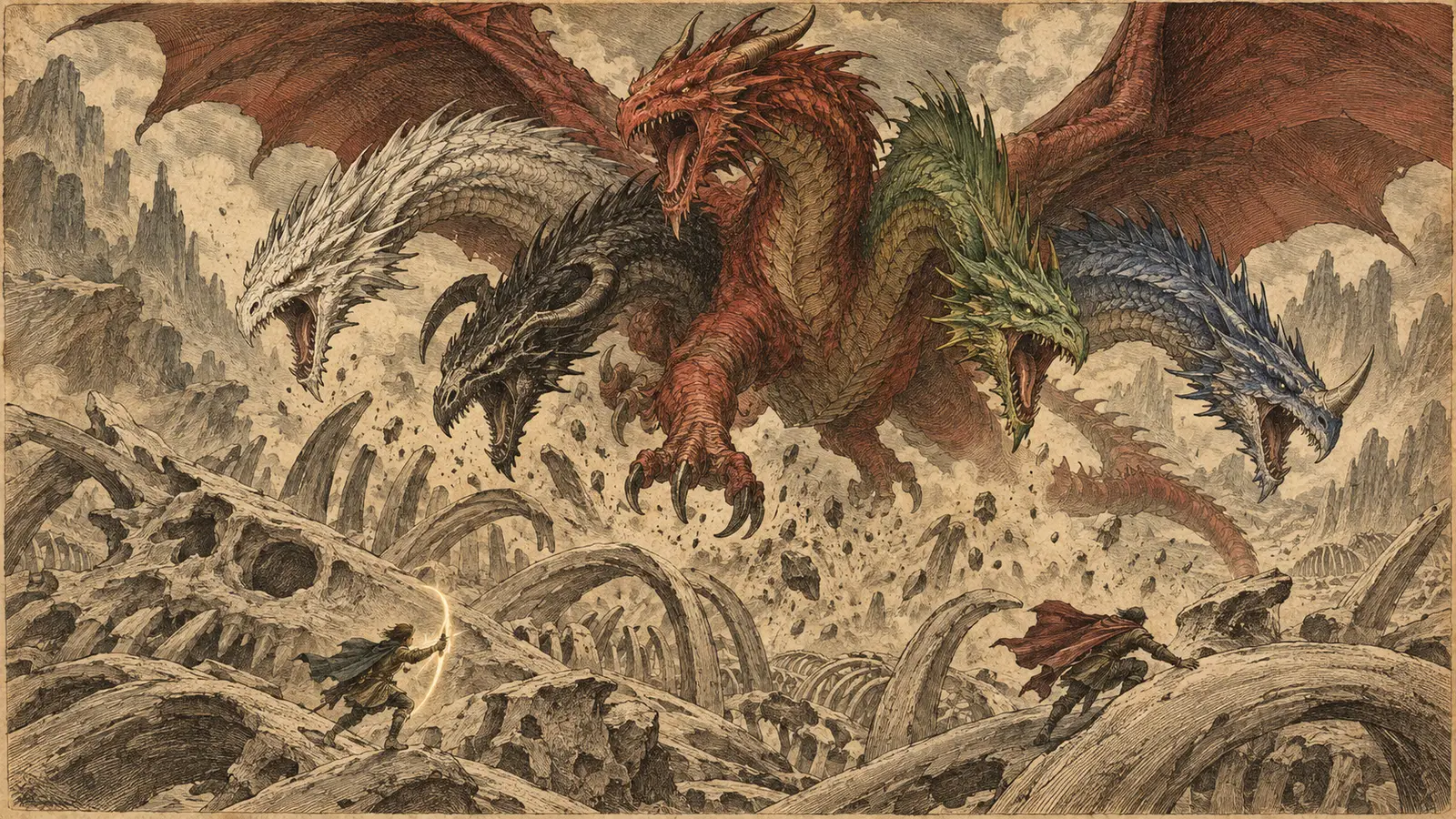
We turn now to the first edition of Advanced Dungeons & Dragons, which began in 1977 with a hardcover book called the Monster Manual. Gary wrote it, and it was the first of the great hardbound books for the new game. When readers turned to its entry on the Chromatic Dragon, they found that the Dragon Queen finally had a name. She was called , after the dragonlike Babylonian goddess of the salt waters. The Platinum Dragon, on the facing page of her story, became , king of the good dragons, associated with the Seven Heavens.
With the name came a new home. No longer did she dwell only in a cavern beneath the earth. The Monster Manual said that Tiamat "rules the first plane of the Nine Hells where she spawns all of evil dragonkind." In a single line, she was set in the uppermost layer of the realm of devils, and given a role as the mother and maker of every evil dragon in existence. Those two ideas, the throne in Hell and the spawning of dragonkind, have stayed with her ever since.
She was seldom seen outside her lair, the book said. She kept to it almost all of the time, and ventured out only rarely. When she did come up to the world, it was to place a new dragon somewhere in it, or to seek more treasure. It's a quietly evocative image: every so often, a vast shape rises out of Hell and comes to earth, sets down a new dragon in some wild mountain range like a gardener setting a seedling, gathers up a hoard, and goes home.
The Monster Manual also sharpened the picture of how she fought. She was so huge that she couldn't bother with claws. Instead she could bite with all five heads at once and sting with her tail at the same time, the wyvern's barb full of poison. Or each head could breathe, or cast spells, alongside the others. The bites grew stronger from head to head, weakest in the white and strongest in the red, and the spells grew in power along the same line, from white up through black and green and blue to red. Each head's breath matched its color, frost and acid and gas and lightning and fire, and each was as strong as the breath of a huge, ancient dragon of that kind. She was a creature of order in her own way, her powers arranged in a neat ascending scale from one end of her crown to the other.
In this first book, it's worth noting, she was still a monster. She had statistics that a party of very powerful adventurers could, in principle, measure themselves against. She wasn't yet a goddess. But that was about to change.
In June of 1980, in the pages of Dragon magazine, a writer named Len published an article about rethinking the mighty dragon. In it he said plainly what the game had only hinted at: that Tiamat and Bahamut were divine. He called her "the Chromatic Dragon, Queen of Evil Dragonkind," and urged that she be treated as a deity. He described her as an arch-devil, a great lord among the powers of Hell, and gave her a set of powers she could call upon at will, among them the raising of the dead and the ability to teleport. It was the first time anyone had said outright that the Dragon Queen was more than a monster.
That same year, TSR published Deities & Demigods, a great hardcover gathering of gods and heroes from real-world mythologies and from fiction. Tiamat had no entry of her own there. But in the section on the gods of Babylon, in the entry for , a short line appeared. "His battles with Tiamat are legendary." And beside that section was an illustration by the artist Diesel, showing Marduk locked in combat with a dragon. With that line, the game's Dragon Queen and the ancient mother of the salt sea were formally joined. The name borrowed from the old poem had brought its old enemy along with it.
Three years later, a young Canadian writer named Ed Greenwood turned his attention to the Nine Hells. In the summer of 1983, Dragon magazine ran his article "The Nine Hells," in two parts. It was the first time the layers of Hell had been named and described in real detail, and the names he gave the first five have lasted: , Dis, , and . Greenwood had written these ideas for his own home campaign, the world that would become known as the Forgotten Realms, but Gygax gave the article his blessing, and for years it was treated as the standard picture of Hell.
In Greenwood's Hell, the topmost layer was Avernus, a place where the lesser devils without great titles made their homes. And Avernus had a ruler, of a kind. "Avernus is nominally ruled by Tiamat," he wrote, who "holds Avernus through the support of , but her actual authority extends only as far as her physical reach."
It's a lovely, knowing sentence. It tells you a great deal about her place in Hell in very few words. Asmodeus, the King of the Nine Hells, sits far below on the ninth layer, , and it's his favor that lets Tiamat hold her title. She is a queen by permission. Wherever she stands, her word is law, because nothing wishes to argue with five dragon heads at once. But beyond the reach of her necks and wings, Avernus goes on about its business. It's a portrait of a proud and dangerous creature who rules the ground beneath her claws, and knows it, and perhaps resents knowing it.
Then in 1987 came the Manual of the Planes, written by Jeff Grubb, which laid out the whole cosmos of the game in one book. Grubb gave Avernus a special role. It was the only layer of Hell that touched the Astral Plane, the silver void between worlds. So anyone who wished to enter Hell, whether as a visitor or an invader, had to come in through Avernus first. It was the front door.
And standing at that front door was Tiamat. "The watchdog of the Hells' front parlor is Tiamat," Grubb wrote. And more: "Tiamat, the Lady of Dragonkind, guards the only known entrance to the next layer. It's only through her lair that one can arrive in the verdigrised plains near the Iron City of Dis."
Verdigrised plains, the green-crusted color of old copper. You can almost see them, stretching away beyond her caves toward the dark iron walls of the city of Dis. Grubb had given her a job. She was the guardian of Hell's first descent, and the only road down into its deeper layers ran through her home. Whoever wished to go further had to pass the Lady of Dragonkind.
So by the end of first edition, a great deal had come together. She had a name from the oldest story of creation. She had a rival, now called Bahamut. She had a home in Avernus and a title that was grander than her actual power. She was the mother of evil dragons, and more and more, she was spoken of as divine. And she guarded a door.
But we've moved a little ahead of ourselves, because while the books were placing her in Hell, a very different version of the Dragon Queen had taken wing on television, on Saturday mornings, before an audience of children who had never opened a rulebook.
Chapter IV
The dragon of Saturday mornings
In the autumn of 1983, the Dungeons & Dragons cartoon premiered on CBS. It was made by Marvel Productions together with TSR, and the animation was done in Japan by Toei Animation. Mark Evanier developed and wrote it, with a team that later included Michael Reaves, and Gary consulted on it. It ran for three seasons and twenty-seven episodes, and for many people who grew up in those years, it was the first time they ever heard the name .
The premise was simple and a little wistful. Six young people climb aboard a carnival ride called "Dungeons & Dragons," and the ride carries them away into a world of magic and monsters known only as the Realm. There they meet a small, cryptic old man called the Dungeon Master, who gives each of them a role and a magical weapon. Hank becomes the Ranger, with a bow of light. Eric is the Cavalier, Presto the Magician, Sheila the Thief with her cloak of invisibility, Diana the Acrobat, and little Bobby the Barbarian. Every episode, they search for a way home. And every episode, they are thwarted, most often by the villain of the show, an evil wizard named , who wants their weapons for himself.
Venger was the great enemy. But even Venger was afraid of something.
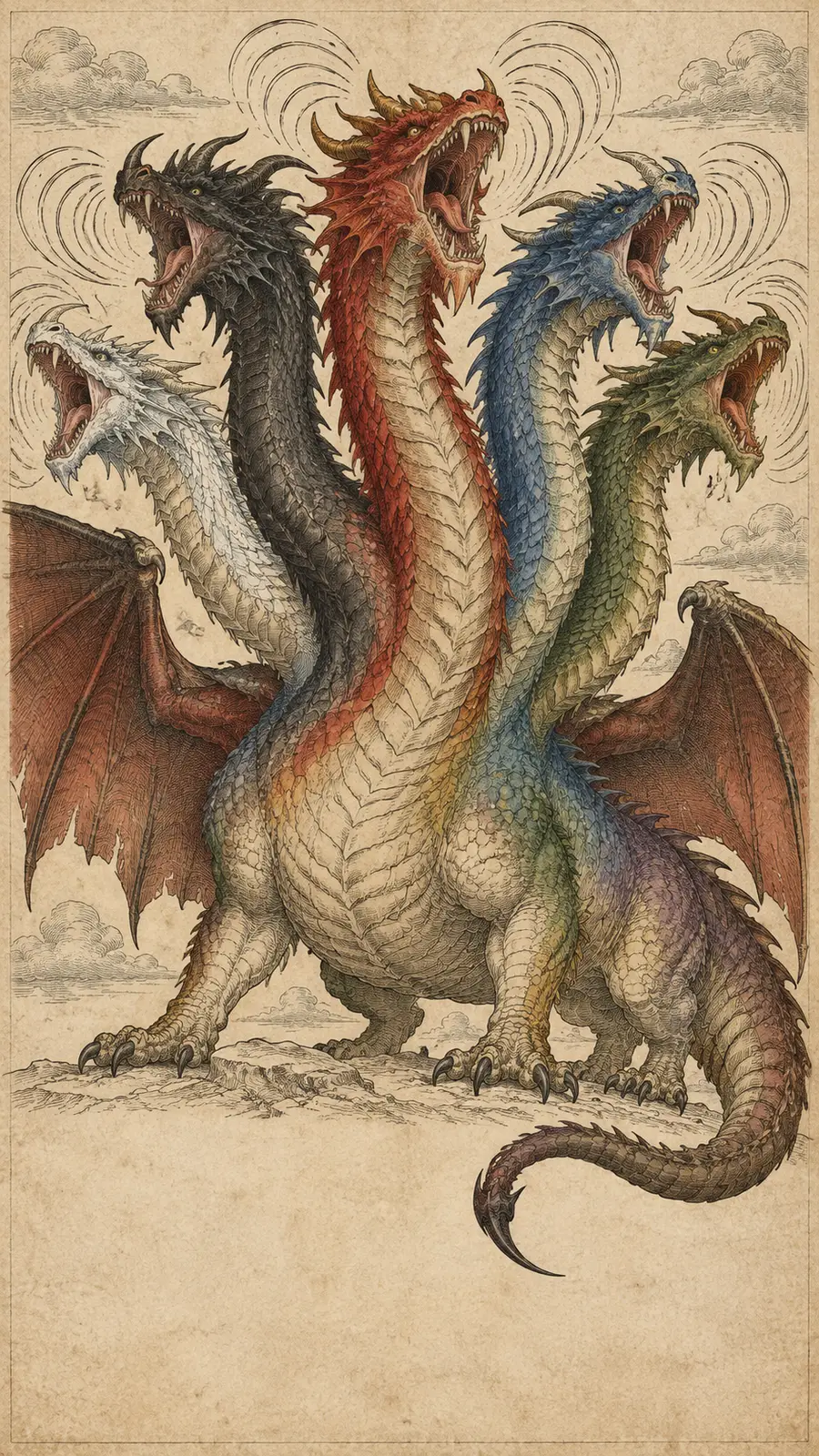
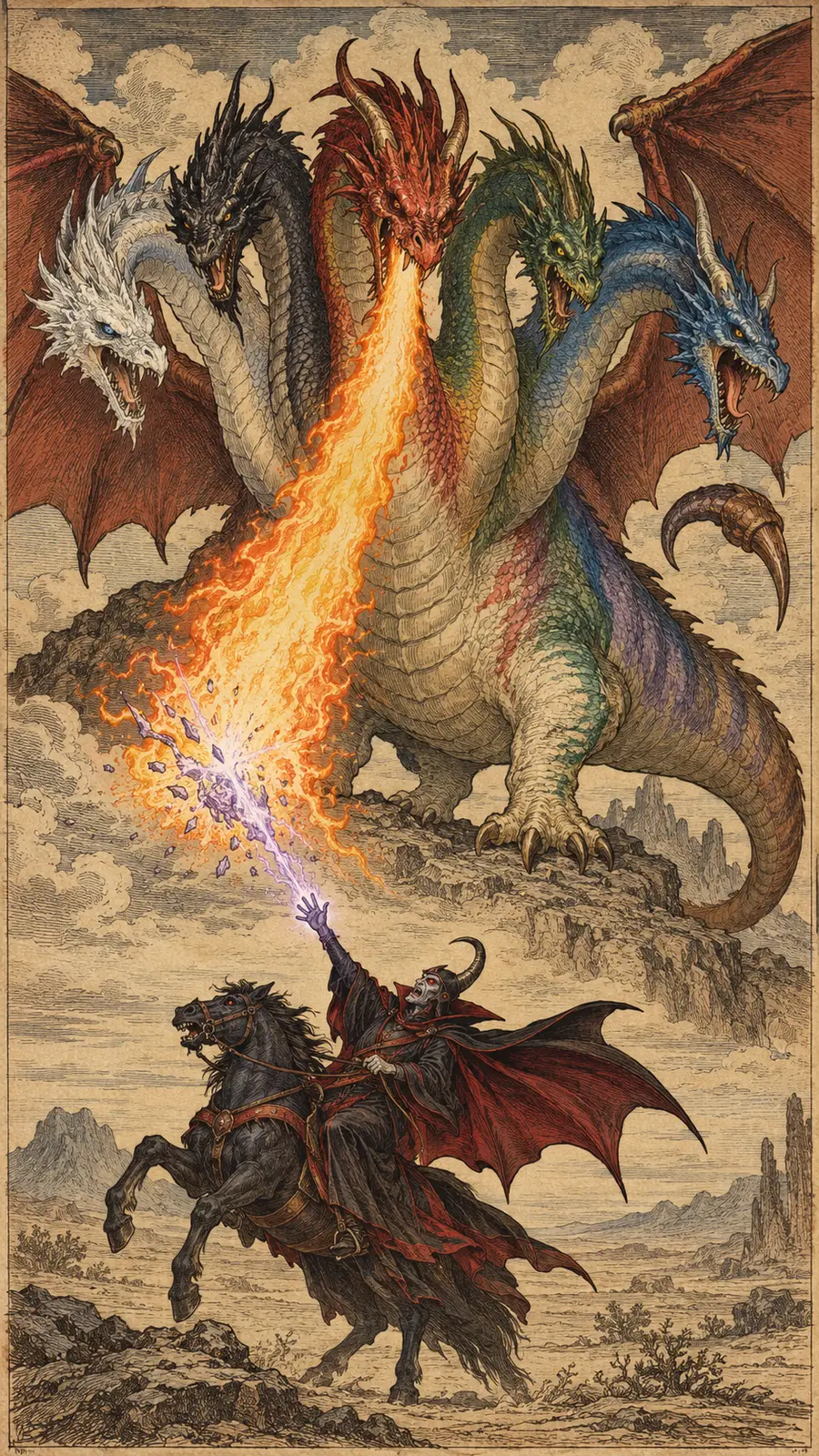
Tiamat, in the cartoon, is the most powerful creature in the Realm, and the only being that Venger fears. She is a vast five-headed dragon, and each of her heads is its own color with its own breath. The white head breathes ice, the green poisonous gas, and the red head, in the center, breathes fire. The blue head breathes lightning, and the black head acid. And she has a voice unlike anything else on the show, screeching and layered and echoing, as though five throats were speaking at once. That voice belonged to Frank Welker, who was given an "And Starring" credit for the role.
In the cartoon she is no goddess with temples and priests. She's something wilder: a force of nature, hostile to everyone, to the children and to Venger alike. She hates Venger more than she hates the children, and he has lost magical duels to her before. She is the one power in the Realm that answers to nobody.
She came into the show only a handful of times, in perhaps five episodes. She appears in the very first one, "The Night of No Tomorrow," in which Presto, tricked by Venger, casts a spell meant to open a way home that instead calls down fire-breathing dragons on the town of Helix. She appears in "The Hall of Bones," where the children travel to recharge their failing weapons and Venger, by one account, tries to use those weapons to make himself Tiamat's master, and fails only because their power has run too low. And she appears in "The Box," a story about a magical box that opens doorways to many places.
Her most remembered moment is an episode from the second season called "The Dragon's Graveyard," written by Michael Reaves. At its start, Venger has foiled yet another attempt to go home, and the children have had enough. They decide to stop running and put an end to him. Hank, the steady leader, is the angriest of all. They ask the Dungeon Master where they might find help against Venger, and he tells them of the one creature Venger fears, and where she can be found.
Tiamat has several lairs, but this one is special. It's the Dragon's Graveyard, a place where the eldest of dragons go when they are ready to die. The children pass through a magical portal into it, a landscape of enormous old bones. There they find a sword that can split stone and a curving horn shaped like a cornucopia. Presto, being Presto, blows the horn. And Tiamat comes.
At first she attacks them, believing them to be thieves come to rob the dead. But when they speak Venger's name, she stops. She tells them something they did not know. Their Weapons of Power, she says, came from this very graveyard, and their strength is great enough to destroy Venger. With her help, they lure him there for a final reckoning.
And then the episode does something unusual for Saturday morning. The plan works. Presto traps Venger in a way that means he will die if Hank simply does nothing and walks away. And Hank, at the end of all that anger, chooses not to let him die. He spares Venger. The Dungeon Master, who had been uneasy with their plan all along, is moved by their mercy. In the real world, the script had nearly been cancelled, because a children's show in those years was not supposed to have its heroes set out to kill anyone. What survived was a story about a group of frightened young people who went looking for the most terrible dragon in the world, borrowed her strength, and then put it down.
The show was cancelled before it could finish its tale. A final episode called "Requiem" was written by Michael Reaves but never animated. It would have revealed much about Venger's past and brought the children to a last choice between going home and staying to fight. Years later it was recorded as an audio drama and included with the complete series on DVD. Wizards of the Coast also made a small hardcover handbook for that set, adapting the cartoon's characters, Tiamat among them, into the rules of the game.
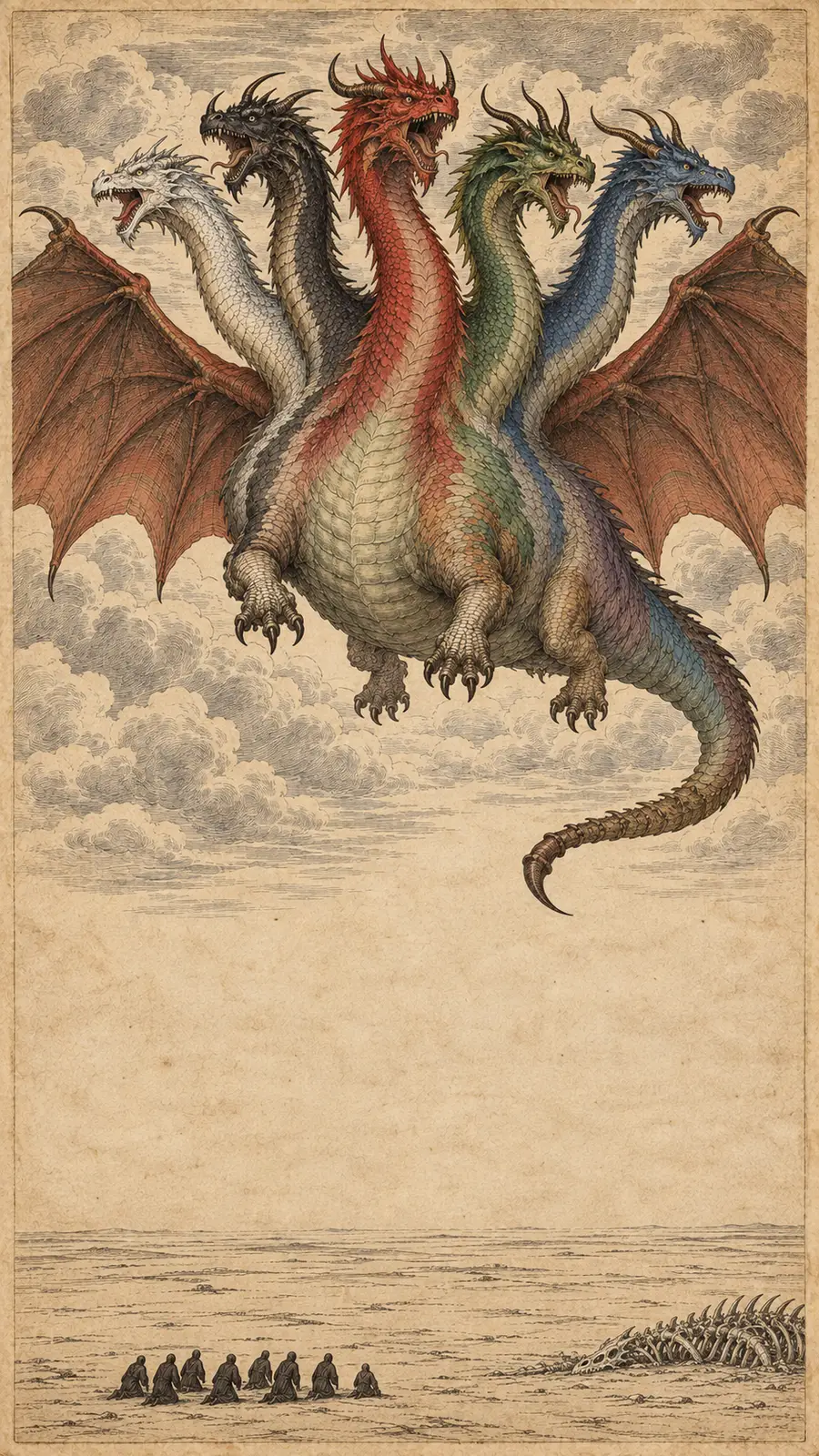
The Tiamat of Saturday mornings had the same five heads and the same five colors as the Tiamat of the rulebooks. But she was not a goddess and not a queen of Hell. She was the great wild dragon at the edge of the map, the thing even the villain feared, and she lived among the bones of her ancestors. Many people carried that image with them for the rest of their lives.
Meanwhile, in the offices of TSR, another group of writers had been dreaming about dragons too. They were building a whole world around them, and in that world, the Dragon Queen would wear a different name.
Chapter V
The Queen of Darkness on Krynn
We come now to , the world of Dragonlance, and to one of the longest and most beloved stories in the game's history.
In 1982, a young designer named Tracy Hickman proposed to TSR a series of three adventures built around evil dragons. The project was developed under a code name, Project Overlord, and it soon drew in a small team: Harold Johnson, who championed the idea to TSR's management and pushed it to grow beyond a trilogy, the artist Larry Elmore, and Jeff Grubb, among others. The first adventure, Dragons of Despair, appeared in 1984, and it began a series of sixteen that ran for four years. Alongside the adventures came novels, and the first of them, Dragons of Autumn Twilight, written by Margaret Weis and Tracy Hickman, was published that same year. It was in that novel that readers first met , the Queen of Darkness.
Takhisis is the chief of the evil gods of Krynn, the head of what is called the Dark Pantheon. She has a family. She is the sister of , the Platinum Dragon, god of good, and of , the god of neutrality and knowledge. She is consort to Sargonnas, and mother of Zeboim, the goddess of the sea, and of Nuitari, the god of dark magic and the black moon. She is the goddess of control, and of evil, and above all of pride.
The peoples of Krynn know her by many names, and each name tells you something about how she has appeared to them. The elves call her the Dragon Queen. The barbarians of the plains know her as Nilat the Corrupter. The dwarves call her Tamex, the False Metal. In the old empire of Ergoth she is Mai-tat, She of Many Faces, and if you move the letters of that name around, you'll find the name hiding in it. The Knights of Solamnia call her the Queen of Many Colors and None. She is also the Dark Queen, Lady Chaos, the Dark Warrior and the Shadow Sorcerer, and in some tongues Tii'Mhut, another quiet echo of the older name.
Her true form is a great dragon with five heads, blue and black and white and red and green, and it has its own lovely title, the Dragon of All Colors and None. But she doesn't always wear it. Her favorite form is that of the Dark Temptress, a beautiful woman in silken robes and a jeweled headdress. She sometimes appears as the Dark Warrior, a menacing figure in scale armor as black as midnight. And her avatars might come as a giant serpent, or any many-headed beast, a hydra or a leviathan.
Even the sky of Krynn remembers her. Among its constellations is one called the Queen of Darkness, also known as the Five-Headed Dragon. Across the heavens from it shines the constellation of Paladine, the Valiant Warrior, also called the Platinum Dragon. In the old stories of Krynn, the stars of the gods are the gods themselves, set in the sky. And at the opening of Dragons of Autumn Twilight, the people of Krynn look up and find that both constellations are gone. The Queen of Darkness and the Valiant Warrior have left the sky, which can only mean that they have come down to the world.
Krynn has its own tale of how dragons began. In the Age of Dreams, at the dawn of everything, Takhisis was Paladine's mate and his equal. Together they forged the first beings of creation, the dragons, and they made them out of chaos. But Takhisis grew jealous. Before the chromatic dragons were finished, she stole them away into the Abyss, and there her evil corrupted them. So the evil dragons of Krynn are, in a sense, unfinished children, taken from their making and raised in the dark.
Long before the novels begin, Takhisis tried to conquer the land of Ansalon in what was called the Third Dragon War. It was then that the most famous hero of Krynn's history, a Knight of the Crown named , rode against her. He carried a dragonlance, a shining weapon forged by the smith Duncan Ironweaver, and he drove it into the heart of one of her aspects. Then he made her swear, "by the High God," to leave Krynn and never enter it again. She was banished to a prison in the Abyss, a place called the Abthalom. The tale of Huma became Krynn's great legend, sung for centuries after.
But oaths can be circled around, and Takhisis is patient.
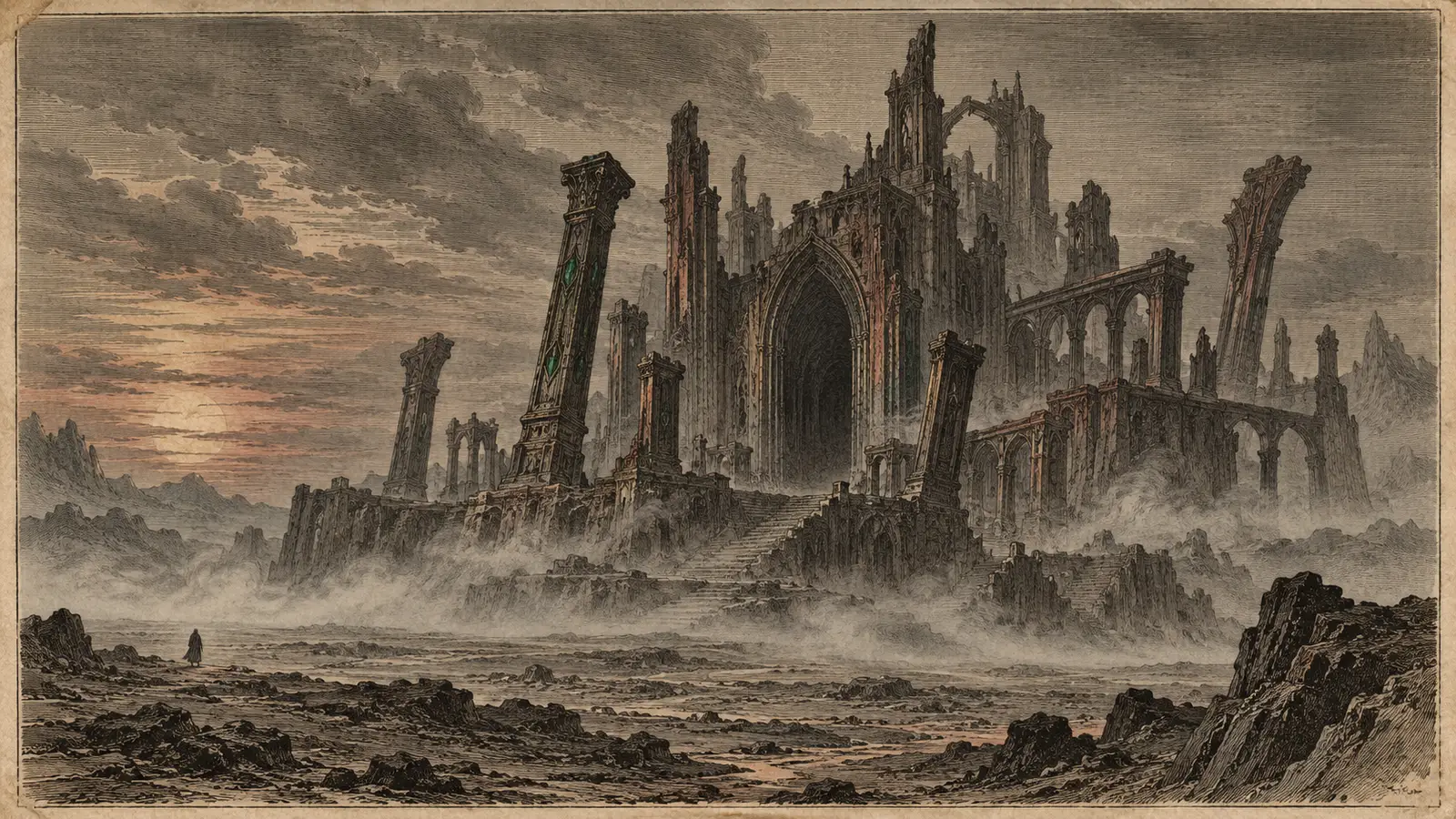
Many centuries later, the great city of was destroyed in a catastrophe from the heavens, and the Foundation Stone of its Kingpriest's temple fell all the way into the Abyss. Takhisis found it. She pushed it back up and out onto the plains of , and there it grew, slowly, into a twisted mirror of the temple it had once supported. It became the Temple of Darkness at Neraka, and through it, she meant to return.
A man named Berem found that temple before it was finished, when its pillar was still set with emeralds. He tried to pry one loose. His sister Jasla, who was with him, fell and struck her head on the stones and died. The emerald fused into Berem's chest, and from that day he could not die. He became Berem the Everman, the Green Gemstone Man, wandering the world with a jewel in his heart. And the stone in his chest was the missing piece. Without it, the door through the Foundation Stone would not open fully, and the Queen of Darkness could not come through. So her armies hunted him, across years and across the whole continent.
Those armies were the Dragonarmies, and they were led by Dragon Highlords under the Emperor Ariakas. Among the Highlords were the cruel Verminaard and the brilliant, restless . And fighting beside the Highlords were creatures that Takhisis had made in a way that is among the darkest turns in the story.
Her forces had stolen the eggs of the good dragons, the metallic dragons of gold and silver and bronze and copper and brass. The good dragons, to get their children back, swore an oath not to take part in the war. And Takhisis broke her side of the bargain almost at once. The eggs were given to a ritual performed by the black-robed wizard Dracart, the priest Wyrllish and the red dragon Harkiel, and they were corrupted. What hatched were the draconians, winged soldiers with scales. Each kind came from a different kind of egg. From brass eggs came the baaz, from copper the kapak, from bronze the bozak, from silver the sivak and from gold the aurak. A single egg could yield dozens of them. When the truth was finally discovered, the good dragons came into the war after all.
The war ended at Neraka, where Ariakas summoned his Highlords to witness the Dark Queen's return. Berem found his way to the jeweled column where his sister had died so long before. He threw himself upon it, and his blood ran over the stones. His spirit joined Jasla's, and it turned out that she had been there all along, holding the Dark Queen back. The door slammed shut. The Temple of Darkness fell, and Takhisis was thrown back again.
After the War of the Lance, the Queen of Darkness returned to her place in the night sky of Krynn, and her five stars shone there once more.
Her story went on. In the Legends trilogy, which ended in 1986, the wizard , the most gifted and most troubled of the heroes, set out to become a god himself. With the cleric Crysania at his side, he opened the Portal to the Abyss and went to fight the Queen of Darkness for her seat. His twin brother and the small, curious kender traveled forward in time and found a future where Raistlin had won. Both Paladine and Takhisis were defeated, an hourglass shone alone in the sky, and the world had been left grey and empty. It is one of the saddest images in the series, and it helps turn the story back toward home.
In 1995, Dragons of Summer Flame brought new changes. A new order of knights had arisen in her name, the Knights of Takhisis, founded by Ariakan, the son of Ariakas. They were disciplined, honorable in their own fashion, and utterly devoted to her. Among them was Steel Brightblade, the son of Kitiara. Then the Irda, an ancient people, broke open a stone called the Graygem of Gargath, and Chaos itself was freed. In the war against Chaos that followed, Takhisis did something no god of Krynn had imagined. She stole the world. She took Krynn away from the other gods and hid it, and the Age of Mortals began, a time when the gods seemed silent and great Dragon Overlords ruled the land.
Stealing the world had weakened her, though, and she withdrew into the Abyss to recover. There she found a slumbering godling and woke it. That godling grew into a girl named Mina, with amber eyes, who was raised on the isle of Schallsea by people who were Takhisis's own enemies, which amused the goddess greatly. When the time came, Mina went out into the world and worked miracles in the name of a new, unnamed "One God." That One God was Takhisis.
This was the War of Souls, told in a trilogy of novels in the early two-thousands. Before its end, Takhisis killed Raistlin in the Abyss, and meant to kill him and bring him back every day forever. Paladine, remembering an old sacrifice Raistlin had made, granted him a long sleep instead. And at the last, Paladine gave up his own godhood and immortality, so that the balance of the world would require her to lose hers too. He became a mortal elf. Takhisis, now mortal as well, was struck down by the young elf king Silvanoshei with a broken dragonlance. Mina carried her body away and laid it to rest in the mountains.
And now a question that the people of the game have asked for decades. Is Takhisis the same being as Tiamat?
In the planes beyond, the sages noticed the likeness long ago. Both are five-headed dragons. Both have a Dark Lady form. Both rule over evil dragons and share much of their nature. Yet Tiamat's great sin is avarice, and Takhisis's is pride. Some sages said they were one goddess known by two names. Others said they were entirely different beings who happened to look alike. Still others said that one was the avatar or reflection of the other. For many years that question was simply left open. Jeff Grubb, who had worked on Dragonlance from its beginning, always held that they were one. Tracy Hickman and Margaret Weis long treated them as separate.
Later books came down on Grubb's side, as a deliberate retelling. The fourth edition dragon books said Takhisis was Tiamat, and the fifth edition's Dungeon Master's Guide repeated it. In 2021 the fifth edition made it firm: on Krynn, is known as Paladine and Tiamat is known as Takhisis. In the Dragonlance adventure Shadow of the Dragon Queen, published in 2022, Takhisis is described as "known as Tiamat on other worlds," banished from Krynn more than a thousand years before. That adventure begins at a kingfisher festival in the fishing town of Vogler, which the Red Dragon Army attacks in the Dragon Queen's name, and it goes on to the defense of the city of Kalaman. Her servants are there, the cleric Kansaldi Fire-Eyes and the death knight Lord Soth among them. Takhisis herself appears at most as a vast, glowering face in the sky over the final battle.
Whatever you decide about the two queens, Krynn gave the Dragon Queen something she had never had before: a whole mythology, a family, a history of oaths and betrayals, and a world that looks up at night and sees her stars. Now we leave the skies of Krynn, and return to the wider cosmos of the game as it entered its second edition, where Tiamat was about to be given a family of her own and a great deal more.
Chapter VI
Goddess, family and the gate of Avernus
The second edition of Advanced Dungeons & Dragons began in 1989, and during the dozen years that followed, grew from a fearsome monster into a fully described goddess. Three lines of books built her up, each from a different direction: a book about the gods of monsters, the planar setting called Planescape, and the Forgotten Realms.
One small change in wording sets the tone. In second edition, the Nine Hells were given another name, , and devils were called baatezu. The places and the creatures were much the same, but the words were new, and they had a stranger, older sound.
In 1992 came Monster Mythology, written by Carl Sargent, a book about the gods worshipped by the game's nonhuman peoples. In it, the dragons received a whole pantheon. There was Io, the great dragon god of creation, and around him Aasterinian, , Chronepsis, Faluzure, and Tiamat. Like most of the dragon gods, Tiamat was a child of Io. And Bahamut, the Platinum Dragon who had opposed her since that first supplement in Greyhawk, was now her brother. Their rivalry, which had begun as simple opposition, became a family feud. The hatred ran down to their followers too, who carried the same grudge.
This book also gave her a banishment myth. For a long time, the stories said, Tiamat lived on the Prime Material Plane, the world of mortals, seeding it with evil dragons and dark magic. Eventually Bahamut, together with a god of the sun or sky, drove her out and banished her to the Nine Hells. So her home in was no longer only a throne. It was also a sentence. She did not simply live in Hell, she had been sent there.
In the same book she keeps five great consorts, one ancient dragon of each chromatic color, in the uppermost layer of Hell. And she keeps an unusual relationship with the smallest of the dragon-kin. The kobolds, those little scaly creatures that swarm in tunnels and set clever traps, revere Tiamat as their creator, though they don't worship her as their god. Their own god is , and Kurtulmak is her servant. So the kobolds bow, in a sense, to the one who serves the Dragon Queen.
Tiamat was also one of the very first gods in the game to have aspects, lesser forms that could travel apart from her, carrying a fragment of her power. That idea would grow and grow over the years to come.
Then, from 1994, came Planescape, a setting about the great city of Sigil and the planes that surround it. Planescape was a setting in love with places, and it gave Tiamat's home in Avernus a name and a geography.
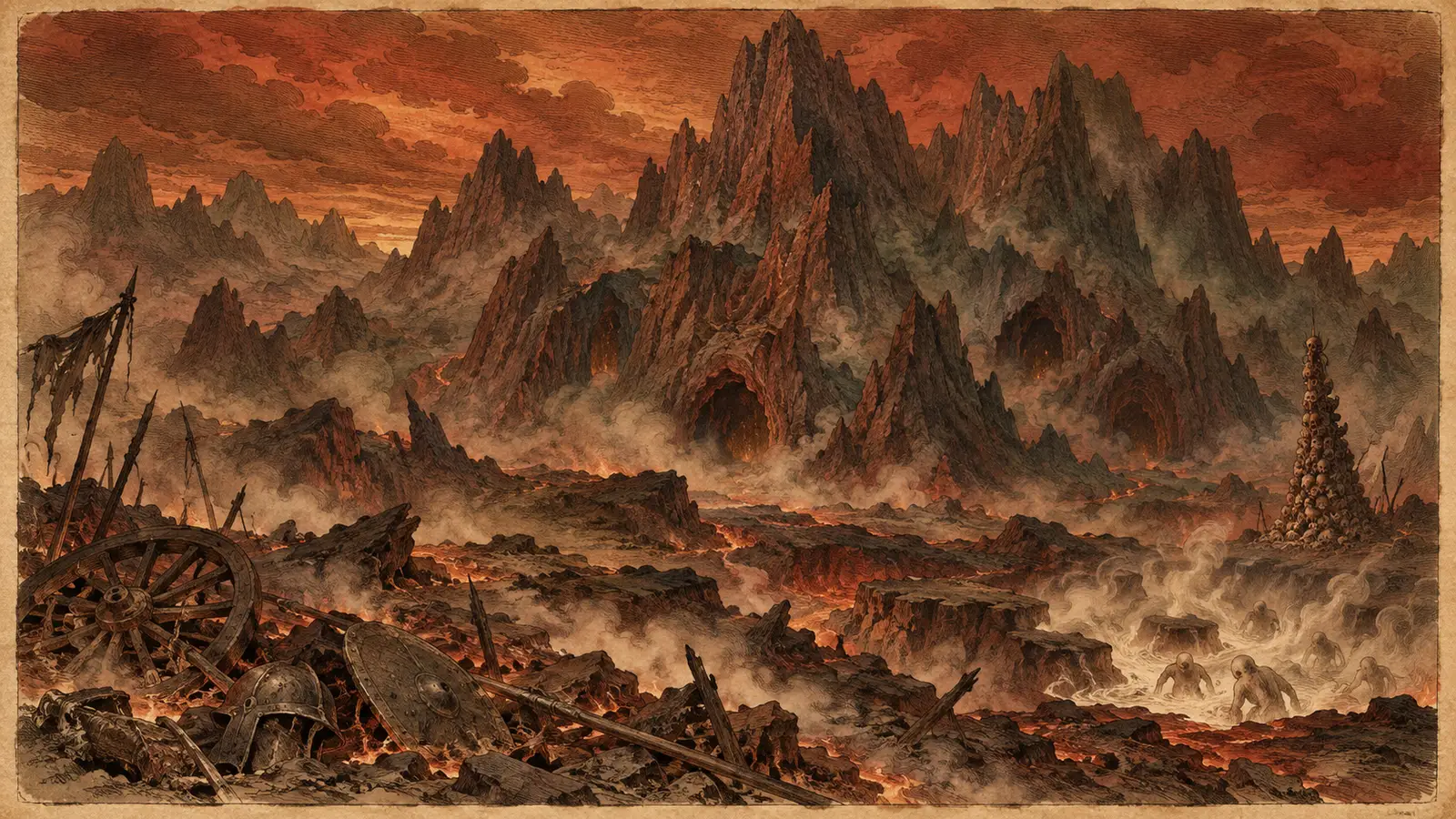
Her realm is called the Dragonspawn Pits of Azharul, or, among those who don't like to say the full name, simply the Lair. Picture Avernus: a blasted landscape of red rock and rust-colored sky, scarred by war and scattered with the wreckage of old battles. Among its hills rises a cluster of tall mountains, and inside one of them lies a great system of caves. That is Azharul. Nearby, as landmarks for travelers who dare come close, stand two terrible sights. One is a pillar made from the heads of liars, still in torment. The other is a pit of maggots, and from it crawl the lemures, the lowest and most shapeless of all devils, newly made from the souls of the damned.
The stories told of her caves in Planescape have a certain pleasing strangeness. They say the Lair is layered like an onion, winding ever deeper toward her five innermost chambers, one for each of her heads, and that there are many false lairs along the way to confuse intruders. Her hoard doesn't sit in one great pile. It lies scattered across the floors throughout the whole complex, coins and crowns and old weapons glittering in the dark. Her mates live there with her, and their descendants too, so that the mountain is less a palace than a warren full of dragons.
And her caves hold something even more important than treasure. The Planescape books kept the idea that Jeff Grubb had given her in the Manual of the Planes. Somewhere within Azharul lies the only known passage from Avernus down to Dis, the second layer of Hell. Tiamat guards it herself. Travelers who wish to go deeper must come before her and offer a worthy sacrifice, and only then will she let them pass. So the gatekeeper of Hell's first descent is also the collector of its toll. The planar books that told of all this included Planes of Law, in 1995, by Wolfgang Baur and Colin McComb, and On Hallowed Ground, a catalogue of the gods by Colin McComb the following year. By 1999, a book called Guide to Hell, written by Chris Pramas, described her as a resident power of Avernus, living there while one of the lords of the baatezu ruled the layer itself.
Her servants in Hell got a shape too. In 1994, a Planescape monster book introduced the abishai, devils with scales and wings who look something like small dragons themselves. They came in black, green and red, and they serve Tiamat. Their work is grim: they guard and escort the captives of the Nine Hells, prepare them for torment, and go out to corrupt mortals. Scholars of Hell rank them among the lowest of the lesser devils. But the abishai don't see it that way at all. They are arrogant, and they believe themselves to be Tiamat's purest children, above her other servants and above other devils entirely. They are fiercely conscious of rank, and will deal only with the abishai just above or just below them. The green abishai serve as her diplomats and envoys, sent out on her errands both inside Hell and beyond it. The red abishai are the strongest, share the red dragon's love of fire, and are quite sure that they are her chosen ones.
We come now to the third line of books, and to a world that had grown large and lively by this time: the Forgotten Realms.
In 1990, a Realms sourcebook called the Draconomicon first described Tiamat as a goddess of that world, . There, evil dragons have worshipped her for as long as their kind has existed, and the chromatic dragons are believed to be her spawn.
In the Realms she has a church, and the Church of Tiamat has one of the most wonderful hierarchies in the whole game. Its ranks rise like steps on a stair, and each has its own title. At the very bottom are the Custodians of the Copper Chalice. Then come the Defenders of the Silver Shield, the Wardens of the Electrum Mail, the Guardians of the Gold Scepter and the Keepers of the Platinum Crown. Every one of those first five ranks is named for a precious metal, which is to say, for the colors of Bahamut's dragons. Only above them do the chromatic titles begin: the Scales of the White Wyrm, the Horns of the Black Beast, the Wings of the Green Gargantua, the Talons of the Blue Baatoran and the Breaths of the Red Ravager. At the very summit are the Dark Scaly Ones. It's a quiet joke, and a pointed one. In Tiamat's church, the colors of her brother's dragons are only fit for beginners.
Her faithful believe that one day Tiamat will take her throne as the only goddess of the Realms, and that when she does, her dragon children will become its dukes. So the clergy compete with one another to become the vassals of dragons, and power and wealth come before everything. In the eastern lands of Unther and Chessenta, the church seeks raw power. In the west, it works to undermine a rival group, of which more in a moment.
The richest part of Tiamat's Realms history is tied to Unther, one of the oldest empires in . The book Powers & Pantheons, from 1997, set it out. Unther's gods were modeled on the gods of ancient Mesopotamia, and so, very fittingly, the Dragon Queen was their ancient enemy. There the old poem echoes most clearly. Long ago, the god slew her incarnation in Unther, just as he did in the Enuma Elish. In those days, while she was bound up in Unther's story, her realm lay in a place called Zigguraxus.
In this telling her portfolio is evil dragons, chromatic dragons, evil reptiles, conquest and greed. She is lawful evil, grasping and extremely vain, and she claims to have created all evil dragonkind. Her avatar is a gigantic dragon with five heads.
As the ages passed, Unther's gods faded and died, until the god-king Gilgeam ruled almost alone, and his rule turned to cruelty. His people suffered, and some of them, in their despair, turned to his oldest enemy. A cult in Unther called up an incarnation of Tiamat, a three-headed form, in the hope that she might free them from Gilgeam's tyranny.
Then came the Time of Troubles, a great upheaval in the Realms when the gods were cast down to walk the world in mortal forms. It is often called the Godswar. During it, Gilgeam challenged the three-headed incarnation and slew it. It had been a fairly weak form, and when it died, her divine essence scattered into three pieces. Each piece passed into a great chromatic dragon of the matching color: Tchazzar the red, Gestaniius the blue and Skuthosiin the green.
You might think that was the end of her in the east. It wasn't. Tchazzar the red hunted down the other two and consumed them, gathering all three fragments together, and in that gathering, the Dragon Queen was drawn back into herself. Restored, she looked upon Gilgeam and saw that he had been weakened, reduced almost to a demigod. She ambushed him outside his Ziggurat of Eternal Victory and destroyed him. Their war raged across the Outer Planes and through Unther itself, and much of the great city of Unthalass was destroyed. After Gilgeam's death, Ao, the overgod of the Realms, dissolved the old Untheric pantheon entirely. In later ages she was remembered as the slayer of Gilgeam, and given a proud title, Nemesis of the Gods.
But victory cost her. The war left Tiamat so weakened that, for a time, she stopped granting spells to her priests. Her temples called to her and received silence. It's a rare picture of the Dragon Queen exhausted, curled somewhere deep in her caves, gathering her strength.
We come finally, in this chapter, to that rival group in the west. In 1998, a book called Cult of the Dragon, written by Dale Donovan, told the story of one of the Realms' most famous villainous orders. Centuries before, a wizard named , misled by a figure called Algashon, misread an old prophecy written by a sage named Maglas. He came to believe that one day, "dead dragons shall rule the world entire." So he founded the Cult of the Dragon, devoted to making dracoliches, dragons who had passed through death into undeath. Some generations later, the great red wyrm Shargrailar became the first dragon to survive that change.
In second edition, the Cult did not worship Tiamat. It worshipped dead dragons, and its devotion belonged to dracoliches. The Church of Tiamat was its rival. By the time of the book, the two had become outright enemies, and since the Time of Troubles the Church had been quietly infiltrating the Cult. One splinter sect, called the Dragon Lords, had already turned to the worship of devils and served the Dragon Queen directly. That rivalry would not last forever. In a later edition, as we'll see, the Cult would read its prophecy again and find her waiting in it.
So at the close of the twentieth century, Tiamat was a goddess with a father and a brother, a banishment, a mountain full of caves at the gate of Hell, scaly devils who adored her, a church of eleven ranks, and a long and bitter war in the east. The next edition would take all of that and set it down in careful numbers, and it would give her a court.
Chapter VII
The lesser deity and her court
The third edition of the game arrived in 2000, published by Wizards of the Coast, which had taken over TSR a few years earlier. It was an edition that liked to measure things, and so the first question it asked about was: exactly how powerful is she?
The answer, given most fully in Deities and Demigods in 2002, written by Rich Redman, Skip Williams and James Wyatt, was that she was a lesser deity. The gods of third edition were ranked in tiers: demigods at the bottom, then lesser deities, then intermediate, and at the top the greater deities. Tiamat sat in the second tier. She was a true goddess, but not among the mightiest. Her titles were the Chromatic Dragon and the Queen of Evil Dragons, and her domains of concern were evil dragons, conquest, greed and cruelty. Her holy symbol was a dragon with five heads, white and black and green and blue and red.
That same book gave the most detailed portrait of her body that the game had yet offered, and it's worth lingering on, because it's rather more homely than you might expect. She has a fat, bloated body, blending the shapes of all five kinds of chromatic dragon into one. The color of each head runs down her neck and along her back and sides, so that she is striped from front to back in her five hues. Toward her hindquarters those colors fade and mingle into three bands of grey, blue-green and purple, and along her tail they turn a muddy brown, like paints running together in water. Her underbelly and her short, stubby legs are a greenish white, blending into the colors of her flanks. And her tail ends, as it always has, in the poisonous stinger of a wyvern. It's the portrait of something ancient and heavy, a creature who has lain on her treasure a very long time.
She still lives in , in the Dragonspawn Pits of Azharul, among those tall hills with the pillar of liars' heads and the lake of maggots nearby. She still keeps her five consorts, great wyrms of each chromatic color. But now the book gave her a court, and it gave her a feudal lord. Bel, the lord of Avernus, had assigned her three Dukes of Hell to command her armies. led forty companies of abishai. led twenty-nine companies of abishai. And Goap led three companies of erinyes, the winged fallen warriors of Hell. So Tiamat had her own host, and it was lent to her by the devil who ruled her layer, an arrangement that says a great deal about her standing there.
On the Material Plane, she had few clerics and fewer temples, and she accepted only evil clerics into her service. Their shared goal was simple and immense: to bring the whole world under the rule of evil dragons.
In 2003 came the Draconomicon, a large book about dragons written by Andy Collins, Skip Williams and James Wyatt. It told the story of the dragon gods again, and gave Tiamat and a new beginning. In this telling, Io, the great father of dragons, made one pair of children, a male and a female, one good and one evil, who between them held all the passions of dragonkind. They were Bahamut and Tiamat, and they were twins. Io intended for them to grow up together, learn from one another, and one day mate, so that their young would carry every trait of dragons in a single line. But their natures were too opposed. What Io had hoped would become a marriage became an endless rivalry instead. There's something melancholy in that story, a father's plan undone by the very differences he gave his children.
The idea of aspects grew in this edition. A book of rules for miniatures, in 2003, introduced aspects properly: beings that look exactly like a god, but hold only a small fraction of the god's power. They are closer to servants than to the goddess in person, fragments of her will set loose in the world. Aspects of Tiamat appeared again and again, in a miniatures set called War of the Dragon Queen, in the books Races of the Dragon and Dragon Magic, and in material released alongside a book about Hell. None of them was the true Dragon Queen. All of them were things that heroes of middling experience could meet and overcome, a way of touching her power without facing her whole.
Races of the Dragon, in 2006, written by Gwendolyn Kestrel, Jennifer Clarke Wilkes and Kolja Raven Liquette, told the kobolds' story of their own beginning. , their god, served Tiamat. One day he found one of her eggs, which had fallen from her nest. He judged that it had been gone too long to hatch on its own, and so he hatched it with magic. Out came the first kobolds, small copies of Kurtulmak himself. It's a charming story in its way, a little god rescuing a lost egg and finding his own people inside. The same book set the dragonspawn of Tiamat against the dragonborn of Bahamut, so that the rivalry of the twin gods ran all the way down to the creatures who served them.
That same year, Monster Manual IV gave many pages to the Spawn of Tiamat. The idea was that the Dragon Queen presses her power into the world by warping the offspring of chromatic dragons into new servants. The greenspawn razorfiend is lanky and crested, shaped something like a person, with wings that grow from its arms and fingers the way a bat's do. The bluespawn godslayer is made when Tiamat lays her blessing on one of her most trusted blue dragon lieutenants. It becomes a giant, wingless blue dragon standing upright like a warrior, carrying a huge blade and a shield made from a dragon's skull, and it exists for one purpose: to slay her most powerful enemies. Many of the spawn share a gift called Tiamat's Blessing, which protects the spawn around them, so that they fight best together, in mixed bands of many colors.
Also in 2006, near the end of the year, came a book called Fiendish Codex II: Tyrants of the Nine Hells, written by Robin D. Laws and Robert J. Schwalb. It retold Tiamat's place in Hell, and the new telling is a small tragedy of pride. Once, it says, Tiamat truly ruled Avernus as an archfiend, loyal to . Her task was to keep the outcast devils who gathered on that layer from becoming a danger. She failed at it. Asmodeus demoted her. But he did not cast her out or punish her. He let her stay in Avernus, as the guardian of the main gate to Dis, and left open the chance that she might win back her former place if she impressed him. So the old sentence from 1983, about ruling in name only, became a history. She had been queen, she had fallen, and now she kept the gate and waited to rise again.
That year also brought one of the best-loved adventures of the whole edition, Red Hand of Doom. In it, a great horde of hobgoblins called the Red Hand of Doom sweeps into a peaceful land called the Elsir Vale, and the horde worships Tiamat. Its leader is a half-dragon named Azarr Kul, the High Wyrmlord, who over twenty years grew into a mighty warlord and a priest of the Dragon Queen. Beneath him serve the Wyrmlords, who are his high priests. The adventure builds to a great battle at the fortress city of Brindol, and then moves on to the horde's holy place, the Fane of Tiamat. It lies inside a mountain that has been carved in the likeness of the Chromatic Queen herself. Imagine it, a whole mountainside shaped into five great heads. There, in the final confrontation, Azarr Kul performs a ritual to open a portal into her realm in the Nine Hells, and the heroes must stop him.
The Forgotten Realms went on developing her too. In the Realms books of this edition, she was one of the very few surviving gods of the old Untheric pantheon, and also counted among the dragon gods as Io's daughter. Scholars of the Realms wondered aloud about her nature. Her power, they suggested, equaled a lesser god's, and yet her origins were bound up with the Material Plane, which would make her a different kind of being from the gods who were born in the Outer Planes. She was something between a god and a very great dragon, rooted in the world she wished to rule.
The Realms also told more of that summoning in Unther, years before the Godswar. The aspect that the cultists called forth was known as the Dark Lady. It stirred up rebellion against the church of Gilgeam, and its influence had consequences reaching far to the west. It pushed , by then a lich, and his Cult of the Dragon to seek out an ancient magic called the Dracorage mythal, a great spell that could drive dragons mad. Years later, that same mythal became the heart of a dark season in Realms history, when Sammaster tried to twist it so that every dragon would be driven permanently mad unless it became a dracolich.
So third edition gave Tiamat a measured rank, a detailed body, a court of dukes, twin-birth with her brother, spawn of her own making, a fallen crown in Hell, and a carved mountain for a temple. The next edition would take much of that and begin again, telling a new story of how she came to be, and it would be told with an axe.
Chapter VIII
The halves of Io
The fourth edition arrived in 2008, and it came with a new cosmology, a new map of the heavens, and a new story at the root of everything. That story was the Dawn War.
At the beginning of the world, the fourth edition says, there were two great powers. There were the primordials, vast elemental beings who had shaped the raw stuff of creation. And there were the gods, who came to love the world and wished to fill it with life and order. The two went to war. It was the oldest and greatest war there had ever been, and the gods only barely won it.
Among the gods in that time was Io, the great dragon god. The dragon-sages say that Io first lived in a hidden place called the First Void, before creation, and that he made the known multiverse by willingly shedding his own blood. He was the father of all dragons, and he went into the Dawn War like any other god.
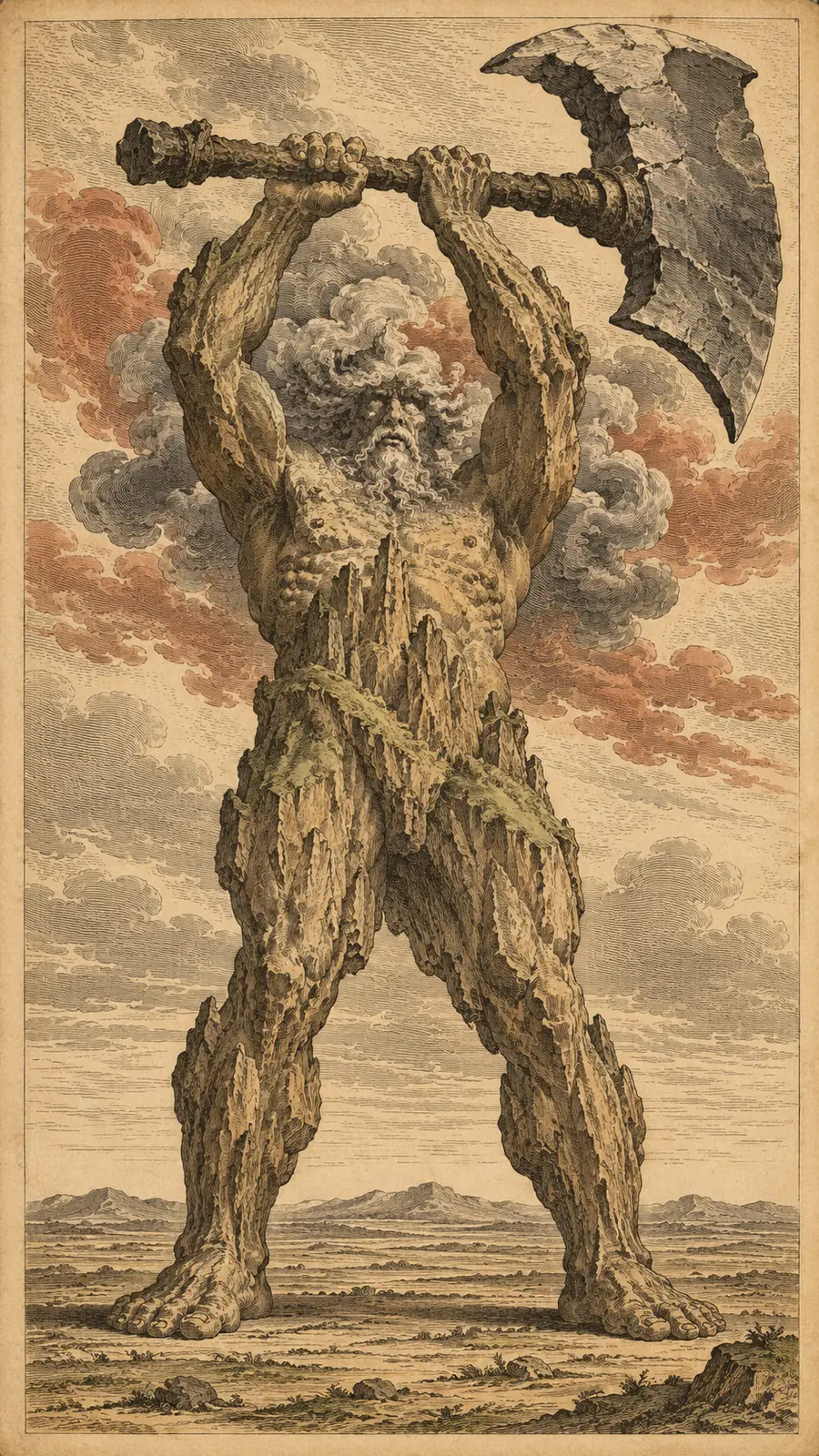
One day, Io faced a primordial alone. Its name was Erek-Hus, the King of Terror, and it carried a rough-hewn axe of adamantine, said to be the size of a mountain. With a single blow, Erek-Hus split Io in two, from head to tail, into two equal halves.
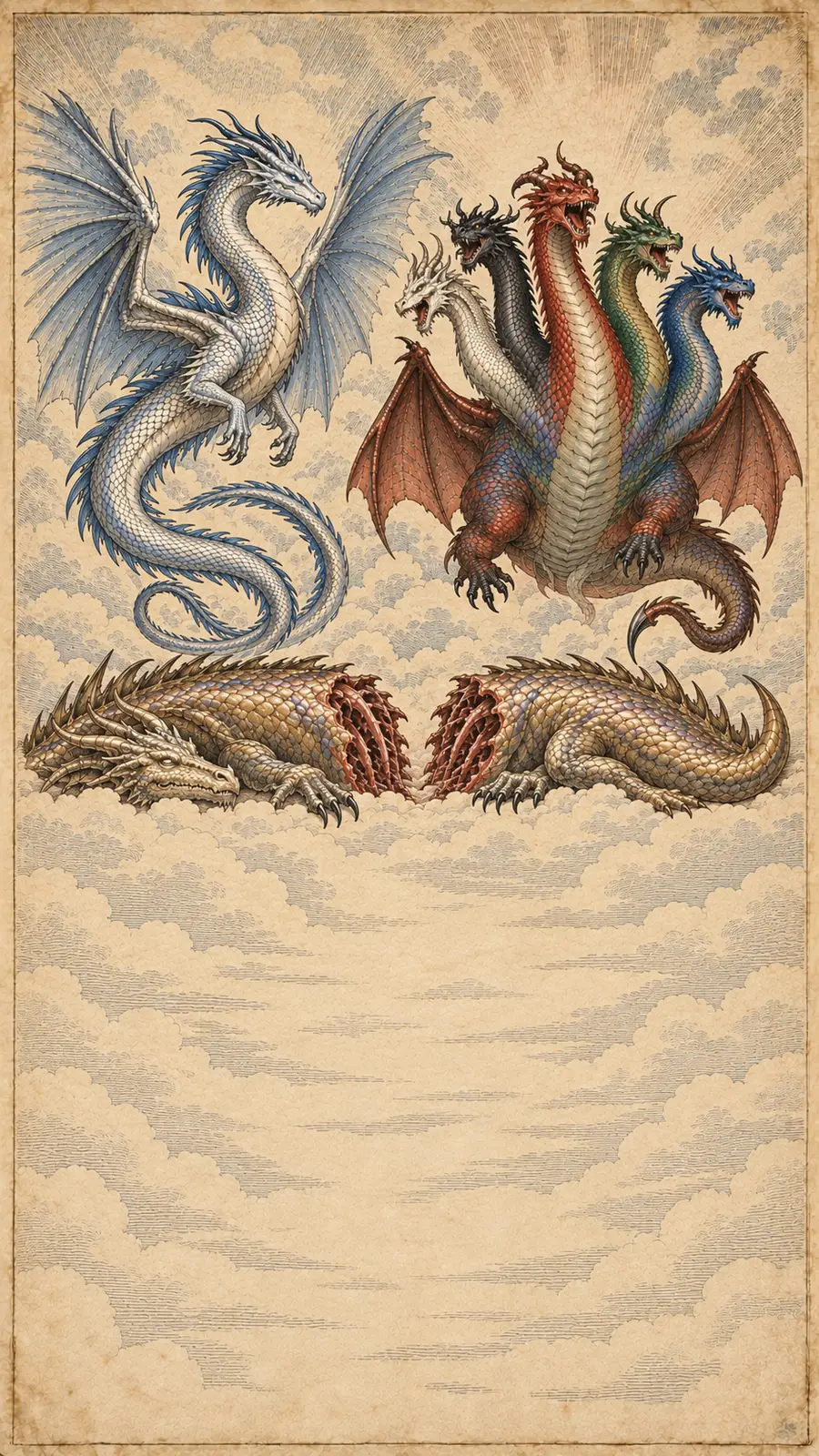
But the power of Io did not die with him. From each half a new god rose. rose from the left half, and from the right. The two new gods turned together on Erek-Hus and killed him, and they did it with very little effort.
And Io's nature, like his body, was divided between them. His wish to protect creation, and his sense of fairness, went to Bahamut, who became the god of justice, honor and protection. His hubris, his arrogance and his covetousness went to Tiamat, who became the goddess of greed and envy. So in this telling, Tiamat and Bahamut are not so much siblings as two halves of one broken father, each carrying what the other lacks. When the dragonborn of this age look at the two gods, they see Io's best and worst, standing apart forever.
Fourth edition is gentle enough to admit that its dragons don't all tell this story the same way. Another legend, told within the world itself, says that Bahamut and Tiamat were Io's eldest children, born at the dawn of creation, and that when Io died, each of them claimed half his power. Which is true, the priests say, depends on whom you ask.
The same axe stroke gave rise to a people. The dragonborn, in this age, sprang from Io's spilled blood, ready to serve dragons. And in the ancient past of this world, the dragonborn built a great empire called Arkhosia, where both chromatic and metallic dragons lived. Arkhosia fought a long war against the tiefling empire of Bael Turath, until both empires were brought to their knees.
In this edition, Tiamat is the Chromatic Dragon, the goddess of wealth, greed and envy, the mother and queen of the chromatic dragons, and her brother's endless rival. She is greedy, vain and arrogant. She wants the chromatic dragons to spread and flourish as a kind, and she wants evil to spread with them. Her followers, dragons and others alike, are taught to take as much land and wealth as they can hold. Her teachings were set down as commandments. Hoard wealth, acquiring much and spending little. Forgive no slight, and leave no wrong unpunished. And take what you desire from others, because those who lack the strength to defend what they have don't deserve to keep it.
Her home moved too, and for the first time in many years, she left Hell. The fourth edition's heavens were arranged around a great silver expanse called the Astral Sea, where the gods kept their dominions like islands. Tiamat's dominion is called Tytherion, the Endless Night. It's a maze of canyons so deep that no light has ever reached their floors, and through the darkness, dragons and serpents swim as though it were water. You'd never see them coming. You would only hear the rustle of scales.
She doesn't hold Tytherion alone. It first belonged to Zehir, the serpent god of darkness and poison. Tiamat came to it and invaded, meaning to take all of it for herself. She didn't quite manage, and so now the two of them share an uneasy rule over the Endless Night, the queen of dragons and the god of snakes, coiled around each other in the dark, neither trusting the other.
In the pages of Dungeon magazine, starting in 2008, a long adventure path called Scales of War took a group of heroes all the way from their first steps as adventurers to the heights of legend. Its great villain was Tiamat. She formed an alliance with the githyanki, the warlike people of the Astral Sea, and together they made war on the world.
In the highest stretches of that story, the unthinkable happens. Tiamat's plan succeeds, and Bahamut is killed. Hope rests on an artifact called the Arrow of Fate, a spear formed from the last of Io's blood, left over from the moment the primordial cut him in two. It holds unmatched power over life and death, and with it, the heroes can bring the Platinum Dragon back. But another power among the gods tries to steal Bahamut's strength before he can return, and the heroes must travel through the great forge of , the god of the dwarves, to the very heart of creation to prevent it.
At the end of that long road, the heroes have broken Tiamat's army. Her forces are splitting apart and turning on one another, and the Dragon Queen is reeling. They storm her last stronghold. Inside, they must pass five gigantic chromatic dragons, the Broodmothers, her consorts, each waiting in a chamber shaped to her own color. And at the very last, they come to Tiamat herself, standing on a platform held aloft by a twisting column of molten lava. It is one of the grandest endings the game has ever written, and she is at its center.
In the Forgotten Realms, the fourth edition moved the story forward by about a century, past a catastrophe called the Spellplague, when magic itself went wild. During the Spellplague, a twin world called Abeir traded pieces of its land with , and one of the pieces that arrived was a dragonborn nation. On Abeir, the dragonborn had risen up against the dragons who ruled them. Now their citadel city of Djerad Thymar was set down in the lands of southern Unther, and its survivors founded a new nation there called Tymanther.
For Tiamat, this was a hard turn. Unther had been one of her strongest bastions of faith, and almost overnight, much of it was gone, replaced by a proud people who became her enemies. In Tymanther, an order called the Platinum Cadre serves Bahamut openly, and the worship of Tiamat is forbidden, so her followers there must keep to the shadows. She turned her attention elsewhere, to the land of Murghôm, to Tymanther itself, and to the dragon empires of distant Laerakond, while never quite letting go of her old interest in Unther and Chessenta.
And in Chessenta, there was Tchazzar. You'll remember him from the Godswar, the red dragon who gathered the scattered pieces of her essence. Tchazzar had long ruled Chessenta disguised as a human warlord, called the Invincible Warrior and the Father of Chessenta, and his people worshipped him as a god. He was content to be a minor divinity and a chosen of Tiamat, though only in name. When Tiamat shows herself in Chessenta, she sometimes wears Tchazzar's shape.
In a trilogy of novels by Richard Lee Byers called the Brotherhood of the Griffon, published between 2010 and 2011, a company of griffon-riding mercenaries led by a sellsword named Aoth Fezim rescues the long-lost Tchazzar and restores him to Chessenta. The dragon king goes to war against a powerful dracolich. As the war goes on, Tchazzar grows erratic, and Aoth begins to suspect that he and his riders are pieces in some larger game being played by dragons. It's a fine example of how the Dragon Queen's shadow lies over a story even when she is hardly in it.
So the fourth edition split her from her brother with an axe, moved her into an endless dark she shares with a serpent, wrote down her commandments, and let her kill her brother in one long tale. The fifth edition would bring her home again, to , and to the Sword Coast, where a cult was gathering her treasure.
Chapter IX
Five masks and a well of bones
The fifth edition of the game began in 2014, and its very first great storyline was about . It was called Tyranny of Dragons, and it came in two hardcover adventures. The first, Hoard of the Dragon Queen, appeared in August of that year, and its sequel, The Rise of Tiamat, followed later in 2014. They were designed by Press, working with Wizards of the Coast, and led by Wolfgang Baur and Steve Winter, with Alexander Winter joining for the second book. It was the first time a hardcover adventure for the new edition had been made by an outside studio. Baur and his colleagues had played through many editions of the game, and they reached back toward an older style in which not every meeting has to end in a fight. Some would be settled by trickery or by talk, and some simply walked away from.
The story is set on the Sword Coast of the Forgotten Realms, in the late fifteenth century by the Realms' reckoning. And at its heart is the Cult of the Dragon, the same order founded, the one that had spent centuries devoted to undead dragons. Now, the story reveals, the Cult has changed its faith. It no longer waits on dracoliches. It waits for Tiamat.
The change came from a single young man. Silrajin was a cultist from the southern land of , and he had been inspired by the Dragon Queen. He went back to the old prophecy of Maglas, the one Sammaster had based everything on. Sammaster had read it this way: "naught will be left save shattered thrones with no rulers, but the dead dragons shall rule the world entire." Severin read the same words, and saw a different pause in them. "Naught will be left save shattered thrones, with no rulers but the dead. Dragons shall rule the world entire." With one moved comma, the prophecy no longer promised a world ruled by dead dragons. It promised a world of the dead, ruled by living dragons, and by their queen. So the Cult's devotion turned to Tiamat. Not everyone accepted it. Some of the older members still longed for Sammaster's true path and the raising of dracoliches. But under Severin, the Cult became hers.
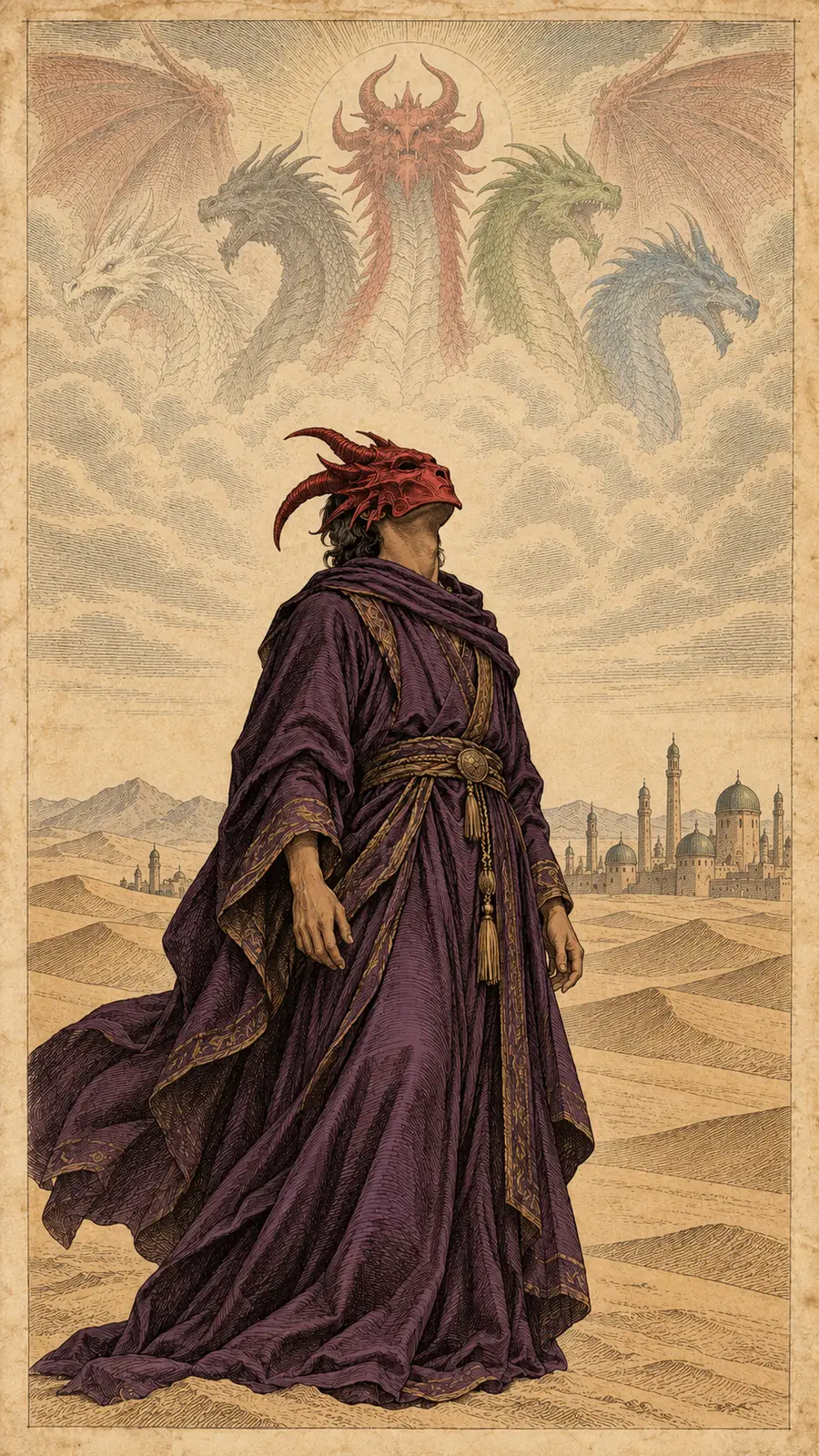
Severin leads an inner circle called the Wearers of Purple. Among them are the five Wyrmspeakers, one for each of Tiamat's colors, and each keeps a dragon mask. Severin himself is the Red Wyrmspeaker. Galvan is the Blue, Neronvain the Green, Rezmir the Black and Varram the White. They never part with their masks except in the direst need, because the five masks can be joined together into one great mask, the Mask of the Dragon Queen. With that mask and a ritual worked by a splinter faction of the Red Wizards of , the Cult believes it can draw Tiamat up out of the Nine Hells and into the world. To honor her when she arrives, they are gathering a hoard.
That hoard is where the first adventure begins. It opens in a small town called Greenest, on a night when the Cult attacks it. Houses burn, and raiders run through the streets. Overhead circles a blue dragon named Lennithon, striking at the keep with crackling bolts of lightning. The heroes are caught in the middle of it, and then set out to learn who these raiders are.
They follow the raiders to a camp, and inside the camp find a hatchery of dragon eggs. The raid, they learn, was led by Rezmir, the Black Wyrmspeaker, a woman who is half black dragon. With her are other leaders: Frulam Mondath, a half-dragon named Langdedrosa Cyanwrath, and a Red Wizard called Azbara Jos. From there the trail follows the stolen treasure north. The heroes travel with a merchant caravan up the trade road, learning along the way that the Cult has allies among the Red Wizards and among hired soldiers. At Castle Naerytar, deep in a marsh, they find the Cult living alongside bullywugs and lizardfolk. At a hunting lodge they meet a cultist named Talis, who has grown disillusioned, and a troll with four arms.
The first book ends in the sky. The treasure is being carried north in Skyreach Castle, a flying fortress that belongs to a cloud giant named Blagothkus. It's built around part of an iceberg, and its walls are made of ice, drifting over the land beneath the clouds. The spirit of the giant's dead wife, Esclarotta, still lingers in it. And hidden somewhere within is the Black Dragon Mask.
The Rise of Tiamat takes up the tale on a larger stage. It opens with the Council of , a meeting of the great powers of the Sword Coast called together because of the Cult's campaign. Five factions sit at that table: the Harpers, the Order of the Gauntlet, the Emerald Enclave, the Lords' Alliance and the . They don't trust one another. Some of them barely tolerate each other. But they all fear what the Cult means to bring.
The heroes travel into the far north, to the Sea of Moving Ice, in search of an ancient artifact called the , whose call summons dragons. The Cult has been using it to gather the evil dragons of the world. The heroes win the help of the metallic dragons, too. A metallic dragon, long disguised, reveals its true form and carries them on its back to a council of its kin. They even go on a mission to Thay itself. By then the Cult has gathered great stores of treasure, joined forces with Thay for the ritual, collected all five masks, and persuaded or pressured many of the oldest and strongest evil dragons in to take its side.
And at the end, a great army raised by the Council of Waterdeep marches on the place where the Cult will make its summoning. It's called the Well of Dragons.
Let's rest a moment there, because the Well of Dragons is one of the loveliest and saddest places in the whole story. It's the caldera of an extinct volcano at the northern end of the Sunset Mountains. It's roughly oval, and its walls are high and steep. Its floor is covered with the bones of dragons, heaped into immense, tangled piles. For thousands of years, dying dragons have come here to lie down, and many of them brought their treasure with them, so that the bones rest among old gold. The Cult found this place long ago. Beneath the dormant volcano, lava tubes form natural passages between caverns, and the Cult widened them and built its halls there. In the caldera it made a ritual space, and for a long time this was where it turned dying dragons into dracoliches.
Now, in the fifth edition story, it becomes the site of something else. The Cult and the Red Wizards work a ritual that pulls Tiamat's temple out of and sets it down in the Well of Dragons. The temple is shaped like a five-pointed star. At each of its points is a chapel, and each chapel glows in one of the five dragon colors, white and black and green and blue and red, around a central hall. Five spires rise at the points, tall as a large tree, around a central spire twice their height.
Then the second part of the ritual begins. It needs a hoard of vast worth, blessed by five priests of Tiamat. It needs five chromatic dragons, one of each color. And it needs a great many captives to be given to her. Severin leads ten Red Wizards in the chanting, and among them are Rath Modar of Thay and several of the Cult's own leaders. The spellcasters channel their power toward him, and a portal to the Nine Hells begins to open inside the temple.
If the heroes can strike down enough of those wizards, six of the ten or more, the ritual fails, and Tiamat never comes. If fewer fall, she comes anyway, but how strong she is when she arrives depends on how much the heroes have spoiled the ritual. And so she emerges slowly, within a whirling cloud of many colors. Her body comes first. Then, with each passing moment, another head pushes through, not yet fully solid, until all five are there.
This is the Tiamat of fifth edition. She is gargantuan, with five heads, each breathing its own ruin: fire from the red, lightning from the blue, acid from the black, poison from the green and cold from the white. She claws and she lashes with her tail, and a terrible dread rolls off her. Her many heads let her answer threats faster than any single-headed creature. She heals herself as she fights, and she can shrug off magics that would fell any lesser being. And there is a truth about her that sits at the center of the whole story. If she falls anywhere outside her home, her body is destroyed, but her essence simply returns to her domain in the Nine Hells, where she cannot take form again for a time. Only there, in her own realm, can she truly die.
So the story ends as it must. The heroes and their allies fight in the Well of Dragons, and Tiamat is driven back down into the pits of Hell. She is not slain. She is returned to her prison.
The Tyranny of Dragons stretched beyond the books. The online game Neverwinter told its own version across 2014, ending in a zone set in the Well of Dragons and a great battle in her temple, where players faced Severin and then Tiamat herself, "the five-headed Queen of Dragons and Nemesis of the Gods." Wizards of the Coast published a free web comic in ten parts that followed the story all the way to her summoning. The two adventures were later gathered into one book, Tyranny of Dragons, in 2019, and reissued again in 2023 with new cover art showing her.
And so the Dragon Queen went back down, into the red dark of Avernus. But the game did not forget where it had left her. Five years later, it came to visit.
Chapter X
A prisoner who keeps her word
We come now to once more, in an adventure called Baldur's Gate: Descent into Avernus, published in 2019. Its lead designers included Jeremy Crawford, and its story team was led by Adam Lee, with Christopher Perkins among them. It begins in the great city of Baldur's Gate, and then descends, very literally, into the first layer of the Nine Hells.
The story's great disaster is this. The holy city of has been torn from the world and dragged down into Avernus, where it hangs, held by enormous chains. Behind the plot is , a fallen angel who now rules Avernus as its archduke. Avernus in this age is caught up in the Blood War, the endless struggle between demons and devils, and its red plains are scarred with the wreckage of that war.
And somewhere in those plains, still, is . After her defeat at the Well of Dragons, she remained a prisoner in Avernus. Her lair, which is also her prison and her divine realm, is a great system of caves inside a tall mountain. It holds the only known portal down to Dis, as it always has. And she has tested the limits of her prison many times.
The way into her lair is one of the most memorable places in the adventure. It's called the Monument to Tiamat. Against a mountainside, among bones as large as houses, leans the skull of a colossal dragon. Acrid smoke drifts up from between its jaws. At the back of the skull, a tunnel leads down into Tiamat's lair. , those scaly devils, nest inside the skull. Some say they do her bidding, and others that they guard her prison on the orders of . Perhaps both are true.
And the skull listens. When her faithful come and call their prayers into its mouth, Tiamat hears them. If she chooses to answer, her voices come out of the darkness, five of them, hissing, made louder by the great hollow bone, giving commands and finishing one another's sentences. Imagine standing in the smoke among those old bones, hearing one voice begin a thought and another end it, and a third begin the next.
On the far side of the mountain rise five towers, one on each of five peaks, one for each of her heads. Together they form a stronghold shaped like a crown, and her dragon followers use them as their doors.
Near the monument stands a tower, and in it lives Tiamat's champion, the Cruel. He is a dragonborn, a paladin who broke his oaths, and he serves the Dragon Queen with total devotion. He was designed with Matthew Mercer, and comes from the world of Exandria. His great hope is to free Tiamat from her prison. To that end, he has done something terrible to himself. He cut away his left hand and replaced it with the Hand of , the ancient relic we followed in an earlier evening's story, because he believes its power might break her chains. But the Hand is slowly rotting the left side of his body, and he can only slow the decay by sacrificing good creatures to it. He keeps company with a manticore named Chango and a minotaur bodyguard named Torogar Steelfist. He also keeps a vial of Tiamat's own blood. He goes to the monument to speak with his queen and to tell her how his struggle with the Hand is going. So far, it has not gone well enough.
Here the story offers one of its most interesting paths. The heroes want to save Elturel. And one way to do it runs through Tiamat. If they come to Arkhan, he will make them an offer. There is a certain puzzlebox he has been unable to find, and an ancient fiend knows where it lies. If the heroes bring him that box, he will use it to release Tiamat into Avernus. And if they do, she keeps the bargain. She goes to the great chains that hold Elturel, breathes upon them, and breaks them, and the city returns to the world. She doesn't betray the heroes. She simply takes her freedom and honors her word.
Zariel, the archduke of Avernus, fears Tiamat. If the Dragon Queen sides with the heroes, the archduke has no real plan except to try to kill them and hope Tiamat goes away. It's a quiet and striking moment in the lore. The most famous villain of dragonkind, a queen of greed and envy, turns out to be one of the few powers in Hell whose promise you can count on.
There are smaller threads too. A spined devil named Uldrak, whom Tiamat once cursed, asks the heroes to bring him some of her blood so that he can lift the curse. And her treasure, or some of it, lies in four chests in her lair, opened by a key carried by a devil called Yignath, the Iron Consul.
Two years later, in 2021, came a book that retold the beginning of all dragons: Fizban's Treasury of Dragons. Its lead designer, James Wyatt, described it as a "neat-and-tidy unified theory of dragonkind in myth form." At its heart is a short poem called "Elegy for the First World," and it tells a story that asks you to see Tiamat in a new light.
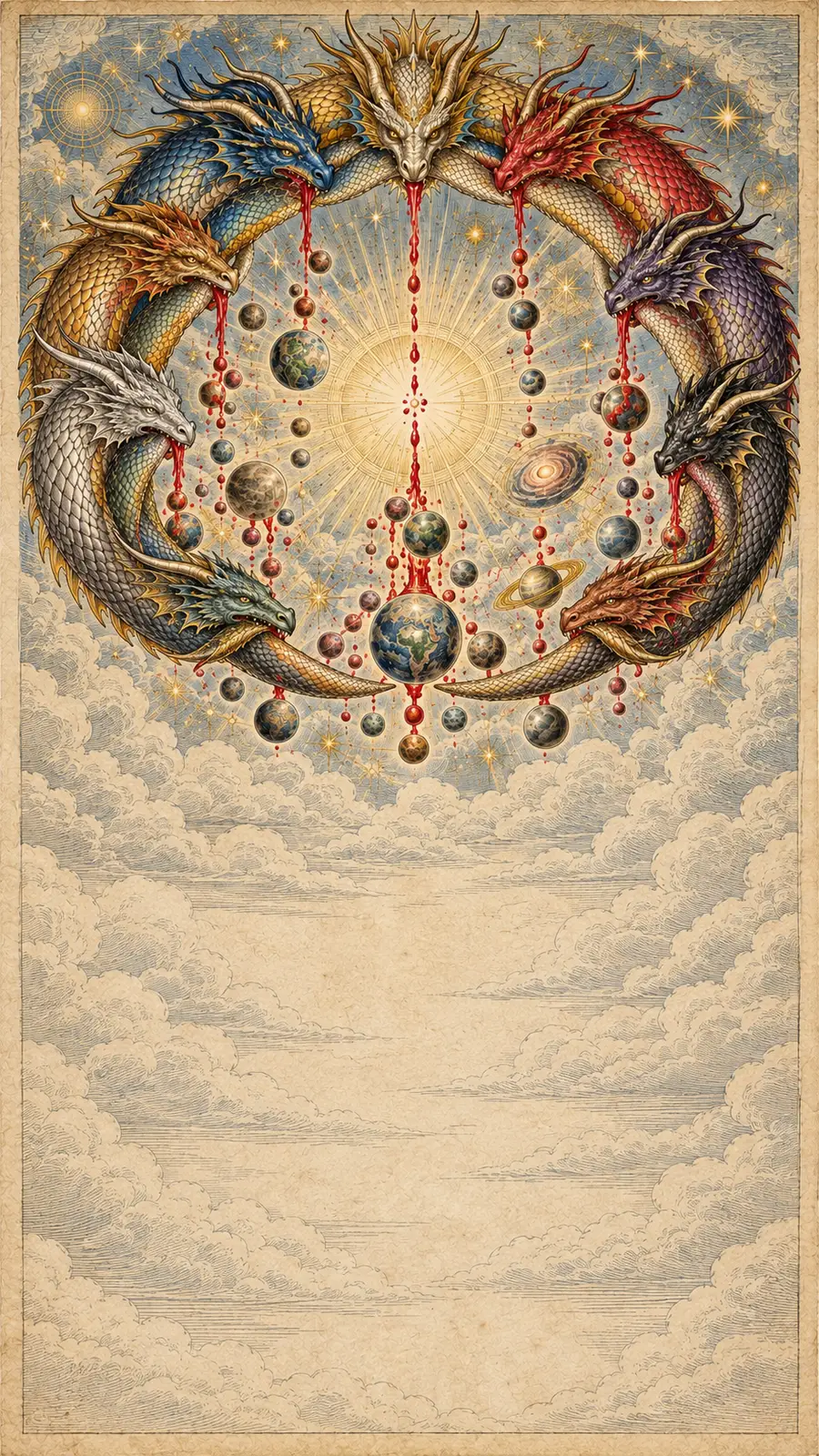
Long ago, before the many worlds existed, and Tiamat worked together. The two of them made a single world, the First World. And they made a dragon in their own likeness, a ruby dragon named , the firstborn of all dragonkind. Sardior joined with Bahamut to make the metallic dragons, and he joined with Tiamat to make the chromatic dragons. So in this telling, all dragons, metallic and chromatic both, come from a time of shared work between the two gods who now oppose each other.
Then other gods came and invaded the First World. The dragons fought back, but they were overwhelmed. Bahamut was defeated. Sardior fled and hid in the heart of creation. And Tiamat kept fighting, alone, long after the others had stopped, until at last she too was beaten and sealed away in a place of darkness. Most readers take that place to be her prison in Avernus.
After that, some great catastrophe that nobody can explain shattered the First World, and Sardior with it. Its pieces scattered into countless new realities, and those grew into all the worlds of the Material Plane. That is why every world has its own echoes of dragons and of the dragon gods. Sardior's shards became the gem dragons, and five great gem dragons travel from world to world, gathering those echoes, hoping one day to merge together and make Sardior whole again.
Think about what this does for Tiamat. In this story, she is the one who didn't give up. When the First World was invaded, she fought on alone until she was overcome and locked in the dark. Her anger at the other gods has a reason now, beyond simple wickedness. And her brother, in this telling, isn't truly trying to fight her. Their rivalry becomes the lingering grief of two makers who lost what they made together.
The book also set down how that myth fits different worlds. In the Forgotten Realms, Tiamat is imprisoned in Avernus. In Greyhawk, where she was first born, the name of Io is still spoken. And for , as we heard earlier, it made the change that the old sages had argued over: is Bahamut, and is Tiamat.
Because the true Tiamat stays trapped in the Nine Hells, the book gave her an Aspect, a form she can send out into the world while she herself remains below. The Aspect of Tiamat is as mighty as any creature in the game. When it seems to be defeated, it rises again, its wrath renewed, and fights on. Among its powers is one that hurls an enemy briefly through Avernus, sending them into the red wastes of her prison for an instant before they return, shaken and wounded. Beside it the book set an Aspect of Bahamut, with spears of radiant light and a shield from the heavens, so that the two can meet on the field. And it described the dragonborn champions of Tiamat, whose breath carries the chill of death, and who work tirelessly to free their queen.
So now we have seen the whole long line of her, from Babylon to the First World. Before we come to the present, let's step to the side for a while, and look at the many shapes and echoes that have grown out of her across the game's many worlds.
Chapter XI
Echoes, aspects and daughters
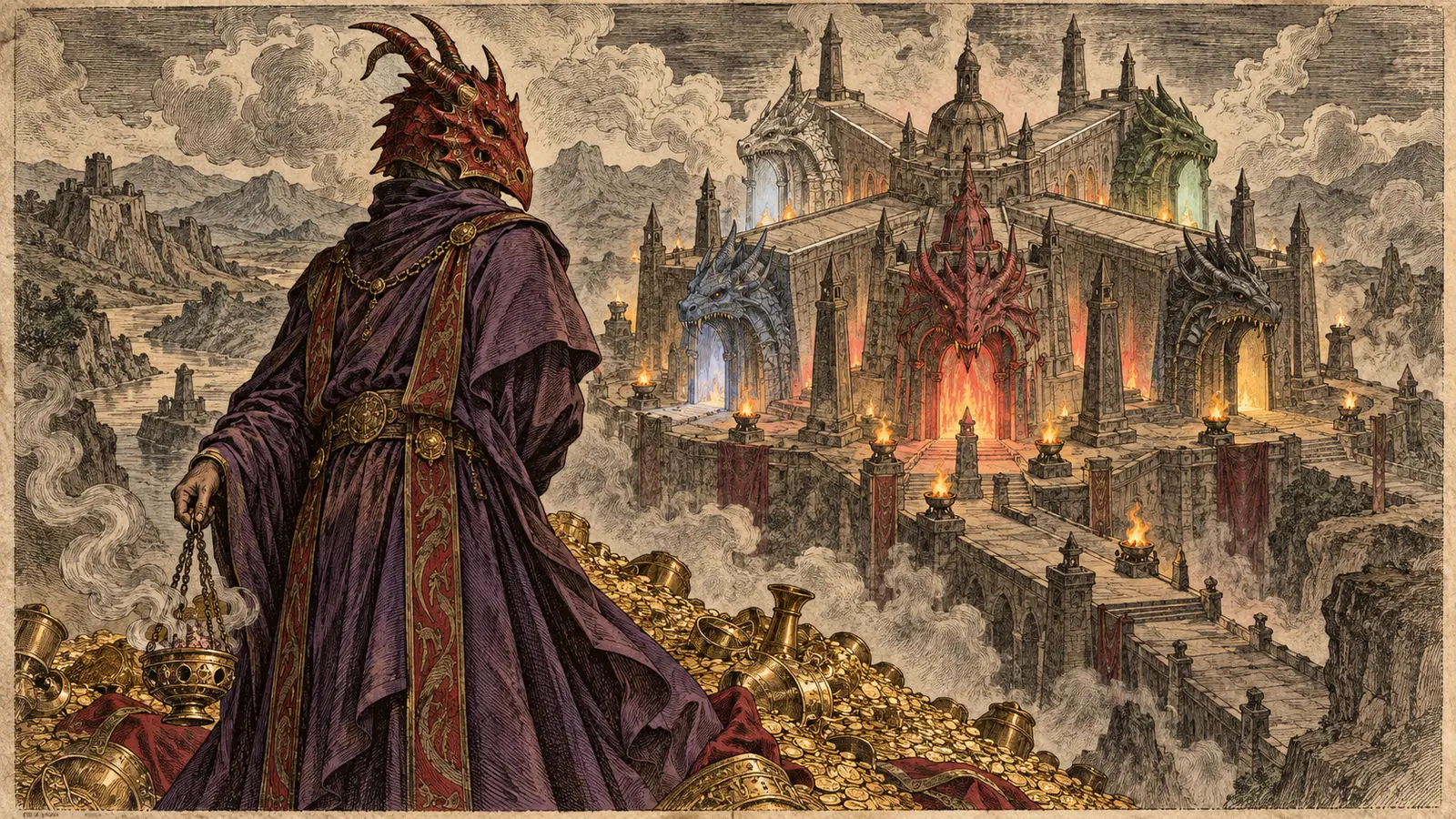
The Dragon Queen has never been only one creature. Over the years, she has been given aspects and avatars, spawn and heirs, and even whole alternate selves in other worlds. Let's gather some of them together.
In the lore of the game, an avatar is a physical form a god takes to walk the planes. An aspect is something smaller, a fragment of a god's life given a body of its own. was among the first gods ever to have aspects, which were sometimes called lesser avatars. Through the third edition, her aspects were the Dragon Queen at a size heroes could meet, a way of feeling her presence without facing the goddess herself. In the fifth edition, her Aspect grew to the very top of what the game can describe, the shape she sends into the world while she stays below. Even in plastic, the idea has lasted. Makers of miniatures have carved her aspect for tables everywhere.
Her spawn are another kind of echo. In the third edition, you'll recall, she warped the young of chromatic dragons into her servants: the bat-winged greenspawn razorfiends, the great upright bluespawn godslayers with their skull shields, and many more, fighting side by side under her blessing. In the Forgotten Realms, such creatures are called dragonspawn.
The kobolds are an echo too, and a humble one. , their god, serves her, and in their own story they hatched from one of her lost eggs. When you next picture a kobold setting a clever trap in a tunnel, you might remember that in their telling, they are her small, far-flung grandchildren.
Then there is Tchazzar, the red dragon king of Chessenta, who once carried a third of her essence inside him and in whose shape she sometimes walks in that land. And there are the dragonborn, who in different ages have been her children and her foes. In one age they sprang from the blood of Io, from whose halves she rose. In another they came to from Abeir and built Tymanther, where her worship is forbidden. And in the newest telling, as we'll see shortly, she and her brother blessed their first eggs.
we have already met: the Queen of Darkness on , the Dragon of All Colors and None, whose five stars hang over that world. For many years sages argued whether she and Tiamat were the same. Now the game says they are one goddess, known by different names in different skies.
But perhaps the strangest echo of all is in , the world created by Keith Baker, a place of airships and lightning rails and old, deep magic. In Eberron, Tiamat is not a god at all, even though dragons worship her. She is an Overlord, one of the mightiest fiends from a time before history called the Age of Demons. Her title is the Daughter of .
To understand that title, you need Eberron's own creation story. In it, three great dragons shaped the world. There was , of the sky, and Eberron, of the land, and Khyber, the Dragon Below. Khyber and Siberys were siblings, and Khyber's darkness hides, like a seed, inside every dragon. Tiamat, as a true daughter of Khyber, can reach into dragons and draw that darkness out. Her domain is not a place at all. It's dragons themselves. She can corrupt and command the children of Siberys and Eberron simply because a little of Khyber sleeps in each of them.
In the Age of Demons, she was the most feared of all the Overlords, and she turned an army of dragons and her own twisted spawn against their kin. Now she is bound in a place called the Pit of Five Sorrows, in the dragon continent of , sealed by wards and watched by dragons of an order called the Light of Siberys. A cult called the Talons of Tiamat works in secret to free her. Keith Baker has written that even from her prison, her influence reached out to dragons across the whole world, and that this is why the dragons of Eberron withdrew to Argonnessen and kept to themselves, to be as far from her whispers as they could. And because Overlords aren't bound to any single shape, he notes, Eberron's Tiamat could have metallic heads if she wished. It's a lovely, unsettling thought: a Dragon Queen who might wear gold and silver, and still be exactly what she is.
So across the worlds, she is a goddess, a fiend, a constellation, a spirit in a red dragon, a fragment in a shape heroes can fight, and the mother of spawn and kobolds. The shape changes. The five heads remain. Now let's lean closer to the table itself, where people sit with dice and paper, and see what it has been like to meet her there.
Chapter XII
Tiamat at the table
For more than forty years, people have gathered around tables to face the Dragon Queen, or to make her appear, or to wonder whether their characters would ever be strong enough to try. What has that felt like?
In the first edition, she was a monster with statistics in the Monster Manual, and that meant something simple and a little thrilling: she could, in principle, be fought and killed. A party of very powerful adventurers who journeyed into and made their way to her lair might meet her there, and if they were strong enough and lucky enough, they might win. Players who faced her had to think about five heads at once, all biting, breathing or casting in the same moment, with the poisoned tail striking behind, the white head weakest and the red head strongest. It was like facing five dragons fused together, which is exactly what she was.
In the fourth edition, her statistics were built to feel like that experience more directly. She stood at the very top of the edition's range, a single enemy meant to challenge an entire party of the mightiest heroes. And she didn't take her turn once each round, like other monsters. Her five heads each acted at their own point in the round, and she chose which head would act each time. So at the table, she moved five times in every round, again and again, until the players felt surrounded by her. Her great breath rolled out in all five colors at once, burning and freezing and eating away at them. When she was first badly wounded, her breath came back at once, as though in rage. And her frightful majesty could leave heroes frozen in terror where they stood.
In the fifth edition, the most famous way to meet her is at the end of The Rise of Tiamat. By then the heroes have grown very powerful, and the whole campaign has been building toward that one night in the Well of Dragons. What makes the fight memorable is that it isn't only about hurting her. It's about holding her back. She tries to force her way through the portal before it closes, and the heroes must keep her from breaking fully free until the doorway fades. If they deal her enough harm, she is driven back into Hell. And even if they bring her all the way down, she is only banished, not slain.
The best part, for many groups, is how much the story before that night matters. Every victory earlier in the campaign can weaken her. The factions the heroes won over at the Council of come to fight beside them: armies of the Council, metallic dragons battling in the sky above, and giants and lizardfolk if the heroes have been persuasive enough. The paladins and priests of the Order of the Gauntlet are especially valuable against the devils fighting for the Cult. And the ritual can be spoiled bit by bit, so that she arrives less than whole.
One thoughtful guide for game masters, Mike Shea, who writes as Sly Flourish, offered gentle advice for running that night. Describe the wider battle raging across the bloody sands of the Well, he suggested, with cultists and hired swords and devils everywhere, and give the heroes particular places to seize and villains to cut down. If the players worked hard to spoil 's arrival, let them see that it mattered: she should come through wounded and vulnerable. "Don't steal that victory," he wrote. And because no single great monster lasts long against a clever party, he suggested giving even Tiamat a few powerful devils as bodyguards.
In Descent into Avernus, the table meets her differently. Most groups never fight her at all. They meet her champion, , in his tower near the smoking skull, and they bargain. Should they fetch the puzzlebox and set her free, to save a city? Will she keep her word? What will she do once she is loose in Avernus? It's the Dragon Queen as a power to negotiate with, and many players remember the unease of making that choice more than they remember any battle.
And with the Aspect from Fizban's Treasury of Dragons, a game master can bring a piece of her into any world, at any time. It's as mighty as the tarrasque, the great beast of legend. When it seems to fall, it rises, renewed, and fights on. And if the game master wishes, the Aspect of can come to meet it, so that the heroes find themselves standing between two gods at war.
The figures on the table have grown with her. When the Tyranny of Dragons began in 2014, a painted figure of Tiamat towered over every other piece in its line. In 2021 an enormous new figure followed, more than a foot tall, with a wingspan of more than two feet, a centerpiece bigger than a dinner plate that seemed to fill the whole table. People who own one tend to leave it out on a shelf between games, five heads raised, watching the room.
And tables everywhere make their own versions of her. Game masters build tougher Tiamats for strong groups, write new stat blocks, and ask one another for help designing the perfect final battle. It says something simple about her place in the game. For many campaigns, she is where the story is meant to end. She is the last door, and behind it, five heads, waiting.
From the table, her image traveled outward, into cartoons and video games, card games and popular memory. Let's follow it there.
Chapter XIII
A shadow across the wider world
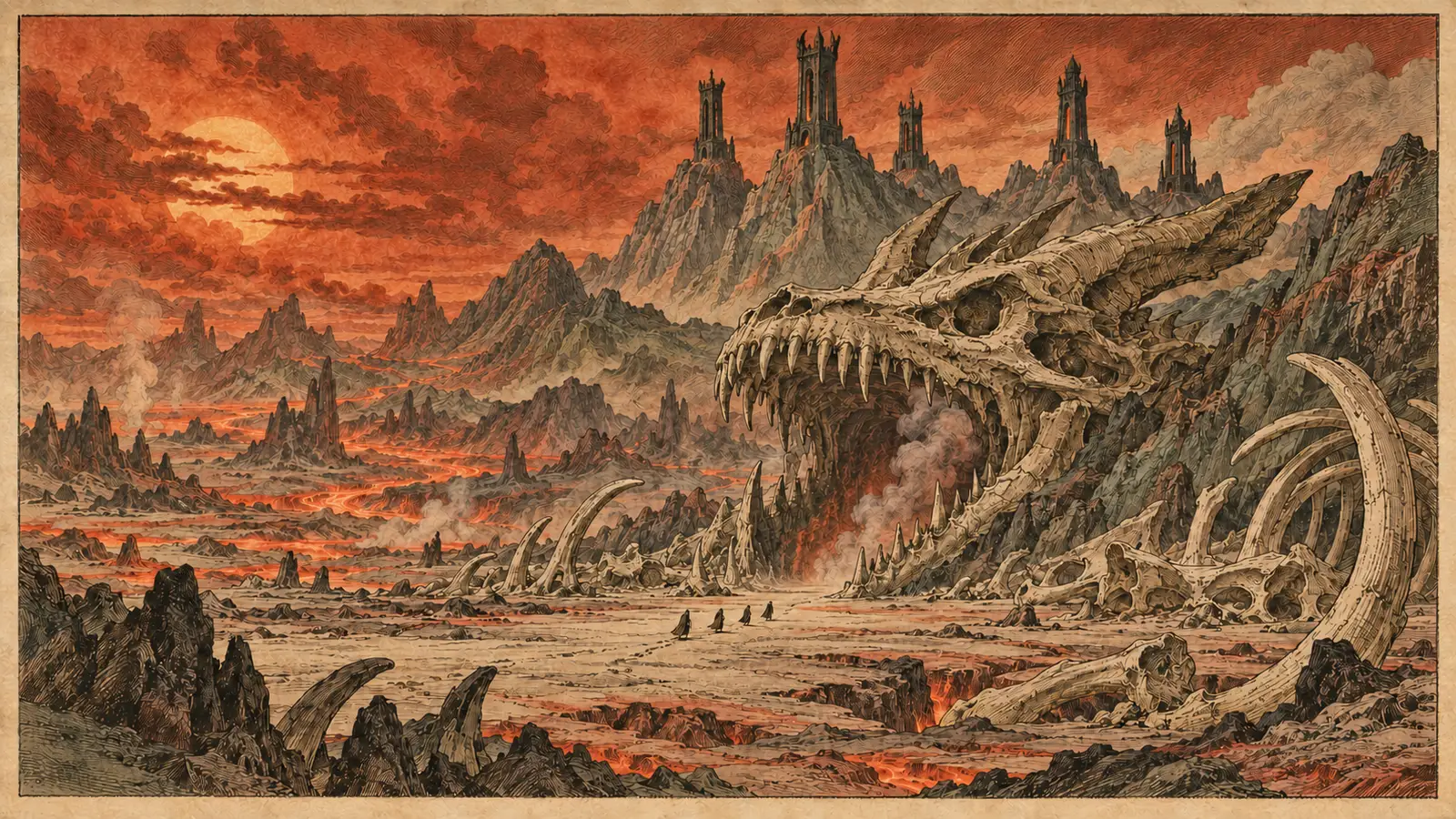
is one of the great villains of Dungeons & Dragons. In 2007, Dragon magazine, in its very last printed issue, named her among the game's most famous villains in a list of twenty. A writer for Forbes, David M. Ewalt, called her "the most fearsome dragon in D&D's history." It's a fair description, and a warm one, as warm as anyone can be about a creature like her.
For most people outside the game, her first home was the cartoon, the Saturday-morning Realm of the nineteen-eighties, where Frank Welker's layered voice echoed from five throats and even looked away. That cartoon never quite left the culture. When the film Dungeons & Dragons: Honor Among Thieves came out in 2023, the six children from the cartoon appeared briefly, in live action, in the middle of an arena scene, a little older than they'd been on television, slipping away to the next stage of their journey. Tiamat herself doesn't appear in the film. But for those who remembered, seeing the children again was enough to bring her to mind.
Her self found her way to the screen as well. In 2008, an animated film of Dragons of Autumn Twilight was made, and was voiced by Nika Futterman. Years earlier, in 1992, a computer game called The Dark Queen of Krynn had sent players against Takhisis herself as she plotted her return. It was the last of a celebrated series of Dragonlance computer games.
Video games of the Forgotten Realms have kept her close. In Neverwinter, players stormed her temple at the Well of Dragons and faced her. In Idle Champions of the Forgotten Realms, there is a mode called the Trials of Mount Tiamat, in which players gather five champions and have one week to banish her back to the Nine Hells. There's also a little game variation called "It's Tiamat, the Dragon," in which she appears and breathes on the whole party. In Baldur's Gate III, released in 2023, she never appears, but she is spoken of. The game calls her "the Many-Mawed," a roiling mass of avarice and hate trapped in the Nine Hells, reaching the chromatic dragons through the Cult of the Dragon. Clerics devoted to trickery may choose her as their goddess, and there's an old tale told in that game that she once stole one of 's eyes.
In 2021 she came to the card game Magic: The Gathering, in a set of cards drawn from the Forgotten Realms. There she is a legendary Dragon God, painted by the artist Chris Rahn, and she costs one of each of the game's five colors of mana, which is exactly as it should be. When she is cast, she calls up to five different dragons from the player's deck, gathering her brood around her. Toy makers have made her in vinyl, and miniature makers have sculpted her again and again.
And she reached further than the game itself. In 1987, the first Final Fantasy included a great many-headed dragon named Tiamat, perched atop a flying fortress, and she has returned many times in that series since. Many who love both games have noticed that the resemblance to the five-headed Dragon Queen seems more than chance. Many other games have monsters named Tiamat that follow her pattern. Today, if you ask most people who know the name what Tiamat looks like, they'll describe a dragon with five heads in five colors. That picture doesn't come from the clay tablets of Babylon. It comes from Lake Geneva, and a supplement written in 1975.
That brings us close to the present day, and to the question of where the Dragon Queen rests now.
Chapter XIV
Where she rests today
As of this autumn, the rules of the game have been revised. A new Player's Handbook appeared in 2024, a new Dungeon Master's Guide late that year, and a new Monster Manual early in 2025. doesn't have a page of her own in that new bestiary. Being a goddess, she stands a little outside it. Her chromatic children are all there, the great proud dragons of folklore. And her own statistics remain those she has worn since 2014: the gargantuan fiend who rose in the Well of Dragons, and the Aspect she sends out from Hell.
The new Player's Handbook keeps her in the story of the dragonborn. One legend it tells says that and Tiamat blessed the eggs that hatched into the very first dragonborn, because both wished to fill the multiverse with people made in their image. Another says that dragons made the first dragonborn without any god's blessing at all. The book leaves both tales standing, as the people who tell them do.
Her most meaningful place in the new rules is in the Dungeon Master's Guide, and it's a fitting one. That book presents the world of Greyhawk, the very world in which she first appeared, as its example setting. Among the great threats facing Greyhawk are the chromatic dragons, and they are growing restless. The reason is Tiamat. Her whispers invade their dreams while she remains trapped in the Nine Hells. Heroes may hear rumors that the dragons dream of freeing her, and there may be powers working even now to bring her into the world. So after half a century and many worlds, she has come home, at least in her dreams, to the land where she began as a queen in a cavern beneath the earth.
In the Forgotten Realms, the Cult of the Dragon remains active. The new player's book of the Realms, Heroes of Faerûn, published in late 2025, counts it among the great factions of that world, and a character may even begin as one of its initiates. The masks may be gathered again someday.
In 2025 a lore book called The Book of Dragons, written by Michael Witwer, was presented from the perspectives of Tiamat and Bahamut, the first book for the game written from their points of view. After all these years, she was given a voice to tell her own side.
And one more book is on its way. Fiends & Foes, a book of art and lore written by Erin M. Evans, has been announced for November of this year, 2026. In it, Farideh, the tiefling heroine of Evans's Brimstone Angels novels, is sent by Glasya, a princess of the Nine Hells, to deliver a letter to a very powerful and unknown figure. Her journey passes among the great villains of the game, and Tiamat is among them, alongside , , and , with lore and statistics for the Dragon Queen promised. The book has been announced, and hasn't yet been released.
So that's where she rests now. She is in , in her mountain behind the smoking skull. She is whispering into the dreams of dragons in Greyhawk. She waits in a hidden cult in , in five stars above , and in a pit of sorrows in . She is, as she has almost always been, waiting.
Chapter XV
Five crowns in the dark
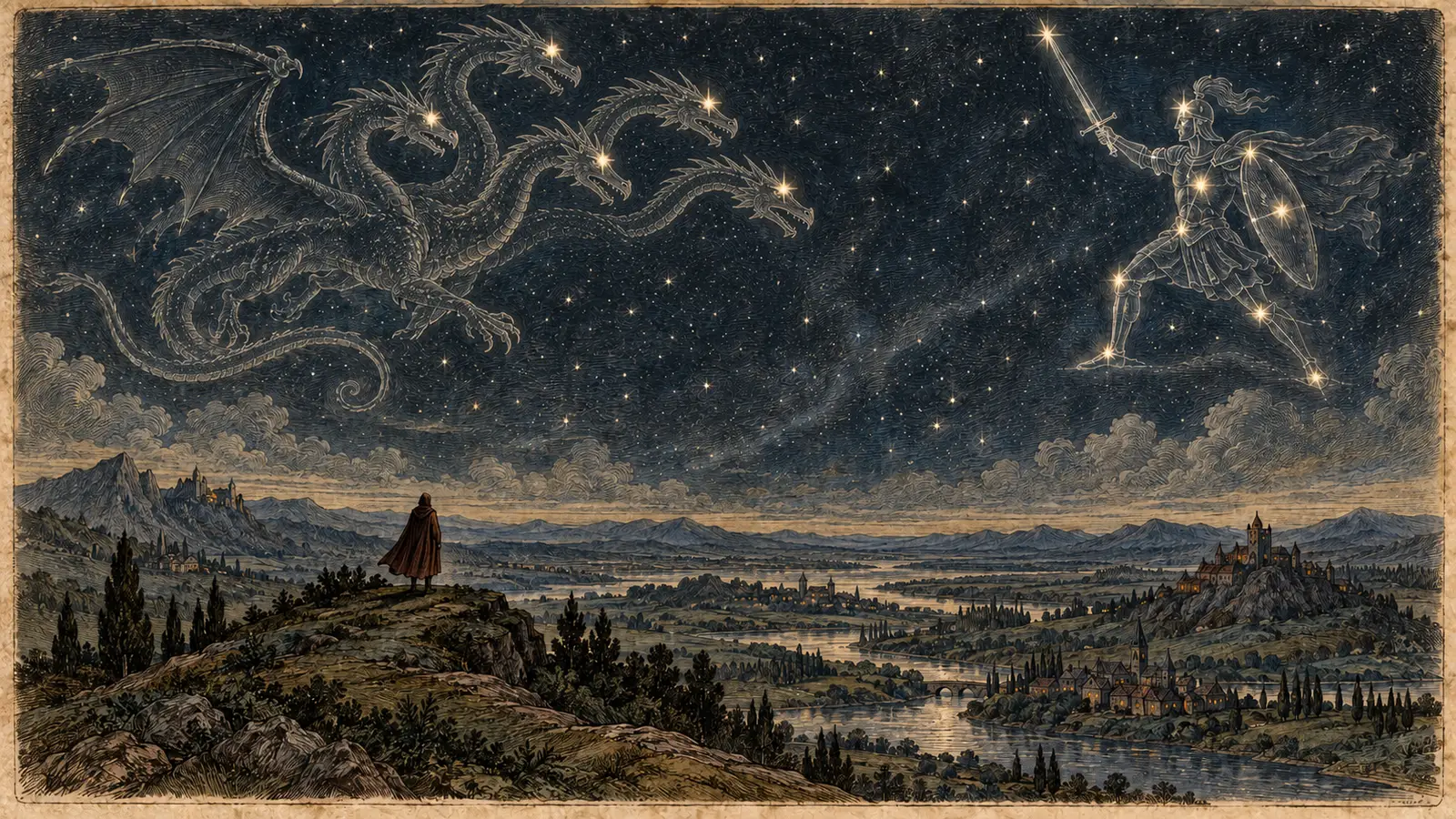
If there's one pattern that runs through all of 's long story, it's this. She is defeated, and she returns. split her and she became the world. bound her with an oath, and she found another door. Berem sealed the door with his blood, and she went back to the sky and waited. The heroes of drove her back through the portal, and she went home to her mountain and tested its walls. She has been banished and imprisoned, demoted and divided, cut from her father and set against her brother. Only once, on , has she truly died, and even then, the game later decided, she lives on in other skies under another name.
So when you picture her now, don't picture her in battle. Picture her at rest. Far below the red sky of , inside a mountain layered like an onion, down through false lairs and winding caves where coins lie scattered across the floors, there are five chambers, one for each of her heads. Outside, among the bones, the old skull leans against the mountainside, and a thread of smoke rises slowly from its jaws and drifts away over the plain. Now and then a small voice calls a prayer into that skull. Sometimes it is answered, in five voices finishing one another's thoughts. Most often, there is only the quiet.
And far away, on another world, on a clear night, the people of Krynn look up. Across the heavens from the Valiant Warrior, the constellation they call the Platinum Dragon, five stars hang in the shape of a dragon with five heads. They were gone once, when she came down to walk the world. They came back. They are there tonight, pale and steady, watching over the sleeping towns and the dark fields and the quiet rivers.
Long ago, in the oldest of these stories, the first Tiamat was the salt sea, and when she fell, her body became the sky and the earth, and her eyes became the rivers that watered the fields. The Dragon Queen of the game has never been made into a world. But she sits in the stars of one, and in the dreams of every chromatic dragon, and in the little legends of kobolds who hatched from her lost egg. She is patient. She has always been patient.
The smoke drifts on over the bone fields. The five stars turn slowly overhead. And somewhere beneath the mountain, five heads rest together in the dark, and the Dragon Queen waits for a morning that hasn't come yet.