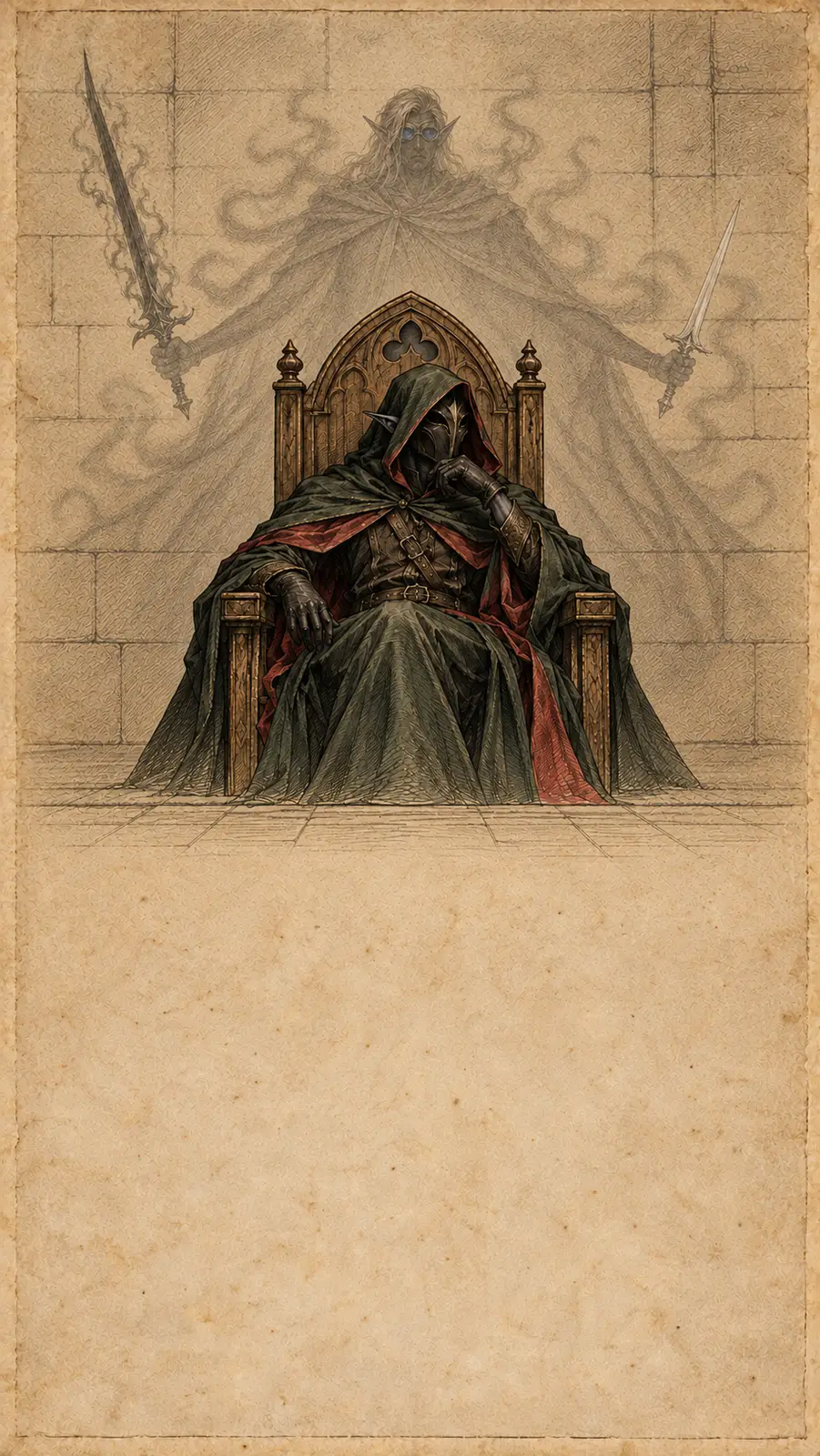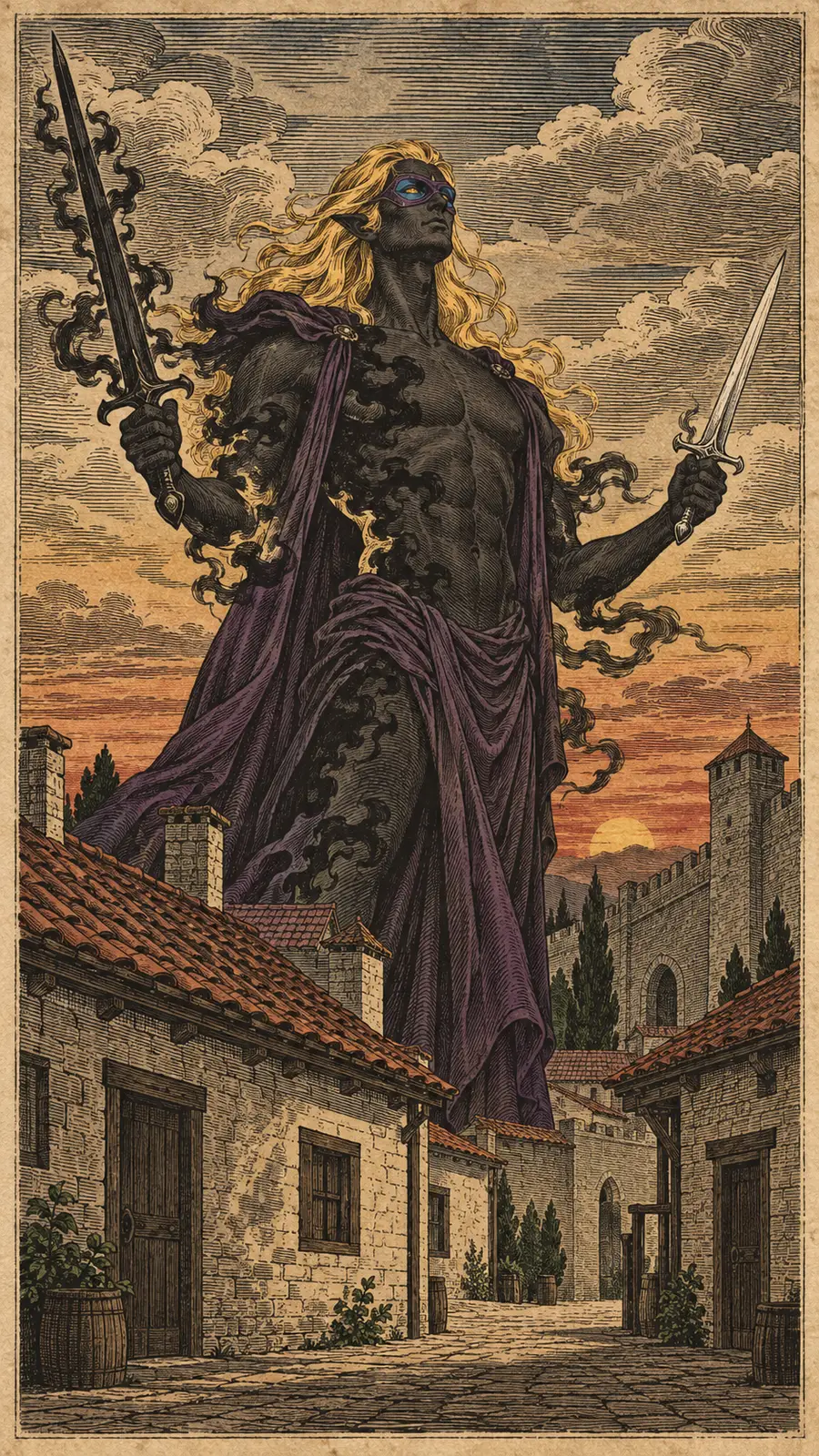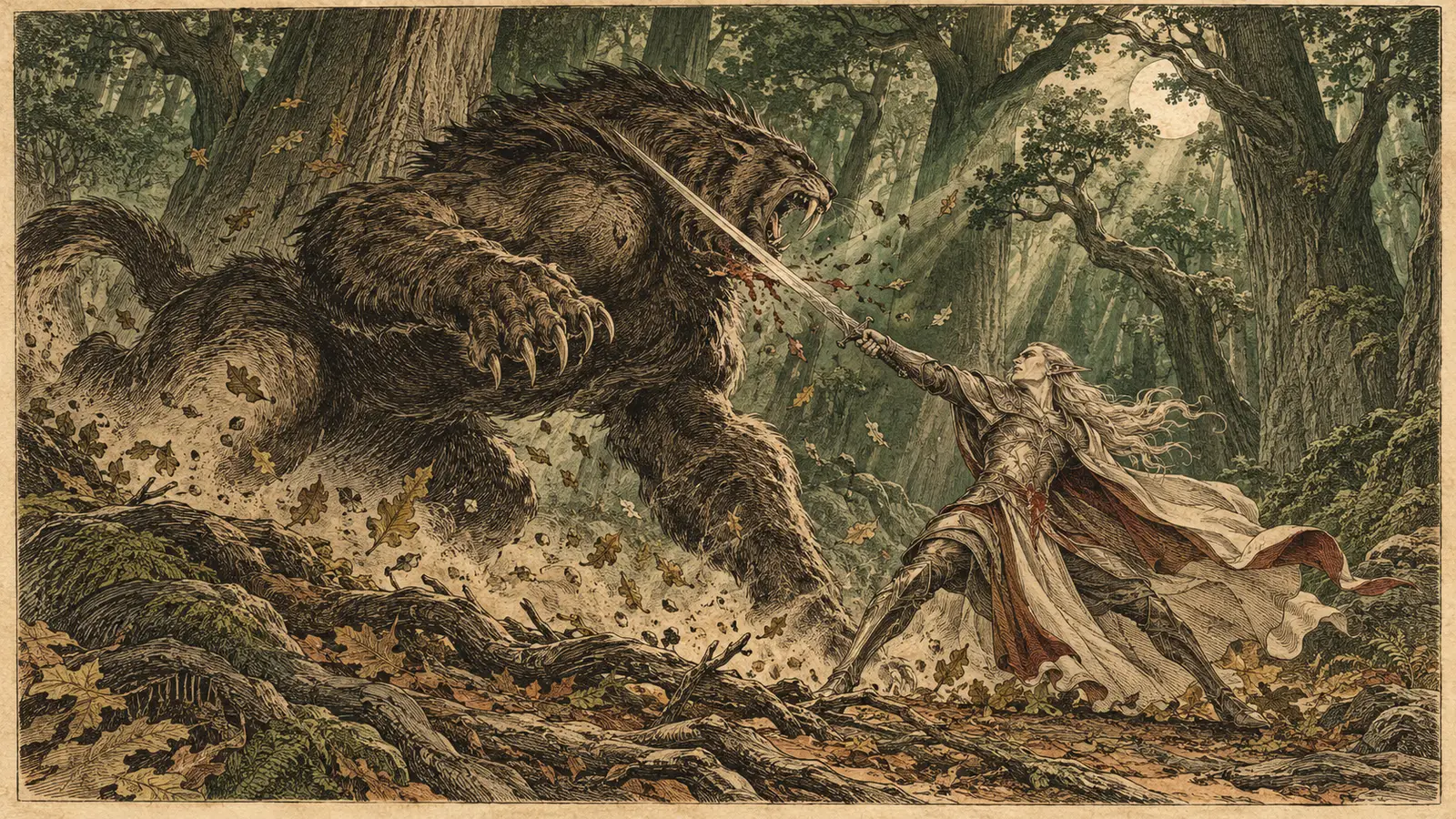
Chapter I
The son who stood beside his mother's plot
Over the hours ahead we follow , the Masked Lord of the drow, from the night he betrayed his father in the forests of to the uneasy peace he keeps with his sister in the Realms of today. We'll watch the game's writers give him a mask, then a church, then a death, and at last a return, and most of our time will be spent in the shadows he likes to keep around himself. It's a long road and an unhurried one, running from the oldest elven myth to the newest books on the shelf.
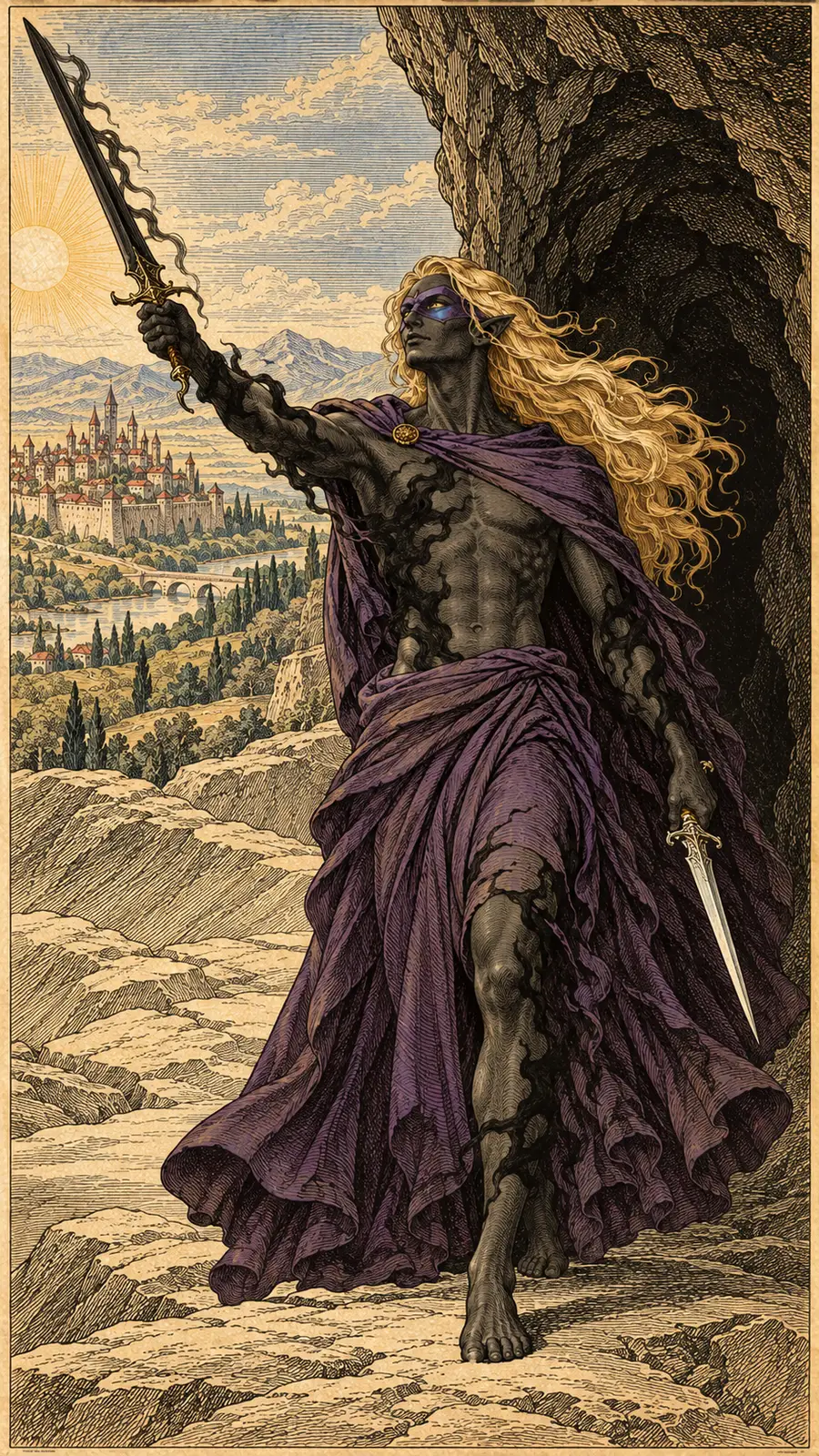
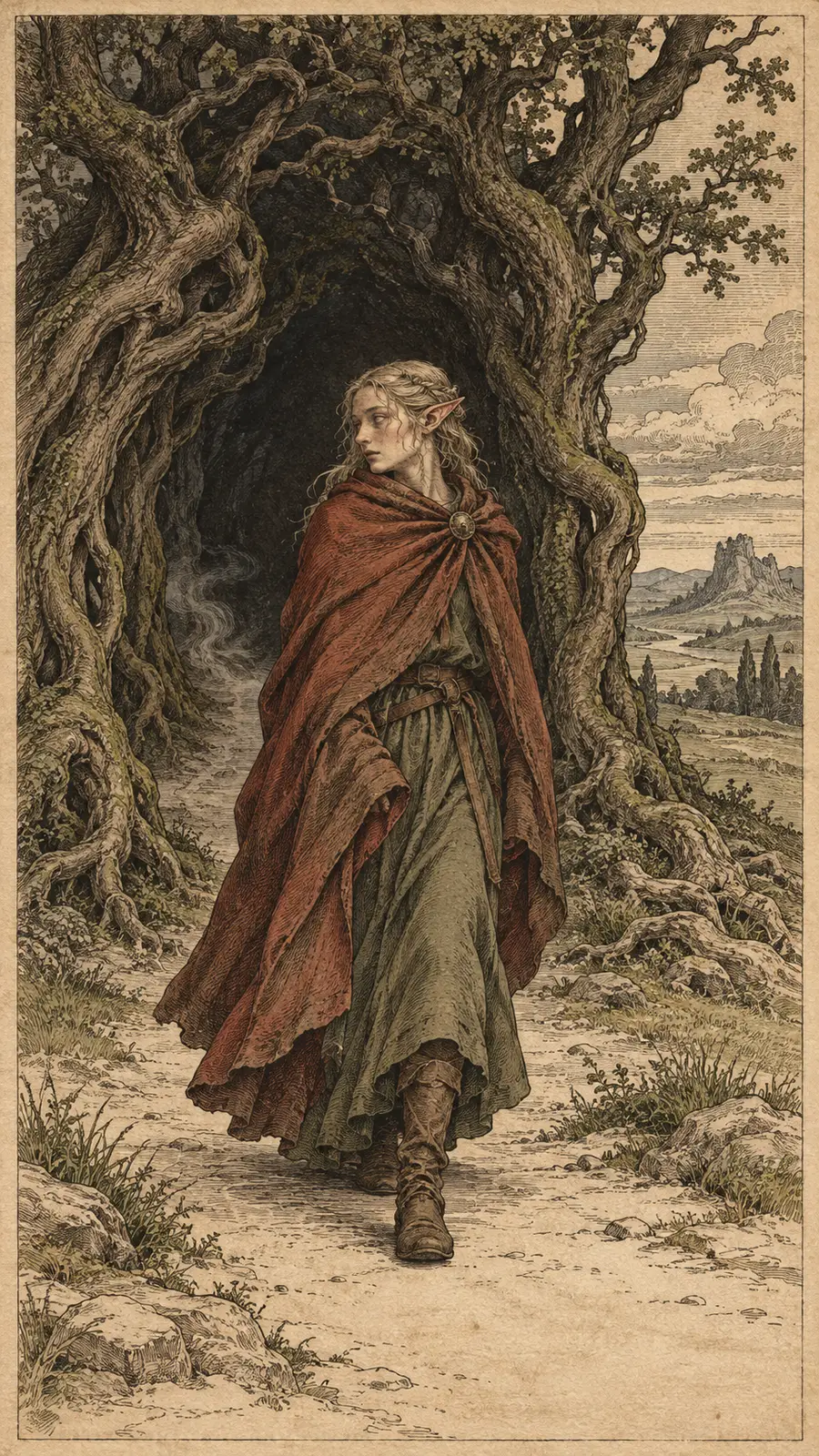
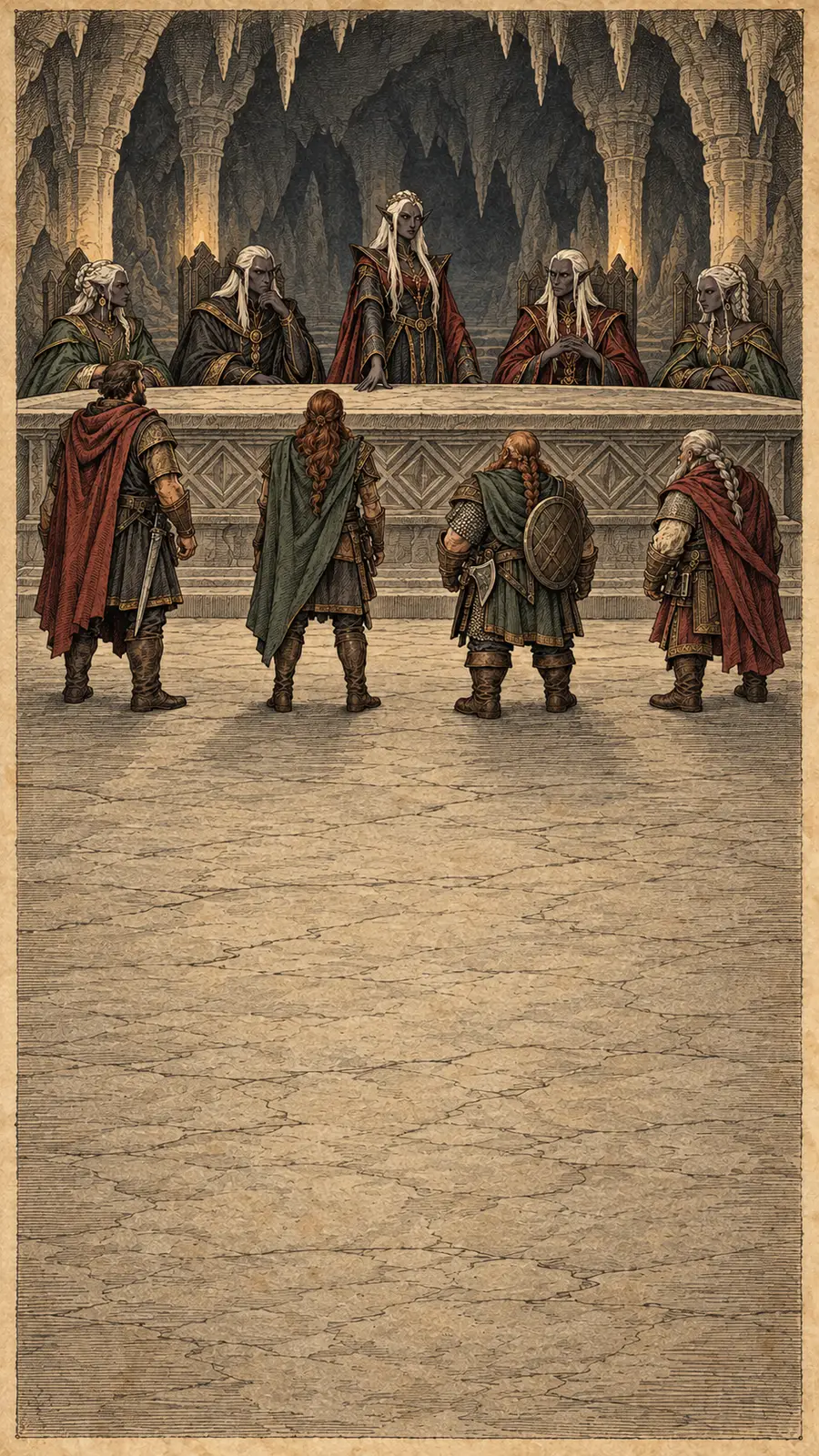
Before there were drow, and before the dark elves of the south had any reason to look upward and grieve, there were the gods of the elves, the , who lived in Arvandor. Arvandor is a forest realm on the plane of , a place of tall trees and deep green light where every season seems to arrive at its loveliest. At the heart of that realm stood , first of the elven gods, the artist and warrior who in elven belief shaped their people and watched over them. Beside him stood his consort, a goddess named Araushnee.
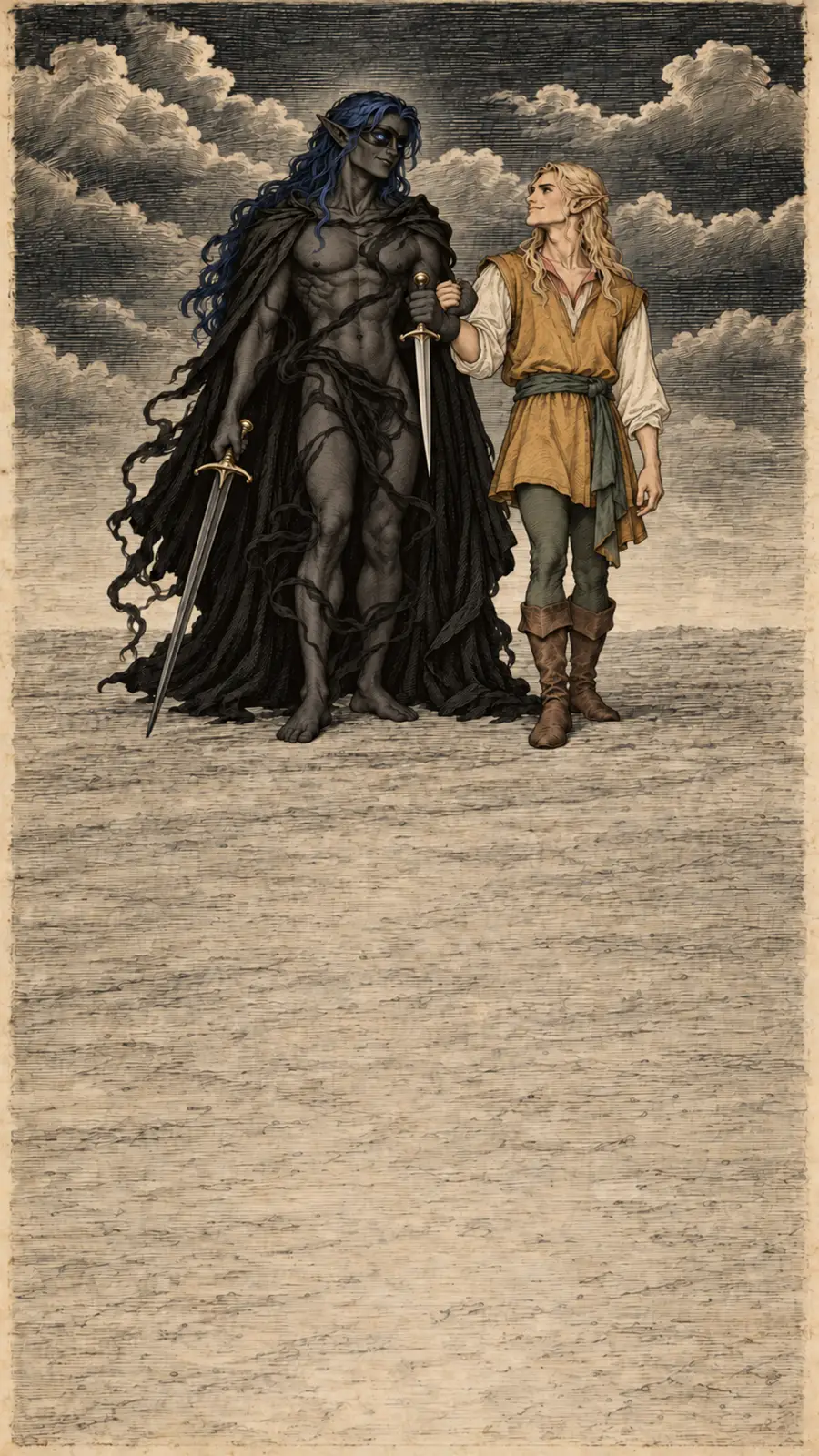
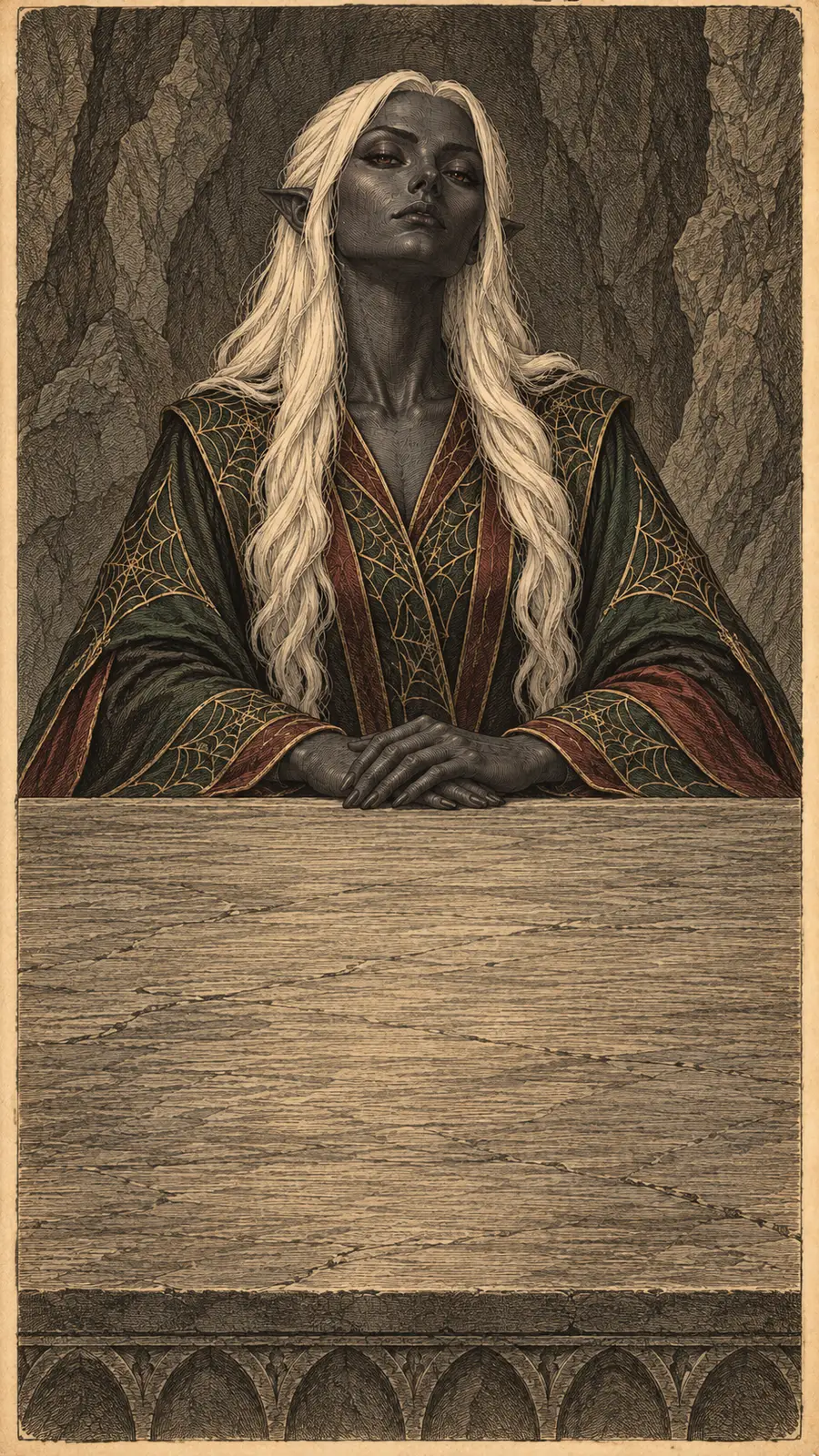
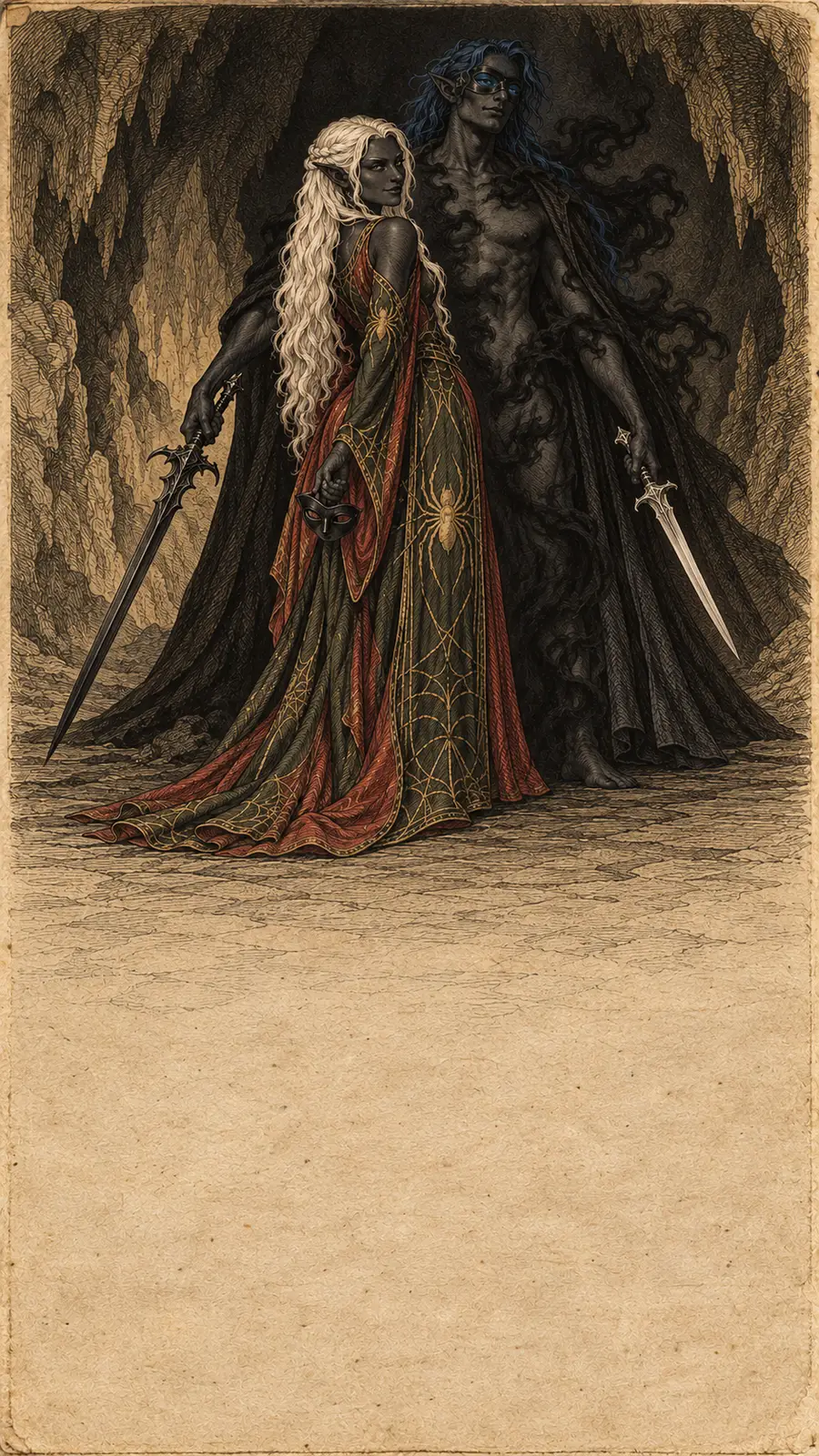
Araushnee was the Weaver of Destiny. Her portfolio was destiny itself, along with artisans and the dark-skinned elves who would one day carry her shadow with them into the deep places of the world. Corellon was completely taken with her. The tales dwell on her grace and her beauty, and on how thoroughly the first of the Seldarine gave his heart away to her. From that union came twins. The elder was a son, Vhaeraun. The younger was a daughter, . One telling says he came into the world only a minute before his sister, and that small minute would echo a long way down the ages.
You might picture the twins as children of the forest, dark-haired and quick, raised among gods who danced and sang beneath the leaves. The myth doesn't linger on their childhood. It moves quickly to the thing that defines this whole family, which is that their mother was not content.
Araushnee was jealous. She envied Corellon his place, and in secret she planned to bring him down, so that she would become First of the Seldarine and Coronal of Arvandor in his stead. The Realms' long chronology places this rebellion some thirty thousand years before the reckoning that the people of the Dales would later use to count their years, so far back that even the elves remember it only as a story told by their gods.
Her first attempts were careful and indirect. She made common cause with , the one-eyed god of the orcs and Corellon's oldest enemy. She enchanted a scabbard so that Corellon's sword would shatter during his duel with the orc god. But the moon goddess Moonbow, who sees what moves in the night, found the tampering, and the scheme came to nothing. Araushnee tried again by stirring , the beast god, into falling on Corellon while he was wounded. Corellon drove him off. These were small moves, and each failed. Their real purpose was to teach her that she couldn't topple Corellon alone.
So she turned to her son.
In this story Vhaeraun is his mother's co-conspirator, the one member of the family who knew what she intended and chose to help. Together with Araushnee and with Gruumsh, he helped gather a vast alliance of gods hostile to the elves. The greater and lesser powers of the orcs joined it, and so did those of the goblinoids and the kobolds, the giants and the ogres, and many other peoples who had their own grievances against the bright folk of Arvandor. It was a great dark host, assembled with patience and persuasion, and you can imagine the elder twin moving among those divine war camps, speaking softly, promising, arranging.
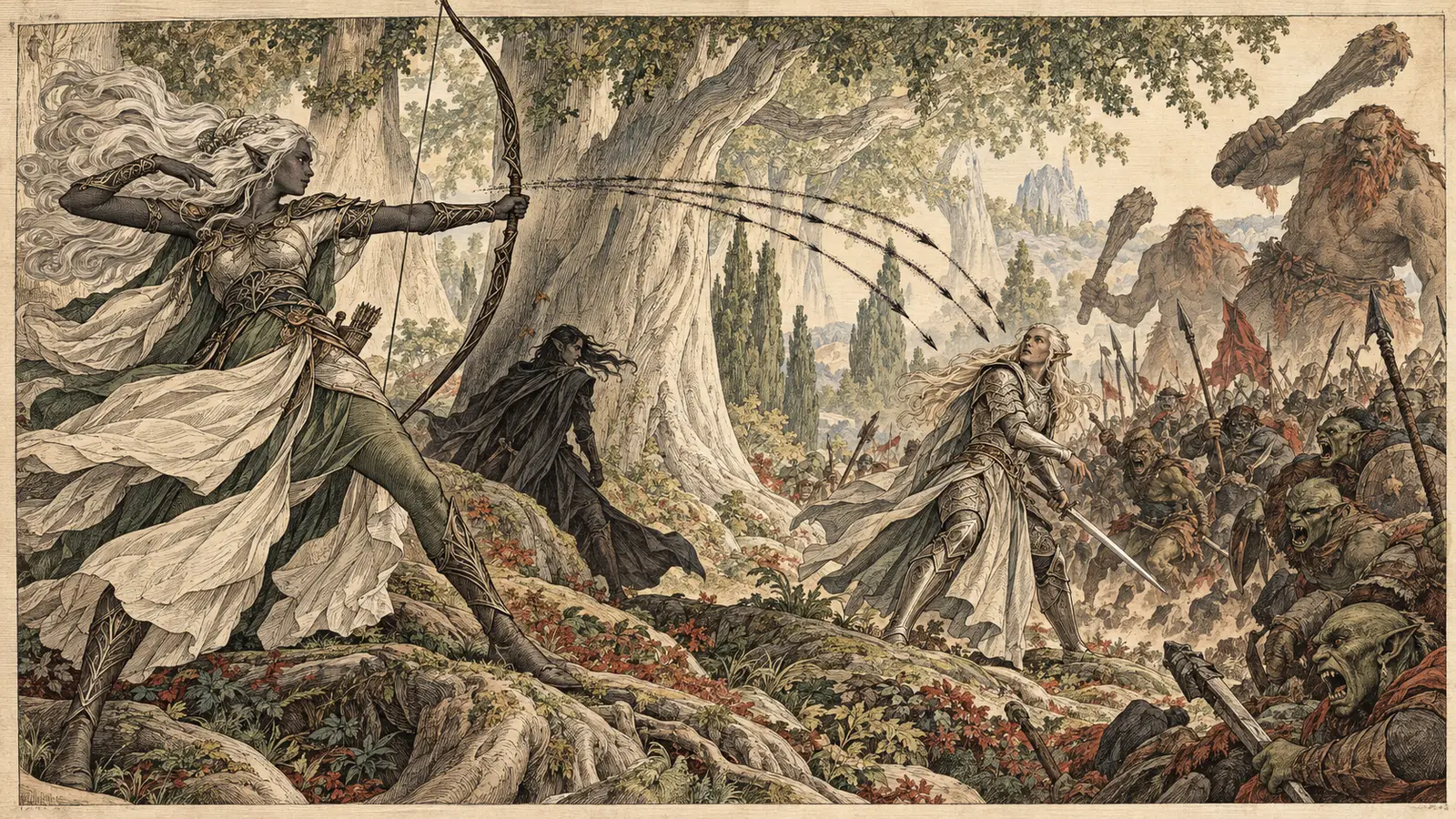
Here the myth adds a twist that tells us a great deal about Araushnee. She knew this army was badly organized. She expected it to fail. Its true purpose was cover. While the gods of the orcs and giants threw themselves against the Seldarine, a quieter plan would unfold behind them. The cursed scabbard would find its way back to Corellon. In the heat of battle it would draw the arrows of Eilistraee, the younger twin and a gifted archer, straight into her father's chest. Corellon would die by his daughter's hand, and the innocent girl would take the blame.
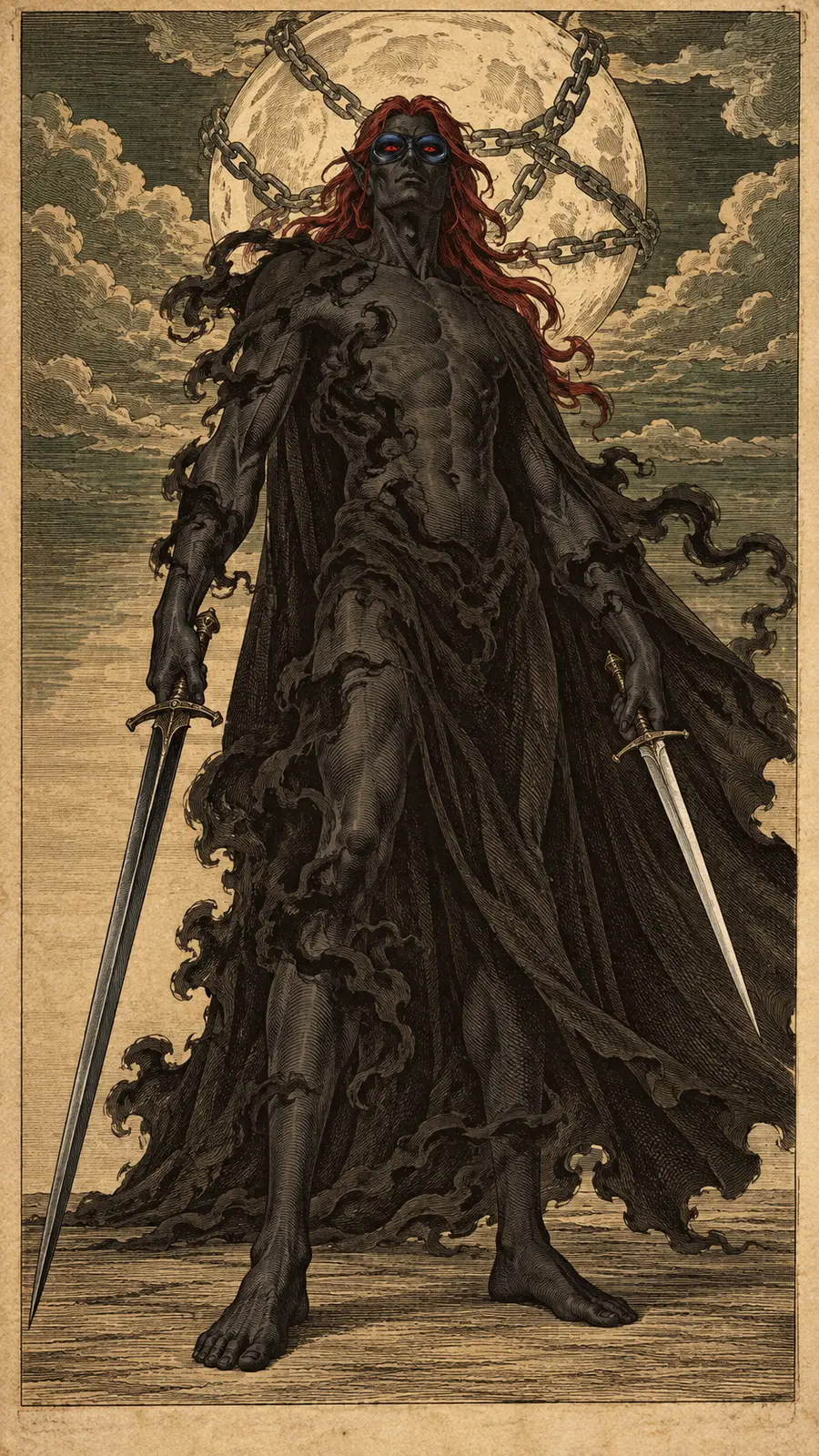
There was one obstacle. Araushnee had taken the first step of her betrayal within sight of the moon goddess, so Sehanine knew. The moon goddess went to confront her, but she went by day, when the moon's power is at its weakest. Araushnee struck first. And it was Vhaeraun who imprisoned Sehanine, holding the moon goddess captive while the plot went forward. If you want a single image of the son's part in this story, that is the one: the moon locked away so that the dark could do its work undisturbed.
Mother and son then made sure that Eilistraee would find the scabbard herself, carry it to her father as a gift, and stand near him when the fighting began. She knew nothing of what they planned. She was simply placed where they needed her, the way a piece is placed on a board.
Then came the war. The host of hostile gods marched on Arvandor, and Corellon and the Seldarine rode out to meet them beneath the great trees. Araushnee and Vhaeraun took the field as though they fought for the elves. In truth they were quietly helping the attackers, turning a blow here and opening a gap there. In the chaos of that battle, Eilistraee loosed her arrows at the enemy, and the curse bent them. They struck Corellon.
Near the end of the war Sehanine broke free. The price she paid for her freedom is never spelled out, only that it was heavy. She came in time to stop Araushnee from poisoning the wounded Corellon, and with that the whole treachery came into the light.
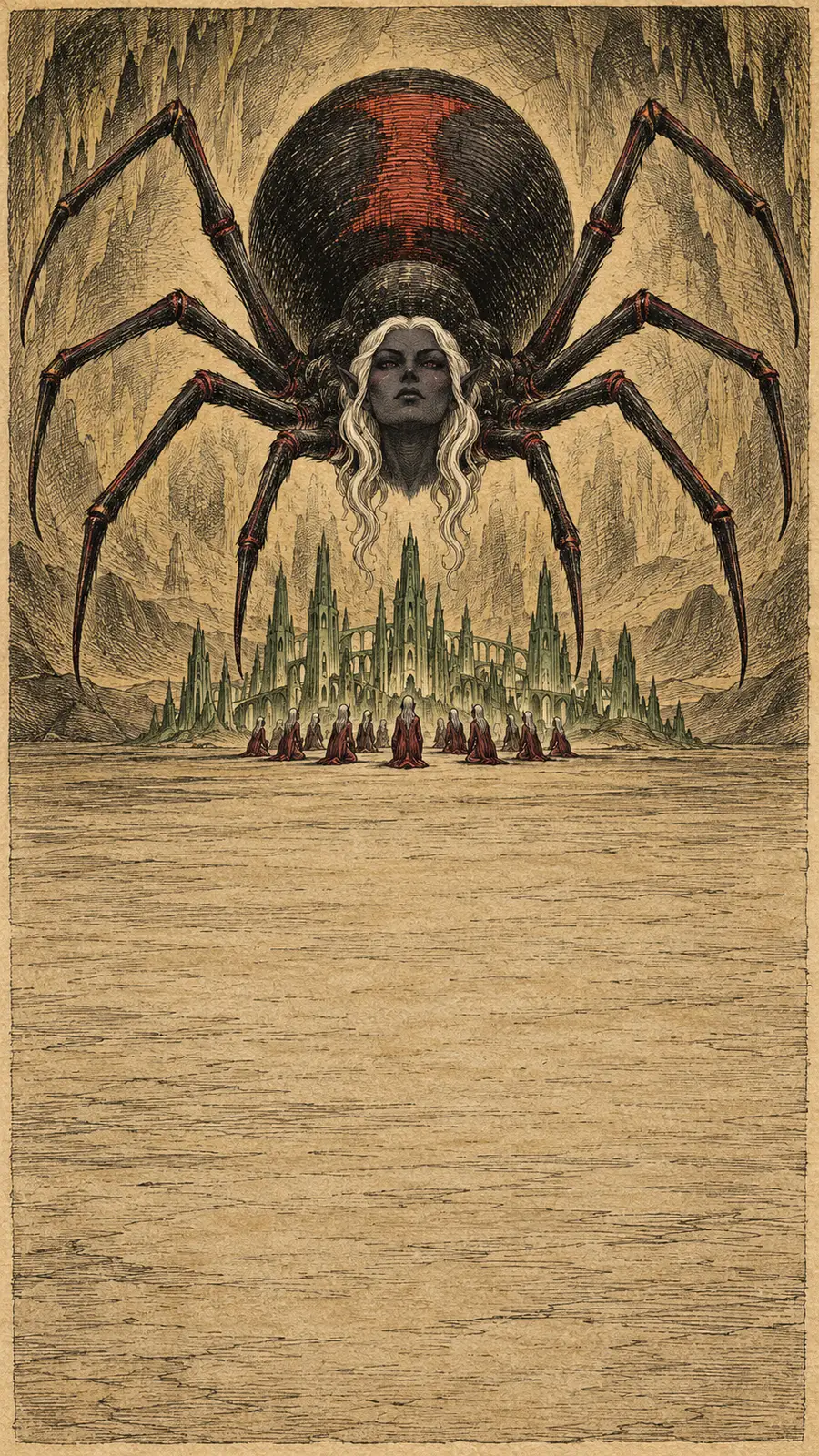
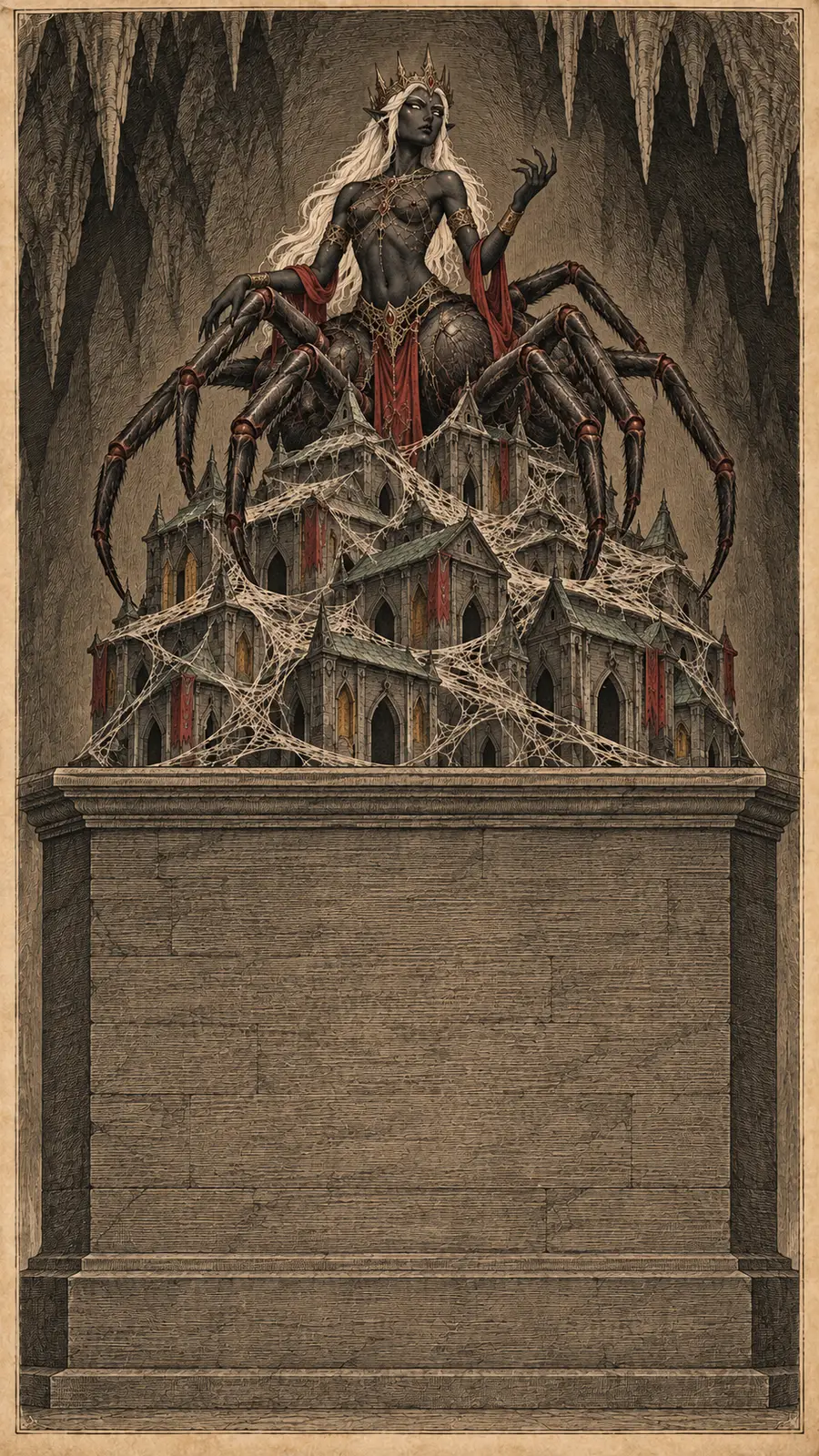
The judgment followed. Corellon banished Araushnee, and she was transformed into a tanar'ri, one of the chaotic fiends of the Abyss, a demon in the shape of a spider. She took a new name, , and made her home on the sixty-sixth layer of the Abyss, the Demonweb Pits. That story belongs to her, and it has been told many times elsewhere. What matters for us is her son's sentence.
When Corellon learned how his son had played him false, Vhaeraun was simply exiled. He was cast out of Arvandor and out of the company of the Seldarine. It was a lighter sentence than his mother's, and yet it carried its own quiet weight. He wasn't twisted into a demon. He was sent away, and he went.
Eilistraee was cleared of all guilt, for everyone could see she had been used. Even so, she chose to go into exile beside her brother. She had foreseen that the dark elves would need her light and her hope in the times to come, and she would not leave them without it. So the twins went out from Arvandor together, one because he was sent and one because she chose to go. Ever after, both counted as exiled members of the Seldarine.
Each twin kept a small residence in the Abyss, near their mother's realm, but neither used it much. Eilistraee wandered Arvandor and the surface world, dancing under the moon. Vhaeraun preferred the Plane of Shadow, that grey echo of the world where light thins and everything seems a little further away than it should be. He was at home there.
And Corellon grieves. The Realms' lore says the rift between the father and his son runs nearly as deep as the one between Corellon and Araushnee herself. Corellon despairs that Vhaeraun has never repented. There is something very quiet and sad in that detail: the god of elves, who forgave his daughter at once, still waiting through the ages for a word from his son that never comes.
The exile did not leave Vhaeraun idle. He turned his attention to the world of and to the elves who lived there, and in the south of the continent of he built strong influence. He became a major patron of the dark elves of Ilythiir, a realm of dusky-skinned elves in the warm southern lands. Under his guidance they pushed outward, expanding their territory and their power. , the ancient and formless god of oozes, also found a place in Ilythiir, though only a secondary one. Eilistraee worked against her brother there, trying to undo what she saw as his corruption of the Ilythiiri.
Then the world itself broke. Around seventeen and a half thousand years before the Dale Reckoning, the elves worked a mighty ritual that tore apart the land. They called it the Ever'Sakkatien, and later ages would know it as the first Sundering. Much of Ilythiir was destroyed, including its capital, Atorrnash, and many of Vhaeraun's followers died in the ruin. His influence ebbed. His long struggle with his sister weakened him further, and into the space he left behind came others, his mother Lolth and Ghaunadaur above all.
During the Crown Wars, the long series of conflicts among the elven realms, Lolth sent the balor Wendonai and other demons to offer the dark elves power at a corrupting price. Some ten thousand years before the Dale Reckoning, in the event called the Descent, Corellon and the Seldarine cursed the dark elves for their crimes and drove them below the earth. They became the drow. This, too, is a larger story with its own tellers, and we leave it here.
What matters is what that long history left inside Vhaeraun's faith. From these ancient days grew the doctrine that would set the son against his mother forever. Lolth favours females, and her drow cities are matriarchies ruled by her priestesses. Vhaeraun holds that males and females are of equal worth. Lolth demands that surface elves be sacrificed to her. Vhaeraun urges cooperation with them. Lolth keeps drow society still and stagnant, every house locked in its place. Vhaeraun draws those drow who want change, trade and expansion. Lolth wants to snuff out the drow longing to return to the surface world. Vhaeraun wants them to go back up and seize power there.
It's worth noticing how strange this is. The god who betrayed his father, who imprisoned the moon, who joined a host of orc gods against his own people, became in time the voice for drow freedom and drow equality. He was never good. He has never been anything but chaotic and evil. Yet he offers the males of a cruel matriarchy something no other god of theirs will give them, and that offer is the root of everything that follows.
This whole tale of betrayal, so central to the Masked Lord, arrived in the game fairly late. Elaine Cunningham told it in her novel Evermeet: Island of Elves, published in 1998, whose opening chapters show the early strivings of the elven gods. The same year, the sourcebook Demihuman Deities set the same lore down in game form. The name Araushnee comes from that 1998 material. In older lore outside the Forgotten Realms, Lolth had simply been a demon queen with no elven past at all. So the myth we've just walked through is something the Realms later gave him, a story of where he came from written after he had already existed for some years.
To see how he first arrived, we have to go back much further than 1998, to a single mention in a thick first edition rulebook.
Chapter II
A name among the drow gods
Our next stop is 1985, and a book called Unearthed Arcana.
By then the drow were already familiar figures to players of Advanced Dungeons and Dragons. Gary had created them, along with their goddess , in a run of adventure modules in the late 1970s that led players down from the hill giants' halls into the depths of the earth, and at last into a great cavern holding the drow city in the Vault of the Drow. Those drow were frightening, beautiful and alien, ruled by Lolth's priestesses, and for years they were simply enemies, waiting in the dark.
Unearthed Arcana changed that. It was a first edition rulebook written mostly by Gygax, with design work from Jeff Grubb, and among its many new options it made the drow a race that players could choose for their own characters. For the first time, you could sit down at the table and play one of the dark elves rather than fight them.
In its section on drow, the book made a small observation that would turn out to matter a great deal. Not every drow community worships Lolth, it said. Some honour other gods. In those communities the social order shifts, and the usual roles of males and females may be reversed. Among those other gods was a name: .
He was given to the reader in the briefest possible way. He was the god of thievery and of drow males. That was nearly all. There was no mask yet, no twin sister, no mother named Araushnee, no realm hidden on another plane. There was simply a god for the males of a society that kept males beneath its heel, and a god who stole.
It's worth pausing on how much those few words already contain. Think about what it means, in a culture ruled by the priestesses of a spider goddess, for there to be any other god at all. A drow city as Gygax imagined it was a place of absolute religious order, where the will of Lolth ran through every noble house and every street. To say that some communities turn elsewhere is to say that cracks run through that order, and that in some of those cracks the whole arrangement of power is turned on its head.
And the god whose name stands in that crack is a god of thieves. That fits. A thief takes what he isn't given. A male in Lolth's cities isn't given much. You can feel, even in that thin early sketch, the outline of a faith built on taking: taking back power, taking back dignity, taking back things that belonged to someone else and making them yours.
In these first appearances Vhaeraun is a minor figure, the sort of name a careful reader might notice and then forget. He's a thieving god for drow males who stand against Lolth's matriarchy. The things we now think of as most essential to him all came later. His descent from Lolth and , his mask, his doctrine that males and females are equally valuable and his hunger for the surface world would be added by other hands in the years ahead.
Something else is worth noticing about where he began. The drow of the late 1970s modules lived in the world of , Gygax's own setting. Unearthed Arcana was written for the game as a whole, not for any one world, but its roots lay in Gygax's Greyhawk. Vhaeraun's lasting home, though, would not be Greyhawk at all. He would find his fullest life a few years later in another world entirely, the Forgotten Realms, where a writer named Ed Greenwood was building a vast and detailed setting that would soon swallow up much of the game's attention.
So picture him as he stood in 1985. A god with a single line or two, a god of thieves and of males, suggested more than described. A shape at the edge of the lantern light. The mask had not yet been put on, but the face was already turned away from his mother.
Six years later, the Forgotten Realms gave him a voice.
Chapter III
The Masked Lord takes shape in the Realms
We come now to the early 1990s and the second edition of Advanced Dungeons and Dragons. This is the era when the drow gods beyond truly came to life. , , , and were all introduced or fleshed out during these years, and Vhaeraun gained more than any of them.
The first great step came in July 1991, in a book called The Drow of the Underdark. Ed Greenwood, the creator of the Forgotten Realms, wrote it for second edition, and it focused on the drow of his own world. It covered almost everything a curious reader could want to know about the dark elves: their nature and their society, their history, their spells and magic items, their craftwork and languages, the way they name their children and the runes they carve. And it had a chapter on their religion, which described four powers: , Ghaunadaur, Lolth and Vhaeraun.
Here, for the first time, the Masked Lord stepped forward as an active god of the Realms with a church and a purpose of his own. In Greenwood's book he is the male drow god of stealth and thievery, and he stands for the aims of the drow on the surface world. That last phrase is the great addition. The thief of 1985 now has ambitions that reach up through the stone to the open sky.
What does he want? He wants the world above. Long ago, his people were driven down into the Underdark. He means to reclaim the surface world they were forced to flee. This is the core of him from now on, the thing every later writer would return to. Lolth's drow are content to rule the dark, or at least their goddess wants them to be. Vhaeraun's drow are restless. They look upward.
Greenwood's book gave his church its basic shape as well. It is loosely organized. This isn't carelessness. Lolth's priestesses rule most of the drow race, and they persecute the Masked Lord's faithful wherever they find them. A church that's hunted can't build great temples or keep long lists of members. It survives as scattered cells, small groups that know only a few of their fellows, so that no single capture can unravel the whole.
The clergy is almost entirely male. That's natural for a god of drow males in a world where females hold nearly all religious power. To serve Vhaeraun is, among other things, to claim a priesthood that Lolth's cities would never allow a male to hold.
And there's a quiet heresy inside the faith, too. Some of Vhaeraun's priests argue that the elven races should be united, dark elves and surface elves together, because a united people could dominate the surface world more easily. Most of the faith rejects this as heresy. It's a lovely detail, because it shows a church that isn't of one mind. Some of the Masked think that the old wound between drow and their surface cousins might be healed, if only for the sake of conquest. Most of the faithful find the idea unthinkable.
Then, in May 1992, came Monster Mythology, written by Carl Sargent. It was a second edition sourcebook devoted to the gods of the non-human peoples: the powers of elves and dwarves, gnomes and halflings, orcs and goblins, dragons and giants and many more. In its section on the gods of the Underdark, Vhaeraun appeared alongside Lolth, Kiaransalee and Zinzerena, and he was given his first full portrait, priesthood and all.
Sargent made him a lesser power, chaotic evil in alignment. He gave him the titles that would follow him ever after: the Masked Lord, and the Masked God of Night. His spheres of influence were drow males, thefts and evil activities on the surface.
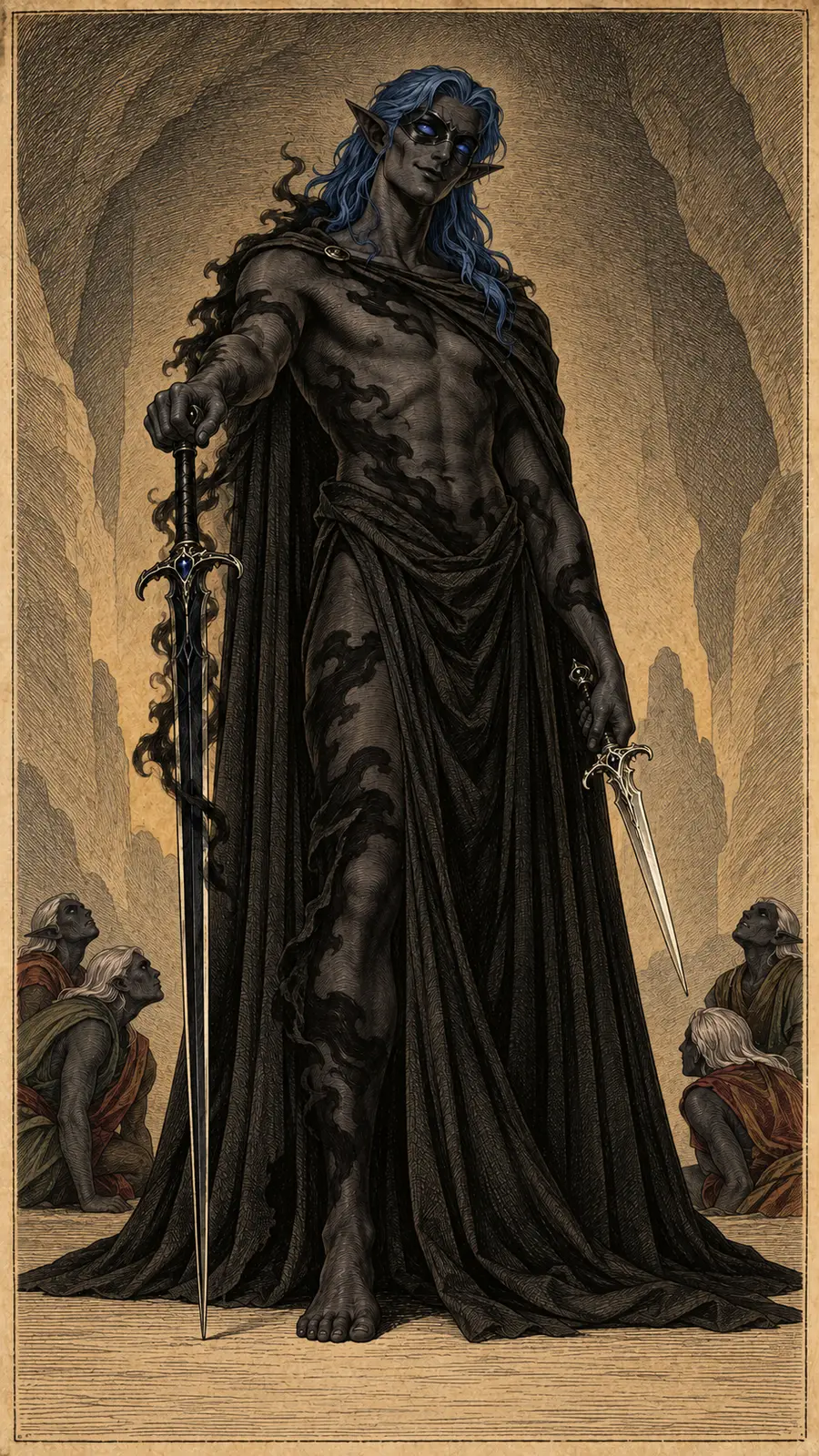
And Sargent described what the god looks like when he walks among mortals. His avatar is a drow male, slim and graceful and handsome, and well muscled beneath that grace. The most memorable detail is this: the colour of his eyes and hair changes with his mood. When he is angry they burn red. When he is amused they turn blue. In triumph they glow gold.
It's a small touch, and a beautiful one. Picture a dark elf standing in shadow, his face mostly hidden, and then picture the colour in his hair shifting slowly as you speak to him, from a cool blue of amusement to the first flush of red. You'd know exactly where you stood with him, if you knew how to read it, and you might wish you didn't.
That avatar wears a mask, and here the mask enters his story in earnest. His holy symbol in Monster Mythology is a black half-mask, the kind that covers the upper part of the face, and it isn't merely a picture on a shield or an amulet. It can actually be worn. The symbol of the god is something a priest puts on. In the Forgotten Realms the symbol would come to be described a little more precisely as a black mask with blue glass lenses set over the eyes, and that is the image that has lasted: a black mask, and behind it, two cool panes of blue glass.
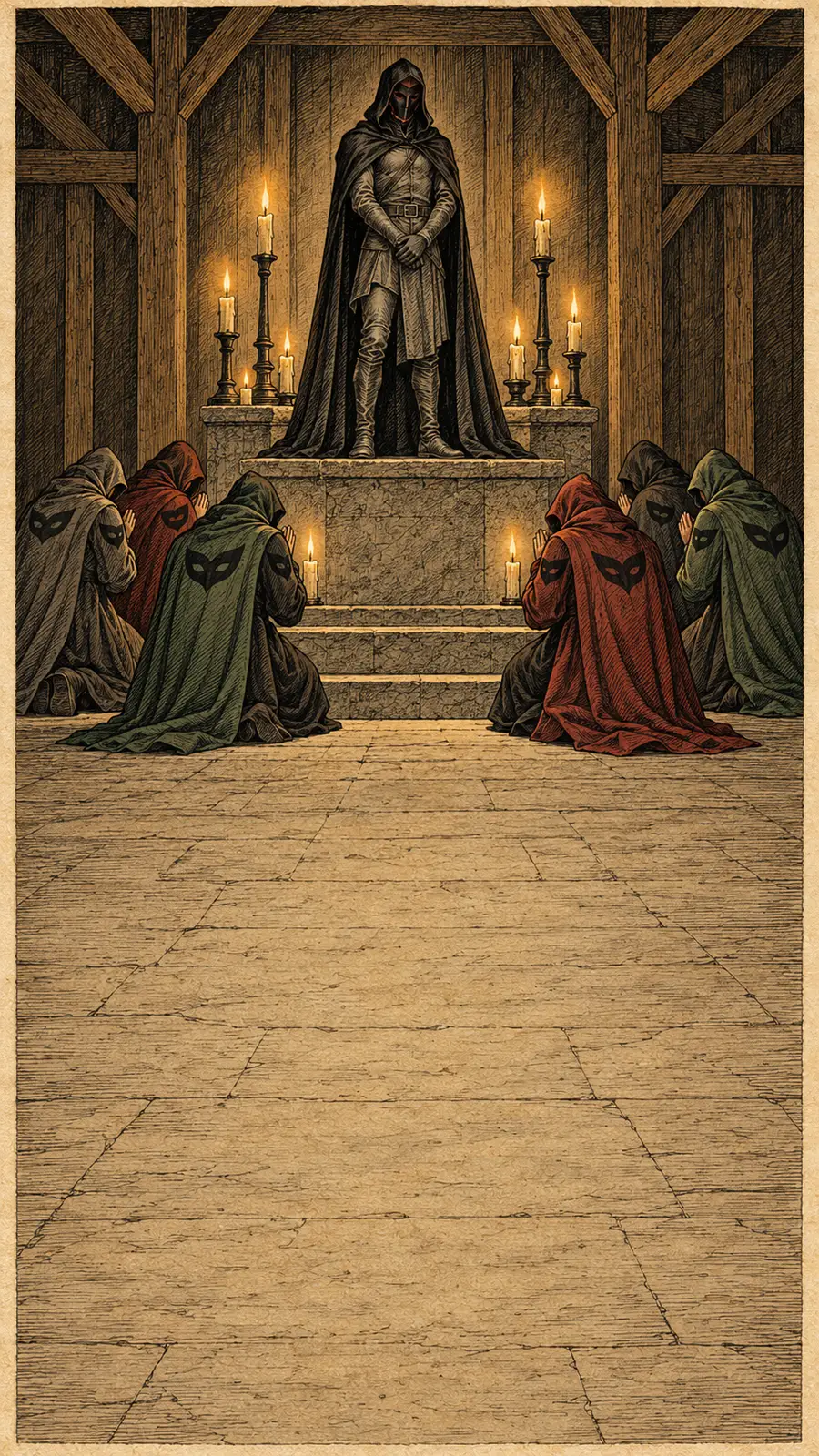
His priests dress the part. They wear half-masks, loose silk shirts, snug trousers and leather boots, and all of it is dyed jet black. Every priest carries at least one bladed weapon whose edge has been blackened so that it won't catch the light, and many carry several. You can picture them moving through the dim streets of a drow city or the dark lanes of a surface town, almost invisible, every gleam of steel dulled, the only shine the faint glint of glass over their eyes.
This was also the era that fixed his place within his family and set his doctrine down in the form it has kept. He is Lolth's son, and Lolth sees him as her real rival, the one enemy among the drow gods she genuinely has to watch. The contrasts between mother and son were drawn sharply. She favours females, and he holds the view, almost unheard of among the drow, that males and females are of equal worth. That view draws in male drow who want something better than a life of servitude under the matriarchy. She demands the sacrifice of surface elves, and he urges cooperation with them, at least among some of his priests. She keeps drow society frozen in place, while he draws in those who want change, economic growth and new territory. She wants to extinguish the drow wish to return to the surface. He calls on them to settle it and seize power there.
Because of all this, his following became large. Among the gods of the drow, Vhaeraun commands the largest following on the surface and the second largest overall, behind only his mother. That's a remarkable position for a church that is loosely organized and constantly hunted. It suggests how many drow, above and below, quietly long for what he promises.
Drow lore of this time also gave him a son. Selvetarm, the spider-warrior who would become Lolth's champion, was said to be the child of Vhaeraun and the Dancer, an elven goddess. We'll return to that strange family tie later, because it comes back to Vhaeraun in a very direct way.
There was one more piece to place in this era, and it came from the planes. In 1996 the Planescape line, which charted the great wheel of outer planes that so many earlier episodes have wandered, published a book called On Hallowed Ground. It set out where each god of the multiverse makes his home. Vhaeraun's divine domain, it said, is Ellaniath, and it lies on Colothys, one of the layers of .
Carceri is the prison plane, the place where the multiverse sends its traitors and its exiles. Its layers are strung one beneath the other like cells in a long, dark gaol. Colothys is a place of jagged spires and sudden chasms, a vertical landscape of narrow ledges and long drops, and it is home to liars who harm others. For a god exiled by his father for treachery, there could hardly be a more fitting address.
Ellaniath itself is hidden. No one can find it without Vhaeraun's permission. You can imagine a traveller on Colothys picking along a ledge between the spires, passing within a few steps of the Masked Lord's realm and never knowing it was there. It's a hiding place within a prison, a secret tucked inside a punishment. That's the second edition picture of him: an exiled god who made his home in the prison of liars, and arranged things there so that nobody would ever find him unless he wished it.
By the end of these years the Masked Lord had become a real presence in the Realms, with a face, a mask, a creed and a hidden home. But the fullest portrait was still to come. It would arrive in 1998, in a book that gave every elven and drow god of the Realms a long and careful accounting.
Chapter IV
The full portrait in Demihuman Deities
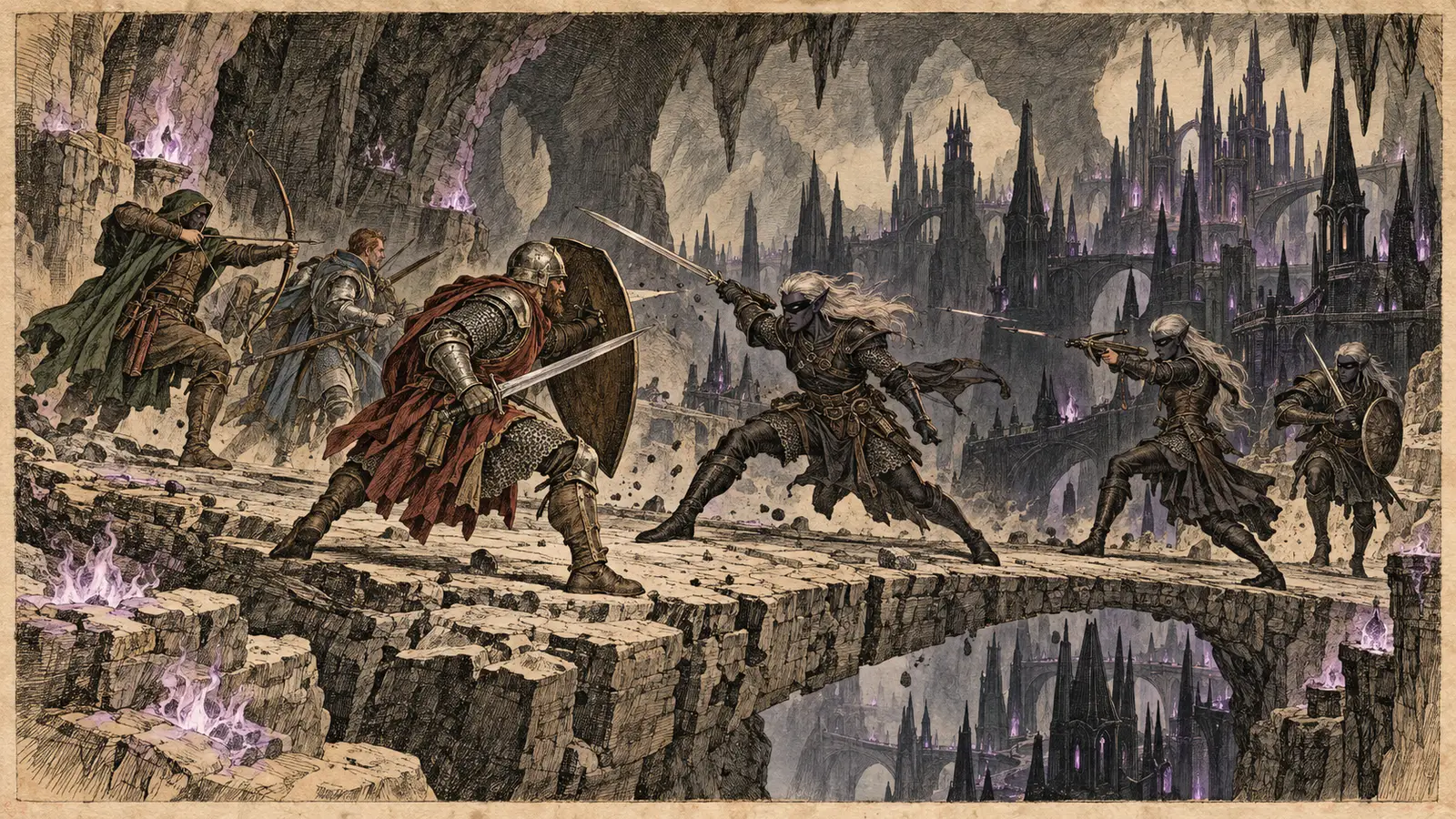
In 1998 the publisher TSR released Demihuman Deities, a second edition Forgotten Realms sourcebook written by Eric L. Boyd. It covered the gods of the elves, drow among them, along with the dwarves, the gnomes and the halflings. Every god received the same thorough treatment: appearance and personality, worshippers and portfolio, allies and foes, symbol and avatar, the ways the god shows its presence, and a long account of the church that serves it. For , this book became the definitive portrait. Much of what later editions say about him is Boyd's work, condensed or carried forward.
It's also the book that, together with Cunningham's Evermeet the same year, brought the story of Araushnee's betrayal into the game. So in a sense, this is where all the threads we've followed so far are finally woven into one cloth.
Let's begin with the god himself. He is still the Masked Lord, the Masked God of Night. His portfolio covers thievery, drow males and evil activity on the surface world, and Boyd added one more word to it: territory. He is a god of claimed ground, of borders pushed outward and land taken. His symbol is the black half-mask, sometimes described in purple rather than black.
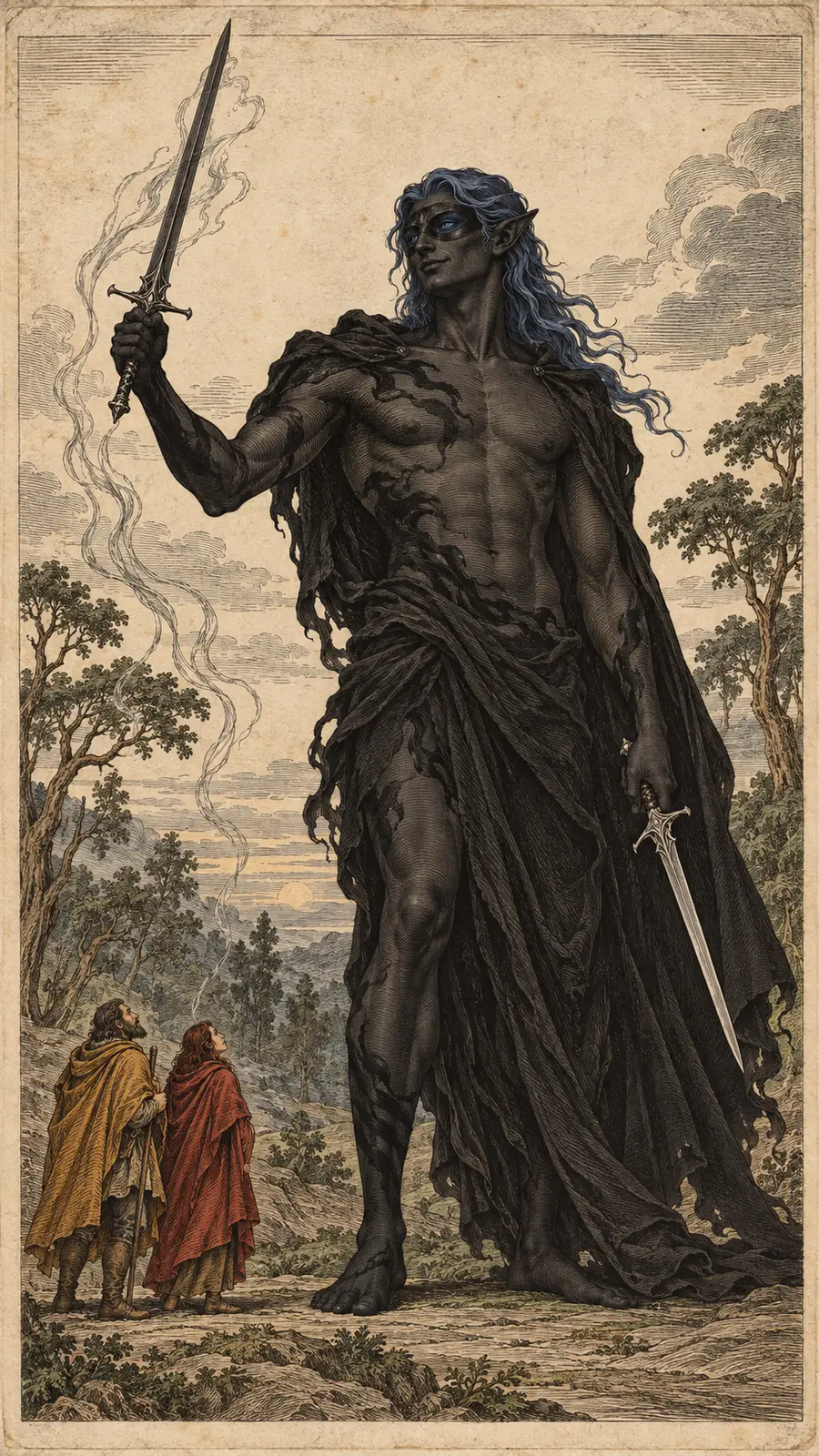
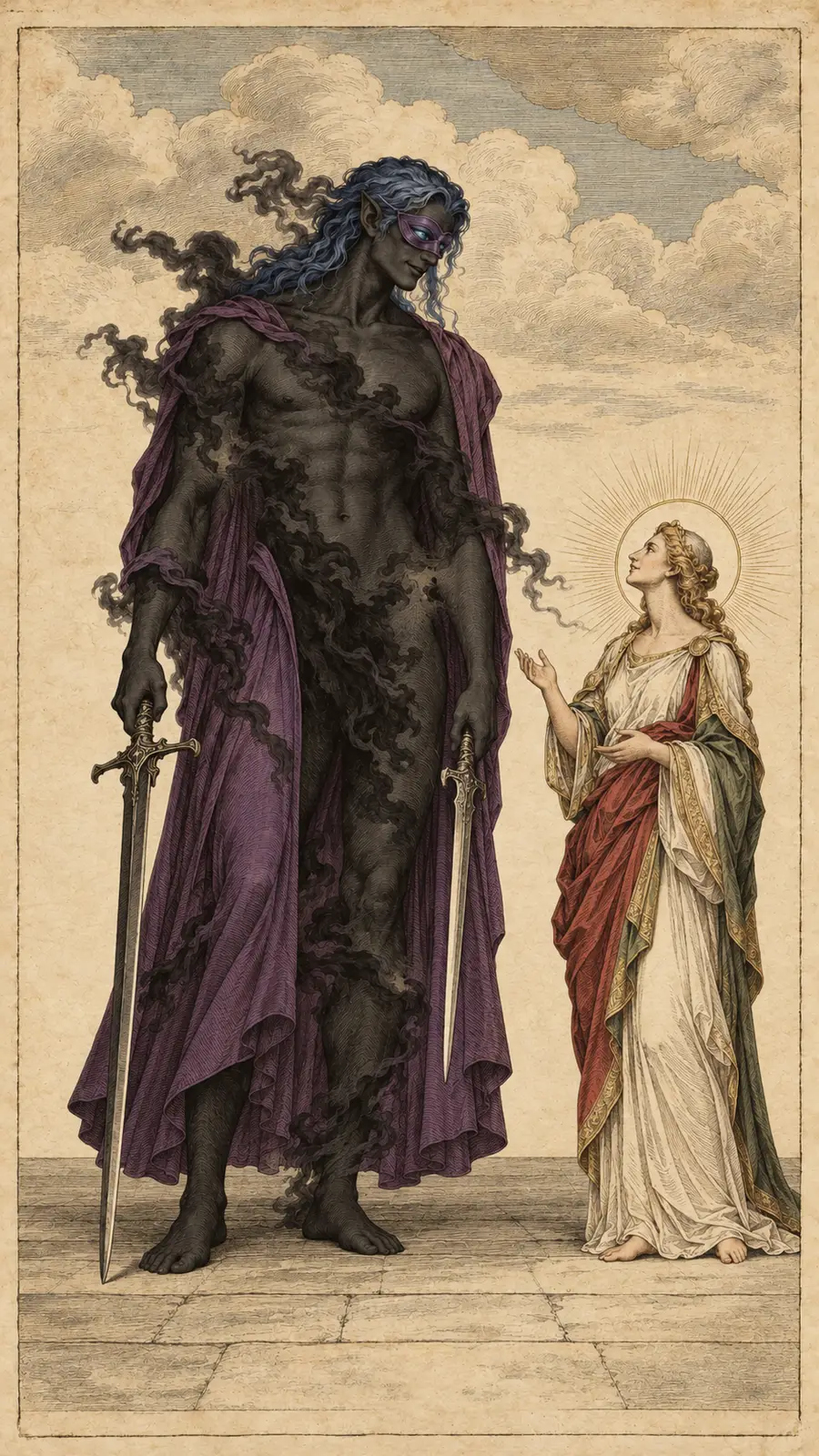
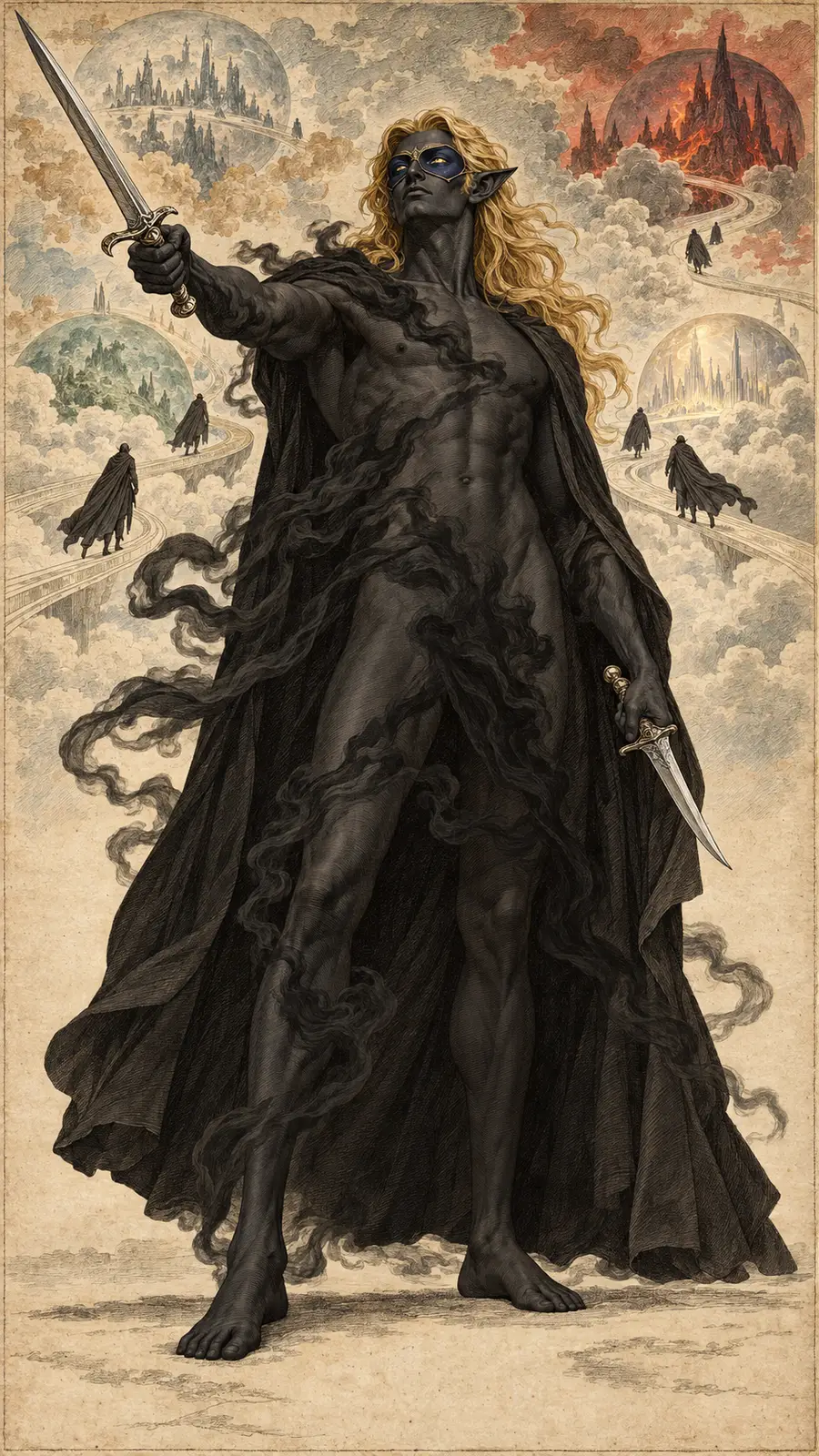
His avatar, when he takes form, looks at first like any handsome male drow, slim and graceful and toned, and there's nothing about his face that would mark him out in a crowd. But he can stand either about sixteen feet tall or about six feet tall, and he can change his height as he pleases. He wears no armour. He wears only his mask, in black or purple, and a long cloak of the same colour that falls to his heels.
And around his body there is shadow. This is one of the loveliest images in all his lore. The shadow isn't a simple darkness that hangs about him. It moves over him, drifting across his limbs and his chest, and wherever it passes he seems to vanish. You'd see an arm and then no arm, a shoulder and then only darkness, as though the god were being slowly erased and redrawn. If he lets that shadow swallow him completely, he can teleport, moving almost instantly from one place to another. He doesn't step through a door or speak a word of power. He simply lets the darkness close, and when it opens again he's somewhere else.
When he fights, he fights as both warrior and assassin, with a blade in each hand. In his main hand he carries a longsword called Nightshadow. In his off hand he carries a silver short sword called Shadowflash, and that short sword is his favoured weapon. The short sword would become the favoured weapon of his faith as well. The book gave his avatar formidable gifts, and above all a dexterity far beyond anything a mortal could reach. He's quick in the way the night is quick, there before you see it.
The god doesn't always come in person. When he can't send his avatar, or when the proper ritual of summoning hasn't been performed, he shows himself in other ways. Sometimes a flitting black shadow wraps itself around one of his favoured followers, and for a short time that follower is filled with the god's power. And sometimes he sends a mask.
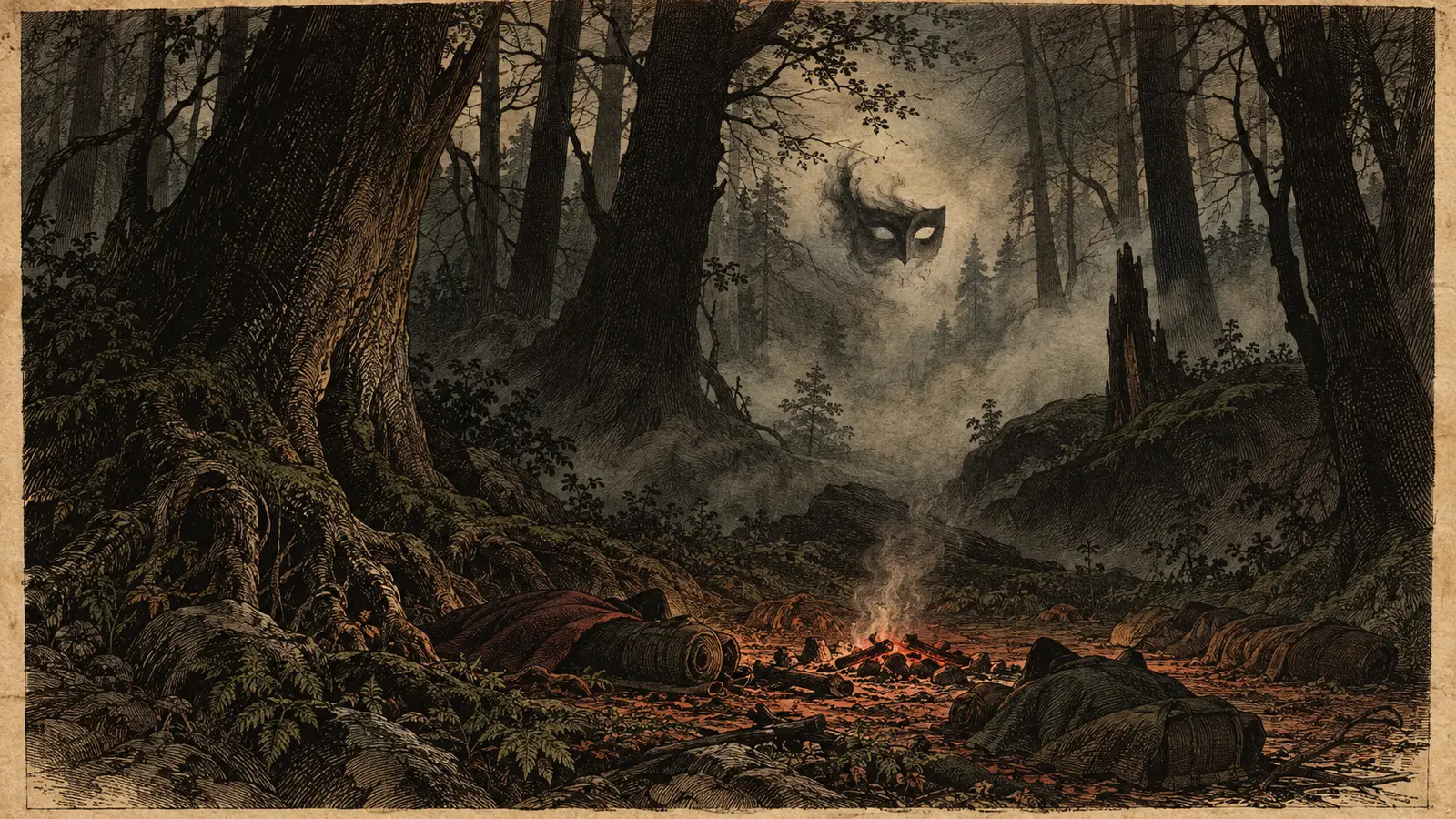
This manifestation is the one people remember. A half-mask made of shadow appears in the air, insubstantial, floating at about the height of a face. It drifts silently toward whoever the Masked Lord wishes to confront. It can do nothing but move, and laugh. When it appears, it gives a chilling, mocking laugh, twice. That's all. There's no blade in it, no spell. Only the mask, gliding slowly toward you through the dark, and the sound of a god who finds you amusing. Imagine sitting by a dying fire in some forest camp and seeing that shape come out from between the trees.
He also works through minions, and through his worshippers, whom he can strengthen and inform. In the end, most of Vhaeraun's work in the world is done by mortals in masks, and the god is content to stand behind them.
Now we come to his realm. Ellaniath is small, a hiding place where he can hole up when he needs to. Only Vhaeraun knows exactly where it lies, and perhaps does too, for very little in the drow world escapes her. The reason for this secrecy is a frightening one. Vhaeraun steals the memories of everyone who enters Ellaniath. When they leave, they don't remember where they've been. This is true even of weaker gods. A lesser deity could walk into the Masked Lord's home, speak with him, walk out again and never recall that the meeting took place.
The souls that dwell in Ellaniath are mostly ordinary petitioners, the dead faithful who have come to their god. But there are rare exceptions, called vhaeraths. These are souls who keep their full memories and every skill they had in life. Unlike the ordinary dead of his realm, they can leave Ellaniath and go out on divine missions. So in a realm where everyone else forgets, a few chosen servants remember everything, and those few are sent out into the planes to do the Masked Lord's work.
His servants beyond the faithful dead are a gloomy and varied company. He commands gehreleths, the scavenging fiends of , in their three kinds: the farastu, the kelubar and the shator. He commands mephits of air, of smoke and of earth. He commands shadow dragons, shadow fiends and shadows, and the yeth hounds that bay across the night sky. His favoured animals are black cats and ravens, and also dead spiders. That last one deserves a quiet moment. The son of the Spider Queen counts among his favoured creatures the spider that has died. He takes pleasure in his mother's sacred animal only when it's no longer alive. His favoured monsters include the demodands, the mephits and shadows, shadow dragons and shadow fiends, the yeth hounds, and of course the vhaeraths of his own realm.
Among the other gods he has allies, though none of them are friends in any warm sense. He worked with Mask, the human god of thieves, and with , the goddess of darkness and loss, and with , the goddess of poison and disease. Mask was the closest of these allies, and the two gods were so alike that surface folk who weren't drow often confused them. Both were thieves, both were masked, both worked in shadow.
His enemies are many. He hated his sister . He opposed every other drow god, and his mother above all.
His worshippers are mostly drow and half-drow males who want their people freed from Lolth's matriarchal rule, and who want for themselves a life better than servitude. Among them are thieves and rogues, assassins and poisoners, and in later editions the shadowdancers, rogues who learn to step from one shadow to another.
His dogma, in its essence, runs like this. The drow were wrongly exiled into the Underdark, and they belong on the surface. His shadows must throw off the tyranny of the Spider Queen and take back by force their birthright, their rightful place in the Night Above. The Night Above is the faith's name for the surface world, and it's a beautiful phrase. It means the sky that the drow have not seen in ten thousand years, the stars and the moon and the open air, and it means a dark that belongs to them rather than one forced on them. The matriarchies of the drow cities must be broken. The endless feuds that Lolth encourages, house against house, must end, so that the drow can become one people instead of a quarrelling crowd of rival houses and clans, each with its own small aims. The faith's power lies in unity, because its goal is to return to the lands above, where the ancestors of the drow once thrived.
Notice that this is a creed of unity, from a god of thieves. Vhaeraun's faithful lie and steal and kill, and yet what they preach is that the drow should stop tearing one another apart. Lolth thrives on division. Her son preaches togetherness in the service of conquest.
The church that holds this creed is still loosely organized, because the priestesses of Lolth, who rule most drow, persecute it without pause. Its clergy is entirely drow, and almost entirely male, roughly ninety-nine men to every woman. And it doesn't make open war on Lolth. It opposes her passively, through intrigue and trickery and treachery, quietly undermining her where it can.
The clergy as a whole are called the Masked. A novice of the faith is one of the Uncloaked, and a priest who has passed beyond the novice stage becomes a Nightshadow. Beyond that there's no strict ladder of rank. Instead the Masked carry an assortment of titles that don't form a hierarchy at all. A priest of Vhaeraun might be called Ascendant Darkness, or Black Moon, or Dark Mantle. Another might be Deep Rogue, or Enveloping Night, or Raven's Cowl. Others are Shadow Hunter, or Silent Sable, or Twilight's Herald. These names sound almost like poetry, and none of them tells you who gives orders to whom. In a church that must stay scattered to survive, that vagueness is a kind of protection.
The clergy is made up of several kinds of servant. More than half are specialty priests called darkmasks, the true elite of the faith, sent on the church's special assignments. Smaller numbers are ordinary clerics, and a few more are clerics trained also in the arts of the thief. About a quarter of all the clergy are thieves in some measure. A handful are crusaders, fighting priests. And there is one very rare order, about one in a hundred of the clergy, called the masked traitors.
The darkmasks are a particular kind of priest. They have strong wills, and their reflexes are unusually quick for clerics, though they're less sturdy in body than ordinary priests. They're made for slipping in and out, not for standing in a line of battle.
The masked traitors are stranger still. They are priestesses who serve Vhaeraun as spies inside an enemy church, and in practice that enemy is almost always the church of Lolth. Picture a high priestess of the Spider Queen, robed and proud, standing at the altar of some great drow temple, leading the rituals and speaking the prayers. And behind her eyes, in the private place where she keeps her true faith, she belongs to the Masked Lord. These women live dangerous lives. If they're discovered, there will be no mercy. But unlike other traitor priestesses, they receive special attention from their god and extra powers to lessen the danger. Vhaeraun watches over his traitors.
All of the Masked share certain gifts. Every priest of the faith has some skill in trickery, and many learn the skills of rogues. Across the clergy the god grants powers suited to a church of spies: the ability to see far-off places, to detect lies, to dispel magic and to plant a suggestion in another mind. Some of his priests can also read the thoughts of other drow, and can sense undead and hide from them.
His priests pray for their spells at dusk, as the light fails. They also pray whenever they accomplish something that brings them closer to their goal, a little private moment of thanks after a successful theft or a well-laid plan. Their prayer is silent. They meditate in shadow, without words. You might picture a priest standing very still in a dark corner of a room, mask in place, his whole body quiet, while somewhere far away his god listens.
The Masked teach practical things. They teach how to pick a lock, how to mix and use poison, how to lay an ambush. And they work their way into thieves' guilds and fellowships, on the surface and in the Underdark alike, taking quiet control of them without the members ever quite knowing who now pulls their strings. Their most important work, whether it's an attack, a negotiation or any other great undertaking, is always done at night.
At the heart of their year lies their holiest rite, the Masked Lord's Embrace, held on Midwinter Night, the longest night of the year.
On that night the faithful gather. Each of them calls upon the innate magic that every drow carries, the ability to summon darkness, and wraps himself in it. The darkness becomes a curtain of shadow that shuts out every distraction, every sight and sound and sensation. Normally such darkness would fade after a short while. But on Midwinter Night, Vhaeraun's power sustains it, for up to a full day. Inside that darkness the worshippers float, levitating, held in the air with nothing touching them. And they meditate. They turn over new ways to advance the faith, new schemes, new plans for the year ahead.
It's a ritual of total sensory deprivation, and it's worth lingering on, because there is something oddly peaceful about it. You might imagine yourself among them: drifting in perfect darkness, weightless, with no sound and no light and no ground beneath you. Time loosens. The cold of midwinter, wherever it waits outside, doesn't reach you. There is only your own mind, and the quiet presence of a god who has made the dark into a shelter. For a faith that spends its whole life hiding, this is what rest looks like. A whole day held in the shadow, safe, plotting slowly toward the dawn.
The vestments of the faithful are the ones we've already met: the black half-mask, the loose silk shirt, the snug trousers and leather boots, all jet black, and at least one blackened blade. In their daily lives the Masked wear black or grey. They worship in hidden shrines, in the surface communities where drow have settled and deep in the Underdark cities themselves, always secret, because the priestesses of Lolth are always hunting.
That is the fullest portrait the Masked Lord had received, and it was the foundation on which every later writer built. But even before Boyd's book was published, novelists had begun to show what Vhaeraun's faithful looked like in motion. To see them, we need to step back a few years, to a drow girl named and the masked merchants who crossed her path.
Chapter V
Masked merchants and avengers in Cunningham's novels
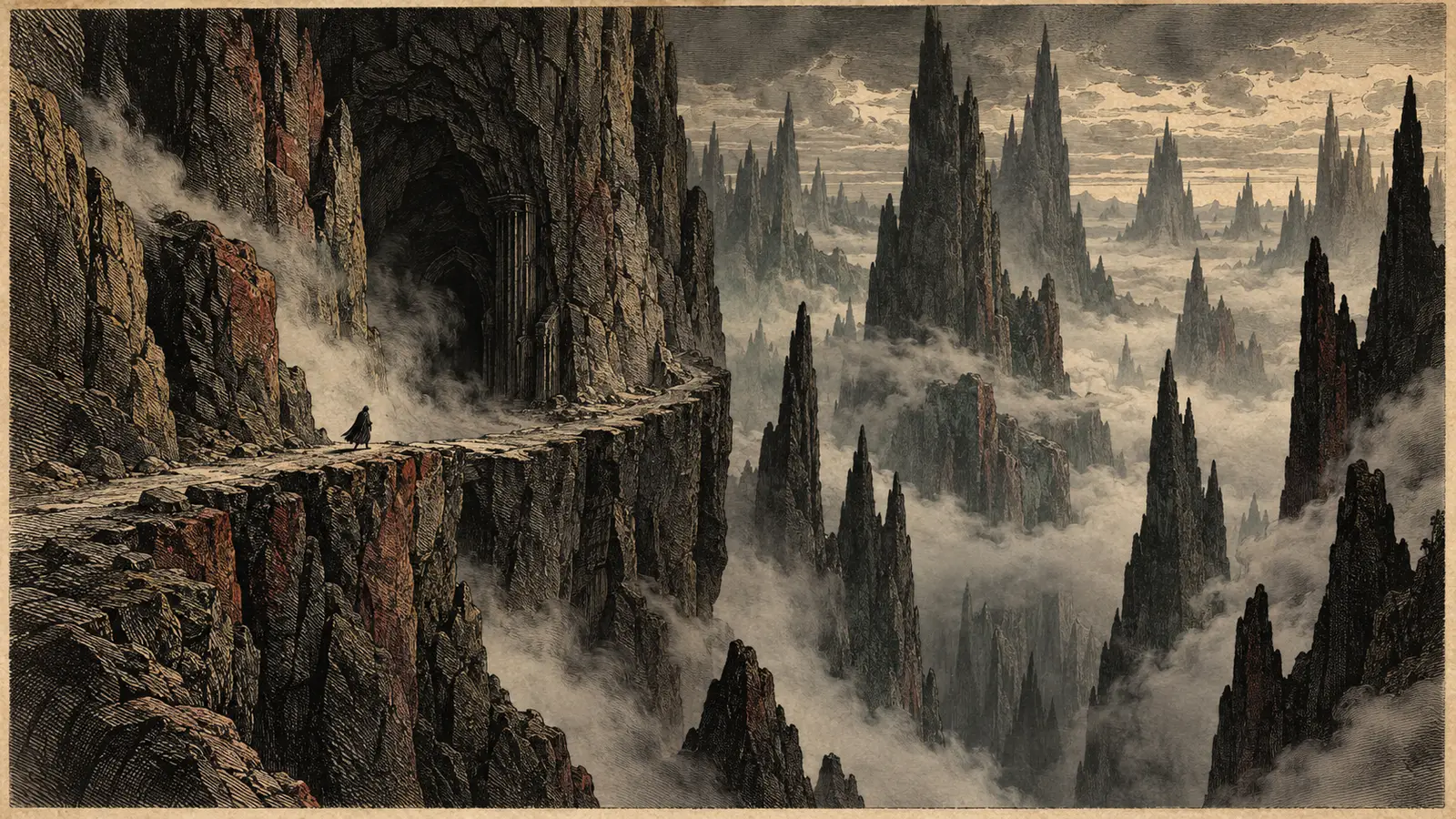
In 1995 Elaine Cunningham published Daughter of the Drow, the first book of a trilogy that came to be called Starlight and Shadows. Its second book, Tangled Webs, followed in 1996, and its third, Windwalker, in 2003.
The heroine is , the daughter of Baenre, archmage of the great drow city of . She's a wizard and a fighter, and in time a cleric, and above all she is a drow who longs for the world above. Her companion is , a berserker from the cold land of . Their story is hers, and we won't retell it here. What concerns us is the world of gods around her.
Behind the whole trilogy there runs a quiet contest among three powers for the souls of the drow. One is , the Spider Queen. One is , the Dark Maiden, dancing in the moonlight. And the third is , the drow god of thievery and intrigue. Liriel's own struggle over what it means to be drow is played out against that contest. In Cunningham's hands Vhaeraun's faith is more than a set of tables in a sourcebook. It's a living road a drow might choose, with real people walking it.
The most important of those people is a drow wizard named Nisstyre.
Nisstyre had grown up in the matriarchy of his homeland, and he resented serving it. He was a male, and a male in a drow city, however gifted, stands always in the shadow of the priestesses. So he left. On his travels he found the worship of Vhaeraun, and in it he found a god who spoke to the resentment he had carried for so long.
He built something with that faith. He formed an independent merchant band called the Dragon's Hoard. To the world it was a trading company, buying and selling goods and magic across the realms above and below. In secret it was devoted to the glory of the Masked Lord, and to spreading drow settlement on the surface. In Nisstyre's band, Vhaeraun's surface agenda comes alive. These are drow who don't simply raid the world above. They trade there, and settle, and slowly plant their people in it.
The Dragon's Hoard made its base in , the lawless port that lies deep beneath the city of Waterdeep, below even the great dungeon of Undermountain. Its stronghold there was the lair of a deep dragon. You can picture it: a vast cavern once home to one of the purple dragons of the Underdark, now full of crates and coin and the quiet traffic of masked merchants, all in the service of a god who wanted his people back under the open sky.
In the Year of Maidens, which the Realms number as 1361, the band travelled to Rashemen to buy magical artifacts from a Red Wizard of named Merdrith. There they crossed paths with Fyodor, who had stolen a powerful amulet called the Windwalker from that same wizard. Nisstyre took the amulet from him. But the party carrying it back toward Menzoberranzan was killed by deep bats in the dark, and the amulet was lost. Liriel found it, and meant to use it to store her drow magic so that she could keep that magic when she went to the surface. And so the Masked Lord's merchant and the drow princess were bound together by a single stolen jewel.
Nisstyre gained an unlikely ally as well. In Menzoberranzan there was a priestess named Hunzrin, who hated Liriel and wanted revenge on her. She went to Nisstyre and offered to become what the story calls a traitor priestess, serving both Lolth and Vhaeraun at once. It's the masked traitor of the sourcebooks, made into a person, though with a twist: Shakti served the Masked Lord less from faith than from hatred.
She bound Nisstyre to her in a way few allies would accept. She set a magic ruby into his forehead. Through that stone she could see what he saw and speak to him. And through it, too, she could hurt him with her mind. It's a fine image of how the drow make alliances: a gem gleaming red on a man's brow, through which a priestess watches, whispers, and punishes. Shakti pursued Liriel far across , even as the girl and Fyodor took ship on a vessel called the Elfmaid to the island of , seeking a sacred tree where Liriel had to carve a rune to keep her magic.
Nisstyre's road ended in that same Year of Maidens. Liriel joined forces with the followers of Eilistraee, the faithful of a temple called the Promenade of the Dark Maiden, and together they attacked the Dragon's Hoard's base in Skullport. The assault effectively destroyed it, and Nisstyre was killed. In that fight, for the first time in the novels, the faithful of the Dark Maiden and the faithful of the Masked Lord meet face to face, sword to sword, the sister's people against the brother's. It's an image the Realms would return to many times.
But Nisstyre had a son.
Gorlist, like his father, worshipped Vhaeraun. He wore his white hair cut short, and on his left cheek he carried a tattoo of a dragon. The tattoo was magical. When a dragon came near, it glowed, and it glowed in the colour of that dragon, so that Gorlist could tell at a glance whether a red or a black or a silver wyrm was close at hand. It's a lovely piece of invention, a reminder that the Dragon's Hoard had lived in a dragon's lair and dealt in dragon lore.
Gorlist wanted vengeance for his father. To get it, he hired a deathsinger named Brindlor Zidorion, and he joined forces with the old enemies of Liriel: the former Red Wizard Merdrith and the priestess Shakti. In Windwalker, the third book, they caught up with Liriel in Rashemen, a land ruled by its witches, where she had to go in disguise. There Liriel and Fyodor defeated Gorlist, and this time he was killed for good.
He lingered in the Realms a little longer in another form, though. In 2004 he got his own short story, "Gorlist's Dragon," in an anthology called Realms of Dragons. A minor villain, perhaps, but one whose glowing tattoo readers remembered.
Cunningham gave the Masked Lord's faith something it hadn't had before. In her books we see what it feels like from inside: the resentment of a gifted male in a matriarchal city, the slow building of a trading empire on the surface, the bitter alliances with traitor priestesses, the son who carries on his father's grudge. And in her novels a drow house named Jaelre first appears, a house of Vhaeraun's worshippers that would play a far larger part in his story a few years later, when the Spider Queen herself fell silent.
Before that, though, the game itself changed. A new edition arrived, and with it a new set of books that gathered all of this lore together again and gave it a third shape.
Chapter VI
Third edition: the Masked Lord's shadows on the surface
We come now to the third edition of Dungeons and Dragons, published by Wizards of the Coast, which had taken over the game. Its Forgotten Realms Campaign Setting appeared in 2001, and in its table of the gods of , was listed as a lesser deity of the drow pantheon. The following year, in May 2002, came Faiths and Pantheons, written by Eric L. Boyd and Erik Mona. It was the great book of the gods for third edition Realms, and because Boyd had written Demihuman Deities, its portrait of the Masked Lord carries the earlier one forward, condensed and adapted to the new rules.
In third edition Vhaeraun is still a lesser deity, still chaotic evil. His titles are the Masked Lord and the Masked God of Night, and now he is also called the Shadow, or the Lord of Shadow. His portfolio covers thievery, drow males and evil activity on the surface. His symbol is the black mask.
His clerics could draw on five domains, the spheres of divine power that third edition clerics chose from: Chaos, Evil, Travel, Trickery, and a new one called Drow. The Drow domain was an invention of the third edition Realms, shared by the gods of the dark elves, a sign that he was very much one of their family whatever he thought of his mother. Travel suits a god whose people mean to move up and out into the world. Trickery suits a god whose church survives by deception.
The worshippers this era named for him were assassins, male drow and half-drow, poisoners, rogues and thieves, and the shadowdancers. The shadowdancer was a prestige class in the core rules of third edition, a rogue who learns to melt into shadow and step out of another one some distance away. It was a natural fit for a god whose avatar does exactly that on a grander scale.
His family hadn't changed. He is the son of and of Araushnee, who became , and the twin brother of , older by that single minute. And is still his son, born of the Dancer.
His dogma kept its old shape, with a sharper edge. His shadows must throw off the Spider Queen's tyranny and take back by force their birthright and their place in the Night Above. He will lead his followers to a society in which the drow once again rule over the lesser races, and in which males and females stand as equals. The same god who preaches equality between the sexes preaches domination over everyone who isn't drow. He's no gentle reformer.
The relationship between mother and son was given a delicate new shading. Lolth encourages her son's rivalry. She likes that he struggles against her, because struggle is her whole philosophy, the way she keeps the drow sharp and divided. But she also sees his success as a genuine threat. She regards him as her true enemy and rival. So she lets him fight her, and watches closely to make sure he never wins.
His church in this era held a few surprises. Most of its members were drow and half-drow who wanted their people freed from Lolth, united, and holding power on the surface. Many were males seeking more than total subservience. But there were also a few humans in its ranks, and even a handful of draegloths, the half-demon children of Lolth's priestesses, creatures usually born to serve the great houses of the Spider Queen. That a few of them had turned to her son says something about his reach.
His clergy was the same in its bones as before. It was almost entirely drow and almost entirely male, loosely organized because of persecution, opposing Lolth passively by working against her wherever it could, rather than in open war. The Masked, the Uncloaked, the Nightshadows: the old names held.
The darkmasks returned too, now in a new form. In Faiths and Pantheons the darkmask became a prestige class, a path a character could follow in the rules. Darkmasks are the enigmatic special agents of Vhaeraun, acting under the shadow of night, the elite of his clergy who handle his most delicate missions. Most of them blend the cleric and the rogue. A few are rangers, or rangers who are also clerics, suited to the wild places where surface drow live.
To become a darkmask, a character had to be a drow or a half-drow. They had to be skilled at hiding, at moving silently, at picking pockets and at surviving in the wilderness. They had to have learned to bear the daylight that troubles every drow eye, and to move with uncommon stealth. They had to be able to work divine magic of some power. Vhaeraun had to be their patron. And they had to have survived a fight against one or more clerics of Lolth.
That last requirement is a story in a single line. You can't become one of the Masked Lord's elite until you've faced his mother's priestesses and lived. Every darkmask carries a memory of that fight: a night in some dark corridor, the whip of a Lolthite priestess snapping toward them, and a narrow escape into shadow.
At first the darkmasks admitted only male drow. By the default year of the third edition Realms, 1372, that barrier had been dropped. Females could join, and so could half-drow. Even a faith built on the grievances of males had come to practise the equality it preached.
The faith's offerings also came into sharper focus. Vhaeraun's faithful offer him the spoils of conquest, things taken from the enemies of the drow, or taken from female clerics of Lolth. These treasures are melted down on altars of obsidian. Picture it: a hidden shrine deep in a forest or beneath a city, a slab of black volcanic glass, and on it a stolen holy symbol of the Spider Queen slowly softening and running in the heat, as masked figures watch in silence.
Ellaniath, his realm, moved in this era. In the revised cosmology of the third edition Realms, which redrew the planes for that world alone, Vhaeraun's home was no longer on Colothys in . It lay instead within the Demonweb Pits, his mother's own realm, in a territory Lolth allowed him to keep. Think about that for a moment. The son who has spent ages opposing his mother now lives, in a sense, in her house. Ellaniath became a hiding place where he could hole up when her patience ran out. It still kept its old secret: no one could find it without his leave, and visitors lost their memories of it when they left.
The surface world received a great deal of attention in this era. Races of Faerûn, published in 2003, gave the drow a full chapter, and it said plainly that most of the drow living on the surface are evil, and that they worship Vhaeraun. A few outcasts and renegades are more neutral, and there are even good drow communities that follow Eilistraee or gods from outside the drow pantheon. But the Masked Lord's faith is the largest among surface drow.
The contrast with his sister became the heart of the surface picture. Eilistraee's faithful encourage drow to come up into the world as peaceful neighbours, people who want to live in the moonlight and make friends among the other races. Vhaeraun's faithful come up to dominate. Two drow might climb out of the same cave into the same forest, one to dance under the stars and the other to begin quietly claiming the land, and you couldn't tell them apart until you saw what they did next.
The house we first met in Cunningham's novels, House Jaelre, had settled in the great forest of by this time. Exiled from for their heresy, they had wandered the Underdark until they found a portal that led up into that forest, and there they made their home. They worship Vhaeraun, and they're organized much like a military force. By 1372 they were the largest drow faction in Cormanthor, holding roughly a tenth of all the forest's drow. A drow house that had been cast out of the greatest city of the Underdark had become a power in the surface woods, exactly as their god would wish.
Another book of 2003, called Underdark, written by Bruce R. Cordell, Gwendolyn F. M. Kestrel and Jeff Quick, described the drow faiths and cities of the current era. In it we find Eryndlyn, a drow city where three cults rose side by side: those of , of Lolth and of Vhaeraun. Over time each cult gathered its followers onto its own plateau, so that the city came to be split three ways by faith. Imagine looking across a great cavern from one high plateau to another, knowing that the folk over there worship a different god and would kill you if they could.
In Eryndlyn the Masked Lord's people even made common cause with the followers of Ghaunadaur, the old formless god, on particular projects. Together they once destroyed the Lolth-worshippers of that city. It's a striking alliance, but it fits him. Vhaeraun's allies are always chosen for the work at hand, and the work is nearly always the same: bringing down his mother's church.
Among the gods, too, his alliances were filled in. , the goddess of darkness and loss, counted Vhaeraun among her allies. As patron of shadow magic for the drow, he worked with Shar on projects touching the Shadow Weave, the dark mirror of the ordinary magical Weave that Shar had secretly woven. The School of the Shadow Weave, the mages who drew on that dark magic, included followers of both gods.
His alliance with Mask was revealed to be more fragile than it seemed. It was a businesslike arrangement. Mask, the human god of thieves, had lost much of his own power to , the mad god of strife, and he privately planned to make up those losses by taking Vhaeraun's divinity for himself. Vhaeraun, for his part, used the likeness between their masked symbols to his own advantage, drawing half-elves and humans into his church who might have thought they were joining Mask's. Two thieves, each pretending friendship and each with a hand near the other's purse.
The Player's Guide to Faerûn, in 2004, updated the Realms pantheon for the revised rules of that period, and the Masked Lord was carried forward into it. But even as these rulebooks were setting him down in their careful tables, a series of novels was showing him do something far more dramatic. In the year 1372 his mother fell silent, and Vhaeraun went to kill her.
Chapter VII
The Masked Lord at the throne of a silent goddess
Between 2002 and 2005, Wizards of the Coast published a series of six novels called War of the Spider Queen, overseen by R. A. , the author whose dark elf hero Drizzt had made the drow famous far beyond the gaming table. Six writers each took a book. Richard Lee Byers wrote Dissolution, Thomas M. Reid wrote Insurrection, Richard Baker wrote Condemnation, Lisa wrote Extinction, Philip Athans wrote Annihilation, and Paul S. Kemp wrote Resurrection.
The heart of the series is a single event. In 1372, the Year of Wild Magic, fell silent. For about a year she answered no prayers and granted no spells to her priestesses. It came to be called the Silence of Lolth. Behind it lay her own design: she had withdrawn into a kind of hibernation, seeking to become a greater deity and to tear the Demonweb Pits loose from the Abyss so that they would become a realm of their own. That transformation is her story. What concerns us is what her son did while she slept.
For every enemy of the Spider Queen, the Silence was an opportunity. For the Masked Lord it was the opportunity of the ages.
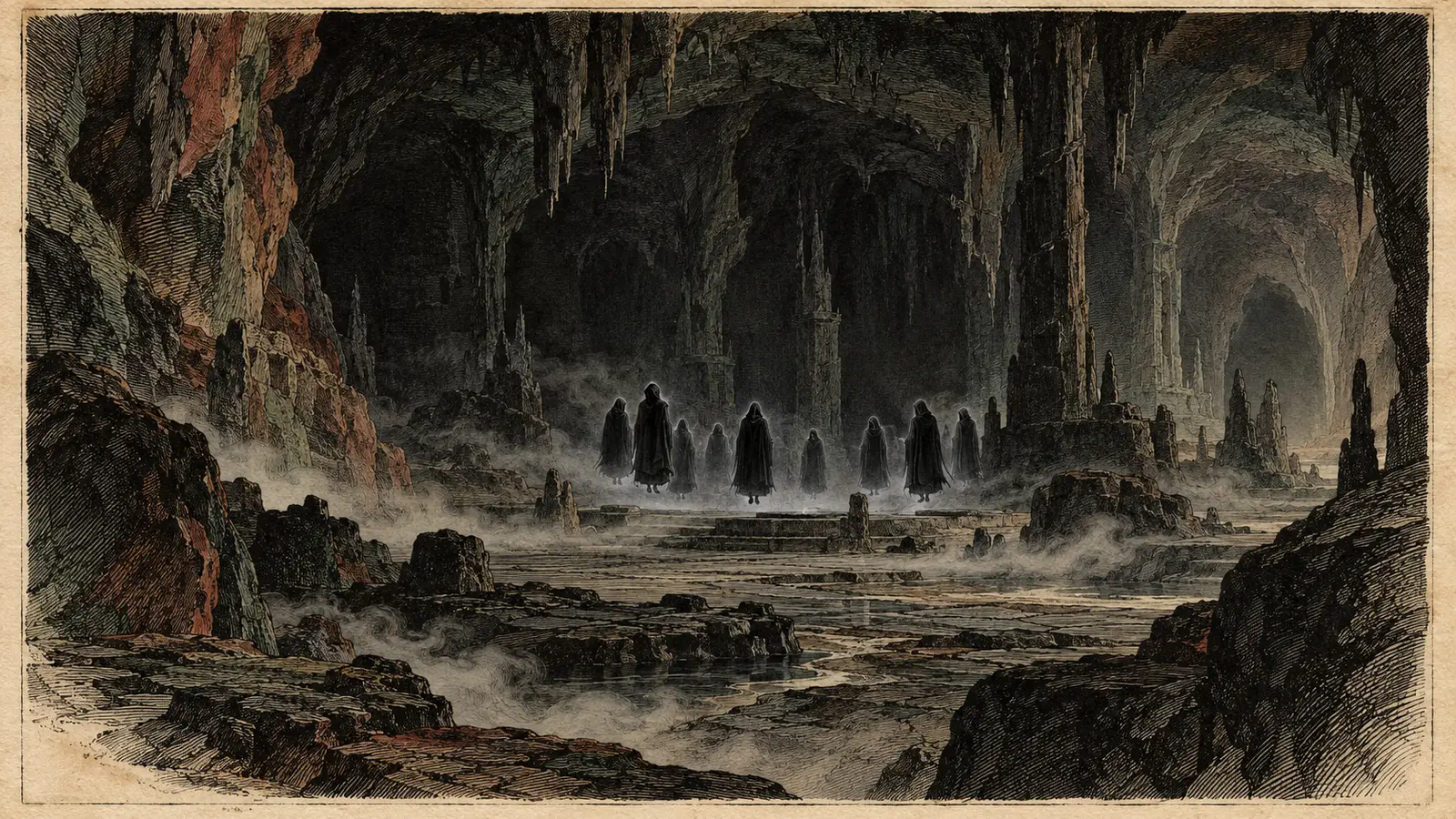
His mortal servants moved first, through a secret society called the Jaezred Chaulssin. These are drow assassins, and they trace their descent back to the ancient drow city of Chaulssin. That city still exists, in a way, but it's trapped now in the Plane of Shadow, the same grey realm where has always liked to wander. Vhaeraun is the patron of the Jaezred Chaulssin, and their head priest of the Masked Lord was a drow named Xorthaul Barriath.
Their goal was the oldest goal of his faith, pursued with uncommon violence. They meant to free the drow from Lolth and her priestesses by tearing down, by force, the whole system that let her church rule. Not slow infiltration this time, but a blow at the root.
Their leader was Nimor Imphraezl, who held the title of the Anointed Blade. Nimor was half drow and half wyrmshadow dragon, a creature of shadow on both sides of his blood. During the Silence he set wars in motion. He stirred the legions of Kaanyr Vhok, a demon-blooded warlord, and the duergar army of Horgar Steelshadow, and turned them against itself. The City of Spiders, its priestesses suddenly powerless, faced siege from below and beyond.
It didn't work. Menzoberranzan held, and when Nimor failed to take the city, he lost his title of Anointed Blade. The Masked Lord's assassins had struck their great blow, and the city of his mother still stood.
But there was another servant of Vhaeraun at work in those years, and his work went much further.
We met House Jaelre a moment ago, the exiled house of Vhaeraun's faithful living in the forest of . In Condemnation, the third book of the series, the house has made its home in Minauthkeep, an abandoned elven fortress among the great trees. It's organized like a military force. And among its people is a high priest of Vhaeraun named Tzirik Jaelre.
A band of drow from Menzoberranzan came to him. They were led by , high priestess of the city's greatest house, and they were searching for the reason their goddess had gone silent. Imagine the strangeness of that meeting. The proudest priestess of the Spider Queen, at the head of a company of her mother's faithful, comes to the forest fortress of heretics who worship Lolth's rebel son, and asks for help.
Tzirik would help, but only at a price. They had to bring him a book called the Geildirion of Cimbar, a secret volume of lore from the fallen elven city of . The book lay in the lair of a beholder, and the party had to take it from there. They did.
In return, Tzirik told them what he knew. Lolth was alive. She hadn't died or abandoned them. She was sealed inside her temple in the Demonweb Pits, neither speaking nor leaving it. And he would take them to see. Through astral projection, their spirits journeying out of their bodies, Tzirik escorted Quenthel's party to the Demonweb Pits.
Now we come to the turning point.
Tzirik had not taken them there only to show them their goddess. He opened a gate, and through it he brought Vhaeraun himself into Lolth's domain. The Masked Lord stepped into his mother's realm while she lay helpless in her silence, and he tried to kill her.
There was a deeper plan behind that attempt, a plan that would echo in the years to come. Vhaeraun meant to kill his sister too, take her portfolio for his own, and join their two churches into one. With that added strength, he would be powerful enough to kill his mother outright. The attack in the Demonweb Pits was a move in a longer game.
And he came close. Lolth lay sealed in her temple, unable to defend herself, and her son stood over her with his blades. But someone came to stop him.
was Lolth's champion, the spider-warrior who served her as her sword. He was also, as we've heard, Vhaeraun's own son. Selvetarm stepped between them. He seized his father and dragged both of them down from Lolth's temple, falling together into the depths of the Demonweb Pits, all the way to the bottom.
You can picture the long fall, two gods locked together dropping through the endless webs and dark of that realm, father and son, each trying to destroy the other. The son who had betrayed his father in was now dragged down by his own son, in defence of his mother. The family of the drow gods seems doomed to repeat its quarrels in every generation.
The fight between them shook more than the Pits. It stirred turmoil across the planes. The edges of the planes began to fray, and to bleed into one another, as though the fabric of the multiverse had been pulled too hard by two gods wrestling at its seams.
The mortals who had come to the Pits had to escape. Jeggred Baenre, a draegloth who served Quenthel, slew Tzirik's astral form, and with that the high priest died in 1372. The party fled the plane.
Lolth woke at last in Resurrection, the final book, published in 2005. She came out of her Silence transformed and stronger, and her son's attempt had failed. But it had come close. In all his long rebellion, Vhaeraun never came nearer to killing his mother than in those days when she lay sealed and silent, and his blades were in her temple.
The plan he'd revealed, though, didn't die with that failure. To kill Eilistraee, take her portfolio and join their churches: that thought stayed with him. A few years later, in the world's time, he would try to carry it out. And it would cost him everything.
Chapter VIII
The death of the Masked Lord
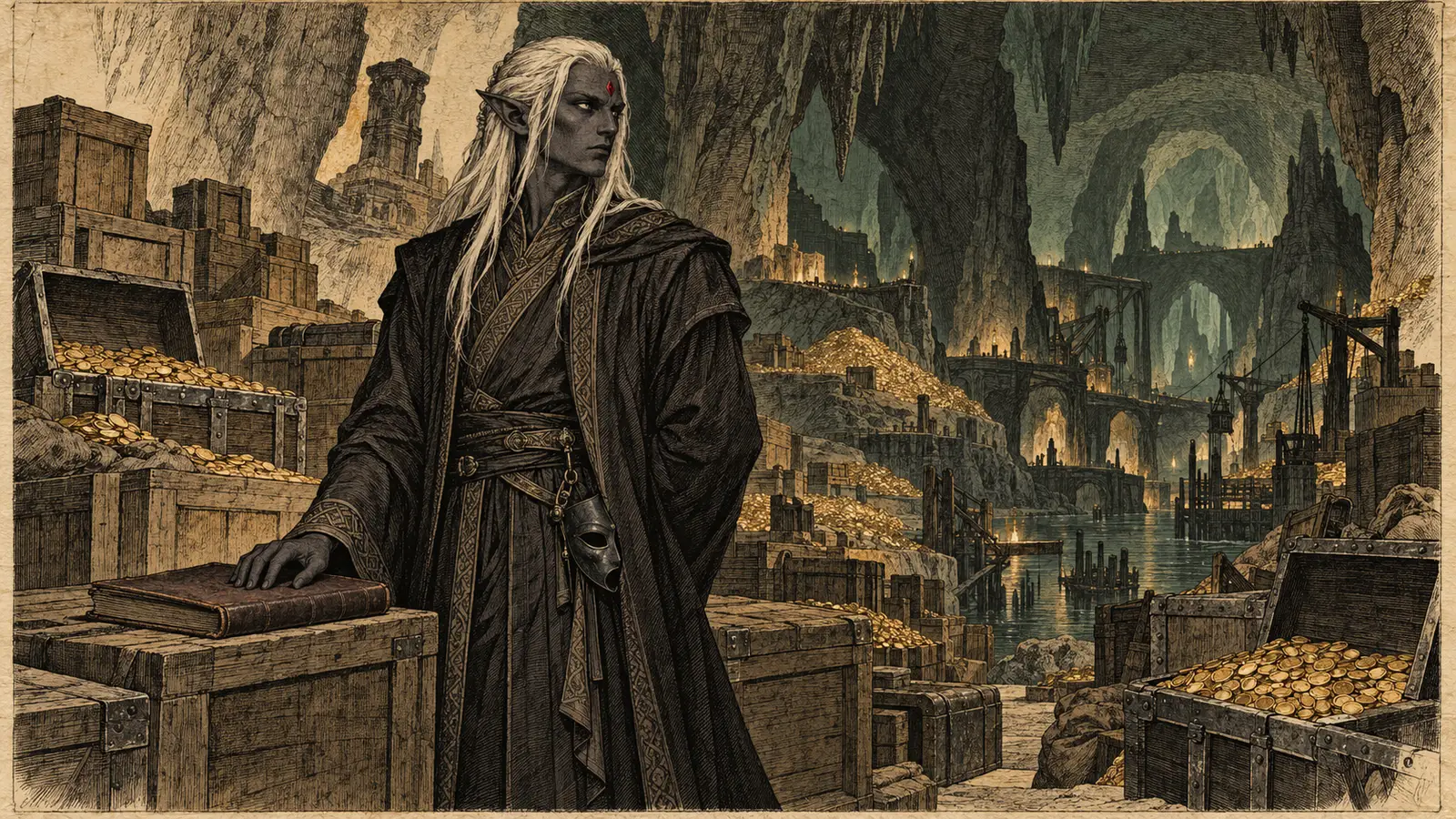
We come now to a darker chapter, and a quiet one, despite the violence at its center. Between 2007 and 2008, Wizards of the Coast published a trilogy by Lisa called The Lady Penitent. Its three books were Sacrifice of the Widow and Storm of the Dead, both in 2007, and Ascendancy of the Last in 2008. The trilogy carried on from War of the Spider Queen, and it had a particular task. A new edition of the game was coming, the fourth, and it would remake the Forgotten Realms. The drow pantheon was to be changed, and these novels would tell the story of that change.
Smedman later said that she would have loved to keep both and alive, because they make such interesting antagonists for . But her assignment from Wizards of the Coast was to make the necessary changes to the drow pantheon. The company had stipulated that the twins had to die. What she was given was the chance to work out how.
The story begins in the winter month of Nightal, in the year 1375. Lolth and her daughter Eilistraee play a game of sava, the drow game of strategy that resembles chess. But this game is played on a divine scale. The stakes are the fate of the drow and the very existence of the two goddesses, and each move on the board plays out as an event somewhere in . Whole lives move like pieces.
On the twentieth day of Nightal in 1375, died. A Darksong Knight of Eilistraee named Xarann had recovered a weapon called the Crescent Blade in the Demonweb Pits, and with the help of Melarn, a former priestess transformed into something bound to Lolth, she killed the spider-warrior god. Lolth's church absorbed his.
On that same day, the Masked Lord made his move.
His followers had prepared a great working of elven high magic, the ancient art of rituals that once could reshape continents. With it they meant to open a gate between Ellaniath, Vhaeraun's own realm, and Eilistraee's part of , the forest home of the elven gods from which her brother had been exiled so long ago. Vhaeraun would walk through that gate, into his sister's home, and assassinate her.
A ritual of that kind normally needs hundreds of casters, a whole choir of elven mages bound together in a single working. Vhaeraun's followers didn't have hundreds. They had cleverness instead. They drew on an earth node, a place where the power of the earth gathers, hidden in a cavern of darkstone. That node cut the number of casters needed down to three. And they used a spell called soultheft to complete the working. It's a very Vhaeraunite piece of magic: where others need a great assembly, the Masked Lord's priests achieve the same with three people in a dark cave, and a stolen soul.
The gate opened. Vhaeraun walked through.
But Eilistraee had been warned. She knew her brother was coming, and she was ready for him. And she had help she didn't even need to ask for. , the goddess of magic, aided her indirectly. Through the Weave, the fabric of all magic in the Realms, Mystra weakened Vhaeraun's magic and strengthened Eilistraee's. The brother came into his sister's realm with his power ebbing, and found her waiting with hers renewed.
The fight itself is left in shadow. What is told is how it ended. Vhaeraun failed. Eilistraee killed him. On the twentieth day of Nightal, 1375, the same day Selvetarm fell, the Masked Lord died.
There's a long circle closing here. The elder twin who had once helped curse his sister's arrows so that she would shoot their father, who had arranged for her to stand blamed for a murder, who had plotted for ages to take her power, came at last to take her life. And she took his instead.
Eilistraee took on her brother's portfolio. She became, for a time, the goddess of thievery and of drow males and of the surface ambitions he had stood for, alongside her own song and moonlight. She was known now as the Masked Lady, and she wore his mask as a sign of that union. Among her new faithful there were whispers that she sometimes went about in the guise of her brother, letting his old followers believe they still served the Masked Lord, so that she could slowly turn them toward good.
For Vhaeraun's faithful, the death of their god was a catastrophe. Chaos and despair spread through his scattered cells. Priests reached for their god in prayer and found something else answering. And Eilistraee made a choice that tells you much about her. She chose to accept the Vhaeraunites, her old enemies, the people who had fought her faithful in and across the surface world, into her own church. The two faiths joined, uneasily.
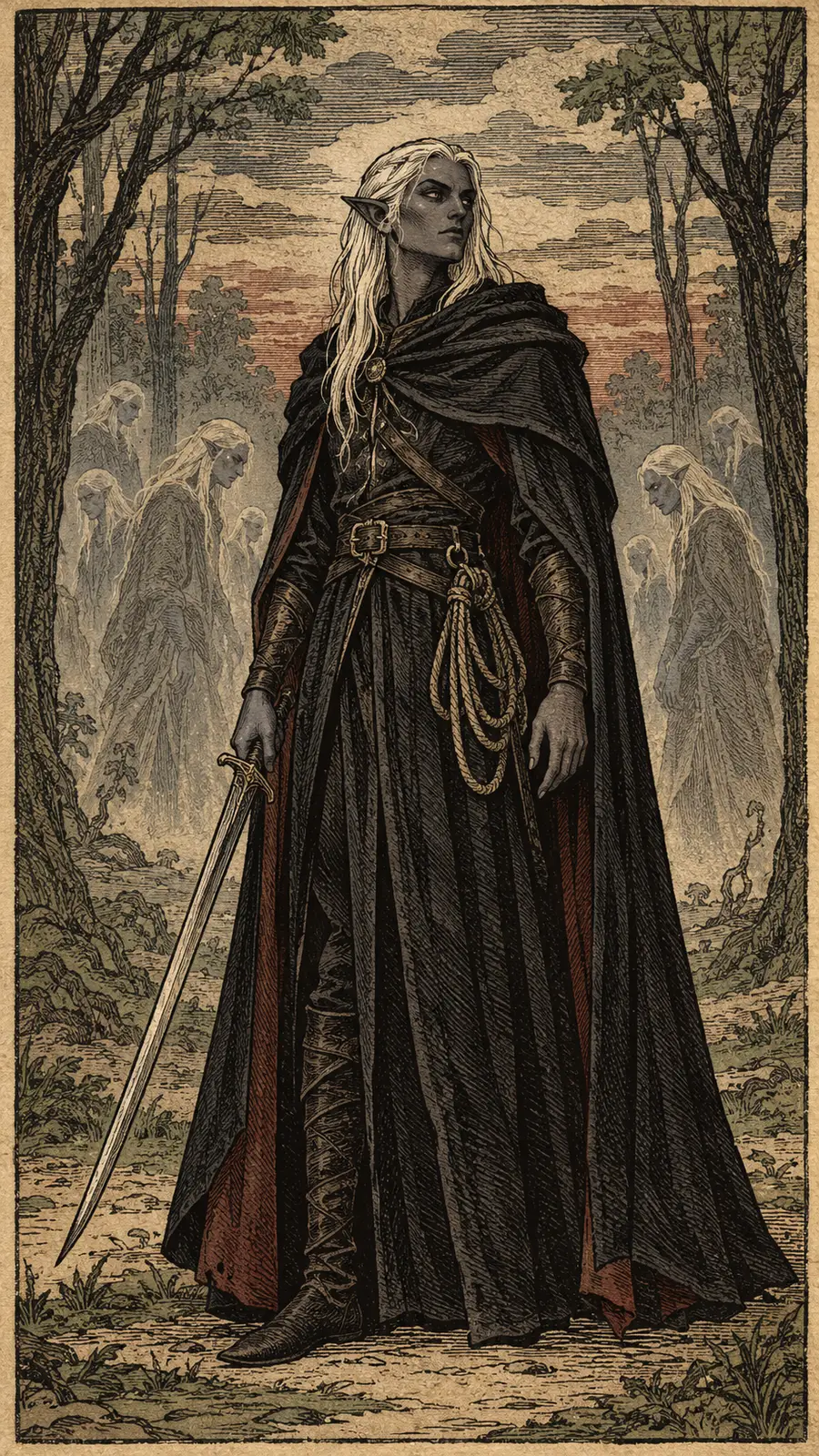
Not everyone came. His followers split in many directions. Some joined Eilistraee. Some turned to other gods, to among them, finding in the goddess of darkness a home for their shadowed habits. Some refused to have anything at all to do with the Dark Maiden. And some kept the old faith anyway, or never learned that their god had died. They went on praying to the Masked Lord in their hidden shrines, wearing their masks and plotting in the dark, unaware that the god they served was gone. These would later be called the skulkers of Vhaeraun. There's something deeply sad in them, and something quietly faithful too: priests praying into a silence they don't know is a silence.
Among those who came over to Eilistraee, a drow priest named Kâras rose to lead the former clerics of Vhaeraun. He was a divine seeker, an agent who specialized in stealth. And the old title of the Masked Lord's clergy, Nightshadow, lived on as the name for former Vhaeraunites who now served the Masked Lady. They were sent to infiltrate drow houses, doing for the sister what they had once done for the brother.
Taking on her brother's portfolio changed Eilistraee's church, and changed the newcomers too. Her clerics grew more violent. The former Vhaeraunites grew kinder. Each faith pressed on the other, the way two rivers mix where they meet, and neither came out the same.
In Storm of the Dead, the second book, Eilistraee's faithful struggle to make room for their new converts. There are power struggles between the Nightshadows, her new servants from the old faith, and her protectors, her established guardians. Her old creed, which had always been simple, was to always be kind. Now that creed is watered down by new teachings about assassination and trickery, justified as ways to defeat Lolth. The brother was dead, but his way of doing things had moved into his sister's house. In the same book a mage named Q'arlynd Melarn works a great ritual of high magic that wipes the name of , the drow goddess of vengeance and undeath, from the minds of mortals and gods alike, and she fades from existence. The drow pantheon was emptying.
In Ascendancy of the Last, in 2008, the trilogy reached its end. The story returned to the Promenade, Eilistraee's temple home, where her high priestess Veladorn led the faithful. A demon beset Qilué, and 's oozes gathered for a last assault on the Promenade. Halisstra Melarn, now the Lady Penitent, a demigod in Lolth's service, came for the Dark Maiden. While Eilistraee dwelt within Qilué's body, Halisstra struck Qilué down with the Crescent Blade, and the goddess seemed to die with her.
With Eilistraee went everything she had absorbed. Her brother's portfolio, the thievery and the masks and the surface ambition of the drow males, went into silence alongside her own.
The fourth edition Forgotten Realms Campaign Guide, published in 2008, leapt the Realms forward past a great catastrophe called the Spellplague, which began in 1385. In the history it told, between 1375 and 1379 the drow pantheon had shrunk to a single deity: Lolth. Ghaunadaur had left the Demonweb Pits and withdrawn to a place called the Dismal Caverns. The other drow gods were dead. The Masked Lord was simply gone from the world, his mask lying empty, his hidden realm forgotten even by those who had never been allowed to remember it.
Many readers grieved. Fans of Eilistraee and of the good drow were especially unhappy, and the deaths, once told, were never built upon. Fourth edition went on without them. For a few years of real time, and nearly a century in the Realms' own history, there was no Masked Lord at all.
But a god of shadows has a way of not being where you think he is. And when the Realms turned again, the mask came back.
Chapter IX
The mask returns after the Sundering
In 2013, Wizards of the Coast launched a project called the Sundering, a great event told across novels and adventures that carried the Forgotten Realms out of fourth edition and into fifth. Within the world, this event became known as the Second Sundering, an echo of that first great breaking of the land that had once destroyed Ilythiir and so many of 's earliest worshippers. It unfolded through the 1480s, and during it many gods long thought lost came back to the world.
The dead members of the drow pantheon brought themselves back during the Second Sundering. Among them were the twins. In the summer month of , and Vhaeraun returned.
They came back with the power they'd had before 1375, and with their own old portfolios. They were separate gods again. Eilistraee was once more the Dark Maiden, no longer the Masked Lady, because her brother had returned and taken back what was his. The mask passed from her face to his. And they announced their return themselves, each appearing through an avatar before their followers. Somewhere, in some hidden shrine in a forest or beneath a city, a skulker of Vhaeraun who had prayed for a century into silence may have looked up and seen the shadow-wrapped figure of his god standing before him again.
How could they return? The story of their deaths was told again, in a new light, and here the lore itself shifted, as a retcon told in the world's own terms.
In one later telling, Vhaeraun had not died outright when he went into his sister's realm to kill her. Defeated there, he had been trapped in a prison of dreams, and while he lay caught in it, Eilistraee had absorbed his portfolio and taken charge of the souls of his worshippers. A god in a dream is not a god who is dead. He was only absent, sleeping, held.
Ed Greenwood, the Realms' creator, gave a further account in his own words, around 2015, outside the pages of any printed book. Eilistraee and Vhaeraun, he said, had not truly died. They had been held in stasis within the Weave itself, the fabric of magic that tends. They had been absent, not destroyed. And now they were back. They were allies, he said, though they don't always agree on methods.
This is the most surprising turn in the whole of Vhaeraun's long story. For untold ages the twins had been enemies. He had imprisoned the moon goddess to set his sister up for murder. He had sent his merchants and assassins against her faithful. He had walked into her home to kill her. And yet after their shared ordeal, after death or imprisonment or the long sleep in the Weave, whichever you prefer to believe, they came back changed.
They understood each other better. They had grown closer, and become more open to each other's ways and goals. They reached a truce, and even something like a friendship. The old hostility between the gods ended. Now Vhaeraun backs Eilistraee against , and she backs him. Some of their followers haven't let go of the old quarrel, and his faithful and hers still skirmish here and there. A few of his worshippers remain hostile to hers. But between the gods themselves, the ancient war is over.
One quiet detail in the lore of this time suggests how they keep their peace. It's said that Vhaeraun and Eilistraee speak with each other mind to mind, through a chamber in Ellaniath. Think of it: the realm no visitor can remember, and somewhere within it a room where the masked brother sits and hears his sister's voice from far away. The god who wipes away every guest's memories keeps one room where he listens.
His church changed with him, or perhaps simply grew more skilled at what it had always done. The old habit of building a trustworthy front became stronger than ever after the truce. On the surface, Vhaeraun's faithful show a cooperative face to other elves and to other peoples. They are good neighbours, reliable partners in trade, friendly enough. Behind that face, they scheme as they always have. The mask, after all, was always meant to be worn.
The first fifth edition book to describe the post-Sundering Realms in detail was the Sword Coast Adventurer's Guide, published by Wizards of the Coast in November 2015. It described the Second Sundering and the state of the gods afterwards. Vhaeraun was there, among the gods of the drow. He is presented as a god of thieves, and of the drow males who rebel against the matriarchy. He's chaotic evil, and his clerics in this edition draw on the Trickery domain. His symbol is the one the Realms had long given him: a black mask with blue glass lenses set over the eyes. His favoured weapon is the short sword, the same blade his avatar carries in his off hand.
The guide's account of the drow tells of exiles who have heard Eilistraee's song calling them to the surface, and of drow adventurers who have fled the cruel theocracy of their city-states to live as outcasts and wanderers. It's in that wandering world of outcasts that the Masked Lord's faithful still find their recruits. A drow male who has escaped the matriarchy and now walks the Sword Coast, mistrusted by every town he passes through, has every reason to listen when a masked stranger speaks to him of equality and power.
In 2018, Mordenkainen's Tome of Foes turned to the elves and drow in a long chapter of its own, drawing on the whole family of drow gods, the Dark : Lolth and Eilistraee, and , and Vhaeraun. In the picture of drow faith from this era, the Masked Lord is the patron of thieves, and he's prayed to before a raid begins. His worshippers go out masked, for two reasons. Their god is shown masked, and so they imitate him. And even the smallest challenge to the drow social order is deadly dangerous. A male who questions the matriarchy, even quietly, risks everything. The mask lets him do it and live.
That double meaning has been part of the mask from the start, and fifth edition put it most plainly. The mask is worship. And the mask is survival.
So the Masked Lord returned to the Realms neither triumphant nor diminished, but changed. He's still a god of thieves and of rebels, still chaotic and evil, still hungry for the surface world. But he no longer walks alone against everyone. His sister, the one he once tried to destroy, now stands beside him against their mother.
Before we follow him to the present day, let's look sideways for a while, at the other forms he has taken and the faces that resemble his.
Chapter X
Other faces of the Masked Lord
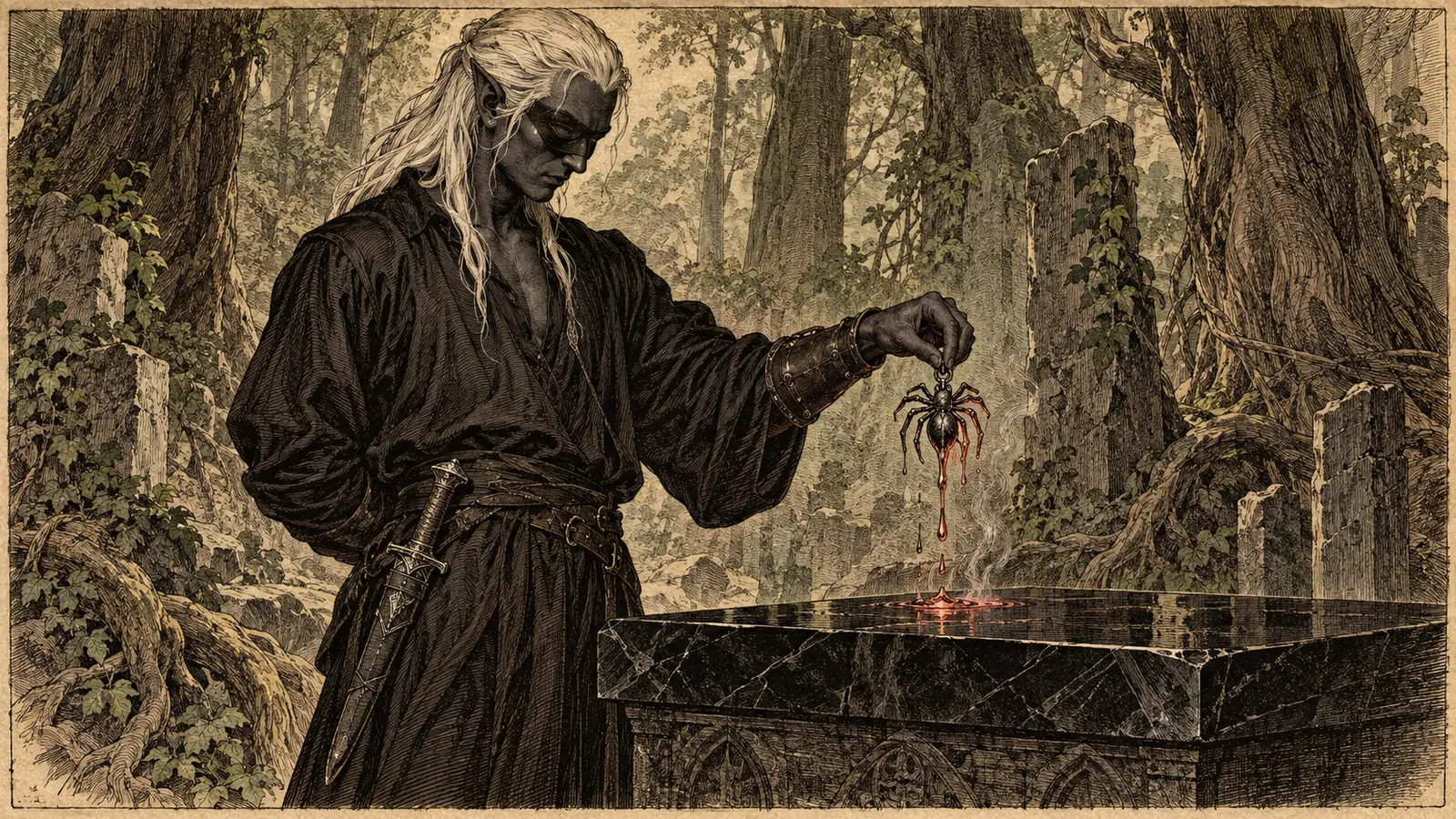
Every god in a game that spans many worlds wears more than one face, and the Masked Lord, of all gods, might be expected to have several. We'll begin with the world where his story first started, and where he never quite found a home.
In , the world of Gary , is known by the same titles as in the Realms: the Masked Lord, the Masked God of Night, the drow god of thievery, of drow males, and of evil activity on the surface. He entered Greyhawk's official lists through the deity roster of the Living Greyhawk campaign, the great shared game that ran in that world from the start of the new century. That list was issued from 2002, and a revised official version followed in 2005.
In that listing he's a lesser deity, chaotic evil, with the same domains his Realms clerics had in third edition: Chaos, Drow, Evil, Travel and Trickery. He's the son of and Araushnee, just as in the Realms. His home is still Ellaniath on Colothys, in the prison plane of . Greyhawk never moved him into his mother's realm. And one more detail stands out. In the Greyhawk listing is named as his superior. In that world, at least on paper, the rebel son still answers to his mother.
But in Greyhawk he's worshipped only in theory. He's not among the gods of Erelhei-Cinlu, the drow city in the Vault of the Drow, where the drow of Gygax's first adventures dwell. That city's great faith is Lolth's. Its other gods are Keptolo, Kiaransali, as Greyhawk spells the goddess of vengeance, and . When Fred Weining wrote about the Vault of the Drow for the Living Greyhawk Journal, printed within Dragon in August 2002, his attention was on Lolth's city, and the Masked Lord had no place in it.
So in Greyhawk, Vhaeraun remains mostly a name on the list of gods. He's present the way a rumour is present. Some drow somewhere on that world may whisper his name, and the same promise is there: freedom from the matriarchy, and the equal worth of males and females. But no great house of his faithful stands in Erelhei-Cinlu, and no novel has told his story there. It's a quiet irony that the god first named in a book rooted in Gygax's own world found his fullest life in another.
Now let's return to the Realms, and to his family, where some of his strangest echoes lie.
There's his son, . The story of how Selvetarm came to be is a story of betrayal, which is fitting for a child of Vhaeraun. the Dancer was a minor goddess of the Yuirwood elves, a goddess of dance and passion. She seduced Vhaeraun. Some tell it that she did so to gain information. Others say she wanted his help against the minions of Lolth. Whatever her reason, Vhaeraun betrayed her, as he betrays so many, and imprisoned her.
Zandilar escaped with the help of Bast, a cat goddess of . Weakened by her captivity, Zandilar merged with Bast, and from their joining came a new goddess, , the lady of pleasure and festivals. So one of the gentler goddesses of the Realms was born, in part, from Vhaeraun's cruelty.
Their son Selvetarm grew into something his father would never have chosen. He became Lolth's champion, utterly loyal to her, even when that loyalty cost him his own freedom. And so, when Vhaeraun stood over his helpless mother in the Demonweb Pits in 1372, it was his own son who seized him and dragged him down. The god who had betrayed his father was stopped by a son who wouldn't betray his grandmother. The family repeats itself in mirrors.
Then there is Mask, the human god of thieves, who is in many ways Vhaeraun's echo among the humans of . Their symbols are alike. Their methods are alike. Even their titles are nearly the same: Mask is the Lord of Shadows, and Vhaeraun the Lord of Shadow. Only a single letter separates them. Surface folk confused them constantly, and Vhaeraun made use of that confusion, drawing half-elves and humans into his church through the likeness of their masks. Mask, for his part, secretly hoped to take Vhaeraun's divinity for his own. Two thieves wearing nearly the same face, each with his eye on the other.
There's Shevarash, the Black Archer, an elven god sworn to destroy the drow. For Shevarash every drow god is an enemy, and he counts Vhaeraun among his main targets, alongside Lolth herself. It doesn't matter to the Black Archer that Vhaeraun also wants Lolth gone. To him the son and the mother are both drow gods, both to be hunted. Vhaeraun is caught between them, despised by his mother's people for rebellion and by the surface elves' avenger for being drow at all.
There is the Masked Lady, the strangest echo of all. For the years between 1375 and the Second Sundering, his sister wore his mask. She carried his portfolio, led his former priests, and perhaps sometimes let his old followers believe they were still praying to him. For a while, the Masked Lord had a second face, and it was his sister's.
And there are the faces of his own avatar, which changed over the years in the hands of different writers. In 1992 he was a slim, handsome drow whose hair and eyes shifted colour with his mood, red and blue and gold. From 1998 onward he became the shadow-wrapped assassin, sixteen feet tall or six, cloaked and masked, a longsword in one hand and a silver short sword in the other, his body vanishing wherever the shadow passed. Both are the same god, seen at different hours of the night.
Finally, there are his worshippers themselves, each one a small echo of their lord. Male drow and half-drow, assassins and poisoners, rogues and thieves and shadowdancers, and through the shared mask a scattering of humans and half-elves too. Every one of them wears a mask, and in every mask you can see a little of his.
From the faces of the god, let's turn to those of the players who wear his mask at the table.
Chapter XI
Wearing the mask at the table
What is it like to bring into a game? Let's imagine it from a few sides: as a player who serves him, as a party that crosses his agents, and as a Dungeon Master who runs his schemes.
Suppose first that you want to play one of his priests. In third edition you'd have built a cleric with access to his five domains: Chaos, Drow, Evil, Travel and Trickery. In fifth edition you'd most naturally reach for the Trickery domain, with its illusions and duplicates and blessings of stealth. Either way, you're playing a character who is, by the god's own nature, evil, and most likely a drow or a half-drow who has turned against the matriarchy.
That makes for a particular kind of campaign. A Vhaeraunite character suits games that are morally grey, or frankly villainous, or full of infiltration on the surface world. The best moments of such a character come at night. You might picture your priest kneeling in a ruined chapel at dusk, praying in silence, mask in place, and rising to lead the party on a raid in the darkest hours. You'd wear black, carry a blade with a blackened edge, and dream of the Night Above.
There's a real tension built into such a character, and it can make for rich play. You preach the equal worth of males and females. You preach unity among the drow. And you're also a thief, a liar and a believer that the drow should rule over every lesser race on the surface. You could play that character as a reformer with a cruel streak, or as a conqueror with a strange streak of justice. Both are true to the Masked Lord.
If you wanted to climb higher in his service in third edition, you'd aim to become a darkmask, one of his elite. And here you'd meet the most vivid requirement of all: before you could enter that order, you had to survive a fight with one or more clerics of . A good Dungeon Master would make that fight a story, not a box to tick. Perhaps your character slipped into a Lolthite shrine to steal a relic and was caught by a priestess. Perhaps you escaped with her whip-marks still on your back. That scar becomes the badge you carry into the god's inner circle.
Now imagine that you're on the other side, an ordinary party of adventurers crossing paths with the Masked Lord's faithful.
The most unsettling of his servants you could meet is the masked traitor. Picture your party in the Underdark, negotiating with a drow house. Across the table sits a priestess of Lolth, proud and cold and dangerous. You'd assume she's your enemy. But she might be more than that, and less. She might belong, in secret, to the Masked Lord. She might be working against her own temple while she smiles at you. Whatever she offers, you'd do well to wonder whose purposes she really serves.
Or picture a city thieves' guild on the surface. Its members pray to Mask, the human god of thieves, and they wear his symbol on their cloaks. But the masked figure at the top of their organization, the one who gives the orders and never shows his face, might be a drow. And the god he serves might not be Mask at all. Since the symbols look so alike, the members might never know. For a Dungeon Master, that's a wonderful slow reveal: a guild the party has worked with for months turns out to serve a dark elf god with plans for their whole city.
There's a drow group called the Dark Dagger, devoted to Vhaeraun, whose name is whispered with growing weight in the dark alleys around the lands of the Inner Sea. A party in those cities might hear the name long before they meet anyone who bears it, the way you'd hear thunder before you see the storm.
In the forests of and the Dales, the Masked Lord's people are thick on the ground. There's the Auzkovyn clan, and there's House Jaelre in its old elven fortress of Minauthkeep, organized like an army. A party travelling those woods might meet masked drow raiders by night, or masked recruiters speaking softly to anyone with a grievance. A half-elf woodcutter might be drawn in. A human outlaw might join them. The forest becomes a place where you never quite know who's wearing whose mask.
Beneath Waterdeep, in , there are older memories. The Dragon's Hoard once made its base there, in the lair of a deep dragon. And there are groups called the Points of the Dagger, faithful of the Masked Lord who like to take over the local thieves' guilds from behind the scenes. A party that ventures into Skullport would find the shadows already claimed.
The novels give a fine model for a different kind of encounter, too. In Condemnation, the priestess goes to Tzirik Jaelre, a high priest of Vhaeraun, for help reaching the Demonweb Pits. You could build a whole adventure on that idea: a party forced into an uneasy alliance with a Vhaeraunite, who will help them only for a price, and whose true plans they discover too late. Every alliance with the Masked Lord's faithful comes with a hidden blade.
And if, on some rare night, a party drew the god's own attention, the encounter would be memorable for its quiet. There might come a half-mask of shadow, drifting silently toward them out of the darkness. It does nothing but move closer, and then it laughs, twice, a cold and mocking sound. Then it's gone. Nothing has happened, and everyone at the table knows they're being watched.
Or, at the very height of a campaign, the avatar itself might appear: a slim drow in a cloak and mask, the shadow moving over his body so that pieces of him blink in and out of sight, and then, as the shadow swallows him whole, he's gone, and a heartbeat later he stands behind you.
A Dungeon Master running his schemes might also set a scene on Midwinter Night. Picture the party breaking into a hidden cavern to find a circle of the Masked floating in perfect darkness, levitating and silent, deep in the Masked Lord's Embrace. They are vulnerable and utterly still, drifting in the god's own shadow. What would your party do? Wake them, or leave them, or slip quietly away and hope no one noticed?
Running Vhaeraun well always comes down to the same few things: the night, the mask, the theft, and the long patient building of drow power in the world above. He doesn't storm fortresses. He buys them, or infiltrates them, or quietly persuades their guards to look the other way. A Vhaeraun campaign is a slow one, full of whispers and doubled loyalties, and its worst enemy is often a friend.
Chapter XII
The Masked Lord beyond the page
From the tabletop we come to the wider world, where the Masked Lord has appeared in computer games, in novels and in the imaginations of fans.
His first steps into video games came with Neverwinter Nights, made by BioWare and released in 2002. It used the third edition rules, and its story was set on the Sword Coast. Among the many gods a character could follow, was one. He isn't someone you meet in its tale. He's a name a player might write onto a character sheet, a quiet patron whose mask hovers somewhere behind a drow or half-drow hero. Its expansion Hordes of the Underdark, in 2003, took players into the deep places of the world and to Lith My'athar, a city of good drow, but the Masked Lord had no story of his own there.
In Neverwinter Nights 2, made by Obsidian and released in 2006, Vhaeraun could again be chosen as a character's god, and his clerics drew on the same five domains as in the tabletop rules: Chaos, Drow, Evil, Travel and Trickery. Its expansion Mask of the Betrayer, in 2007, added half-drow as a race a player could choose. That fits him well, since the half-drow have always been among his faithful, though the expansion gave him no tale of his own.
Then came Baldur's Gate 3, made by Larian and released in 2023, a game that brought the Forgotten Realms to an enormous new audience. Players creating a drow character there choose between two origins: -sworn drow, who serve the Spider Queen, and drow, who have turned to the elven gods. Among the drow gods, it's who gets the spotlight in that game. The Masked Lord doesn't appear as a choice. Some players noticed his absence and asked for a way to play a male drow devoted to Vhaeraun, a faction of their own and an enemy of the Spider Queen. That wish is a small, telling thing. Even when he isn't present, people go looking for him.
So in video games Vhaeraun has been mostly a selectable patron, a god whose name appears in a menu while his mother and his sister take the stage. That fits him rather well. He has always worked behind others.
In novels his legacy is larger. He walks through Evermeet: Island of Elves, where his ancient treachery is told. His faithful scheme through Daughter of the Drow and the rest of Elaine Cunningham's trilogy. He comes within a breath of killing Lolth in Condemnation, and the consequences ripple out to Resurrection. He dies in Sacrifice of the Widow. For a god who had begun as a single line in a rulebook, that's a remarkable shelf of stories.
His death in The Lady Penitent left a mark on the fandom. Readers who loved Eilistraee and the good drow were dismayed, and the long conversations among fans about those books show how much the twins had come to mean to people. And since the deaths were never built upon, those conversations kept going until the twins came back. In a strange way, his absence made people care about him more.
Among fans, Vhaeraun has a particular appeal. He's the drow god who says that males and females are of equal worth. In a culture built around the Spider Queen's matriarchy, he becomes the voice of the rebel, the god of the male drow who won't kneel. That makes him a magnet for stories. Fans have written fan fiction about him and his faithful, built homebrew worlds where his church plays a central role, and filled long forum threads with debate about the drow pantheon and where he fits in it.
A recurring note in those conversations is that the drow gods other than Lolth have been underused. The Spider Queen dominates almost every drow story, and fans keep reaching past her to the son and the daughter, to the god of masks and the goddess of moonlight, wondering what tales might be told about them.
There's an old piece of Realms lore that seems to anticipate all of this. It says that knowledge of Vhaeraun was common only among the surface drow, and in those parts of the Underdark where Lolth's grip had grown weak. Wherever her web is strong, his name is barely spoken. Wherever it frays, people begin to whisper it. In the game's wider world, much the same is true. Where Lolth fills the stage, Vhaeraun waits at its edge. But where the light shifts and people look around for other stories, they find him there, masked, smiling, patient.
And that brings us to where he stands today.
Chapter XIII
The Masked Lord in the present Realms
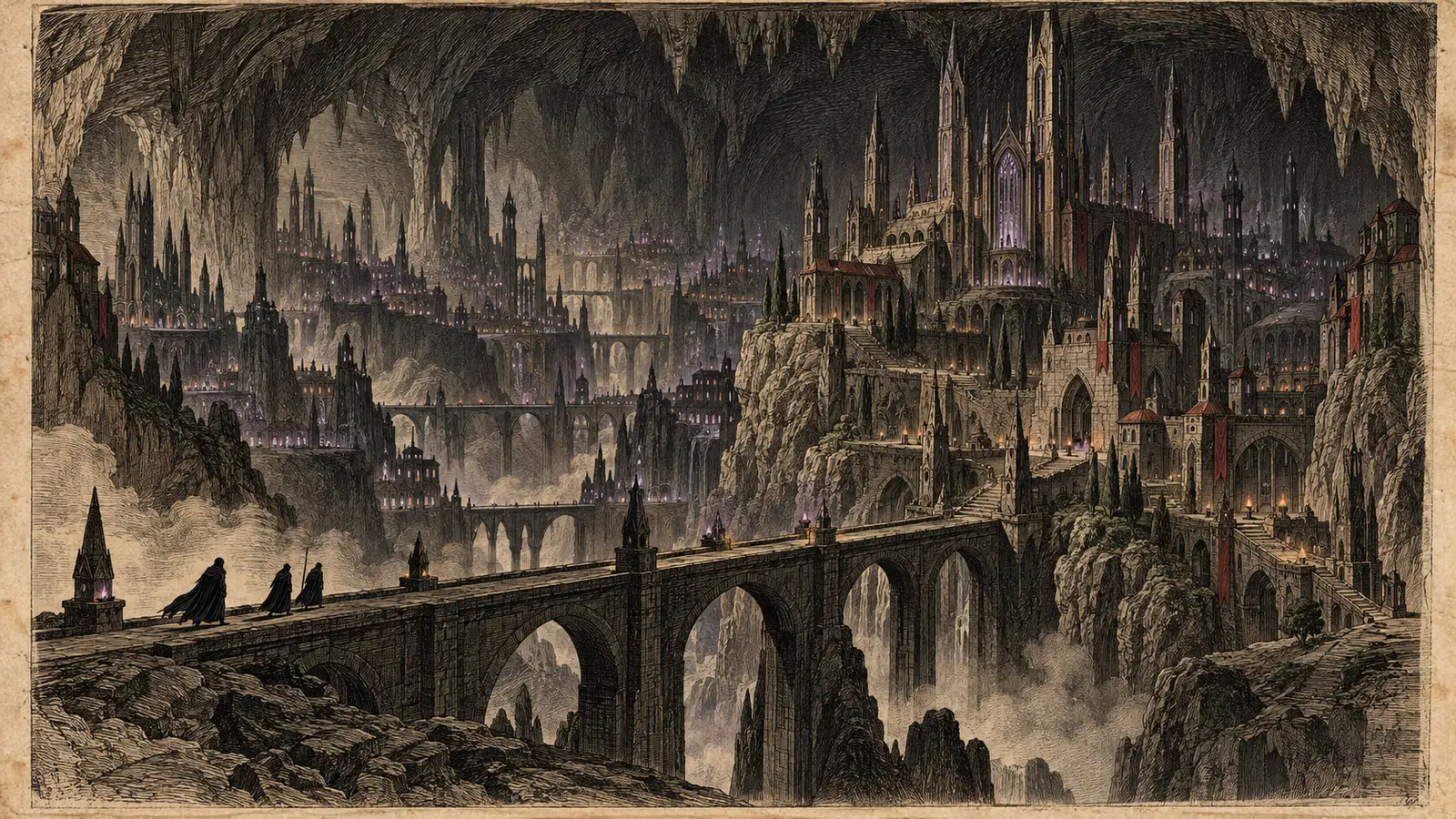
In the Forgotten Realms as they're told today, lives. He returned during the Second Sundering, and the setting's present day runs on from the late 1480s by the Dale Reckoning, in a world where the Masked Lord walks once more among the gods.
He is still the Masked Lord and the Masked God of Night, god of thievery, of the drow males who oppose 's matriarchy, and of drow ambition on the surface. His symbol is still the black mask with blue lenses. His blade is still the short sword. His church still keeps its trustworthy face toward the world, with its schemes behind it.
And he stands now beside his sister. In the account Ed Greenwood has given, the twins are allies, bound together by their shared ordeal, by their death or imprisonment and their return. They no longer fight each other as they did in every earlier age. They still differ in their methods: she would bring the drow up into the moonlight peacefully, and he through cunning and conquest. But they face Lolth together.
In 2025, Wizards of the Coast published two new books for the Realms: Forgotten Realms: Heroes of Faerûn and Forgotten Realms: Adventures in Faerûn. These books reshaped the presentation of the pantheon once again, the third time it had been rearranged during the fifth edition years, after the 2014 Player's Handbook and the 2015 Sword Coast Adventurer's Guide.
The new books set aside the old habit of giving each god an alignment and a fixed gender. Lolth, for instance, isn't defined as chaotic evil anymore. It's the Abyss, her plane, that embodies chaotic evil. The book says that the makeup of the pantheon "has shifted over the ages, as a result of changes in the Realms and its people (or vice versa, depending on which scholars you believe)." There's a gentle wisdom in that line, and the Masked Lord would surely appreciate it. Gods rise and fade as their worshippers change, and worshippers change as their gods do.
In the main list of gods in Heroes of Faerûn, two drow powers stand out. is there, goddess of song and moonlight. Lolth is there, goddess of spiders. Many gods from the earlier lists are no longer featured, and even , father of the twins, has no entry. Vhaeraun's mask isn't among the faces on that page.
That seems right for him, somehow. His sister stands in the moonlight on the page, singing, and his mother crouches in her web. And the Masked Lord is where he has always preferred to be, a step back, just outside the circle of light, where you'd have to know to look for him. He's still there in the Realms. He's still worshipped in hidden shrines on Midwinter Night. He's simply doing what he has always done: working from the shadows, letting others take the stage.
And so we come to the last part of our journey.
Chapter XIV
The mask in the moonlight
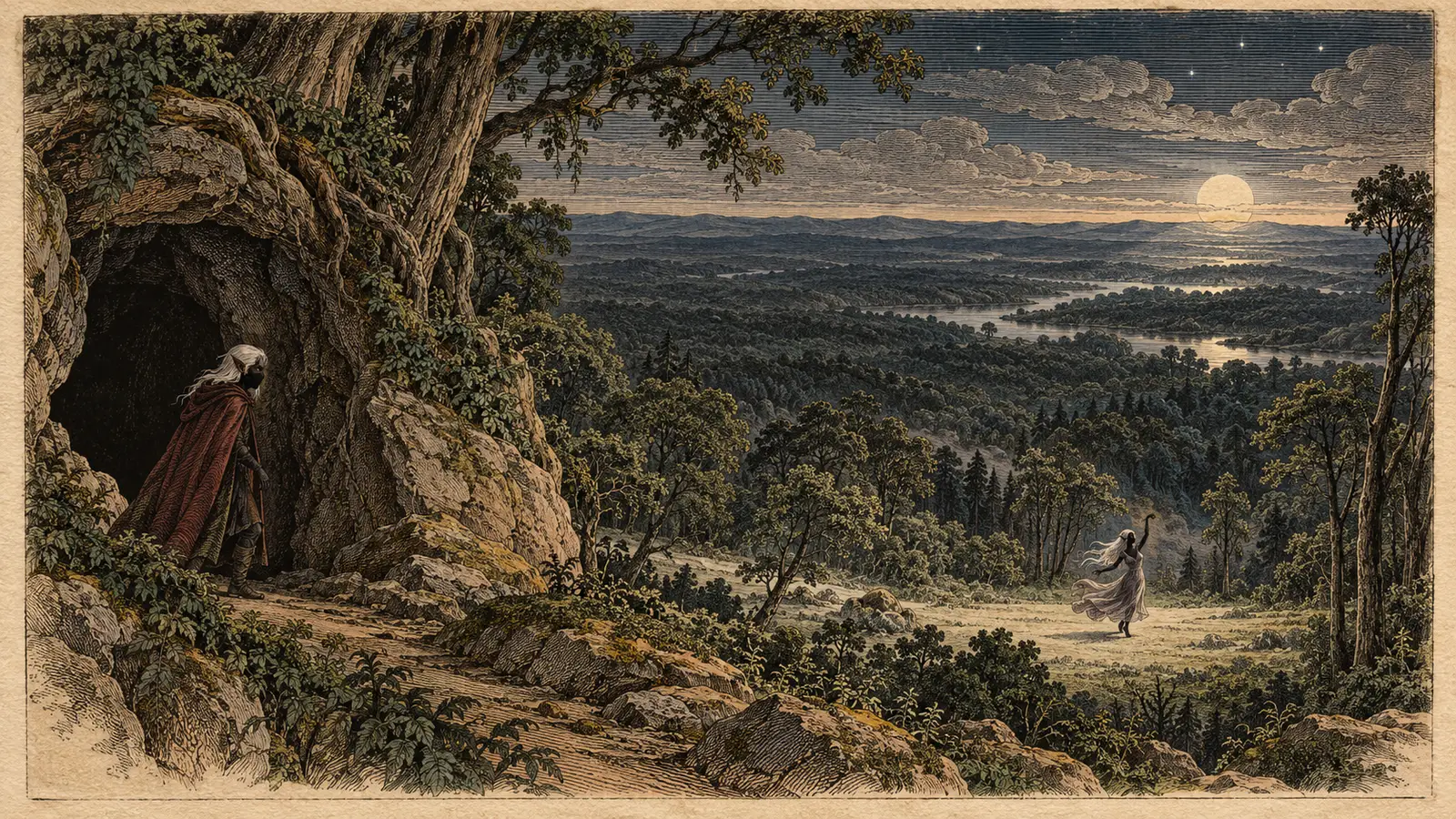
Let's end where his faithful begin each night, at dusk.
Picture the mouth of a cave in a forest of the surface world, somewhere in the old woods of perhaps, or in the hills above the Sword Coast. The day is fading. The last gold light slips off the leaves and the shadows lengthen among the trunks. Inside the cave, where the passage slopes down toward the Underdark, a drow stands very still.
He has climbed a long way to get here. Behind him, far below, lie the cities of his mother's goddess, where he was born to serve and expected to kneel. Above him, through the cave mouth, there's a sky he has only heard about in stories, the Night Above.
He lifts a mask to his face. It's black, a half-mask that covers his eyes and the bridge of his nose, and set into its eyeholes are two panes of blue glass. Through them the dusk looks cool and strange. He ties it in place and stands for a moment in silence. He doesn't pray aloud. He prays the way his god taught him, meditating in shadow, without words.
Somewhere far off, on some hidden ledge of the planes, in a realm that no visitor can remember, a god hears him.
The Masked Lord has been many things over the long ages of his story. He was the son who stood beside his mother's treachery and locked away the moon so that his sister would be blamed. He was the exile who made his home in shadow and patronized the dark elves of the south until the land itself broke beneath them. He was the god of thieves and of males, a name in a single line of a rulebook. He was a slim figure with hair that shifted colour with his moods, and a shadow-wrapped assassin who could step from one place to another by letting the darkness swallow him. He nearly killed his mother while she slept. He walked into his sister's home to kill her, and died there. And he came back.
Through all of it, one thing hasn't changed. He's the god who looks up. Every other power of the drow wants them kept below, in the dark, in their place. Only has always said that the drow belong on the surface, that the sky is their birthright, and that no drow, male or female, was born to kneel. He's cruel and grasping and faithless, and he means to rule. But he's also the one voice among their gods that tells a drow male in a dark city that he's worth as much as anyone, and that the world above is waiting.
Now picture the young drow at the mouth of the cave stepping out. The trees are dark around him. The first stars are coming out between the branches, and above them rises the moon.
He isn't alone. A little way off, at the edge of a clearing, another drow has come up from below, and she's dancing in the moonlight, her silver hair moving as she turns. She sings softly, a song that has called her people up to the surface for ages. She's one of 's faithful. Once the two of them would have drawn blades on sight. Tonight they only nod to each other across the clearing, and go their separate ways into the same dark wood.
That's where the story of the Masked Lord rests for now. Two roads lead up out of the Underdark, and they were laid down by twins. One is the sister's, open and moonlit, full of song. The other is the brother's, hidden and masked, full of plans. For ages those two roads ran against each other. Now they run side by side, under the same night sky.
And somewhere, in a room within a realm that no one remembers, a god in a black mask sits in the dark and listens to his sister's voice. The shadow moves slowly over his shoulders, and his body fades where it passes, and returns, and fades again, like a figure glimpsed through drifting cloud. Outside, the moon rises over the forests of , and in its light, at the mouth of a cave, a pair of blue glass lenses catches the silver and holds it.