Chapter I
A lich without a name, and a tomb that came by post
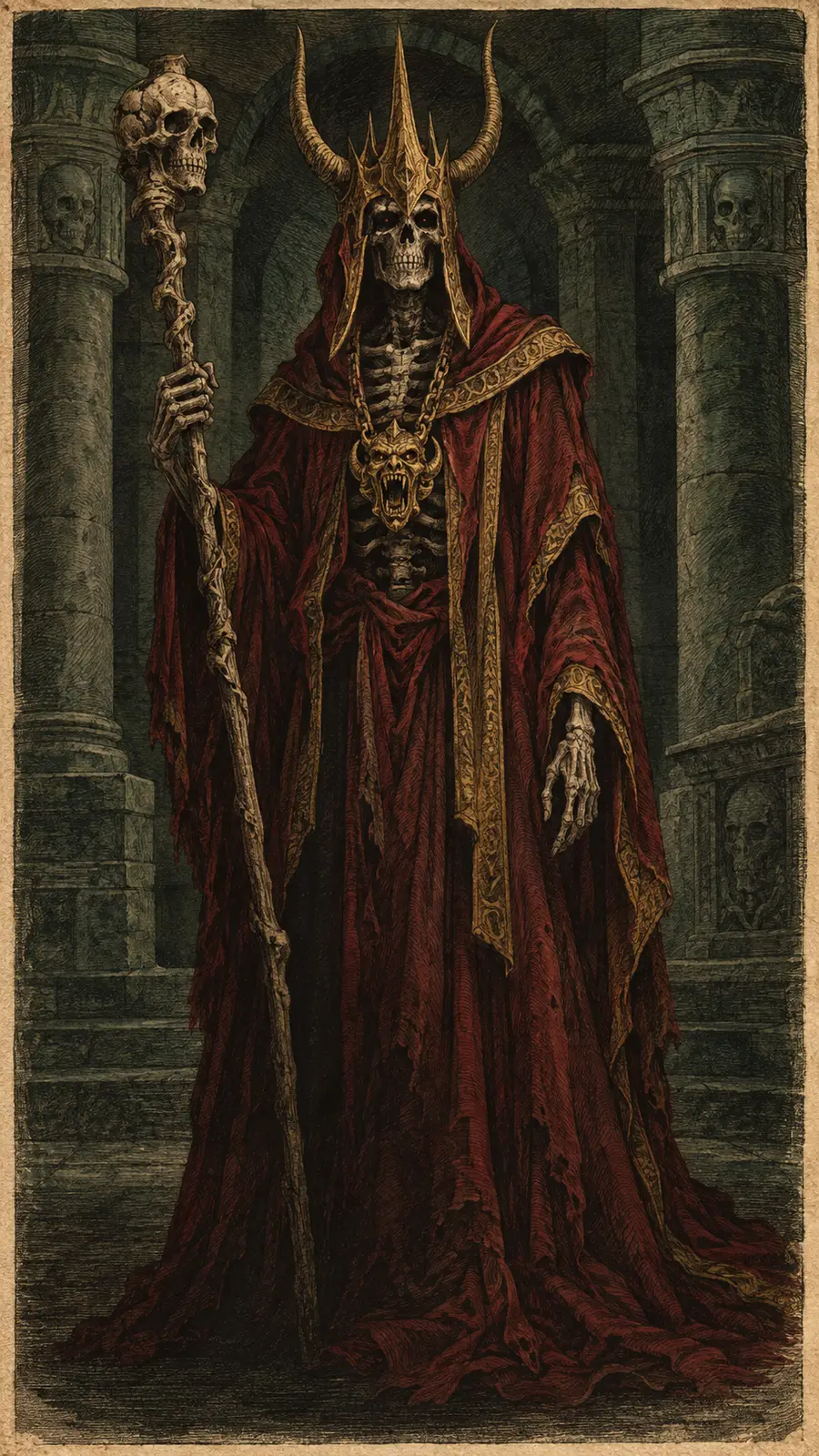
Every long story about begins with a kind of creature, and only later with a person. Before there was a name or a tomb, there was the lich.
The lich came into Dungeons & Dragons in 1975, in a slim supplement called Greyhawk, the first addition to the original rules. It was a skeletal undead thing that had been a magic-user in life, or a magic-user and cleric together, and had kept all those powers through death. It was a sorcerer that refused to stop being a sorcerer just because its heart had stopped. Characters of modest experience who met one tended to turn and run, because the creature's presence filled them with fear. Gary said he took the idea for the game's lich from a short story by Gardner Fox called "The Sword of the Sorcerer," published in 1969. Fox wrote for pulp magazines and comics, and the lich carried that pulp flavour with it: a dark, patient, very old magician who had outlived the whole idea of an ending.
If you've heard the earlier episodes on this channel about and about , you've already met the lich as a family of sorts. Vecna would come to stand at the head of that family. Szass Tam would rule from behind his council's quarrels. Acererak, though, came from a different direction. He wasn't born in a supplement of rules or in a campaign setting's history. He came out of a dungeon. It was one particular dungeon, written for one particular weekend, and it was meant from the very start to be cruel.
The idea came from a player named Alan . He moved in the same wargaming circles as Gygax, ran a Dungeons & Dragons campaign of his own in California, and later became one of the original playtesters for Advanced Dungeons & Dragons. In 1975 he sent Gygax a dungeon of his own design, called "Tomb of ." It was a tomb in the Egyptian style, crowded with traps, and its master carried an Egyptian name. You can picture the package arriving in Lake Geneva, Wisconsin: pages of maps and notes describing a buried place that wanted nothing more than to kill whoever opened it.
Gygax took Lucien's ideas and built something larger from them. He needed a dungeon for a tournament, and the occasion was a new one. Origins, the first convention of that name, was held over a summer weekend in July 1975 at Johns Hopkins University in Baltimore, Maryland. Gamers gathered there to push painted soldiers across tables, play board games about old wars, and in some rooms try this odd new game in which you played a single character instead of a regiment. Gygax ran his tomb there as a tournament event.
In that tournament text the master of the tomb had no name at all. It was simply called "the Lich," written in capitals as the word for a thing, not a person. Lucien had called it Ra-Hotep. Gygax, for the moment, left it nameless. The name Acererak would arrive three years later, when the dungeon was printed and sold, and from then on it would never leave.
Tournament play has its own rhythm, and it shaped the tomb. Every party played the same characters, made in advance, so that teams could be compared fairly. They ranged from a twelfth-level magic-user down to a fourth-level fighter, a band of seasoned adventurers with a few younger ones carried along. The players sat down with characters they'd never seen before and were sent at once to the edge of the tomb. Nobody arrived with a favourite sword or a beloved old familiar. There were only the pages in front of them and whatever the next room held.
Some of the tomb's later furniture wasn't there yet. The decoy lich, the false master who waits in a false crypt to fool the over-confident, wasn't part of the tournament version. It was added in 1978. Lucien's draft had leaned harder into its Egyptian dressing, and Gygax softened that into something stranger and harder to place. The bones were already in place, though: a buried labyrinth, a series of deceptions and a master at the bottom who had prepared for visitors a long time in advance.
Gygax had two reasons for building it, and both had to do with the people at his own table. The first was the expert players of his home campaign, the Greyhawk campaign that had given the supplement its name. They had grown very good at the game. He later described the tomb as "yet another challenge to their skill — and the persistence of their theretofore-invincible characters." The second reason was a type of player he'd met at conventions and in letters: the one who boasted that his high-level character could beat anything the Dungeon Master could design. The tomb was an answer to that boast.
Gygax had two characters in particular in mind. One was , played by Rob , an early co-designer of the Greyhawk campaign and one of its most daring players. The other was , the character of Gygax's own son Ernie. Both had seemed impossible to kill, and Gygax meant to change that.
They beat the tomb anyway, as players tend to.
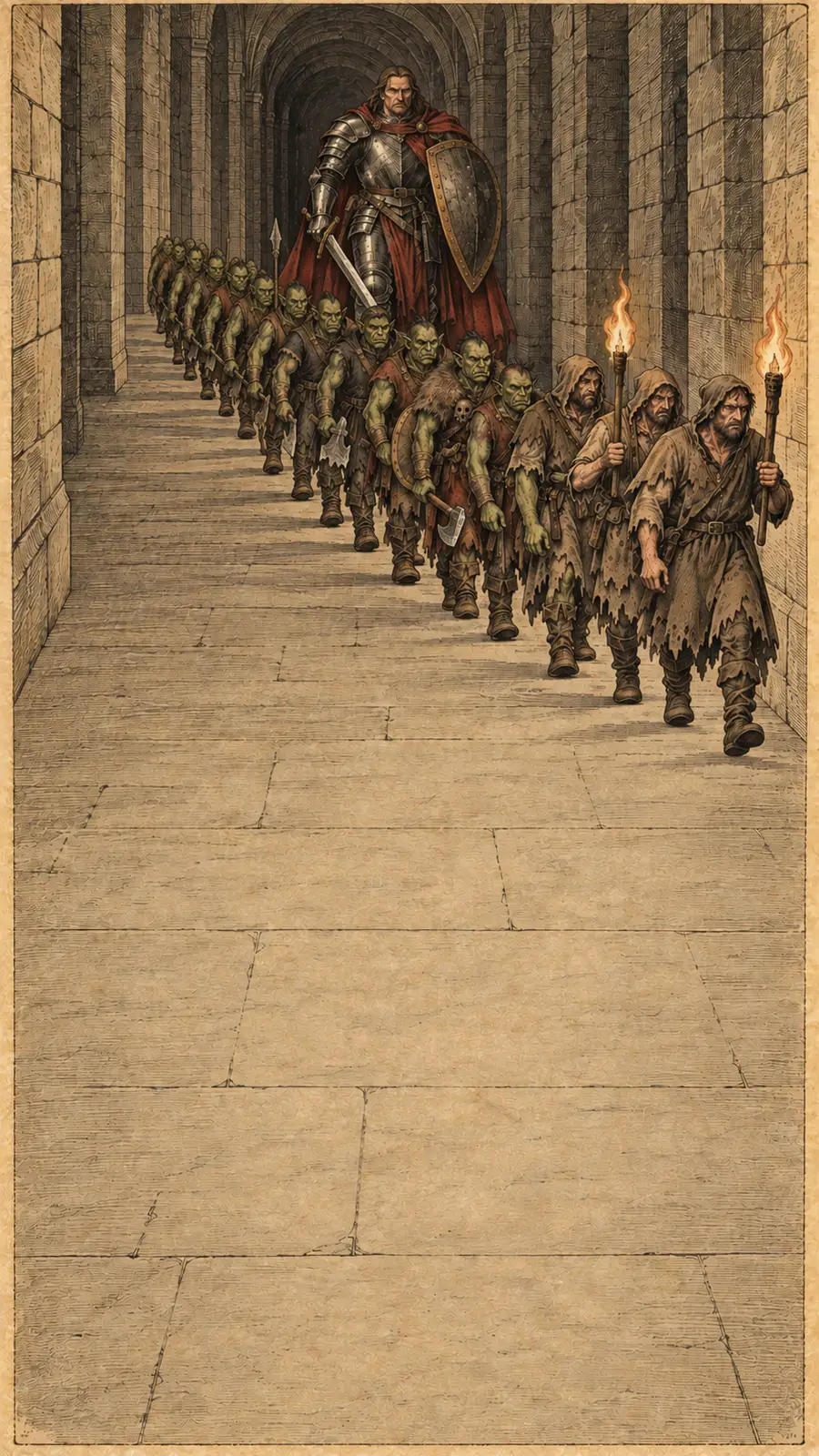
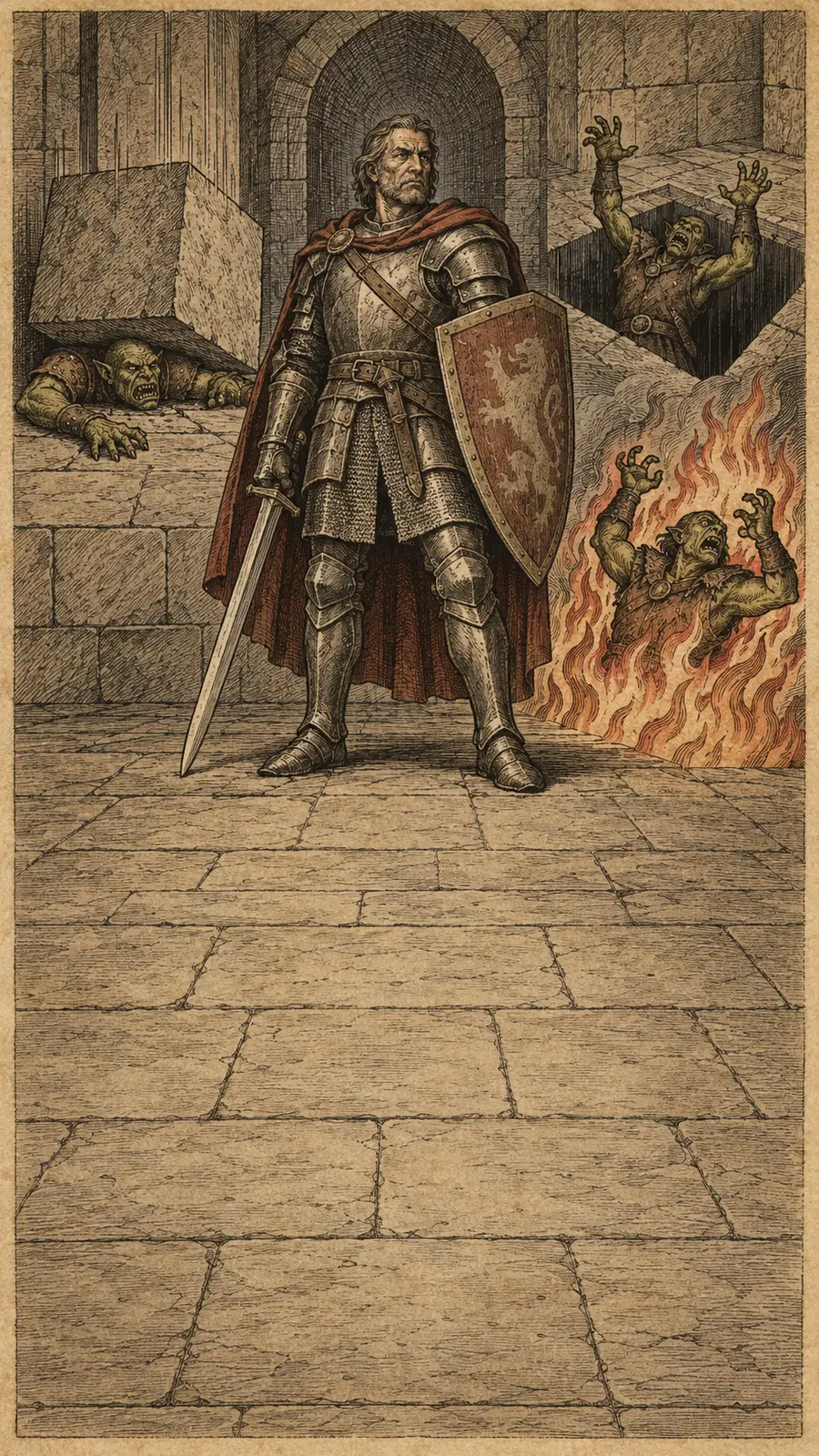
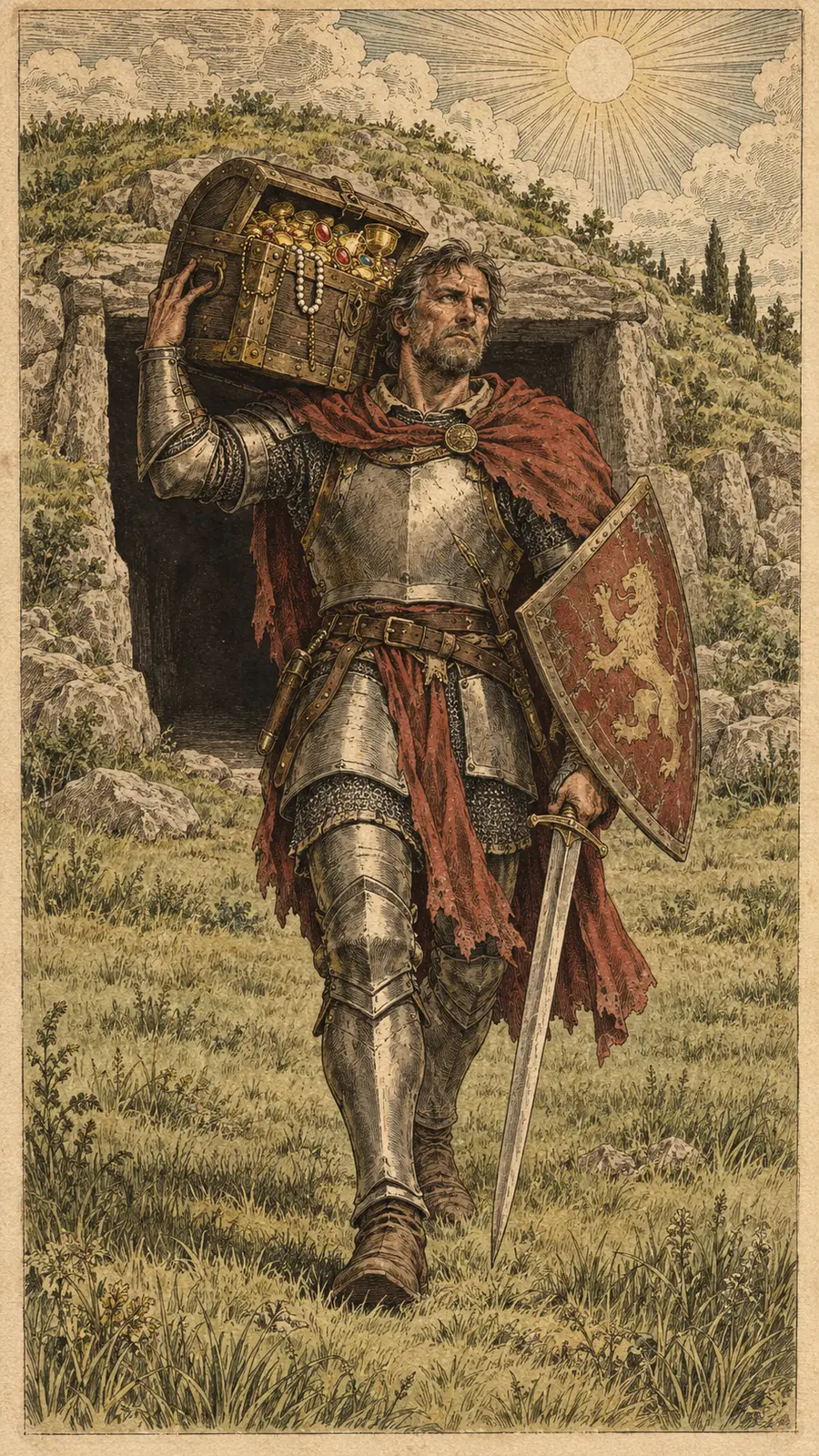
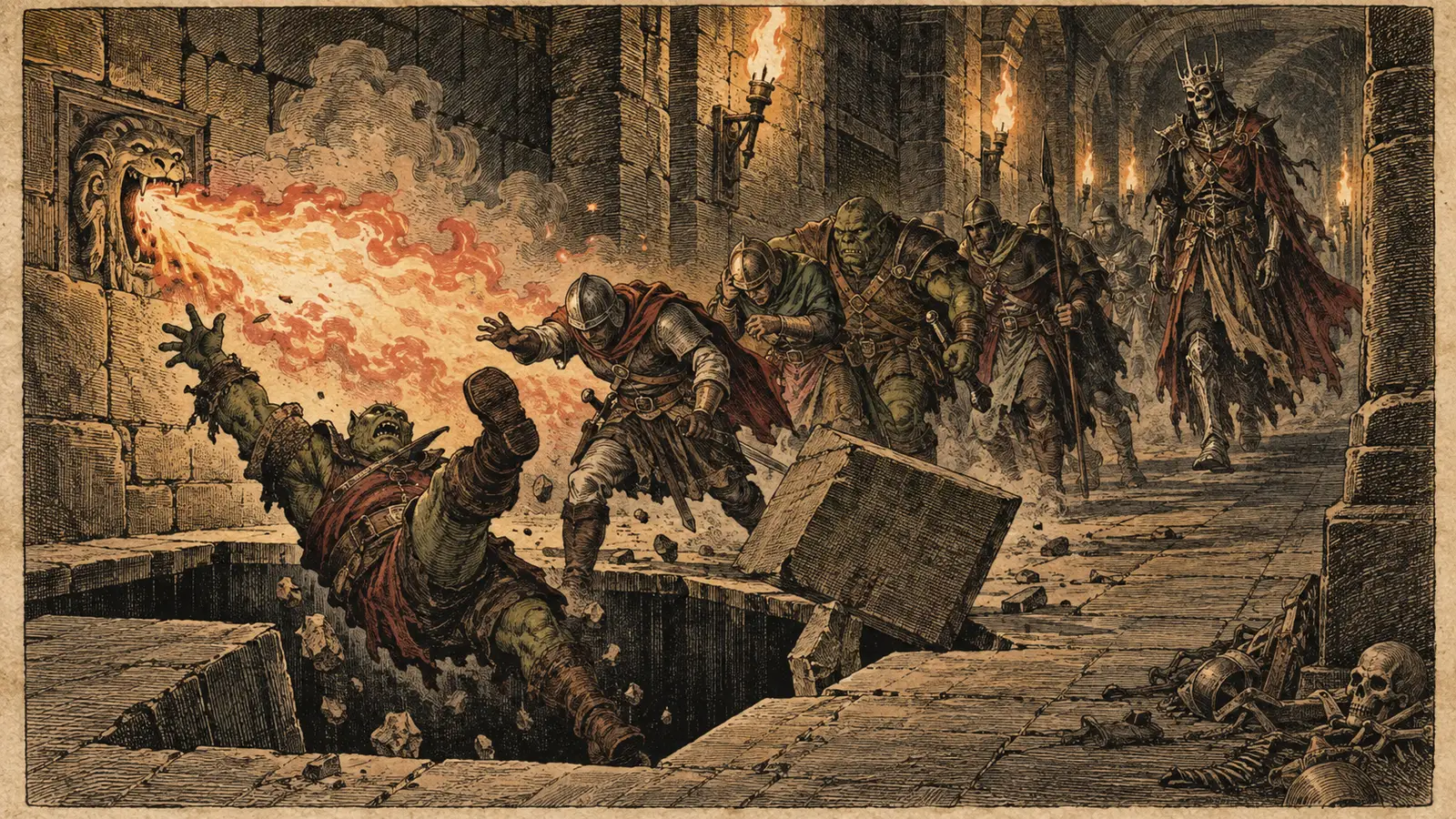
Robilar was the first character ever to complete it. Kuntz played him as a thirteenth-level evil lord, and he went into the tomb with fourteen orcs and a handful of low-level followers walking ahead of him. In about four hours of real time he went through the whole dungeon. Every one of his followers was lost along the way, swallowed, crushed, burned or simply gone, and Robilar himself reached the lich's crypt, looted it, and walked back out into daylight with the treasure. Tenser's run was quieter and in some ways wiser. When he reached Acererak, he didn't stay to fight. He grabbed all the treasure he could fit in his bag and fled, and his Dungeon Master counted that as good play.
That was the pattern of Gygax's home group generally. They got through the tomb by sending disposable hirelings ahead to find the traps with their bodies. It's a grim piece of early gaming history, told now with a rueful smile: a dungeon built to humble heroes, beaten at last by the hired men who walked in front.
For decades the tournament text and Lucien's "Tomb of Ra-Hotep" were known only to the people who had held them. In 2018 both were printed for the first time as booklets, tucked into the special edition of Dungeons & Dragons Art & Arcana: A Visual History, by Michael , Kyle Newman, Jon Peterson and Sam Witwer. So the two older drafts of the tomb, the Egyptian one and the nameless one, sit now on a few bookshelves beside the finished version, like earlier sketches kept behind a painting.
It was the finished version, the one that came out three years after the tournament, that gave the lich his name.
Chapter II
The lonely hill and the crypt of the demi-lich
We come now to 1978, the year the tomb was printed and the year was named.
TSR published Tomb of Horrors as the first of a short run of special modules, adventures that stood apart from any series and asked something unusual of the people who played them. revised his tournament dungeon for the new Advanced Dungeons & Dragons rules and aimed it at high-level characters, the kind who had already seen most of what an ordinary dungeon could offer. The first printing came in a plain cover in two colours. A reprint in 1981 carried a new painting by Jeff Dee, showing adventurers fighting the demilich itself, and for many players that's the image the module brings to mind.
Gygax's own notes to the Dungeon Master set the tone plainly. He called it "a thinking person's module." Then he added a warning that has been quoted ever since: "If your group is a hack and slay gathering, they will be unhappy." The designer Lawrence later described the tomb as a kind of thought experiment. Imagine a dungeon built the way a real tomb would be if its builder truly wanted to kill and discourage everyone who came, and had no interest at all in offering them a fair fight. That's what Gygax had written.
The module begins with a legend. Somewhere, it says, under a lost and lonely hill "of grim and foreboding aspect," lies a labyrinthine crypt, and "there is said to be a demi-lich who still wards his final haunt." The being inside is said to have powers that make him nearly undefeatable. The legend goes on to say that whoever finds the place and survives it might win great treasure, and almost in the same breath it suggests that nobody should be foolish enough to try.
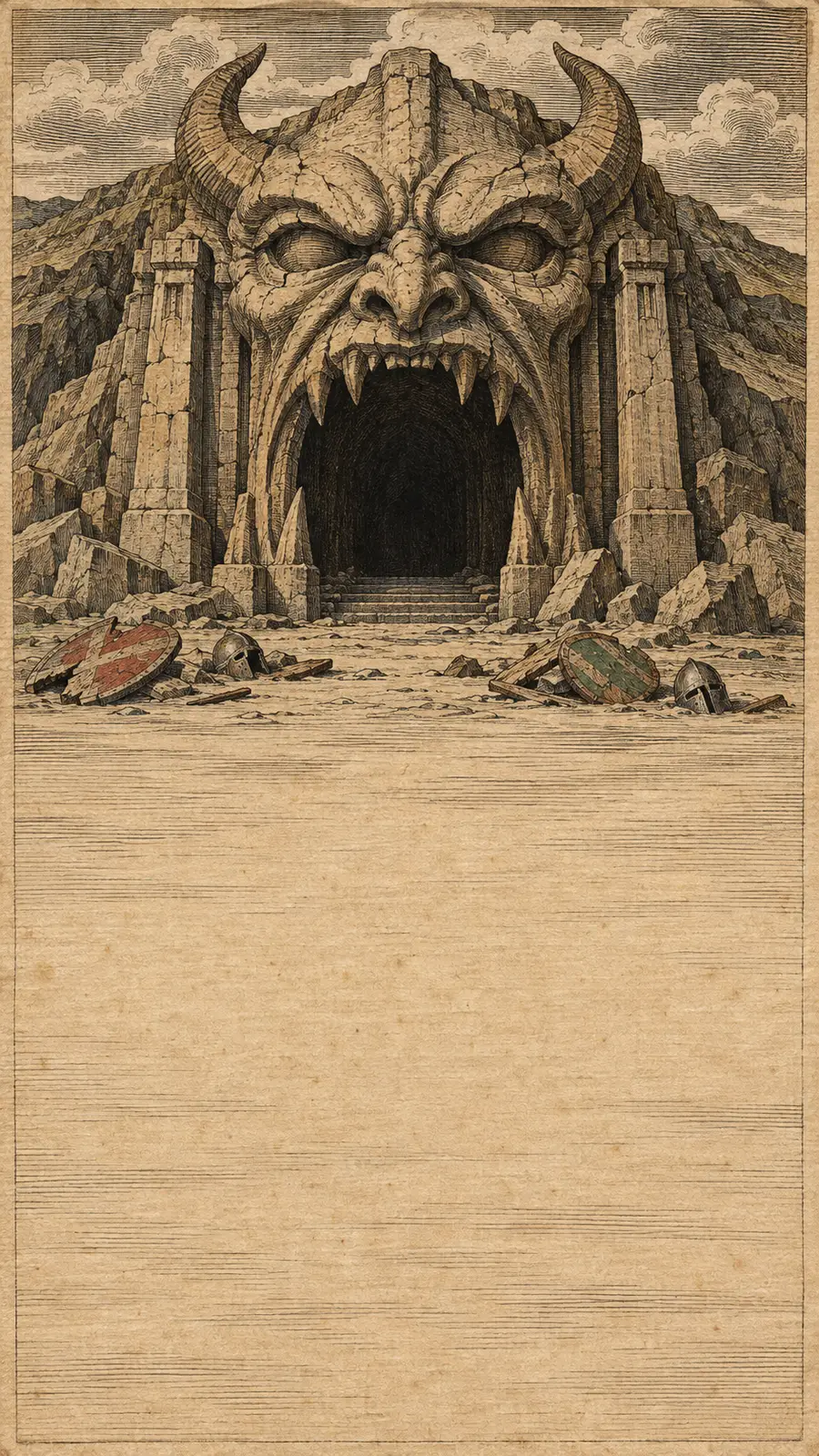
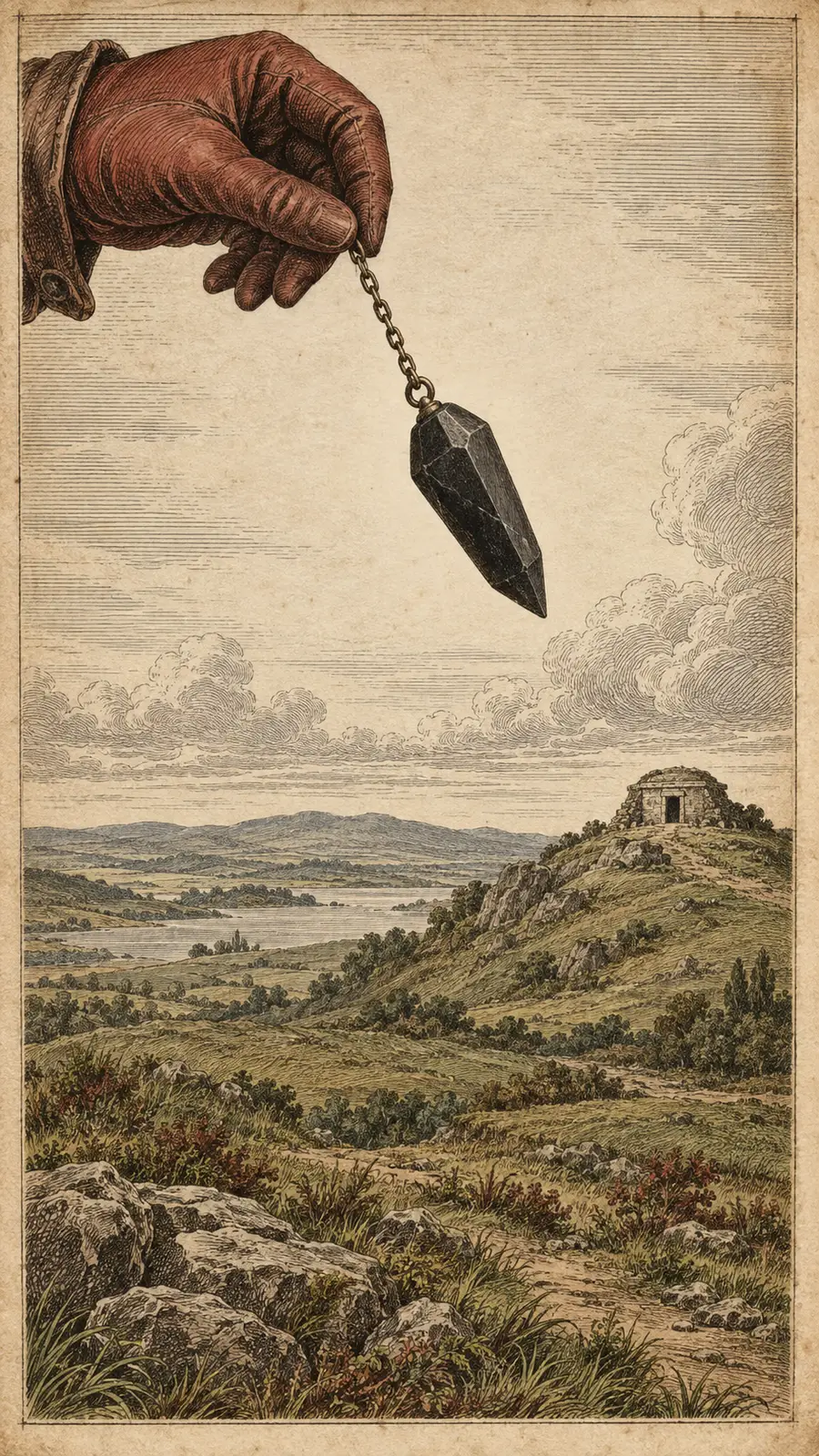
Then the hill itself appears. Picture it with me. It's a long, low mound, flat across the top, a few hundred paces from end to end and about sixty feet high. Nothing grows on its steep sides or its bald crown except ugly weeds, thorns and briars. If you walked up and over it you would see only scattered black rocks among the brambles. If you could rise into the air, though, far above it, as a bird might, you'd see that the rocks aren't scattered at all. They form the shape of a human skull: heaps of black stone for the eye holes, a dark gap for the nose, a jagged line of stones for the grinning teeth. The hill has a death's head on its brow that only the sky can see.
On the north side the ground has worn away into a crumbling cliff of sand and gravel, a little taller than a house. A low stone ledge hangs over the eroded slope, and shrubs and bushes have grown up around it so that from any distance the place looks like nothing at all. That is where the tomb waits.
Gygax gives the players a poem before they go in. It's a riddle of about nineteen lines, presented as Acererak's own guide to his tomb, and it promises to lead the reader all the way to his resting place. It sounds like a gift. Luke Gygax, Gary's son, has said it's as much a trap as a clue, because it tempts you deeper, and some of its lines are ambiguous enough that players still argue over what they mean. Here it is, read slowly, the way it might be read aloud by a nervous adventurer holding a lantern.
"Go back to the tormentor or through the arch, and the second great hall you'll discover. Shun green if you can, but night's good color is for those of great valor. If shades of red stand for blood the wise will not need sacrifice aught but a loop of magical metal — you're well along your march. Two pits along the way will be found to lead to a fortuitous fall, so check the wall. These keys and those are most important of all, and beware of trembling hands and what will maul. If you find the false you find the true and into the columned hall you'll come, and there's the throne that's key and keyed. The iron men of visage grim do more than meets the viewer's eye. You've left and left and found my Tomb and now your soul will die."
Notice how the poem ends. It doesn't promise treasure or glory. It promises that you'll find the tomb, and then that your soul will die there. Acererak doesn't flatter his visitors. He tells them the truth in a voice so calm that they don't believe him.
The tomb opens with a deception. Beneath that overgrown ledge are three ways in, and two of them are false. Each false entrance has its own deadly trap, waiting for the adventurer who's pleased to have found a door so quickly. Only the third is true. Before anyone has taken a real step inside, the tomb has made its first point: the obvious path isn't the safe one, and the first thing you find is rarely the thing you're looking for.
Inside, the corridors are painted and tiled, and there are messages in the walls. In one place, red tiles hold runes that spell out a sentence meant for anyone clever enough to read them. In the module it's written all in capitals, but let me give it to you the way a patient old voice might say it across a quiet room. Acererak congratulates you on your powers of observation. So make of this whatever you wish, for you will be mine in the end no matter what.
It's a strange kind of courtesy. He praises you for noticing, and then he reminds you that noticing won't save you. Many villains boast. This one sounds like someone who has watched a great many visitors come and go, and who is quite sure how the evening will end.
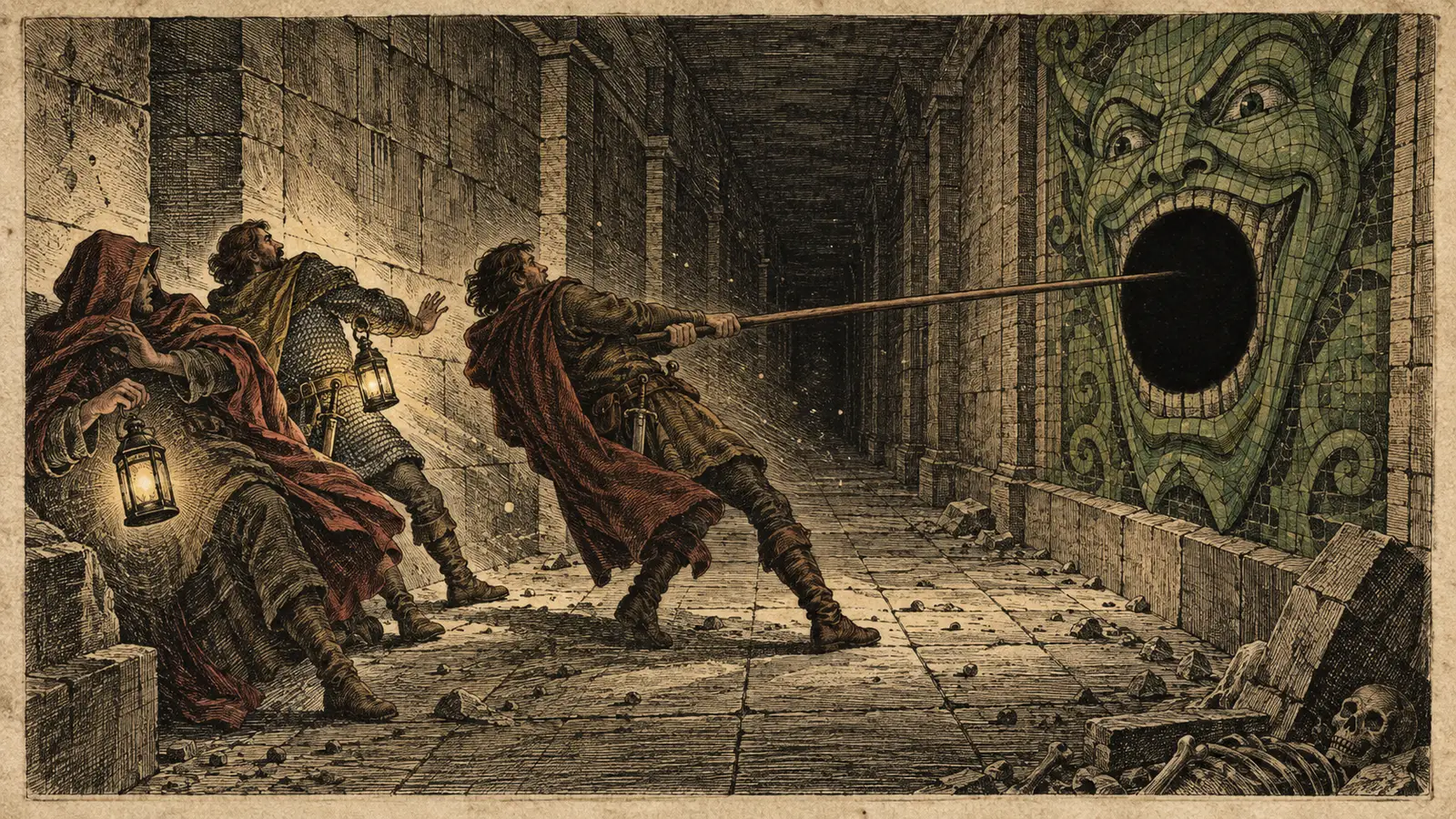
Further on is the image people remember most. At the end of one corridor, set into the wall, is a great mosaic of a devil's face, green and grinning, with a large black circle for its open mouth. It's the Green Devil Face. Its mouth is just big enough to step into, and the darkness inside it seems to invite exploration. Anything that goes into that mouth, whether a hand, a pole, a curious adventurer or a whole person, is simply gone, because hidden inside is a sphere of annihilation, a ball of absolute nothing that erases whatever touches it. There's no sound and no struggle. The Face doesn't so much kill people as delete them, and it does it with a grin.
Other wonders and horrors line the way, and the poem hints at many of them. There are pits that lead to falls, some of which turn out to be fortunate. There are keys to be found and keys to be used. Trembling hands appear somewhere, and something that will maul. There's a columned hall and a throne that is both a key and a lock. There are statues of iron men, grim of face, which, as the poem says, do more than meet the eye. False doors open onto stone. Hidden pits wait under floors that look solid. Treasures are trapped, illusions hang where walls should be, and mechanisms work for reasons nobody can easily guess. Some traps kill without warning and without a saving roll, and a whole party can be undone by a single careless gesture.
The module came with a separate booklet of illustrations, pictures the Dungeon Master would hold up to show the players exactly what their characters were looking at. The idea was that the clues lived in the images, so you had to study each one as your character would, looking for the detail that didn't belong. Those pictures are remembered fondly: a four-armed gargoyle, the middle entrance to the tomb, and the charred remains of some earlier visitor. Players leaned over the table and peered at them by lamplight, trying to read a dead man's mind from the way his bones lay.
Deep inside, the tomb tells one more lie. There's a crypt, and in it a lich, and a party that has struggled this far might well believe their journey is over. It isn't. This is the false crypt and the false lich, the decoy Gygax added when he revised the tournament text for print. The real crypt lies further in, behind more stone and more secrets.
What sort of being built all this? The module gives us only a little, and the little it gives is cold and clear. Acererak was a human, a magic-user and cleric "of surpassing evil." He had already lived for centuries, longer than any ordinary man, and he took the steps needed to keep his life force going beyond even that. He became a lich. Then, the module says, his servants spent about eight decades building the Tomb of Horrors. Think about that span of time. Whole generations of servants were born into the work and died in it, cutting stone in the dark for a master who had stopped needing to breathe.
Over the years the lich changed again. He became a demi-lich, a greater kind of undead that no longer needed any body except its skull. He let the rest of himself crumble into what the module calls "lich dust," and while his skull stayed in the tomb, his consciousness wandered away to other planes. The master of the tomb wasn't, in the usual sense, at home. What waited at the bottom of the dungeon was what he'd left behind.
Gygax's Acererak is barely more than that skull: a bodiless thing in a crypt behind a secret door at the far end of the dungeon. The module doesn't explain why the tomb exists beyond guarding him. It doesn't say what he was seeking, whom he served, or what he did on the planes beyond. That silence would leave room for a great many later stories.
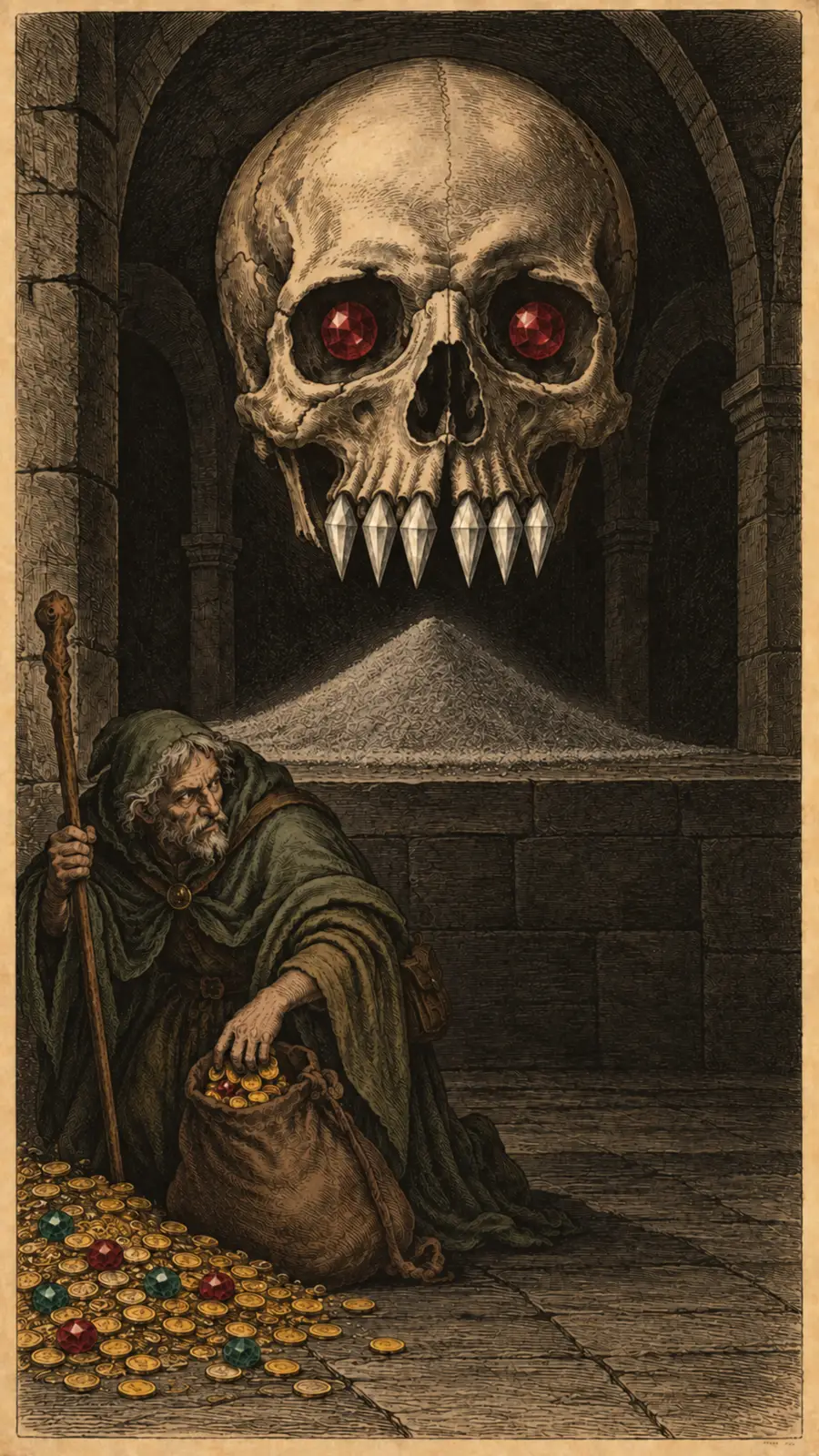
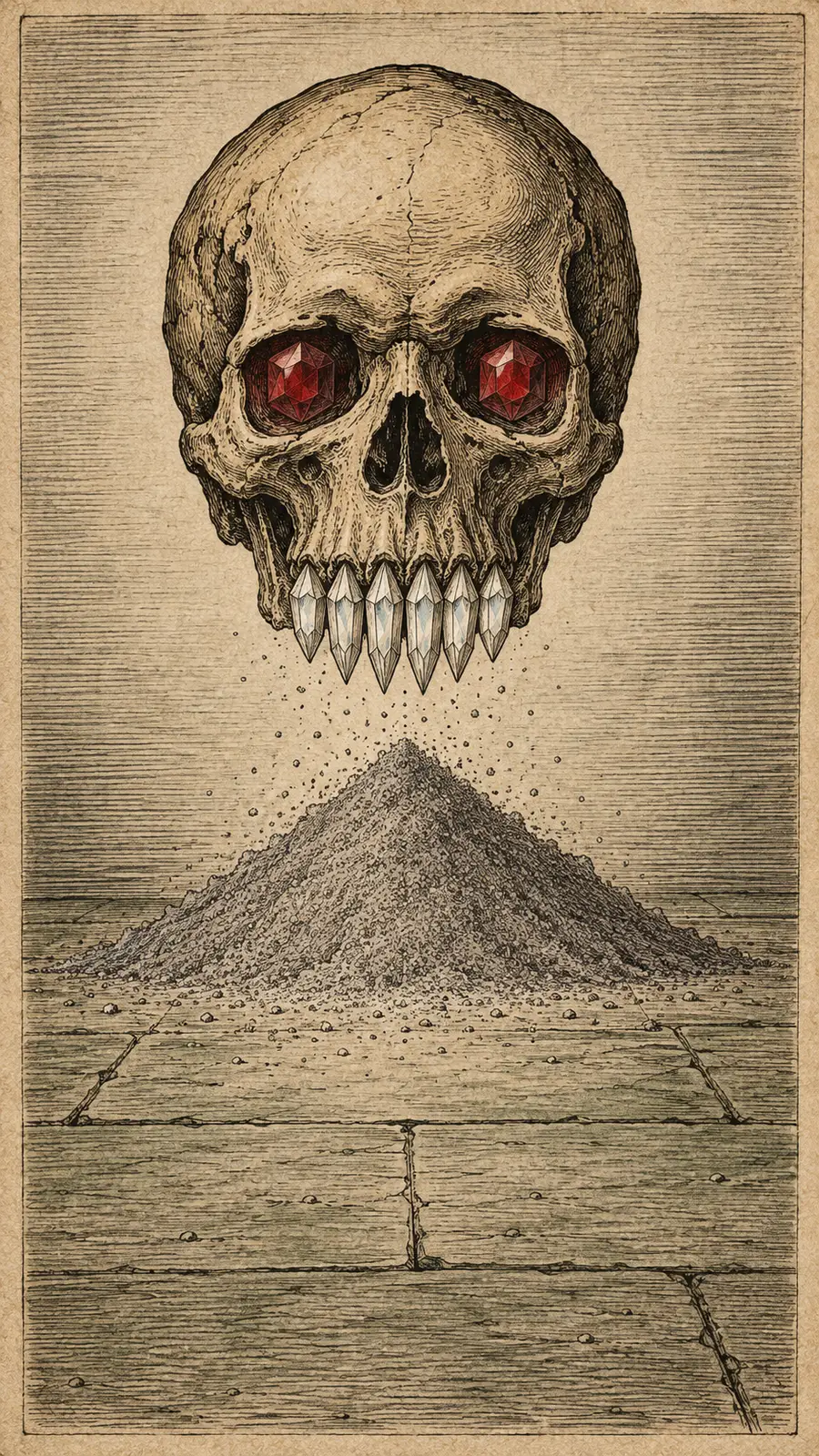
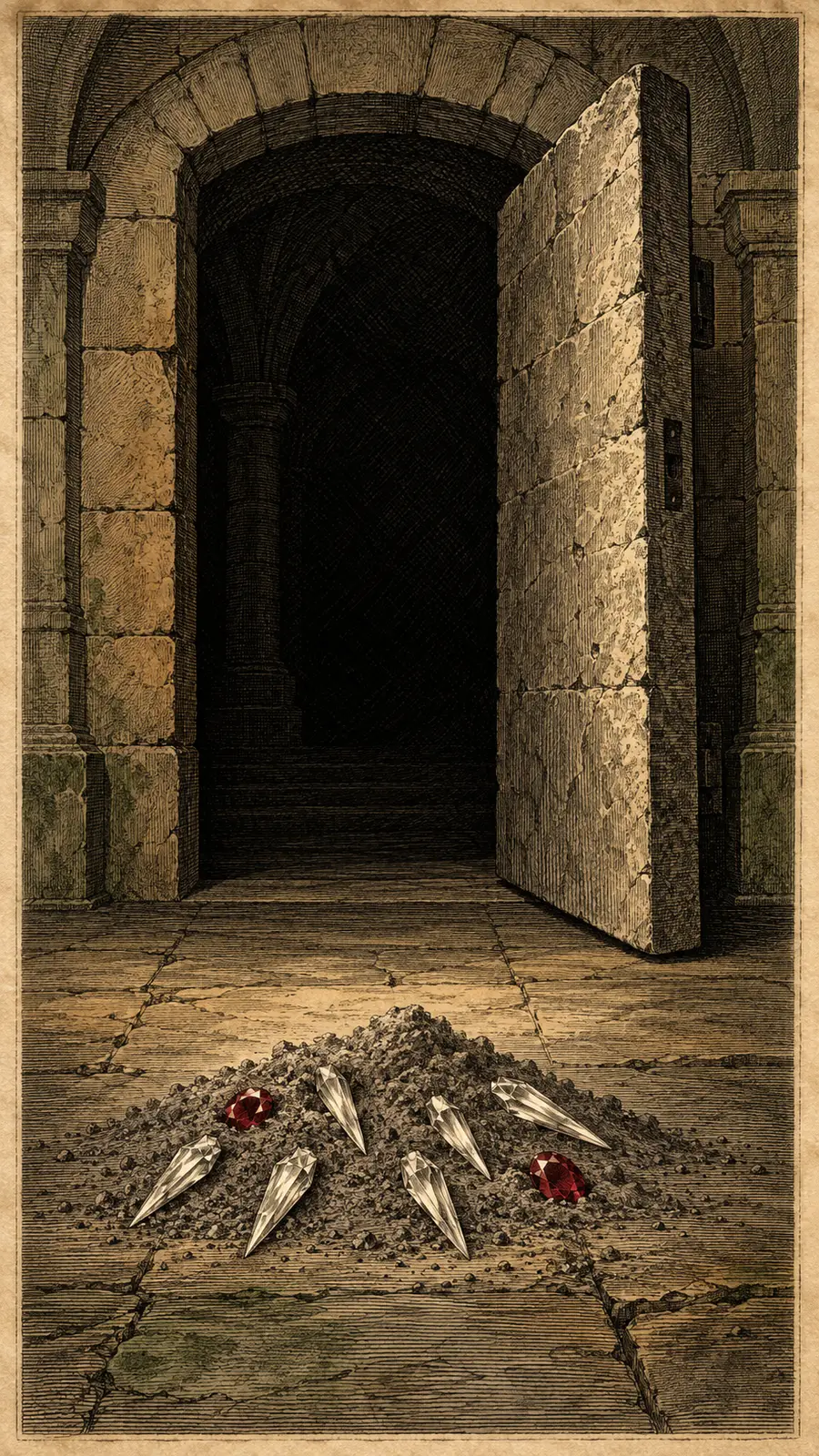
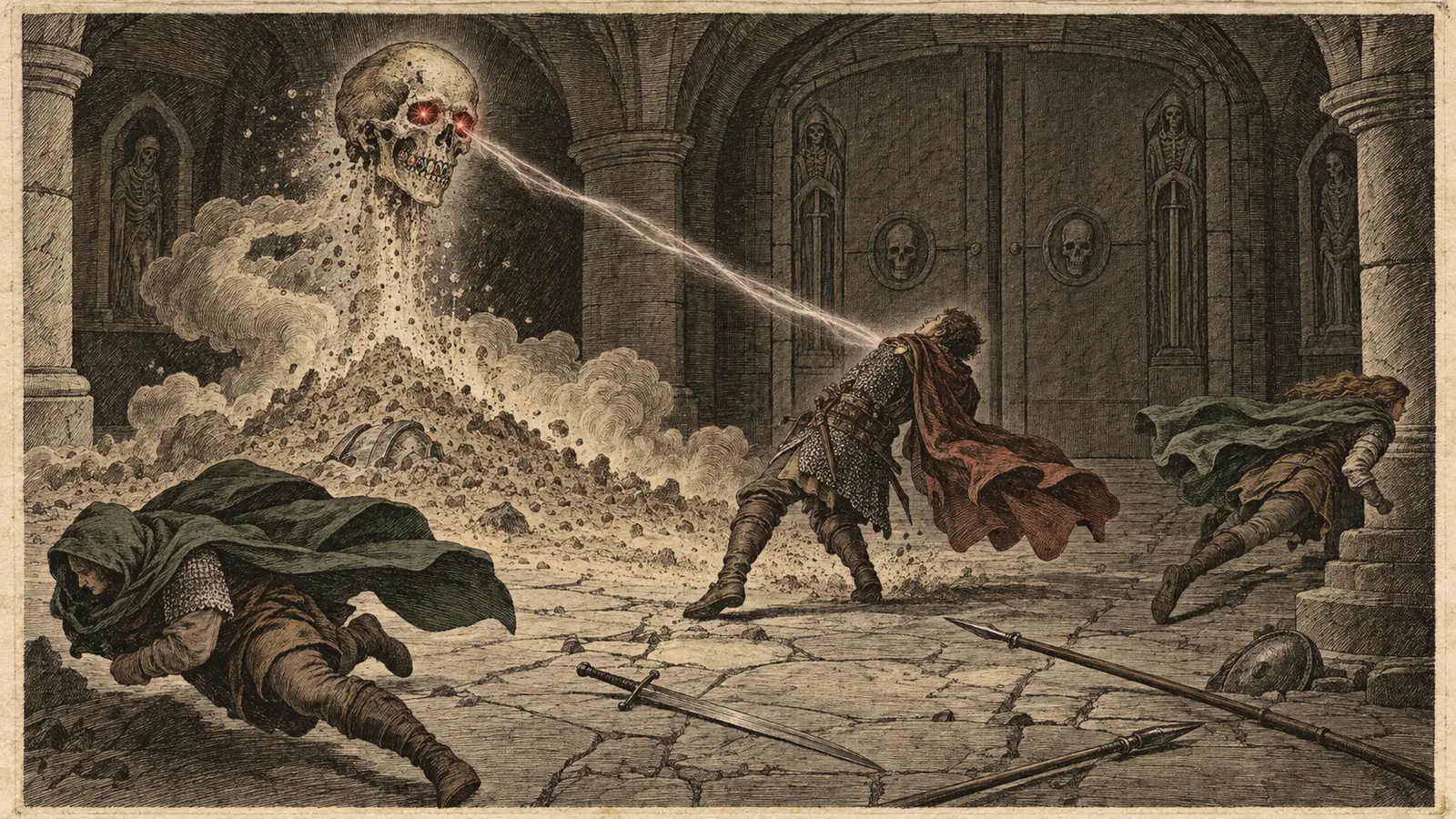
The last chamber is called the Crypt of Acererak the Demi-Lich, spelled with a hyphen, the way Gygax spelled it. Picture a sealed room. On the floor, or perhaps on a low resting place, lies a heap of fine dust, which is all that remains of his bones. Among the dust lies a skull, and set into it are jewels: two rubies where its eyes should be, and six diamonds where its teeth once were, cut long and pointed. Treasure lies around the room as well, including swords and spears, and some of them are cursed.
A careful party can make that room safe. That's one of the quiet surprises of the ending. The skull doesn't wake for those who merely enter and look. It attacks only if someone touches it or tries to harm it. But adventurers are adventurers, and the skull is covered in gems, and so it often wakes.
When it's disturbed, the skull rises into the air. Each of those jewels is a magic device of great power, able to trap the soul of an enemy, and the skull turns them on the intruders one at a time, taking roughly one person each turn. A soul taken into a gem shows only as a faint gleam inside it, unless someone looks with magic that sees true things. The body of the victim rots to dust almost at once. Only the direct intervention of a god can restore someone whose soul is held there.
The module still prefers wit to force, even at the end. Lying in the treasure pile in that same room is the weapon that can destroy the demilich. A party that searches with care can find the means of victory waiting beside the danger, as though Acererak, or Gygax behind him, had left it there to see whether anyone would think to look.
If the skull is destroyed, it falls to dust, the module says, "like snowflakes." The rubies and diamonds drift down and settle among the dust, gleaming. And the adventure ends. There's no epilogue, no reward ceremony and no postscript. The players are left standing in a quiet room with a little heap of jewels and powder, wondering what exactly they've done.
Acererak was also the first of his kind. The demilich as a type of monster was introduced here, in this module, with this skull. Every jewelled skull that has risen from dust in a Dungeons & Dragons game since then traces its line back to this crypt.
Chapter III
Six hills on Oerth, and a swamp that kept the secret
Now we follow the tomb out into its world, and into the first decade of its life.
Tomb of Horrors was written for the World of Greyhawk, 's home campaign setting, on the world called . The special modules that followed it shared no plot and no theme, but all of them were nominally set in that world. The tomb belonged to Greyhawk as a lighthouse belongs to a coast, even before anyone said exactly where it stood.
In fact Gygax didn't say exactly where. He gave Dungeon Masters six places far apart from one another, and let each table choose.
The tomb might lie inside the highest hill on the Plains of Iuz, in the cold north where the cambion lord Iuz rules. It might lie on an unmapped island somewhere in the , the great inland lake at the heart of the , whose depths no one has ever fully measured. It might be hidden in the Bright Desert, among dunes and blowing sand. It might stand at the western border of the Duchy of , where the land rises toward high hills. It might lie somewhere in the Vast Swamp, south of the land of . Or it might wait on an island beyond the realm of the Sea Barons, out in the grey water.
There's something lovely in that indecision. For a while the tomb existed everywhere at once, a possibility under six different skies. One campaign's adventurers might ride north into Iuz's plains and find a bald hill with black stones on its crown. Another's might sail out past the Sea Barons to a lonely island. Every table had its own Tomb of Horrors, and each was the true one for the people who played it.
Over time, though, Greyhawk lore settled on one of the six. The accepted home of the tomb became the Vast Swamp. Later writings would say that moved there and built his lair, the place known as the Tomb of Horrors, and that legends spoke of the lost tomb of a demilich somewhere near the heart of the swamp.
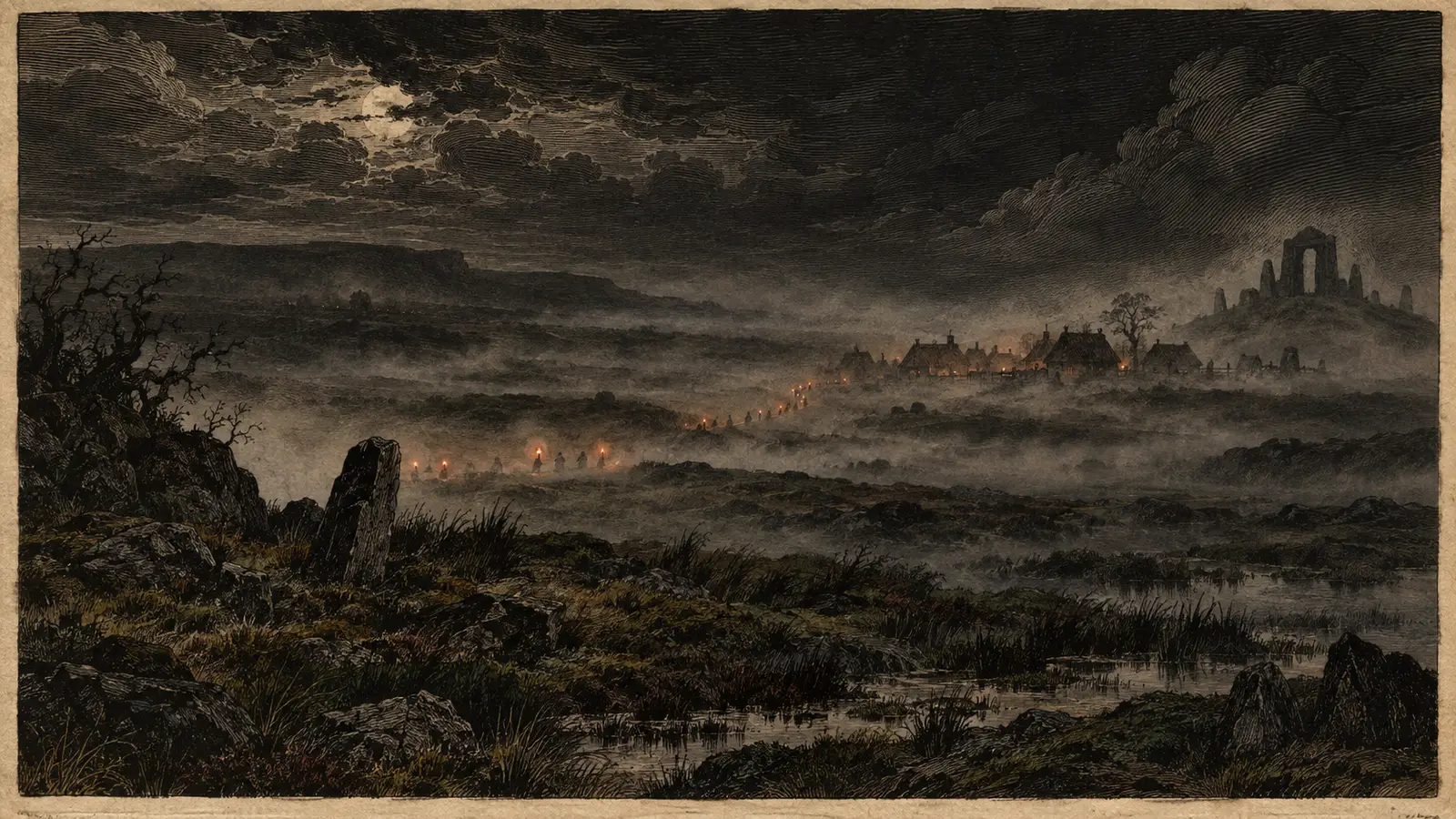
The Vast Swamp is a wide, wet country of reeds and black water, and it isn't empty. Bullywugs, the frog-like folk of the marshes, live there in great numbers, around fifteen thousand of them by one count, and lizardfolk number around three thousand more. Imagine their villages of mud and reed scattered through the mist, croaking voices carrying across still pools, while somewhere in the middle of it all there's a dry hill where nothing grows but thorns. The marsh folk have lived beside the tomb, in a sense, for as long as anyone remembers. It's not hard to imagine that they've learned to leave it alone.
Meanwhile the demilich was spreading. Gygax brought the creature back in another Greyhawk adventure, The Lost Caverns of Tsojcanth, published in 1982. That module is about the caverns of the witch , mother of demons and mistress of dark arts, and in it the party faces Drelnza, Iggwilv's vampire daughter, who waits in an enchanted sleep among her mother's treasures. The demilich had been one skull in one crypt; now it was a creature that could turn up in other dungeons.
A year later, in 1983, it reached the general bestiary. Monster Manual II, a hardcover credited to Gygax alone with a cover painted by Jeff Easley, gathered more than two hundred and fifty monsters, and the demilich was among them, along with many creatures first seen in Tsojcanth. In the bestiary it became a kind of being any Dungeon Master could use: a leering skull crusted with jewels, rising on a swirl of dust, its gems ready to drink the souls of whoever came near. The look Acererak had in his crypt became the look of every demilich after him.
Here we should pause over a small word that will matter a great deal later in the story. When Acererak's gems trapped souls in 1978, the module didn't say where those souls went or what they did for him. The idea that a lich keeps its life in some vessel apart from its body came into the game separately. In 1979 Len wrote an article for Dragon magazine called "Blueprint for a Lich," which offered a formula for how a magic-user might become one. In it the lich keeps its soul in a "jar," a container that holds the essence it has saved from death. The word that later editions would use, phylactery, came later still. But the idea had arrived: somewhere apart from the lich, there's a vessel, and as long as the vessel lasts, the lich lasts.
It would be a long time before anyone joined those two ideas, the soul-trapping gems in the skull and the vessel that keeps a lich alive. When they did, Acererak's whole purpose would change.
As the first-edition years drew to a close, TSR brought the tomb back once more. In 1987 it gathered the four special modules into a single volume, Realms of Horror, credited to Gygax and Lawrence with Wm. John Wheeler and given a cover by Larry Elmore. The four adventures had never shared a plot, and the collection reworked them into a linked campaign, so that the Tomb of Horrors became one stop on a longer road instead of a stand-alone ordeal.
Then a new edition began, and with it a new idea of what a demilich was.
Second edition's general monster books, first the Monstrous Compendium Volume One in 1989 and then the Monstrous Manual in 1993, explained the demilich a little differently. In their telling, a lich becomes a demilich once its spirit has moved on to the outer planes. The skull that adventurers fight is only the old physical shell, left behind and fallen apart. The real being is elsewhere. Van Richten's Monster Hunter's Compendium, written in the voice of the famous vampire hunter of Ravenloft, told the same idea.
From here on, two ideas of the demilich run side by side through the editions, and it's fair to tell them as two old legends that never quite agreed. In the first, the demilich is a lich grown so powerful that it no longer needs a body at all, so it's stronger than an ordinary lich, a mind that has outgrown its house. In the second, the demilich is a lich that failed, one that didn't keep feeding its vessel and has decayed into something smaller, a remnant instead of a master. One is ascent and the other is ruin. Acererak, being the first, has always stood with a foot in each. He's a remnant who left his skull behind, and he may also be the most powerful thing in his tomb.
For twenty years, more or less, that's how things stood. The tomb waited in its swamp, the skull lay in its crypt, and players kept arriving to try their luck. Then, near the end of the second edition, a designer named Bruce went back under the hill and found that the tomb was much deeper than anyone had thought.
Chapter IV
Moil, the City That Waits, and the Fortress of Conclusion
We come now to 1998, and to the first great retelling of the story.
Return to the Tomb of Horrors was a boxed adventure for second-edition Advanced Dungeons & Dragons, published by TSR and written by Bruce R. . It was a long work, meant for characters of thirteenth to sixteenth level, and the box carried a reprint of 's original module alongside the new material, plus a book of illustrations for the Dungeon Master to show the players, just as the original had. It won the Origins Award that year for best roleplaying adventure, which is a pleasing echo, since the tomb had first been run at the very first Origins. Some years later Dungeon magazine ranked it among the ten greatest Dungeons & Dragons adventures of all time. A companion article of the same name appeared in Dragon magazine that summer, filling in the history behind the box.
The story takes place about twenty years after the original. In those twenty years the tomb's fame has spread, and it hasn't drawn only treasure hunters. It has drawn necromancers: men and women who studied death and wanted what had achieved, mastery over it. They came to the Vast Swamp in a slow stream, and they stayed. In the shadow of the tomb they built a community called Skull City, devoted to the dark arts and eager to help with whatever schemes Acererak might still have.
The heroes' journey begins far from the swamp, in the city of , and from there it turns south into the marshes. Somewhere among the reeds and black water they find the Black Academy, a strange and menacing school of necromancy built around the Tomb of Horrors itself. It's a place where students learn the arts of undeath in sight of the most famous grave in the world, and beneath it there's a portal leading onward.
This is where Cordell revealed the great secret, the retcon that turned the old story inside out. The original Tomb of Horrors, the deathtrap that had ended so many characters and humbled so many boasts, was false. It had never been Acererak's true resting place. It was only an antechamber, an entrance hall to something larger and a gateway toward the Negative Energy Plane, the dark source of all undeath. And the skull that so many adventurers had "slain" in the crypt was both a decoy and a key. When it fell to dust like snowflakes, that dust wasn't the end of him. It opened a door.
Think of everyone who had ever stood in that last crypt, looking at the gleaming jewels in the dust and feeling that they'd won. In this telling they had only turned a key in a lock and walked away without noticing the door had opened.
Acererak's tomb now had a relic attached to it. The Amulet of the Void guides its bearer to what the adventure calls the "true Tomb." It's described as Acererak's only known relic. It's a small, dark thing that pulls toward the place its maker wants you to go, the way a needle swings to the north.
Cordell gave the lich a past as well. In the backstory set out in this era, Acererak, while he was still alive, built an unholy temple deep underground, a great subterranean complex raised in the name of , the Demon Prince of Undeath. When it was nearly finished, he killed everyone who had helped make it: the labourers and excavators, the priests who consecrated it, and the architect who drew its plans. He sealed them all inside. That temple became the Tomb of Horrors. The experiments he carried out there to lengthen his life became the challenges that adventurers would later face.
So the tomb was built over a crowd of its own builders. Every corridor a party walks was cut by hands that were never allowed to leave. That pattern, the master who buries his makers in the thing they made, will come back more than once before our story is done.
Years later, in 2009, Cordell looked back on what he'd done with the character in a Dragon magazine feature about the game's alumni. He described developing Acererak "as a persecuted tiefling child to his development as a wizard and priest of Orcus, to his creation of his tomb that was actually a test to winnow souls." All the threads of the new story are there in that one sentence. Acererak had been a child with fiendish blood, hunted for what he was. He grew into a wizard and a priest of the demon of undeath. And his tomb had never been a mere lair. It was a sieve. From here on, the tomb exists to lure adventurers in and take their souls, sorting the strong from the weak like grain from chaff.
Now the dust of the skull had opened a way. Through the mouth of the Green Devil Face, the very mouth that once swallowed the curious and the careless, the heroes pass into , the City That Waits.
Moil's story is one of the saddest in all of Acererak's lore, and it's best heard slowly.
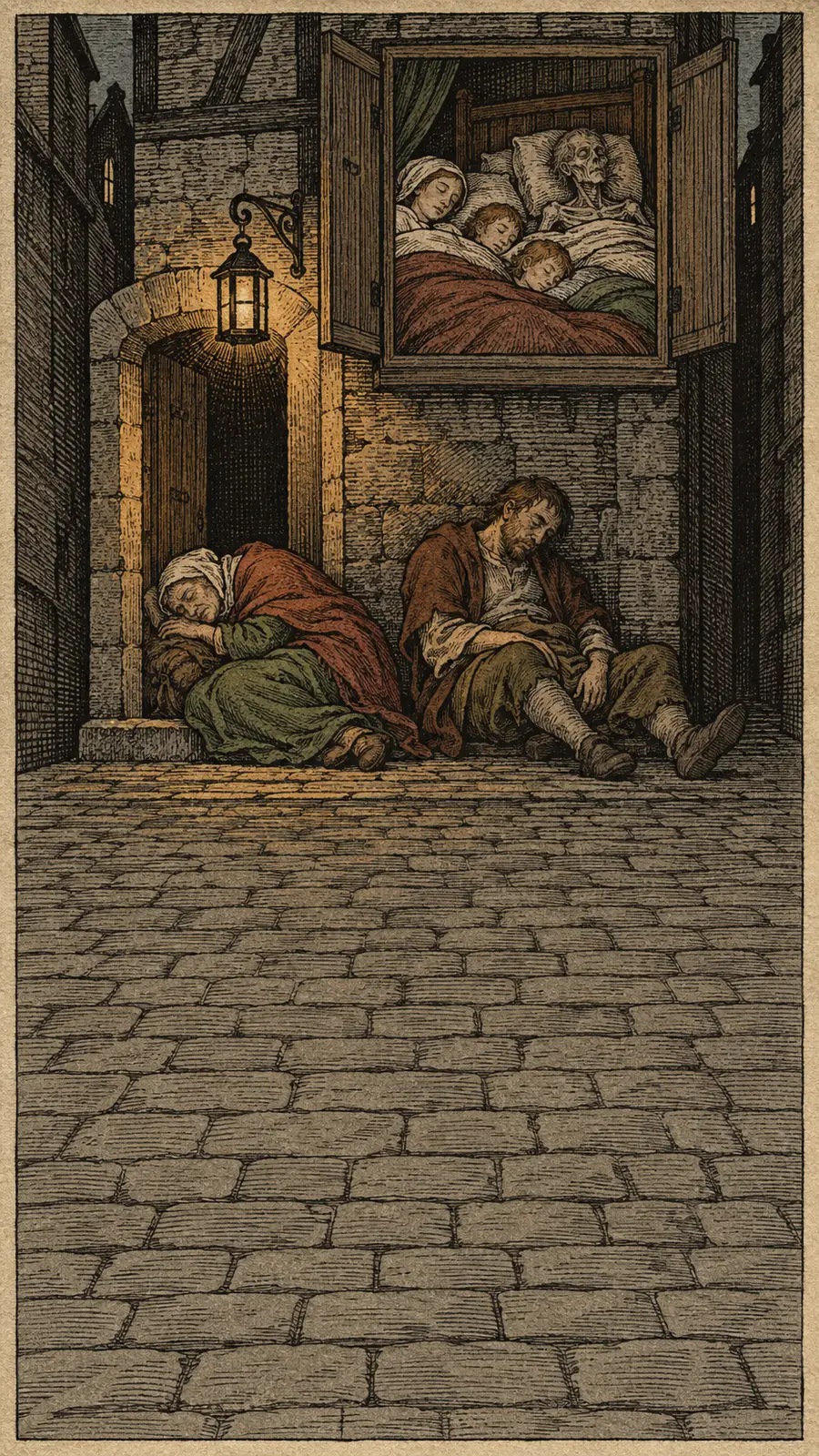
Once, Moil was a living city of ordinary people. They worshipped Orcus. But in time the people of Moil turned away from him to other gods, and Orcus wasn't a forgiving lord. He tore the city from the face of the world, buildings and people together, and cast it into a demiplane near the Negative Energy Plane, a small, sealed pocket of reality cut off from everything else. Then he laid a curse on its people. They would fall into a sleep from which they couldn't wake until they saw the sun again.
The demiplane is dark, and has always been dark. There's no sun there, and never will be. So the people of Moil slept and waited for a dawn that couldn't come. That's why it's called the City That Waits. Generation after generation they lay in their beds and in the streets where they'd fallen, and the waiting went on, and one by one they died in their sleep, still waiting.
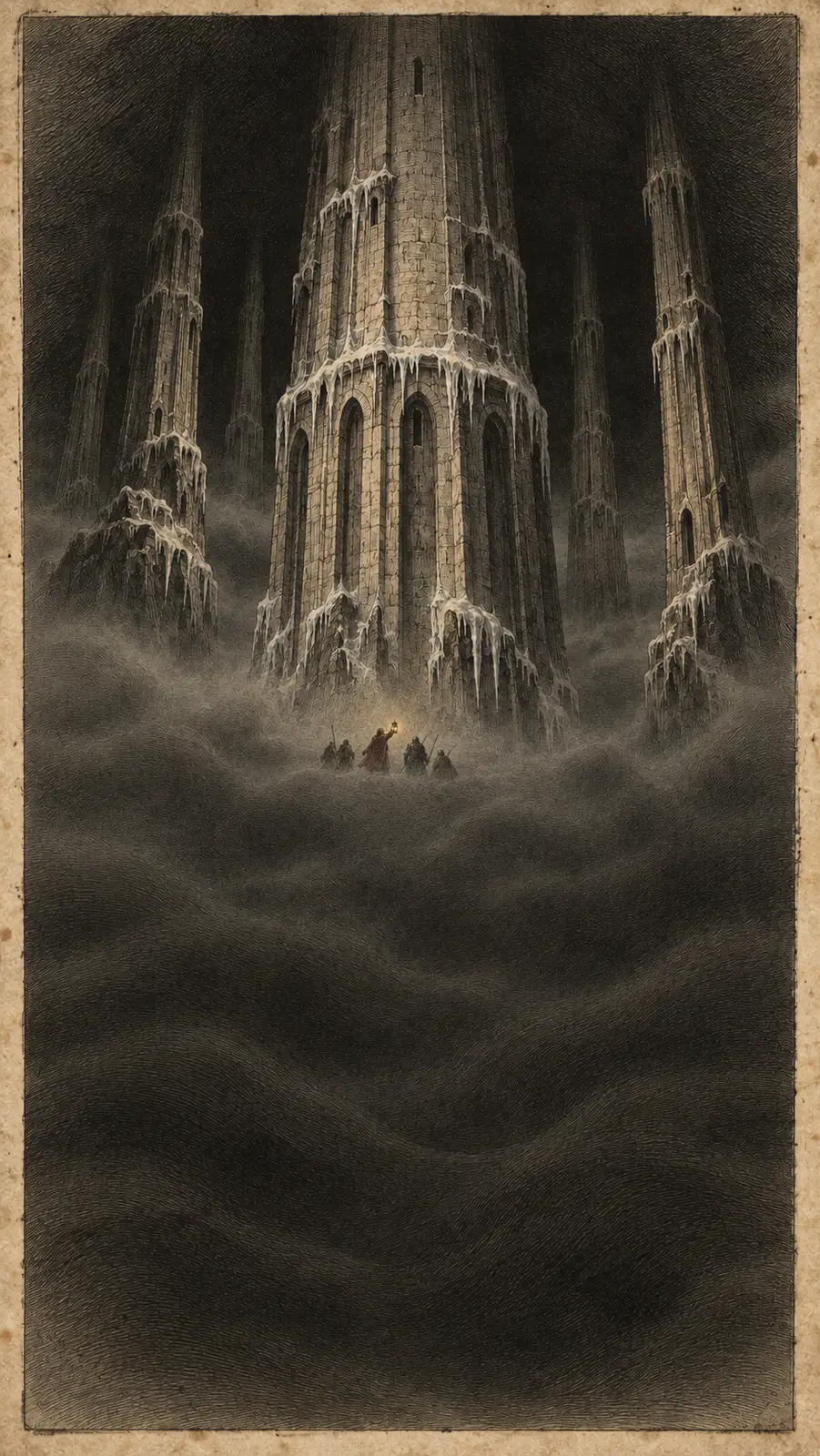
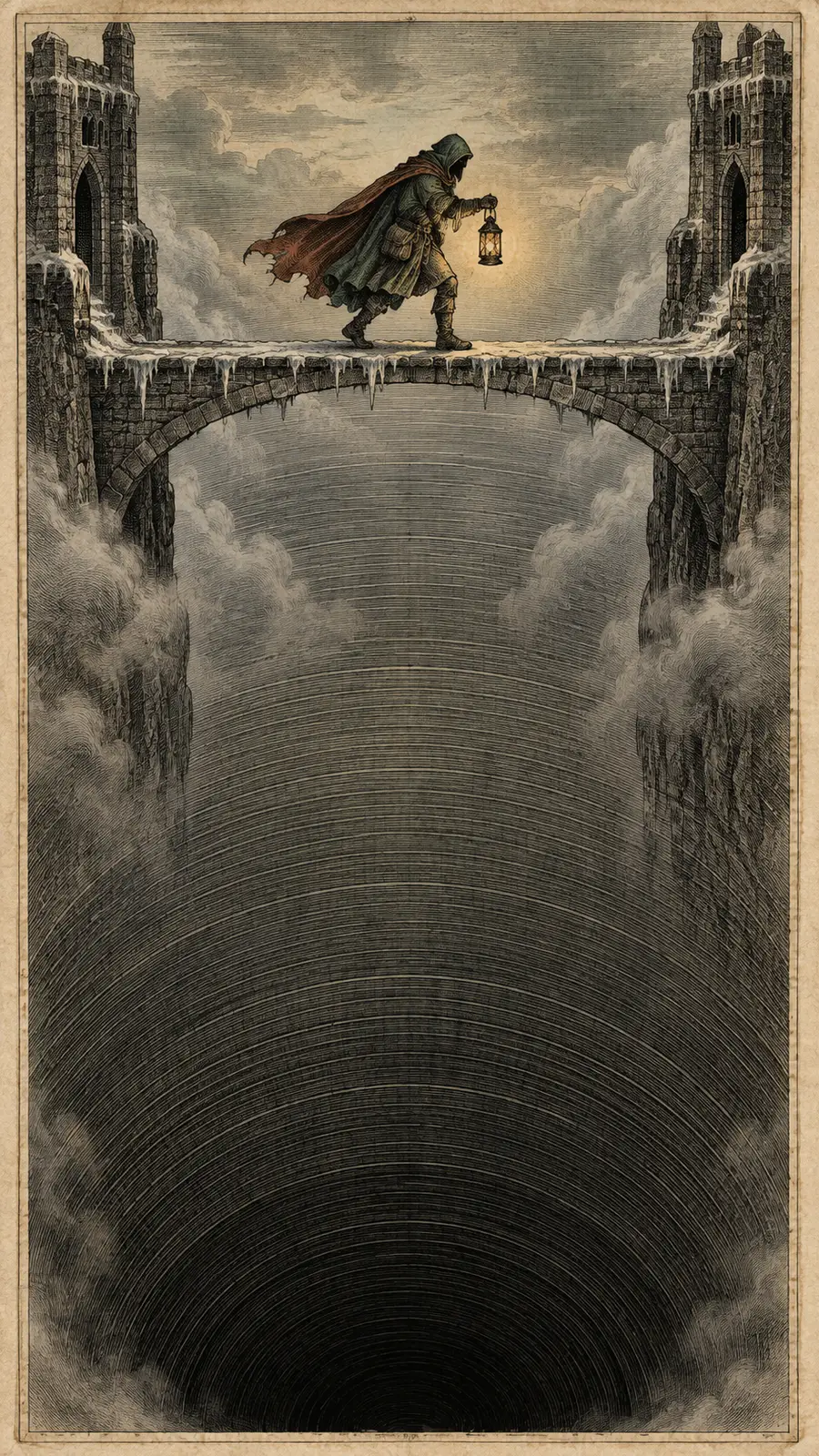
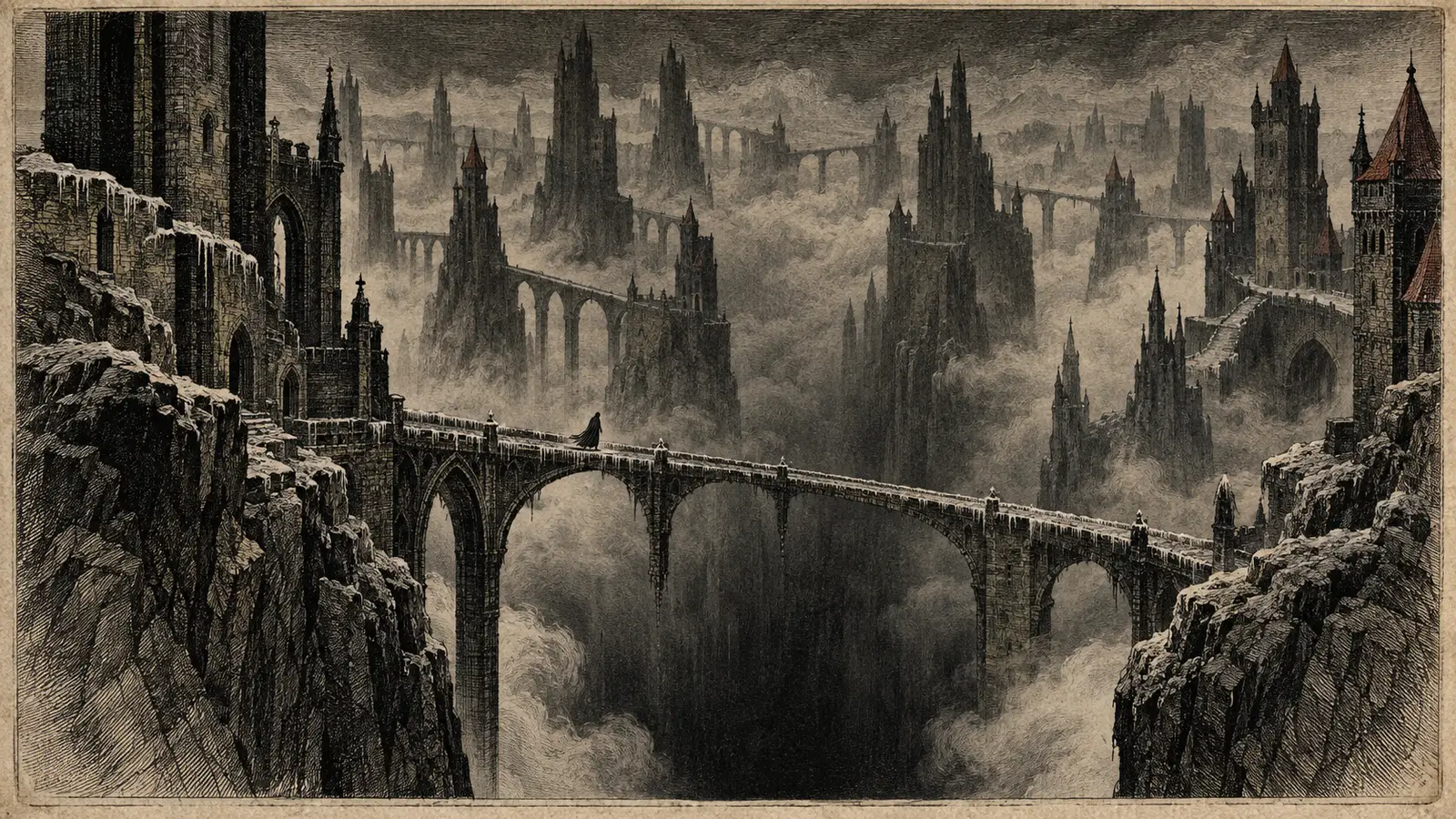
Picture it as the heroes find it. It's a pocket universe of eternal darkness and ice. Great towers rise out of formless black mist, and their tops are lost in shadow. Between them hang narrow bridges, frosted and slick, stretched across a long, long drop toward the Negative Energy Plane, so that every step across them is taken above a darkness that goes down forever. The cold is deep and still. Nothing moves in the streets except the things that shouldn't. The mood of Moil is dread, slow attrition and intricate puzzles, a city that wears you down hour by hour instead of all at once.
Centuries after Orcus cast it away, Acererak found Moil. Where others might have seen only a curse, he saw a foundation. He used the demiplane as an anchor for his stronghold. He raised the sleeping dead, the people who had died waiting for the sun, as undead workers, and set them to building his fortress. Most of the Moilians were destroyed in that labour. Their long wait for the dawn ended in service to a lich, and then in nothing.
Something else drifts through the City That Waits. It's called the Vestige, a slow and nearly invincible creature formed from the combined nightmare of all the Moilians, every bad dream they dreamed in their endless sleep, gathered at last into one shape. It moves through the streets without hurry. It can engulf and destroy any victim it chooses. It's meant as a fight the heroes can't win, only flee from, a sorrowful presence that reminds everyone who meets it that this city is full of grief. As the heroes make their way through the dark, they never quite know when they'll turn a corner and find it there, patiently coming on.
Moil had other dwellers too, new kinds of undead made for this cold place. There was the winter wight, born of ice and death, and the darkweaver, a creature of shadow. They haunt the towers and bridges of the city, and every frozen street could hide one.
Beyond Moil lies the Fortress of Conclusion.
This is Acererak's real tomb of horrors, a second dungeon behind the first. It hovers at the edge of the Negative Energy Plane, built by the undead of Moil, a great structure floating on the border between the last of reality and the endless dark. Everything about it is built to test, and in the end to take.
Here at last we learn what Acererak has been doing all this time. He's near the end of a project that has lasted thousands of years. His goal is apotheosis, to become a god, and the power for it comes from the souls he has consumed over all those ages. Every adventurer who ever died in his tomb, every soul drawn into a gem, every spirit caught in the dark: all of them have been fuel. And now he needs only three more. They can't be ordinary souls. They have to be of exceptional purity and strength, the souls of true heroes. That's why the tomb was built as the greatest challenge in the world. It's bait for exactly the people who most want to prove themselves.
It's a cold and clever thought. Every boast that sent a party marching into the swamp, every proud hero who said a dungeon couldn't beat them, was walking toward exactly the end he wanted. The more heroic they were, the more useful they were to him.
The souls go into his phylactery, which here has grown immense, large enough to let him merge with the whole Negative Energy Plane. If his plan succeeds, he'll become one with the source of undeath and gain command over every undead creature in the multiverse. That would include every skeleton and ghoul and wight, every vampire and every lich, on every world.
In the Fortress, Acererak doesn't sit on a throne waiting for a duel. He's an incorporeal spirit, and he can inhabit the body of any undead creature in the Fortress. He keeps several bodies ready, so that if one falls he simply steps into another. To end him truly, the heroes have to destroy every undead in the Fortress, including one he has deliberately placed near an escape route, a last body waiting quietly by the door. And they have to dissolve the phylactery itself. When the climax comes, they have only a short time to destroy it before the apotheosis completes and Acererak joins the dark plane. If they succeed, the stolen souls can go free.
His great flaw, in this telling, is arrogance. He's confident that he can personally defeat anyone who gets through all the parts of his tomb. He has spent thousands of years arranging everything, and he can't quite imagine anyone matching him at the end.
The adventure closes with Acererak apparently destroyed. Apparently is the right word, and later editions would make the most of it. For now, though, the City That Waits lay quiet behind the heroes, the Fortress was broken, and the souls that had fed his long plan scattered back to wherever souls go.
Chapter V
The Devourer, his demon father and the vestige
We pass now into the third edition, the years from 2000 to the end of that decade. No new hardcover tomb appeared for in this era. Instead his story grew in quieter ways: through his family, through the rules that shaped what a demilich could be, through a free retelling of the original tomb, and through a strange afterlife that let him linger after death had supposedly claimed him.
had called him a persecuted child of fiendish blood. In this era that blood got a name.
Acererak, in this telling, was a cambion, the child of a demon and a mortal. The story of his conception is dark, and it's best told from a distance. Long ago an ancient conjurer summoned a balor, one of the great fire demons of the Abyss, a creature far beyond his power to control. Its name was . The conjurer's wards failed and Tarnhem devoured him. Then the demon forced himself on a human woman, and she became Acererak's mother. Greyhawk lore says she was a , one of the oldest peoples of the , whose ancestors had lived on those lands since long before the great migrations.
She survived the birth, and for ten years she raised her strange son. Then a mob came, carrying torches, and killed her. The boy was ten years old. Whatever Acererak became later, this is where the story puts its beginning: a child of a demon's violence, who watched the people of the world murder his mother for what he was.
Tarnhem didn't stay a nameless fiend. He had once ruled a layer of the Abyss called the Noisome Vale, deep down among those endless planes of chaos and cruelty. He was a worshipper of , and Greyhawk lore treats him as Acererak's father and, in his strange way, an ally. Tarnhem had first appeared in one of Cordell's design books, the Dungeon Builder's Guidebook, and he went on to the third edition's Manual of the Planes in 2001 and later into the tomb itself.
The Greyhawk lore of this era gave Acererak a darker title too. He was known as Acererak the Devourer, and in his early days, it was said, he came from a part of not far from Castle Greyhawk itself, that famous ruin full of dungeons near the great city. So the boy whose mother was killed by a mob grew up somewhere in the heart of the Flanaess, within reach of the most famous dungeons in the world. Perhaps it isn't surprising that he grew up to build one of his own.
The rules of this era changed what a lich was in the game. The third edition's Monster Manual, in 2000, turned the lich into a template, a set of changes that could be laid over any creature. In principle any spellcaster of the right sort, of almost any people, could be made into a lich. The lich was no longer a single monster on a page. It was a destination many could reach.
The demilich went further still. In the Epic Level Handbook, it became an epic-level threat, a power of the highest tier, described as a lich that had moved beyond its body entirely. In this telling soul gems were bound up with the undead, and they could work like a phylactery. Destroy the gem and the undead could finally be destroyed for good. The gems in the skull's eyes and teeth had become more than weapons. They were part of what kept the creature in the world.
The trapping of souls stayed at the heart of the demilich. It draws a victim's soul into one of its gems, and the body and everything it carries disappear. A soul held for about a day is devoured and gone. Whatever else changed, that grim little clock kept ticking.
Then there was Libris Mortis: The Book of Undead, in 2004, which gathered the lore of undeath for the revised third edition. It added new kinds of lich, among them the good lich, a rare being who had chosen undeath to keep watch over something precious, and the lichfiend, a darker variant. The family of liches was growing larger and stranger, and Acererak's tomb would borrow some of that new flavour.
On Halloween of 2005, Wizards of the Coast gave the tomb away. Bruce Cordell had converted 's original adventure to the revised third-edition rules, and it was released as a free download on that night of the year when the dead are said to walk. It was set again around the tomb of the demilich Acererak. Most of the original was kept, the hill and the poem and the devil face, and the halls were given new touches drawn from Libris Mortis so the undead felt current. It was written for characters of around ninth level.
That release had one curious problem to solve. The epic demilich of the third edition was so powerful that it didn't fit the tomb as written, so in this version Acererak's skull became something unique, a thing closer to a construct, built for this crypt alone. And the demon father appeared in the tomb as well: Tarnhem stands in this conversion. Those who played it found the final foe and many of the deadliest traps noticeably gentler than in the original, partly because the rules themselves had changed.
During those same years, Dungeon magazine, then published by Paizo, ranked the original Tomb of Horrors third among the thirty greatest Dungeons & Dragons adventures of all time. It was 2004, the game's thirtieth anniversary, and the old skull under the hill had lost none of its reputation.
The most important piece of new lore in the third edition, though, came in 2006, in a book called Tome of Magic. It introduced a strange kind of magic called pact magic, and with it a strange kind of being called a vestige.
Vestiges are remnants. They're beings who have passed beyond the reach of existence, through death or banishment or some fate stranger than either, and have left behind something that lingers at the edge of reality. A vestige is neither good nor evil. It can't be fully described. It's an echo, a shape where something used to be. Certain characters, called binders, learn to draw a vestige's seal, summon it, and make a pact with it, letting it share their bodies for a time in exchange for its gifts.
Tome of Magic tells a story about Acererak's end. Adventurers finished the Tomb of Horrors and destroyed him. But he didn't vanish into nothing. He passed beyond true destruction and became a vestige.
So now, in some far place beyond the edge of things, Acererak lingered: not alive, not quite dead, not even fully a lich anymore, only a shape that could be called by those who knew his seal. A binder who made a pact with him gained gifts like a lich's. They could resist the cold, sense the dead, and even speak with them. For as long as the pact lasted, the binder carried a little of the demilich's nature inside them, a borrowed chill and a borrowed sight.
It's a haunting image. The lich who spent his existence trapping the souls of others had become a thing that others could call into themselves. In the third edition this is simply where his story rests, one edition's telling of how the tomb's master ended. But a vestige is a remnant that remains, and remaining was something Acererak had always been good at. The next edition would take that thread and pull on it.
Chapter VI
A paladin in the tomb
Before we leave the third edition, there's a book to visit, a novel that walked into the Tomb of Horrors and told the story from inside.
In 1999, for the game's twenty-fifth anniversary, Wizards of the Coast began a line of novels called the Greyhawk Classics. Each one took a famous old adventure and turned it into a story, so that the modules people remembered from their tables became books they could read. There were seven of them, drawn from adventures like the giants' strongholds, White Plume Mountain and the Temple of Elemental Evil. In February 2002 it was the tomb's turn. The Tomb of Horrors was written by Keith Francis , with a cover painted by Justin Sweet.
The novel's hero is , and he isn't the shining figure you might expect. He was once a paladin of , the god of valour and honour in Greyhawk, but he fell from grace about ten years before the story begins. It happened when the forces of Iuz captured him in Dorakaa, the cambion lord's grim capital in the north. Whatever happened to him there broke something in him. Since then he's sunk into drink and despair, a man trying to forget who he used to be.
But his holy sword won't let him forget. It's named , and it won't leave him. Whenever Kaerion tries to throw it away, it turns up again among his belongings, patient and faithful, waiting for him to become worthy of it again. It's a quiet, lovely piece of storytelling: a fallen man who keeps finding his own better nature tucked into his pack.
A band of adventurers recruits Kaerion to join them on a venture to the legendary Tomb of Horrors. There, beneath the hill, they face the tomb's architect, the demilich , and every trap and riddle he left behind. They aren't alone in the dark, either. A rival band of evil adventurers is moving through the tomb as well, and the halls of Acererak's labyrinth become a contest between them.
The book has a second viewpoint, which turns its gaze toward Greyhawk's oldest and deepest shadow. is a priest of , the imprisoned god of eternal darkness, a power so terrible that the other gods once joined together to lock him away. Durgoth has allied himself with the Scarlet Brotherhood, the secretive order of the far south, and together they seek to free his god.
So the novel takes the old tomb, which in 1978 had stood almost alone with no history and no neighbours, and ties it to the greatest powers of its world. Iuz broke the hero. The Scarlet Brotherhood schemes in the background. Tharizdun waits in his prison. And between them lies Acererak's hill, its skull of black stones still grinning at the sky, ready to receive whoever comes.
In the Greyhawk novel the tomb is a place where a broken man goes looking for a reason to pick up his sword. The next tomb would take Acererak much further from home.
Chapter VII
The Shadowfell and the four tombs
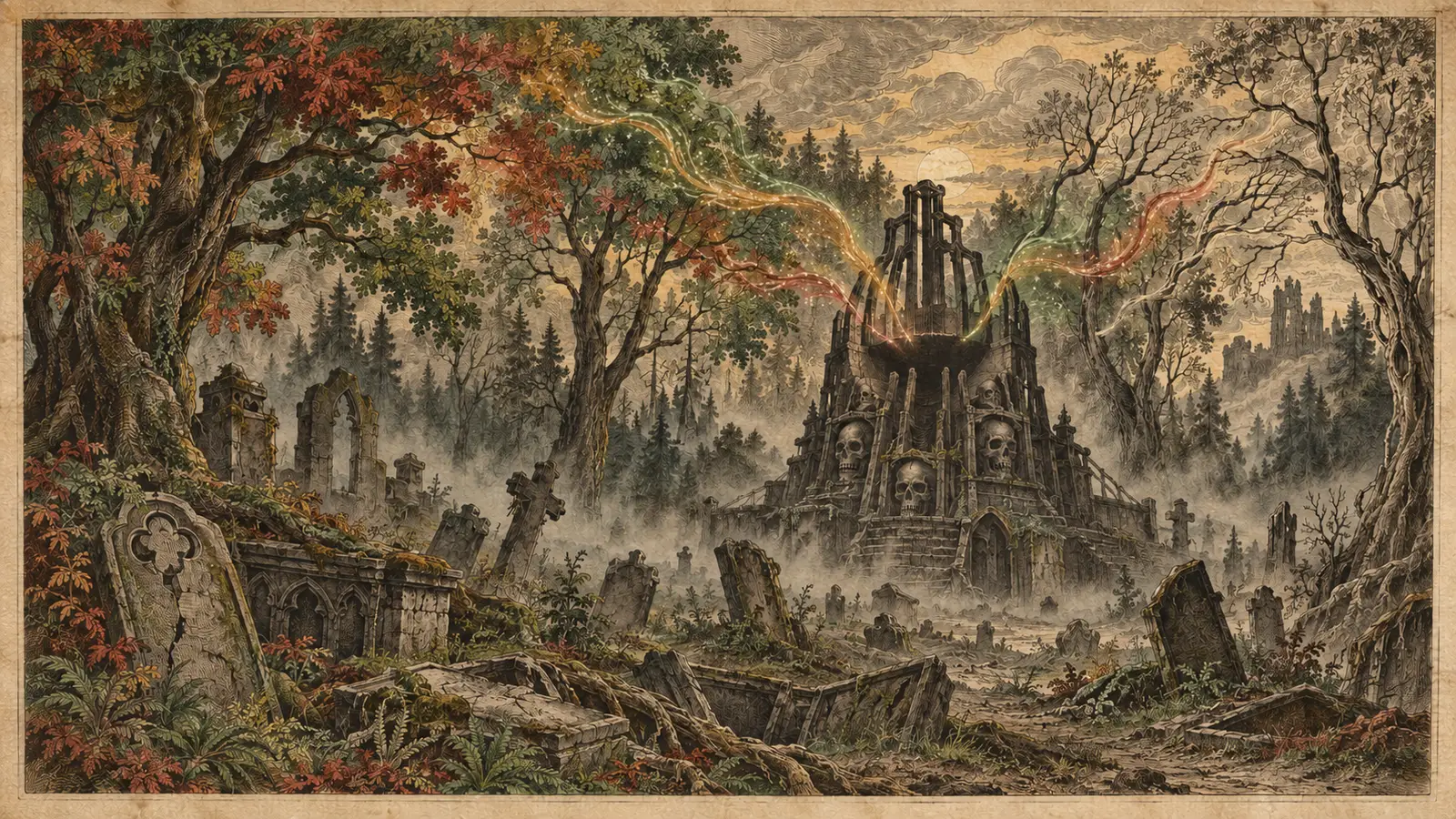
We come now to the fourth edition, and to 's second great bid for godhood.
Even before the big adventure arrived, he'd been honoured in his own way. In 2009 a book called Open Grave: Secrets of the Undead gathered the lore of the dead for the new edition, and in it there was a section called the Undead Hall of Infamy, a gallery of the most notorious undead in all the game's history. Acererak was there, with his own entry and his own statistics as a unique being. His story in that book followed 's account in Return to the Tomb of Horrors.
Then, in July 2010, Wizards of the Coast released two products, both called Tomb of Horrors. One was small: a bare-bones conversion of 's 1978 module to the new rules, written by Scott Fitzgerald Gray and sent to members of the official play network as a reward for their Dungeon Masters. It was a gift to the people who ran games, a way of letting them take their players to the original hill once more.
The other was large: a hardcover super-adventure written by Ari and Scott Fitzgerald Gray, for characters from about eighth level all the way to twenty-second. It was built in parts, so a Dungeon Master could run the whole thing as a campaign or pull out individual chapters as adventures of their own. It mixed complex battles with the traps and tricks the tomb was famous for.
It began where Cordell had ended. This new adventure was a direct sequel to Return to the Tomb of Horrors, set about a century after those events. And the world had changed around it. The fourth edition had reshaped the cosmos into what it called the World Axis, and it had its own pantheon of gods in place of Greyhawk's. Acererak's story had to find its footing in this new arrangement of the planes, and it did.
His domain was still, at heart, made of negative energy. But instead of a plane of its own, it had become a void-like region inside the , the dark echo of the world, where everything is a little greyer and colder and closer to death. And , the City That Waits, was no longer a cursed demiplane drifting alone. It had become a city within the Shadowfell itself, one of that plane's best-known places. Its frozen towers and black bridges now stood in the land of shadows, where travellers might hear of them as a famous, terrible landmark.
The fourth-edition book retold Acererak's past with a careful eye on his relationship with . In its words, "Acererak resurfaced as a worshiper of Orcus, using the cult's resources to construct a number of lairs and tombs — the most infamous of which would become known as the Tomb of Horrors." Then it adds a note of doubt: "some sources claim that Acererak was using Orcus's worshipers to complete his own schemes, and that he felt no true loyalty to the demon prince." Once he became a lich, the book says, he stopped paying homage to Orcus at all, "lending credence to the notion that his worship had never been more than a means to an end."
It's a revealing portrait. The temple to Orcus, the cult and the priesthood had all been tools. Acererak had knelt before the Demon Prince of Undeath only for as long as kneeling was useful, and when he no longer needed the demon, he stood up and walked away. Those who know Orcus from his long history in the game, and from our episode on , where Orcus appears as a rival in the courts of darkness, may appreciate how few beings have done that and gone unpunished.
How, though, could Acererak be scheming again a century after Return had ended with him apparently destroyed? The answer reached back to the third edition. He had survived as a vestige, just as Tome of Magic had told. For ages his spirit had lingered at the edge of existence, a remnant that binders could summon, and in all that time it hadn't been idle. Now the vestige was gathering itself again. Acererak was once more scheming toward divinity, in the book's phrase, "to ascend to godhood and beyond."
So the story that one edition had told as an ending became, in the next, a pause. The vestige wasn't a grave. It was a waiting room.
His new plan stretched across several planes, and the heroes had to follow it through four tombs.
The first lay in the , the bright, wild echo of the world where the fey dwell, all deep forests and glittering streams and colours a little too vivid to be real. Deep in its forests the heroes find a graveyard of the eladrin, the elves of the Feywild, and it has been desecrated. Acererak has turned it into a planar engine, a great machine of death that drains the magical essence of the Feywild itself and pours it into his phylactery. Imagine a place of quiet graves in an enchanted wood, its stones cracked and its peace broken, feeding the life of a whole plane into a lich's vessel.
The second tomb lay in Moil, now part of the Shadowfell, the city that had already given Acererak so much. The heroes walk its frozen bridges once again, above the long drop, among the towers rising from the mist.
The third tomb lay in a city built around the ruins of the original Tomb of Horrors itself. A century after Return, the old hill was still drawing people, and a whole city had grown up around its broken remains. The place where it all began had become a town.
The fourth tomb, the last, lay in , and here Acererak's ambition took on a cosmic scale. Pluton had once been part of the Gray Waste, the bleak plane of despair in the older cosmology. In the fourth edition it had become the lost, fallen realm of the dead. It had been the home of , the old god of death. The fourth edition's Divine Power tells how the Raven Queen replaced Nerull as god of death and left Pluton behind for the Shadowfell. So Pluton is a realm whose god is gone, an empty seat of death, and in it lies the tomb of Nerull himself. That's where Acererak meant to finish his work.
His purpose was much the same as in Cordell's Fortress, drawn larger. He wanted strong adventurers to reach his final chamber so he could take their souls and use them to become one with the Negative Energy Plane. That would make him, in effect, a god, with total control over all undead, and Nerull included. There's a bold irony in that idea: the student of Vecna's line rising to command the master of liches, and the lich who once knelt to the gods of death holding the old god of death himself in his grip.
Great powers moved through the story. Orcus appears, the demon prince whose cult Acererak used and then abandoned. Vecna appears, the Whispered One. Demogorgon appears, the two-headed prince of demons. And Nerull appears, the fallen god whose tomb was the stage for the final act.
At the end, the heroes find Acererak's phylactery and destroy it. It's not quite over even then. Acererak makes a last desperate effort to hold on to the power he has gathered, long enough to make a new phylactery, and to do it he reaches for the Eye of Vecna. Those who heard our episodes on Vecna will know that relic: the eye cut from the Whispered One's face long ago, still holding some of its master's power. For the lich who would be a god, it's one last tool, one last bargain with his old master's legacy, made in the ruins of a dead god's tomb.
People who ran the 2010 adventure called it "brutally fun," and spoke of many fallen characters. One story tells of a cleric caught by a sphere of annihilation in the middle of a fight, the old devil face's trick appearing once again to swallow someone whole. The tomb, it seemed, hadn't lost its taste for sudden endings.
When the fourth edition gave way to the fifth, Acererak's story moved again, out of Greyhawk's old haunts entirely and into a jungle on another world.
Chapter VIII
Chult, the Soulmonger and the stillborn god
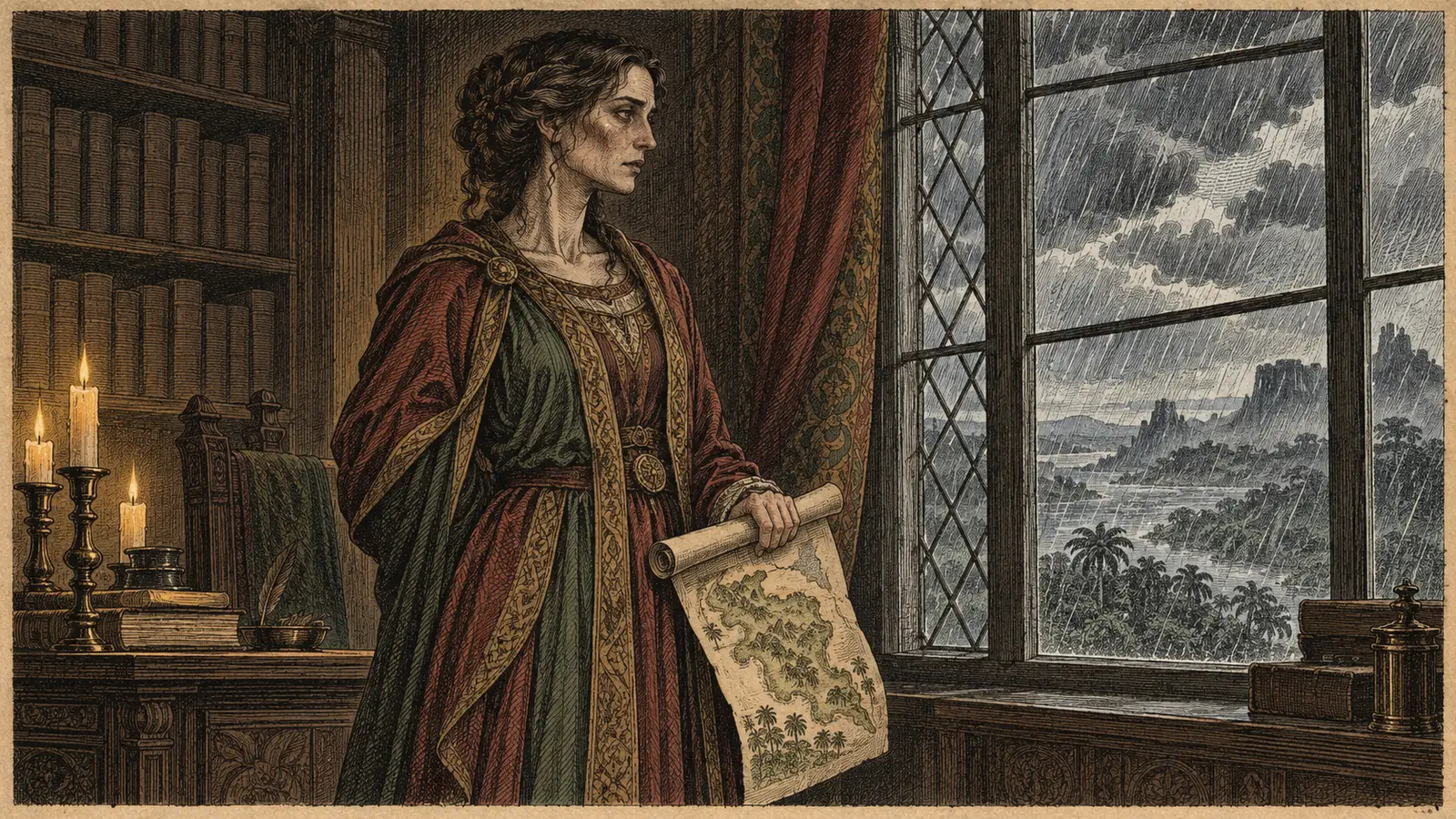
We come now to the fifth edition, and to the longest and most detailed of all 's stories.
The new edition began by setting down what a demilich was. Its Monster Manual, in 2014, explained that a demilich hides its earthly remains and its treasures in a labyrinthine tomb, with its skull and the dust of its bones resting at the heart of the maze. The book chose Acererak as its great example. He was a powerful wizard and demonologist, it said, the master of the infamous Tomb of Horrors, and he anticipated his own transformation. Long before his body failed, he set enchanted gemstones into the eye sockets and teeth of his skull, and each of those gems could capture souls for his phylactery to feed on. Then he let his body crumble to dust while he travelled the planes as a mind without a body.
Here the two old ideas were finally joined: the gems in the skull and the vessel that keeps the lich alive. The skull in the crypt was no longer only a guardian. It was a fishing line, left dangling in the dark, feeding souls back to its distant master. The book framed the choice of becoming a demilich, made deliberately, as the next step in a dark evolution. Acererak hadn't decayed. He'd chosen to leave his body behind.
The demilich of that book has gifts that suit its legend. It has an uncanny way of avoiding harm, taking little or none from blasts that would scorch an ordinary creature. It can let out a bloodcurdling howl that can drop everyone nearby or leave them shaking with terror. It can pull the life out of several creatures at once to heal itself. And it can trap a soul in a gem, as the very first demilich did. A soul held for a day is devoured.
Acererak stood on the cover of the fifth edition's Dungeon Master's Guide in 2014 as well. There, at the front of the book every Dungeon Master would open, was the lich who built the Tomb of Horrors. For a whole generation of new players, he was the face of the Dungeon Master's craft.
In 2017 the original tomb came back in its own right. Tales from the Yawning Portal, released that spring, gathered seven classic adventures for the new edition, and Tomb of Horrors was among them, alongside The Sunless Citadel, The Forge of Fury, The Hidden Shrine of Tamoachan, White Plume Mountain, Dead in Thay and Against the Giants. The book had a lovely frame. Each adventure is presented as a tale told in the Yawning Portal, the famous tavern in Waterdeep, built around a great well that drops into the dungeon of Undermountain. You can imagine a grizzled old adventurer sitting by the fire, tankard in hand, telling the young ones about a hill in a swamp on another world where the stones on the summit make a skull.
That same year brought the great new story. Tomb of Annihilation was published by Wizards of the Coast in September 2017, the year's main storyline for Dungeons & Dragons, announced that June. Its design is credited to Christopher Perkins, Will Doyle and Steve Winter, with additional design by Adam Lee, and Pendleton Ward, the creator of Adventure Time, served as a story consultant. It takes characters from first level to around eleventh, and it came with a large pull-out map of a peninsula called .
It was pitched as "Indiana Jones meets zombies," a lost land of volcanoes, jungle and dinosaurs, and its tagline was "Dare to defy death." Perkins blended three old adventures into it: the dinosaur-haunted lost world of Isle of Dread, the overgrown jungle ruins of Dwellers of the Forbidden City, and a deathtrap dungeon inspired by the Tomb of Horrors. The promotional copy described its heart in one striking line: "an unholy machine feeds stolen souls to the undead fetus of a stillborn god."
The story is set in the Forgotten Realms, on the world of , in the late fifteenth century of the calendar called Dale Reckoning. Acererak had come a long way from the Vast Swamp of . He was now a traveller between worlds, and his tombs could be found wherever he chose to build them.
It begins with a sickness. Across all of Toril, everyone who has ever been raised from the dead begins to waste away. Each day they grow a little thinner and a little weaker, sliding slowly back toward the death they once escaped. This is the death curse. And there's worse: when they die, they can't be raised again. Neither can anyone else. Whether or not someone was ever brought back before, if they die now, they stay dead. Resurrection magic, which priests and wizards had relied on for generations, fails everywhere at once.
Imagine what that means across a whole world. Heroes who once came back from death now feel it returning for them, quietly, day by day. Temples that offered resurrection have to turn away the grieving. Every death has become permanent again, and every adventure more dangerous. A world that had grown used to second chances has lost them.
The cause lies far to the south, "somewhere in Chult." Chult is a peninsula ringed by mountains and choked with rainforest, a land of steaming jungles, ruined cities, roaring dinosaurs and old, half-forgotten gods. Hidden somewhere in that green darkness is a necromantic artifact called the Soulmonger. It catches and traps the soul of everyone who dies on Toril. Instead of passing on to their gods, the souls of the dead are drawn to Chult and held there. And the Soulmonger does something else too: it draws positive energy, the force of life, away from the rest of the world. That's why the raised are wasting. The life that sustained them is being pulled toward the machine.
The adventure's hook is gentle and human. A wizard named , herself suffering from the curse, gathers a group of inexperienced adventurers at her mansion. She explains what's happening to the world and to her, and she sends them to Chult to find the Soulmonger and destroy it. They're young and untested, and the world is depending on them.
Their first stop is Port , the great city on the coast of Chult. It's vibrant and loud and full of colour, ruled by merchant princes who compete for trade and power. There's intrigue in its markets and halls, information to be gathered from guides and rumourmongers, and dinosaur races thundering through its streets, a sight to stop any traveller in their tracks. From there the adventure opens into the jungle itself, a vast wilderness to be crossed on foot, where food and water and fresh boots matter as much as swords.
Somewhere in that jungle lies a lost city called Omu, and its story is at the heart of the tale.
Omu was once a living city whose people worshipped nine reclusive local spirits, the trickster gods, and built shrines to them in the earth beneath the city. Each of the nine took the form of a creature of the land, and each had its own nature.
I'jin took the form of an almiraj, a horned hare, and was fickle and unpredictable. Kubazan was a froghemoth, a great tentacled creature of the swamps, wild and free-spirited and unafraid of great risks. Moa was a jaculi, a serpent that springs from the trees, and Moa was kind and honest and always told the truth. Nangnang took the form of a grung, one of the small poisonous frog folk. Obo'laka was a zorbo, a little creature of the trees, obsessive and overly cautious and a slave to routine. Papazotl took the form of an eblis, one of the tall, scheming bird folk of the marshes. Shagambi was a kamadan, a great cat with serpents sprouting from its shoulders. Wongo was a su-monster, a strange psychic ape of the treetops. And there was Unkh, the last of the nine.
Picture the people of Omu going down to their shrines beneath the streets, bringing offerings to these odd, mischievous, very local gods. Their gods weren't the vast distant powers of the great pantheons. They were spirits of the jungle around them, playful and dangerous and close.
Then Acererak came.
In the late fourteenth century of that same calendar, about a century before our heroes are born, Acererak invaded Omu. He slew the nine trickster gods. Then he enslaved the people of the city and set them to work building a new dungeon beneath it, the Tomb of the Nine Gods. When it was finished, he slaughtered the remaining , sealing their fate together with that of their gods. The remains of the nine lie entombed there still, and their spirits are held within the tomb.
You'll recognise the pattern by now. In Greyhawk, Acererak built a temple and buried every builder inside it. In Chult, he made a city's people build his tomb and then killed them all. Wherever he goes, he makes the same kind of thing in the same way, and the people who make it never leave.
The tomb has a keeper. Among the Omuans set to work on it was an engineer named , and Gorra was very good at what he did. He designed some of the tomb's most insidious traps. As a reward for his exceptional work, Acererak turned him into a wight and made him overseer of the whole dungeon. Now he's called Withers. He watches over the tomb through a scrying pool, and when something breaks, when a trap has been sprung or a mechanism damaged, he sends crawling claws, severed undead hands, to scuttle through the halls and make repairs. He commands the tomb dwarves too: albino dwarves of Chult whom Acererak captured, killed and raised as wights to keep the dungeon working. Withers travels between dimensions, but he usually appears on the lowest level of the tomb, and he can be met and talked to. He's a figure of quiet, dutiful horror, an artisan who loved his craft so much that his master let him keep doing it forever.
Acererak's tomb isn't the only threat in the ruins. Others have come to Omu with their own reasons.
Ras Nsi leads the yuan-ti, the serpent folk, from a temple called the Fane of the Night Serpent, near the lost city. He's a snake-tailed villain who carries a flame tongue sword. He was once a paladin of , one of Chult's great cities, but he fell, and in the middle of the fifteenth century he fled to Omu. When a natural disaster killed the yuan-ti abomination who led the serpent folk there, Ras Nsi performed a ritual that turned him into a malison, a yuan-ti, and he took command. Now the death curse is eating away at him too, and so his yuan-ti hunt for the keys to the tomb. It's a pyramid of exploitation: Acererak uses Ras Nsi, and Ras Nsi uses the yuan-ti.
The Red Wizards of have come as well. They're led by Shadowmantle, a servant of the lich , whom you may remember from our episode about the ruler of Thay. She's based at a place called the Heart of , and her minions search Omu for the Soulmonger. The lich of Thay has sent his servant into the lich Acererak's domain. Two of the great undead of the game are moving pieces on the same board, without ever meeting face to face.
There's also , a former Harper, one of the secret network that works for balance in the Realms. He carries the Ring of Winter, an artifact that can freeze an enemy to death with a single touch. He found the ring in Chult long ago, and there too he met his wife, . Now he searches for Mezro, a great city that has left this plane entirely, hoping to find her again. Artus comes from an older Chult story, James Lowder's 1992 novel The Ring of Winter, and he's a reminder that this jungle has seen other journeys before this one.
Above all of it, or perhaps beneath, is Ubtao, the old god of Chult, who abandoned the land more than a century before. His absence hangs over the jungle like a held breath. The tomb's tests remember him.
To open the way into the Tomb of the Nine Gods, adventurers must gather puzzle cubes from the shrines of the nine gods scattered through ruined Omu. And once inside, something surprising happens. The spirits of the trickster gods, imprisoned in the tomb, can reach out to the characters, possess them, and lend them aid. One might give advice, another a burst of strength or luck. When Nangnang takes hold of a character, a croaking voice speaks in their mind: "Nangnang will help you now." It's a small and rather tender moment in a cruel place, the slain gods of Omu reaching out through the dark to help the people trying to set things right. A guide named Eku hopes to coax the spirits home again and drive the evil out of the city at last.
The first level of the tomb is called the Rotten Halls. The air there is stale and humid, heavy with the smell of decay. Moss covers walls carved with screaming skulls. Rotting tree roots and dead vines hang down from above, as though the jungle itself has tried to push its way in and died trying. Below the Rotten Halls, level after level, the tomb goes down, every chamber designed to kill. The free wandering of the jungle gives way to something narrow and merciless, a deathtrap dungeon in the oldest tradition.
At the bottom lies the Cradle of the Death God, and here we meet the heart of Acererak's plan.
An atropal is a stillborn godling, what the lore calls an "unfinished immortal." It's something that was meant to become a god and never did, and it rose by itself as an undead abomination. Atropals drift through the planes, spreading death wherever they go. They're malformed and bloated, marked with splotches of black afterbirth, covered in wet, wrinkled, dead skin. The head is hairless and enraged, and the black eyes are vacant. They drool and ooze a pungent ichor. Their limbs are thin, with tiny clawed hands, and their legs are atrophied and useless, so they never walk. They float, always.
Not long before our story, Acererak found one, adrift on the Negative Energy Plane, alone in that endless dark. He brought it to Toril and placed it in the cradle of his tomb. He meant to nourish it into a god, a true god with dominion over death itself. Once grown, it would glut itself on life until only the dead walked the world.
To feed such a thing takes souls, more souls than any tomb could gather one adventurer at a time. So Acererak built the Soulmonger. It catches the souls of everyone who dies on Toril and carries them down to the cradle, where they're fed to the atropal. Every soldier who falls, every elder who passes in their sleep, every child taken by fever anywhere in the world feeds the stillborn god in the jungle.
He didn't build the Soulmonger alone. He struck a bargain with the Sewn Sisters, a coven of night hags feared throughout the Lower Planes. Their names are Peggy Deadbells, Widow Groat and Baggy Nanna, and they helped him craft the machine. Under their bargain they guard and tend the Soulmonger and the atropal down in the lowest levels, harvesting the souls and feeding the godling. Imagine them at their work in the dark, three old hags fussing over a cradle like nursemaids, humming as the souls of the world drift down to them.
Acererak himself in this era is called an archlich, which simply means a lich of extraordinary power. He travels between worlds, luring adventurers into trap-filled dungeons to feed himself souls, and the tomb under Omu is only one of several he owns. In his absence the tomb does his work for him, snaring adventurers and harvesting their souls for his phylactery, which is hidden on a demiplane he created. If his body is destroyed, it simply re-forms.
He carries a fearsome staff, an artifact called the Staff of the Forgotten One. It's a crooked staff carved from bone and topped with the skull of a forgotten archmage, a rival he destroyed so long ago that even the name is lost. The staff's curse can leave a victim unable to heal and newly vulnerable to the touch of death. It's a fitting thing for him to carry, a reminder that he forgets his enemies as easily as he destroys them.
And so we come to the end of the story. If the adventurers survive the Tomb of the Nine Gods and reach the Cradle of the Death God, they can destroy the Soulmonger and the atropal. When the Soulmonger breaks, the souls trapped inside it are released, and they stream upward and away toward whatever waits for them. The tomb begins to collapse. As the party flees through falling stone, Acererak appears, and he tells them they will all die for what they have done to his machine.
But they can escape. The Soulmonger, the atropal and the Tomb of the Nine Gods are destroyed. The death curse ends. Across all of Toril the sick begin to recover, resurrection works again, and the dead can be called back. The official copy for the book says it simply: the adventurers put an end to a death curse.
Acererak himself is defeated, at least for that day. He's far from vanquished, though. In the lore that follows, he soon returns to Omu and begins restoring the tomb, so it can once again serve as a death trap feeding him souls. The machine is broken, the stillborn god is gone and the trickster spirits are free, and Acererak, as always, has started rebuilding.
Chapter IX
The lich on screens, boards and cards
As 's tale in grew, it spread beyond the books into games of other kinds, and each carried a little of his lore to new people.
Long before Chult, the tomb had already shaped the look of one beloved computer game. In 2000, Black Isle Studios released Icewind Dale, built on the same engine as Baldur's Gate, and they called it the ultimate dungeon crawl. Its makers said they wanted something that would remind players of their first dungeons, like the Tomb of Horrors, "with traps around every corner and undead crawling out of the walls." Acererak wasn't in it, but his shadow was. Anyone wandering its frozen halls was walking, in spirit, a little way into the hill.
When Tomb of Annihilation arrived in 2017, the jungle of Chult came to life on screens. Neverwinter, the free online game from Cryptic Studios and Perfect World, opened its own Tomb of Annihilation chapter that summer, before the tabletop book had even reached the shelves. Players could walk the streets of Port , cross the jungles of Chult and reach the Tomb of the Nine Gods, and they met familiar faces along the way, including the ranger Minsc and his hamster Boo. In early 2018 a follow-up called "Lost City of Omu" took players into crumbling temple ruins and a maze of tunnels beneath them, full of yuan-ti, where an undead tyrannosaur called the Tyrant stalked the stones. At the end of its great trial, in the Tomb of the Nine Gods, waited Acererak and the atropal. Another chapter, "Fane of the Night Serpent," followed after.
That same autumn of 2017 brought Tales from Candlekeep: Tomb of Annihilation, a turn-based dungeon crawler from BKOM Studios, the first of its line. In its telling, the lich Acererak plots in his stronghold in Chult, having cast a curse that could bring the whole world to bend to his undead knees, and the player's task is to end his reign of terror and bring peace to Chult. It was later delisted and has since faded away, a small game passing quietly from the shelves.
On kitchen tables a different kind of game told the same story. The Tomb of Annihilation board game, part of the cooperative Adventure System, came out in October 2017. Up to five players, or a single player alone, guide their heroes through the jungles of Chult and down into the Tomb of the Nine Gods, which the game calls the work of "an archlich of incredible power." The game itself runs the traps and monsters, so there's no Dungeon Master, only the tomb, laid out in tiles that the players turn over one at a time. It could be joined with older sets like Castle Ravenloft, so a party of heroes might wander from one great villain's halls into another's. Miniatures of Acererak, Withers, and Ras Nsi were made too, so that the lich and his keeper could stand on a game table in painted plastic.
In Idle Champions of the Forgotten Realms, a gentle game of heroes who adventure while you're away, there's a Tomb of Annihilation campaign. One adventure, "Tomb of the Nine Gods," asks players to destroy the Soulmonger and save the world. A variant called "Acererak's Puzzle" lets players bring only champions who are strong, quick and hardy enough, a little echo of the tomb's habit of turning away the unprepared. A later adventure, "The Beginning is the End," returns to the tomb to stop Acererak from gathering what the game calls "a villainous super-team."
In the fan-made variants of the old roguelike NetHack, the dungeon game of letters and symbols, Acererak appears as the great enemy of a role called the Binder. He guards the Bell of Opening and holds the Binder's sacred artifact, the Pen of the Void. He attacks with weapons and spells and a touch that drains life, and he teleports constantly around the level during the fight. When he's defeated, the player learns his seal and can bind Acererak as a spirit. The vestige from Tome of Magic lives on there, quietly, in a game made by fans out of letters on a screen.
Then there's the card. In Magic: The Gathering, in the set Adventures in the Forgotten Realms, there's a mythic card called Acererak the Archlich, a legendary undead wizard. It plays the way he lives. When he enters the game, if you haven't yet completed the Tomb of Annihilation, he returns to your hand and you "venture into the dungeon," taking one more step through his deathtrap. Whenever he attacks, each opponent must give up a creature, or you gain a zombie. The card sends others into his tomb again and again and feeds on those who die there, which is exactly what Acererak has always done. It was reprinted later in a special collector's series, with new art.
Wherever the lich turns up, whether in a jungle online, on a board of tiles or on a single card, he's doing the same thing: building a trap, waiting at the bottom and taking what falls in.
Chapter X
Demiliches, disciples and other tomb-builders
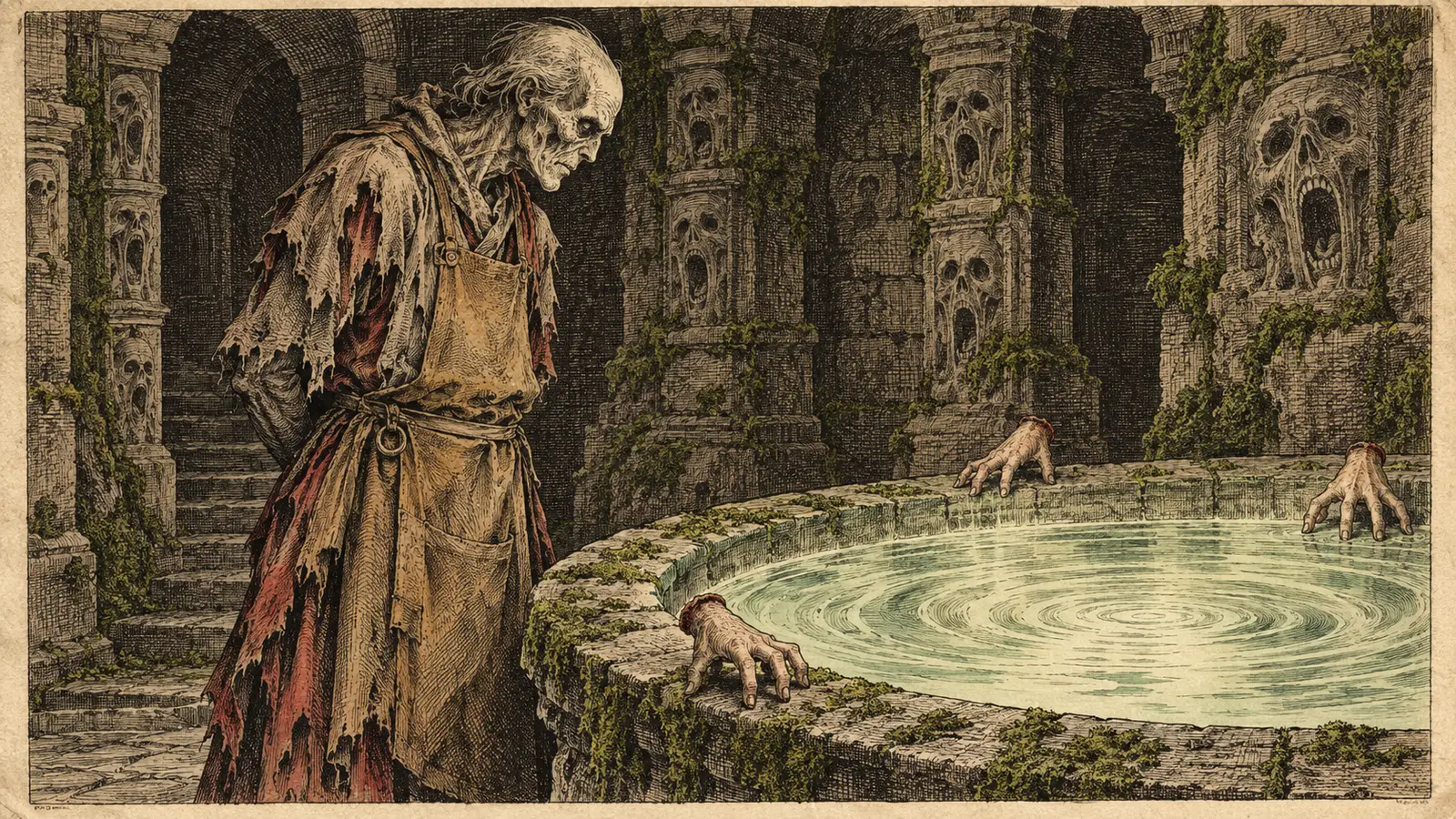
doesn't stand alone in his long story. Around him gathers a wide family: creatures of his kind, beings who serve and command him, and others who echo his shape in other worlds. Let's walk through that gallery slowly.
First there's the demilich itself. Acererak was the first, and from his crypt the type spread outward. The demilich of 1978 was a skull lying in dust with gems in its eyes and teeth, and in Monster Manual II it became a creature any Dungeon Master could summon. Second edition told it as a spirit gone on to the outer planes, leaving behind only the shell. Third edition raised it to the epic tier, a being beyond its body whose soul gems could act like a phylactery. The revised third-edition tomb gave Acererak a unique skull of his own, something closer to a construct than a creature. The fifth edition's Monster Manual made the chosen demilich the next step in a dark evolution.
And through all of it, those two old legends of the demilich run side by side. In one, the demilich is ascended, a lich grown so mighty that it needs no body. In the other, it's diminished, a lich that failed to feed its vessel and has decayed into a remnant. Every Dungeon Master who places a jewelled skull in a crypt chooses, quietly, which of those stories they're telling.
The family of liches grew around it. Libris Mortis, in the third edition, added the good lich, a rare and lonely being who keeps watch over something precious through the long centuries, and the lichfiend, a darker and stranger kind. The lich had always been a single path into undeath, and now it branched.
Beyond Dungeons & Dragons, the demilich found homes in other games. Paizo's Pathfinder Roleplaying Game Bestiary 3, in 2011, has a demilich of its own. And in Baldur's Gate II: Shadows of Amn, there's , a demilich cut very clearly from Acererak's mould. In that game the party gathers his scattered golden limbs from across a city's tombs and restores him, and he rises as a lich and attacks. When his lich body is destroyed, he becomes a demilich, far more powerful than before, very hard to harm with ordinary weapons, wielding a spell that imprisons his enemies and a demilich's howl. Every player who has faced Kangaxx has felt, if only at second hand, what it might have been like to stand in that last crypt in the swamp. Real skulls followed as well: a life-sized replica of a demilich skull was sold for those who wanted one resting on a shelf.
Now Acererak's own household, the beings who made him, served him, or stood against him.
His father was , the balor who devoured a conjurer and once ruled the Noisome Vale in the Abyss, a worshipper of . His mother was a human woman, a in the Greyhawk telling, killed by a torch-bearing mob when the boy was ten. His master was , as we'll hear more fully in a little while. His god, for a time, was Orcus, the Demon Prince of Undeath, whose cult he used to build his first tombs and then abandoned once he no longer needed it.
His servants were many. There were the long generations who spent eighty years cutting the Tomb of Horrors. There were the builders of the Orcus temple, sealed inside their own work. There were the sleeping people of , raised from their beds to build the Fortress of Conclusion. There were the necromancers of Skull City and the Black Academy, who came of their own will to live in his shadow and help with his schemes. In there were the , enslaved and then slain; the engineer, who became Withers; the tomb dwarves, raised as wights; and the crawling claws that scuttle through the halls doing repairs.
His partners were the Sewn Sisters, Peggy Deadbells, Widow Groat and Baggy Nanna, the night hags who helped craft the Soulmonger and tended the stillborn god.
His pawns included Ras Nsi, the fallen paladin turned yuan-ti malison, who believed he was pursuing his own ends while serving Acererak's. His rivals included of , through the servant Shadowmantle, who came hunting for the Soulmonger. And his foes, always, were the adventurers who came to the tomb, every one of them both an enemy and a meal.
If you lay all these stories side by side, a pattern shows through them, as clear as the skull on the hilltop. Acererak builds a tomb, and the people who build it never leave. It happened under the temple to Orcus in Greyhawk, and in the Fortress of Conclusion, raised by the dead of Moil. It happened again in Omu, where a whole city built the Tomb of the Nine Gods and was slaughtered at its completion, and its best engineer was rewarded with eternity at his drawing table. There's a terrible tidiness to it. Acererak wastes nothing. His builders become his first victims, and sometimes his longest-serving staff.
Of all his kin, though, one stands above the rest, and his story is the one later legend would tie most tightly to Acererak's own. That is Vecna, the Whispered One, the archetypal lich-god of the game. We'll meet him again in a little while, when we reach the present day and the legend of how a frightened boy found his master.
Chapter XI
Facing the tomb, the traps and the lich himself
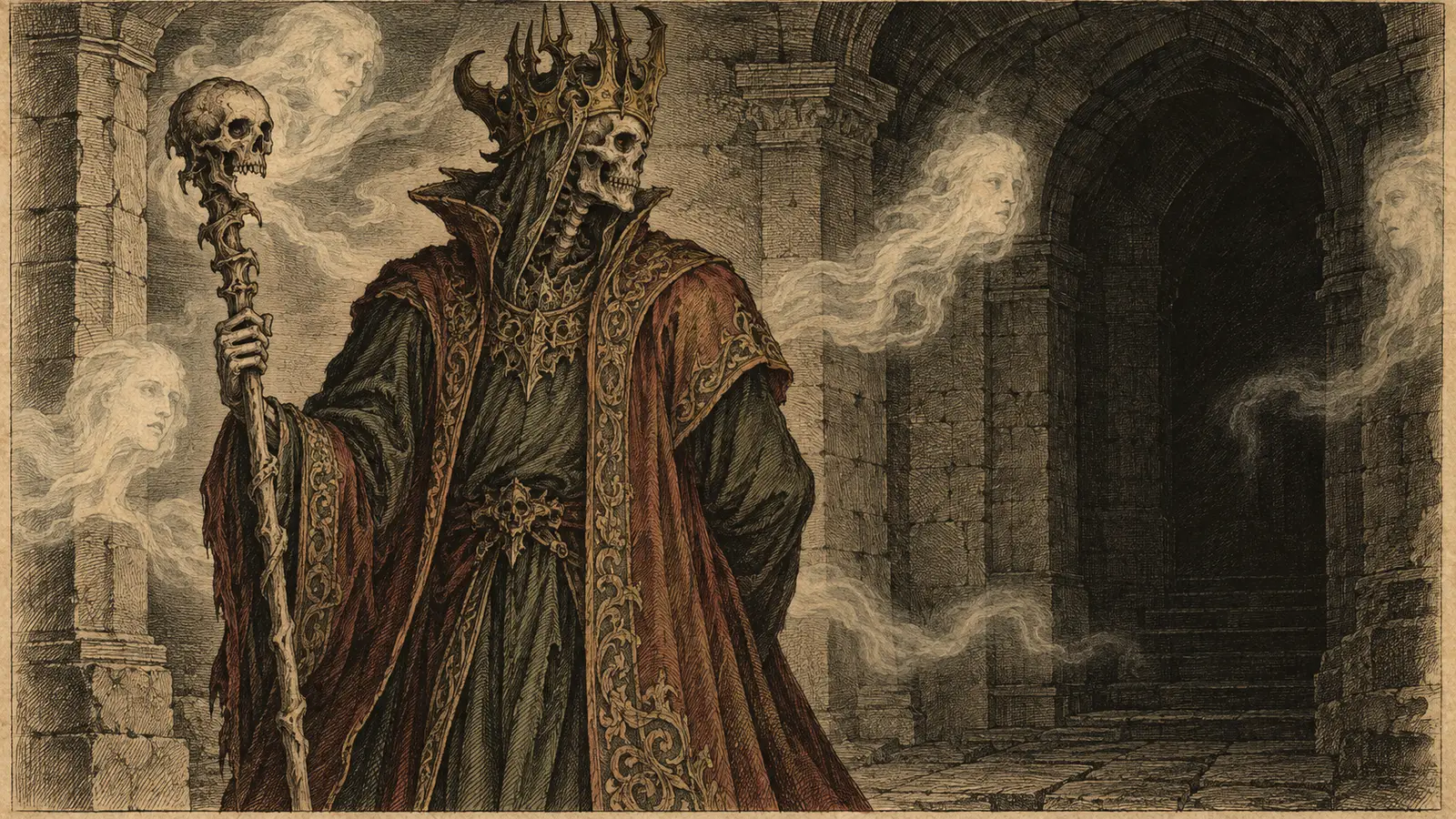
Let's step away from the long history for a while and imagine what it's like to sit at a table and face .
The first thing to understand about the original tomb is that it's a contest of wits, not of swords. called it a thinking person's module, and he meant it. You don't get through by being strong. You get through by noticing things. The players are expected to watch closely and catch the very specific clues Gygax planted in the descriptions and illustrations: the colour of a tile, the angle of a statue's arm, a word in the poem that suddenly makes sense.
The classic tool for this is the ten-foot pole. It's the oldest joke and the oldest wisdom in the hobby, a long wooden pole carried for no reason except to poke things you don't trust. In the Tomb of Horrors, you don't trust anything. Adventurers push their poles at floors, walls, ceilings and doors, and at anything that looks interesting. One party, coming upon the Green Devil Face, pushed their pole into its dark mouth, and when they drew it back the end was simply gone, erased by the sphere of annihilation inside. They learned the secret of the Face without losing anyone. That's how the tomb is meant to be beaten: by careful people who would much rather lose a pole than a friend.
The poem is a strange companion on the journey. It promises guidance, and in its way it delivers, but Luke Gygax was right that it's also a trap. Its lines tempt you to rush, to trust, to go deeper. Some of them are so ambiguous that people still argue over what they mean. A wise party treats it as advice from a host who openly wants them dead.
The pace of play has its own feel. Some groups love it: they move through the tomb like archaeologists, brushing dust from carvings, testing every stone, mapping every corridor with care, savouring each small discovery. For others, the caution turns to tedium, and the slow, punishing rhythm wears them out. That's the nature of the place. It doesn't hurry, and it doesn't forgive hurry.
Most parties failed where and succeeded. In tournaments and home games over the decades, the tomb has quietly swallowed a great many proud characters. A familiar story at conventions is of a party that spent hours creeping forward, celebrating every clever deduction, only to vanish all at once because someone was curious about a doorway.
The writer known as DMDavid has offered a lovely reading of the whole thing. In his view, Acererak is a stand-in for Gygax himself, a bored immortal who builds deathtraps because they amuse him. The real contest in the tomb isn't between the heroes and the lich. It's between the players and the Dungeon Master, a duel of wits across the table, with the dead wizard as the Dungeon Master's mask. It's often said that the tomb is deadlier than its master. The skull in the crypt is dangerous, but by the time you reach it, the tomb itself has usually done most of the work.
In the fifth edition's version, carried in Tales from the Yawning Portal, the demilich at the end keeps its oldest power. It can trap a soul in one of its gems, and when it does, the body and everything the person carries simply cease to exist. After a day, the soul is devoured. Even someone who resists the pull can be drained so badly that they fall, and lose their soul anyway. When the skull rises, everyone at the table goes very still.
Return to the Tomb of Horrors has a different texture. It's longer and colder, a slow wearing-down through the frozen streets of , where every few hours there's a chance the Vestige will appear out of the dark, drifting toward you, and you'll have to run. It's a story about endurance as much as cleverness. The heroes who reach the Fortress of Conclusion arrive tired, low on supplies and short of friends, and then they have to face a lich who can step from one undead body to another.
The 2010 adventure, by all accounts, was "brutally fun," with many deaths and sudden reversals, and that famous story of a cleric swallowed by a sphere of annihilation in the middle of a battle. The Halloween conversion of 2005 was gentler, a softer road through the old hill.
Tomb of Annihilation is something else again: a long campaign instead of a single dungeon, and the death curse gives it a ticking clock. If any of the characters has ever been raised from the dead, they lose a little of their vitality every day, wasting slowly. And no one who falls can be brought back. That changes everything at the table. Players who are used to death being a temporary setback suddenly find it permanent again. Every fight feels heavier, and every risk is a real one.
The jungle of is vast and open. The adventure lets the party wander freely, hacking through vines, crossing rivers, meeting dinosaurs and lost explorers and strange little tribes. That freedom has a cost: without direction, a group can feel adrift in all that green. Dungeon Masters are advised to keep offering leads and rumours, little threads that tug the party onward, and to read the whole book before beginning, so they know where every thread leads. The writer Mike Shea, who publishes as Sly Flourish, has written guides for running the death curse and for handling the adventure's deadly last stretch, where the open jungle gives way to the narrow, merciless tomb.
Through all of it, Acererak's presence hangs over the campaign. Many villains stay far in the background and appear only at the end. This one is felt everywhere, in the curse that wastes the raised, in the ruins of Omu, in the slain gods whispering to the characters, in every trap Withers keeps in working order.
In the Cradle of the Death God, the atropal can make the battle swing wildly, because it has so many terrible things it can do. But it has a weakness: it's vulnerable to radiant power, the holy light of the gods. A paladin's smite can bring it down quickly. Breaking the bond between the atropal and the Soulmonger helps a great deal too. A party that thinks clearly in that dark room has a real chance.
And then, as they flee, Acererak himself. In one account of a party's escape, the tenth-level heroes watched him stop time, raise invisible walls of force, speak a word that kills outright and summon a sphere of annihilation. They didn't defeat him. They ran, and some of them made it out. That's usually how it ends with Acererak: not with his destruction but with your escape, and the knowledge that he let you go because he has more patience than you do.
Chapter XII
The tomb in the wider world
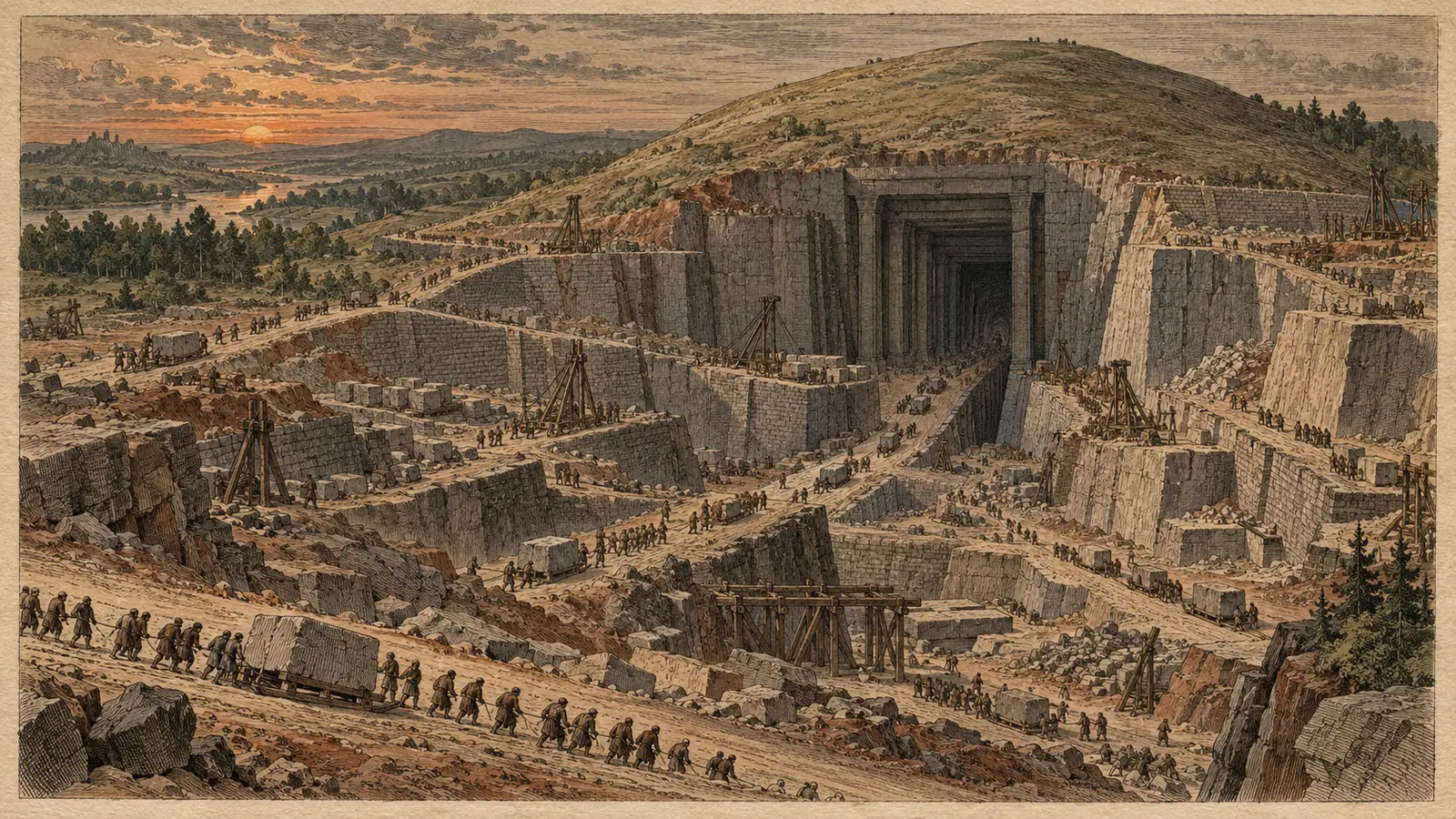
Now let's look at how far the tomb and its master have travelled beyond the tables where they began.
In 2004, for the thirtieth anniversary of Dungeons & Dragons, Dungeon magazine published its list of the thirty greatest adventures of all time. The Tomb of Horrors placed third. Only Queen of the Spiders and Ravenloft stood above it, and The Temple of Elemental Evil came just behind. Decades later, the ENnie Awards inducted it into their Hall of Fame, calling it a landmark of roleplaying design whose influence and notoriety still resonate nearly half a century after it first appeared.
It became the archetype of a whole kind of dungeon. People speak of the "killer dungeon," a place built to destroy its visitors, and of the "funhouse dungeon," where physics and logic bend to the whims of whoever made it. The Tomb of Horrors is the model for both. It also shaped, for better or worse, the early relationship between Dungeon Masters and players, that sense of a contest across the table that so many early groups knew. Countless killer dungeons followed it, and many of them owed it everything.
Its single strongest image, the Green Devil Face with its dark open mouth, became an icon. People who have never played the module recognise it. It's on T-shirts and dice boxes, and it peers out of fan art and convention banners, still grinning, still inviting you in.
Its influence shows in later official books too. Jason Bulmahn drew on it for some of the traps in Dungeonscape, a third-edition supplement about building dungeons, published in 2007. In 2009 the actor and writer Wil Wheaton played through the tomb, updated to the rules of that day, and wrote about it on his blog, titling his post with the old legend's line: "there is said to be a demi-lich who still wards his final haunt." Essays and podcasts still dissect it. One of the best-known essays carries the title "Tomb of Horrors tests patience, but still ranks as Dungeons & Dragons' best villain." A podcast episode calls it "The Funhouse that Hates You." Another writer composed "An Ode to the Tomb of Horrors." People keep returning to it, the way people return to an old house where something once happened.
Its most famous appearance outside the game came in a novel. In 2011 Ernest Cline published Ready Player One, a story set in a future where most of humanity spends its days in a vast virtual world called the OASIS. The game's late creator, James Halliday, has hidden a fortune somewhere in that world, behind a series of challenges drawn from the games and films of his youth. And Halliday loved the Tomb of Horrors. He rebuilt it in loving detail, on a planet called , the school world where the young hero, Wade Watts, attends his classes. Hidden inside it is the first of the keys, the Copper Key.
Wade, whose avatar is called , works his way through the tomb, remembering every trap and every clue from his studies of the old module. At last he reaches the throne room, and there sits , a demilich run by artificial intelligence. Wade asks for a chance to prove himself. The lich's throne transforms into an arcade cabinet for Joust, the game from 1982, and Acererak challenges him: best two games out of three. If Wade wins, he gets the key. If he loses, he dies.
Wade loses the first game badly. Then, watching closely, he begins to see patterns in the demilich's programming, small habits in the way it plays, and he wins the next two. Acererak transforms into , the wizard who was Halliday's own avatar, and hands over the Copper Key. Wade's name appears on the public scoreboard for all the world to see. As he leaves the tomb, he meets , another seeker, who had found the tomb before him but hadn't yet beaten its lich.
There's something very fitting in that scene. In the novel, as in 's module, the tomb is beaten by attention, by noticing patterns, and by refusing to give up after a crushing first defeat. Acererak's tomb had always been a test of whether you were paying attention, and it was still testing people in a story about the future.
When Steven Spielberg made the film of Ready Player One in 2018, an early draft of the script had a Tomb of Horrors sequence. It was set aside. Cline has said that none of the people who read the script had ever played the module. The producer Dan Farah suggested a car race instead, and Spielberg developed it into the film's first challenge. The tomb didn't vanish entirely, though. On the back door of a getaway van, if you look closely, the Green Devil Face peers out, a tiny grinning secret for anyone who knows where to look.
Chapter XIII
Acererak in the present day
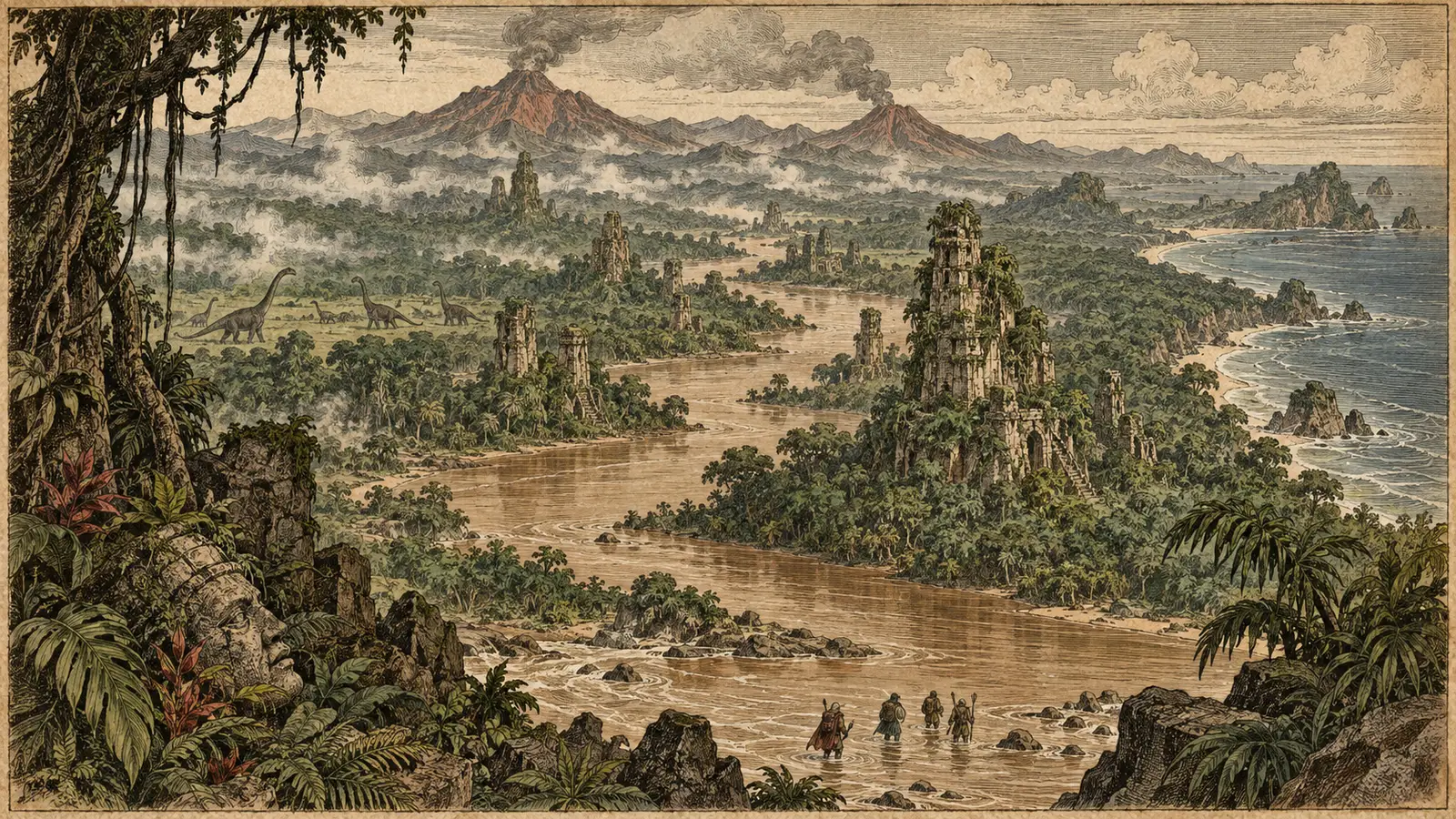
We come now to the present, to the latest layers of the story and to the lich as he's remembered and retold today.
In May 2024, for the fiftieth anniversary of Dungeons & Dragons, Wizards of the Coast published Vecna: Eve of Ruin, a great adventure for characters of tenth level and beyond. Its story follows the Whispered One's grandest scheme, and among the villains whose influence runs through it is , called in the book's preview the "Lord of Unlife," and described as the only one ever to betray and live.
With that book, the oldest piece of Acererak's later legend came fully into the light: the story of how a frightened boy found his master.
After the mob killed his mother, the ten-year-old cambion was rescued by Vecna himself. Vecna's advisors urged him to kill the child, a half-demon orphan who could only bring trouble. Vecna killed the advisors instead and took the boy as his apprentice. Acererak became one of the very few spellcasters ever to study directly under the archlich. Even at ten years old, the legend says, he loathed life and looked forward to the day he would become undead like his master.
The boy grew, and his master's empire grew with him. In those years Vecna, already a lich, ruled a terrible dominion, and he laid siege to the city of with spellcasters and undead. Those who heard our episode on Vecna will remember Fleeth, the city of his birth and of his mother's burning. There the clerics of , god of light, called down holy power and nearly destroyed him. Acererak carried his badly wounded master out of the ruin, and afterward Vecna raised him higher in his service. Later, the student followed his teacher into undeath, became a lich in his turn, and in the end went his own way and betrayed him. Of all Vecna's servants and disciples, only Acererak did that and survived.
This is a later layer of the legend, laid down long after 's skull first rested in its crypt. In the beginning, Acererak was a lone, unexplained wizard under a lonely hill. Over the years, he became the cambion son of a balor, a priest who used and then discarded him, and finally the apprentice who saved Vecna at Fleeth and betrayed him later. Each layer settled over the one before, like silt in a still pool.
In Eve of Ruin he's more presence than adversary. The heroes don't necessarily fight him, but his work is all around them. The book's preview describes him as a lich who traps adventurers in dungeons full of danger and harvests their souls to feed his spirit jar, the vessel that keeps him in the world. He has built dozens of tombs across the multiverse, it says, and the most famous of all is the Tomb of Horrors, "D&D's deadliest dungeon." The preview remembers too, and the Soulmonger feeding souls to an atropal he found adrift on the Negative Plane.
One chapter of the adventure is called "Tomb of Wayward Souls." The heroes, hunting for the sixth piece of the Rod of Seven Parts, travel to a chain of tropical islands on , Acererak's home world. On the Isle of Serpents lies a labyrinthine maze of deadly traps, built by the archlich, who enjoys littering his dungeons with the bones of defeated adventurers. Its master isn't Acererak himself but , an advanced simulacrum, a copy made in his image to keep the place in his absence. The tomb is a smaller echo of his older works, the Tomb of Horrors and the Tomb of Annihilation, and its puzzles are a little kinder than theirs. In one chamber a ceiling begins to fall, and the trap spells out plainly what will happen if one member of the party chooses to sacrifice themselves to save the rest. It's a quiet, solemn sort of trap, and it asks a question instead of simply killing.
Elsewhere in the same adventure, Kas the Betrayer, the fallen paladin who once cut off Vecna's hand and eye, appears in disguise as the wizard and turns on the party. So the fiftieth-anniversary story holds both of Vecna's great betrayers at once: Kas, who struck his master down in his tower, and Acererak, who simply walked away and built a life, or an unlife, of his own.
In November 2024 a new Dungeon Master's Guide arrived with the revised core rules. Acererak had been the figure on the front of the 2014 guide. This time his place on the cover went to , the sorcerer from the 1980s cartoon, along with and from the old toy line, descending a staircase with a skeleton army and a dracolich, while an alternate cover showed , the spider queen. But Acererak wasn't forgotten. At the back of the book is a new Lore Glossary, a who's-who of the game's fifty years, and he has his own entry there. It tells his story simply: a wizard who willingly died to become a lich, whose body later withered to dust while his power gathered in his skull, making him a demilich, and who built the Tomb of Horrors to lure adventurers to their deaths and take their souls. It's the whole long story, folded small and set on a shelf.
There are newer portraits of him too. Two later versions of the archlich have been given full game statistics for the fifth edition: Acererak the Everlasting and Acererak the Devourer. The Devourer's name recalls the old Greyhawk title. Both describe a being who travels between worlds, luring adventurers into trap-filled dungeons and taking a sick pleasure in devouring their souls. The names say it well enough. He goes on, and he eats.
And there are physical likenesses, made for people who want to keep a little of the lich at home. A diorama of Acererak by Diamond Select Toys, due in 2025, was based on concept art by the comic artist Caesar and sculpted by the Brazilian artist Sandro Luis . It shows him in his restored lich form: a skeleton in a tall, pointed, crown-like helm with long horns, wrapped in flowing robes, gripping a twisted staff topped with a glowing skull, standing on crumbling brick. Sirius Dice sells licensed packs called Acererak's Treasure, and the counter display that holds them is shaped like the Great Green Devil Face. To get a pack, you reach into its mouth. It's a gentle joke, decades in the making: the mouth that once erased the curious now hands out dice to anyone brave enough to put a hand inside.
As for what comes next, no new tomb of his has yet been announced. The plans Wizards of the Coast has set out for 2026 turn toward other worlds and other shadows. For now Acererak rests between stories, as he always has, somewhere far off among the planes, while his tombs wait for him.
Chapter XIV
The patient skull beneath the hill
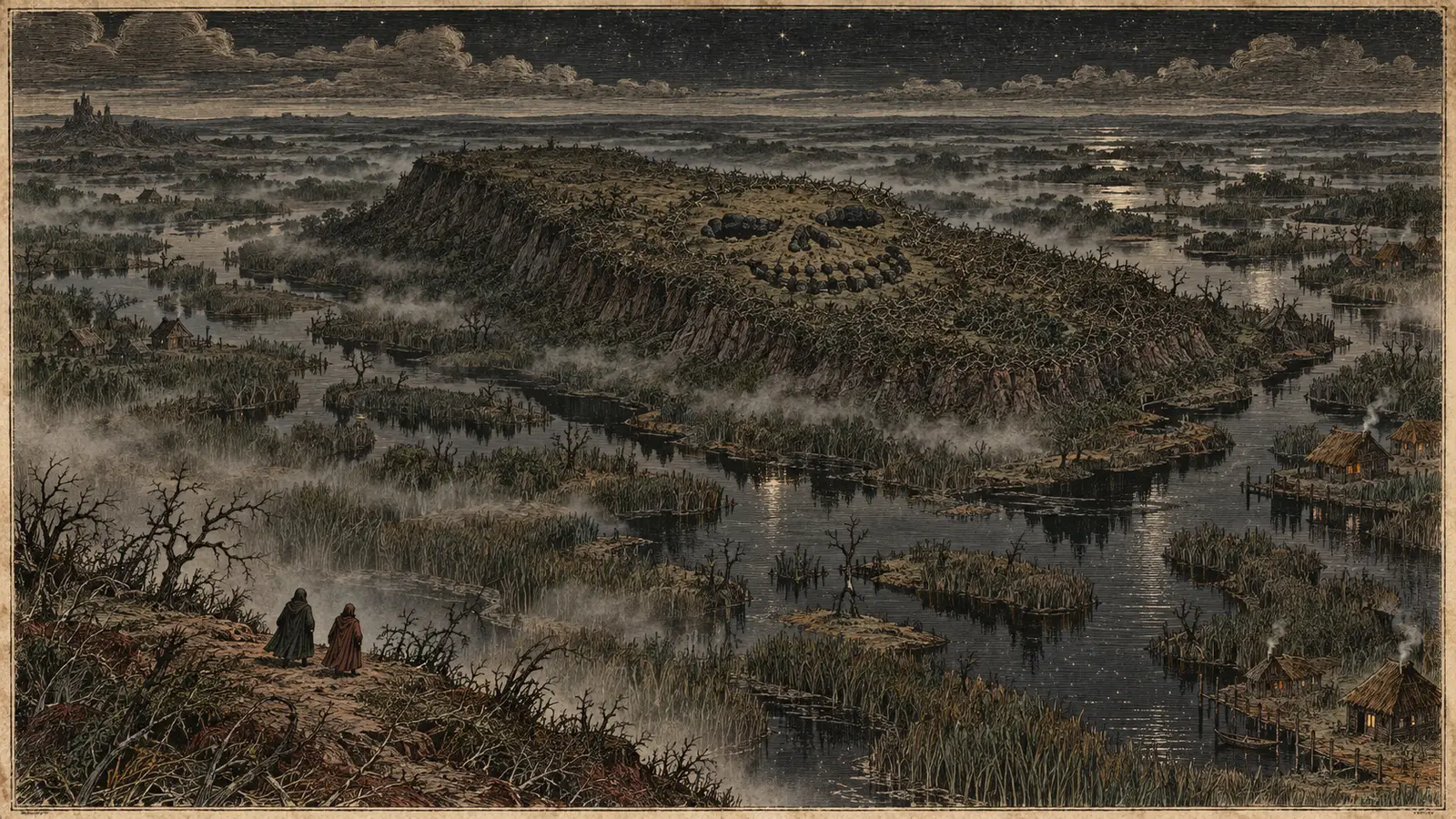
We come back, at the very end, to where it all began: a hill in a swamp, on a world called .
The marsh is quiet tonight. Reeds stand in the still, black water, and somewhere far off a bullywug croaks once and falls silent. Mist lies low over the pools. And in the middle of all that wet, green country rises a long, low mound of dry earth, flat across the top, where nothing grows but weeds and thorns and briars. A little wind moves through them, and they whisper against each other in the dark.
On the bald crown of the hill lie the black stones. If you walked among them you'd think nothing of them. But high above, where only the night birds fly, they make a face: two dark hollows for eyes, a gap for the nose, a crooked line of teeth. A skull, grinning up at the stars. Only the sky has ever seen it whole.
On the north side, the old cliff of sand and gravel has crumbled a little more with the years. The low stone ledge still hangs over the worn slope, and the bushes have grown thick around it again, so that from any distance there's nothing to see at all. Behind them, the three doorways wait, two false and one true.
Far below, beneath all that earth and stone, past the painted halls and the trembling hands and the iron men of grim visage, past the grinning green face with its dark mouth, past the false crypt and the false lich, there's a sealed room. In it there's a little heap of dust, finer than flour, which was once a man's bones. Among the dust lies a skull. In its eye sockets two rubies gleam, very faintly, with a light that has no source. Along its jaw, six diamonds catch that light and hold it.
The master isn't here. He hasn't been here for a long time. He's far away, out among the planes, building other tombs on other worlds and tending other traps, waiting for other visitors. He doesn't need to be here. The tomb remembers what to do. The skull remembers what to do. And he's patient in a way that only something very old can be. He has waited for centuries, and he can wait for centuries more.
Somewhere in those halls, red tiles still spell out the words he left for whoever would read them. congratulates you on your powers of observation. So make of this whatever you wish, for you will be mine in the end no matter what. It isn't a shout. It's barely more than a murmur in stone, the voice of someone who has never once been in a hurry.
The wind passes over the hill again. The briars stir. The black stones go on grinning at the sky. Deep in the dark, the gems keep their faint light, and outside on the north face the bushes still hide the ledge and the doorways behind it. One day someone will push them aside.